GORE-TEX Professional

Archive for the ‘Design’ Category

How to Equip 100,000 Troops with the Right Uniform Size – First Time

Monday, March 30th, 2026

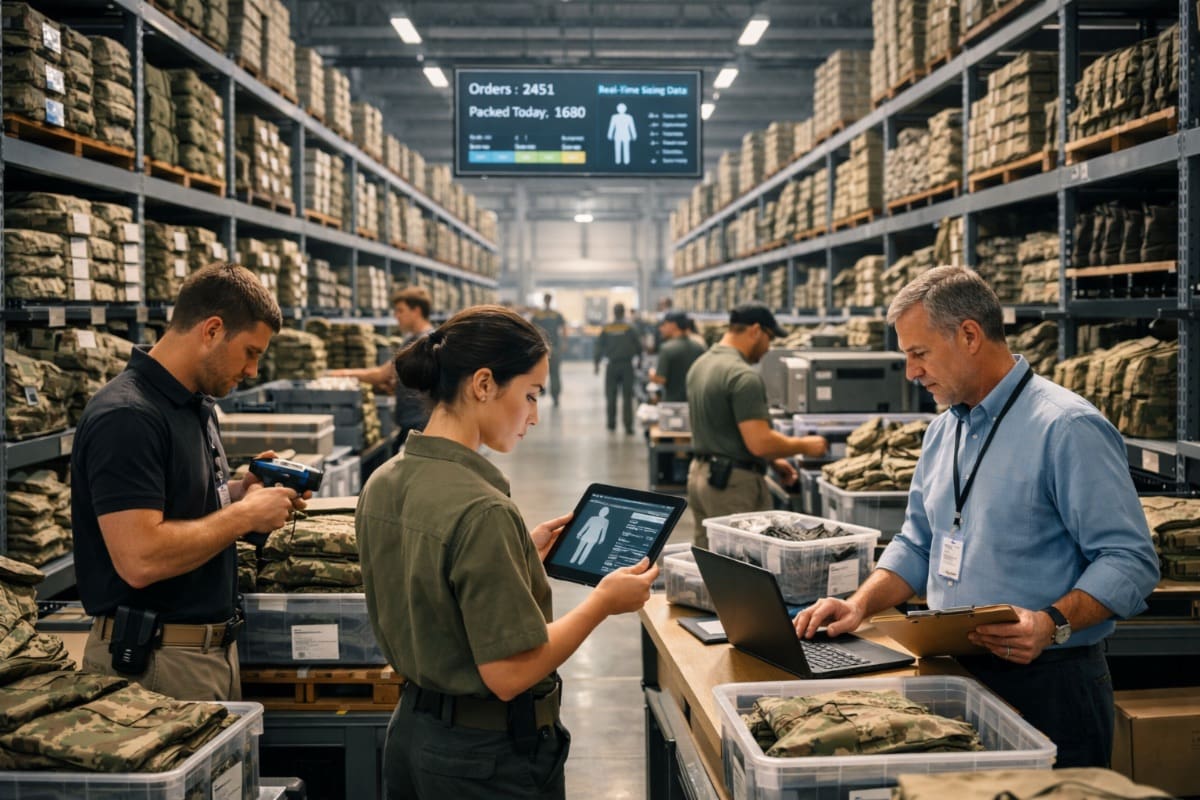
Equipping 100,000 troops across a war?torn territory is no longer just a supply chain challenge – it is a data challenge. Speed and accuracy in sizing and distributing uniforms and gear directly affect readiness, safety and cost. When thousands of military personnel are constantly moving between bases and front lines, every sizing mistake turns into wasted budget, delays and operational friction.

This is exactly the problem Bodi.Me’s Size?Me technology is built to solve: giving defence organisations and their partners a fast, accurate and scalable way to collect size data, predict demand and deliver the right uniform size first time – at scale.
Why speed and accuracy matter in large-scale uniform operations

When organisations need to distribute uniforms across large, decentralised workforces, speed and accuracy become critical. Delays in issue, incorrect sizing, excess stock, and avoidable returns all increase costs and reduce operational efficiency.

This is especially true in sectors such as healthcare, first response, military, corporatewear, utilities, transport, and large-scale public service operations, where thousands of wearers may need uniforms, protective garments, or workwear across multiple sites at the same time.

In these environments, traditional sizing methods are often too slow, too inaccurate, and too dependent on guesswork.

What causes waste in uniform distribution?

Uniform distribution becomes expensive when organisations rely on outdated assumptions instead of real wearer data.

Common problems include:

  • ordering the wrong quantity of each size
  • letting wearers guess their size
  • manually collecting inconsistent size information
  • overproducing unpopular sizes
  • underordering high-demand sizes
  • managing returns, exchanges, and redistributions after issue

These problems affect more than cost. Poor sizing can also reduce wearer comfort, limit mobility, create safety concerns, and undermine confidence in the uniform programme.

For large operations, even a small sizing error rate can create major financial and logistical consequences.

Why accurate sizing is now a business-critical issue

The cost of getting sizing wrong has increased. Tariffs, energy prices, supply chain disruption, shipping costs, and tighter operational budgets all mean that overproduction and incorrect fulfilment are more expensive than ever.

For uniform buyers and programme managers, this means one thing: sizing can no longer be treated as an estimate.

It must be treated as operational data.

Accurate size data helps organisations:

  • predict the correct quantity of each size before production
  • allocate the right garment to each wearer during distribution
  • reduce waste and avoid unnecessary replacement costs
  • improve stock planning and procurement decisions
  • increase wearer satisfaction from the start

What is digital sizing technology?

Digital sizing technology uses wearer data to generate accurate size recommendations quickly and at scale.

Instead of relying on self-selection or historical averages, digital sizing platforms gather a few simple inputs and use them to predict the best-fitting garment for each individual wearer.

This makes uniform allocation faster, more consistent, and more cost-effective.

How Bodi.Me solves the uniform sizing problem

Founded in 2013, Bodi.Me is a UK-based pioneer in digital sizing and fit technology. Since launching its first size and fit recommendation solution in 2014, Bodi.Me has specialised in helping organisations solve the garment industry’s fit problem through accurate, scalable, and user-friendly technology.

The company is widely recognised for its work in professional clothing and uniforms, where accurate sizing is essential for cost control, wearer safety, comfort, and sustainability.

What is Size-Me?

Size-Me is Bodi.Me’s award-winning digital sizing platform for uniforms, workwear, and professional clothing.

It helps businesses:

  • predict the right quantity of each size before production
  • allocate the correct size to each wearer during distribution
  • reduce overproduction
  • improve stock planning
  • lower return rates
  • avoid the cost of incorrect sizing

By replacing guesswork and historical size assumptions with real wearer data, Size-Me improves efficiency across the uniform supply chain.

How does Size-Me work?

Using just a few simple inputs, Size-Me extrapolates a detailed body profile and delivers instant, personalised size recommendations.

The platform is designed to be:

  • easy to use
  • mobile-accessible anytime, anywhere
  • private and non-intrusive
  • inclusive across different body types and genders
  • highly customisable for different sectors and garment categories

No body scans or photos are required unless requested by the client.

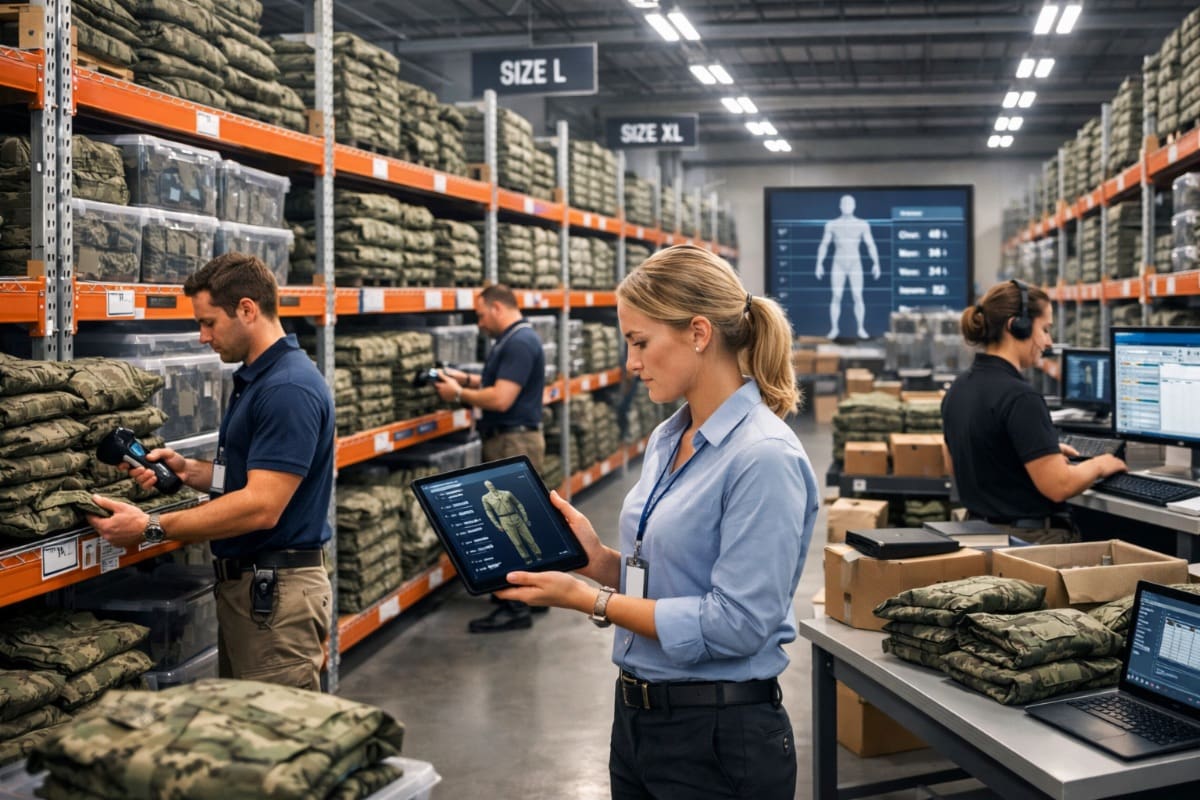
Size-Me also integrates with customer systems, making it suitable for large-scale rollouts where speed, accessibility, and consistency are essential.
Why Size-Me is effective for large-scale uniform distribution

Large uniform programmes need more than a sizing tool. They need a system that supports planning, procurement, allocation, and wearer satisfaction at scale.

Size-Me helps organisations improve both cost-effectiveness and operational performance because it brings together four essential capabilities:

Fast data capture

Wearers can access the platform instantly from their mobile device, allowing large groups to submit sizing data quickly across different locations.

Accurate size allocation

Each wearer receives a personalised size recommendation, reducing the risk of incorrect issue and follow-up exchanges.

Better production planning

Real sizing data helps buyers predict size ratios before production, reducing overstock and understock.

Lower return and redistribution costs

When more garments are right first time, organisations reduce return handling, replacement orders, and wasted inventory.

What results has Bodi.Me delivered?

Bodi.Me has demonstrated strong results across uniform, workwear, healthcare, corporatewear, first responder, and inclusive fashion projects.

Key results include:

  • more than 1.5 million size recommendations delivered
  • 500,000+ recommendations delivered in 2025 alone
  • 100,000+ wearers supported in 2025
  • over 95% wearer engagement
  • return rates reduced in some uniform applications from around 15% to 5%

These outcomes help organisations improve purchasing accuracy, reduce waste, and increase operational efficiency.

How does Size-Me support sustainability?

Uniform waste is not only a cost issue. It is also a sustainability issue.

When organisations produce the wrong size mix, they increase:

  • unnecessary manufacturing
  • excess shipping
  • packaging waste
  • reverse logistics
  • disposal and landfill risk

By helping organisations order and distribute the right garments first time, Size-Me supports a more efficient and sustainable supply chain.

This is particularly important for businesses and institutions under pressure to reduce waste, improve ESG performance, and operate more responsibly.

How has Bodi.Me continued to develop the platform?

In 2025, Bodi.Me further advanced its offering with Size-Me 5.0, a user-friendly, multilingual evolution of Size-Me 4.0.

This includes a dedicated try-on solution for the workwear sector featuring a dynamic 360-degree avatar, helping wearers visualise fit more accurately and make more confident choices.

For organisations running large and diverse uniform programmes, this adds another layer of confidence, accuracy, and user engagement.

Why digital sizing should now be standard in uniform programmes

Large-scale uniform operations cannot afford to rely on manual sizing, wearer guesswork, or historic averages alone.

Digital sizing technology is no longer a nice-to-have. It is becoming essential for any organisation that wants to improve:

  • cost control
  • fulfilment accuracy
  • wearer experience
  • sustainability
  • stock efficiency
  • rollout speed

The bigger the workforce, the greater the value of getting sizing right from the start.

Conclusion

Speed and accuracy are the foundation of effective uniform distribution. When organisations need to size and equip large numbers of people across multiple locations, the cost of error rises quickly. Better sizing data leads to better purchasing, better allocation, fewer returns, lower waste, and a better experience for the wearer.

Bodi.Me’s Size-Me platform is designed to deliver exactly that: fast, accurate, scalable digital sizing for modern uniform operations. By turning wearer data into actionable sizing intelligence, Size-Me helps organisations improve cost-effectiveness, increase efficiency, and distribute uniforms with greater confidence.

Bodi.Me’s mission is simple: to help businesses deliver the right fit first time, reduce waste, optimise production, and create a more sustainable future for the garment industry, while ensuring that wearers across sectors, including healthcare, emergency response, utilities, transport, and corporatewear, receive the right garment first time, without discomfort or safety concerns. In large-scale uniform programmes, this is not only a sustainability goal but a core part of operational efficiency, wearer readiness, and responsible resource management.

About Bodi.Me:

Bodi.Me is a UK-based SaaS company founded in 2013 by Lara Mazzoni and partners. In 2014 launched the first Size and Fit recommendation software, with the mission to help solve the garment industry’s fit problem and promote better sustainability within the industry. Helping wearers select the best fit through fast and accurate size recommendation tools can reduce returns, optimize stock levels, and help businesses focus production on the sizes that sell.

Bodi.Me has been a pioneer in clothing size and fit optimization since 2014 with a (but not exclusive) focus on workwear and uniforms.

Bodi.Me’s Size-Me tool integrates with customer systems and matches wearers to the right size garment from the customer’s range via Bodi.Me’s AI and proprietary technology. From just a handful of basic measurements, Size-Me extrapolates a complete body profile to provide instant size recommendations personalized to each wearer. Size-Me is uniquely customizable and adapts to each customer’s needs.
Creativity: The Art of the Possible

Saturday, February 21st, 2026

Creativity is often described as imagination, inspiration, or artistic expression. In professional fields especially those tied to real-world consequences like tactical operations, engineering, or business creativity is something far more practical.  It is the disciplined art of making the possible real.

You start with a vision > You have the initiative to try > Now comes the hard part.

The Foundations of Practical Creativity.

Real creativity is not spontaneous. It is built on layers of competence and understanding. Before a solution can exist, certain conditions must be met.

You must have:

• Knowledge of the subject.

• Experience to understand its practical or tactical application.

• A clear understanding of the problem set.

• The technical ability to create a solution.

• The mental flexibility to see that solution before it exists.

• A defined and realistic end state.

Creativity is not just about inventing something new. It is about answering the right question.

Sometimes that question hasn’t even been asked yet.

Are You Solving the Right Problem?

Before building anything, you must understand the nature of the problem itself.

• Are you answering a question no one has recognized yet?

• Are you solving a clearly identified problem?

• Is the problem singular, or is it multi-layered?

• If you solve one part, will the rest fall into place?

• Or is each layer its own independent requirement?

Many failed designs are not failures of execution—they are failures of problem definition.

From Concept to Reality

Once the problem is understood, creativity shifts from abstract thinking to applied execution.

You must consider:

• Is the solution efficient?

• Can it be produced at scale, or only as a one-off?

• Does it actually improve the system, or just look different?

In tactical equipment design, creativity is not measured by novelty. It is measured by effectiveness.

A new concept must:

• Improve function

• Reduce complexity

• Increase survivability or efficiency

• Be producible and supportable in the real world

Otherwise, it is just an experiment or as some say it’s just a hobby.

Rethinking the Paradigm: Symmetry and Function

One example of practical creativity is the concept of load carriage symmetry.

Ergonomic symmetry exists when a task or tool allows the body to operate in a balanced, neutral, and repeatable manner—without forcing one side to compensate for the other.

In equipment design, this often translates to:

• Three to four rifle magazine pouches centered on the torso

• Pistol magazines placed for rapid access

• Grenades, flashbangs, and mission items distributed evenly

• Ambidextrous access to critical equipment

This configuration promotes balance, consistency, and repeatable performance across a team. But symmetry is not always the answer. During special tasks or mission-specific operations, the real question becomes: Is visual or load symmetry more important than immediate access to the correct tool at the exact moment it is needed? In many cases, the answer is no. Creativity means knowing when to follow the paradigm and when to break it.

Understanding the business side of creativity is just as important as the technical side.

A great idea must:

• Reach the market

• Be produced reliably

• Be supported long-term

• Compete against other solutions

Creativity without execution is just theory

Case Study: The Mayflower UW Chest Rig Evolution

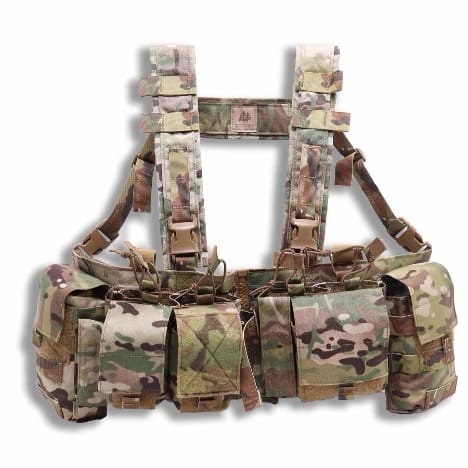
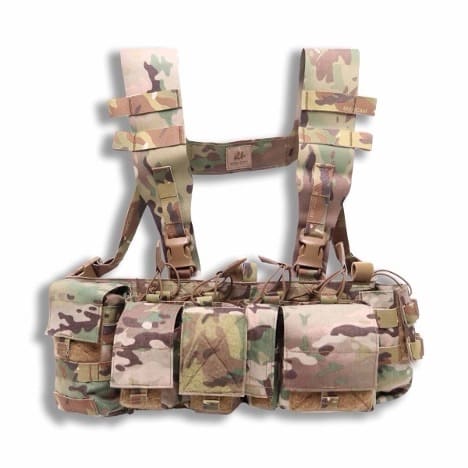
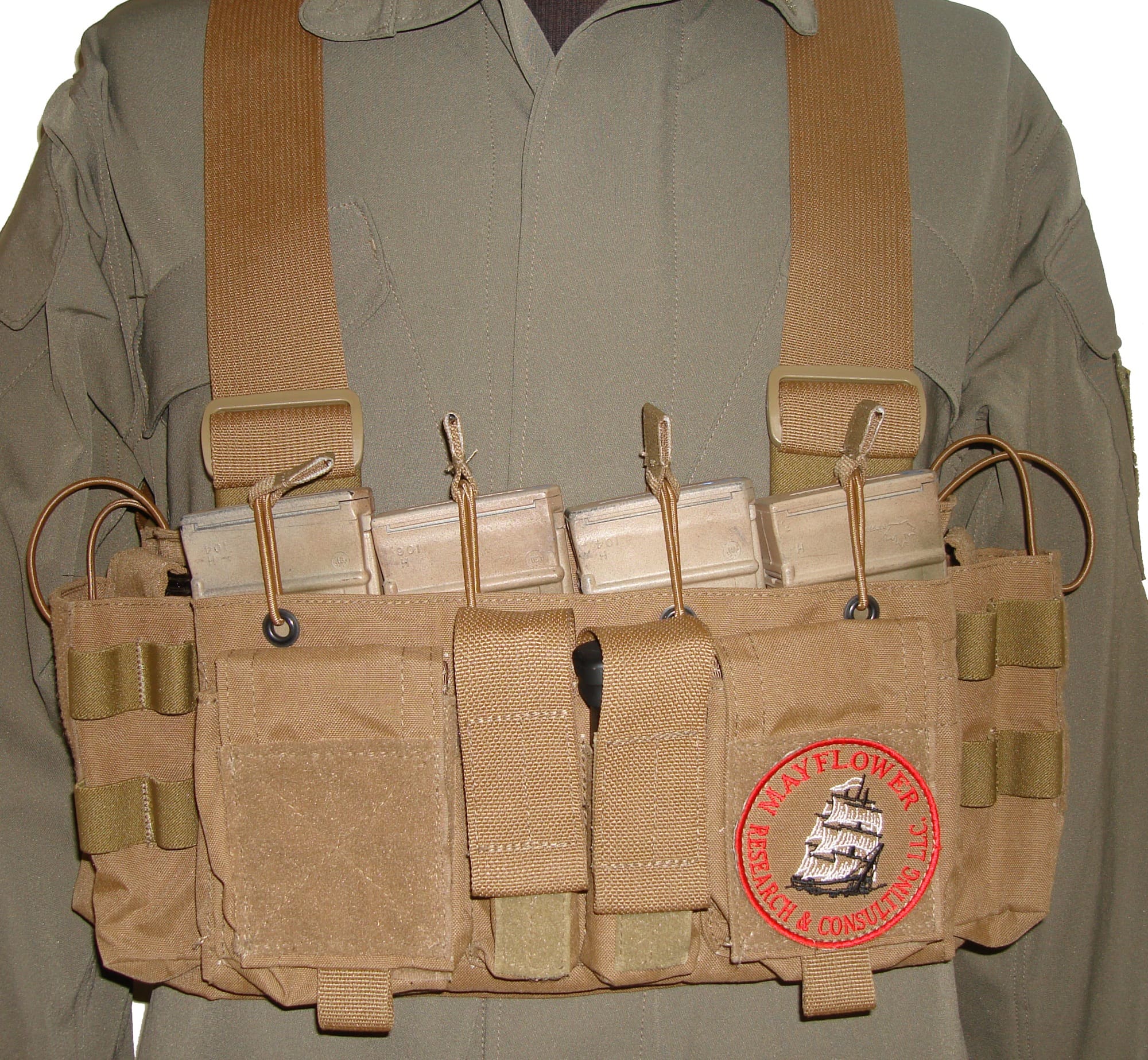
One example of creativity as an iterative, problem-solving process is the development of the Mayflower UW (Unconventional Warfare) chest rig series. These designs were not the result of a single flash of inspiration. They were the result of years of operational experience, observation, and incremental improvement.

Each generation solved a specific problem. I took the lessons learned from my designs for the DBT Low-Vis Chest Rigs and operationally improved them:

UW Gen I – The Baseline Concept, breaking the paradigm:

The Gen I represented a shift away from traditional load carriage systems that were either:
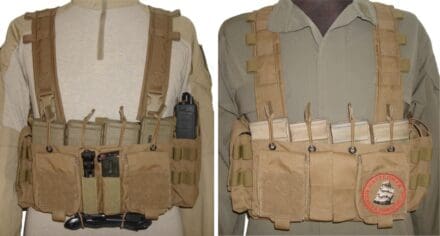
too minimal (CHICOM Chest Rig) or too complex (full vest systems replacing belt kit). The goal was simple: carry the essential fighting load in a compact, balanced, low-profile format.

The Gen I focused on: centerline rifle magazine carriage, integrated general-purpose storage, only what you need. A balanced, symmetrical layout, dual comms, ambidextrous and low bulk for vehicle and urban operations.

It established the core concept: self-contained, multi-missionfighting load in a simple chest-mounted platform.

UW Gen II & GEN II.V Refinement Through Use

The Gen II was not a radical redesign. It was a refinement.

Changes were driven by real-world feedback. Long-term wearand practical adjustments from field use.

Key improvements included:  H-Harness refinements, initially fixed but still range of motion/size adjustable then a quick don/doff capability was added.

The lesson from the Gen II was simple: small, thoughtful changes often produce the biggest performance gains.

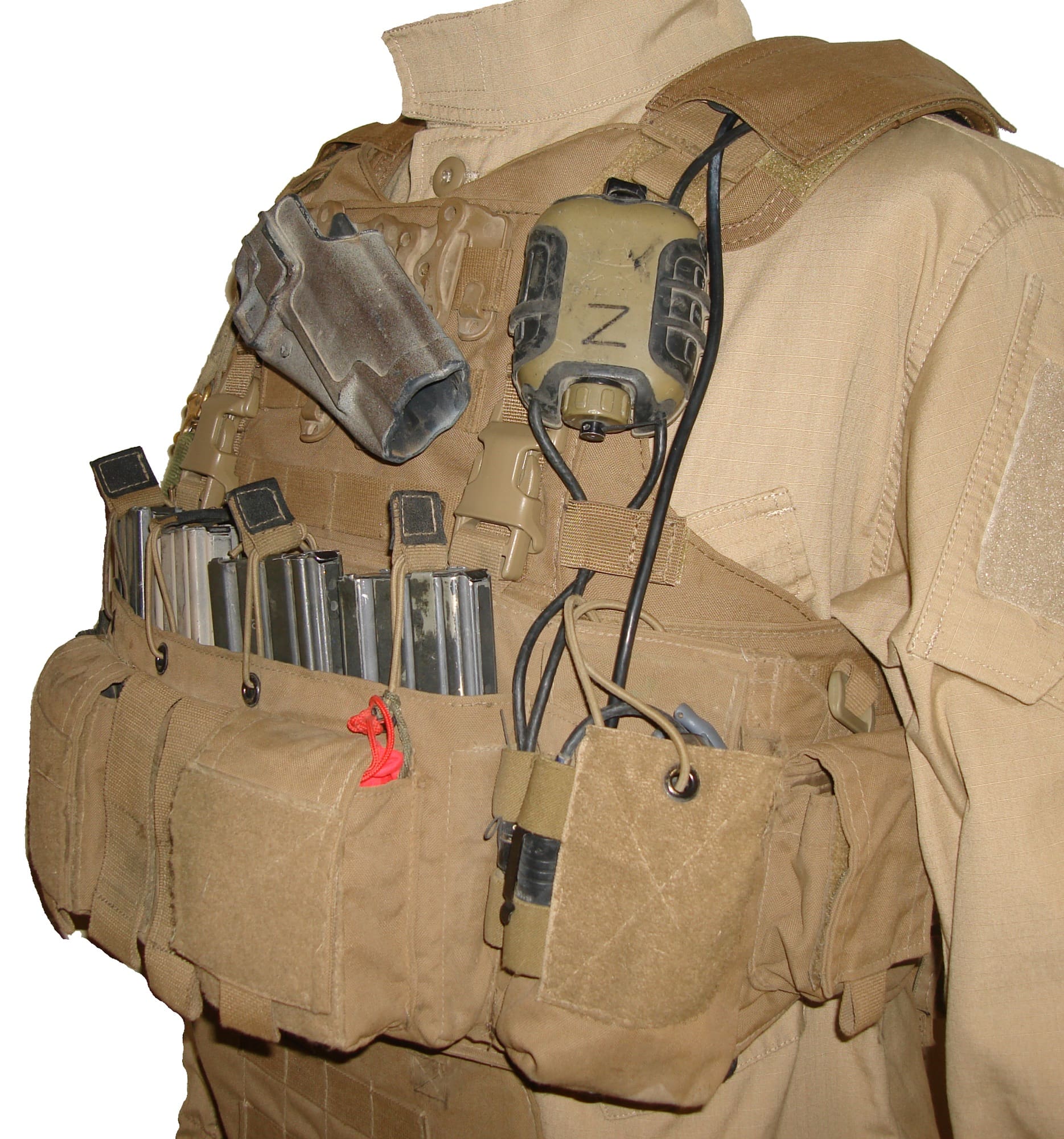
UW GEN I “Custom” that led to future development (as it was worn in combat).
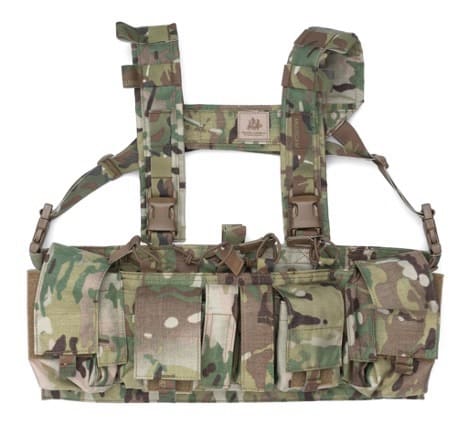


UW Gen III — The Standardization Phase

By the time the Gen III emerged, the concept had matured.

This generation focused on: refined magazine retention, a cleaner manufacturing processes, and a format suitable for broader adoption across units

The Gen III represented the transition from:

“a good idea” to “a scalable, supportable piece of equipment.” This is a critical step in creativity:

A solution is not complete until it can be produced, issued, and sustained.

UW Gen IV — Modularity and Integration

The Gen IV reflected changing operational realities.

Users increasingly needed, integration with armor, greater modularity, and compatibility with multiple mission sets

The Gen IV addressed this byimproving attachment options, increasing compatibility with plate carriers and allowing mission-specific add-ons

This generation acknowledged a key truth: The environment changes. The equipment must evolve with it.

UW Gen V — The next step

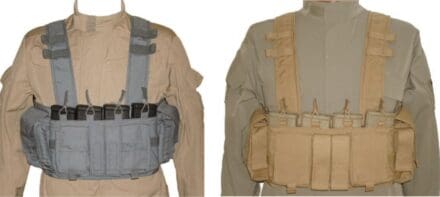
By the time the Gen V arrived, the original concept had been fielded in the tens of thousands.

This design focused on splitting the base in half to meet a different operational need (an open front), streamlined construction, matching H-Harnesses, similar construction techniques, optimized pouch geometry to meet operational requirements, magazine inserts for different calibers, improved materials and manufacturing methods.  Abalance between modularity and simplicity.

UW Gen VI “Pusher” — The Mature Concept
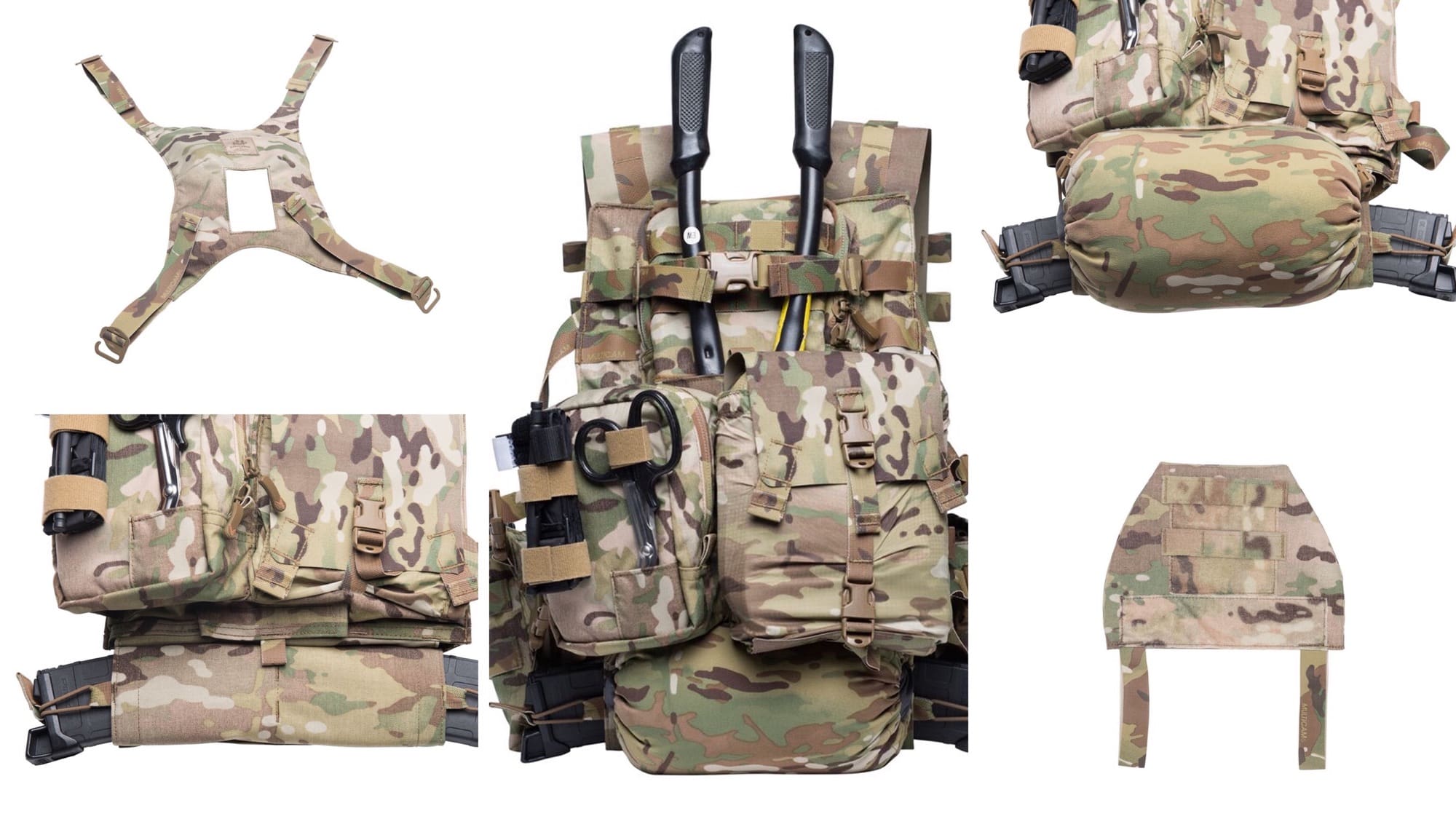
The “Pusher” chest rig represented the evolutionary development of the UW series—a single platform, multi-caliber capable, and configurable for use with or without armor. It was built as a plug-and-play system, allowing magazine pouches to be mounted on the lower back for prone use, the addition of a cold-weather jacket pouch, and the ability to carry a NODS-mounted helmet as required.

Lessons from the UW Series.

The evolution from Gen I to Gen VI demonstrates several key principles of practical creativity:

• Creativity is iterative; no design is perfect at the start. Each generation solves a problem the previous one exposed.

• Experience drives innovation; most improvements were not theoretical. They came from actual use, under real conditions.

• Simplicity is the end state, as a concept matures, unnecessary complexity is stripped away.

• Production matters; a design is only successful if it can be produced in quantity and supported over time.

The Business Reality of Creativity

Creative success brings its own set of challenges.

After achieving even moderate success, many designers and entrepreneurs experience a predictable cycle:

• Imposter syndrome: was this a one off or have I spent my creativity?

• Learning to deal with success

• Reconciling unconventional paths to achievement, no college degree versus experience

• Pressure to recreate the successful formula

• Pushing through self-doubt

• Selling your own strengths while trying to remain humble

• Regaining the drive to outperform competitors

The Next Chapter

At some point, you begin to recognize where your real strengths lie.  Not just what you can create, but:

• What problems you are best suited to solve

• What environments you perform best in

• What kind of impact you want to have

That realization marks the transition into the next chapter.  You stop trying to prove yourself = You start building with intent.  Creativity, at its core, is not about originality for its own sake. It is about:

• Understanding the problem

• Seeing a path forward

• Having the skill and discipline to make it real

That is the true Art of the possible.

About the author:  Travis Rolph is a retired Airborne Infantry and Special Forces veteran and founder of Mayflower Research & Consulting.

Blast from the Past – Objective Force Warrior? What’s That?

Thursday, January 1st, 2026

This article was first published in 2014 and I thought it would be a great way to kick off the new year.

OFW

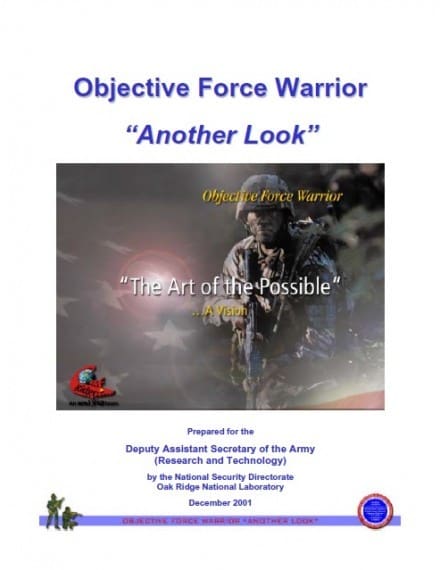
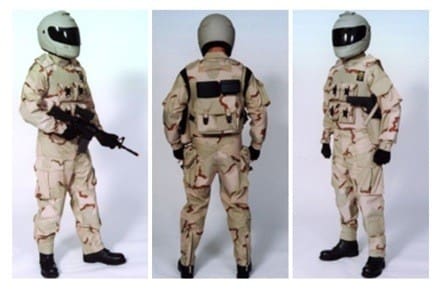
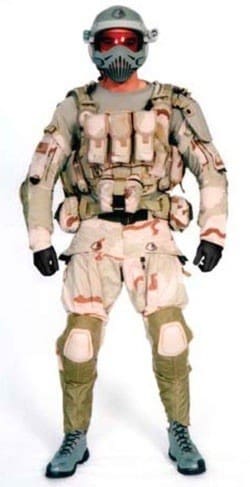
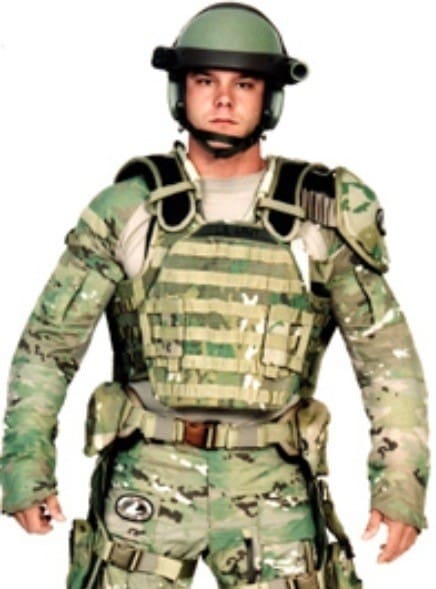
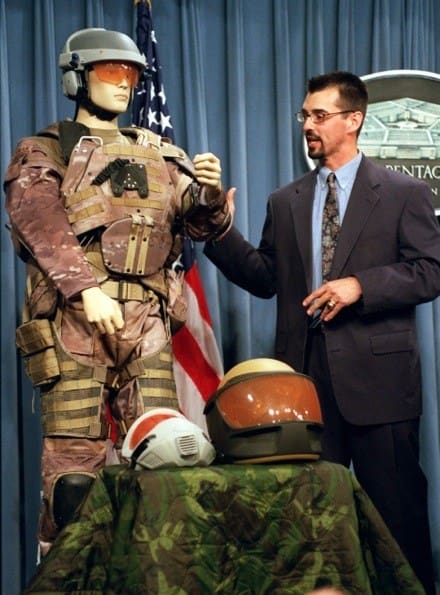
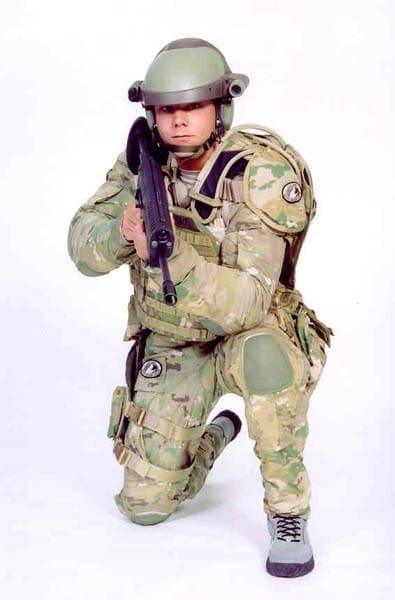
I just realized that many of my readers have no idea what Objective Force Warrior or its follow-on, Future Force Warrior are all about and I’m afraid some may think it’s something new. Objective Force Warrior was one of many Soldier Modernization Programs which trace their way back to Soldier Integrated Protective Ensemble in the early 90s to 21st Century Land Warrior to simply Land Warrior and then OFW in the early 00s. You could go on for days talking about what they wanted it to do. If you want to really delve into it, download a vision document below.

OFW

Click to view .pdf
For our purposes, the system was intended to integrate with the conceptual Objective Force that would have provided the Army with a new family of ground and air vehicles under Future Combat System. Unfortunately, like FCS, it wasn’t fielded but influenced overall development.

20140129-172750.jpg

20140129-181023.jpgWhat’s important to you is that it’s where Crye Associates made their bones and many staples of modern Soldier Systems spun out from that program. Working in conjunction with other firms such as Juggernaut Defense and Artisent (which sold off as Ops-Core to Gentex) as well as large contract system integrators, Crye was responsible for the clothing, load bearing and armor components of this Soldier Digitization effort.

20140129-174108.jpg

As with most of these programs, lots of money is poured into the software and comms portion and relatively little effort and funding is put toward the clothing and individual equipment components. With many of these programs actual development of the system’s digital operating environment becomes virtual and during program reviews and Congressional dog and pony shows, Crye’s efforts became the face of the program. They produced prototypes that a Soldier could wear and that looked unlike anything else out there. I’d say that they kept that program moving for as long as it did. The clothing and armor developed by Crye was something you could actually see and lay your hands on. Eventually, after a name change to Future Force Warrior and facing actual combat in multiple theaters, the Army let the project drift away with the C4I component transitioning over time to Nett Warrior.

20140129-175537.jpg

Industrial Design house Crye Associates founded Crye Precision based on the success of their work on FFW and after commercialization, caught the eye of the Special Operations community. The rest you should know.

20140129-175734.jpg

Ultimately, four critical Soldier Systems technologies find their roots in FFW and with Crye:

MultiCam Camouflage Pattern – It began life as Scorpion for use with FFW but Crye Precision refined the pattern for commercial use and later provided modified variants of the pattern for both the UK (Multi Terrain Pattern) and Australia (Australian MultiCam Pattern). In 2009, the US Army selected MultiCam for use in Afghanistan as the Operation Enduring Freedom Camouflage Pattern (OCP). In 2010, Crye Precision developed Woodland and Arid patterns for the US Army’s Camouflage Improvement Effort. They were selected as finalists along with three other companies. In late 2013, Crye Precision introduced four new patterns to complement the decade old Transitional pattern: Alpine, Arid, Black and Tropical.

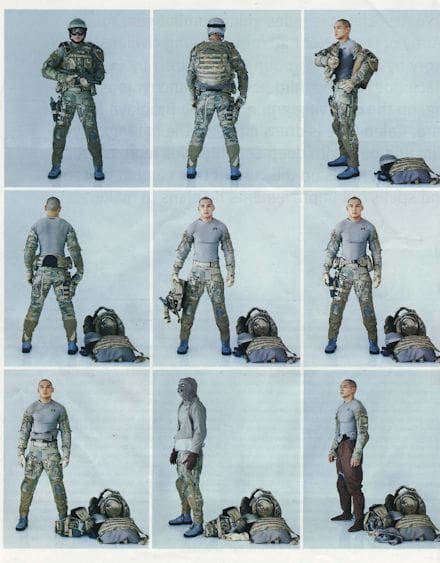
Combat Uniforms – The concept of producing a shirt that combines a moisture wicking torso with heavy duty sleeves for wear with armor systems was unheard of prior to OFW. The same goes for garments with integrated knee and elbow protection. Now, these concepts are accepted as state of the art.



Crye Armor Chassis – Crye Precision’s armor chassis took an entirely fresh approach to body armor, combining special, ergonomically shaped armor plates in such a way to allow movement. It has been adopted for use by niche forces and has influenced armor design.

Close Fitting Modular Combat Helmets – While the material science wasn’t quite there yet when the OFW/FFW helmet demonstrators were built, several companies produced enhanced combat helmets over the years including Crye Precision’s AirFrame which fits very close to the contour of the head.

ID Magazine did a great article on Crye’s participation in the project which we offer here for historical purposes.

page

(Click image to view the article.)

Station 150 by LOFT – Now Available

Thursday, August 7th, 2025

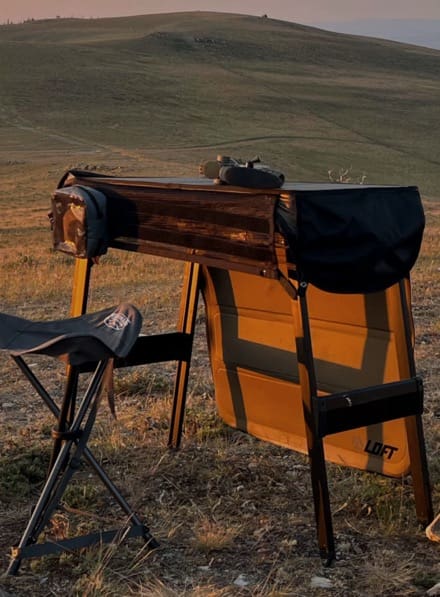
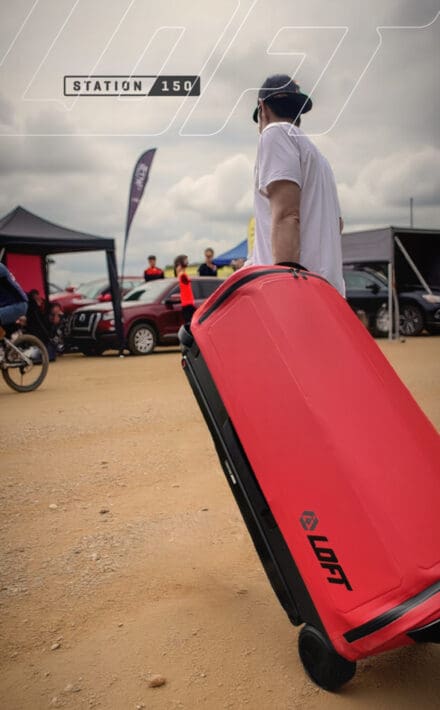
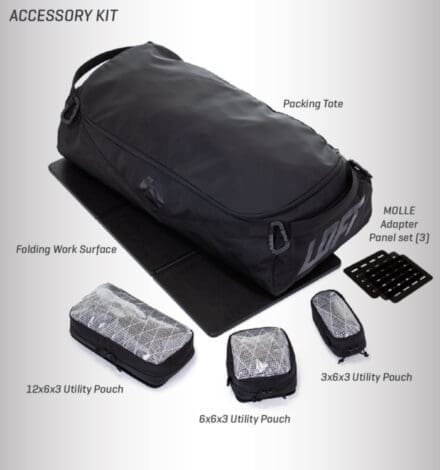
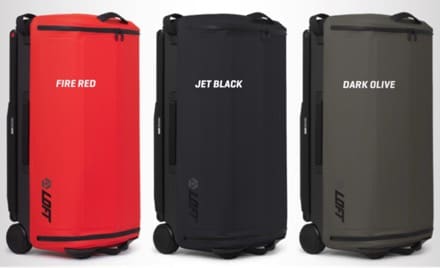
Developed by Caleb Crye to keep sensitive equipment organized and out of the dirt, the LOFT Station 150 converts from a rolling duffle to workstation in seconds.

Some of you may have seen professional skydiver Jeff Provenzano at drop zones around the world using the Station 150 where it’s drawn a lot of interest.

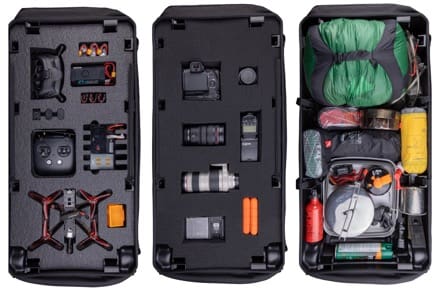
The Station 150 can be internally configured for a variety of applications including weapons and equipment transport and maintenance as well as drone and recce work.

Offered in Dark Olive, Fire Red, and Jet Black, Station 150 is now available for commercial order via Kickstarter with deliveries beginning in December. This is a great way to get ahold of the Station 150 as it comes bundled with all of the accessories:

  • 3 MOLLE Adapter Panels
  • Modular Pouch Set of 3
  • Packing Tote
  • Folding Worksurface

Station 150 Dimensions:

Overall: 36” x 18” x 14”

Worksurface height: 34”

Interior of rigid backshell: 35” x 17.75”

Volume:  approximately 149 Liters

Weight: 16.5 lb (only 1 lb more than market-leading traditional rolling duffle)

Wheels: 5” diameter, 2” wide with smooth gliding air-less tires

Max supportable weight in table mode: 50lbs

Order yours at loftgear.com.

Tomahawk Performance Welcomes New Director of Design, Vic Kang

Thursday, January 16th, 2025

Nashville, January 2025 – Tomahawk Performance is excited to announce the appointment of Vic Kang as the company’s new Director of Design. Kang’s addition to the team comes at a pivotal moment for the company, which is expanding its distribution across North America and Europe and driving forward with several innovative projects.

With a background in industrial design and a deep passion for crafting purpose-driven products, Kang brings a unique approach to problem-solving and product development. Over the course of his 20-year career, Kang has become a recognized expert in the outdoor apparel and gear industry, having worked at leading brands such as Arc’teryx, Patagonia, Lululemon, and YETI. His expertise spans a wide range of technical design, including a specialized focus on soft goods.

Before joining Tomahawk, Kang served as Design Director at YETI, where he built the soft goods design team and center from the ground up. Under his leadership, the team grew from four to fourteen members, and Kang played a key role in shaping the company’s product development, process, and structure, specifically in the creation of high-performance, technical soft goods.

At Tomahawk Performance, Kang will play a critical role in scaling the design and development team in alignment with the company’s medium- and long-term growth plans. His efforts will focus on attracting top-tier talent and driving innovation in product design, with a particular emphasis on delivering solutions that address the unique challenges faced by warfighters in demanding tactical and outdoor environments.

“I am thrilled to join Tomahawk Performance,” said Kang. “The opportunity to collaborate with such a talented team and leverage their vast knowledge and experience is invaluable. Together, we’ll develop gear that not only supports critical missions but helps shape the future of tactical design.”

Kang’s approach to design emphasizes creating meaningful, functional solutions that solve real-world problems. His ethos aligns seamlessly with Tomahawk Performance’s mission of delivering high-quality, mission-specific products for professionals in the field.

As the Director of Design, Kang will lead efforts to innovate and refine the company’s offerings, ensuring that every product delivers exceptional performance and functionality. With a hands-on approach to both design and problem-solving, Kang is committed to pushing the boundaries of product development to meet the evolving needs of Tomahawk’s customers.

For more information, visit tomahawkperformance.com.

Sneak Peek – Large Becker Patrol Pack from Bongo Gear

Tuesday, July 9th, 2024

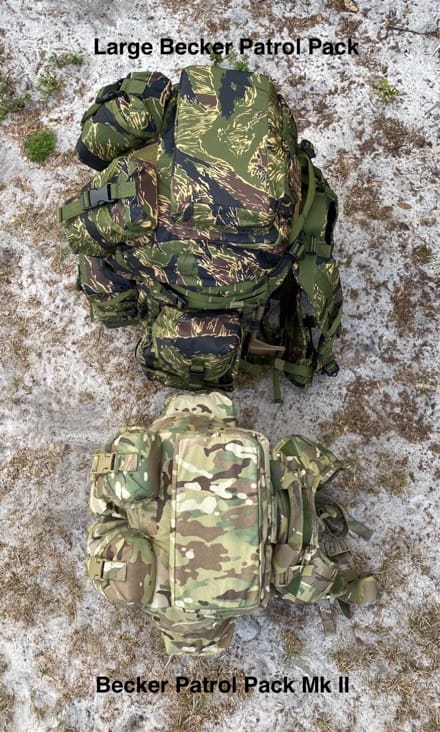
Bongo Gear reports that the Large Becker Patrol Pack (LBPP) has completed prototyping and field testing and it is now in production. It goes on sale tomorrow, 10 July in Green and Tigerstripe.

Bongo Gear’s owner Tom G has worked with Ethan Becker, the originator of the Becker Patrol Pack and several knife designs, to produce a modern version of the famous pack and Ethan has approved this new design.

The LBPP was a project Tom decided to take on after multiple requests regular BPPs users who required more capacity. The answer was to go with a larger, external-frame version of the BPP with a few more outside pouches with a goal of 65 liters / 90 lbs capacity.

He related to SSD, “I was averse to adding more outside pouches because I’ve read studies which suggest five or six places is about the maximum for most people for remembering where things are. I know from experience too many pockets/pouches on a pack can be a bad thing.”

He found that his concerns weren’t an issue with the LBPP considering the lid registers as a separate entity while the main body, with its combination of buckled and zippered pouches, categorizes things into smaller groups (buckled and zippered) making it easier to remember what’s where.

Above you can see the new LBPP side-by-side with the current Mk II and the MOLLE 4000 while below is a great comparison of the two BPP models.

The LBPP will be supplied with an internal frame sheet and end-users can set it up with their preferred external frame. Tom says this is because, just like favorite flavors of ice cream, people have different favorite external frames. The pack can utilize legacy ALICE frames, the Marine Pack frame / MOLLE 4000 ruck frame (DEI 1606-MC), and the newer DEI 1622 Arch frame, among others.

bongogear.com

Carryology Presents: Mission to Mars | Designing a NASA Backpack

Saturday, April 6th, 2024

Carryology has shared a great video about the NASA x Mission Workshop BASALT EVIB.

In 2016, Mark Falvai, co-founder of Mission Workshop, received a call he’d always dreamed of. On the other side of the line was an engineer named Mike Miller. He worked for the National Aeronautics and Space Administration. A government organization known to the world as NASA.

Mike had a top secret project and he needed Mark’s help. NASA was preparing for a Mars Landing, and they needed the perfect backpack designed for the mission.

And many months later, the NASA x Mission Workshop BASALT EVIB was born.

Read the full article here: www.carryology.com/projects/carry-collaborations/mission-to-mars-designing-backpacks-for-nasa

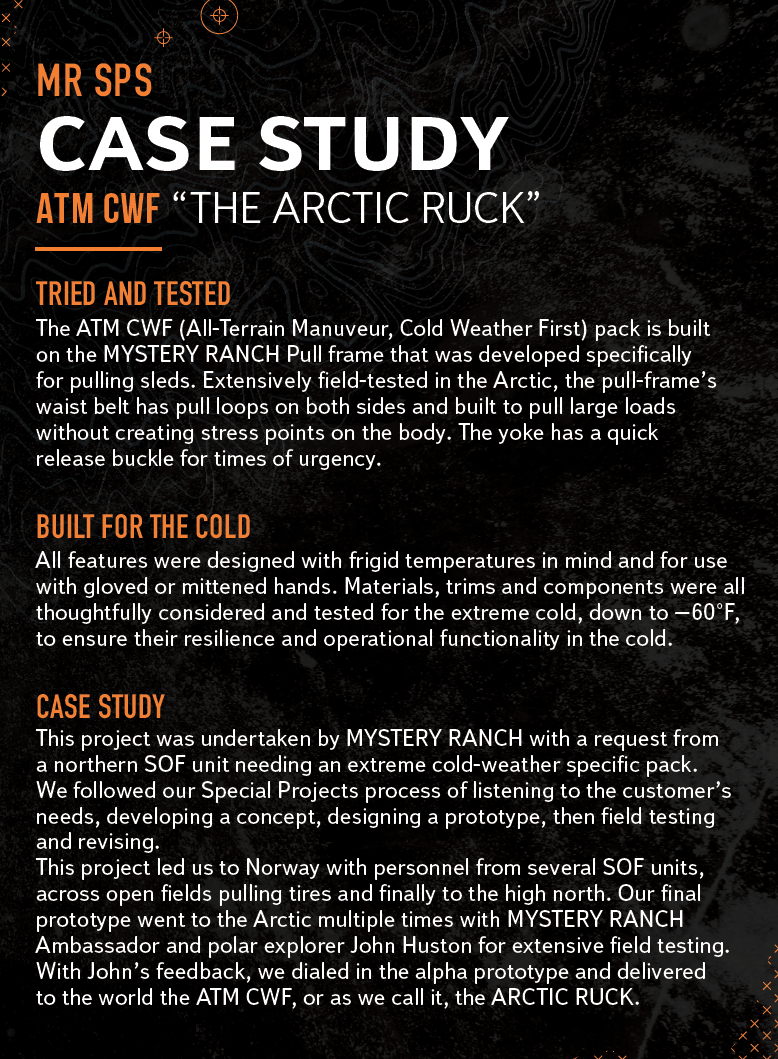
Mystery Ranch Special Projects Service

Monday, September 19th, 2022

At MYSTERY RANCH, we solve problems for our customers – we work with them to identify a solution that meets their needs.

MYSTERY RANCH builds the best load-bearing gear in the world. Period.  

In addition to designing products for commercial sale, we regularly work on Special Projects for government and other industry organizations. With our Special Projects Service offering, MYSTERY RANCH designs and manufactures custom products when no other load-carriage solution exists. That includes packaging weapons, comms gear, optics, sensors, connectors, cabling, and so on.

If needed, we collaborate with in-field experts that bring their expertise to the design and help deliver a rigorously field-tested product to the client.

MYSTERY RANCH has many patents on technologies necessary for special load-carriage requests, which cannot be found otherwise. Our Montana-based, in-house product development and production teams are structured to facilitate such specific design needs.

Our most recent Case Study is the ATM CWF – aka “THE ARCTIC RUCK.” Details of this service outlining the process and collaboration efforts with in-field professionals can be found here.

In many cases, the client comes to our facility to brainstorm a solution with our design team for their load carriage or packaging needs. They show us the equipment we need to design around. In other cases, the client may send us the equipment and then collaborate with us via video conference, phone, or email. When necessary, we travel to the client’s location to work with them directly or see or experience items or factors that cannot be brought to us.

If it needs to be carried by a human – let’s talk or visit our site: www.mysteryranch.com/Packs/Military/SP.