GORE-TEX Professional

Archive for the ‘Materials’ Category

No-Contact – The Stun Gun You Wear

Tuesday, February 23rd, 2010

Recently, my friends at Protect The Force told me that they wanted to show me an extraordinary technology that was initially designed to protect women from sexual assaults but that could be used for a variety of personal protection tasks. I must admit that in my mind’s eye I formed a picture of some sort of chastity belt-like contraption. Fortunately, my imagination run wild was nowhere near the truth of the matter. Instead, I was shown the video below and it brought everything into focus.

I immediately “got it” and began running scenarios in my head where I could apply the technology. I mean who couldn’t see the potential here? It’s phenomenal. No-Contact’s technology was developed by Adam Whiton, a researcher at Massachusetts Institute of Technology and Yolita Nugent, an apparel designer. Named Conducted Energy Clothing, the concept is simple; bad guy grabs you, much to his chagrin he gets shocked, he unhands you, you fight or flight.

Now I can imagine that some of you are skeptical but they’ve been working on this for awhile. No, it won’t shock you. The wearer is insulated from the effects of the charged outer layer. Additionally, the garment features a Teflon coated waterproof layer to protect the wearer in the rain. Concerned about power requirements? Currently, the system is powered by a single 9v battery.

Remember, the system was initially designed to protect women from sexual assault. It had to be simple to use, so you wear it. Unlike firearms or blade weapons, it requires no training. Once armed, the system is passive. In fact, they are working on a variant that will allow security personnel to remotely activate someone’s CEC in the event they are unable to themselves. This would be great for VIPs and others who risk kidnapping or assault. Even in its current configuration the CEC technology is well suited for Law Enforcement, Corrections, and Security officers.

Some statistics to consider:

“Close-quarters assault from aggressors using fists and hands account for more than 80% of all total assaults faced by law enforcement officers.”
Federal Bureau of Investigation 2008 Uniform Crime Report

No Weapons were used in 74% of all violent crime incidents on civilian victims, just fists and hands. In addition offenders used a weapon in only 1% of all rapes/sexual assaults. Most often fists and hands are used to overpower and restrain the victim.”
U.S. Department of Justice – Bureau of Justice Statistics, 2008

They are still about six months out from full production. For more information visit www.no-contact.com or www.protecttheforce.com.

No-Contact, for when “No” really means “No.”
Gecko Tape

Tuesday, February 23rd, 2010

“Get in on this.” If I could only say one thing about this material that would be it. The so-called gecko tape is amazing. Made from hard microfibers, and act similar to the hairs on tips of a Gecko’s toes called satae. In fact, they act on weak forces of attraction called van der Waals forces. While the electric charges are minuscule when joined in the millions the two items stay attached, even when wet.

I saw some gloves with the fingers and palm covered in this material at the 2008 SHOT Show. The manufacturer had placed corresponding tape on a knife handle and a pistol grip. When I picked the items up they stayed fast yet I could handle items without tape normally. He wouldn’t tell me what it was and I didn’t figure out until I started researching this article but in my limited interaction, it works.

Much of the work is pie-in-the-sky work hoping to create a real-life Spider Man. But I see more practical things on the horizon. While still in the developmental stage, this technology may one day lead to such items as the pouchless magazine pouch or those gloves I tried out.

So How Does 500D Really Fare in Combat?

Friday, February 19th, 2010

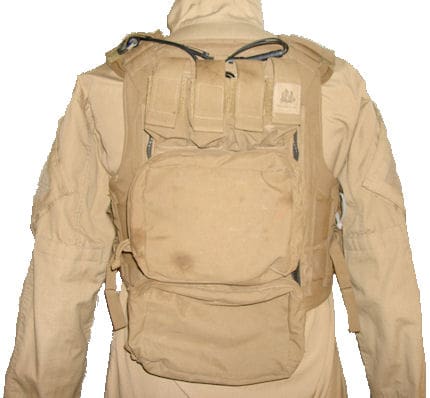
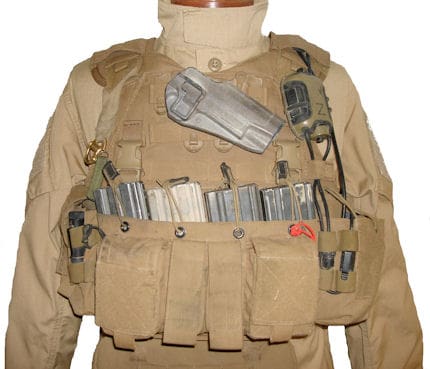
There has been a lot of conjecture as to whether or not 500D Cordura is up to the task for use on individual equipment, particularly armor carriers. When I spoke with Mayflower Research and Consulting about this issue, they were able to provide me with these images of an Low-Profile Assault Armor Carrier, an early modded UW GEN I Chest Rig, and Assaulter Back Panel worn in Iraq for the past six months by an Assaulter. If that isn’t a rough environment, I don’t know what is. As you can see, the kit is stained with weapon oil but overall is none the worse for wear. The vest only came back for the addition of the new ITW Quick Attach Surface Mount buckles as well as new custom shoulder pads.

Mayflower Research and Consulting's LPAAC

Mayflower Research and Consulting LPAAC

My opinion? You are going to get a you money’s worth out of kit manufactured from 500D. It might just be a bit less expensive than 1000D and will certainly be lighterweight. The purveyor of Mayflower once asked me if I had ever had any kit wear out before you replaced it for a newer design. I answered that since we switched to Cordura from the old ALICE days I have not. And I think that answer says volumes on the subject.

Revitalize Your DWR

Monday, February 15th, 2010

It looks like it’s going to be a LONG winter. During a recent shooting class I attended it started raining day one and by the middle of the second day it looked like a blizzard. Most of my fellow shooters were wearing waterproof breathable outerwear and several began to feel clammy and then damp the longer each day progressed. A couple of guys were wearing issue Gen I ECWCS parkas. Probably not the best garment available as Gore long ago decided that the basic design could not meet their “Guaranteed to Keep You Dry” standards. Of course these jackets were old. More than anything, they needed some maintenance.

The key to any modern outerwear is its Durable Water Repellent (DWR). There are quite a few treatments available and different manufacturers have their favorites but they are usually are based on flouropolymers. These are PTFE molecules that are applied to the surface and cured at high heat to make them adhere better and increase performance and have a fluorine atom at one end which is highly hydrophobic. Heat causes them to align themselves with their flourines exposed. Water tries to move away from the flourines resulting in beading. This allows the water to roll off without wetting the fabric. Interestingly, Quarpel (Quartermaster Repellent) was one of the first DWRs and used to treat field jackets and other military clothing items.

Since most of us can’t run out and purchase a new jacket every time this happens I thought it would be a good idea to share a few tips with you that will not only revitalize your garment’s DWR treatment but also extend the life of your clothing.

DWR treatments work best when they are clean. I realize this seems counter to what you think is right since a DWR generally lasts about 25 washings and tactical garments get quite a beating in the field but you need to wash your clothing. The first thing is to avoid using liquid detergents as well as fabric softeners. Additionally, avoid optical brighteners as they are not good for DWR or IR treatments. There are wash in treatments you can purchase as well as spray on options to help renew your clothing’s DWR. However, wash in treatments may affect the breathability of your membrane. One of the best spray solutions available is Revivex from McNett and it is what I have used in the past. It also serves as a stain repellent. Revivex can also be applied to garments that never had DWR in the first place so if you have hunting or field clothing that you find yourself wearing in inclement weather regularly you may want to give it a once over. If you use a spray treatment be sure to evenly coat your garment while it is still damp after washing and to pay special attention to any seams.

There are two additional ways you can put some life back into your DWR. One is to put the garment in a conventional dryer on warm and the other is to iron it on low heat. If water fails to bead up on the surface of your garment you will need to retreat.

No matter which method you choose, proper maintenance of your foul weather clothing’s DWR will help keep you warm and dry and extend the life of your equipment.

Electric Clothing You Say?

Sunday, February 14th, 2010

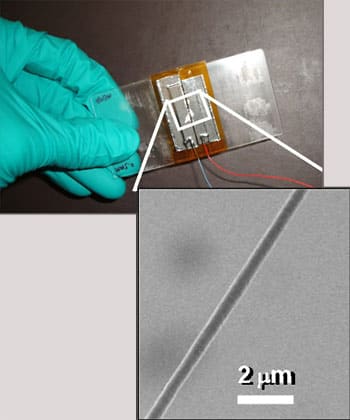
Researchers at UC Berkely have created energy-scavenging nanofibers from organic polyvinylidene fluoride, or PVDF, which makes them flexible and relatively easy and cheap to manufacture. They work by harvesting energy from ordinary body movements. These nano-sized generators have “piezoelectric” properties that allow them to convert the energy created through mechanical stress, stretches and twists into electricity and who twist and stretches more than a Soldier in the field? The nanogenerators have diameters as small as 500 nanometers, or about 100 times thinner than a human hair and one-tenth the width of common cloth fibers. Additionallym the researchers repeatedly tugged and tweaked the nanofibers, generating electrical outputs ranging from 5 to 30 millivolts and 0.5 to 3 nanoamps. Such performance would make them well suited for use in a combat uniform.

Nanofiber Generator

We continue to see the development of these piezoelectric technologies that harness energy from common tasks. Some are integrated directly into the clothing and footwear and others are appliques designed to be added and removed from equipment as needed. Currently, the nanofibers features in this article are averaging about 12/5 percent efficiency but one day much of power a Soldier needs for his equipment may come from energy harvested as he conducts common tasks. Oh the possibilities.

Polartec’s New Power Shield Pro Hitting the Scene

Thursday, December 17th, 2009

You can’t hardly consider a military insulating layer these days without it being made from Polartec technology. Polartec, LLC, is launching a revolutionary new softshell fabric combining weather protection and breathability.

Polartec® Power Shield Pro®

“Polartec helped launch the ‘softshell revolution’ over ten years ago with Polartec® Power Shield®, a fabric that offered superior breathability, durability and stretch with enough weather protection for everything but the wettest conditions,” states Karen Beattie, product marketing manager for Polartec. ”Polartec Power Shield Pro dramatically ratchets up the fabric’s water resistance, while retaining critical breathability.”

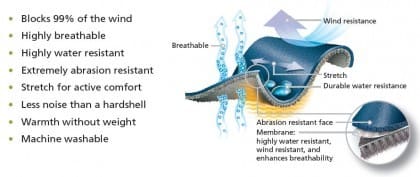
Several characteristics make it a promising choice for tactical garments. It is quieter than traditional shells yet repels 99% of wind. Additionally, insulation, breathable membrane, and shell are laminated into a single fabric solution making for lighterweight and lower volume clothing.

Thanks to a new proprietary membrane technology and lamination techniques, Polartec Power Shield Pro allows true air permeability (8 l/m2/sec = 2CFM) for a controlled two-way air exchange that significantly improves moisture transport over softshells that do not allow airflow. At the same time, Polartec Power Shield Pro holds a water column of 5000mm, offering superior water resistance.

Polartec Power Shield Pro is a laminate that can offer a combination of poly or nylon woven face fabrics with excellent DWR and durability characteristics, paired with lightweight to high loft backs. Sandwiched in between is a proprietary new hydrophobic, microporous polyurethane membrane that allows actual airflow through the entire fabric package but stops water from penetrating.

Polartec Power Shield Pro will be launched at the January 2010 Outdoor Retailer and ISPO trade shows by multiple brands including 66 North, Eider, Lowe Alpine, Millet, Montura, The North Face, Norrona, and Trangoworld. Let’s start to see this fabric with some tactical brands…hint, hint.

eVent by Any Other Name

Wednesday, December 9th, 2009

Apparently GE has decided to revise their branding strategy for eVent fabrics. No longer will they market the eVent brand but rather continue development of the technology and license the fabric to customers allowing them to build their own brands. This means that a lot more manufacturers will be using the eVent technology just under a variety of private label brands.

Goreâ„¢ Military Fabrics to Showcase Its Newest Protective Gear at the 2009 Soldier Equipment & Technology Expo

Monday, November 16th, 2009

In true fashion, as a leader in the development of cutting edge protective clothing and individual protection, Gore is at it again.

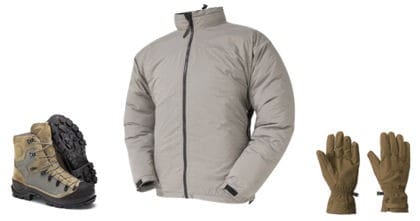
A selection of products from GOREâ„¢ Military Fabrics

The scientists and product engineers at Gore have listened to the needs of the elite warfighter, and responded with the development of some of the most functional gear to hit the street. Whether that street is in the city of Mazari Sharif in Balkh Province, or in the remote mountains of Tora Bora; this new gear is meant to increase mission effectiveness through innovations in comfort and performance. Innovations based on the functional needs of the warfighter in the harshest and most demanding environments around the world.

Whether that need be durably waterproof, windproof and breathable protection, concealment, burn protection, or chemical and biological hazard protection, the military looks to the GOREâ„¢ Military Fabrics team for creative, dependable solutions.

Building on the tradition of GORE-TEX® fabric, GOREâ„¢ Military Fabrics continue to play a vital role in the production of best-in-class protective clothing products for all branches of the U.S. Military – products our military personnel have come to trust for more than 25 years.

Visit the Goreâ„¢ Military Fabrics booth #508 at the Soldier Equipment and Technology Expo, to see the hottest new gear, and to discuss why Gore is a leader in developing solutions to systems level protection.