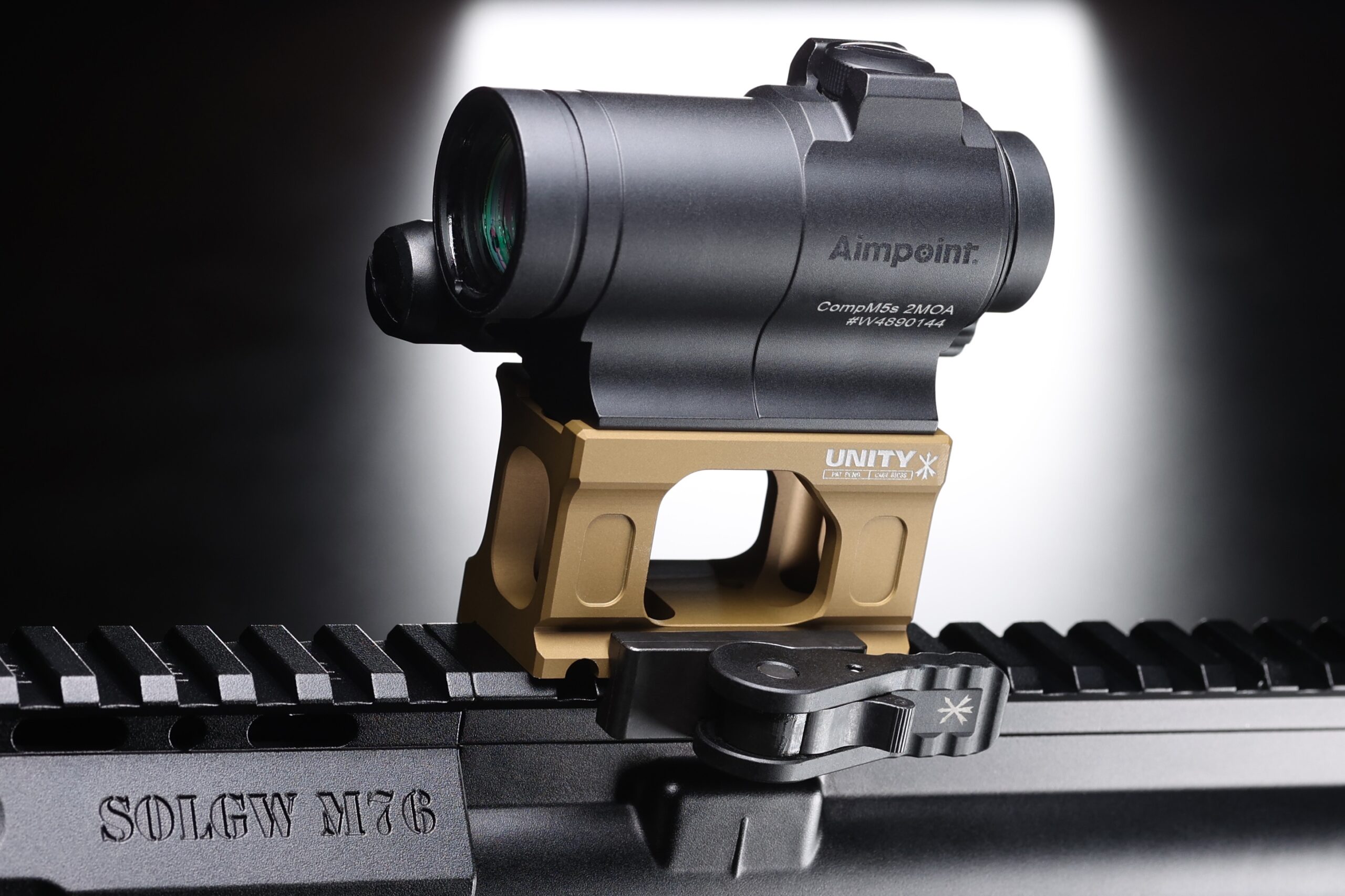
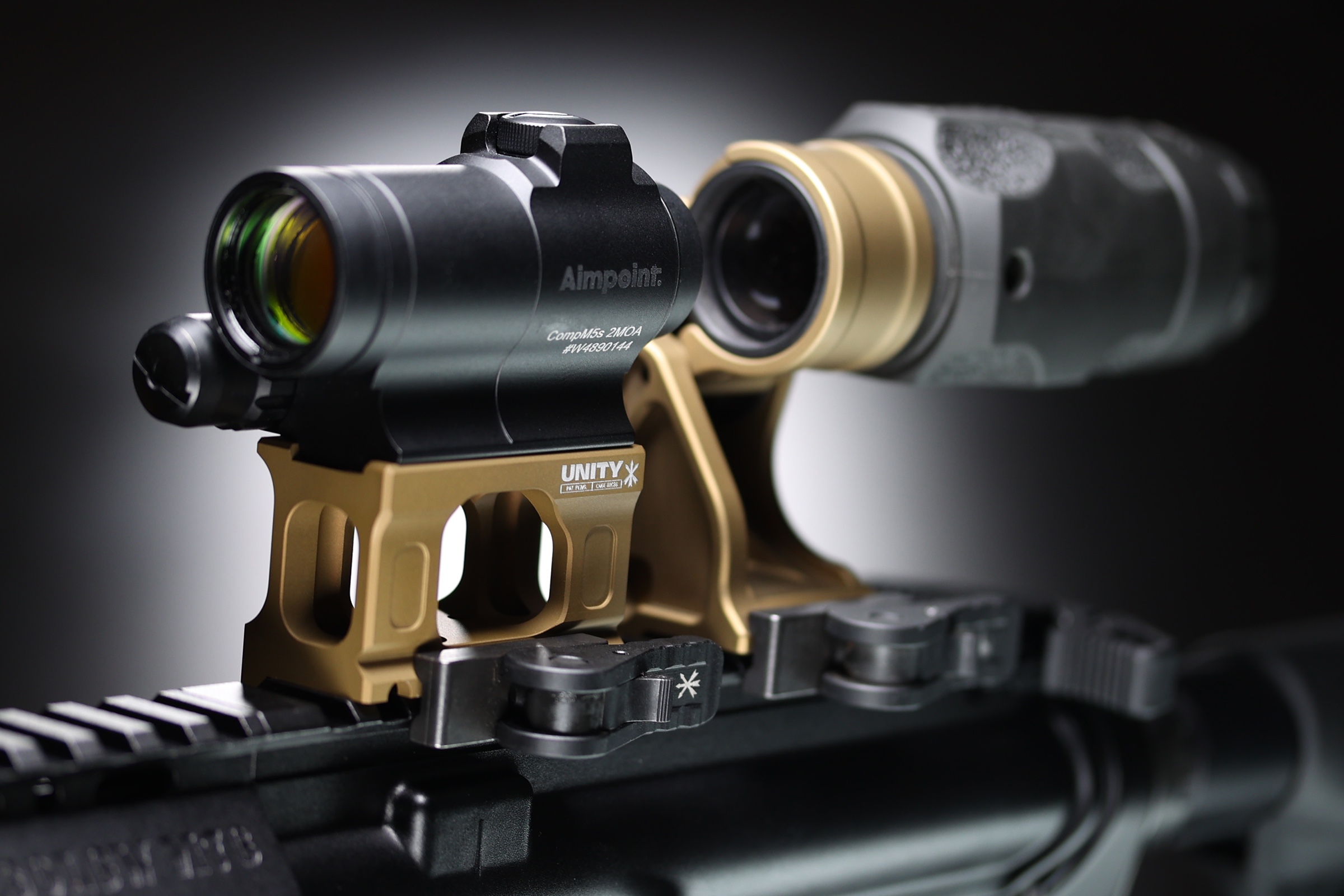
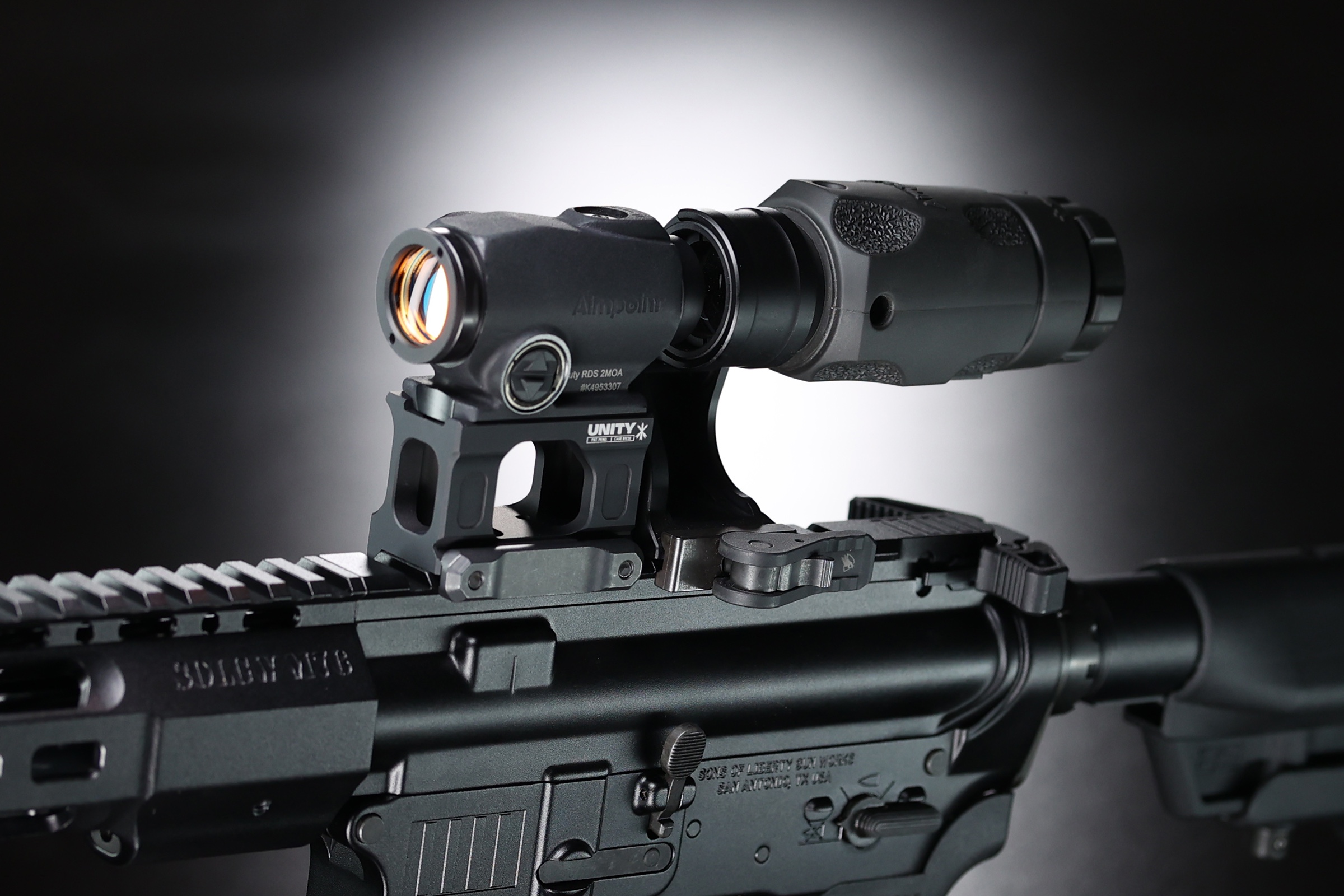
Nightforce has given us a real treat. It’s not often we get to see government contract optics paired with the actual weapons they were procured to work with. Nightforce had three set ups depicting their USSOCOM wins for the Ranging – Variable Power Scope (R-VPS), Precision-Variable Power Scope (P-VPS), and Squad – Variable Power Scope (S-VPS) contracts. As you can see, all of the optics are Dark Earth color for these contracts.


First up is the SU-393/PVS R-VPS which is an ATACR 4-20×50 F1 and used as an enabler for the Knights Armament Co SR-25 in 6.5 Creedmoor.
Next, the SU-296/PVS P-VPS is an ATACR 7-35×56 F1 optic paired with the Barrett MRAD, known as the Mk22 Advanced Sniper Rifle within DoD.
Last but not least, the SU-294/VPS S-VPS is a 1-8×24 ATACR F1 optic and used in conjunction with the M4A1 carbine which is also equipped by SOCOM with the Geissele Upper Receiver Group Improved (URGI).
Fort Worth, Texas (May 23, 2022) – Owners of the popular Springfield Armory® SA-35™ 9mm and Ruger® LCP® MAX .380 Auto pistols can now upgrade their factory sights with XS night sights for improved performance, day or night.
XS’ R3D with green front sight is now available for the Springfield SA-35, and the DXT2 Big Dot with orange or yellow front sight is available for the Ruger LCP MAX .380. These self-illuminating night sights enable faster and more accurate target acquisition in high-stress, self-defense situations, giving you an advantage when every fraction of a second counts.
R3D for Springfield SA-35
Featuring a 3-dot notch and post sight picture, the R3D green front sight is equipped with XS’ proprietary Glow Dot technology. Not only does the Glow Dot absorb ambient light and glow in low light, it also absorbs light from the tritium center which continually charges the dot making it glow brighter than the rear tritium dots which drives focus to the front sight.
The R3D offers a high-contrast sight picture in bright and low light settings. The rear notch is 15% wider than the front sight, allowing more light around the front blade for faster indexing and more accurate alignment. The rear sight is blacked out to reduce glare and keep focus on the front sight and the threat downrange. It also has a rear sight ledge for one-handed slide manipulation.
DXT2 Big Dot for Ruger LCP MAX .380
The DXT2 is XS’ second-generation Big Dot sight, delivering ultra-fast target acquisition in any light thanks to its industry-leading large front sight with Glow Dot and tritium center. Available with an orange or yellow front sight, the Glow Dot is visible even before the tritium can be seen. This glow, in addition to the large dot size, improves speed and accuracy while shooting on the move. Its V-notch rear sight with vertical white stripe and tritium inset facilitates a dot-the-‘i’ sight picture that is fast and instinctive in high-stress situations.
“Our night sights with XS’ proprietary Glow Dot technology offer gun owners distinct advantages in high-stress, self-defense situations,” said Addison Monroe, Marketing Manager, XS Sights. “The purpose-driven designs deliver excellent contrast to drive focus to the front sight for fast and accurate target acquisition when every fraction of a second counts.”
All XS Sights are backed by a 10-year, No Questions Asked Warranty and XS’s 30-Day Satisfaction Guarantee.
Posted in Optics, Press Release, Weapon Accessories | Comments Off on XS Sights Introduces Night Sights for Springfield Armory SA-35 9mm and Ruger LCP MAX .380 Auto Pistols
SOFIC, Tampa, FL. MOHOC, Inc., creator of the world’s first military-optimized helmet cameras, announced today the launch of the all-new MOHOC® 2 Camera.
While the original MOHOC® Camera is used primarily for recording video to an SD card, the MOHOC® 2 Camera is built to stream real-time video over mobile ad hoc networking (MANET) radios. Designed as a live sensor for the hyper-enabled operator, it maximizes situational awareness at the tactical edge.
Dan Fuhrman, VP Product Development, described the new technology, “We continually listen to feedback from operators, and their #1 request has been to improve the camera’s transmission. We thoroughly studied this input, innovated, and MOHOC® 2 now marks our evolution from an after-action review device to a real-time streaming tool for mission-critical information.”
MOHOC® 2 utilizes a radically improved sensor offering 20X better low-light performance than its predecessor. It is smaller, lighter, and simpler to operate than the original MOHOC®, but with the same low-profile, helmet-contour, and military-grade ruggedization. Additional features include a rotating lens, Curvelock™ Velcro® mount, and connectors canted to minimize snagging.
The camera is designed with extensive input from leading C5ISR companies for plug-and-play, resilient comms within integrated tactical networks. Built in multiple video formats tailored to the protocol of specific tactical radios, the first MOHOC® 2 model (released today) outputs SDI video compatible with the Persistent Systems MPU5 MANET radio. Additional models with IP, USB, and HDMI video formats are expected starting in Q3, and specialized ports and connectors are available for custom-build solutions. All MOHOC® 2 Cameras are made in the USA.
Three new options deliver increased speed and accuracy for hunters and shooters.
BARNEVELD, Wis. – Whether your perfect day consists of time at the range or on the mountain, three new laser rangefinders from Vortex® will help you do what you love and do it well.
The time-tested Vortex® Razor® HD 4000 is now joined by the new Viper® HD 3000, Diamondback™ HD 2000, and Crossfire™ HD 1400 laser rangefinders. Each unit comes equipped with a powerful HD optical system and soft carry case.
VIPER® HD 3000 LASER RANGEFINDER
Whether you’re in open country or tall timber, precision and speed mean the difference between filling your freezer and tag soup. The Viper® HD 3000 laser rangefinder gives you the tools to act quickly and confidently, with a 3,000-yard max range, and 2,000 yards on game.
• 7x magnification
• Red OLED display for stellar low-light performance
• .1 yard increment display
• Line of Sight and Horizontal Component Distance range modes and Scan Feature
• Normal, First, Last, and ELR target modes
• Tripod compatible to get the most out of its range
If ranging targets at 1,000 yards and beyond is a staple in your repertoire, your laser rangefinder needs the horsepower to go long and the toughness to stand up to the field. The ultra-fast Diamondback™ HD 2000 gives hunters 2,000 yards max range, and 1,400 yards on game.
• 7x magnification
• Red OLED display for stellar low-light performance
• .1 yard increment display
• Line of Sight and Horizontal Component Distance range modes and Scan Feature
• Normal and Last target modes
• Tripod compatible to get the most out of its range
If you’re on the hunt for the perfect go-to laser rangefinder for archery and rifle hunters alike, you’ve found it in the Crossfire™ HD 1400. It carries light at only 4.8 ounces and hits hard, offering up to 1,400 yards max range, and 750 yards on game.
• 5x magnification
• Red TOLED display optimized for low light
• .1 yard increment display
• Line of Sight and Horizontal Component Distance range modes and Scan Feature
To learn more about the all-new lineup of Vortex® laser rangefinders and how they stack up against previous models, tune in to episode 233 of the Vortex Nation™ Podcast. For an in-depth look at which rangefinder is right for you, check out “Rangefinder Modes – EXPLAINED!” on the Vortex® YouTube channel.
For a list of specifications, frequently asked questions and high-resolution images, check out the Vortex New Product Portal. For more information, visit VortexOptics.com.
Posted in Optics, Press Release | Comments Off on Vortex Drops New Laser Rangefinder Lineup
The NOX allows the addition of a nighttime optical device such as night vision or thermal to be mounted directly in front of your spotting scope. The NOX attachment was designed as a direct add-on attachment for the KDG Optics Hub, but could also be used as a stand alone unit. Machined from 6061 aluminum and hard anodized black for a rugged versatile platform, the NOX utilized standard 1913 picatinny rail to affix your sight and is completely adjustable for length and height to fit a wide variety of spotting scopes and nighttime devices. Utilizing the industry standard ¼ x 20 thread the NOX also allows for the installation of any standard arca mount and a variety of tripod mounts to be attached. Paring your nighttime optics with our universal sidelok mount will allow for quick installation or removal of your nighttime optic as the mission deems fit. Own the night with the new KDG NOX Attachment.




Essex Junction, Vermont (April 28, 2022) – Revision Military, a leading producer of protective eyewear for military, law enforcement, and civilian users, has recently completed the delivery of 50 prototype micro heads-up display systems to the U.S. Air Force’s 129th Rescue Squadron as part of an Air Force program to explore new technologies. The Revision Smart Eyewear powered by Ciye enhances situational awareness and mission effectiveness while offering state-of-the art ballistic eye protection.
The Revision Smart Eyewear powered by Ciye HUD system, is based on commercially available technology developed by Ciye, a U.S.-based leader in fitness tracking technology. The U.S. Air Force provided development funding for the device through the Air Force Research Laboratory’s (AFRL) AFWERX small business innovation research grant program.
“The goal in creating this system is to give the wearer access to essential tactical information in real-time without overwhelming them, all while providing ballistic eye protection,” says Revision CEO Amy Coyne. “The smart eyewear is based on Revision’s longstanding expertise in providing combat-proven solutions that protect our men and women in uniform.”
While wearing the 1.9-ounce smart eyewear, the user looks up and to the left to see an array of user-selectable data fields related to navigation. The display is only visible when needed, leaving the wearer’s entire field of view free from distracting information.
“The display is not in the user’s field of view,” says Ciye CEO Yuri Zhovnirovsky, “giving the wearer access to information without compromising situational awareness. A critical information need for the military is ‘where am I, and where am I going.’ Normally, you’d have to stop what you’re doing and consult a map or device to figure that out,” says Zhovnirovsky, “but with our device navigation and movement are seamless.”
Once the user selects and downloads a route from the Android or iOS smartphone app using a Bluetooth connection, the unit then runs autonomously, displaying route direction, moving time, and distance data that’s dynamically updated in real-time in three visible fields.
The smart eyewear contains a ballistic lens, an integrated display, GPS and antenna, a compass, accelerometer, gyroscope, and a 12-hour battery. The unit is semi-autonomous, only requiring a smartphone app to set navigation waypoints and configure the display. The battery is rechargeable in 30 minutes using a common USB power bank. The entire system is contained within the footprint of a set of spectacles that are designed to integrate with existing helmets and communication headgear.
As part of the Air Force Program trials, search and rescue personnel used the smart eyewear preloaded with mission navigation waypoints before their aircraft took off. Once on the ground, rescuers used the navigation HUD to guide them directly to their objective without using critical time in the landing zone to consult handheld navigation aids. An arrow pointing to the waypoint or objective, along with time and distance to the objective was displayed and updated in real-time as the wearer moved. Without needing to reference maps or tablets, the personnel had greater situational awareness and were able to move more efficiently through complex terrain.
Now that this initial field trial with the Air Force is complete, Revision and Ciye will continue to evolve the product into a state of operational readiness, identify stakeholders and further define end user requirements. For more information, please contact the team at solutions@revisionmilitary.com.
The Department of Defense Office of the Inspector General has released their report on an audit to determine whether Army officials effectively managed the Integrated Visual Augmentation System (IVAS) program to meet user needs.
IVAS is a $21.88 Billion program to field a militarized version of Microsoft’s HoloLens. Modifications were based on seven requirements that enhance the Soldier’s decisions and capabilities to execute combat tasks with speed and precision identified by the Soldier lethality cross-functional team: communication, lethality, mobility, protection, situational awareness, survivability, and training and human performance.
This program is so important to the Army that it even has its own Program Manager under PEO Soldier. During development PM IVAS used Soldier Centered Design during multiple testing events in the IVAS rapid prototyping phase. This process is intended to ensure that Soldier needs are considered when making design tradeoffs and production decisions. A core metric is user acceptance.
Unfortunately, the IG found that program officials did not define minimum user acceptance levels to determine whether IVAS would meet user needs because Army policy does not require program officials to define suitable user acceptance levels.
Consequently, the IG recommends that the Assistant Secretary of the Army (Acquisition, Logistics, and Technology) develop Army?wide policy requiring program officials to define suitable user acceptance measurements for testing and evaluation.
Furthermore, they also recommend that the Program Executive Officer Soldier define clear measures of user acceptance levels to meet user needs before Soldier Touch Point?5 testing of IVAS. In addition, they recommend that the Assistant Secretary of the Army (Acquisition, Logistics, and Technology), as the decision authority for IVAS, verify whether the Program Executive Office Soldier meets established user acceptance measures and addresses Soldier?identified issues before IVAS production.
This should help satisfy those who feel that the program is moving too quickly, is technologically immature, or does not have Soldier buy-in.