Phantom Lights

Archive for the ‘Profession of Arms’ Category

Michigan National Guard Soldier Earns Ranger Tab

Saturday, July 27th, 2024

LANSING, Mich. – Joining the Army is tough; you’re immediately off to basic and individual training, facing drill sergeants, and learning the basics of soldiering. Going straight to Ranger School after that? That’s an entirely new level of challenge and excellence.

No Michigan Army National Guard Soldier accomplished all three schools through the Ranger Team Leader Initiative program — until now. On June 21st, 19-year-old Pfc. Chase Cammenga achieved this milestone, graduating from all three rigorous training programs.

The RTLI is a specialized training program for enlisted Soldiers in the Army National Guard who aspire to attend Ranger School. This program transitions Soldiers from initial training to the Ranger Training Assessment Course (RTAC) and then directly to Ranger School. The program scouts for top National Guard Soldiers, selecting those with the highest potential to succeed in the challenging Ranger course.

When Cammenga enlisted in the National Guard two years ago in November while still in high school, his ambition to pursue advanced military training was a driving force behind his decision.

“I wanted to challenge myself and be in the best fighting force on the planet,” he said.

Cammenga was initially set on the active-duty route until a friend introduced him to the National Guard. He discovered the Guard offered a balance between military service and pursuing higher education, with educational benefits such as tuition assistance and the GI Bill.

“One of my buddies joined, and I figured this was a good way for me to do both. I could be in the National Guard and still serve while I’m going to college,” he said.

Cammenga embarked on his initial training. The fear of the unknown was daunting, and his One Station Unit Training experience was no exception. OSUT consolidates Basic Combat Training and Advanced Individual Training at one location.

“It was hard because it was the first time I was away from my family for that long. The training was different from anything I’d ever done before,” he recalled.

Cammenga’s determination to excel in training was driven by a desire to be a member of a team. He chose the infantry military occupational specialty of 11B.

“I’ve always wanted to be the best, but more than that, I want to be able to help those around me,” he said. This mindset was particularly evident during Ranger School.

As his time at OSUT ended, he was identified as a standout candidate based on factors such as his PT score of 584 out of 600 points. He earned a spot in the RTLI program.

“I was pretty excited,” he said. “Going to Ranger School wasn’t always a dream, but once I heard more about it, I knew it was what I wanted to do.”

Cammenga’s journey to earning the Ranger tab began with rigorous RTAC training. The 30-day course prepares enlisted Guard members for the Army National Guard “pre-Ranger” course, called the Ranger Training Assessment Course. RTAC lasts 17 days, and all Army National Guard members must complete it before heading to Ranger School.

“In RTAC, the training was incredibly tough. It made us think, ‘If this is hard, just imagine what Ranger School will be like.’ But we always supported each other and lifted each other up,” said Cammenga.

Once RTAC was completed, Cammenga was ready for Ranger School. For more than two months, Ranger students train to exhaustion, pushing the limits of their minds and bodies.

Reflecting on his journey, Cammenga emphasizes the importance of camaraderie and support. “You don’t get your tab; your buddies get it for you. I learned that I had to lean on those around me.”

Recycling during training is a common challenge; for Cammenga, it was no different. Darby, the first phase of Ranger School, was a hyper-structured environment where attention to detail was paramount.

“The instructors were different, with different criteria. It was all about doing everything by the book,” said Cammenga.

Feeling that sinking sensation in his stomach when he realized he had to do Darby again was tough, but he kept telling himself he wasn’t a quitter.

“I felt like I couldn’t go on, but I learned to dig deep and find that inner strength,” he said.

With dedication and hard work, Cammenga passed Darby and moved to the next phase. For Cammenga, the training presented significant challenges, especially the lack of sleep and food for more than 62 days.

“The lack of sleep was the most difficult part for me,” said Cammenga. “There were times I found myself falling asleep while walking. On average, we got about an hour to an hour and a half of sleep a night.” Despite these hardships, he stayed motivated by reminding himself, “At least I’m not in Darby. I can get this done.”

During Ranger School, one mentor, a fellow Soldier in his platoon, had a profound impact on Cammenga.

“He told me that people here will do anything for you; you just have to ask,“ Cammenga said. “His words inspired me to be more patient and to help others wherever I could.“

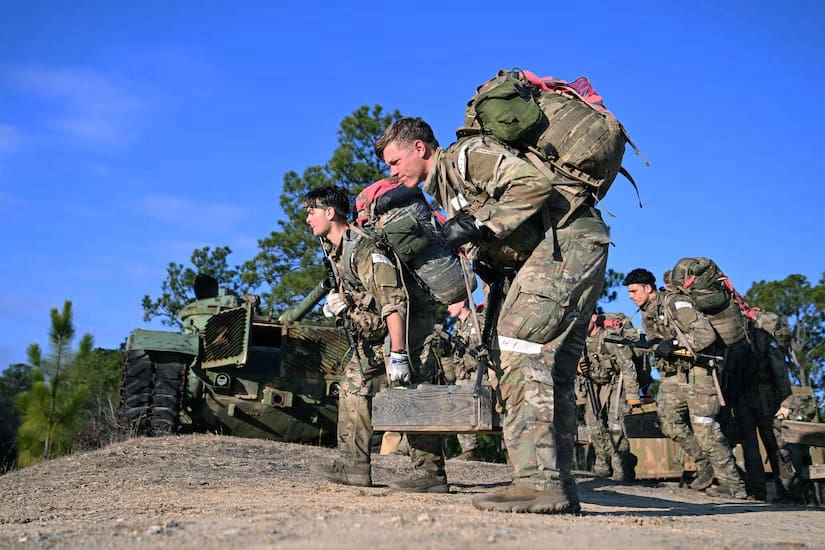
Cammenga pushed through 12-mile rucks, completed water survival training, navigated difficult terrain, and led battle drills.

“Failure was not an option. I pushed myself harder than I ever thought possible,” he said.

His perseverance paid off when he completed Ranger School and earned the coveted Ranger tab.

“It was one of the proudest moments of my life. All the hard work and sacrifices had finally paid off,” he said.

After Ranger School, he attended airborne school. The training further honed his skills and prepared him for future missions.

“My parents always encouraged me to follow my dreams and never give up,” he said. “During training, they wrote me letters and offered incredible support. Their encouragement was a big part of what kept me going.”

By 2LT Paige Bodine, 126th Theater Public Affairs Support Element

CSAF Leadership Library: July 2024

Wednesday, July 24th, 2024

Leadership and learning are indispensable to each other.

-John F. Kennedy

Airmen,

In this time of consequence, we stand at a critical juncture with the opportunity to shape the architecture of our current and future Air Force. As we reoptimize and adapt to the challenges of an evolving security environment, your leadership has never been more important. This next installment of the Leadership Library is intended to provide you with a collection of resources designed to educate, inspire, and provoke thoughtful discussion.

John Kotter’s Leading Change is a must-read for Airmen seeking to drive meaningful change and innovation. Drawing on real-life examples, Kotter outlines a multi-step process that enables leaders to navigate the complexities of change and overcome resistance. By understanding the nuances of change management, Airmen will be better equipped to create a more agile and adaptive force.

George Marshall: Defender of the Republic is a thought-provoking biography exploring one of America’s most influential military leaders and statesmen. By examining Marshall’s leadership style and decision-making process, Airmen will gain valuable insights into strategic planning and crisis management. This work will aid Airmen seeking to better understand the complexities of leadership and the importance of character in shaping outcomes. General Marshall was clearly an extremely effective leader in a time of consequence.

In this At the Table episode, Unveiling the Motivation Vacuum in the Workplace, the podcast offers practical strategies for leaders to enhance motivation, retention, culture, and productivity. The key to success lies in aligning individual and team goals while fostering resilience. This episode provides valuable insights into the challenges of maintaining motivation in the workplace and offers actionable solutions for leaders to create a more driven and productive team.

The recently released CNAS report, Evolution not Revolution: Drone Warfare in Russia’s 2022 Invasion of Ukraine, explores the transformative impact of drones on the battlefield. The report provides an insightful analysis of the changing character of war, focusing on the role of drones in modern warfare. As Airmen, it is crucial to stay informed about the latest technological advancements and their implications for the battlefield.

This library release is designed to empower Airmen at all levels by exploring advanced technologies, delving into the intricacies of leadership, and drawing parallels between historical and contemporary contexts. Through engaging with these selections, I am confident that you will be better equipped to meet the challenges we face today. These titles can be accessed and tracked through the E-Learning CSAF Library Journey.

Together, we will continue to ensure that our Air Force remains the most formidable and ready force in the world. Stay curious, stay engaged, and lead with confidence.

Editor’s note: The CSAF Leadership Library is a fluid set of media selected by Gen. Allvin that evolves as novel ideas are published, recorded and debated. New entries will be added periodically throughout the year.

Secretary of the Air Force Public Affairs

Virtual Symposium Develops Air Commandos to Maximize Potential

Friday, July 19th, 2024

Hurlburt Field, Fl —  

Participants across Air Force Special Operations Command took part in the Commando LEAD Symposium on July 15 virtually to learn techniques to continue to build the force we need.  

“We have a duty as leaders to ensure anyone who chooses to serve has an environment to thrive,” said Maj. Gen. Rebecca Sonkiss, Deputy Commander of Air Force Special Operations Command. “We are talking about building strong teams, a fabric of unique and different thoughts, with trust, that are ready to deliver the full capabilities of our nation with the lethality we need to win,” she added.  

The Commando LEAD Symposium had an array of speakers, which all focused on the need to maximize an Air Commandos potential and to sharpen their mindset. 

“The Air Commando Mindset is a bias for action, setting really high standards, and holding each other accountable. It is this mindset that actually earns us the title Air Commando and comes from a rich heritage,” said CMSgt Anthony Green, Command Chief Master Sergeant at Air Force Special Operations Command. “We must have all three things and remain adaptive. We cannot allow ourselves to stagnate because of the risk of failure. Know the mission, seek our purpose, and unleash that out the box thinking that AFSOC has always been known for,” he added.  

At the virtual symposium, participants were provided insights on how to cultivate a professional workplace, nurture workforce talent, and promote an inclusive environment.  

“We are not a social justice organization, we are a combat capability generating and warfighting organization, but we can still find ways to take care of each other. And so, to that end, Air Force capabilities and warfighting skills are enhanced by the diversity of its personnel,” said SMSgt Remy Voisin, Senior Enlisted Advisor for the 1st Special Operation Wing Commanders Action Group.  

Topics at the event included “Air Commando Mindset,” “Diversity as an Operational Necessity,” and “Overcoming Systemic Barrier’s.”  

When we foster an environment of inclusion, our force becomes a more engaged, effective, and lethal.

“Bringing broad spectrum of teammates to the table so they perform to the best they can stands the test of time. Our expectation is everyone is a leader, and everyone needs to be leading in this space,” said Sonkiss.  

LEAD stands for Leadership, Equity, Advocacy and Development.

Air Force Special Operations Command Public Affairs

“Mission Over Function” – Developing Combat-Effective Airmen for Great Power Competition

Saturday, July 13th, 2024

JOINT BASE SAN ANTONIO-RANDOLPH, Texas (AFNS) —

Unprecedented changes to the global security environment are driving sweeping reforms to the way the U.S. Air Force will develop, deploy, and employ combat forces and capabilities to defend the United States, allies and partners nations around the world.

Officials from Air Education and Training Command, which will be redesignated as Airman Development Command, are rapidly redesigning core institutional training and development architectures to support Great Power Competition. This includes designing education and training for the future force with a “mission over function” mindset, where the primary focus is on developing Airmen to emphasize their shared military purpose and mission objectives over individual functional roles.

“Success in today’s strategic environment requires a force aligned and focused on the requirements and attributes that will keep us competitive,” said Lt. Gen. Brian Robinson, commander, AETC. “In the context of the U.S. Air Force, ‘mission over function’ emphasizes prioritizing mission success over organizational silos. When it comes to GPC, we are laser focused on developing our Airmen first, ensuring they are mission ready, with the skills we need to succeed as we transform into a more expeditionary force with deployable combat wings.”

As the Department of the Air Force implements major changes, the ADC will develop Airmen with a mission first mindset, and serve as the institutional major command responsible recruiting, training, educating and developing resilient, mission ready Airmen who thrive in complex and contested environments.

“This mindset helps us create an optimized, functionally informed, and agile force development command that effectively accelerates the journey from recruitment to operational deployment, aligns learning content with operational feedback and future capabilities, and precisely matches talent with Air Force requirements,” Robinson said. “Ultimately, our purpose is to enhance the Air Force’s operational readiness by fostering rapid content development, precision talent management, and training pathway agility, ensuring the force remains adaptable, resilient and strategically adept.”

In this construct, force design and operational feedback will serve as the guiding North Star in the overall development of Airmen.

The ADC’s centers of excellence at the Headquarters and Numbered Air Force levels will serve as primary focal points for early integration and coordination with Air Force Materiel Command, Air Combat Command, the service component commands, and the Integrated Capabilities Command regarding sustainment, operational feedback and future capabilities development, ensuring initial skills training and leader development incorporates the competencies every Airman needs for success in GPC.

“With ADC owning overall responsibility for force development, the training for new weapons systems is less likely to be an afterthought due to our ability to integrate with ICC to prepare that training through a mission perspective lens,” Robinson said. “The COEs will expeditiously provide enterprise-focused training and education solutions to support the operationalization of new integrated capabilities in collaboration with the other institutional commands.”

According to the USAF’s The Case For Change, developing personnel is a deliberate priority requiring a dedicated and unified effort to attract, retain and nurture the talent and specialized skills demanded by the emerging strategic landscape. The Air Force must cultivate Mission Ready Airmen—individuals with the expertise and versatile skillsets required to win in various operational scenarios. The personnel we need requires optimizing the force we have by centralizing force development, reinvigorating our warrior ethos to create Mission Ready Airmen, and establishing robust and effective paths for technical areas critical to creating competitive advantage.

“Tomorrow’s Airmen will remain technical experts, but they will also be trained to be mission-ready with additional skills and competencies,” Robinson said. “This includes the concept of mission command, which will allow them to make bold decisions and take advantage of fleeting opportunities to fight and win multiple fights as agile teams. This type of leadership doesn’t just happen. It takes intentional development and practice.”

Additionally, The Case For Change emphasizes centralizing specific facets of force development under a single commander will streamline the coordination, integration, and execution of Air Force training and education initiatives. This centralization will enable the identification and evaluation of specific areas of Airman development that are common and would benefit from a concentrated, integrated approach. This will ensure a more standardized Airman experience and development with a shared understanding of the threat environment.

The desired outcome is the development of the right Airmen for the right place and time, a skilled cadre well-prepared for future challenges, and a cohesive workforce adept at competing effectively—poised to surge and sustain operations during times of conflict. This transition also requires the appropriate renaming of AETC to ADC, reinforcing its focus on shaping the Airmen of tomorrow.

Efficiencies to having force development under a single commander include:

– A single focal point to consolidate and respond to warfighter training requirements that allow the command to rapidly deliver new curriculum that enables the more rapid expansion of training production in a crisis or conflict.

– Enables force providers and components the ability to focus on combat readiness training vice institutional training.

– Improved relationships with industry and provides a single advocate for training modernization research and development and increases the opportunity for new technology use in training at scale.

One example of a mission transitioning to ADC ownership is the development team process, which provides the tools to be accountable for career field succession plans and force development vectors with ultimate responsibility residing with the ADC commander.

“We are transitioning functional force development requirements to ADC while still being advised by functional authorities on the competencies needed by Airmen in the field,” Robinson said. “With multiple functional communities individually directing development in a variety of ways, enterprise needs can sometimes take a backseat to functional career field needs.”

The ADC will provide that holistic, enterprise integration and assessment, via a single commander with the requisite force development authorities to make enterprise-level decisions.

“We’re out of time, and we have to really think differently and figure out how we develop the force at the speed of need and relevance,” Robinson said. “Our strategic advantage is our Airmen. Our sole focus for ADC is making sure our enlisted Airmen, officers and civilians are prepared sooner to be credible, capable, and competent in delivering unstoppable air and space power to detect, deter, confront, and if called upon, combat and defeat potential adversaries.”

By Dan Hawkins, Air Education and Training Command Public Affairs

LeMay Center, AMC Announce Major Update to Air Mobility Operations Doctrine

Monday, July 8th, 2024

MAXWELL AIR FORCE BASE, Ala. (AFNS) —  

The Curtis E. LeMay Center for Doctrine Development and Education and Air Mobility Command collaborated on significant revisions to the recently released Air Force Doctrine Publication 3-36, Air Mobility Operations, reflecting the service’s renewed commitment to maneuverability and lethality.

The publication’s first major revision in five years also reflects the evolving strategic environment and re-emphasizes the importance of the joint functions of maneuver, sustainment and command and control. “These principles are critical to preparing the mobility air forces to effectively position the joint force for advantage and deliver lethal effects at the tempo required for victory,” said Gen. Mike Minihan, AMC commander.

Highlighting the publication’s release, Minihan stressed, “Amateurs study tactics, professionals study logistics, the victors study maneuver.” Remarking on the efforts to update the doctrine he added, “This version of AFDP 3-36 pushes the envelope in recognizing what the mobility air forces bring to the fight and how we elevate the lethality of the joint team. It includes new sections on command and control, maneuver, the key role air mobility plays in deterrence operations, and critical lessons learned from Operation Allies Refuge, the Russian invasion of Ukraine and recent operations in Israel. Our future challenge demands close reading of this document and thinking about how to fight.”

AFDP 3-36 underscores that air mobility operations are a fundamental extension of airpower — the capability to project military power through control and exploitation in, from and through the air. This updated doctrine aligns with the realities of Great Power Competition and is the first in a series of major service doctrine updates designed to prepare the Air Force for future conflicts.

The LeMay Center is responsible for the development, dissemination and implementation of Air Force doctrine. It is conducting a full doctrine review in support of the Air Force re-optimization for Great Power Competition.

By SMSgt Richard P. Ebensberger, Air University Public Affairs

Register Today for Commando LEAD Virtual Symposium

Saturday, June 29th, 2024

HURLBURT FIELD, Fla. —  

Register today for the Commando LEAD Symposium 2024, which will be held virtually on July 15. AFSOC is focused on developing Air Commandos to maximize their potential and this symposium is for any member within the command. Register at forms.osi.apps.mil/r/csGEz3j8c5 or use the QR code in the above image.  

The Commando LEAD Symposium will have an array of AFSOC speakers, civilian to military, from all ranks and AFSCs.  This will sharpen the Air Commando mindset and provide the tools needed to cultivate a professional workplace, nurture workforce talent, and promote an inclusive environment. When we foster an environment of inclusion, our force becomes more engaged, effective, and lethal. 

LEAD stands for Leadership, Equity, Advocacy and Development. 

By Air Force Special Operations Command Public Affairs

CSAF Allvin Adds Details, Articulates His ‘Nonstop’ Commitment to ‘Reoptimize’

Sunday, June 23rd, 2024

ARLINGTON, Va. (AFNS) —  

Adding detail and context to an ambitious effort for “reoptimizing” the Air Force, Chief of Staff Gen. David W. Allvin said in separate appearances June 13 and 14 that changing the way the Total Force trains, plans, modernizes, and is equipped must succeed for the Air Force to meet emerging challenges from China and other competitors.

Speaking first at an Air & Space Warfighters in Action session June 13, Allvin said the Air Force has made real and tangible progress instituting elements of a broad strategy announced in February to evolve how the Air Force develops people, generates readiness, projects power, and develops integrated capabilities.

Allvin pointed out, for example, progress in reinstituting warrant officers to help fill and keep personnel with in-demand skills such as cyber and information technology. That effort, he said, is well underway, with the warrant officer selection board scheduled to convene this month and the announcement of selects tentatively scheduled for late July.

The service started soliciting applications from April 25 to May 31 for Airmen aspiring to become the inaugural cohort of warrant officers in information technology and cyber careers.

He also provided an unambiguous rationale for the undertaking and why Air Force leaders insist on pushing it forward with urgency.

“We are finding that it is more difficult to retain the cyber talent that we spend a lot of time investing in, and that is going to be so critical to us going forward,” Allvin said at AFA. “We believe this is going to be a good path to ensure that we have the talent for today and tomorrow in a very cyber-heavy force that we’re going to need.”

Separate efforts to assemble, train, and deploy so-called “Air Task Forces” are moving briskly. These units will work and train together throughout the AFFORGENcycle to deploy as Units of Action in fiscal year 2026. The introduction of ATFs marks a significant milestone in the journey toward modernization and readiness, laying the groundwork to ensure the Air Force maintains a competitive advantage over the pacing challenge, he said.

“We have an advancing threat the likes of which we haven’t seen for decades,” Allvin said at AFA. He went on to say, “a key piece of reoptimization is taking all our Airmen and developing them with a common understanding of that threat … That’s central to being ‘Mission Ready Airmen’.”

In addition to understanding the threat, Mission Ready Airmen comprehend the service’s unique and inherent capabilities to defend against the threat.

“If we believe that the future of national defense and the joint force is going to require some of the attributes that exist in our air and space forces, then we have a requirement to not only be able to participate in the joint force, we need to be leading it. The character of war is privileging the things that airpower has been doing for a long time.

Air Force Chief of Staff Gen David Allvin

In a media session June 14 at the Pentagon, Allvin expounded on his comments from the day prior and discussed the need to be “One Air Force.”

“We are taking an Air Force that has been somewhat fragmented due to the strategic environment over the years and really better aligning it and coming back to be one Air Force with one force design, one unit of action type, and one Airmen development concept,” he told a group of reporters.

Near the end of the hour-long session with reporters, Allvin articulated his long-term commitment to the reoptimization effort and better integrating the force.

“I got about a little less than three and a half years left [as Chief of Staff] … and this [reoptimization] is what I am going to be about. It will be nonstop. That I can promise you,” Allvin said.

By TSgt Nicholas G. Koetz

Secretary of the Air Force Public Affairs

Space Force to Accept Air Force Reserve Volunteers for Full-Time Positions

Saturday, June 1st, 2024

ARLINGTON, Va. (AFNS) —  

Air Force Reservists in space-related career fields interested in volunteering for the U.S. Space Force in a fulltime capacity can expect the application window to open June 1–Nov. 30, 2024.

This transfer option is part of the Space Force Personnel Management Act (PMA), approved by Congress and signed into law as part of the Fiscal Year 2024 National Defense Authorization Act.

When fully implemented, the PMA will enable the Space Force to create a new model of service that integrates active-component Guardians and Air Force Reservists serving in space-focused career fields into a unified service that offers both full- and part-time service options.

“This is an important first step toward fully integrating critical space expertise from the Reserve into our force,” said Chief of Space Operations Gen. Chance Saltzman. “We’ve been serving side-by-side together, supporting the same mission, for longer than the Space Force has existed. I’m excited to officially call the teammates who decide to transfer Guardians.”

Air Force Reservists who hold the below Air Force Specialty Codes are eligible to apply for transfer into the Space Force in full-time capacity:

Officers: 13S – Space Operations, 17X – Cyberspace Operations, 14N – Intelligence, 62E – Developmental Engineer, 63A – Acquisition Manager, and 61X – Scientist. Officers selected from the 6X career field will re-core to a 62E or 63A since Space Force does not maintain that career specialty.

Enlisted: 1C6 – Space Systems Operations, 1N0 – Intelligence, 1N1 – Imagery Analysis, 1N2 – Sigint, 1N3 – Cryptologic Language Analyst, 1N4 – Network Intelligence Analysis, 1N8 – Targeting Analyst, 1D7X1 – Cyber Defense Operations, 1D7X2 – Spectrum Operations Technician, and 1D7X3 – Cable and Antennae Defense Operations.

“The Space Force is about to integrate some of the most talented space operators,” said Chief of the Air force Reserve and Air force Reserve Command Commander Lt. Gen. John Healy. “I have no doubt they will be key to advancing security in the space domain.”

In time, the Air Force Reserve, like the Air Force, will no longer maintain space operations as career fields, meaning Reservists with 13S and 1C6 specialties must transfer to the Space Force in either a full- or part-time position, or re-train under a different Air Force Specialty Code.

Application windows for Air Force Reservists interested in transferring to the Space Force in a part-time capacity are expected to open in 2026 once policies, processes and systems are established. The PMA does not currently apply to space units and personnel currently resident in the Air National Guard; however, Guard members could expect a similar process to their Reserve counterparts after authorized and appropriate legal and policy changes.



Interested Air Force Reservists can apply via MyVector and can access additional application details and requirements on the Space Force Transfer page.

Secretary of the Air Force Public Affairs