Wilcox Ind RAID Xe

Archive for the ‘Profession of Arms’ Category

Army of 2030

Tuesday, October 11th, 2022

WASHINGTON — As the Army comes out of the conflicts in Iraq and Afghanistan and refocuses on the pacing challenge of China and the acute threat posed by Russia, Army leaders are directing the most significant reorganization and technical innovation since the end of the Cold War — ensuring our adversaries cannot outrange or outpace us on traditional battlefields, or the new frontiers of space and cyberspace. The world is changing, and the Army is changing with it. On the battlefields of the future, the Army of 2030 must:

Acquire sensors to see more, farther and more persistently than our enemies.

Concentrate highly lethal, low-signature combat forces rapidly from dispersed locations to overwhelm adversaries at a place and time of our choosing.

Deliver precise, longer-range fires as part of the Joint Force to strike deep targets and massing enemy forces.

Protect our forces from air, missile and drone attacks.

Be secure from enemy cyber and electronic attacks in order to reliably communicate and share data with ourselves, sister services and coalition partners.

Ensure we can sustain the fight across contested terrain and over time.

To meet the evolving threat, the Army is undergoing a once-in-a-generation transformation to develop the capability to converge effects on land, in the air, sea, space and cyberspace. This transformation includes investment in our people, reorganization of our forces, the development of new equipment, and the adoption of new concepts on how to fight that allow the Army to maintain superiority over any potential adversary.

People: The U.S. Army’s Military Advantage

More than any other area, the U.S. Army relies on cohesive teams that are highly trained, disciplined and fit to fight and win. To maintain a quality force, we must transform the way we recruit, train, educate and prepare America’s sons and daughters for an increasingly complex battlefield. The Army is building a 21st century, data-driven personnel management system to transform how we identify, develop and manage the talent that is the bedrock of our military advantage. Instead of the industrial age system of assigning people to jobs based on a few factors, the Army of 2030 will look at skills, education, experiences and personal attributes to match individuals with positions to which they can best contribute.[1] The Army is also investing in programs and education to improve how leaders identify their own strengths and weaknesses and to allow their organizations and their people to thrive.[2] The Army of 2030 will harness advances in virtual reality and simulations technology to train in more realistic environments at lower cost and with reduced risk to our forces. With the investments we are making, the Army will train Soldiers in simulated environments, where they can interact with and prevail against limitless threats and scenarios, enhancing preparedness from the smallest unit to the largest formation. The Army of 2030 will improve upon our longstanding commitment to the Soldiers who serve, not only with gratitude for their sacrifices, but with investments in their future. In addition to investments in advanced education, comprehensive health and fitness, and development of skills that will benefit them for life, the Army is transforming the way we protect Soldiers, civilians and families from harmful behaviors. The Army is leading the charge to develop prevention efforts for suicide, sexual crimes and extremism while strengthening our support systems to care for those affected.

Transforming How We Organize

To remain the dominant land force on battlefields of 2030, the Army is changing the way it organizes, equips and fights. After two decades of focusing on brigades rotating in and out of Iraq and Afghanistan, the Army is shifting its organizational focus to larger formations that are more capable of working with our sister services, allies and partners around the globe. Theater armies, corps and divisions will gain the personnel, organizations and equipment they need to disrupt and defeat an adversary’s ability to achieve their objectives. These organizational investments are multiplied by leveraging advances in commercial data analytics to improve the speed and accuracy of leader decision-making. Our study and analysis of recent conflicts, exercises, simulations and training indicate that brigade commanders must fully focus on winning the close fight. To allow front-line leaders to concentrate on the close fight, division and corps commanders will have the responsibility and capability to visualize the larger picture. Divisions and corps must be able to employ and allocate the growing array of lethal and non-lethal weapons to attack an enemy across all domains.

Evolving How We Fight

As the Army refocuses from conflict in the Middle East to focus on near-peer challenges, we must adapt to changes in technology and enemy capability and rethink how we deter our adversaries from using force to achieve their objectives. We know that forward positioned ground forces — able to converge effects from land, air, sea, space and cyberspace — complicate our adversaries’ decision-making, disrupt their actions, and assure our allies and partners. Whether in the Pacific or Europe, control of key nodes in the land domain will be required to win in large-scale combat.

The Army of 2030 must equip its forces with new and different capabilities. Many current systems are enduring capabilities developed during the Cold War. To defeat our adversaries on the modern battlefield, the Army is developing newer and more-advanced equipment, and is incorporating cutting-edge technologies to enable us to win on the battlefields of the future.

We are developing a network of connected unmanned and manned sensors that will enable us to see more, farther and more persistently than our enemies.[3]

We will deliver faster, more-survivable fighting vehicles, including unmanned robotic systems able to deliver more firepower.[4]

We will deploy new missiles that are able to travel at hypersonic speeds, increasing the range and ability to avoid traditional air-defense systems.[5]

We will harness the potential of high-energy lasers and microwaves for mobile short-range air-defense systems.[6]

We are innovating, through experiments like Project Convergence, to transform the Army into a data-centric force where commanders at all levels have the information they need to make decisions.

Finally, we are transforming how we sustain the fight by rethinking how the Army provides logistics and sustainment support with lighter and more climate-resilient vehicles and headquarters.[7]

Modernizing for an Uncertain Future

As we transform for the future fight, we are also setting the Army on a sustainable strategic path — one that balances the generational investments we are making to prepare for the future fight with the realities of our fiscal environment. The nation depends on the U.S. Army to respond to a broad range of missions at home and abroad. We must modernize sustainably, maintaining readiness now, while transforming at a pace informed by available resources. This will require hard choices about the pace of modernization and the risk we assume in order to chart a long-term course to integrate new capabilities while maintaining our ability to respond to crises.

Rarely in the Army’s history have we seen changes this significant. As we transform to meet an uncertain future, we must adapt how we recruit and retain talent, how we organize and how we fight to ensure that the Army of 2030 is ready to win when the nation calls. Winning matters.

DOWNLOAD: Army of 2030 Information Paper

DOWNLOAD: Army of 2030 Infographic

By U.S. Army
???????????????

[1] The Integrated Personnel and Pay System – Army (IPPS-A) will become the Army’s total personnel management system. The update pending release in early FY23 will provide the capability for all components of the Army to manage talent and career development.

[2] The Commander Assessment Program (CAP) assesses senior leaders’ ability to lead the Army’s most important organizations. The program was initiated in 2019 and has steadily expanded each year, with an anticipated permanent facility and staff stationed at Fort Knox in FY24. Project Athena provides junior leaders feedback about the skills, capabilities and tendencies they possess as they progress through their careers. The assessment tool is used for officers, warrant officers and noncommissioned officers at each step of their professional military education.

[3] Unmanned Aerial Vehicles have demonstrated in Ukraine the importance of persistent sensors. The Army is investing in systems like the Future Tactical Unmanned Aircraft System (FTUAS), Future Unmanned Aircraft System (FUAS)-Air Launched Effects (ALE), and High Accuracy Detection and Exploitation System (HADES).

[4] The Army will start fielding Armored Multi-Purpose Vehicles (AMPV) in early 2023. The Army recently awarded a contract to field Mobile Protected Firepower (MPF), which will provide infantry units with armored firepower. We are experimenting with Robotic Combat Vehicle technology, with the goal of delivering initial capability by 2030.

[5] The Army is developing four long-range fires systems: Precision Strike Missile (PrSM), Extended Range Cannon (ERCA), Long-Range Hypersonic Weapon (LRHW), and Mid-Range Capability (MRC).

[6] The Army is developing 50-kW high-energy lasers for Maneuver-Short Range Air Defense (M-SHORAD DE) and Indirect Fire Protection Capability (IFPC-DE). The Army Rapid Capabilities and Critical Technologies Office is experimenting with a 300-kW high-energy laser.

[7] The Army is modernizing our watercraft fleet to provide heavy and light versions to enable the execution of contested logistics in the Pacific. The Army is experimenting with hybrid combat vehicles and alternative power for deployed forces to reduce the demand for fuel.

Air Force Introduces New, Foundational Ready Airman Training Program

Sunday, October 9th, 2022

ARLINGTON, Va. (AFNS) —  

The Air Force announced plans to transition foundational training for all Airmen beginning Oct. 1 ensuring they have the necessary skillsets to survive and operate during contingencies both at home station and deployed, including remote and contested environments. 
 
Ready Airman Training will prepare Airmen to develop and demonstrate the mindset required to support the Air Force Force Generation, or AFFORGEN, deployment model. 
 
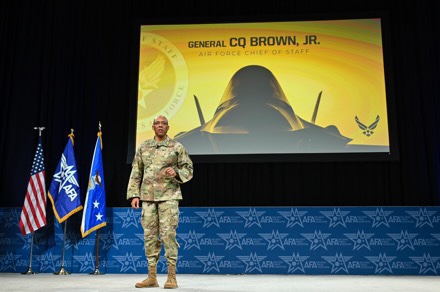
“The vision for how Airmen train and deploy embraces an emerging culture of support maintaining and building readiness across the AFFORGEN phases,” said Air Force Chief of Staff Gen. CQ Brown, Jr. “We must challenge the status quo to prepare our Airmen for operating in environments far more complex than we have in the past.” 
 
Aligned with the Oct. 1 implementation of AFFORGEN, Airmen will begin receiving tailored training spread throughout the 18-month Reset, Prepare and Ready phases of the AFFORGEN cycle. Unit commanders may adjust the number of training events required based on an Airman’s level of preparedness and the deployment phase they are entering. 
 
Previous deployment training, which at a minimum consisted of Basic Airman Readiness and Basic Deployment Readiness, was accomplished as just-in-time training, once notified of a deployment, and consisted of approximately 30 hours of training. 
 
In March, a team of 70 experts gathered in San Antonio for a Ready Airman Training Design Sprint where they identified 12 focus areas, designated as Ready Training Areas, with specific desired learning objectives necessary for Airmen to deploy faster while simultaneously increasing overall expertise. 
 
Ready Training Areas include: Law of War; Survival, Evasion, Resistance and Escape; Small Arms; Integrated Defense; Active Threat Response; Chemical, Biological, Radiological and Nuclear Training; Explosive Ordnance Hazard; Tactical Combat Casualty Care All Service Members Course; Comprehensive Airman Fitness; Cross Cultural Communications; Information Environment Awareness; and Basic Communications. 
 
The Ready Training Area associated training events will be spread over the entire AFFORGEN cycle incrementally over the next two years. The total estimated training hours required over the course of the two-year cycle – four years for Guard and Reserve – depend on whether the Airman is considered inexperienced (40 hours), experienced (24 hours) or staff (15 hours). 
 
“Ready Airman Training serves as the continuum of combat learning for all Airmen while being adaptable to each individual Airman’s experience level and allowing commanders the flexibility to tailor training for specific operating environments,” said Maj. Gen. Albert Miller, Air Force Training and Readiness director. 
 
Cross-functional training requirements and training packages for commanders were developed using validation methods that will present an Airman prepared to execute missions based on emerging operational timelines. Additionally, Ready Airman Training increases flexibility for commanders at all levels to tailor training requirements to their Airmen. 
 
“This is the model and method needed to compete and deter where the adversary’s tactics and techniques have evolved in an effort to match ours,” said Chief Master Sgt. of the Air Force JoAnne S. Bass. “Ready Airman Training is how we, as an Air Force, continue to outpace our strategic competitors and win the high-end fight.” 
 
Specific training objectives for Ready Training Areas are available on the AEF Online and AFFORGEN Connect websites. Major commands are responsible for tracking and reporting readiness annually through myLearning.

Secretary of the Air Force Public Affairs

Win or Die: Air Mobility Command Commander Presents Mobility Manifesto

Saturday, October 8th, 2022

NATIONAL HARBOR, Md. (AFNS) —  

Gen. Mike Minihan, commander of Air Mobility Command, presented his case for the state of air mobility to a packed audience of Airmen at the 2022 Air, Space and Cyber Conference, Sept. 21.

His problem statement was direct, if provocative: the joint force is not as ready as it thinks it is, and the time to act is now.

“Nobody is going to care what our plans are for five to 10 years if we lose tomorrow,” Minihan said. “Our toys, our training, our desires are meaningless unless we maneuver them to unfair advantage and unrepentant lethality.”

During the 40-minute talk, Minihan laid out the role of the mobility air forces in projecting, connecting, maneuvering and sustaining the joint force. He cited both historical and recent examples, including AMC’s role in Operation Allies Refuge, that showed the need to rapidly employ lessons learned and strategically invest in mobility.

In doing so, he highlighted four critical gaps AMC has focused on closing to be ready for a pacing challenge: command and control, navigation, maneuvering under fire, and tempo.

He left no ambiguity about the urgency of the challenge faced.

“If we don’t have our act together, nobody wins,” he said. “They are tailor-making an air force to kill you. Not ‘you’ hypothetically … you. Look in the mirror.”

Similarly, he left no doubt about America’s resolve to face challenges now, even with work still to do.

“We have to make the best of what we have,” Minihan said. “If [my intelligence team] were to walk in my office tomorrow and say ‘[an adversary is] getting ready to go,’ what am I going to do now? I’m going to take roll of who we’ve got, we’re going to take roll of the toys we have, and we’re going.”

He also presented the challenges of geography through the lens of his joint experience in the Pacific, which AMC is preparing for on the road to Exercise Mobility Guardian 2023, set to take place next year within the Indo-Pacific region.

“There’s just too much water and too much distance for anyone else to deliver mobility at pace, at speed, and at scale like we do,” Minihan said. “I’m not interested in being the best Air Force on the planet. I’m interested in being the most lethal force the world has ever known. Mobility Guardian will be the crown jewel where we rehearse the winning scheme of maneuver.”

To get after the problem he presented, Minihan cited the need for a Mobility Manifesto, which he described as a public declaration of intentions, opinions and objectives of mobility as an organization. He argued the document is needed to best position mobility Airmen and their tools to present a scheme of maneuver for the joint force to win.

“Lethality matters most, and I’m coming at you like an Airman,” Minihan said. “This is about us and about our culture – it’s about Airmen. We’ve been here before. You will get zero sympathy from me about having to do big things quickly and about the significant challenges that exist.”

The presentation was a preview of the manifesto document that will be made available to mobility Airmen publicly at the end of October.

Over the last year, AMC has taken a deliberate approach to rapidly prepare for a high-end fight with a pacing challenger. Operations, activities and investments have all been focused on extracting maximum value out of existing capabilities and exploring how the mobility air forces can address gaps across communication, survivability and agility.

“In order to generate the tempo required to win, I’d rather check things out now,” he said. “Victory language comes into sharper contrast – the stakes are incredibly high.”

Minihan had words of advice for the audience: “Generate your courage, point the pointy end at the scary place, and execute.”

He concluded the discussion by putting the challenge ahead in contrast with Air Force Chief of Staff Gen. CQ Brown, Jr.’s readiness charge.

“When he says accelerate change or lose, we say we win or die.”

By Air Mobility Command Public Affairs

Photo by TSgt Zachary Boyer

Air Force Releases the ‘Purple Book’

Thursday, October 6th, 2022

ARLINGTON, Va. (AFNS) —  

The Air Force added another guide, titled The Joint Team, or the “Purple Book,” to its arsenal of foundational documents dedicated to developing Total Force Airmen.

The “Purple Book” educates Airmen on how airpower fits into the Joint Force construct and identifies the joint doctrine, values, capabilities, and warfighting concepts that capture how the Air Force effectively partners with other services to protect America’s interests across the globe.

“Today, we find ourselves in an era of strategic competition against adversaries who seek to outpace and eventually overtake us,” said Chief Master Sgt. of the Air Force JoAnne S. Bass. “Every Airman must know what is at stake and understand the critical importance of synchronizing our capabilities with our joint partners to amplify our collective strength and power.”

The new book provides a baseline for understanding the value each service contributes to the Joint Force and outlines the essential framework to work with other branches to compete, deter, and win the high-end fight.

The new “Purple Book” explains all service members are part of a Profession of Arms. This holds them to a strong set of Joint Core Values and supports a foundational strategy to defeat any threat, anytime and anywhere.

Additionally, it clarifies the fundamental questions all Airmen must answer: “How do I fit into the Joint Force;” and “How can I ensure I hone and deliver my unique capabilities to assure its success?” This guide helps Airmen internalize what it means to fight jointly, understand the missions of the joint force, appreciate the joint organizations that are leading the fight, comprehend how to integrate into a joint warfighting environment, and identify how the Air Force fits into the joint construct.

“Airmen of tomorrow will be required to collaborate and communicate with our joint teammates to win in future complex and contested environments,” said Air Force Chief of Staff Gen. CQ Brown, Jr. “We owe our Airmen a solid foundation on jointness much earlier in their careers.”

Developing and updating these guides was part of the 28 Enlisted Force Development Action Plan objectives focused on developing the future enlisted force. The new “Purple Book” can be found here. The revised “Brown Book” can be found here. The revised “Blue Book” can be found here.

Secretary of the Air Force Public Affairs

“Truly an honor.”: SOST Member Recognized as Air Force OAY

Friday, September 23rd, 2022

HURLBURT FIELD, Fla. —  

U.S. Air Force Master Sgt. Brandon Blake, a special operations surgical team member assigned to the 24th Special Operations Wing, is set to be recognized as one of the Air Force’s 12 Outstanding Airmen of the Year at the 2022 Air, Space & Cyber Conference Sep. 19-21.

Blake and 35 fellow airmen were considered by an Air Force selection board for the department-wide award. Enlisted members are chosen based on superior leadership, job performance and personal achievements.

Blake is the Superintendent, Special Operations Surgical Team Detachment One, 720th Operations Squadron assigned to the 24th Special Operations Wing, Hurlburt Field, Florida.

Last summer, Blake was a catalyst in the evacuation of over 124,000 evacuees in support of Operation ALLIES REFUGE. He drove a six-member team supporting thousands of military and civilian personnel, treating over 70 wounded individuals and assisting seven surgeries.

“I couldn’t have asked for a stronger team sergeant than MSgt Blake. His experience and leadership in stressful, highly dynamic environments was crucial to our team’s success while deployed to Afghanistan,” said U.S. Air Force Major Jesse Payne, deployment team lead and Medical Operations flight commander for the SOST Detachment 1.

The efforts of Blake and his team earned praise from then 82nd Airborne Division commander Maj. Gen. Christopher Donahue and Commandant of the United States Marine Corps, General David H. Berger.

Additionally, Blake tackled the COVID-19 front lines at the University of Alabama Birmingham, a Level 1 trauma center, providing 768 acute service hours and aiding treatment for 156 severely injured patients.

“His ability to integrate with the civilian trauma system to see high acuity patients at UAB highlights the value of the Air Force partnership with the university,” said U.S. Air Force Lt. Col. Marc Northern, Blake’s former supervisor.

“He demonstrates his commitment to his unit, to his patients and to the mission every day. MSgt Blake upholds the highest level of compassion, clinical judgement, skill, and composure under pressure,” added Northern.

His leadership proved vital in his role as detachment superintendent, managing 25 members, four teams and four flights on top on a 1.5-million-dollar inventory.

His active roles, on top of countless trainings, exercises, and crisis response situations led to dozens of lives saved and exceptional operational readiness for the detachment.

Simultaneously, Blake earned a degree in Public Health and Healthcare Administration and spent free time with local animal rescue along with toy and food drives supporting low-income populations.

“To be recognized as OAY for Air Force Special Operations Command is truly an honor, and I am grateful for the opportunity,” said Blake. “I stand on the shoulders of giants, and I couldn’t have done any of this without my team.”

AGR Program Changes on the Horizon

Wednesday, September 14th, 2022

ROBINS AIR FORCE BASE, Ga. (AFNS) —  

In line with Lt. Gen. John Healy’s strategic priorities of “Ready Now!” and “Transforming for the Future,” Air Force Reserve Command is instituting changes to the Active Guard and Reserve program effective Oct. 1.

On that day, roughly 6,000 AGR positions will complete the transition to “term” and have initial tour determination and extension approval authority at the wing commander level. Career status will be granted at six cumulative years of service in the AGR program.

“The AGR program will continue to provide promotion, career progression, retention, education and professional development opportunities for Reserve Citizen Airmen,” said Healy, chief of the Air Force Reserve and commander of AFRC. “Taking care of our Airmen will remain our priority during the transition as commanders ensure they have the critical AGR positions filled to be combat ready to meet operational demands in the future.”

As always, the program may lead to Airmen earning an active-duty retirement after attaining the required years of total active federal military service.

Career AGRs who wish to remain in the AGR program will continue to adhere to existing guidance and will accept permanent change of station, permanent change of assignment, training, developmental education and force development opportunities in accordance with Air Force Manual 36-2114, section 6.6.

AGR term positions were successfully introduced in 2019, and provide more agility in recruiting, retaining and managing AGR talent. After three years of implementation and review, AFR leadership is instituting changes to the AGR program. The transformation is part of AFRC’s mission and compliance with Healy’s task order “to ensure units are mission ready and properly resourced.”

Wing commanders, or their equivalent, will have tour length determination and extension approval authority. In the past, initial term tours were fixed at three years, with an extension up to five years requiring Deputy Commander, Air Force Reserve Command (AFRC/CD) or Deputy to the Chief, Air Force Reserve (AF/RE-D) approval. Now, advertisements for initial tour lengths – two, three, four or five years – will be determined by wing commanders and above. Tour extensions may not exceed a total tour length of five years.

The second change will remove the AGR career status option from the AGR continuation decision process. AGR members will be granted career status after completion of six cumulative years in the AGR program, in accordance with Department of Defense Instruction 1205.18, section 6.6.

Over the next month, communication will be provided through virtual town hall meetings, Facebook Live events, email and MyPers messages, and updates to command social media sites regarding the AGR changes.

For additional information, elevate any questions through your Numbered Air Force A1 staff or Headquarters Commander Support Staff.

Air Force Reserve Command Public Affairs

Blast From The Past – Don’t Confuse Enthusiasm With Capability

Saturday, September 10th, 2022

I can’t remember why I wrote this in 2016, but it’s still true today. Maybe more so, as organizations are tested by social pressures. Keep the faith my brothers and sisters. This too shall pass.

There’s a old adage in Special Operations, “Don’t confuse enthusiasm with capability.” I heard it used a lot over the years and was told it stemmed from the ill-fated Operation Eagle Claw, where an ad-hoc task force made up of different service capabilities was created to attempt the rescue of American hostages held by Iran. Truth be told, it’s probably even older than that. The point is, you can call yourself special all day, but that doesn’t mean that you are. With the Iran mission, everyone wanted a piece of the pie whether they were ready or not and the mission failed. Although the lessons learned from that mission led to the eventual creation of USSOCOM, don’t think this idea is solely the purview of SOF. It doesn’t matter what you do, or where you fit in the food chain, it’s  applicable to everyone.



In more recent times, there were many new organizations stood up within DoD after 9/11. They were specialized in nature but not necassarily in capability. In each case, they were weighed and measured by the war. Some matured, others disappeared. The concept of enthusiasm being tempered by capability is an inescapable crucible.


Generally, SSD readers are a cut above. They care about their profession, or interest, and choose the best equipment. Others go a step further and seek out training to improve their capabilities. That is the sign of a true professional. However, such positive traits are not going to be true of everyone in an organization. We are truly as weak our weakest link and we all know someone who is all show and no go. Do not let them define you or your unit and don’t make promises you can’t deliver on.

Everything we do isn’t awesome. Accept criticism and reflect on it. That’s a trait of maturity. If you’re thin skinned, you’ve likely got maturity issues and aren’t very good at what you do. As an aside, don’t take criticisms of your profession in general, or of others in your profession personally. Every profession has plenty of room to improve. However, do deliver constructive criticism to your peers. Use it to grow professionally and personally and encourage others to do so as well. Make things better.

There is a current notion that everyone is a winner and gets a trophy. We must stop this concept from poisoning the profession of arms. Not everyone is going to be an Operator and we don’t need them to be. Figure out what it is you are supposed to do, and be awesome at it, both individually and collectively.

This isn’t meant as discouragement. To the contrary; love what you do. Create enthusiastic capability and make sure that you can deliver on demand, no matter the job. Help others rise to the same level.

CCAF Electronic Transcripts Now Available, Faster Delivery Time

Monday, August 22nd, 2022

MAXWELL AIR FORCE BASE, Ala. —  

Community College of the Air Force students can now order their transcripts electronically and have them processed within a week instead of what usually took up to 45 days.

CCAF has partnered with Parchment, a digital credentialing service, to deliver transcripts electronically. 

To request their transcript, students register for an account with Parchment and add CCAF to their list of schools attended. They then order a copy of their transcript to send to the address of their choice: school, third party or home address. The transcript orders come into the CCAF Student Services section, where technicians will retrieve, verify and process the requests.

Parchment then processes the transcripts for delivery. Although CCAF does not charge a fee for providing student transcripts, Parchment does charge a small processing fee. The transcript request is usually processed within two to three days.

“We’re excited to offer this service to our students,” said Lt. Col. Kevin Pond, commandant, CCAF. “We’re always looking for new and innovative ways to streamline our processes while increasing customer satisfaction. I believe our new automated transcripts process does just that.”

To be the “College of Choice” for enlisted members, and to assist them in paving a way to success, CCAF continues to seek better ways through technology to improve its services. The electronic transcript request and delivery service through Parchment is but one example of current and upcoming improvements to the student experience at CCAF.

By Benny Seawright, CCAF Media and Outreach