SIG SAUER - Never Settle

Archive for the ‘Robotics’ Category

Air Force Installation Contracting Center Acquisitions Bolster EOD Readiness for FY21, Beyond

Tuesday, October 26th, 2021

TYNDALL AIR FORCE BASE, Fla. (AFNS) —


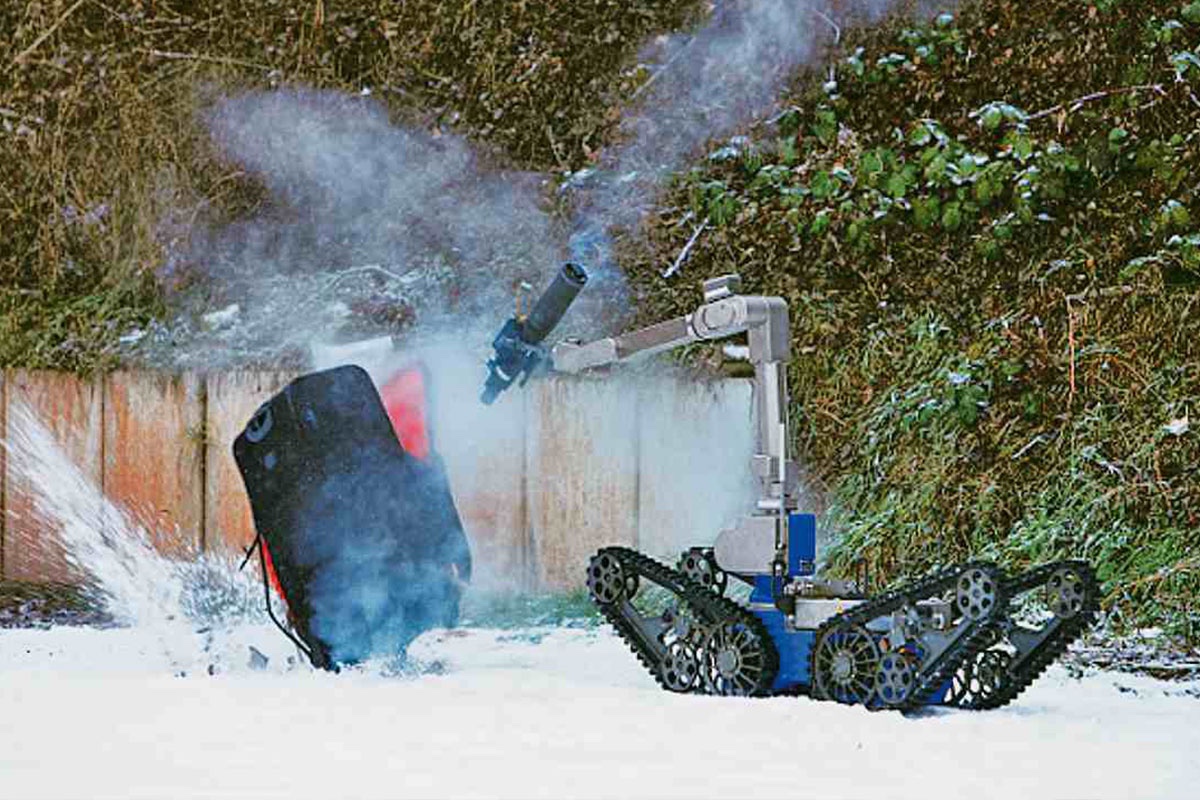
EOD robot upgrade The Air Force Installation and Mission Support Center is acquiring new base support robots for Explosive Ordnance Disposal flights Department of the Air Force-wide. The new T7 Robotic system replaces the 20-year-old Andros F6A. (U.S. Air Force graphic by Greg Hand)

The success of implementing new explosive ordnance disposal technology in fiscal year 2021 has the Air Force Civil Engineer Center looking forward to FY22.

“Our Airmen conduct high-risk operations in support of the mission, and we ensure they have the tools and resources they need to perform their jobs safely, efficiently and effectively,” said Col. John Tryon, AFCEC Detachment 1 commander. “It’s our duty to identify civil engineering needs and advance Air Force capabilities through research, development, test and evaluation, and we take that very seriously.”

AFCEC’s Readiness Directorate partnered with the Air Force Installation Contracting Center to use more than $41 million for new EOD equipment, such as a new base support robot to clear unexploded ordnance from airfields, during the past year.

In July, the AFICC awarded an $85 million, 10-year, indefinite-delivery, indefinite-quantity contract for the T7 Robot System to replace the Andros F6A robot, which has been used by the Air Force for two decades. The T7 offers a suite of new and enhanced capabilities, including a more modular design that allows users to repair it by swapping subassemblies rather than individual parts — an issue that plagued the previous robot.

“This system will move robotics forward 20 years,” said Dennis Carson, EOD robot product manager. “It enhances warfighter readiness with its ability to resolve hazardous threats and missions remotely, allowing Airmen freedom of movement at any location.”

AFCEC will begin distributing the first of the T7s in May 2022 — 56 of the 170 inventory objective of T7s were funded at contract award. The remaining requirement will be purchased this fiscal year.

The T7 is the second of two new robotic systems AFCEC is upgrading for the EOD career field. A year ago, the directorate delivered the first of the Man Transportable Robot System Increment II to the 325th Civil Engineer and the 823rd Rapid Engineer Deployable Heavy Operational Repair Squadrons.

To date, the readiness directorate has distributed 129 MTRS IIs and provided system training to 49 EOD flights. The directorate expects to distribute the remaining 202 systems by January 2023.

The second wave of new technology deliveries took place in July when the AFCEC team debuted the Vidisco Guardian 12 Digital Radiographic X-ray system, a $27 million procurement package, at Eglin AFB, Florida, and Hill AFB, Utah.

“This new system is essentially everything old wrapped into a new package with the addition of digital technology enhancements,” said Dave Hodgson, EOD logistics lead for AFCEC. “Compared to the previous analog models, this new system gives Airmen clear and concise images, which reduces the amount of time they have to spend analyzing the images.” 

To date, the AFCEC team has distributed 36 X-ray systems, with the remaining 15 base support systems to be distributed in 2022 and mobility configurations through 2026.

Just as FY21 came to a close, AFICC awarded a $24 million contract for the Large Clearance Blade Assembly, or L-CBA. Attached to armored front-end loaders, the equipment is used for rapid clearance of unexploded ordnance from airfield surfaces after an attack.

Because it’s mounted to an armored front-end loader, the paired capability will dramatically reduce clearance times, Hodgson said.

AFCEC plans to begin blade deliveries to bases in the European and Pacific theaters and some training sites in mid-October. Full fielding will run through 2026. The contract enables the Air Force to obtain more than 70 large blades needed to support the Rapid Mass Mechanical Clearance program over the next several years.

The directorate also executed a Life Cycle Sustainment order for bomb suits. The suits are designed to protect EOD personnel responding to scenarios with potential explosives. The $2.2 million annual acquisition provides 76 suits to replace one-seventh of the current inventory.

“When EOD technicians have to make that long walk down range to manually perform procedures, this suit — the EOD 10E — provides the best possible protection if an explosion occurs,” Hodgson said.

Rounding out FY21 EOD funding executions, AFCEC’s EOD modernization program is seeing its work pay off as the Air Force prepares to take the next steps in bringing the Recovery of Airbases Denied By Ordnance, or RADBO, system to the Air Force EOD suite of tools.


EOD robot upgrade The Air Force Installation and Mission Support Center recently contracted for the delivery of new explosive ordnance disposal base support robots for the Department of the Air Force enterprise. This chart shows a comparison of the 20-year-old Andros F6A to the new T7 Robot System. (U.S. Air Force graphic by Greg Hand)

AFCEC funded a $3.9 million effort in FY21 to convert the state-of-the-art ground-based laser prototypes to the final production configuration. The system will be delivered to Nellis AFB, Nevada, in December to support career field training as well as tactics, techniques and procedures incorporating the RADBO system, L-CBA, the prototype design completion on the Small Clearance Blade Assembly and an unmanned system application for Rapid Explosive Hazard Mitigation and Rapid Airfield Damage Repair vehicles.

By David Ford, Air Force Installation and Mission Support Center Public Affairs

SOFWERX – USSOCOM Autonomous Interoperability Standards Development Event

Saturday, October 23rd, 2021

SOFWERX, in collaboration with USSOCOM’s Directorate of Science and Technology (S&T) and Naval Special Warfare (NSW), will host the Autonomous Interoperability Standards Development Event, 07-09 December, 2021. In the Human Machine Teaming Aspects of Mission command, the objective is to bring together Special Operations Forces (SOF) representatives and Subject Matter Experts (SMEs) to assist USSOCOM in discerning the future of Autonomous Interoperability for Unmanned Air, Ground, Surface, and Underwater Systems (UxS). Focus areas will include but are not limited to sensors, communications, and platforms.

NSW has developed a vision for the future whose key elements include next generation UxS and autonomy solutions, and interoperable maritime and air assets. To do this effectively, NSW needs interoperability standards for the heterogeneous UxS platforms that they will use now and in the future. USSOCOM thus needs to develop and implement a set of interoperability standards that are not cumbersome, that are flexible, and that will support new technologies. They will also need to provide enough freedom for companies to use their creative approaches but with well-defined interfaces, messaging, communications, navigation, and control systems. Further, the backing of NSW and USSOCOM should provide an incentive for commercial players to rally around the new standards. This effort will support agility, wider government and commercial participation and ensure cost-effective development.

This event is restricted to U.S Citizens Only.

Submit NLT 29 October 11:59 PM ET, details at events.sofwerx.org/interoperability.

MCSC Begins Fielding Amphibious Robot System for Littoral Missions

Friday, October 22nd, 2021

MARINE CORPS BASE QUANTICO, Va. —

In September, Marine Corps Systems Command began fielding an amphibious, unmanned robot system to support littoral operations globally.

The Explosive Ordnance Disposal Remotely Operated Vehicle is a next-generation, box-shaped robot that enables Marines to navigate safely and efficiently in shallow waters to identify and neutralize explosive hazards and other threats.

“This robot gives Marines eyes in the water,” said Master Sgt. Patrick Hilty, an Explosive Ordnance Disposal project officer at MCSC. “It is a capability the Marine Corps has never before had.”

The ROV employs sound navigation and ranging sensors, a high-definition video capability and cameras that provide real-time feedback for EOD divers. It includes an articulator arm that helps Marines maneuver through underwater foliage or neutralize explosive threats.

“It is a system that saves Marine divers from having to swim hundreds of meters, an activity that can tire them out,” said Hilty.

Marines can use the robot for various amphibious missions. For example, they can leverage the ROV to search harbors before docking a Marine Expeditionary Unit ship. Operators can use it for activities in very shallow waters, conducting littoral lost object searches, damage assessments and mine countermeasure missions.

Hilty applauded the ROV’s tether feature, which keeps EOD technicians at a safe distance from explosive hazards. Before the capability, Marine divers could only disrupt or dispose underwater explosive threats by swimming in close proximity, exposing them to hostile elements.

“The ROV gives us a remote means to search underwater while also helping us stay at our best when having to prosecute explosive devices,” said Hilty.

Master Sgt. Matthew Jackson, a staff non-commissioned officer in charge of 1st EOD Company’s Littoral Explosive Ordnance Neutralization section, said the ROV is highly stable in an underwater environment. He noted how the machine requires minimal equipment and reduces the Marine Corps’ overall footprint during operations.

“This intuitive system has the ability to complete critical underwater tasks much deeper than manned missions can,” said Jackson. “The ROV will serve as an important capability to support our tasks.”

Jackson also praised the system for its ease of use. He said it requires minimal training when compared with other unmanned underwater systems. This ultimately saves the Marine Corps time and money required for training.

“Instead of sending a Marine to a course for seven or eight weeks, it takes about four days to learn basic operations for successful employment,” said Jackson.

The ROV also supports naval integration. In 2019, the Navy acquired this commercial off-the-shelf capability. The service conducted a series of tests to determine its viability for EOD missions. These tests included reliability and maintenance evaluations to test its effectiveness and ease of employment during simulated activities.

“Testing conducted by the Navy allowed us to field this capability to Marines more quickly,” said Hilty. “Additionally, the Marine Corps and Navy both having this system increases interoperability among the services.”

The robot is the first increment in the Littoral Explosive Ordnance Neutralization Family of Systems. This series of robotic capabilities will allow Marines to search a wider area in the littorals, including the very shallow water, surf and beach zones.

This robot gives Marines eyes in the water.

– Master Sgt. Patrick Hilty, an Explosive Ordnance Disposal project officer at Marine Corps Systems Command

LEON systems, to be fielded gradually by MCSC over the next several years, will also help the Marine Corps complement Navy EOD teams in joint operations as it strives to evolve naval force integration in the future.

“Having this capability aids in naval force integration by giving us the same equipment that the Navy is using,” said Staff Sgt. Seth Barnes, EOD Technician with 1st EOD Company. “It allows us to bolt on with Navy EOD as we move forward.”

Achieving Force Design 2030 remains an ongoing, concerted effort for the Marine Corps, as repeatedly stated by Commandant of the Marine Corps Gen. David Berger. This goal requires the acquisition of next-generation, unmanned systems, like the ROV, to support Expeditionary Advanced Base Operations.

“We’re bringing the EABO concept to the modern day,” said Ronald Diefenbach, a program analyst on the Explosive Hazard Team at MCSC. “Adhering to this concept, we can use the ROV to support Marines when operating from the littorals and while conducting island-hopping tasks.”

Hilty said the Marine Corps has never before leveraged waters for missions. In the past, Marines would begin operations from land, typically a beach. This new concept requires a shift in the paradigm in how the Marine Corps operates.

Fielding capabilities that conform to the vision to support an evolving naval fight will ultimately support the present and future Marine.

“We’ve always done this piece via the Navy,” said Hilty. “Now that the Marine Corps is doing it, we are learning valuable skillsets, becoming much better-rounded and proving to be a bigger asset to the MAGTF.”

Story by Matt Gonzales, MCSC Office of Public Affairs and Communication

Photos by LCpl Kristy Ordonez Maldonado

Tomahawk Robotics Receives Award from Department of Defense to Strengthen the Domestic Small UAS Industrial Base

Wednesday, October 20th, 2021

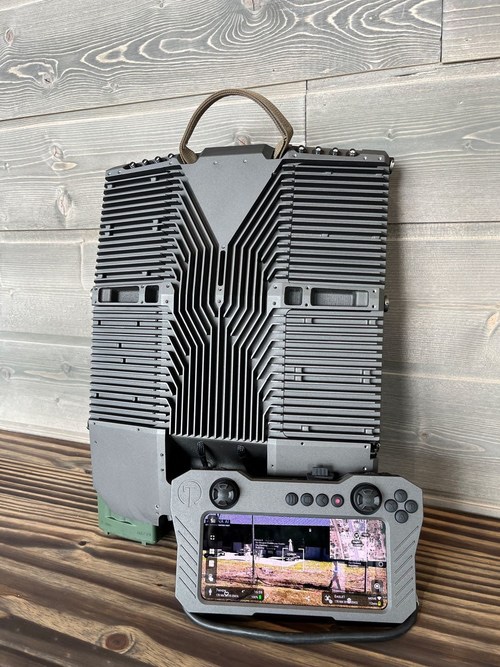
MELBOURNE, Fla., Oct. 19, 2021 // — Tomahawk Robotics, the leading innovator of common control solutions, is pleased to announce their Grip & Mimic controllers have received an award from the DoD for the Defense Production Act, Title III Program.

This award is part of the United States’ effort to expand domestic industrial base capabilities that are critical to the Department and the American Warfighter. The funding will be applied towards Tomahawk Robotics’ on-going prototyping effort with the Defense Innovation Unit (DIU) for the Soldier Robotic Controller Program (SRoC).

“We’re excited to work with DIU, an organization that values and recognizes the speed of technological change,” said Tomahawk Robotics’ CTO, Matt Summer.

Tomahawk Robotics is among 7 companies receiving this award on behalf of the DoD.

“This investment in the defense industrial base is intended to provide critical battlefield capabilities across the spectrum of conflict, including on-demand reconnaissance which augments service members’ capabilities and increases their survivability, lethality, and mission flexibility,” said Deputy Assistant Secretary of Defense for Industrial Policy Jesse Salazar.

AUSA 21 – Ghost Robotics x SWORD Defense Systems

Wednesday, October 13th, 2021

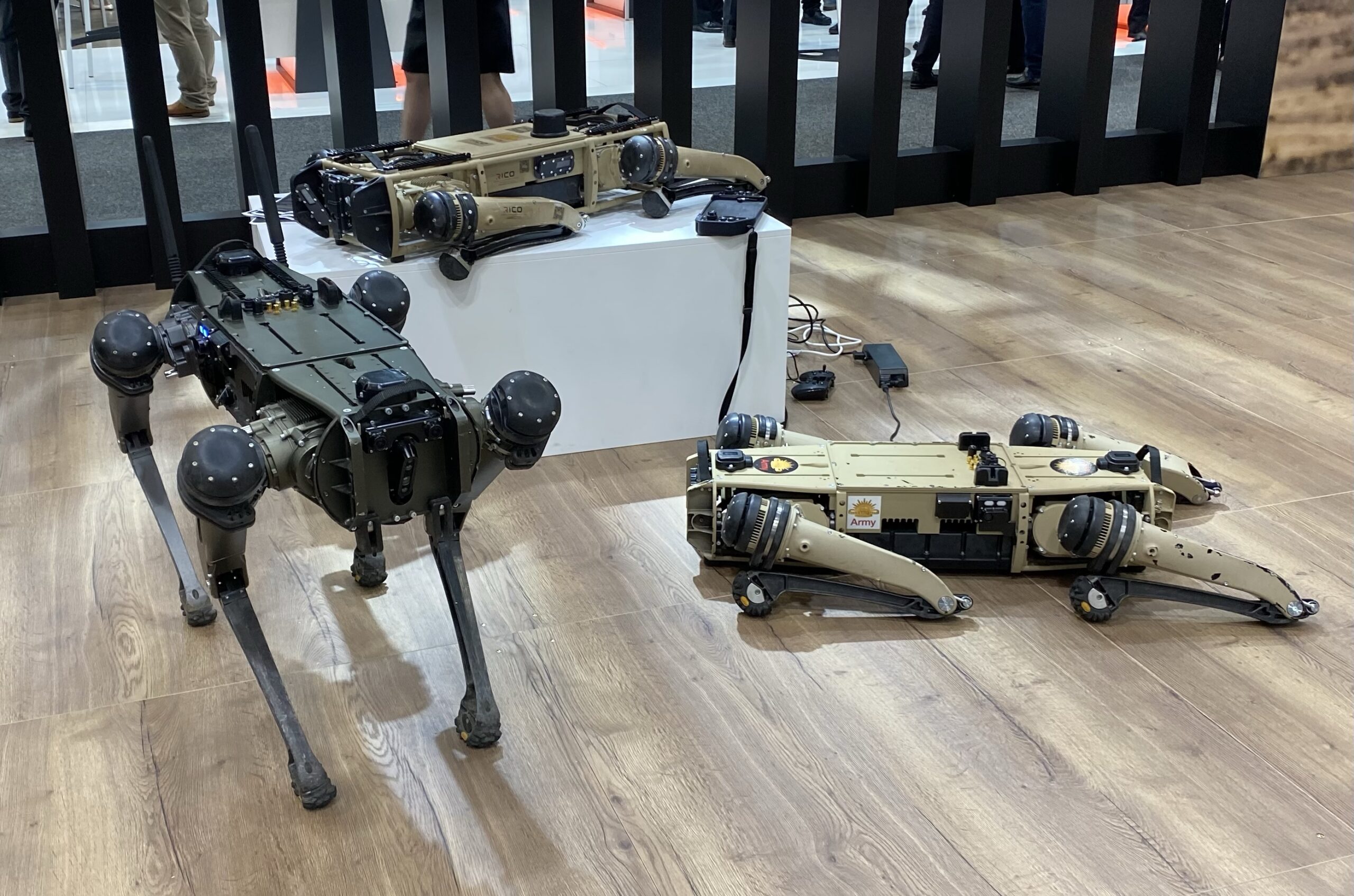
Ghost Robotics showed off the capabilities of their quadrupedal unmanned ground vehicles.

While most of the payloads are ISR related, one really stood out. The Special Purpose Unmanned Rifle (SPUR) is a 6.5 CM rifle package from SWORD Defense Systems designed specifically for use with the Vision-60 quadruped.

Remotely operated, it incorporates a sight and features safe, chamber, clear, and fire capabilities that allows for safe and reliable deployment of the weapon system, the operator can load and safe the weapon at a distance. These features also provide the operator the ability to clear malfunctions, and safely unload the platform prior to recovery.

The suppressor is the CGS Group Hyperion K.

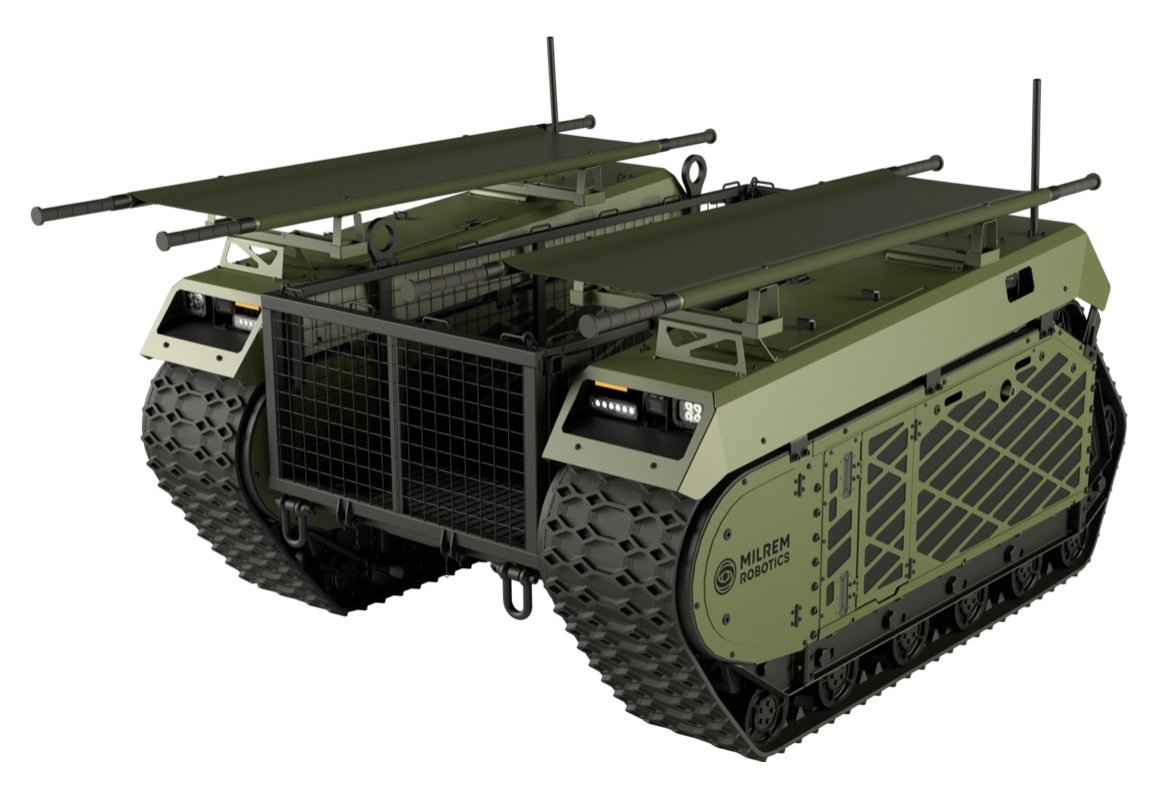
Otokar & Milrem Robotics Teaming To Develop Unmanned and Robotic Systems

Saturday, October 2nd, 2021

Otokar and Milrem Robotics signed a teaming agreement to explore opportunities for unmanned and remote-controlled ground vehicles.

Turkey’s land systems manufacturer Otokar and the European leading robotics and autonomous systems developer Milrem Robotics signed a teaming agreement during the DSEI 2021 exhibition in London to merge know-how and resources for autonomy development and application for unmanned and robotic operations of military vehicles.

Otokar’s and Milrem Robotics’ cooperation will entail working with the existing fleet of vehicles of both companies and introducing new systems by developing intelligent functions, encryption, and safety features as well as environmental awareness and hybridization.

“We anticipate that the future battlefield will consist of a mix of unmanned and manned assets which are seamlessly connected into a well-functioning integrated system,” said Kuldar Väärsi, CEO of Milrem Robotics. “Combining the know-how and expertise of Milrem Robotics, the leading technology provider and systems house for not only autonomous and robotic systems, but also for optionally manned ground systems and Otokar, a strong and innovative land systems provider, will allow us to deliver our customers new capabilities in the land systems segment,” Väärsi added.

Regarding the agreement Otokar General Manager Serdar Görgüç said: “As the pioneer land systems company of Turkey, Otokar continues to introduce innovative solutions in land systems by taking into account the current and future requirements of modern armies and security forces. We consider the different needs and expectations of our users and provide customer-oriented solutions. In this context we are delighted to announce our cooperation with Milrem Robotics. I’m confident the combination of Otokar’s combat proven know-how and unique R&D, engineering and testing capabilities in armored vehicles and the Milrem Robotics’ expertise and know-how in autonomy, artificial intelligence and remote control will lead to significant developments in unmanned and remote-controlled land systems. This collaboration will enable us to go one step further to generate Otokar’s line of unmanned ground vehicles (UGV) in addition to our existing product range.”




DSEi 21 – Aimlock RS1

Tuesday, September 14th, 2021

The Aimlock RS1 is a weapon stabilization system which can be mounted to UAS like this Alta Drone. It will accept weapons up into the .30 range and the mechanism mitigates recoil as well as facilitating aiming and remote firing. They also offer an autonomous fire control solution.

The RS1 is a miniaturized version of the RM1 seen below which will accept crew-served weapons like the M240 but all the way up to the new .338 NM guns. It can be mounted on small vehicles like the MRZR or used on a tripod in overwatch.

Aimlock systems are available in the UK from Edgar Brothers PMD.

The Aardvark Group Unveils RANG-R at DSEI

Tuesday, September 14th, 2021

The RANG-R (Remote Autonomous Next Generation-Rover) is Aardvark’s next generation, class leading, multi-role, autonomous Unmanned Ground Vehicle (UGV) developed through a collaboration with some of the leading minds in the fields of Autonomous vehicles, Artificial Intelligence, Sensor Technology, and the Human Machine Interface to extend critical missions whilst massively reducing the human burden.

Key capabilities:

• Can be deployed on logistics support, C-EO / C-IED, humanitarian and conservation

missions.

• Payload capacity of 3,850Kg (2 x NATO pallets).

• Autonomous load and off load capability.

• Maximum speed of 70 kph.

• Range of 100 km and 72 hr run time without resupply.

RANG-R will be deployed in Defence, Policing, Security and Search & Rescue environs with an advanced toolkit adaptable to match a vast scope of operational requirements and was borne out of our clients informing us that their operations were becoming more remote, more complex, harder to supply and in vastly more hazardous environments. These factors have resulted in the need to carry high levels of capability, equipment, and supplies to maintain the welfare of operators, potentially at the cost of task effectiveness and ultimately increasing the physical burden on the team.

By working with operators around the globe, Aardvark has created an advanced technological solution to these client needs by developing a UGV that can provide crucial support to the front line, reduce the logistical burden of resupply, whilst delivering security and supporting the sustainment of effort on the task. RANG-R can be fitted with a range of tools designed to mitigate a wide variety of threats whilst integrating with other advanced technologies to provide enhanced situational awareness.

The Aardvark Group’s CEO, David St John-Claire said:

“Our clients required a multi-role UGV solution that embodied the Aardvark ethos of reliability, survivability and affordability and I truly believe that the RANG-R delivers fully against that requirement.

“I am incredibly proud of the Aardvark family of colleagues and strategic partners who have worked tirelessly during the pandemic to deliver RANG-R to market.”

www.aardvark.group