GORE-TEX Professional

Archive for the ‘Sensors’ Category

Datron Scout

Saturday, August 27th, 2011

If you’re at the Soldier Equipment & Technology Expo & Conference next week at Fort Bragg be sure to stop by Datron’s booth and take a look at the Scout Air Reconnaissance System. The Scout is a lightweight vertical take off and landing unmanned air system. It features hot-swappable payloads and missions profiles that include beyond line of sight or nighttime routes due to its GPS-based controls.

www.dtwc.com

OASYS Technology

Monday, May 23rd, 2011

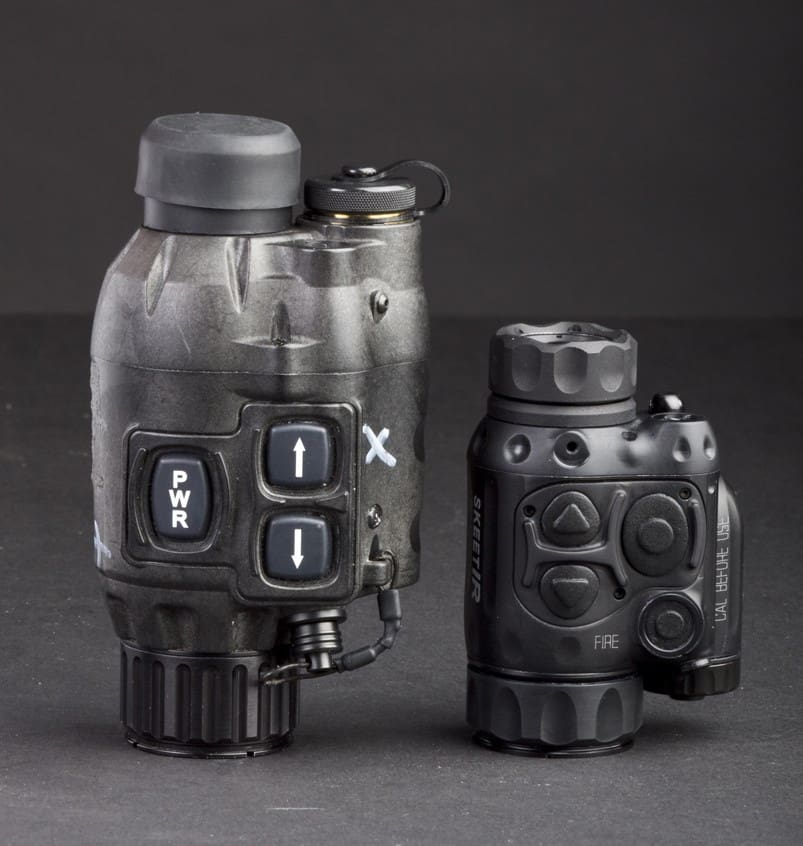
Late last summer we mentioned that BAE Systems had acquired OASYS (OPTICAL ASSEMBLIES AND SYSTEMS) Technology. What we didn’t do is tell you the nuts and bolts of what OASYS actually does. They specialize in Electro-Optics and just happen to make, what are in our opinion, the hottest IR systems out there. In fact, you may already be using an OASYS product and not even realize it. JIEDDO has fielded thousands of Universal Thermal Monoculars (UTM) (and most recently SkeetIRs) through SPAWAR to troops in OEF and OIF to help look for IEDs. The UTM is also known as the StalkIR and can be mounted on weapons as well as used as a handheld device. It features dual band lasers and a modular chassis that can accommodate new technologies as they become available as well as allowing the device to be easily configured at the factory.
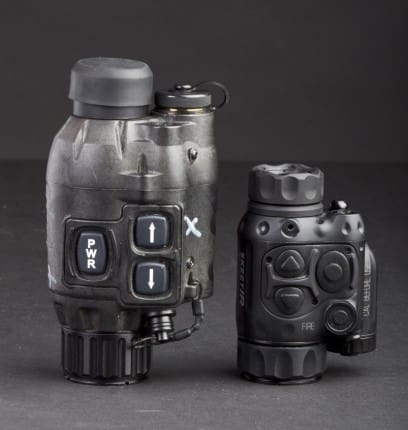
The most important factor in all of their designs is that they are custom products built to the client’s specifications. These uncooled LWIR sights can be turned on and put into action in less than four seconds and are controlled by a combination of hot buttons and an intuitive menu. Calibration is quickly accomplished when needed.
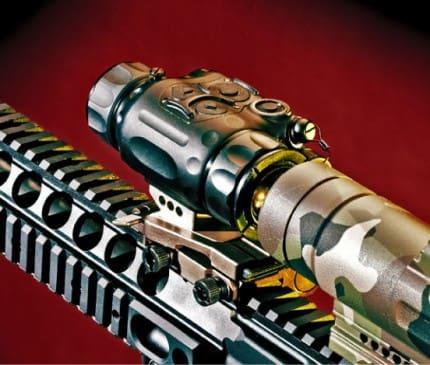
The SkeetIR is even more compact and lightweight that the StalkIR weighing in at a scant 6.5 oz with a CR123A battery. With a 320 x 240 detector and a display boasting 640 x 480 it also features selectable reticles and variable zoom. Additionally, there are three display options, white hot, black hot, or outline mode.

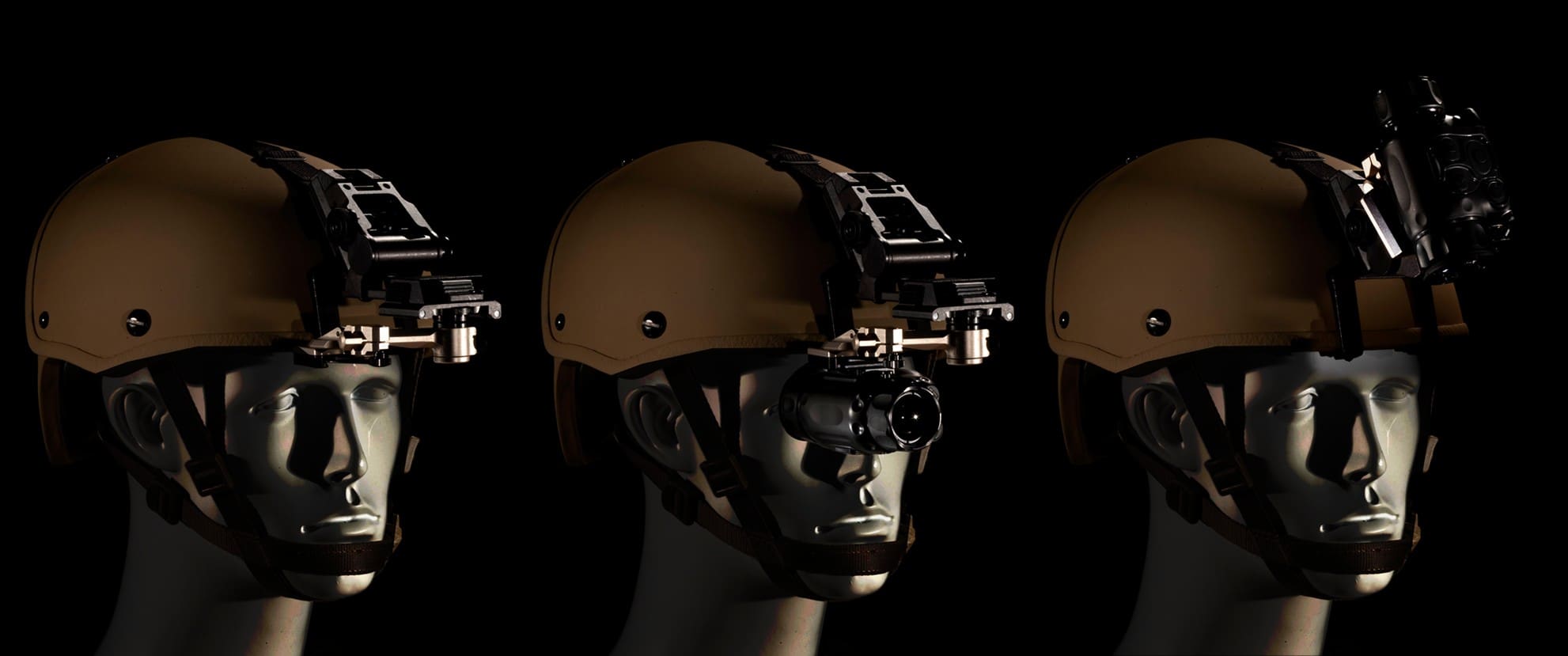
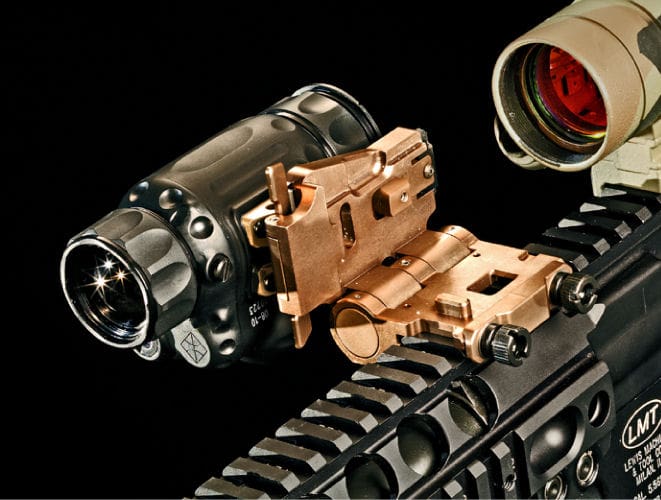
Due to several mounting options utilizing a mounting shoe, the sights are extremely versatile and can be rapidly transitioned from the handheld mode, mounted to a weapon as a stand alone sight or as a clone sight, and can be headborne alone or integrated with a legacy NVG utilizing a COTI (Clip-On Thermal Imager) module to turn it into a NV/IR fusion sight. In this mode, the SkeetIR is set in outline mode and overlays this information directly on to to the night vision scene in real time. This helps define shape and definition to what might appear as blobs under NV alone. All of this is possible as the signal is digital and can be accessed via a data port on the back of the device which is common to both SkeetIR as well as StalkIR. Not only can the IR signal be combined with NV data but it can also be sent via radio protocol just as any other signal. This port also allows the sight to be reprogrammed. Additionally, the SkeetIR’s reticle is smart and will shift from black to white based on the conditions displayed in the view.
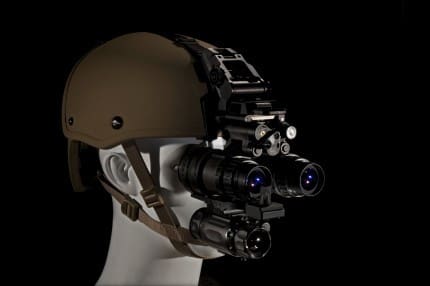
The SkeetIR comes standard with a red laser pointer. Green lasers can be integrated into the larger UTM design but users have found that they use power too quickly. Additionally, units have been delivered with LEDs of various colors for standard illumination. When the device is used as an applique on a night vision system to form a fusion goggle you can look at a target and simultaneously point a laser at it. The laser can be programmed to a variety of patterns. Additionally, as the sight integrates a three axis Digital Magnetic Compass you can determine a target’s azimuth by degree or mil. These features make the technology a great candidate for integration with other digitization efforts.
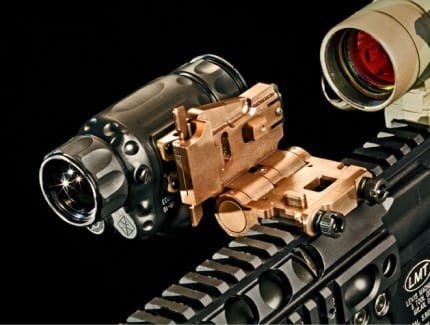
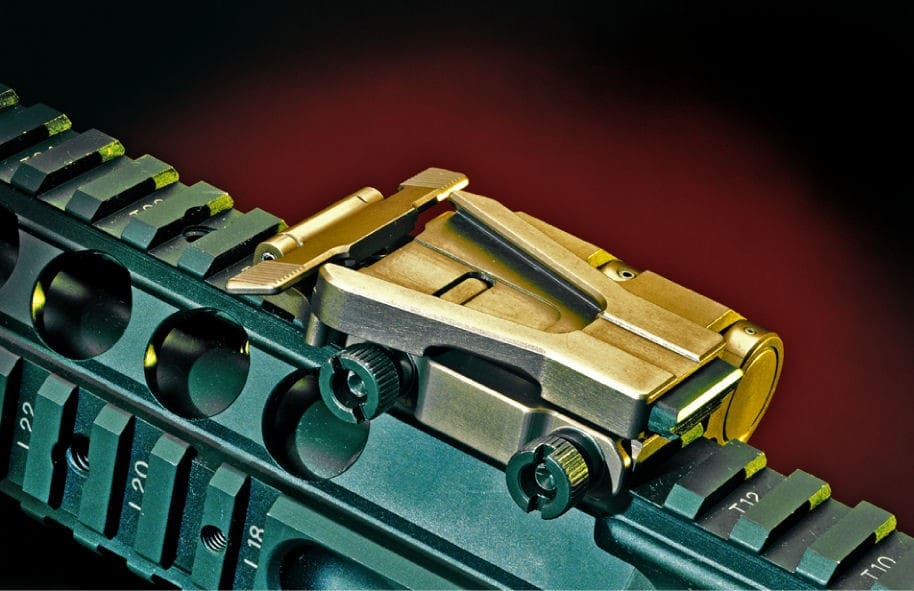
The weapon mount accepts either OASYS sight and allows them to be quickly flipped out of the way when not needed. Additionally, the SkeetIR is easily cloned to the zero of your existing optic. Both IR devices are extremely robust and can handle the shock and vibration associated with being mounted on heavy weapons.
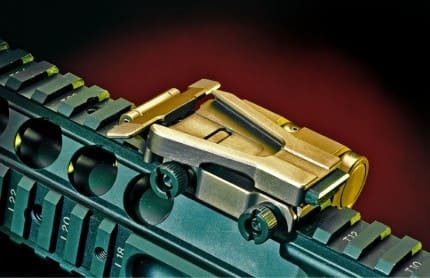
OASYS uses the same remote as Insight for laser activation so the UTM is backwards compatible with the PEQ-2A, PEQ-15, PEQ-16, PSQ-18, and M3X/M6X weaponlights. There is no need to purchase additional new accessories and if a cable is lost or damaged it is easily replaced from existing spares. Finally, to conserve power, the SkeetIR utilizes a Hall Effect Sensor to go into standby mode and eventually shut down when disconnected from its mount.

Look for more articles on OASYS Technology soon here at SSD.

The entire line is available through Stryke Logistical Group LLC.

www.oasys-technology.com

Note: This is an ITAR restricted item.

SIMEG from Digital Force Technologies

Wednesday, March 23rd, 2011

For those of you who are “new” readers, as in having begun reading since we ran this article in June of 2008, we thought you might be interested in a great piece of kit that has been upgraded a couple of times since we published this. They have been providing capabilities for years that other companies are just now beginning to offer. DFT has our highest recommendation for small unit ISR capabilities.


DFT SIMEG

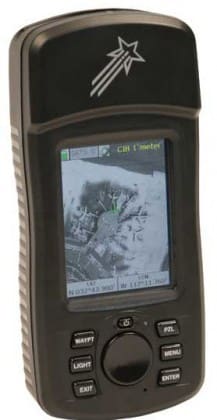
Satellite Imagery Enhanced GPS (SIMEG) Receiver is a rugged, handheld GPS receiver that correlates the receiver’s position and displays it on satellite imagery as a geo-rectified moving-map. What makes the SIMEG so unique is that it supports all National Geospatial Agency digital imagery and map products down to 1-meter CIB imagery. Upgrades are being worked for NGA’s Vector Product Format and specialty products developed by NGA and terrain teams as well as commercial products such as USGS Digital Ortho Quads for work back here in CONUS. While a few new commercial receivers show commercial imagery, no commercial GPS receiver displays NGA products. That alone would make the SIMEG worth pursuing but the team at DFT has also made the SIMEG compatible with PFPS route and threat overlay files. This means you can plan a mission on a Mission Planning terminal and export overlays to the SIMEG. They will show up on the imagery just like they do on FalconView. Top that!

The SIMEG has been under development for about four years and in use by specialized forces. I say development, because as I stated earlier, DFT is constantly updating software to support new requirements and emerging digital geospatial products. DFT is also looking at ways to improve the form and fit of the capability but I’ll leave it up to them to tell you more.

In addition to the SIMEG, DFT has a range of ISR technologies aimed at the small unit.

For more information contact Digital Force Technologies

Mobile Video Surveillance System

Sunday, August 22nd, 2010

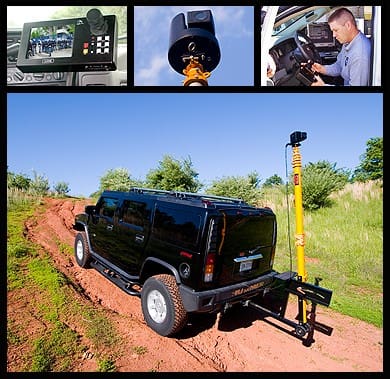
At the recent TREXPO, we ran across a new technology that makes mobile video surveillance affordable to most any department of military organization. The one thing that struck as the adaptability of the system. It can be fitted to any vehicle with a standard trailer hitch and is powered through a simple cigarette lighter adapter. This means you don’t have to purchase an entirely new vehicle, but rather can adapt different vehicles for use as a surveillance system. For example, a van could be used during urban ops or a 4-wheel drive vehicle for use in rural areas and these same vehicles can be used for other purposes when the system is not in use. Additionally, it doesn’t require any long-term institutional training but can rather be learned on the job.

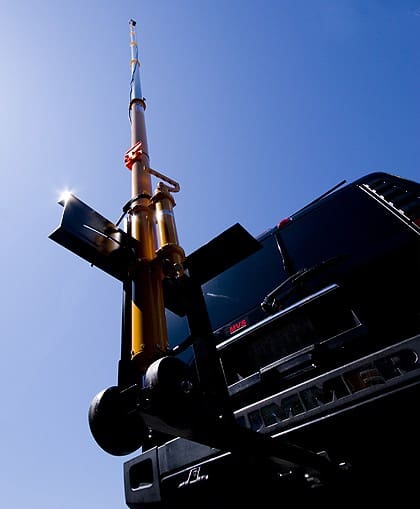
Both Luke and Holloman AFB have recently obtained a Mobile Video Surveillance (MVS) systems from Venture Tec LLC. The system is unique in that it incorporates an adjustable, telescopic mast hitch, which allows users to position the mast vertically at any location, including uneven or sloping terrain. The unit weighs approximately 85 pounds and unlike a trailer-mounted system, this surveillance system can be used anywhere the vehicle can go

The MVS system attaches to any vehicle with a standard 2” x 2” Class III receiver, requiring no vehicle modification and it pneumatically telescopes to elevations up to 32 feet. It’s simple to use, takes only a minute to raise or lower, and can operate day or night in all weather conditions. The MVS system can be equipped with a long range visible light camera and a thermal camera for complete darkness. All surveillance is done from inside the safety and comfort of the vehicle or command center, and all video is recorded with a date/time stamp. To operate the system, users simply tilt the mast to find vertical, lock it in place, and raise the mast to the desired height. The PTZ controller and video display provide an unparalleled view from above in all directions. When ready to relocate, users simply open the air release valve to lower the mast.
For more information, please visit www.mobilevideosurveillance.com.

NOD Retention Lanyard Update

Monday, July 19th, 2010

Down Range Gear’s NOD Retention Lanyard has become so successful it has taken on a life of its own. Down Range Gear found a quality manufacturer that could mass produce them at a price that is both reasonable and attainable for the customer it was designed for; the infantryman. Coupled with some business know-how from the proprietor of Combat Ready USA, they have a product finally ready for the mass market. There are several other announcements that will be forthcoming with the NOD Retention Lanyard, so stay tuned.

Check out the new site at nodretentionlanyard.com.

Multi-Band Video Receiver from Coastal Defense

Wednesday, July 14th, 2010

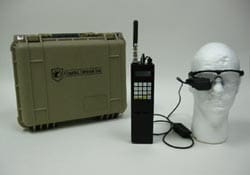
The Multi-Band Video Receiver (MVR) IV from Coastal Defense, Inc. is designed to work over the L, S, and C bands providing access to full motion video from aircraft, unmanned systems, or ground based sources. In addition to compatibility with the Vuzix TAC-EYE LT eye piece, the data can also be sent to a hand held viewer or a computer for storage and retrieval. The video can also be processed with manipulation software (think NFL chalkboard) that allows you to highlight key features.

Make sure to stop by and check out the MVR IV at Booth # 118 at the Warrior Expo-East presented by ADS this Thursday and Friday at the Va Beach Convention Center.

Visit the website for a full rundown on technical specs. www.gocdi.com

Individual Gunfire Detection

Friday, December 11th, 2009

“Popular Science” named the Army’s Individual Gunfire Detection program one of the “Best of What’s New 2009.” Interestingly, despite limited field evaluations, it remains a science project while acquisition officials continue to refine the requirement.

Boomerang Warrior from BBN Technologies

One of the two current systems vying for the program is the Boomerang Warrior by BBN Technologies. Cambridge, Massachusetts based BBN Technologies is a 60 year old company instrumental in the development of the first internet routers and has been at the forefront of acoustic analysis for decades. They were recently purchased by Raytheon. Last year BBN acquired Digital Force Technologies. DFT enjoys an excellent reputation in the Tagging, Tracking, and Locating arena and developed the Satellite Imagery Enhanced GPS (SIMEG) Receiver.

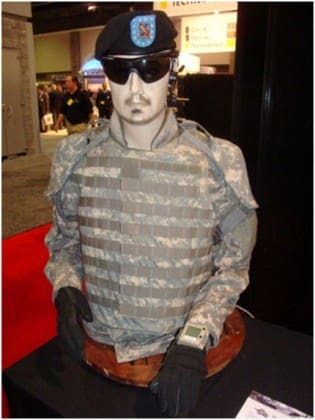
In the case of Boomerang Warrior, three pieces of information are provided to the wearer both on a wrist mounted display and via audio cues from a headset; direction of shot (clock method), elevation, and range. BBN claims that Boomerang Warrior experiences less than one percent false alarms and actually detects more than 95% of all super-sonic projectiles. Accuracy is characterized as Range +/- 20%, Bearing < 7.5 Degrees, and Elevation < 7.5 Degrees. By using the “Clock Method” of reporting information to the Soldier, the information becomes much more subjective and does not need to be nearly as accurate as it is primarily for force protection. Since each hour on the clock covers a 30 degree arc, the system is more than accurate enough for its intended use at 7.5 degrees. An internal electronic compass ensure the cues are relative to the Soldier's current heading. The data may also be shared with battlefield reporting systems such as FBCB2. The shoulder pads are self contained and essentially redundant. They can each work independently of one another. They give a full 360 degree look at the environment relying on a series of embedded microphones. If both Sensor Pads detect an event the system analyzes both sets of data and presents a solution. Also of note, the sensor pads are not ballistic in nature but rather are compatible with the Army’s issue Deltoid Axillary Protection System (DAPS). Only a single Boomerang Warrior has been deployed into theater according to BBN. US Army Natick has funded a portion of the development of the Boomerang Warrior system and one year remains on this contract.

Oddly enough, despite funding the development of Boomerang Warrior, the Army seems to be much keener on the QinetiQ North America’s Soldier Wearable Acoustic Targeting System (SWATS). In fact, photos of the IGD system on PEO-Soldier’s website feature a Soldier wearing SWATS. Army G3 directed PEO-Soldier to execute a field evaluation of an Individual Gunfire Detection system and the system chosen was the SWATS. The Capabilities Production Document (CPD) is still in draft and any use at this point should be considered an operational demonstration to ascertain the validity of the technology and to consider Tactics, Techniques, and Procedures development. Based on candidate technical maturity, Product Manager Soldier Sensors and Lasers deployed 12 Soldier SWATS to theater in 2007 for the first user evaluation. This evaluation prompted several changes to the design and functionality. In 2008, 1100 improved SWATS were sent to theater for a second user evaluation. The information gathered during these evaluations is being used in the development of the IGD CPD.

Note that QinetiQ who builds the Army’s preferred solution was formed from the British Defence Evaluation and Research Agency, along the lines of the US DARPA. This is significant because the US essentially abandoned acoustic range and bearing technology as a means to determine characteristics of an incoming projectile in the mid 1980s. At that point, the Army dismantled its acoustic ranging infrastructure, mothballed the equipment, and retrained the Soldiers who specialized in the technique. This was done in favor of the use of RADAR systems such as the AN/TPQ-36 Firefinder. During this period, the British military continued its reliance on acoustic ranging systems and this may account for some of their technical edge.

Current operations renewed US interest in the development of acoustic systems (UTAMS) for the detection initially of mortar and rocket fire due to lower production and operating costs as well as the passive nature of these systems. Along a parallel path, work began on the detection of small arms fire as a means to counter enemy sniper operations. In fact, development of the successful vehicle mounted Boomerang system also built by BBN was funded by DARPA as a lower cost alternative to the French PILAR system. PILAR saw limited use by SOCOM early in the war.

Finally, it is important to note that BBN’s Boomerang vehicle mounted system has been very successful with over 5000 systems fielded so far in theater through Program Manager-Robotics and Unmanned (PM-RUS). The $73.8 million contract calls for a total of 8,131 Boomerang systems including spare parts.