The second installment of UF Pro Presents : The Pro’s Guide To Tactical Shooting is Team Shooting.
In this scenario, you’ll learn how to react when ambushed and how you and a teammate can work your way out of it.


The second installment of UF Pro Presents : The Pro’s Guide To Tactical Shooting is Team Shooting.
In this scenario, you’ll learn how to react when ambushed and how you and a teammate can work your way out of it.

While it’s a bit of a haul for those of us in North America, the Annual Arc’teryx Alpine Academy in Chamonix offers low-cost training opportunities unavailable anywhere else.
Registration for clinics opens tomorrow, Wednesday, March 21st 2018, 15h00 CET (7:00am PST)
New clinics include:
Aid climbing
Climb & overnight bivy course
Mountain landscapes photography
A FEW REMINDERS:
•Please review skill set requirements ahead of registration
•Plan your clinics accordingly. Sign up for level 1 or 2 clinics before level 3
•If you are registering a guest or friend, please have their information ahead of registration. You will need date of birth, address, phone, and email
•The following payment methods are accepted: MasterCard & Visa
Check it out On Facebook.
chamonix.arcteryxacademy.com/clinics
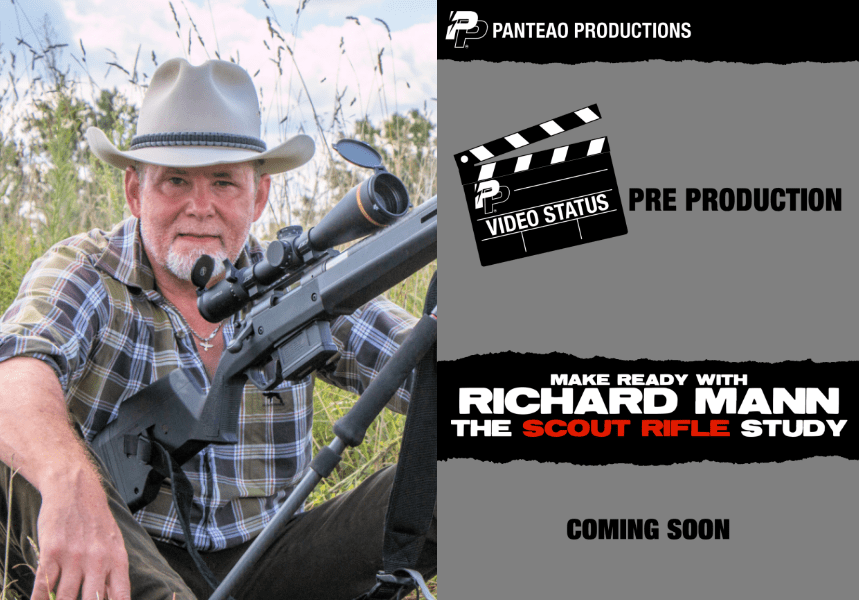
Columbia, SC, March 16, 2018 – Panteao Productions is happy to announce the addition of Richard Mann to the cadre of instructors available from Panteao’s online firearm training center. Richard was born and raised in West Virginia and has hunted from the Montana Mountains to the green hills of Africa. With his experiences in the field and his military and law enforcement background, Richard might be considered a mountain man of the new millennia. Richard worked as a firearms instructor during his time in the military, and while serving as a patrol officer and a special agent for the Railroad Police. He has competed competitively with the pistol, winning the West Virginia Army National Guard Pistol Match in 1999 and the West Virginia Governor’s Twenty in 1995. Richard is also a multiple graduate of Gunsite Academy. Richard now works as a firearms journalist and consultant, and has contributed to every major firearms and hunting periodical. He has also authored numerous books to include, Rifle Bullets for the Hunter, Handgun Training for Personal Protection, Shooters Guide to the AR, Cartridges of the World, Under Orion, and The Scout Rifle Study. The Empty-Cases website is a written and video journal of Richard’s firearms related involvements, and his 60 Seconds or Less video series highlights his experiences and lessons on social media.
Panteao recently added Richard’s 60 Seconds or Less video series to the Panteao streaming video library. The first new full length video Panteao is filming with Richard is “The Scout Rifle Study” which will be the companion video to Richard’s new book of the same title.
“I’ve known Richard for many years and once he mentioned his new book, we decided that a video on the Scout Rifle would be a great addition to our video library,” said Fernando Coelho, President/CEO of Panteao Productions.
The Panteao instructional video with Richard Mann will be available on DVD, Digital Download in HD and SD formats, and streaming in Ultra HD and HD video to the Panteao streaming video subscribers. Panteao subscribers can watch all of the Panteao video titles from a PC or Mac, their phone or tablet with one of the Panteao Make Ready mobile apps, or on television via the Panteao Make Ready channel on Roku, Amazon Fire TV, or Apple TV.
Max Velocity Tactical has released a tactical manual on small unit tactics.
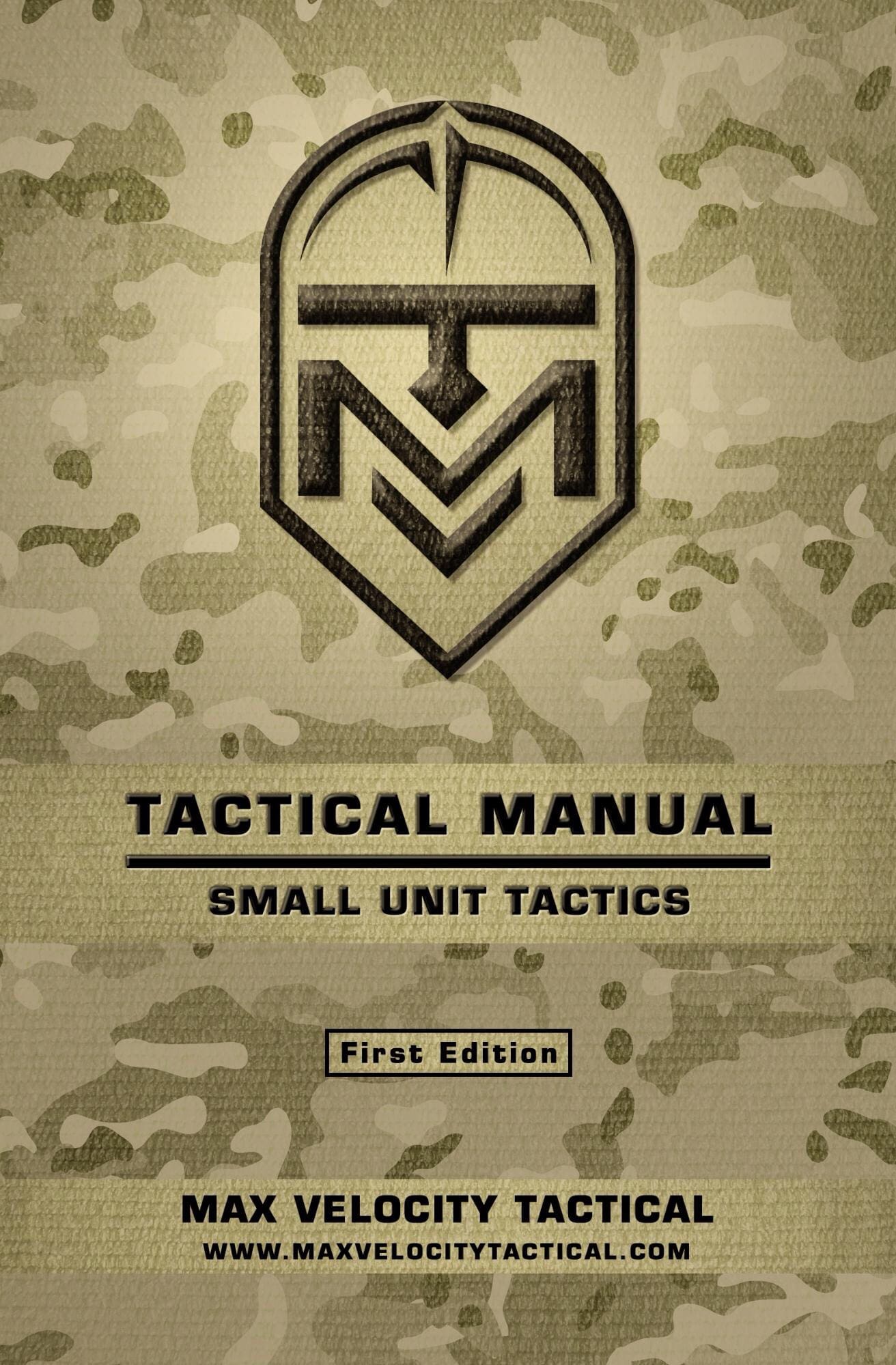
This Tactical Manual (TM) is the result of more than a quarter century of experience at the highest professional levels, based on a solid foundation of SOF selection and training, reinforced by deployments to multiple conflict zones spanning pre-9/11 and the current Global War On Terror. The contents of the TM are combat proven and time tested small unit tactics employed on Light Infantry, Special Operations and Paramilitary deployments.
The TM is intended to support training and operations for small tactical units. The TM utilizes a number of sources, including United States and British Army doctrine, mixed with training and operational best practices and lessons learned. The TTPs laid out are ideal for special operations, light infantry and paramilitary tactical organizations, based on proven tactical principles.
Max Velocity Tactical operates the Velocity Training Center (VTC) tactical and leadership training facility near to Romney, West Virginia, where we provide training for US Special Operations Forces and Responsible Citizens. MVT has established a reputation on the leading edge of tactical live fire and force on force training; we are dedicated to developing tactical excellence.
The manual is available in Kindle and Soft Cover editions from www.amazon.com.
This video covers DRILL No. 1: Protect VIP in a Vehicle.
In this scenario, a car carrying a VIP and 3 bodyguards is frontally attacked. The driver is KIA and the car rolls along uncontrolled until it comes to a stop, leaving the 2 surviving bodyguards no choice but to evacuate the VIP and protect him until support arrives. Learn how to shoot behind cover while protecting a VIP.
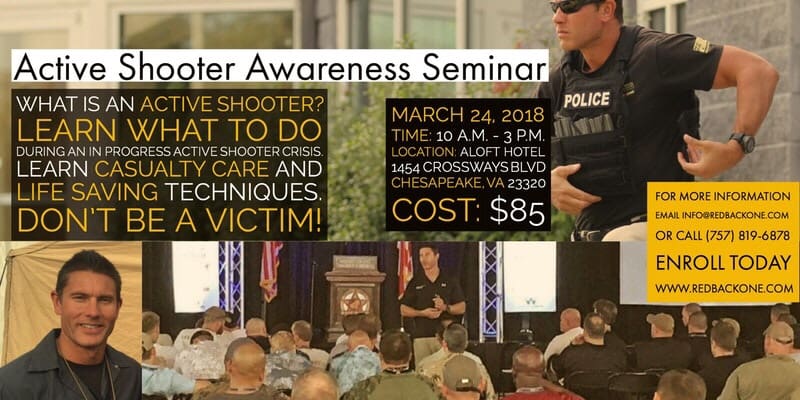
Redback One Active Shooter Awareness Seminar
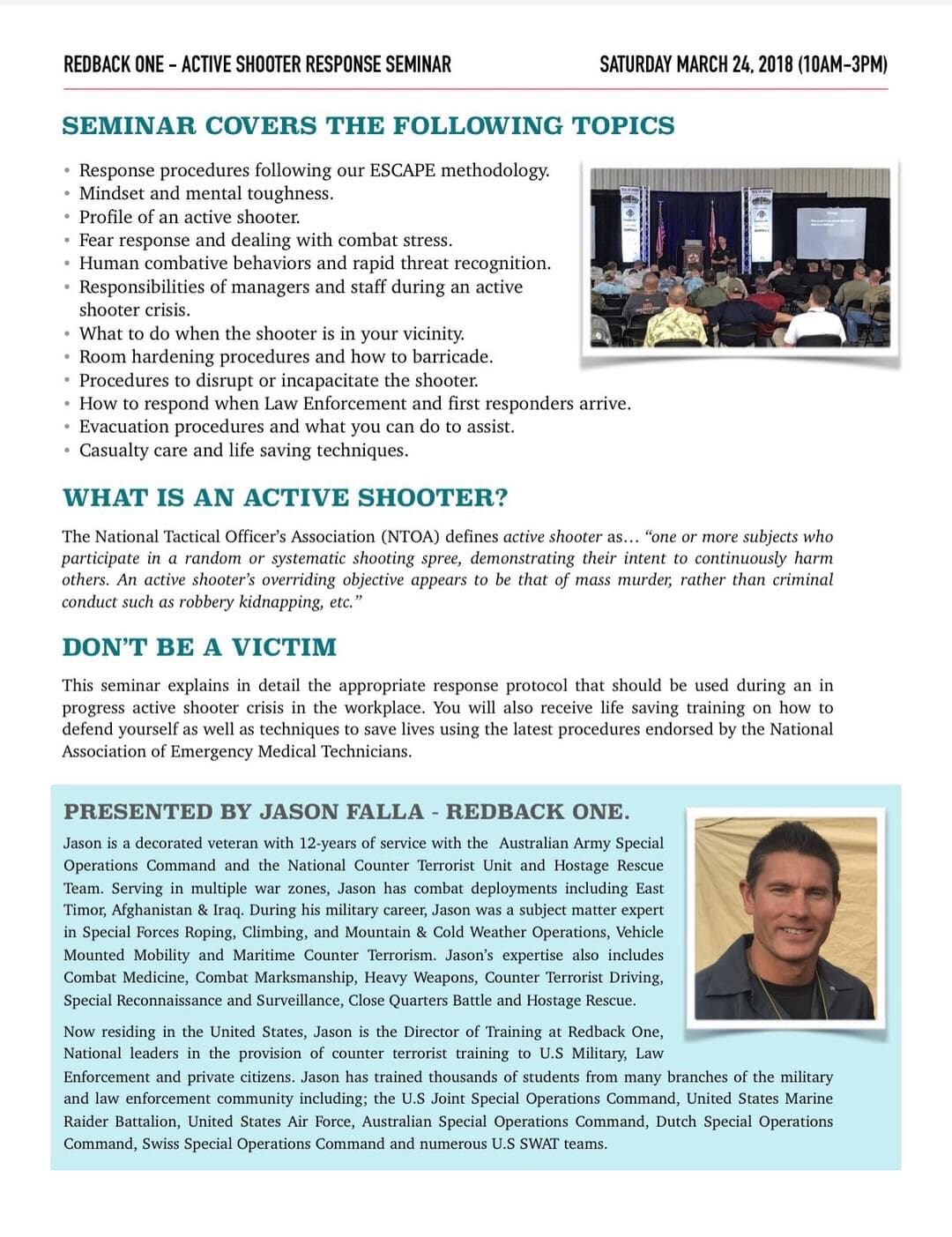
Presented by Jason Falla
When: March 24, 2018
Time: 10 a.m. – 3 p.m.
Where: Aloft Hotel, Crossways Blvd. Chesapeake (may change to Colonial Shooting Academy)
Cost: $85
Registration: www.redbackone.com or email info@redbackone.com
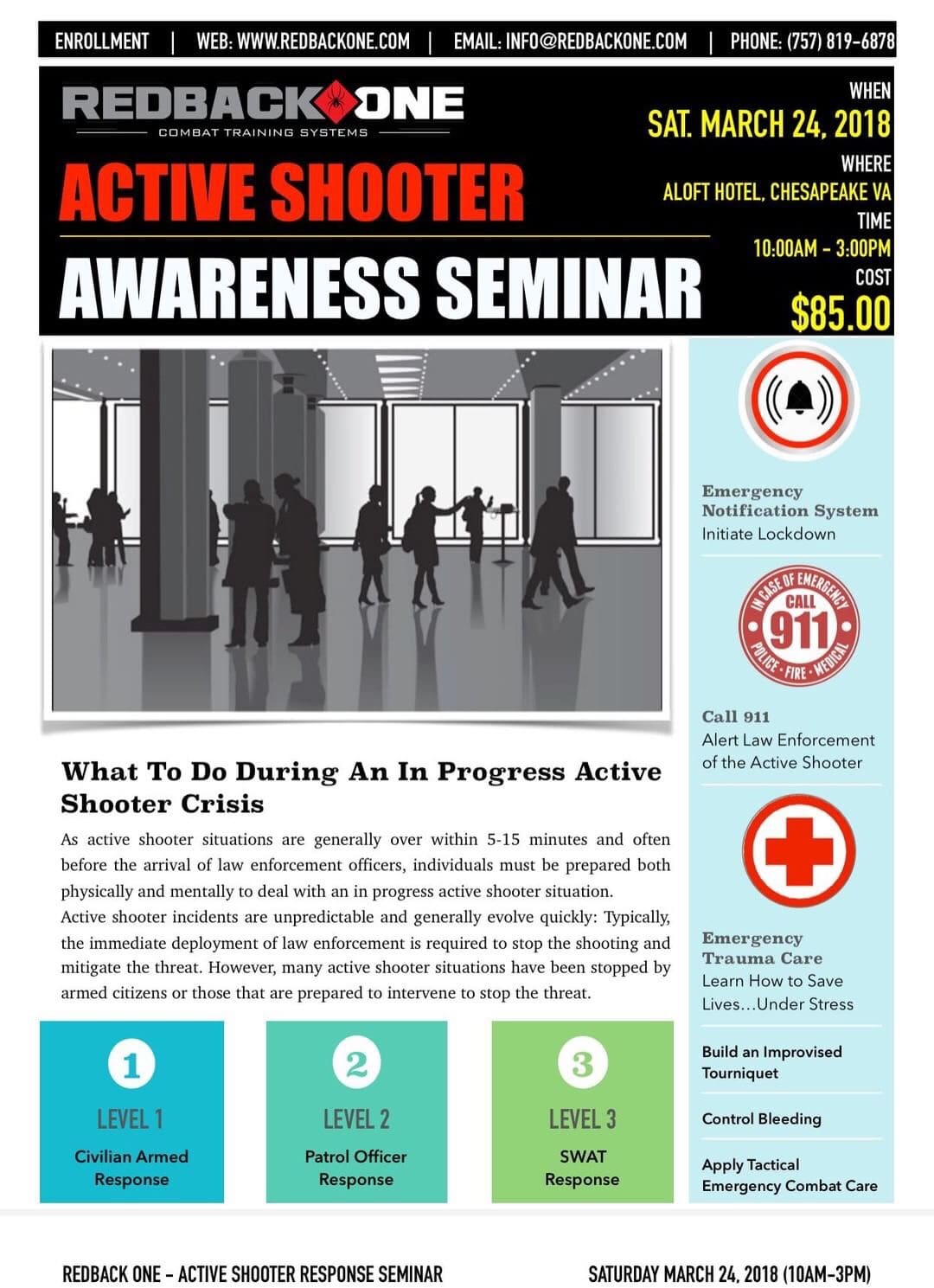
What To Do During An In Progress Active Shooter Crisis
As active shooter situations are generally over within 5-15 minutes and often before the arrival of law enforcement officers, individuals must be prepared both physically and mentally to deal with an in progress active shooter situation.
Active shooter incidents are unpredictable and generally evolve quickly: Typically, the immediate deployment of law enforcement is required to stop the shooting and
mitigate the threat. However, many active shooter situations have been stopped by armed citizens or those that are prepared to intervene to stop the threat.
SEMINAR COVERS THE FOLLOWING TOPICS
• Response procedures following our ESCAPE methodology.
• Mindset and mental toughness.
• Profile of an active shooter.
• Fear response and dealing with combat stress.
• Human combative behaviors and rapid threat recognition.
• Responsibilities of managers and staff during an active
shooter crisis.
• What to do when the shooter is in your vicinity.
• Room hardening procedures and how to barricade.
• Procedures to disrupt or incapacitate the shooter.
• How to respond when Law Enforcement and first responders arrive.
• Evacuation procedures and what you can do to assist.
• Casualty care and life saving techniques.
WHAT IS AN ACTIVE SHOOTER?
The National Tactical Officer’s Association (NTOA) defines active shooter as… “one or more subjects who participate in a random or systematic shooting spree, demonstrating their intent to continuously harm others. An active shooter’s overriding objective appears to be that of mass murder, rather than criminal conduct such as robbery kidnapping, etc.”
DON’T BE A VICTIM
This seminar explains in detail the appropriate response protocol that should be used during an in progress active shooter crisis in the workplace.

The state of firearms training in the United States is a mess and does not further the interests of law abiding firearms enthusiasts. Perception of firearms enthusiasts is so crucial to our civil rights provided in the 2nd Amendment. However, the unregulated internet world of posting videos and attempting to obtain celebrity through inappropriate tactics, ill founded curriculum, lack of safety and unprofessionalism highlights the need for creation of an organization that protects and professionalizes the profession of Firearms Trainers, in an apolitical way.
Therefore, we are proud to announce the formation of the Firearms Trainers Association, www.FTAProtect.com. The FTA is an organization founded by 5 of the most well respected and distinguished professional firearms trainers in the world. Ken Hackathorn-Chairman, Larry Vickers-Vice Chairman, and Board members Jeff Gonzales, Dave Spaulding and Scott Reidy have worked with 2A Association Management and Executive Director Kyle Sweet, to create for the first time, an organization delivering national standards for firearms trainers, protecting the profession of firearms training through standards, insurance (professional liability and property and casualty), business development services, curriculum certification, safety and risk management. The Board members have decades of training experience in military and law enforcement and have dedicated their professional lives to training all levels of civilians. Their recognition of the need to create a mechanism to serve the interests of firearms trainers as well as increase the professionalism of the profession through their experiences, resources and core values lead them to create FTA.
Firearms Trainers Association will provide content that has been vetted, is reliable and trustworthy in addition to being tactically sound. FTA, operating with the the hashtag #ProtectingtheProfession will provide three levels of membership to firearms trainers based on the extent of their teaching and career in the industry. FTA will serve as the industry leader in providing professional development to trainers through resources, networking, marketing assistance (including joint marketing initiatives), web content consulting, video safety briefings from Board Members, and legal forms for Waivers of Liability, and other business related forms as well as use of the FTA logo in marketing and training materials. A comprehensive suite of insurance services are provided with each membership. Certificates of Insurance are available to all members when needing them for conducting classes. Insurance is provided to the FTA through 2A Insurance, a Captive Insurance company reinsured through Port Royal Captive Re-Insurance. FTA has established for it’s members the only stable insurance in the firearms industry available to trainers. This insurance is not subject to political changes, protest or tragic event. It exists for the purpose of protecting the interests of it’s firearms associations.
Level 1: Instructor: this level is for members who teach an occasional class such as Self Defense Act courses to license individuals for a concealed carry permit. NRA basic instructors who teach occasionally.
Level 2: Teacher: This level is for those teaching classes regularly, has had more advanced training themselves and possesses more advanced certifications. Someone who teaches classes beyond mere concealed carry classes, such as tactics, but does not do this for a living.
Level 3: Professional: someone with significant advanced training from military, law enforcement or significant civilian firearms training who is a firearms trainer for a living. The Professional level of membership will require peer reviewed acceptance by the 5 Founders.
All memberships are priced at $400. Payment online is available at www.FTAProtect.com For those who are not trainers and do not need the insurance for a trainer but want access to the content, and support the mission to create standards for trainers and training, an auxiliary membership is available for $100 per year. Support Members will have access to all content and information of all levels of membership.
For more information or access to Board members for media inquiries and interviews please contact Kyle Sweet at 405-684-0900 or e-mail info@FTAProtect.com
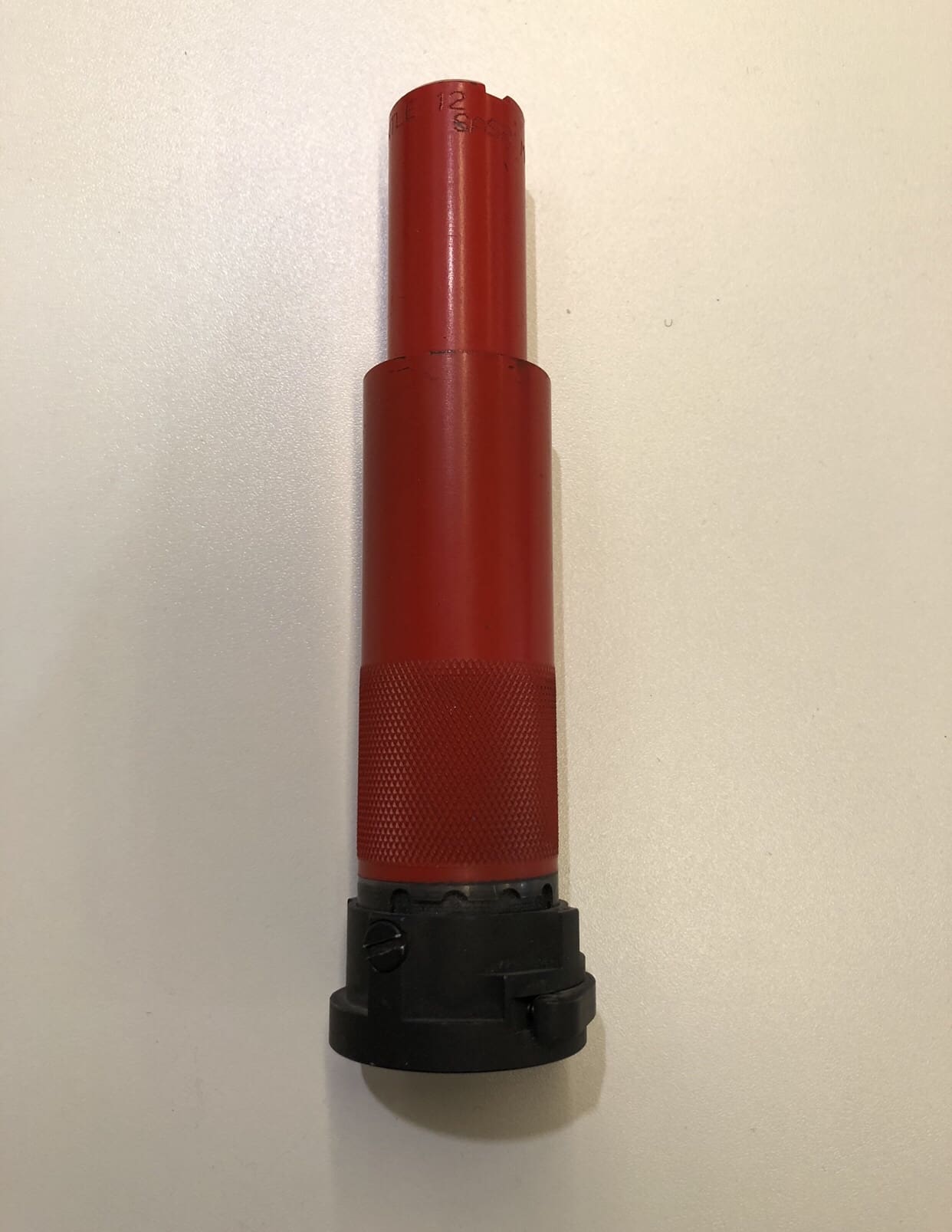
Finnish suppressor manufacturer Ase Utra displayed their new training suppressor. It’s a Denny device and can be used for non-blank firing training such as combatives or non-firing rehearsals. This sample has been painted but they are working on a Cerakote version.
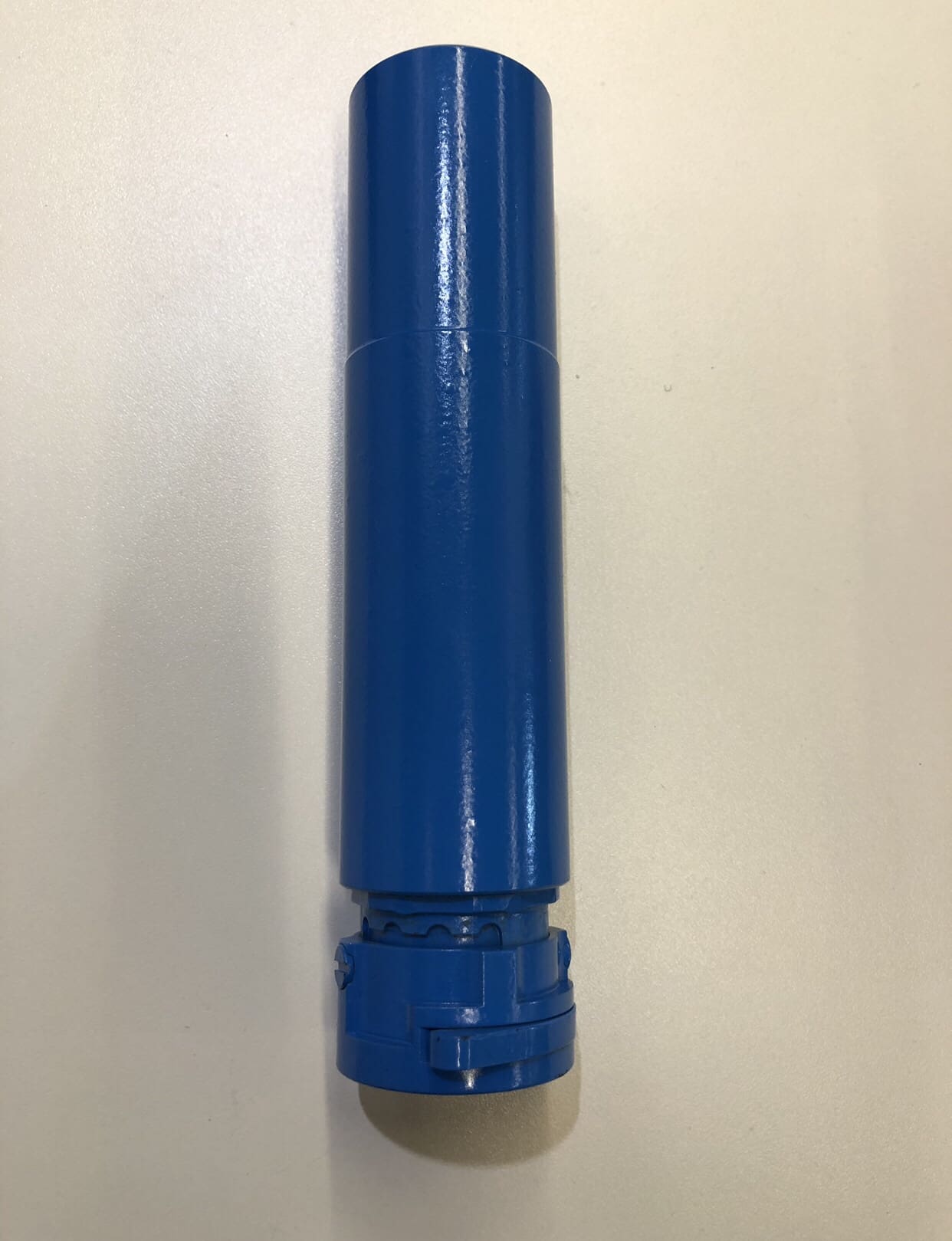
If you need a blank firing device, Ase Utra offers this model from their partner Thales which was developed for use with the Austeyr and has been adapted to their muzzle attachment.