
The answer to the recent request for verification of whether or not Special Operations Forces are allowed to use any weapon they choose, is a very simple, “No.”


The answer to the recent request for verification of whether or not Special Operations Forces are allowed to use any weapon they choose, is a very simple, “No.”
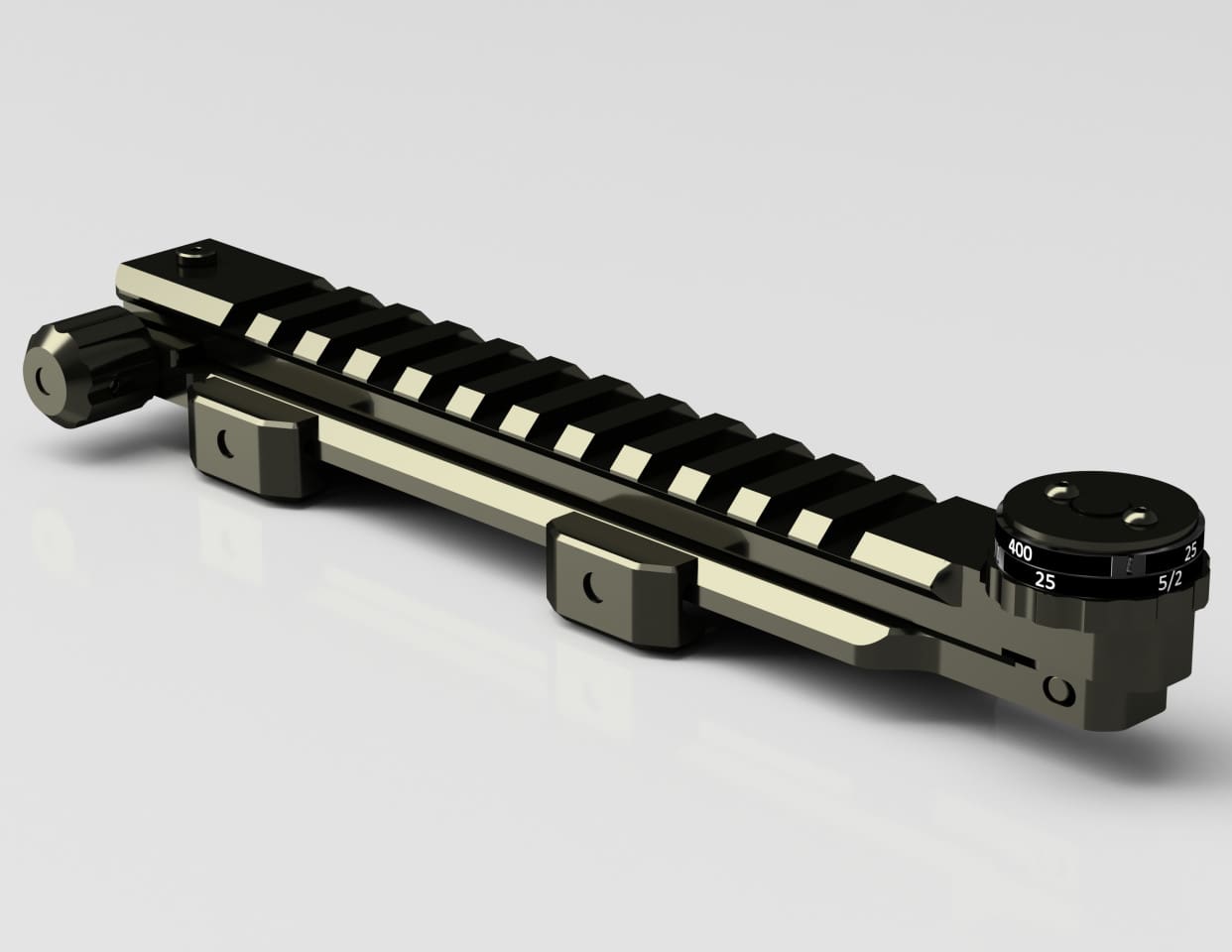
Mod Zero Defense is a Pennsylvania-based company which has created the M-Zero Picatinny Rail. The M-Zero is designed to allow shooters to use a pre-zeroed optic across multiple firearms by adjusting zero on the mount itself, rather than readjust the optic for every new rifle. The below image works as a great visual indicator of the M-Zero’s function.
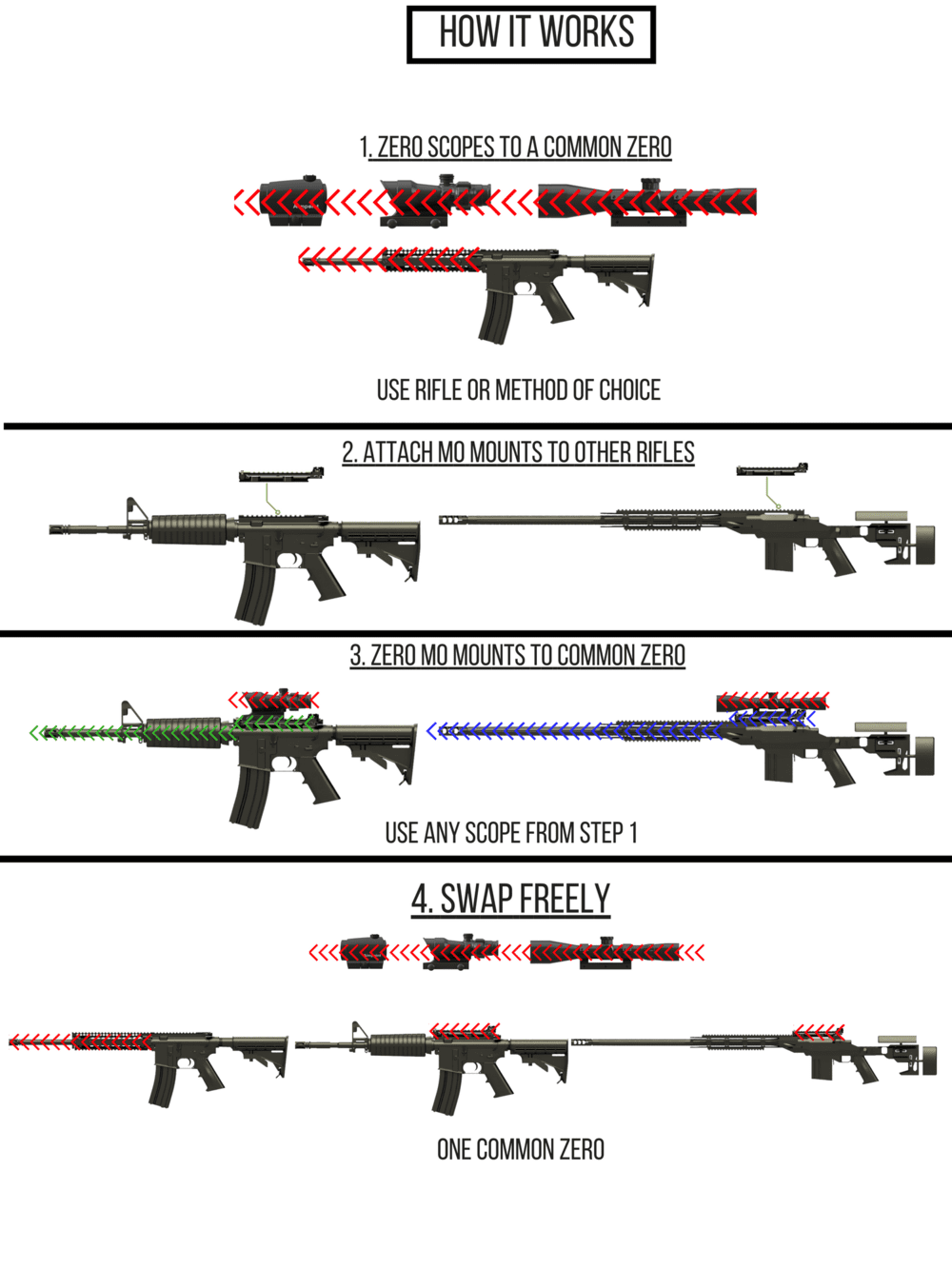
As for the technical details, here’s the bullet point list:
The M-Zero will soon be up for funding on Kickstarter. Check out the link below for more details, and to subscribe to Mod Zero Defense’s email list.
FightLite® Industries, a division of ARES Defense Systems® Inc. located in Melbourne, Florida announces the launch of a new e-Commerce website to help streamline the ordering process for its online customers.
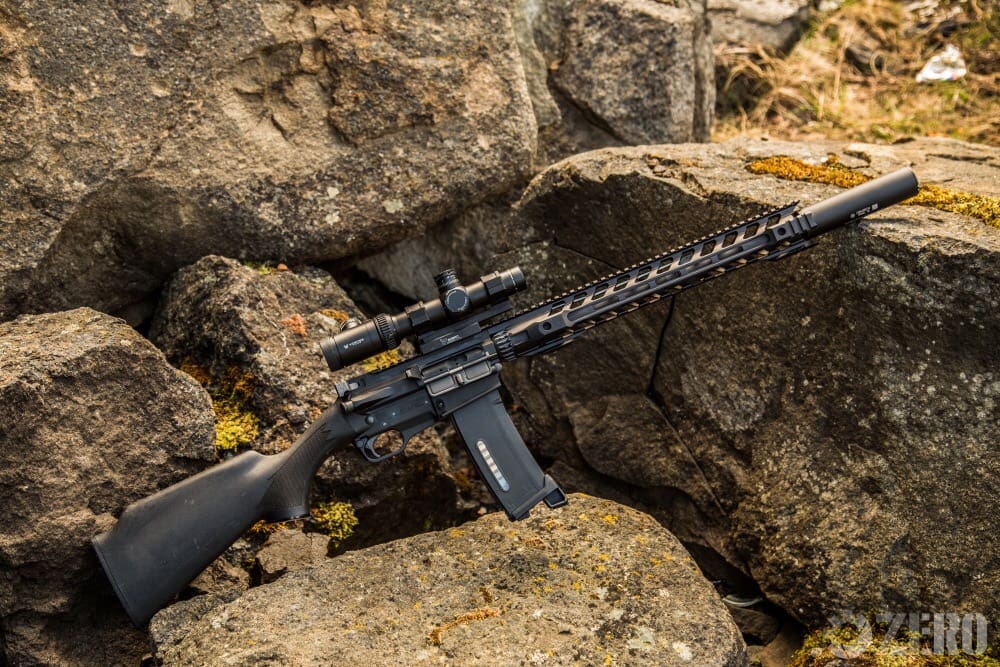
Featured on the new FightLite.com website are FightLite® Industries’ popular and patented MCR® and SCR® product lines, including full rifles, upper receiver assemblies, lower receiver assemblies, performance upgrade kits, spare parts, and accessories that expand the operational envelope and overall utility of these products.
The innovative and patented FightLite® SCR® (Sport Configurable Rifle) is the first of its class of firearms that is not only legal almost anywhere in America including New York, New Jersey, California and other restrictive states, but is also the first rifle to successfully combine the traditional lines of a hunting pattern rifle with the modularity of an AR-15 rifle.
The FightLite® SCR® blends strength, reliability, accuracy and rugged all-weather characteristics of America’s longest serving infantry rifle with the classic lines of an American sporter. Lightweight, accurate and featuring a MIL-STD 1913 flat top upper receiver that accepts most modern optics, the FightLite® SCR® is designed to perform under the most demanding field, competitive shooting or tactical conditions. The multi-caliber, modular design permits the user to instantly change calibers in the field by simply pressing two pins and exchanging one upper receiver assembly for another.
Designed for optimal configuration, the FightLite® SCR® accepts most Modern Sporting Rifle accessories and parts including magazines, upper receivers, barrels, bolts, handguards and optics; so it can be easily and effectively reconfigured for each individual shooters’ style and activity. Supported by a full line of performance accessories and manufactured of the highest quality aircraft grade alloys by American craftsmen, the weatherproof and dependable FightLite® SCR® will provide its users with a lifetime of accurate shooting pleasure and can be passed down from generation to generation. SCR® – One Rifle, Any Season!®
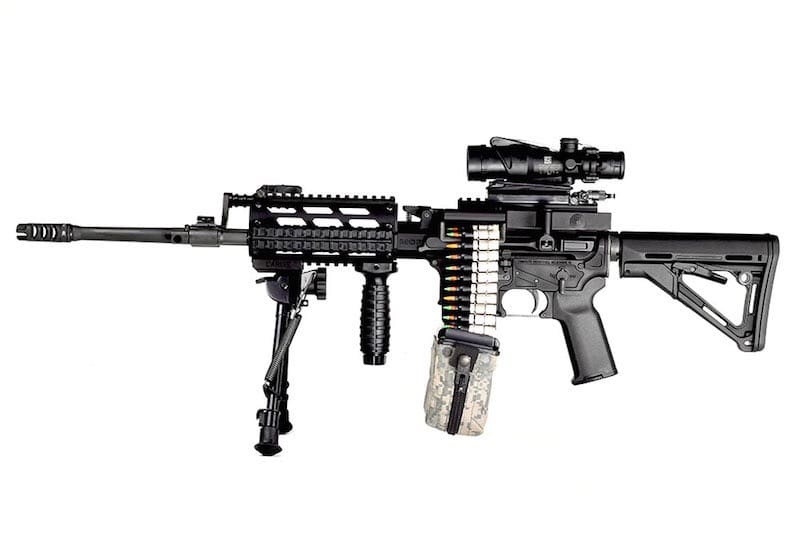
The patented FightLite® MCR® – Mission Configurable Rifle is an 8.5 lb weapon featuring gas piston operation, a 3-second quick change barrel system and has the capability to feed from both M27-linked ammunition belts and standard AR15/M16 box magazines at user discretion.
As FightLite’s premier rifle offering for the commercial marketplace, the MCR® vastly improves upon the standard AR15/M4 by offering exceptional flexibility with its dual-feed capability and quick-change barrel. This flexibility, combined with other unique features, allows users to instantly customize the MCR® without tools for virtually any use.
The MCR® quick-change barrel allows users to configure the MCR® in seconds without the aid of tools and is available in 12” (NFA Rules Apply) and 16” inch lengths. Furthermore, the MCR® features gas-piston operation that provides greater reliability in extreme conditions, and is cleaner, cooler and more reliable in adverse conditions than the legacy direct-gas system.
The unique design of the MCR® also allows customers to upgrade their existing rifles by simply substituting a FightLite® supplied MCR® upper receiver assembly in place of the legacy upper, which are rearward compatible to the earliest AR15’s from the 1960’s. MCR® – One Weapon, Any Mission!®
WEST HARTFORD, Conn. (August 24, 2017) – The Colt Custom Shop, longtime purveyor of the world’s finest custom engraved and tuned firearms, is pleased to announce that it will again begin taking on new orders for 1911 custom work. In an effort to minimize the existing backlog of custom work and reduce future turnaround time, the Colt Custom Shop took a hiatus from accepting new orders late last year.
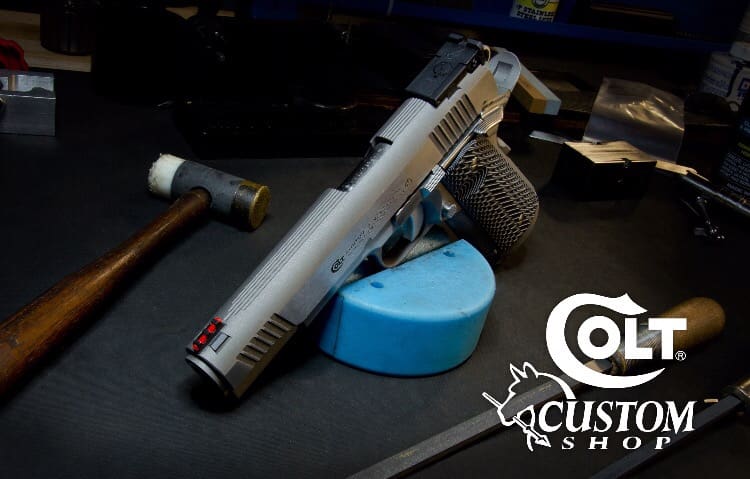
“We’re excited to start bringing in new projects again,” said Mark Redl, Pro Shooter for Colt and head of the Colt Custom Shop. “During the last few months we listened to our customers and refreshed our order options to focus on the types of services and packages that enthusiasts of truly custom firearms want. The master engraving and custom work we can do on Colt 1911 platform pistols produces one of the most sought after, heirloom quality investments available in the firearms industry today. The Colt Custom Shop has a long and storied legacy and we aim to build on that.”
The Colt Custom Shop will begin accepting customization orders for uncustomized Colt brand 1911 style pistols, or Colt 1911 pistols that have been customized by the Colt Custom Shop only, starting immediately. The Colt Custom Shop will also begin accepting engraving work for Colt brand 1911 style pistols as well as Colt brand revolvers. To learn more about the Colt Custom Shop or to download the Colt Custom Shop 1911 Customization Price List and order form, please visit www.colt.com.
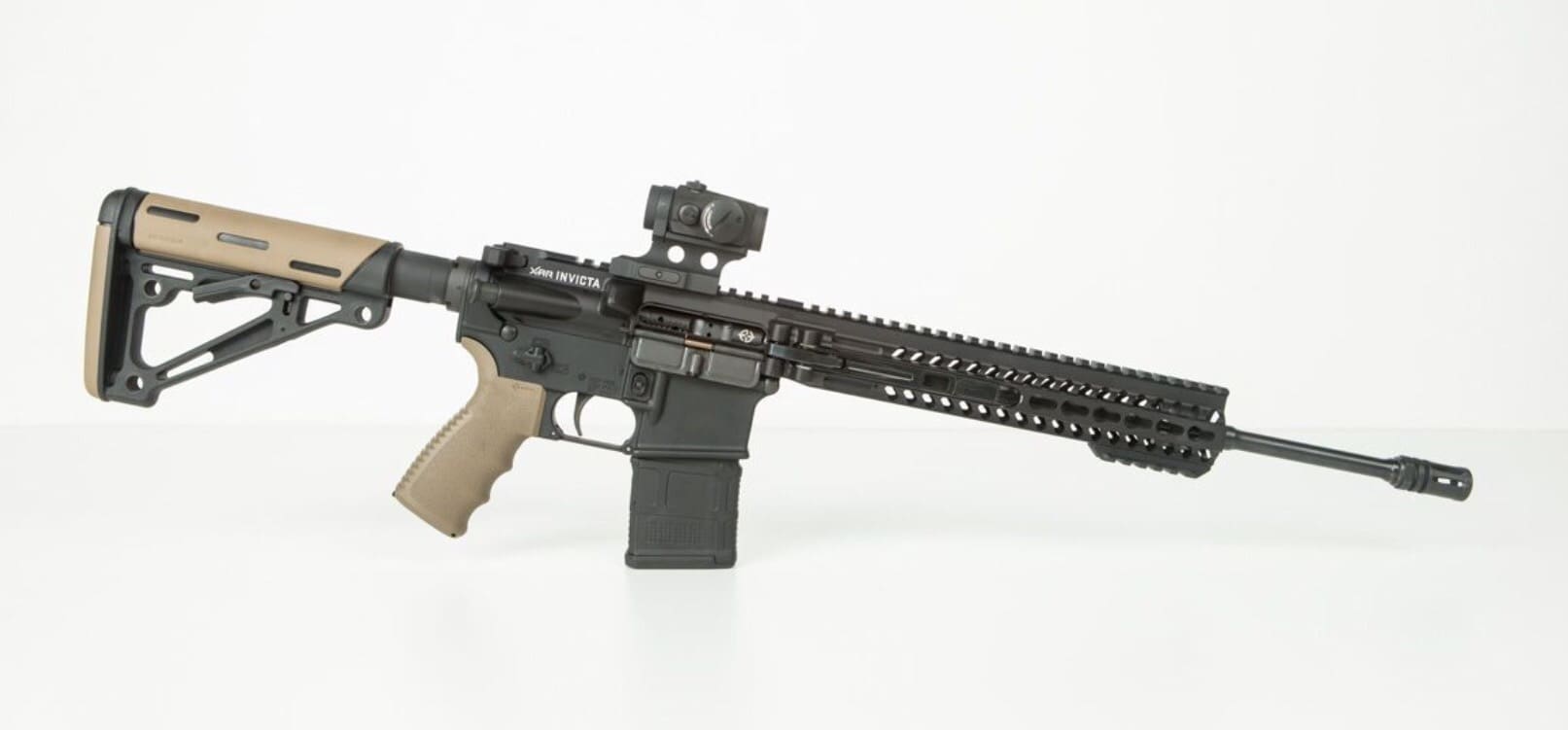
The XAR Invicta Folding Rifle, we first showed you during the NRA Annual Meeting is now shipping.
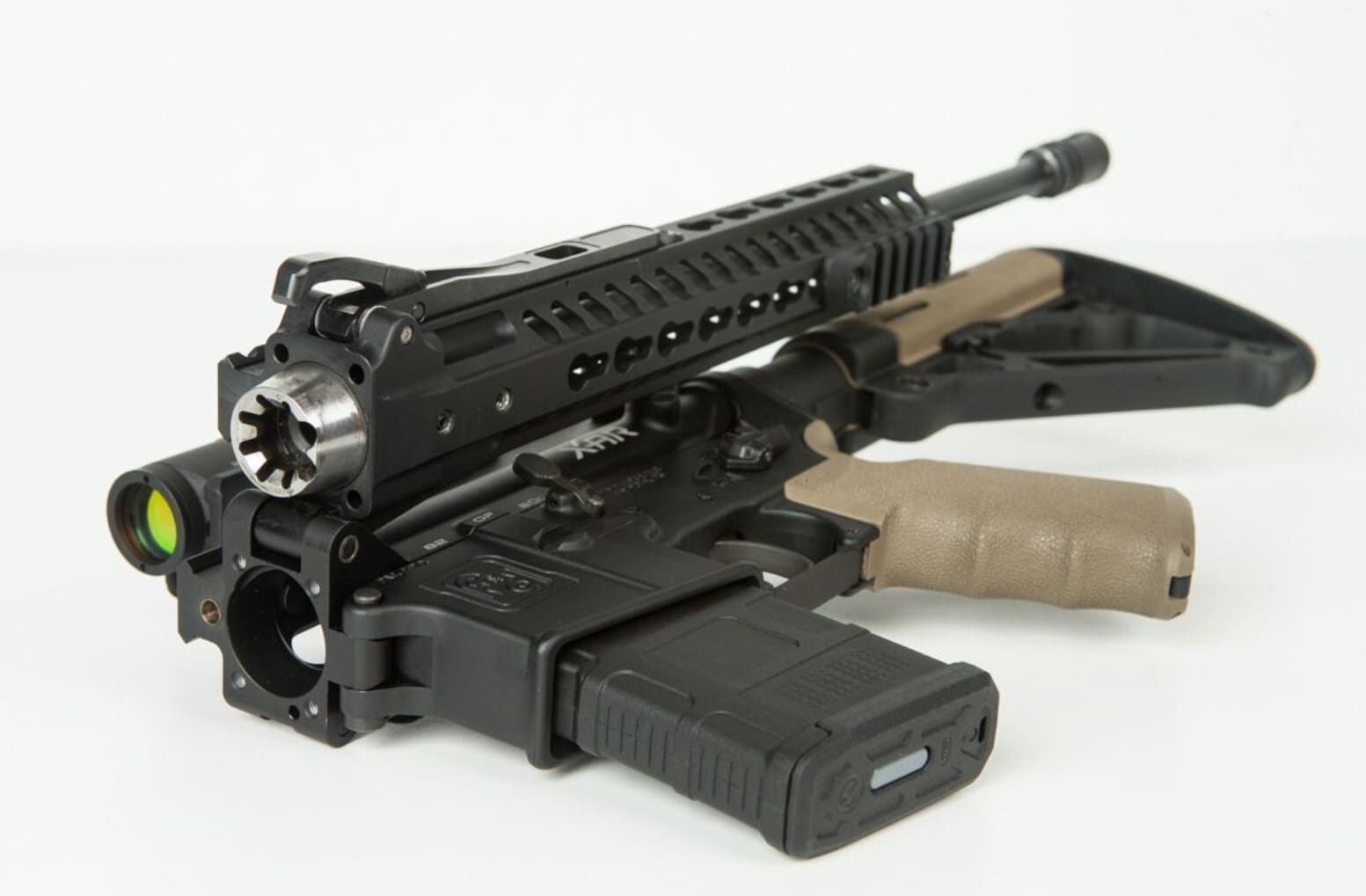
The secret is the taper around the barrel extension which allows it to pivot right into position in the tapered upper receiver.
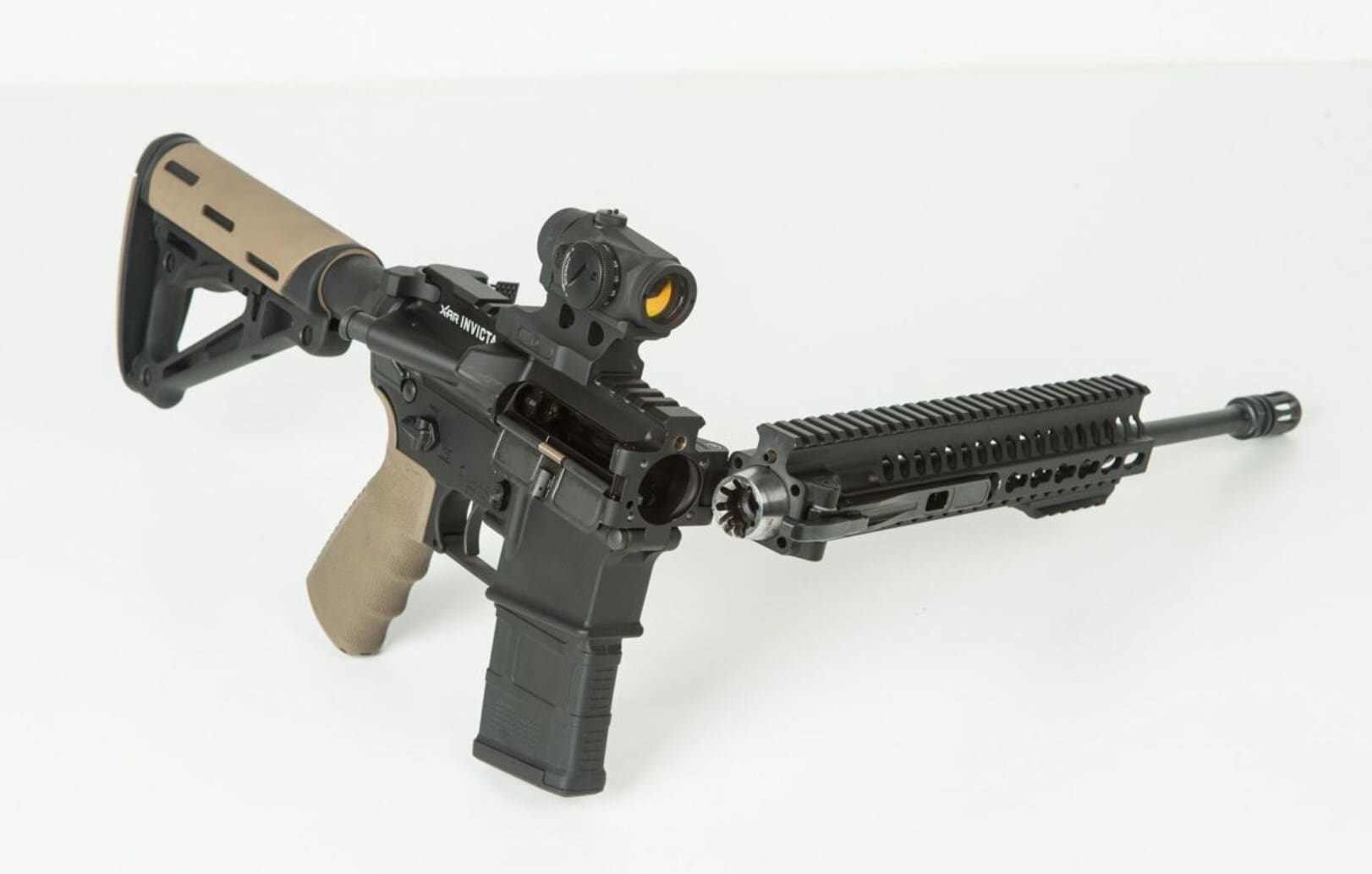
Then, the barrel is locked into place via a latch, similar to many suitcases.
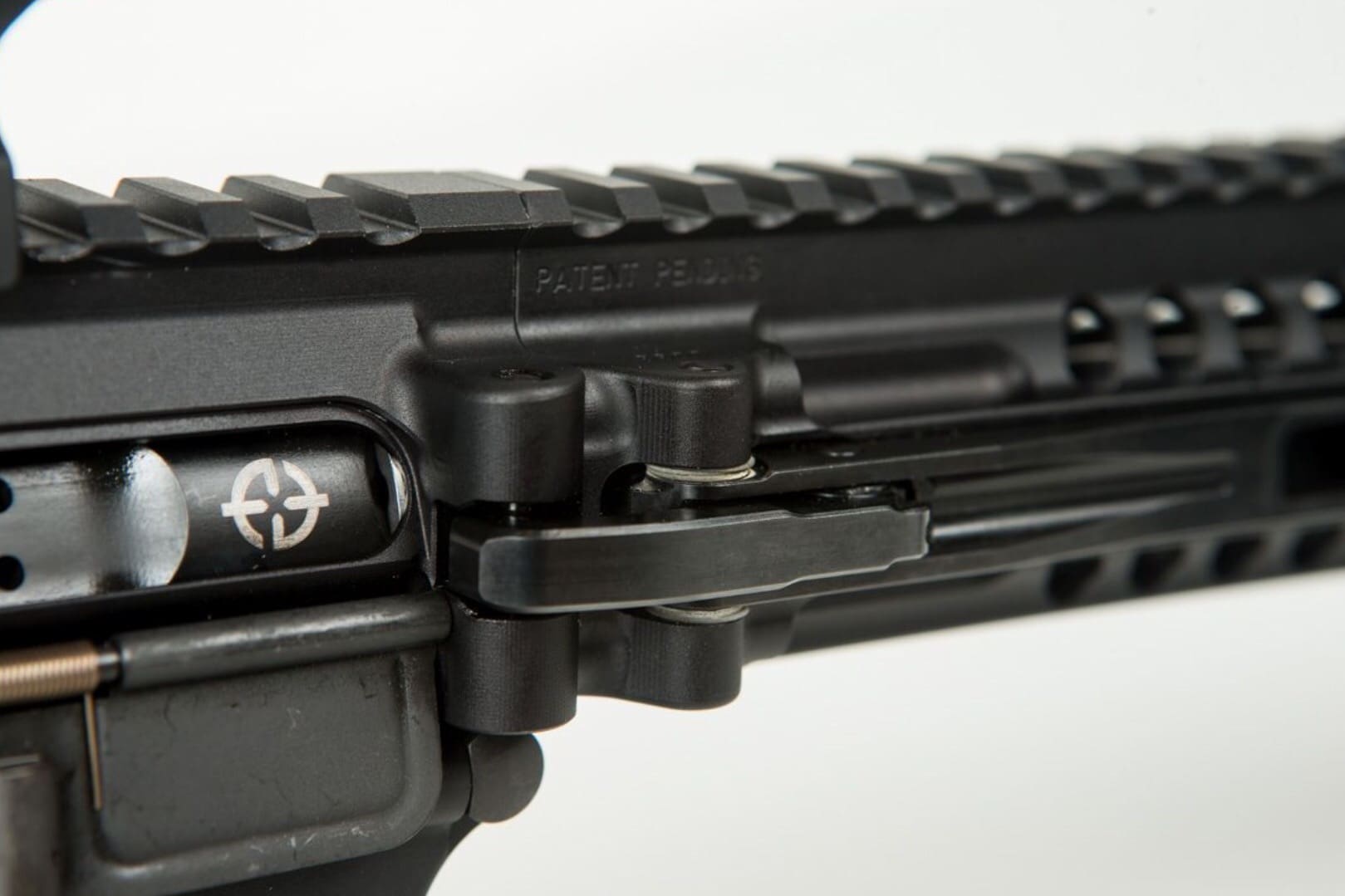
DETAILS:
CALIBER: 5.56 NATO/.223 Remington
WEIGHT: 6.2 Pounds
BARREL: 16″ Barrel or 14” Barrel (pinned and welded comp)
INCLUDED MAGAZINE CAPACITY: 20 Rounds (Comes with Magpul P-mag)
STOCK: Magpul, Adjustable Folding Stock
SAFETY SELECTOR: AR15 type
OPTIC MOUNTING RAIL: MIL-STD 1913
OPERATION: Proprietary Direct Gas operated Semi-Automatic
CASE: Pelican
I knew SIG had been working in a new, compact version of MCX. They’d been refining this design for awhile, having heard rumor of it overseas as far back as two years ago during DSEI. Later, after asking about it, I was shown developmental models. Today, it all becomes clear. SIG SAUER is launching the Rattler, the latest addition to the MCX family. I got a chance to speak briefly about the gun with Patrick Hanley, Rifle Product Manager at SIG.
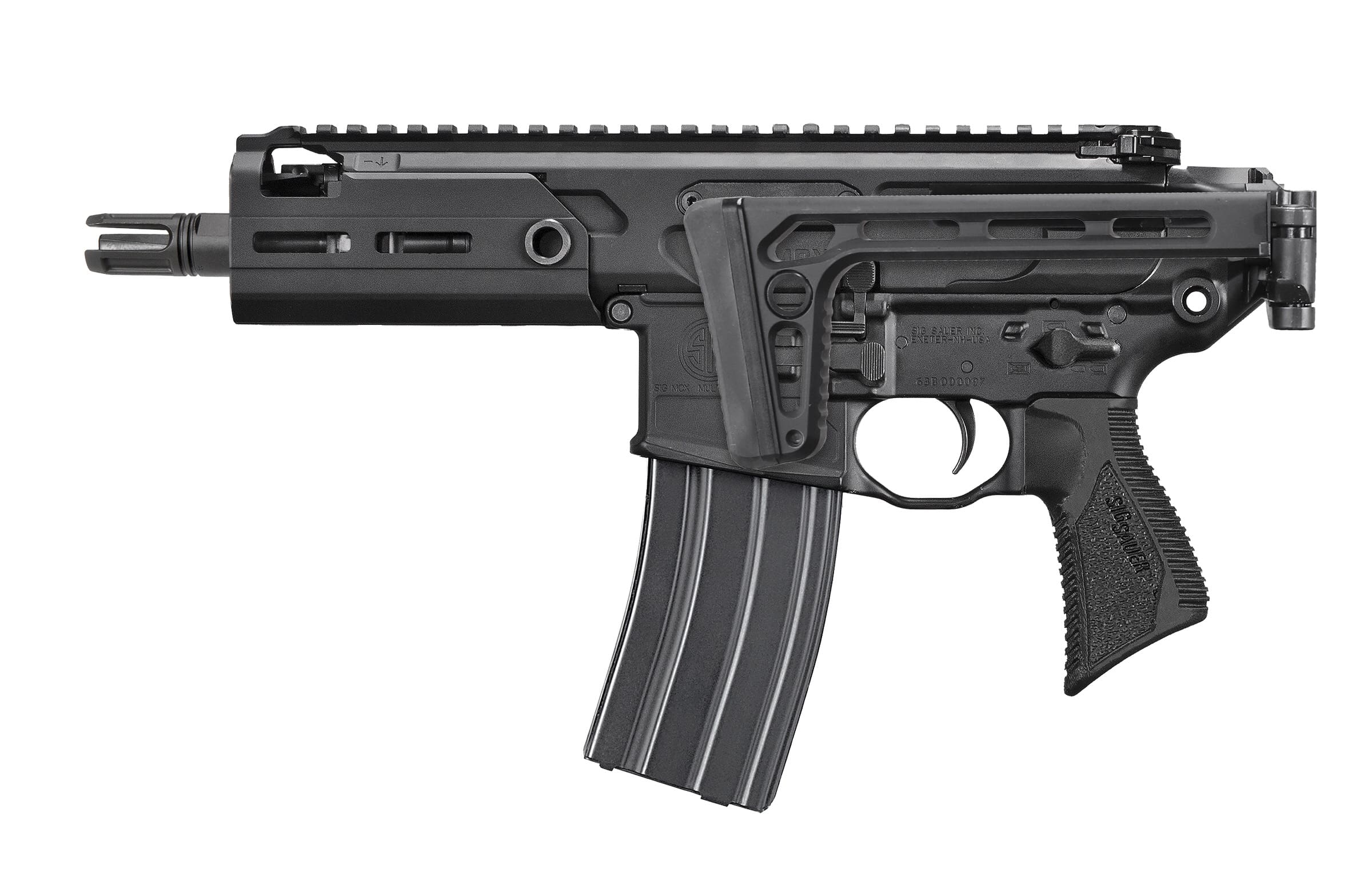
The first question I asked him was about the name. I’d been hearing it float around for quite awhile and wondered where it came from. Apparently, after firing it on full-auto the first time, the designer said, “It really rattles your teeth when you fire it.” Considering the nickname of MCX, Rattler stuck.
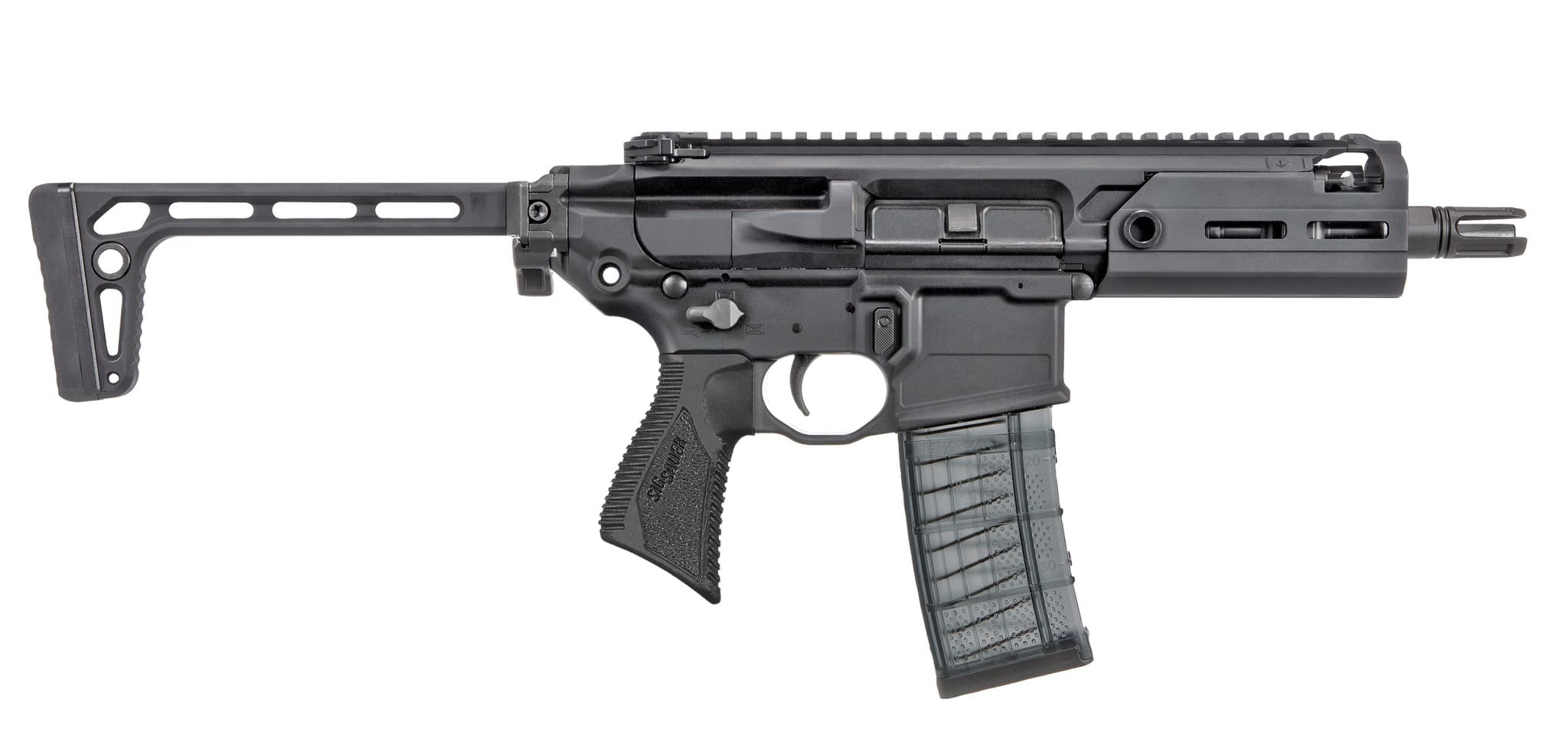
Next, I asked him why they built it. Hanley answered, “Everything was designed to be as discrete and small as possible with this gun.” Quite simply, customers came to them and asked for a Subgun size weapon in 5.56mm or .300 BLK. This is the result of that work.
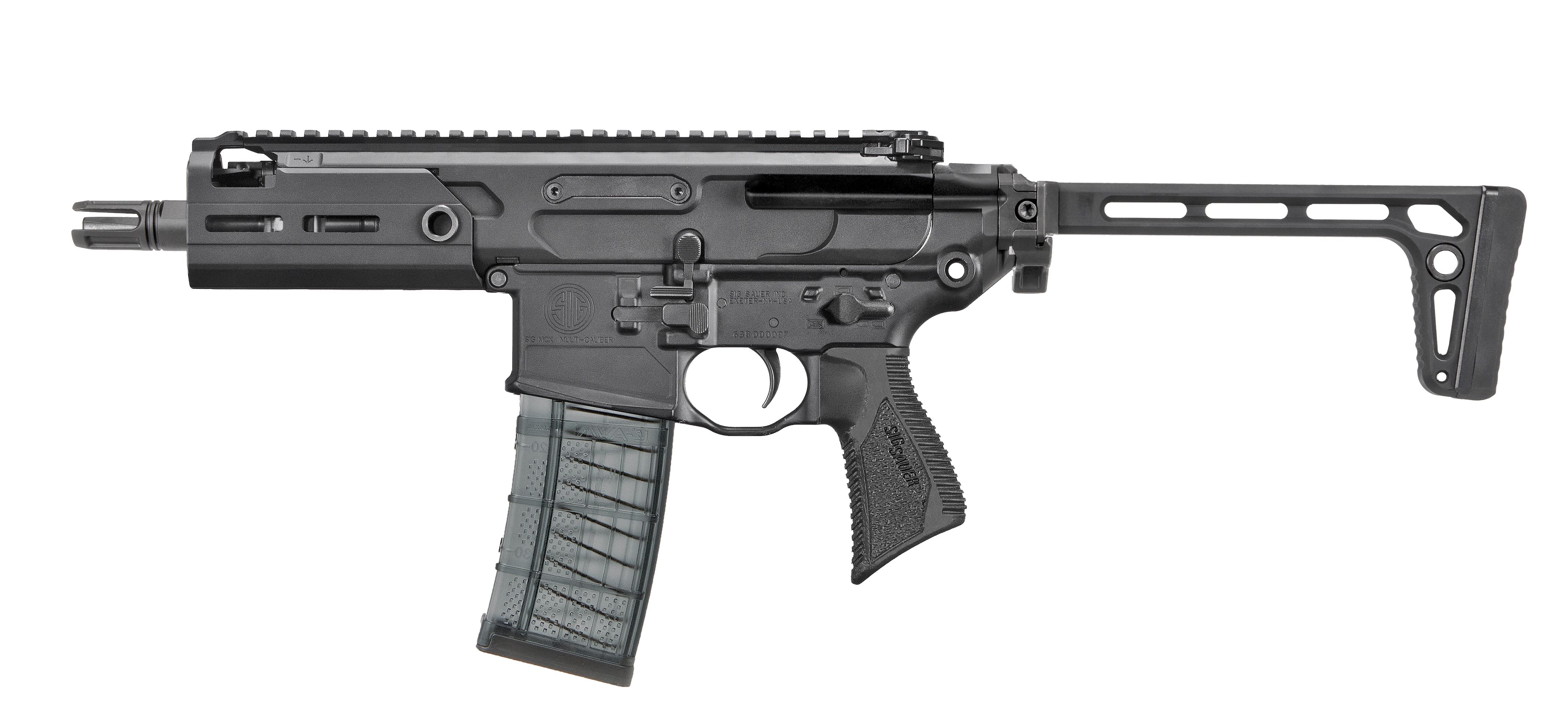
Initially, they leveraged the MCX short stroke piston design, but quickly found that the upper would have been longer than the 5.5″ barrel. Instead, they developed two separate gas systems, one for the .300 and a second for the 5.56.
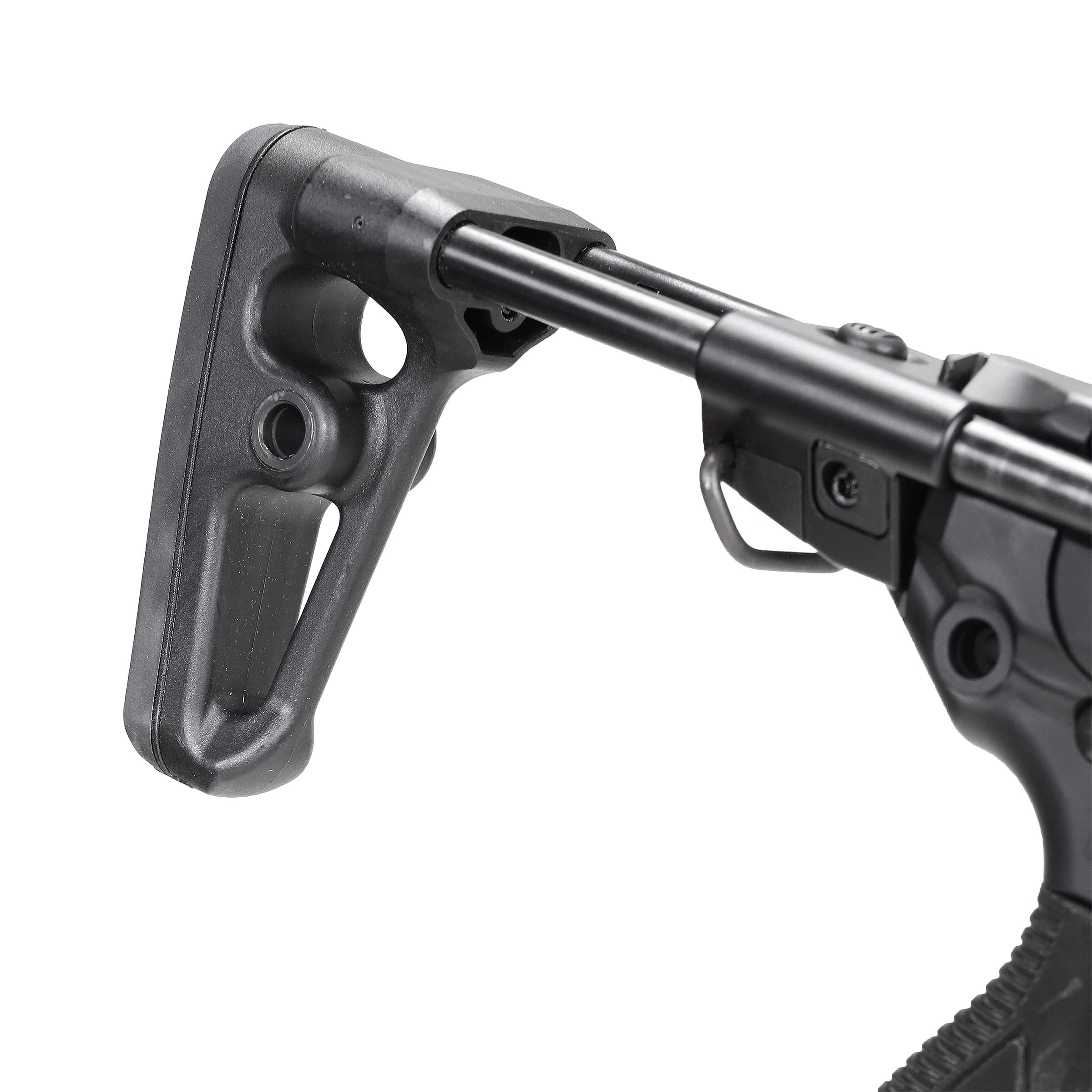
The .300 gas system has two positions and can be used suppressed. The 5.56 is a plugged gas system to prevent valve corrosion. Unfortunately, it cannot be used with a suppressor; not at that length. However, swapping between calibers, is as simple as swapping barrels.
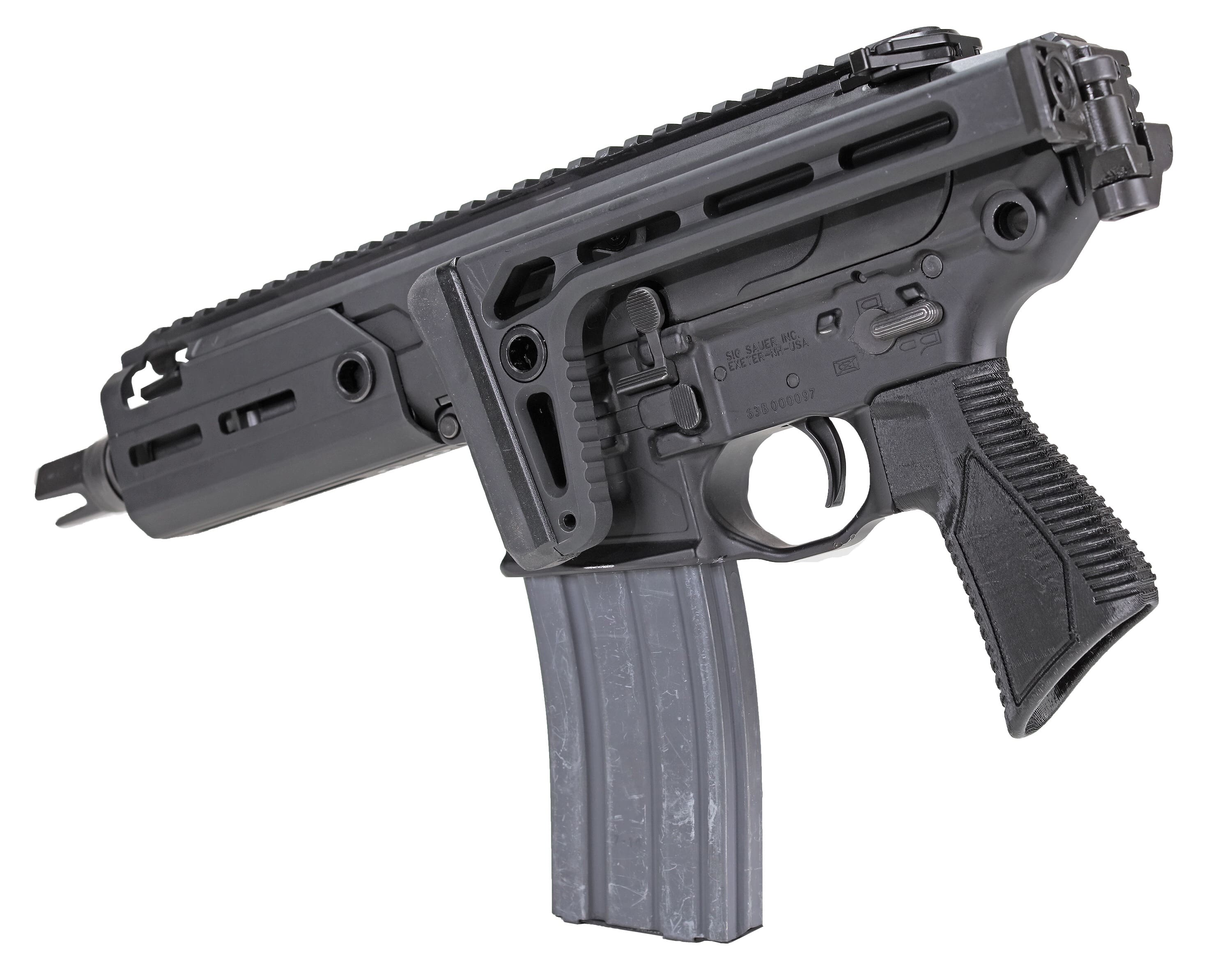
The stock was designed so that all controls can be manipulated with it closed and the weapon itself can be fired with the stock closed, making it a very compact package. Additionally, the Rattler’s upper receiver has no forward assist and their slick side deflector for spent cases.
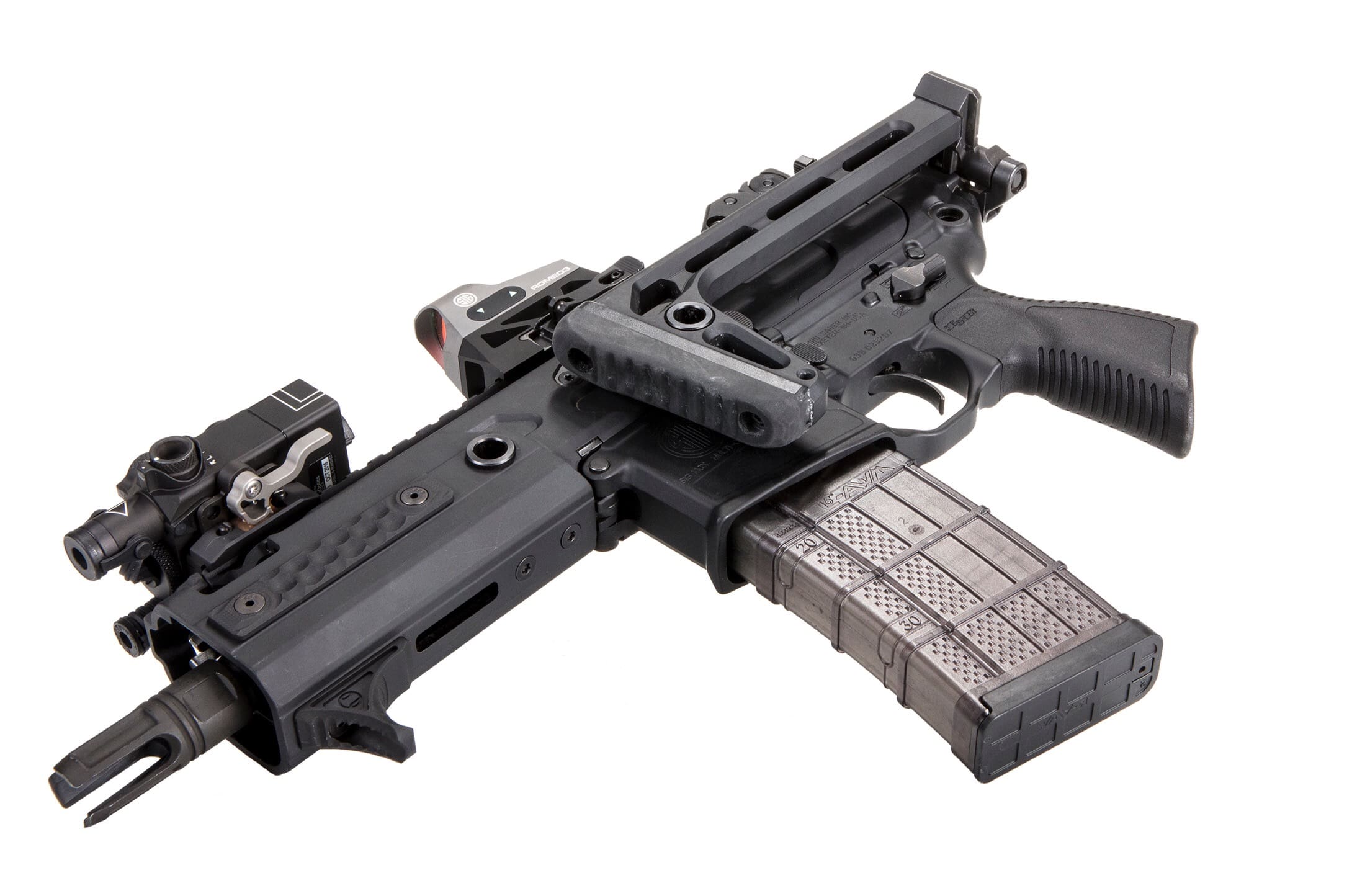
SIG may have succeeded in creating the smallest production AR-style weapon in the world. It’s 16″ while folded and 23.5″ with the stock extended.
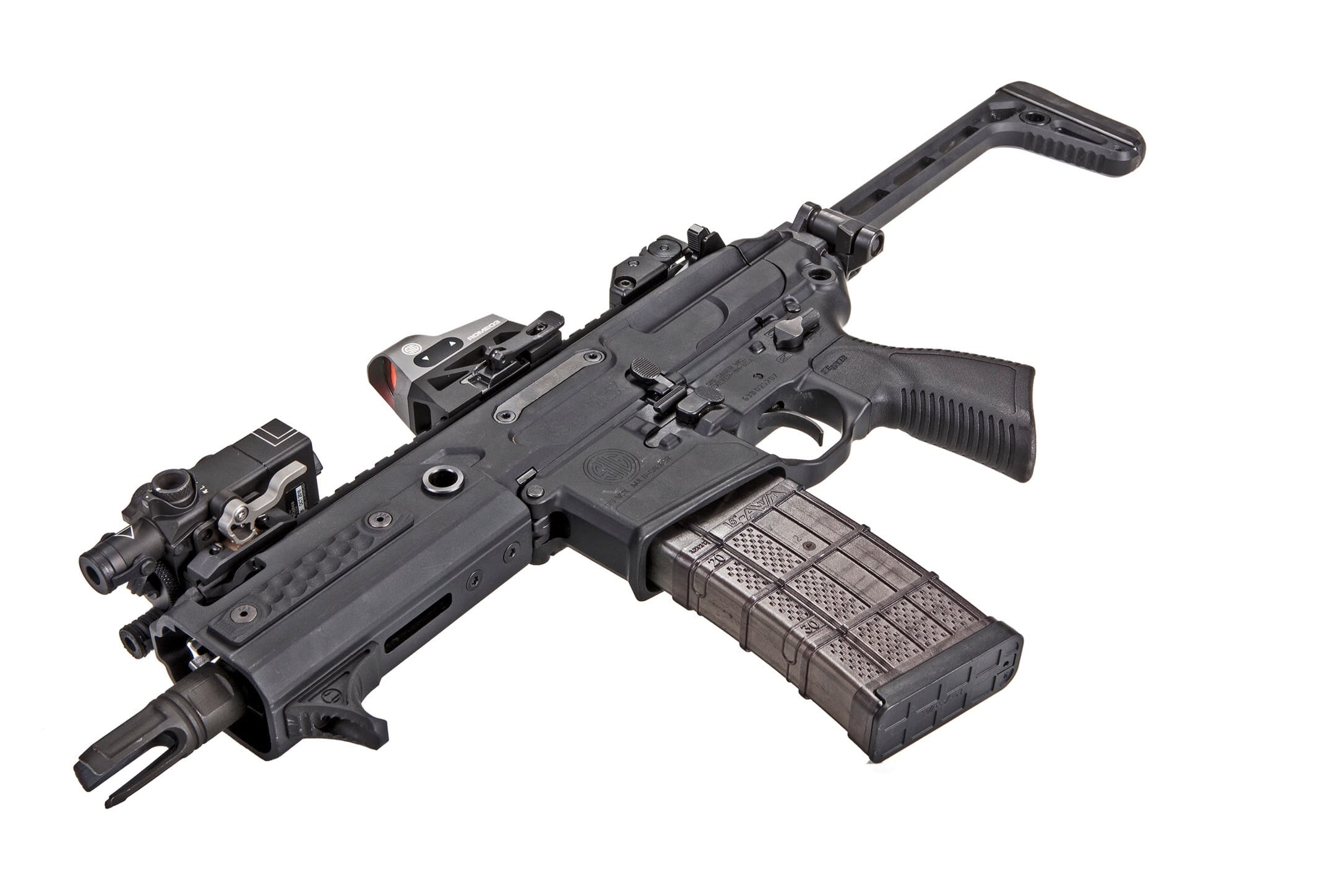
Based on these differences, the Rattler comes as a complete pistol (with SPB) or SBR. The barrels are not compatible with any other MCX upper, so SIG is offering dedicated Rattler Upper Receiver Kits which come with the AR lower adapter knuckle. The Rattler upper kit can be used with an MCX lower or AR lower, when used with the adapter knuckle. For owners of Rattlers, barrel kits to swap calibers will be available so they don’t have to purchase complete URGs.
The MCX Rattler launches today.
UPDATE: .300 Rattlers will ship next week and 5.56 in November.
Knight’s Armament Company has introduced their Light Assault Machine Gun. Chambered in 5.56mm NATO, it offers a low cyclic rate of 575-625 rounds per minute, and constant-recoil/spring run-out operation, making it more controllable than other similar machine guns, weighing nearly twice as much. The optic mounting rail is integral to the receiver, rather than the feed-tray cover, which signicantly improves consistency in optic mounting. These features, combined with the LAMG’s size and weight help it live up to its name. It’s designed specifically for use in the assault, rather than in a fixed position, sustained fire role. However, it does incorprate common machine gun features such as a quick-change barrel (including integrally suppressed barrel) and compatibility with M27 links.
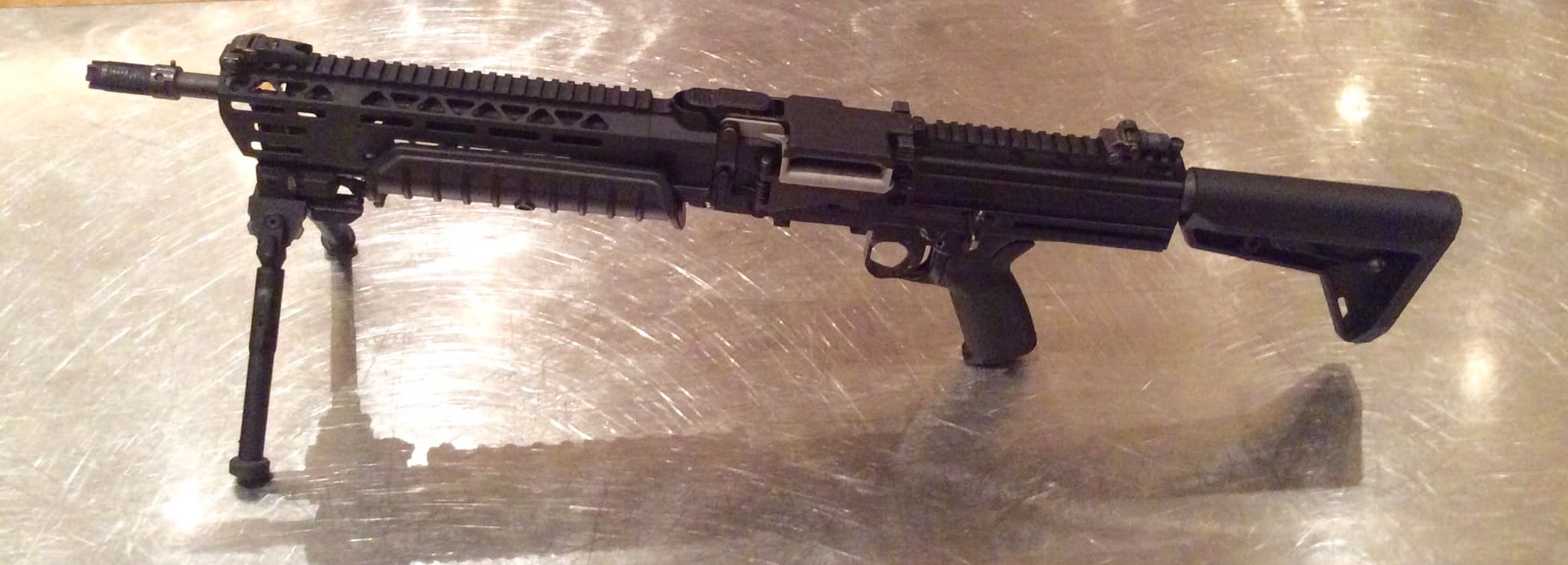
Over the years, I’ve fired various versions of the Stoner-inspired 5.56mm KAC Light Machine Gun, but during May’s SOF Select event in Tampa, I got to check out a very close variant, on static display, of the Light Assault Machine Gun detailed below.
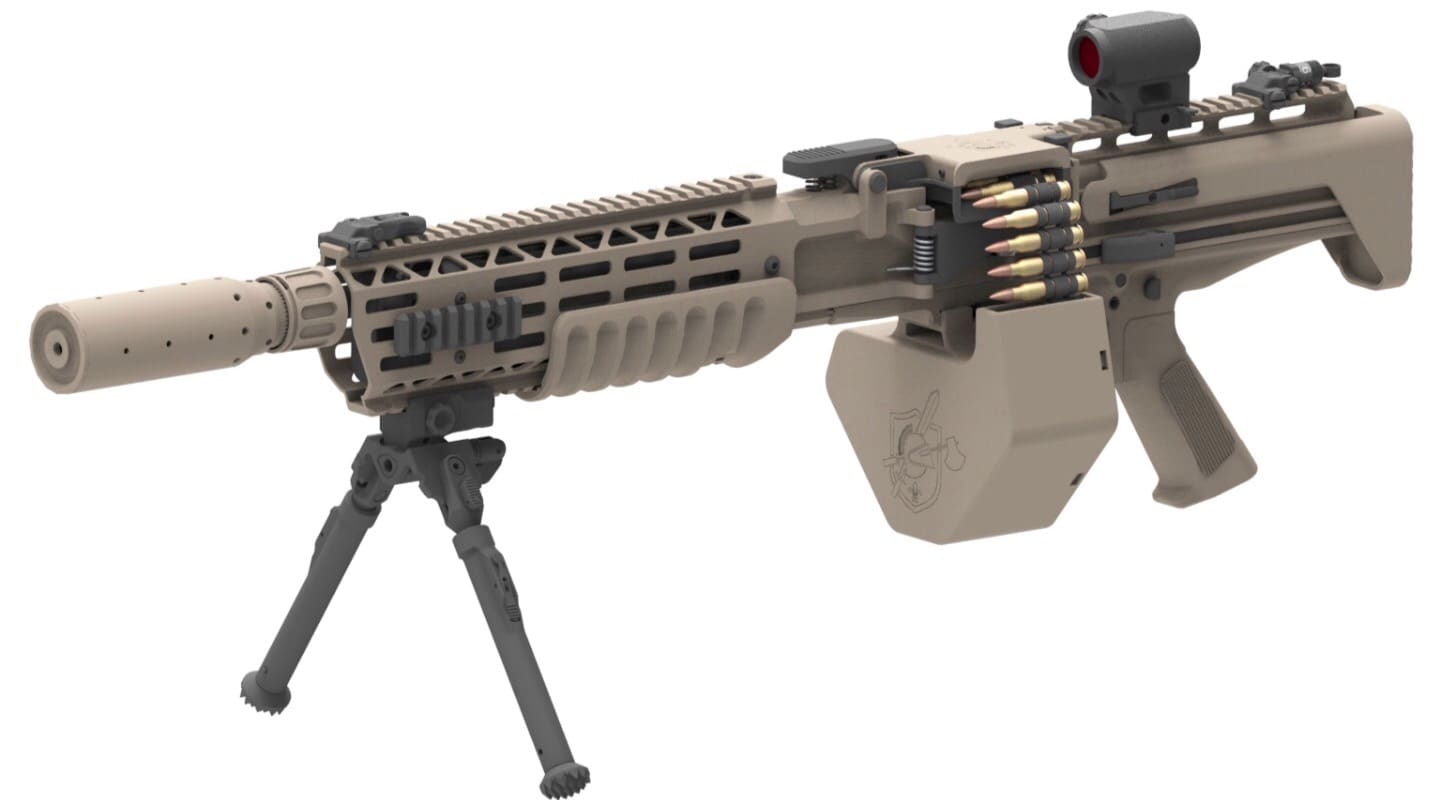
Designed specifically for use in the assault role, it weighs 3.9 kg / 8.9 lbs. Here is a run down of the features:
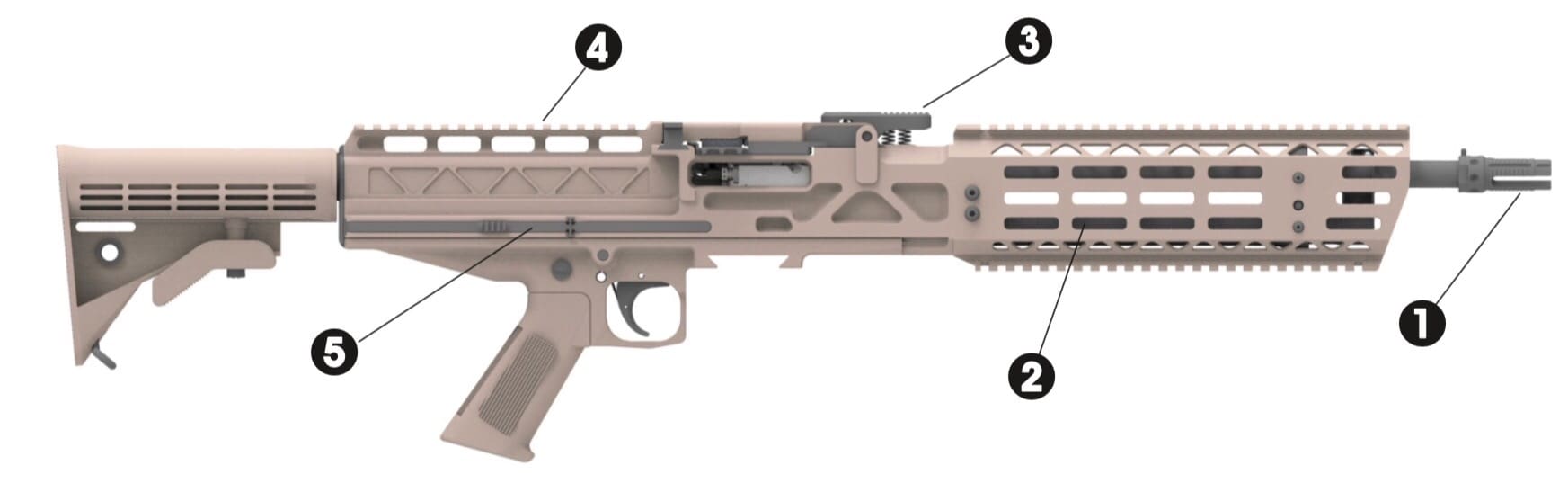
1. 5.56mm 3-Prong Flash Eliminator: This improved design interferes with propellant gas combustion forward of the muzzle to significantly reduce flash signature. The flash hider’s unique 3-prong configuration does not ring when firing or struck. Integral Quick Detach Coupling mounting detents support KAC’s line of QDC sound suppressors for consistent and minimized point-of-impact shift.
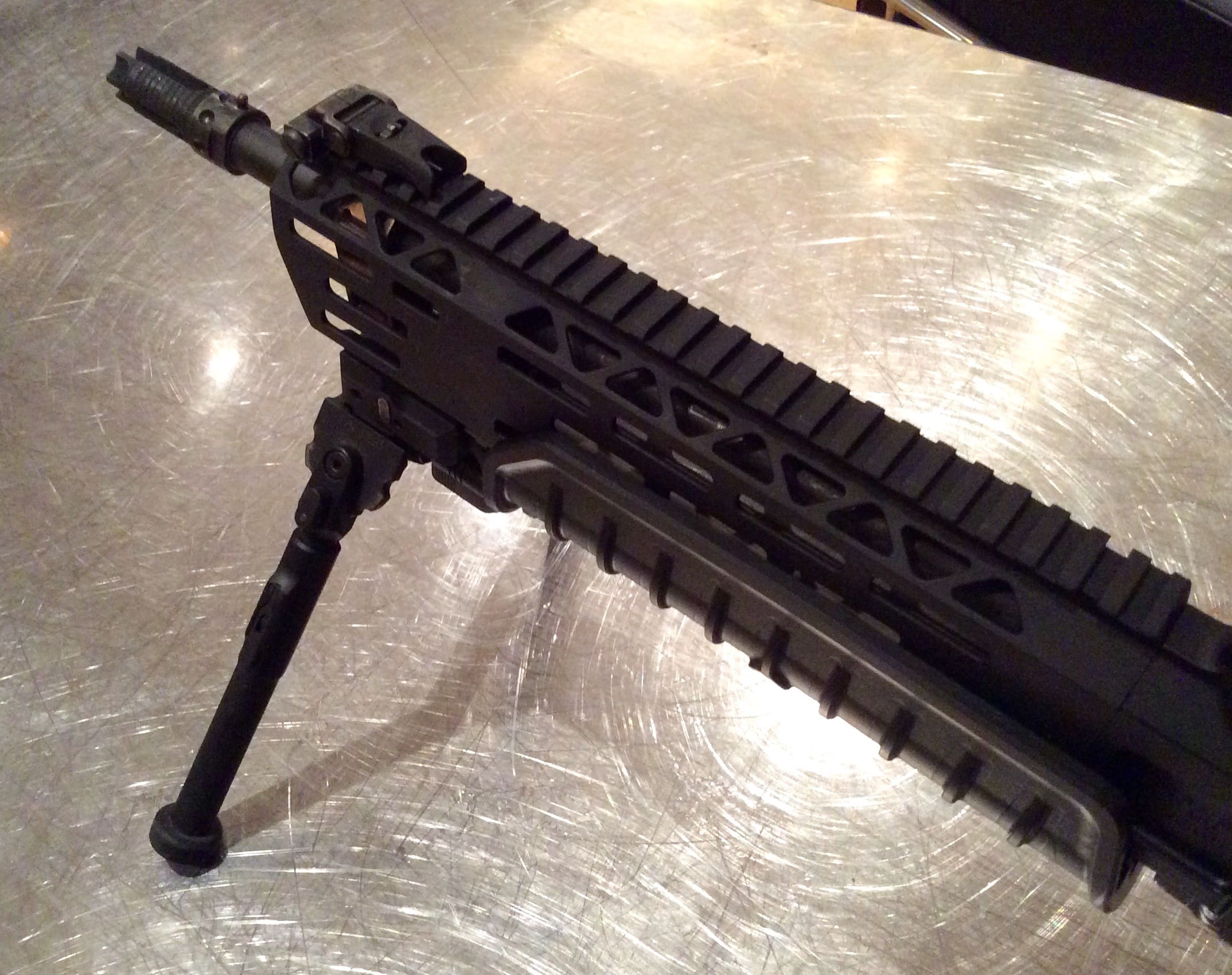
2. Improved Handguard: Free-floats the barrel and gas system, ensuring improved accuracy and easy barrel replacement. Integrated MIL-STD-1913 mounting rails on the 12:00 and 6:00 for maximum strength, rigidity, and security for aiming devices or high-force accessories. Side M-Lok slots permit mounting of a wide array of accessories directly into the handguard, while reducing weight and increasing heat dissipation.
3. Barrel Release and Lock-Up Mechanism: Located at 12:00 on the receiver, it is protected from accidental activation. Unique retention design ensures accuracy and repeatability, but without compromising the ability to quickly replace a hot barrel.
4. Improved Receiver: Integral MIL-STD-1913 rail ensures aiming device precision. Made from weapon-grade aluminum, and milled to reduce unneeded material, the receiver is extremely lightweight, but with the strength needed to provide a lifetime of high-density fire.
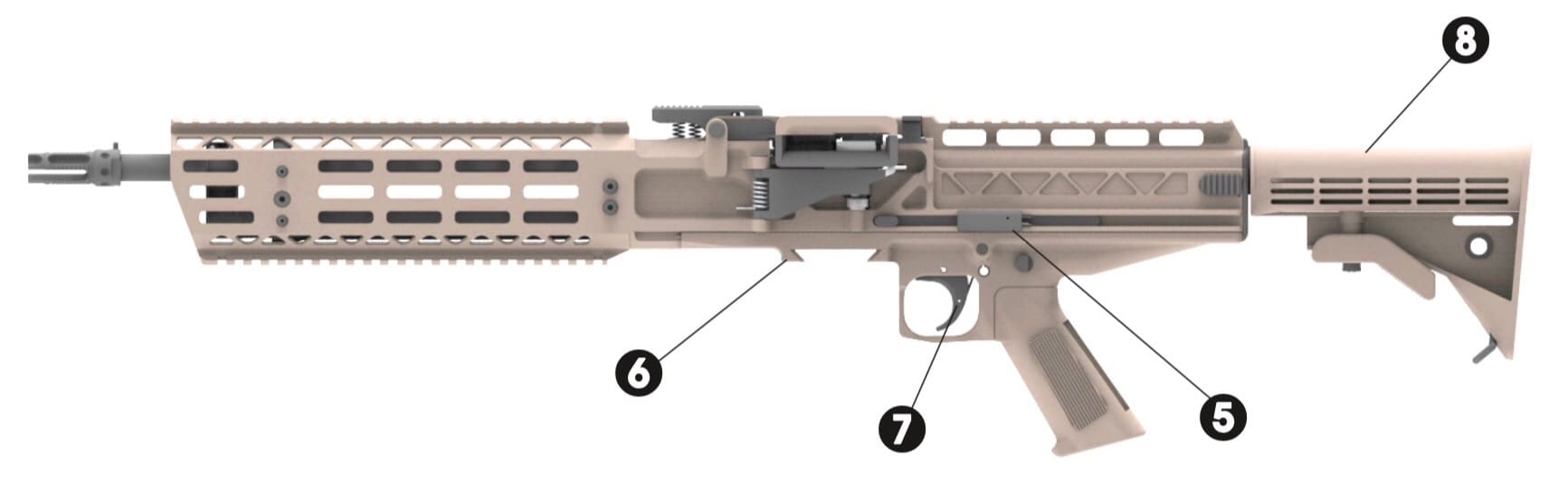
5. Cocking Handle: Placed at the common position for light machine guns for ease of putting the weapon into the firing condition, or to clear a stoppage. Reversible to either side of the receiver to support either primary shoulder, provide the user with alternate manipulation options, and to reduce snag points based on carry position.
6. Ammunition Box Connection Point: Compatible with standard 5.56mm linked ammunition source connection hardware. Fully supports 200-round drums, 100-round reusable soft packs, and other alternate ammunition feed devices.
7. Trigger Pack: Machine gun-specific trigger components and safety bar. Improved hand position for trigger access without interference by safety button.
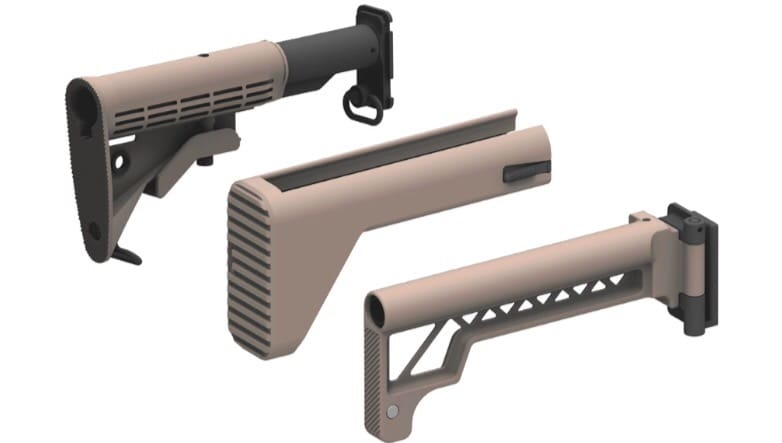
8. Modular Stock: The removable receiver end-plate allows the user to easily swap stocks. Any standard M4 stock can be used with the Mil-Std receiver extension. A fully collapsing solid stock allows the user to immediately pull the stock from a collapsed position, just longer than the receiver itself, to an extended position that supports accurate high-density fire. The folding stock option allows full manipulations and firing from a stowed position, and deploys to an adequate length of pull for comfortable traditional use. Below are a few Modular Stock options. As you can see by the stock designs, the LAMG will operate without a stock istalled but only a receiver end plate in place.
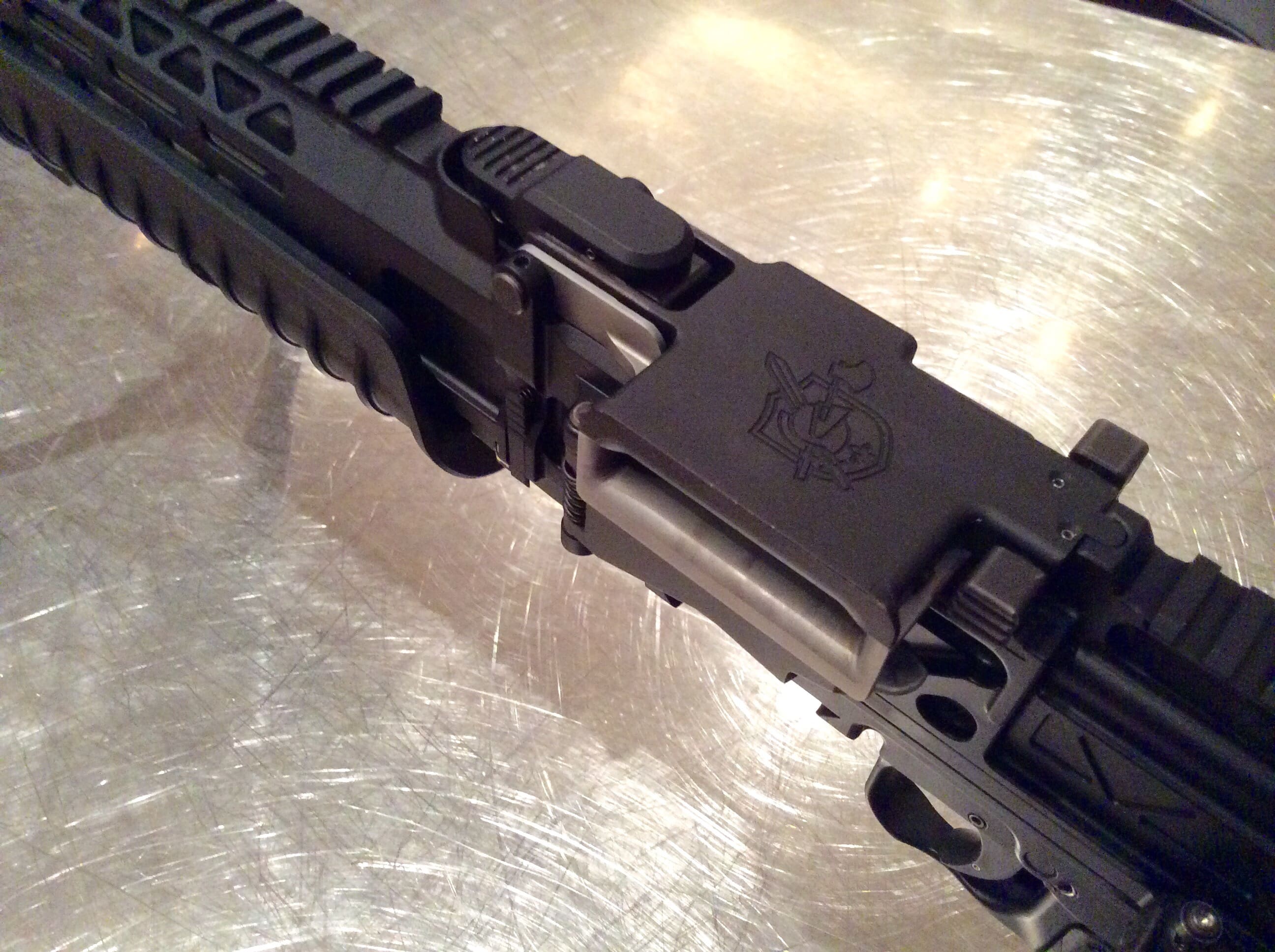
This is a close up of the Barrel Release.
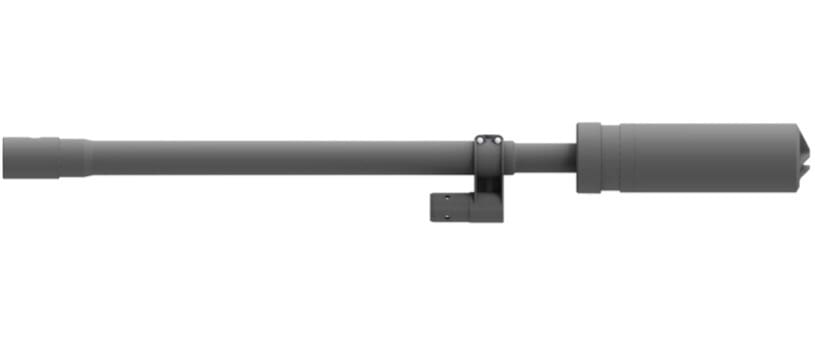
The standard barrel is 15″ in length, hammer forged and chrome-lined, with a 1:7 twist. However, they also offer a lightweight, shortened barrel for use in confined spaces as well as a Dedicated Suppressed Barrel which integrates the suppressor to the barrel, allowing optimal operating pressure. This option is also shorter and lighter than adding a suppressor to a standard barrel due to the elimination of the flashhider and mounting components of the suppressor. Even in this configuration, the suppressor can be removed for routine maintenance.
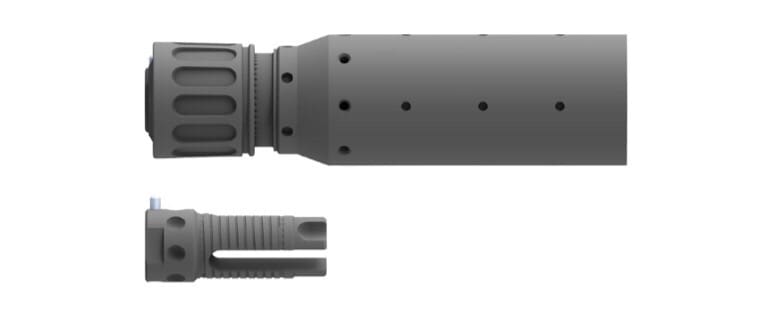
KAC also offers their 5.56mm Machine Gun Suppressor for those who are looking for a modular option. It is a quck detach design with Inconel mount, which was designed specifically to work with the LAMG’s operating system.
Here’s a closer look at the handguard.
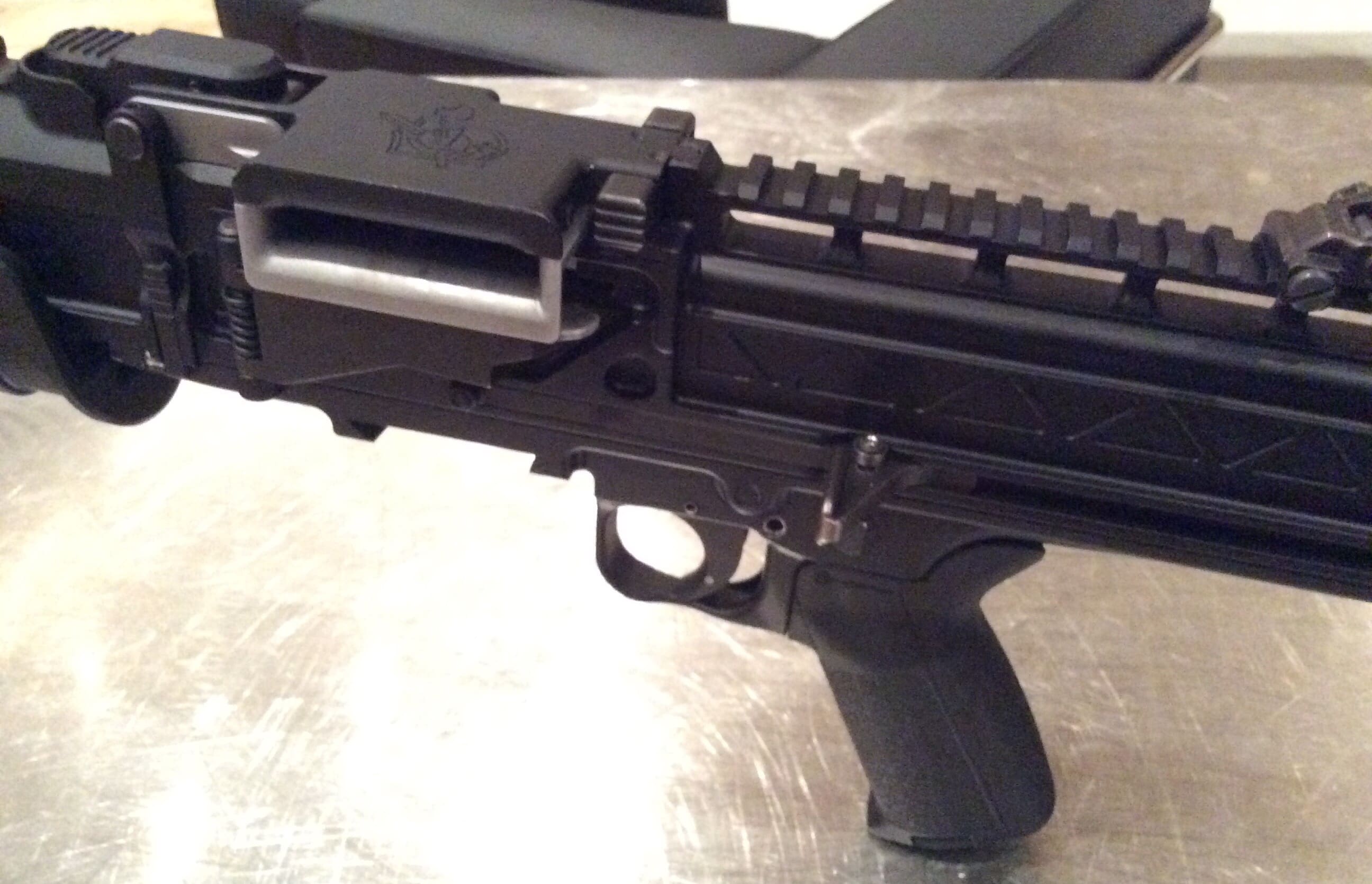
The LAMG will accept AR-style pistol grips, offering a certain degree of customization. You can also see the charging handle as well as the feedtray cover and the various techniques used to lighten the weapon such as the cutouts along the receiver and under the 1913 rail section.
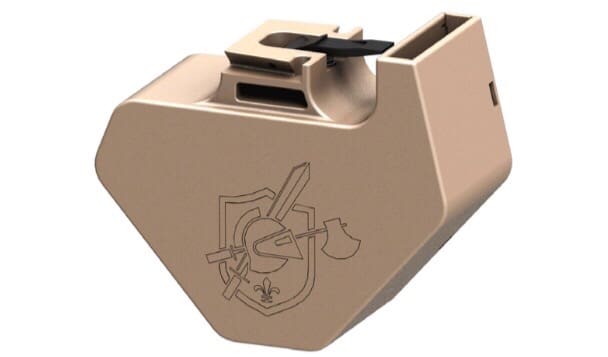
Finally, KAC offers a 150-round Medium Capacity Drum. This hard-side drum can be used as support without the need to deploy a bipod. Raised belt feed control lips give greater protection to the belt to reduce snagging and ensure smooth feed of the belt from the drum to the feed-tray.
The KAC LAMG, coming soon, to a war zone near you.
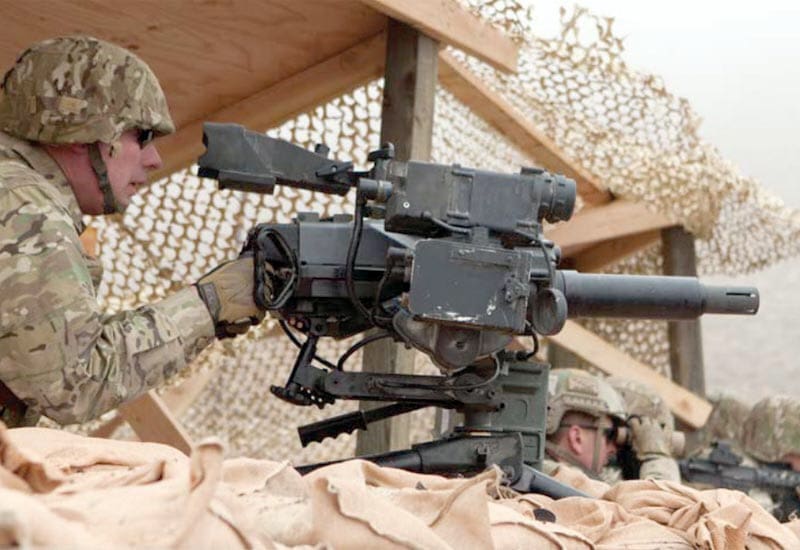
The United States Special Operations Command (USSOCOM) and the PM A&W have issued a Sources Sought Notice to industry seeking sources within the national technology and industrial base for the following:
– High-Velocity 40mm Programmable Airburst High Explosive Ammunition
– The ammunition shall provide effects against multiple target sets, including enemy forces in that are in the open, standard vehicles, behind defilade, and C-UAS scenarios
– The ammunition shall be compatible with existing MK 19 and/or MK 47 High Velocity Weapon Systems
Full details are available on www.fbo.gov.