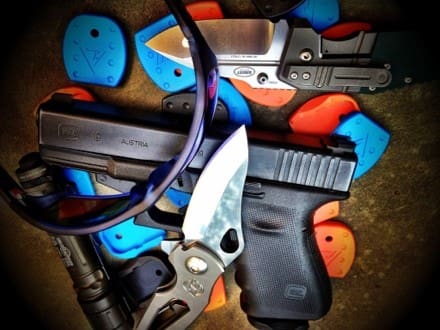
The Red Tac poly filled shooting pillow is now available from OC Tactical in A-TACS AU and FG.
Here are some great shots of the Hog Saddle Tripod Mounted Rifle Rest in Action with some US Marine Snipers.
Get yours from US Tactical Supply or HogSaddle.com.
Magpul is a sponsor of the Hot Shots calendar and during the photo shoot, SSD was able to check out some of their latest wares.
MOE Stock
The new MOE fixed stock for AR-style rifles unveiled at SHOT Show will be hitting the market very soon. QD cups are coming that will accommodate the MS3 mount and be offered separately in order to keep cost down and because not everyone needs them. There are holes in both the front and rear of the stock to accommodate the QD cups offering lot of versatility to the shooter.
It offers slightly larger storage compartment dimensions than the issue A2 stock. Additionally, it uses the PRS buttpad. In fact, it will be compatible with all PRS accessories in the future.
These are the initial photos of production models of the stock.
SGA 870 Stock Upgrades
Look for an MSA style loop adapter that inserts between the SGA stock and receiver. It will fit in the slot seen below. Coming soon.
M3 Magazine
One magazine to rule them all. Seriously. Magpul has invested 3 years in improving their magazine. To me, it’s as if Magpul crossbred the PMAG and EMAG to produce a single magazine that is compatible with the gamut of weapons featuring NATO Std magwells (SA80, HK416, etc) as well as AR Mil Spec weapons. But, it’s not just about new materials. They’ve also improved their molding processes as well as a few design features. By extension, this means they have had to improve their test fixtures to record improved performance. It’s gotten that much better.
Notice the slightly raised portion above and below the mag catch slot. It is an improvement that improves the strength and life of the magazine.


Here you can see the new floor plate design that slides on from the rear. The slim line option shown at SHOT has been abandoned. However, they do plan on releasing a Ranger Plate. Additionally, the dot matrix to aid in magazine marking is visible. You may also notice the bulges along the front of the mag in order to improve grip.
The body of the mag is also a bit different than its predecessors. For example, you can see a slight bulge on the spine about where the magazine bottoms out in the magwell. It’s called an over insertion stop. This is to keep the shooter from over inserting the magazine either during (re)loading or immediate action. Unfortunately, with this feature it looks like that new Kydex I got a few weeks ago from HTC will have to be replaced once these are available. But, the new features are worth it.

Additionally, you may notice the new, more pronounced cut out along the top rear of the mag. This is to more adequately accommodate the bolt hold open devices in some non-Stoner style weapons like the SCAR and ACR. With those weapons the bottom of the carrier could drag across the top of the mag. In fact, both the spine and feed lips performance has improved several fold.

Magpul has also improved the follower. While it won’t look like previous Magpul anti-tilt followers due to its asymmetric shape, they have also improved the channel that it rides along inside the magazine body.
Finally, this doesn’t mean that the PMAG, or for that matter, the EMAG will go away. Magpul will continue to support their contracts for those magazines as well as support those that prefer the slick sided EMAG. If there is one takeaway, it is that M3 (Material, mold flow, mold processing) denotes a technology that will be carried over into all future magazine designs. In addition to a proprietary magazine for an LWRC 6.8 rifle, Magpul assures us that that will be an additional new Magpul M3 technology magazine coming after this model.
Since the invention of the handgun in the 15th century mankind has been steadily improving the concept to what we are familiar with today. It is quite possible that we are at a point where the notch-and-post sight configuration has reached it maximum potential, and red-dot sights for the handgun are becoming more mainstream. This is a great trend for shooters for a number of reasons, but it also has a number of drawbacks that should be understood to ensure you have the capability you need when you need it.
Red dots on handguns might be more prevalent now than ever before, and that is certainly the case for tactical use. However, it’s nothing new, and competition shooters have been aware of the benefits of the red dot for speed and accuracy for decades. As far back as the 1960’s, bullseye shooters experimented with the Burris Bullseye Pistol Scope, and in 1975 Swedish manufacturer Aimpoint released the “Aimpoint Electronic”. Following these in the late 80’s was the wildly popular Tasco ProPoint and C-More, both of which are still available today. One does not have to look too hard to find any number of Aimpoint or C-More optics in the hands of thousands of competitive shooters around the world. These systems are remarkably effective for their purposes, but due to their size and durability were not practical for duty use.
For military/law enforcement/concealed carry use, the trend has just started to gain popularity over the last few years. The Glock and Smith and Wesson M&P series lend themselves to being modified for direct acceptance of small red-dots. Additionally, dovetail adapters for many platforms are available that do not require costly permanent modification to the pistol. David Bowie of Bowie Tactical Concepts was an early adopter of small red-dot sights for duty use, as well as a pioneer in the machining of handgun slides to directly mount the sights. Due to the fragile nature of some older sights, adoption by Military and Law Enforcement users was slow-paced for a few years. Recently, with the release of viable optics by industry leaders, their use has skyrocketed and resulted in a huge growth in the development of mounting systems and support products.
The mini-red dot has a lot going for it. It works the same as the Aimpoint or EoTech most people are familiar with on their rifles: Put dot on target, apply fundamentals. You can maintain focus on your target instead of the sight, which is something many shooters struggle with. It removes the variable of aligning the rear notch and front post precisely on target, although it certainly does not make up for poor shooting ability and in no way acts as a substitute for solid shooting technique. In fact, the new user will likely experience a period of growing pains where the dot is difficult to initially acquire, possibly gets lost in recoil, and is generally slower than when shooting irons until they become familiar with it. Once the average shooter is familiar with using the new system they are likely to see improvement all around, although skills of high-level competitive shooters are at a level where they are so fast and accurate with iron sights the advantages of the dots might be less useful or even nonexistent. People who suffer from visual impairments such as astigmatism or “old eyes” can really benefit from the dot, and may be able to regain a level of former accuracy that would have otherwise been impossible due to declining vision. For military users, the ability to shoot through NVGs to preserve light discipline has been proven on the battlefield with the desired results. The red-dot also offers a tremendous improvement in the ability to aim while moving, track moving targets, and shoot from unstable or asymmetric positions. The cost is significant, generally more than the gun it’s going on, and you are tying yourself to a battery powered optic and hoping the electronics hold up to the violent forces of reciprocating on a handgun. We are not out of the woods on that yet, but the popular modern optics that are suitable for duty use have a pretty admirable track record thus far. Of note, open-type sights like the RMR, Docter, J-Point and MRDS have a diode that is easily occluded by dirt, precipitation, lint, etc. and can block the projection of the dot onto the lens. Care must be taken to ensure that his doesn’t happen, on the tubular style sights (such as Aimpoints) the functional parts of the sight are sealed and this isn’t an issue.
Among the most popular sights for modern defensive handguns are the Aimpoint Micro T1, Trijicon RMR series, Leupold Deltapoint, and Insight MRDS. All of these manufacturers are top-tier manufacturers with decades of experience in making electronics or optics for the tactical market. There are pros and cons to each of them that the user will have to weigh and decide. Direct mounting capability can be provided by Mark Housel at L&M Precision Gunworks, David Bowie at Bowie Tactical Concepts, and Doug Holloway at ATEI. Coupled with suppressor height iron sights from Ameriglo, you can have a fast, accurate electronic sighting system with the reliable backup of traditional irons. L&M also provides the ATOM system from Unity Tactical, which represents the current state-of-the-art mounting system for handguns. The ATOM gives the flexibility to use any of the popular red dots mentioned as well as traditional iron sights through the use of interchangeable mounting bases. This allows the user to forego dedicating a slide to one specific sight only to have it rendered obsolete in the future. With the ATOM, you simply get a new plate with the new sight’s footprint and you’re set. This is a huge asset as small electronic sights are likely to evolve and improve in the near future. Any of these setups can be concealable with the proper base gun and holster setup. Support gear is available from Raven Concealment and Safariland among other smaller boutique kydex makers. Safariland developed the excellent 6354DO holsters in conjunction with elite military units to accommodate the Docter, Insight, and Trijicon miniature red-dot sights and is unequaled for a duty rig with your dot.
Years ago, many rifle shooters were skeptical about the adoption of dot sighting systems, their reliance on batteries, failure of their circuitry, and other concerns. Yet today, the battery powered red dot sight is an overwhelming success for duty use on rifles. The same trend is possibly on the horizon for handguns, certainly the technology is at a point where users with a need for their capability would be wise to start looking into trying a red dot sight for themselves.
For more info, check out the following:
Jon Canipe served on Active Duty with the US Army as a Special Forces Weapons Sergeant at 5th SFG(A) and was a Senior Instructor at the JFKSWCS, training SFQC students in planning, unconventional warfare, small unit tactics, CQB, and advanced marksmanship. He is a veteran of multiple combat tours, and still serves in the Army National Guard’s 20th SFG(A) in addition to working as an industry consultant and small arms instructor.
We mentioned this new G-Code product awhile back and discussed its various attributes. Now we can tell you that it is called a MULE.
According to G-Code – The G-Code MULE is an ISS Carry Platform (Intermediate Suspension System) intended to bridge the gap between traditional belt and thigh transport options. It Rides Higher than a Drop Leg System and Lower than a Duty Mount. It gives the user total security of the weapon platform with the addition of a leg strap, but flexibility with the nylon down strap. Various Belt Attachment Methods are available for the MULE. 1) Standard Down Strap 2) REAC Down Strap 3) RTI Down Strap
Project Manager Soldier Weapons has released a Sources Sought Notice for a Compact Semi-Automatic Sniper System (CSASS). A Sources Sought Notice is a tool used by acquisition officials to query industry on their ability to satisfy a requirement before it is finalized. It serves as a sanity check for a requirement from an industry standpoint as they provide feedback on their capabilities and their capacity to satisfy the need. Additionally, it may uncover a capability that was unknown to those in Government.
In this case, they are conducting a “market survey to identify potential sources for manufacturing a complete system or reconfiguring some or all of the existing 7.62 x 51mm M110 Semi-Automatic Sniper System (SASS).”

The current M110 is a lightweight, direct gas operated, semi-automatic, box magazine fed, 7.62 x 51mm rifle intended to engage and defeat personnel targets out to 800 meters.
Specifically, the are looking for the ability to reconfigure existing M110s or, manufacture new complete systems to meet the following criteria:
1. Operation: Semi-automatic
2. Caliber: Compatible with 7.62x51mm NATO cartridges
3. Accuracy: Capable of 0.60″ AMR at 100m or better with match ammunition.
4. Size: Overall length shall be reduced using a shorter barrel and/or collapsible buttstock. Maximum overall assembled length of the rifle shall be not greater than 36 inches with the stock at its shortest position and no sound suppressor mounted.
5. Weight: Weight shall be no more than 9.0 lb for the unloaded rifle without optics and accessories.
6. Grip: A modular, adjustable pistol grip.
7. Trigger: A non-adjustable match style trigger.
8. Hand guard: A fore-end that includes a fixed 12 o’ clock rail with configurable 3, 6, and 9 o’ clock rails.
9. Sound suppressor: A muzzle mounted, detachable sound suppressor.
10. Muzzle device: A compensator/muzzle break compatible with the sound suppressor.
11. Bipod: Tool-less detachment featuring cant and pan/track capability.
12. Day optic: An Army specified variable power day optic and compatible rings.
13. Back up sights: Iron sights offset 45 deg from the DOS.
14. Sling attachment: Flush cup, quick detach sling attachment points.
15. Barrel and Receiver Life: Significant improvement from M110 requirements while enduring higher rates of fire.
In addition to the above listed enhancements, the CSASS must meet the operational and environmental requirements that were fulfilled by the original M110 SASS.
This means that the Army could be opening up the Compact Semi-Automatic Sniper System or M110 Carbine, as a free and open competition. There are some major implications here as Knights Armament Corp is the current incumbent for the M110.
The Government envisions the production requirement for CSASS is at an estimated range of 125 per month with a capability to ramp up to 325 per month.
For interested parties, the response date is 14 August, 2012.
Use coupon code ARPARTS10 for 10% off all AR parts. This coupon works for all products under the AR15/M16 categories as shown in this screenshot-