Developed for Air Force Special Operations Command, the Massif Field Shirt and Pant are made from an FR blend and printed in MultiCam.
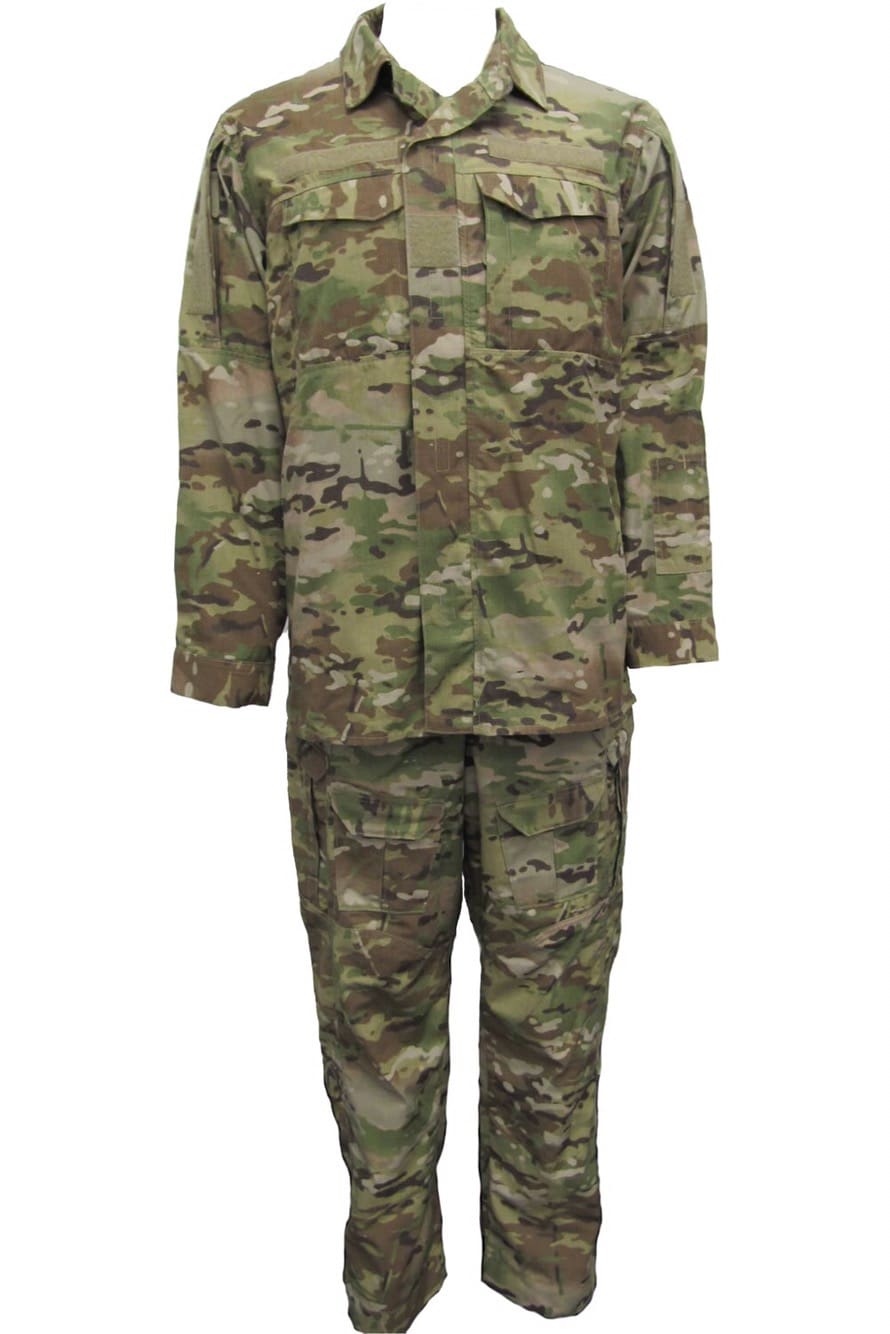
Available in XS-XXXL in short, regular and long lengths.
Look for this and other Massif products at this week’s Warrior East expo at the Va Beach Convention Center.
Author: Armin Wagner
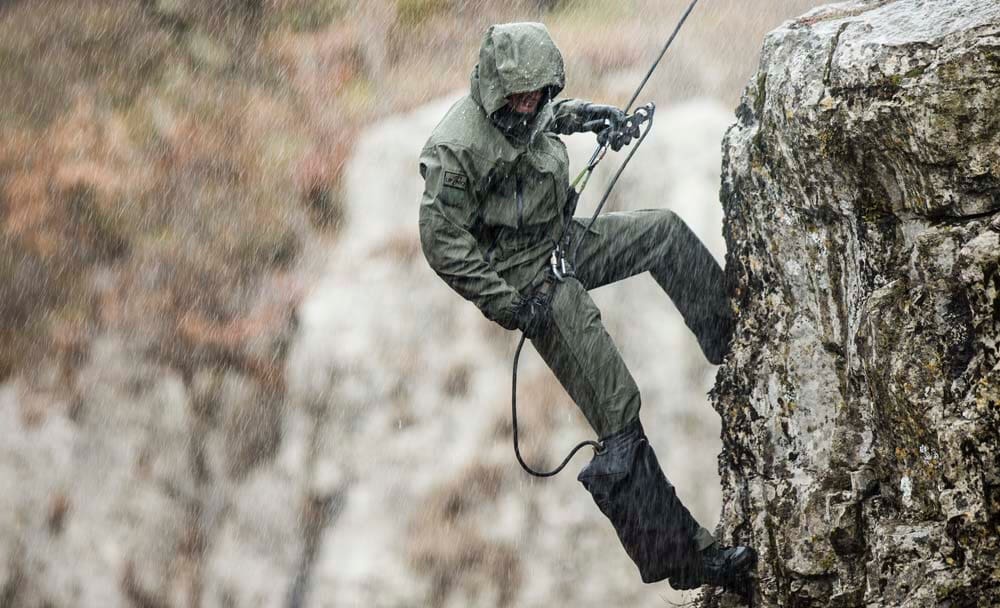
There is quite a mix up regarding waterproof and water repellent textiles. Most of the times, these terms are used synonymously. But there is a big technical difference between them, especially when the expectation is to stay dry in adverse weather conditions.
The significant difference between a waterproof and a water repellent garment is that you’ll probably get wet in a water-repellent garment, especially when exposed to rain for a longer period or under certain wear conditions.
Whereas in a garment made of waterproof textiles one should stay dry, however long and in whatsoever conditions.
Continue reading to find out more about the pros and cons of waterproof and water-repellent clothing. We’ll also explain what DWR means and how you can retain it even after multiple washes.
HOW IS THE DIFFERENCE DEFINED?
The difference between water-repellent and waterproof garments is based on the definition which is applied by the textile industry for waterproofness.
International standards define a water entry pressure of 800mm (hydrostatic water column) above which a textile material (not the finished garment) can be called waterproof. Everything below that can be called only water-repellent.
WHAT IS A HYDROSTATIC WATER COLUMN?
A hydrostatic water column describes the amount of height of a theoretical column of water, which is pressing on the surface of the fabric. So the water column always corresponds to a certain pressure.
A water column of 10 meter (= 1.000 cm, = 10.000mm) equals a pressure of 1 bar, or 100Kilopascal.
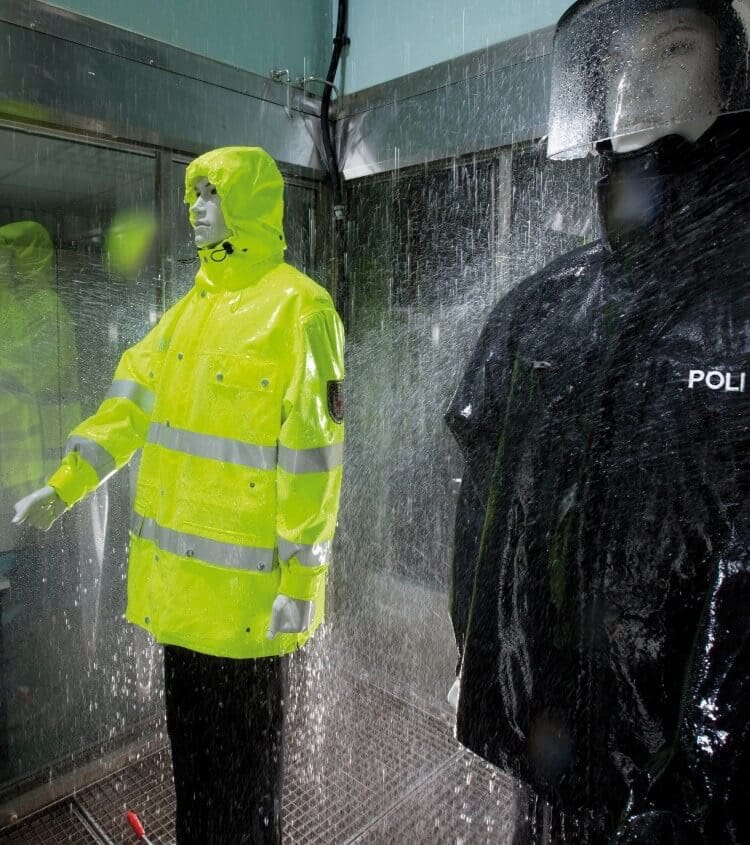
WATER-REPELLENT CLOTHING.
As per definition, textiles with a water entry pressure below 800mm water column or 0,8 bar, can be called water repellent.
This might be enough to stay dry if one is only for a short time exposed to rain or any moisture, which is not pressed onto the textile.
As water-repellent materials usually do not contain any kind of membrane of compact coating, the so-called breathability of these materials is in most cases better than the one in waterproof materials.
This is quite logic, as they have a higher air permeability and also sweat, or better moisture vapour can permeate much easier.
WATERPROOF CLOTHING.
A waterproof material, as per definition above is not the guarantee for waterproof garments.
Also, the overall design of a garment has to prevent rain to enter into the inner layers of the clothing system. That means that all closures, all seams, all edges must block any potential water entry attempts.
To prevent moisture to penetrate the seams, all seams which connect the outside of a garment with the inside of it have to be sealed with a seam sealing tape.
These seals have to be durable to washing, drying and any kind of wear and tear. They have to be durably waterproof.
As water usually finds a way to enter, wherever there is the slightest possibility to enter, this is quite a challenge.
Especially around edges, one might experience that without proper barriers, moisture can be seen wicking around them and all the way up into the inside of a garment.
Critical are the lower hems of the torso and the sleeves, but also the edges of the hood are neuralgic areas for wicking effects. To avoid this, wicking barriers have to be applied in these areas.
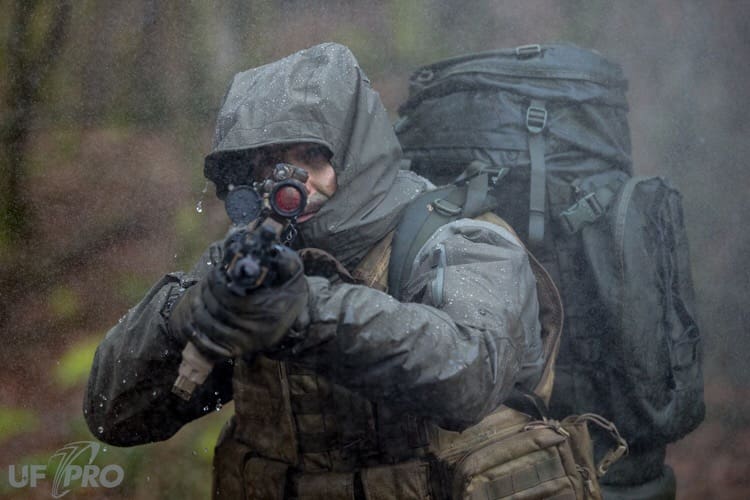
DOES THAT DEFINITION ASSURE THE WEARER TO STAY ALWAYS DRY?
Especially while sitting or kneeling there might occur water entry pressures, which are much higher than 800mm.
That means that depending on how the garment is used the wearer still might get wet, even though the textile is classified by the above definition as waterproof.
Therefore, most of the high-performance waterproof garments are made of textiles, which block the water entry at much higher pressures.
GORE-TEX® laminates, for example, have been tested with a very sophisticated test instrument, which applied a water entry pressure of more than 100 meters. And still, there was no water penetration through the laminate.
Read more about the performances of GORE-TEX fabrics.
Today a truly reliable and durable waterproof performance can only be achieved with membrane-based products.
In these products, the membrane is the primary barrier to any water entry.
The chemical and physical characteristics of these membranes define not only the limits of the water entry pressure but also their durability.
Especially polyester and polyurethane based membranes seem to have a tendency to get weaker over time and sooner or later their performance drops below the critical thresholds.
This might be the result of UV radiation, ageing, flexing, high or low temperatures and of course also of numerous washing cycles.
Still, the bi-component ePTFE membranes, which are used by GORE-TEX®, Event and some other brand membrane manufacturers show the best results regarding the durability of its waterproof characteristics.
But what all of the membrane systems have in common is that if they are punctured, they will leak.
In fact this is the most common reason for all failures, which we experienced over the last 20 years.
Punctures can be caused by any kind of pointed, edged objects.
Very popular are for example pine needles which cover the ground in forests, thorns of bushes, but also dirt, which accumulates over time within the fabric structure.
DURABLE WATER-REPELLENT TREATMENT.
The water-repellent characteristic is in common textile materials achieved by a thermal and chemical treatment of the fabric during its manufacturing process.
This is called a DWR, or “durable water repellent finishing.
Even waterproof fabrics have a DWR treatment, even though the waterproof component (membrane or coating) by itself is already waterproof.
As a matter of fact, when we have the waterproof performance of our GORE-TEX® gear tested, then the DWR is completely washed down, and the garment still has to be waterproof.
So why is this?
4 REASONS WHY DWR IS APPLIED TO ALREADY WATERPROOFED CLOTHING.
1. PREVENTING LEAKS DUE TO SLOPPY CONSTRUCTION WORK
Applying DWR treatment to already waterproofed garments acts as a safeguard against sloppy construction of the sort that might permit leaks to develop following heavy usage or multiple washings.
Before a garment made of GORE-TEX® can be marketed, it must pass the GORE-TEX® Performance Standard (GPS) test to prove its waterproof-worthiness.
Conditioning approval to market a product upon passage of the GPS test is unique to GORE-TEX®.
Does that mean garments will not be waterproof if made of membrane products other than GORE-TEX®?
No.
It simply means that any GORE-TEX® garment you buy will come with a guarantee that it passed a demanding test to prove it is waterproof.
In order to conduct GPS testing, we first need to wash down the initial or subsequent DWR treatment so that any construction deficiencies can become evident.
2. DWR PREVENTS WATER FROM ADDING WEIGHT
All membrane products have an upper or outside fabric layer (also called the face fabric).
The membrane is always located behind this layer.
DWR prevents the face fabric from absorbing moisture or water.
This is important because absorbed water adds weight to the garment. In some cases, the weight gain can be significant.
Good DWR treatment ensures that the garment retains its actual weight, even after hours of exposure to heavy rain.
3. DWR AVOIDS PSEUDO-LEAKAGES
Another benefit of good DWR treatment is it prevents you from feeling as if the garment is leaking.
If the face fabric becomes soaking wet, it will create a sensation of clamminess between your body and the inner fabric.
The garment might not be actually leaking, but the clamminess can make you swear that it is.
It’s a nasty effect, no doubt about it. One way to fight that feeling of clamminess is to create interior “air cushions“, by using our air/pac® inserts.
The air/pac® inserts help enormously, but only in the exact position, where you place them – and where they are designed to go is in just the most critical areas.
In all the other areas, one has to rely on a proper DWR.
4. ACTS AS A TEMPORARY PATCH OVER MICRO HOLES
Sooner or later and after you’ve subjected your waterproof garment to rugged outdoor use, the membrane will almost surely develop micro-holes.
This is hard to avoid, especially when you wear a rucksack, chest rig, or similar other gear atop your garment.
Your garment is also bound to come into contact with pine needles, sand, earth and other small particles.
From this contact micro-damage to the garment’s membrane occurs.
You can minimize the potential for this problem by washing your garment thoroughly after outdoor use.
This helps flush away particles that can become trapped within the outer fabric structure – particles that, if left alone, will tend to burrow through the membrane.
DWR is your best defence. It can act as a temporary patch over micro-holes in the membrane, thereby keeping water and moisture at bay so that you can remain dry.
However, you won’t remain dry indefinitely. The patch effect lasts only until you subject your garment to pressure.
In light of all this, is it important to apply a DWR treatment to already waterproofed garments? Undoubtedly, yes!
But is it also important to apply a DWR treatment after a routine washing?
Very possibly. Here’s why.
DWR is not permanent; it loses its integrity over time and dissipates. So it needs to be renewed after a protracted time of wearing or many wash cycles.
However, there are some things you can do prior to applying DWR that will make the treatment’s effects last longer.
HOW TO RETAIN THE DWR?
Step 1: Check the quality of the DWR treatment
You can test the quality of the DWR by yourself. Just put some water on your gear and check if the water stays round like a little drop.
If this drop flattens and spreads immediately after applied, it gets absorbed by the outer fabric, then it might be the right time to do something aginst it.
Step 2: Iron or tumble-dry your clothing
You can reactivate the initially applied DWR simply by ironing the outer side of your rain gear.
This will help you to retain a good DWR performance for some time and before using some chemicals, which might pollute the water, and might also affect the breathability of your gear.
Also what you can do is to dry the clothing in a dryer and like this reactivate the DWR treatment to some degree.
Step 3 (in case step 2 isn’t sufficient): Apply water-repellent treatment
In case you think it’s time to apply something, then my personal preference is to apply the treatment solely on the outside of the garment, instead of the washing machine procedure.
Why? I prefer that on the inside of the jacket my body sweat is spread over an as big as possible surface so that it can evaporate through the membrane and to the outside as quickly as possible.
If there is DWR on the inside of the garment, then moisture might not spread that efficient, but condensate and run down the inside of the garment.
ARE GARMENTS MADE OF WATERPROOF LAMINATES ALWAYS WATERPROOF?
Not all clothes made out of a waterproof material are 100% waterproof. Its construction significantly defines the level of waterproofness.
As a matter of fact, also a lot of soft-shell garments are based on membranes with a water column of way over 800mm.
But due to its structure, the seam of soft-shell garments are impossible to be reliably sealed.
Therefore, water will after a longer time of rain exposure enter into the clothing.
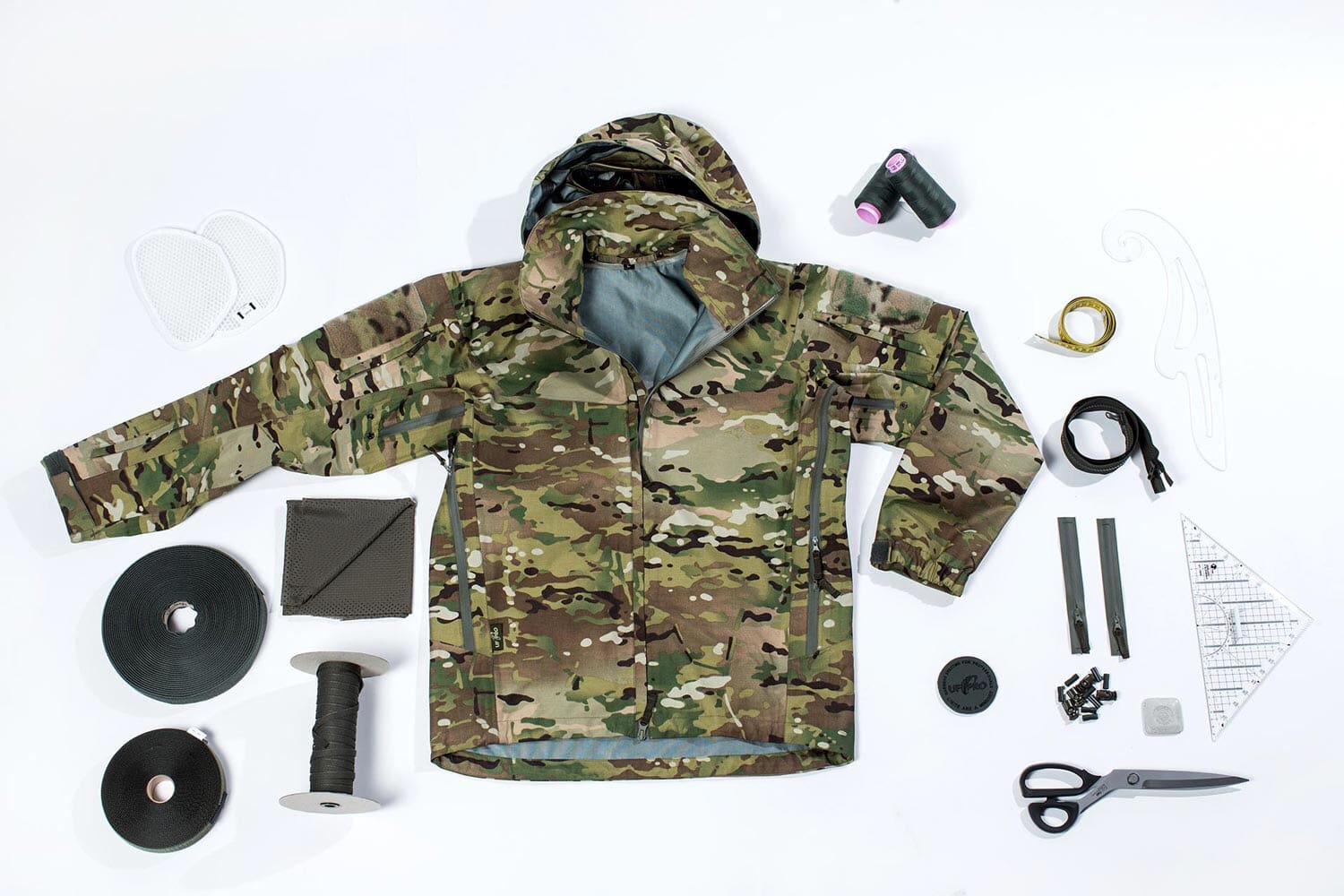
Also, mechanical damages of the membrane, which might be the result of edged objects like dirt or pine needles can perforate the membrane.
These damages have to be professionally repaired.
If you encounter a potential leakage in your Monsoon waterproof garment, then please send them back to us with a precise description where you think the leakage occurred.
We will try to locate the damage and repair it for you.
About the author:

ARMIN WAGNER
is the mastermind behind all UF PRO® products. With over 25 years of experience in the textile industry for law enforcement and military units, and after working for some of the industry’s leading companies, like W.L. Gore, Second Chance and Armour Holdings, Armin finally landed at, as he describes it, his dream job, as the head of product development at UF PRO®.

Fountain Valley, CA—SureFire, LLC, manufacturer of the world’s finest—and most innovative—illumination tools and tactical products, is proud to announce the delivery of SureFire suppressors and Vampire Scout Light® weaponlights for both rifles and machine guns to the Philippine Marines. This delivery is a result of Joint U.S. Military Assistance Group and intended to fight the Maute terrorist group, which has pledged alliance to the Islamic state. The Maute currently occupy the city of Marawi, where an ongoing battle ensues and over 200,000 civilians—many still trapped in the city—have been forced to evacuate. SureFire VP of Sales & Marketing, Mark Hanish, stated “We are glad the Philippine Marines are getting the best possible equipment available and confident this equipment will improve the survivability of their warfighters. We wish them the best of luck.”
Behold the Infiltrator Jacket by Outdoor Research. It’s not about the price, it’s about what it can deliver. Sure, it’s a luxury at $795, but with the ongoing sale, you’ll be able to immerse yourself in unparalleled tactical apparel thoughtfulness for only $596.25.
Here’s Nathan Jenkin, Lead Designer from Outdoor Research, with Steve Keefer, giving a quick overview of the product. Click on the video only if you’re ready to have your mind blown.

Still on the fence about the Infiltrator? Stock up on your gloves and other Outdoor Research Tactical essentials and save 25% off on your purchase until Sunday, July 9.
To read more about the Infiltrator Jacket, visit U.S. Elite’s blog.

Blue Force Gear made 25 of these custom pouches for “Star Trek Beyond”.

For anyone who owns a GLOCK19, they’ll be among the first to tell you that it’s a pretty great pistol right out of the box. Arguably one of the most simple, reliable, accurate and reasonably priced, the GLOCK has been at the top of the pistol market for the bulk of recent history.
GLOCK makes no bones about the fact that they stay true to who they are – even down to the aesthetic of their products. There’s no mistaking what a GLOCK looks, acts and feels like.
That being said, even the most classic models can stand to upgrade. Personally speaking, GLOCK’s triggers aren’t my favorite, the barrels aren’t “match-grade” and the slides are about as exciting as ramen noodles without that spice packet.
Fortunately, the market is becoming more populated with custom-houses who specialize in making GLOCK’s look…well, awesome. However, in order to get this customized look, you have to send your pistol in, wait forever and spend a King’s ransom to get your stock slide machined. Although you achieve ‘cool’ factor, the function and accuracy of your GLOCK is not always increased.
Enter Grey Ghost Precision. Traditionally known for their top-tier rifles, the folks at GGP introduced us to their new line of GLOCK slides while at SHOT Show in Las Vegas.

Few companies have been able to successfully make the step as seamlessly as Grey Ghost Gear – and their expansion into the firearms world. The company, which is best known for its gear, garments and packs, launched itself headfirst into what is seen as an already crowded market. The first three rifles that came out of the firearms entity, Grey Ghost Precision, were nothing short of awesome – and anyone who knows the team at Grey Ghost would know, they weren’t satisfied with stopping there.
Grey Ghost has continued it’s clear focus on the end user, creating a thoroughly tested and combat proven product that focuses on quality and affordability. Additionally, they have made the product available and attainable to ‘us guys’ that can’t really afford the ‘gucci’ bedazzled products and made the products attainable. Tightening up the tolerances and using better materials has really made a difference.
The increase in popularity in handgun modifications also increased turn-around time for many mod-shops. Realizing this ever-growing delay in the process, the team knew they had to come up with a better solution. Never compromising on performance, Grey Ghost turned their heads in the direction of pistol modifications – from slides to barrels, and boy, are they sweet!

Grey Ghost has worked hard to maintain a reputation in the industry that is second-to-none when it comes to class, work ethic, quality and innovation. The team not only brings new products to the market on a consistent basis (typically ALL products go to combat before they are available), but they ensure that each product that goes out the door is worthy to carry the brand’s name.
Grey Ghost takes a different approach to GLOCK modification however, as they manufacture their slides in-house! Made from17-4 billet stainless steel, allowing for tighter tolerances than a factory slide, GGP manufacturers an entirely new slide for your GLOCK right on the premises.
To ensure user-satisfaction and ultimate perfection, Grey Ghost deploys their products into the hands of trusted industry partners and professionals. The team relies on their feedback as an invaluable ingredient in improving every product, and ensuring they are exactly what their customers want to carry. Taking every review and critique, in conjunction with thoughts from Special Forces teams and instructors, Law Enforcement, competition shooters and hardcore hunters, the product you will see come out of the box will be the result of legitimate evaluations and honest feedback. These slides are available in two different slide machine patterns for both G19 and G17 sizes, as well as the option of with or without an RMR optic cut.

At their 2017 launch, the slides are initially available as stripped (ready to go after installing internals, sights and barrel) and only costing $424 – so not only are they badass, and driven by feedback from their end-users (just as is the case with all of their products that come out the door), but they’re also affordable and attainable.
I was given the opportunity to test out one of GGP’s GLOCK Gen4 slides, and walked away from the range, right into my place in line – ready to order my own.
The slide arrives in an intriguing black box marked with a minimalistic line drawing of the slide design, with the ominous skull of the company logo on the side. It doesn’t scream at you – it’s subtle.
Upon opening the box, however, an entirely new tune is sung. The slide comes with a manual depicting the RMR slide plate and mounting screws, and the lifetime warranty information. Perfectly presented and ready to go!
Initial Impressions:
The GGP G19 V1 RMR Slide looked and felt great. Immediately I could tell that the top and side serrations would make gripping and charging the pistol instantly easier; and the rear serrations were cut deep enough to effortlessly power stroke the weapon, without fear of my hand slipping off. It was also already cut to be RMR ready, and an intricately designed plate made the slide look not only intimidating, but statuesque.

I quickly installed the slide onto a stock Gen4 frame and began to dry-fire, racking the slide from both the front and the serrations. The deep-cut groves in the metal seemed to bond directly to my hands, adding a degree of confidence every shooter can appreciate. The slide exterior was Black Nitride coated, offering years of protection against corrosion and abuse. Adding this slide only made the GLOCK feel more comfortable to handle. Once the initial lust for this elegant piece of machinery wore off (and I took a break to go to the store and bought more ammo), I knew it was time to actually put it to work and rip as many rounds through it as my trigger finger could handle.

Range Time:
Let’s be honest, there are a lot of pretty looking guns on the market – guns that just catch your eye. Those fancy guns are a total waste of time, money and effort if the gun doesn’t shoot or improve performance! So I put it through the paces at the range.

Running drills at 5, 10, 15 and 25m, I started with the stock GLOCK, with American Eagle 115gr FMJ ammo, to make sure I had established a base line to judge the GGP Slide from. Adding drills with multiple target indexing, reloads and dummy rounds would ensure I would have to rack the slide a truck load of times.
I incorporated shot clocks and standard 25m bull’s-eye targets, so that I would be able get extra data to compare and to test the accuracy and performance in stress shoot situations.
The next day, I set up to perform the same drills I did the day earlier. Using the same ammo, but now the GGP slide took the place of the standard issued stock slide.

I immediately found it was easy to clear dummy rounds faster, thanks to the serrations, and the ease in sending the slide forward by power stroking it.
I also discovered that having the Grey Ghost match grade barrel, I recorded a better distance score than that from the previous day – shaving seconds off non-dominant hand reloads and failure to fire drills were a huge plus. From my understanding, both the barrel and slide from Grey Ghost Precision were manufactured with tighter tolerances to achieve better harmonics and lockup with each other, while retaining complete compatibility with a stock lower frame. I was told the average accuracy increase was over 30% from a stock slide and barrel.

To verify the accuracy improvement, I setup a pseudo “Pepsi Challenge” using identical targets side by side at a range of 10 meters. For the test, I put 10 rounds of Winchester 115gr FMJ on the left target using a completely stock Glock 19 Gen4. Next, I swapped the slide for the Grey Ghost Precision with a GGP barrel and shot the right target using the same ammo, keeping the same stance, trigger squeeze, and cadence across the board. I performed this test 5 times over, keeping every step consistent. The results for each test were also consistent, with the GGP slide and barrel combo drastically tightening the shot group on target.
Conclusions:
I firmly believe if you buy anything for a weapons system, it should increase your accuracy, make the weapon more efficient to use or increase your ability to employ that weapon. The Grey Ghost Precision slide easily puts a check in the box of all three of these categories.

I will be purchasing one not only for EDC but also for competitive shooting. I not only look forward to the release of these slides to the public for everyone to enjoy, but selfishly, I’d like people to quit asking to shoot mine.
The Grey Ghost slide enhances the GLOCK 19, making it an effortless to use, easy to look at and affordable firearm. There is no need for me to purchase stock GLOCK’s anymore – I’ll be buying 80% lowers and doing builds with these slides from now on. And with them being manufactured in-house, in the US, you can’t go wrong with this set-up!
About SSG B. Brabant

Brent Brabant has attended the Squad Designated Marksman Course, Advanced Marksmanship Instructor Course, Special Forces Advanced Urban Combat, and the Advanced Low-Visibility Shooters Course. He was a Senior Instructor at the I Corps Advanced Markmanship Instructor Course for two years and got to serve as a guest instructor at the Special Forces Advanced Urban Combat Course. B Brabant has served multiple combat tours. Additionally, he has served as an Instructor and taken multiple non DOD course on rifle and pistol.