SIG SAUER - Never Settle

Archive for the ‘Air Force’ Category

Air Force Units Support Navy Valiant Shield Exercise

Monday, August 8th, 2022

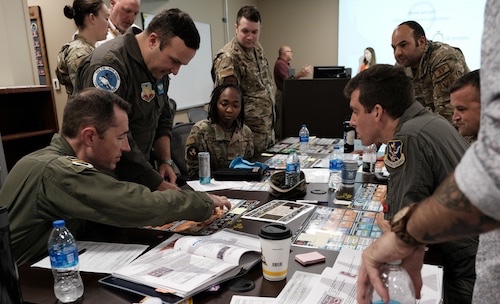
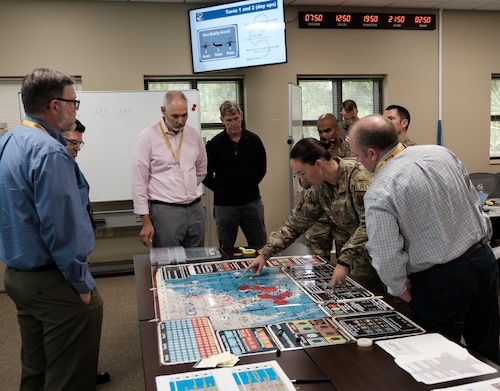
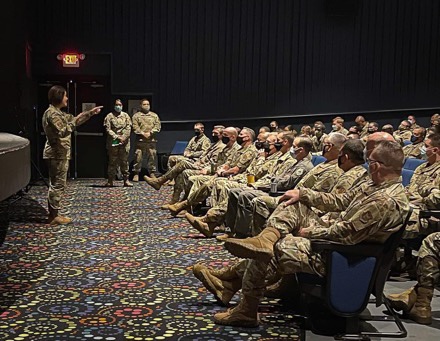
U.S. Air Force Airmen from the 505th Command and Control Wing at Kirtland Air Force Base, New Mexico, and Beale AFB, California, supported the U.S. Navy’s ninth iteration of exercise Valiant Shield 22.

VS field training exercises are biennial, joint exercises focused on enhancing integration between the U.S. forces by conducting joint domain operations at sea, on land, in air, and in cyberspace.

U.S. Indo-Pacific Command headquarters staff forward deployed a joint-force headquarters to Andersen AFB, Guam, for the 12-day exercise.  VS 22 provided a venue to support the demonstration of USINDOPACOM’s forward presence in the Western Pacific, while supporting the test of current and new technologies and platforms, to advance critical areas such as multi-intelligence, artificial intelligence, and long-range fire experiments.

The exercise took place in the Joint Region Marianas area of operations including Palau, Naval Base Guam, Andersen AFB, and the off-shore Mariana Island Range Complex, with some training events also occurring in the Commonwealth of the Northern Mariana Islands. The exercise balanced real-world assurance with competitive overmatch for the theater’s rapid procurement campaign strategy.

“This exercise was the perfect opportunity to conduct integrated deterrence, which was the cornerstone of our approach,” said U.S. Navy Rear Admiral Robb Chadwick, VS 22 Joint Exercise Control Group director.

For this year’s event, the USINDOPACOM commander sponsored the first ever live-fly kickoff of Joint All-Domain Command and Control, or JADC2, best of breed demonstration, where the service components were given the opportunity to execute their own vision using current technology to turn concepts into reality.  JADC2 is the Department of Defense’s vision for a future command and control construct that connects the battlespace cross every domain. 

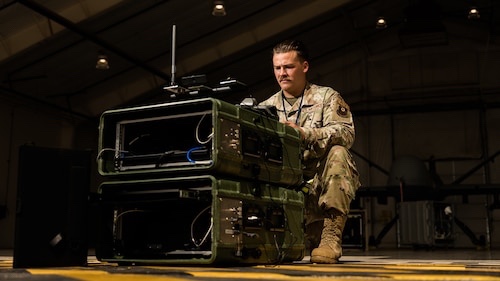
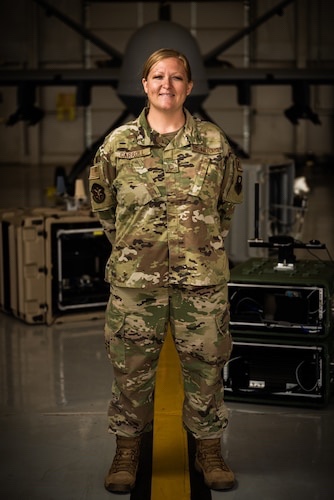
605th Test and Evaluation Squadron, Detachment 3, Airmen at the Common Mission Control Center, Beale AFB, informed the USAF’s approach to realizing its contribution to JADC2, the Advanced Battle Management System, during VS 22.  The CMCC’s direct support to combatant commanders provides the most comprehensive situational understanding of operations while allowing them to synchronize multi-domain effects. 

“These demonstrations are critical to the transformation and dissemination of targeting and intelligence information to achieve the goal of sensor-to-shooter connections,” said USAF Lt. Col. Mikita Brown, 605th TES, Det 3 commander, Beale AFB, California.

During the exercise, the CMCC enhanced real-world situational awareness by feeding the joint force through detecting, locating, tracking, and directing engagement of units at sea, on the land, in the air and in cyberspace.

The CMCC provided capabilities for improving critical C2 and battlespace awareness functions which include: over the horizon target custody across distributed C2 nodes, decreasing the time required for Electronic Order of Battle updates, and rapid dissemination of enemy locations from emerging and traditional intelligence, surveillance, and reconnaissance, or ISR, capabilities such as the MQ-9 Reaper and the Raytheon Multi-Program Testbed, or RMT-727. 

“The CMCC’s Open Mission Architecture was critical to allow the correlation of multi-intelligence data to the U.S. Army Multi-Domain Task Force and U.S. Marines Corps Expeditionary Fire Battalions,” said Brown. “The CMCC successfully conducted operational test of the operational prototype to identify areas of acceleration while measuring the accuracy provided by its machine-to-machine technology during complex ISR collection and targeting problem sets centered on USINDOPACOM’s larger JADO [joint all-domain operations] initiative.”

Brown continued, “Valiant Shield 22 made vital steps forward for both JADC2 stakeholders, allowing them to see advanced demonstrations in an operationally realistic environment.  Incorporating CMCC technology into a modernized C4I [command, control, communications, computers, and intelligence] architecture expanded operational options to disseminate timely access of exquisite ISR feeds into multi-domain CTPs [Common Tactical Pictures] and CIPs [Common Intelligence Pictures] for machine-to-machine solutions.”

Additionally, the 505th CCW participated in VS 22 from Kirtland AFB, New Mexico, where the 705th Combat Training Squadron, also known as the Distributed Mission Operations Center, quickly and effectively responded to a USINDOPACOM commander requirement to support Valiant Shield 22 with joint live, virtual, and constructive capabilities. 

In a first-ever proof of concept which was directly applauded by the U.S. Navy INDOPACOM commander, the DMOC integrated joint LVC capabilities into the exercise by hosting an E-8 JSTARS crew from the 12th Airborne Command and Control Squadron and an MQ-9 crew from the 89th Attack Squadron, connecting them to the exercise through the USN’s Continuous Training Environment.  These crews were able to successfully track and engage enemy shipping, greatly contributing to the overall goals of the exercise. 

“The 705th CTS’s accomplishments during Valiant Shield were providing realistic ISR and tactical kinetic actions utilizing MQ-9 and JSTARS [Joint Surveillance Target Attack Radar System aircraft] in the maritime environment,” according to USAF Lt. Col. Michael Butler, 705th CTS commander, Kirtland AFB, New Mexico. “We incorporated Chat, Link-16 tracks and electro-optical video which greatly enhanced C2 processes in JWAS [Joint War at Sea] operations against threats including high-end Level 1 and 2 surface combatants.”

Butler continued, “In recognition of the DMOC’s seamless short-notice integration both operationally and technically into a combatant commander exercise architecture, Admiral Aquilino [U.S. Navy INDOPACOM commander] added “Joint” to Joint War at Sea.”

The planning for the Valiant Shield 2024 execution has already begun; incorporating lessons learned from VS 22 will enhance USINDOPACOM joint forces’ ability to ensure a free and open Indo-Pacific.

By Deb Henley

505th Command and Control Wing

Public Affairs

USSOCOM Selects L3 Communications Integrated Systems AT-802U Sky Warden for Armed Overwatch Aircraft

Tuesday, August 2nd, 2022

USSOCOM has made a decision for it’s Armed Overwatch program which will add 75 aircraft to provide dedicated Close Air Support, precision strike, and airborne intelligence, surveillance, and reconnaissance (ISR) from austere locations in a permissive environment.

It’s the Sky Warden from the L3 / Air Tractor team.

DoD made this announcement on 1 August:

L3 Communications Integrated Systems, Greenville, Texas, was awarded an indefinite-delivery/indefinite-quantity contract (FA8637-22-D-B001) in the amount of $3,000,000,000 (maximum ceiling value) in support of Armed Overwatch. Research, development, test, and evaluation; and procurement funds in the amount of $170,000,000 were obligated at time of the award. Armed Overwatch will provide Special Operations Forces deployable, affordable, and sustainable crewed aircraft systems fulfilling close air support, precision strike, and armed intelligence, surveillance and reconnaissance, requirements in austere and permissive environments for use in irregular warfare operations in support of the National Defense Strategy. The contract will be a mixture of firm-fixed-price, cost-plus-fixed-fee, time and materials, and cost reimbursement no-fee for the procurement of up to 75 aircraft, training systems, mission planning systems, support equipment, spares, and logistics support, with a period of performance from July 2022 to July 2029, including all options. The majority of the work will be done in Greenville, Texas. This action is a follow-on production contract in accordance with 10 U.S. Code 4022(f) authorized or required by statute. U.S. Special Operations Command, MacDill Air Force Base, Florida, is the contracting activity. (Awarded July 31, 2022)

Here is the L3 Harris Press Release:

L3HARRIS AND AIR TRACTOR SKY WARDEN TEAM SELECTED FOR USSOCOM ARMED OVERWATCH CONTRACT

Highlights:

• Sky Warden™ system to expand SOCOM’s irregular warfare capabilities

• SOCOM weapon system testing begins in 2022

• Six new aircraft will be delivered under the low-rate initial production Lot 1

MELBOURNE, Fla. — U.S. Special Operations Command (USSOCOM) has selected L3Harris Technologies (NYSE:LHX) and Air Tractor, Inc.’s AT-802U Sky Warden™ system for its Armed Overwatch program. Award of the Indefinite Quantity, Indefinite Delivery contract includes a cost ceiling of $3 billion. The program includes delivery of up to 75 manned, fixed wing aircraft, with an initial program contract award of $170 million.

The fleet of modern multi-mission aircraft will address SOCOM’s need for a deployable, sustainable single-engine fixed-wing, crewed and affordable aircraft system. It will provide close air support, precision strike, armed intelligence, surveillance and reconnaissance (ISR), strike coordination and forward air controller requirements for use in austere and permissive environments. The aircraft will be used in irregular warfare operations.  

“An important part of our Trusted Disruptor strategy is listening closely to combatant commanders’ needs, and responding faster than the evolving threats,” said Christopher E. Kubasik, Chair and Chief Executive Officer, L3Harris. “We want to deliver game-changing, modular solutions to U.S. special operators for their hardest missions, and Sky Warden does just that.” 

L3Harris expects to rapidly modify last summer’s Armed Overwatch prototype demonstrator into the production configuration and provide for customer weapon system testing in approximately six months. Production of new, fully-modified, Armed Overwatch mission-configured aircraft will begin in 2023 at L3Harris’ Tulsa, Okla. modification center, following initial production at Air Tractor’s Olney, Texas aircraft manufacturing facility. Six new aircraft will be delivered under the low-rate initial production Lot 1.

“Sky Warden will bring powerful and affordable close air support, precision strike, armed ISR, and command and control capabilities directly to special operations forces in the battlefield,” said Sean Stackley, President, Integrated Mission Systems, L3Harris. “We are ready now to begin work on this modern, multi-mission system for the SOCOM Armed Overwatch program.”

The production-ready Sky Warden system is tailorable for a variety of mission requirements to meet U.S. mission needs.

“The Sky Warden design reflects our commitment to America’s national security and the AT-802U will be equipped with everything we’ve learned manufacturing aircraft over the past 46 years,” said Jim Hirsch, President, Air Tractor, Inc. “The L3Harris team is an excellent partner, and our production and engineering staff are ready to immediately deliver this world-class product to our nation’s special forces.”

Learn more about Sky Warden at www.L3Harris.com/SkyWarden.

Building Resiliency with IRON

Monday, August 1st, 2022

HURLBURT FIELD, Fla. —  

Resiliency of our Air Commandos has always been on the forefront for AFSOC. The command is constantly on the lookout for new programs and initiatives to elevate the ways we can build up our Airmen.

In 2020, helping agencies within AFSOC united under one single initiative, the AFSOC Integrated Resilience Optimization Network (IRON), to bring a more functionally aligned and organized focus on resiliency for our Air Commandos and their families.

 “Building the resiliency of our Air Commandos is so important,” said Onnie Retkofsky, AFSOC Iron Division Chief. “Organizing the helping agencies together under one conceptual framework optimized our resiliency programs and resources within AFSOC, ultimately making them more effectively communicated, and providing the most benefit for our Airmen and their families.”

AFSOC IRON forges resilience around 5 domains: physical, psychological, cognitive, social, and spiritual.

As part of the IRON program, each AFSOC wing has its own IRON lead representative for each performance domain. These advocates coordinate with helping agencies and providers assigned to each pillar to ensure Airmen and their families have access to all resources available. They also coordinate events and facilitate working groups between the agencies of the pillar they represent.

The IRON framework hosts regular resiliency events at various installations across the command to discuss and collaborate on resiliency programs. Often these events are focused around a certain pillar, but always incorporating concepts from the other domains to create and teach a holistic view of resilience.

The AFSOC IRON team held an IRON Physical Performance summit here, July 19-21, bringing in IRON representatives and providers from across the AFSOC wings to collaborate and educate on the programs most recent developments and set the vision for the future of IRON: AFSOC’s Airmen performing at their fullest potential.

“We wanted the focus of this first year’s summit to be on the physical pillar, which has the ability to incorporate all Airmen in a neutral and positive setting regardless of their current individual situations. We will increase our summit to integrate the other resiliency pillars as funding allows and COVID restrictions lift, to continue to create and build a holistic approach to refining resilience in our Airmen” said Retkofsky.

Feedback the IRON team has received on the effectiveness of these resiliency summits, and the program as a whole, has been nothing but positive.

“What our helping agencies and IRON members love about these summits, is the fact that we can all meet, learn and advocate for resiliency programs and techniques in-person again, said Retkofsky. “Meeting over Microsoft Teams once a month allows us to stay connected, but nothing beats the collaborative process of being together in-person.”

To learn more about the IRON program and resources you have available, reach out to your wing’s IRON representative.

By Air Force Special Operations Command Public Affairs

New Flight Milestone in Hexa Testing

Saturday, July 30th, 2022

EGLIN AIR FORCE BASE, Fla. (AFNS) —  

The LIFT Hexa, an electric, vertical takeoff and landing aircraft, or eVTOL, recently completed its first test flight at Duke Field.

The unmanned aircraft, piloted via remote control, used 18 motors and propellers to fly for approximately 10 minutes and reach a height of about 50 feet during the test flight.

The test was an important first step toward the incorporating the Hexa into operations at a controlled military airfield.  Duke Field is an auxiliary field located North of Eglin Air Force Base’s main base. This flight was completed by Hexa 09, one of two aircraft stationed at the installation. Hexa 05 was used for the first test flight at Eglin AFB in April.

The 413th Flight Test Squadron, the Air Force’s rotary wing developmental test experts, has partnered with AFWERX’s Agility Prime to advance eVTOL test and experimentation. The unit, located at Duke Field, provides the coordination, logistics and support for the LIFT team’s developmental ground and flight-testing operations.

“This is an opportunity to leverage some of the unit’s expertise with rotary aircraft and apply it to this new field of electric propulsion aircraft,” said Maj. Riley Livermore, 413th FLTS Futures Flight commander. “This flight was an important step in advancing the testing forward.”

By Samuel King Jr., Eglin Air Force Base Public Affairs

How Drones Will Transform Battlefield Medicine, Save Lives

Wednesday, July 27th, 2022

FALLS CHURCH, Va. (AFNS) —  

Blood loss or “bleeding out” is the leading cause of preventable death on the battlefield, military health experts say.

So, one of the best ways to save lives during combat operations is to provide blood products to forward-deployed medics and corpsmen as soon as possible.

During the wars in Iraq and Afghanistan, getting the needed blood products to injured warfighters was typically not a major challenge when the U.S. military controlled the skies and maintained a nearby network of medical facilities.

“We were pretty reliant on medevac ‘dust off’ to deliver our blood,” said Air Force Col. (Dr.) Stacy Shackelford, Joint Trauma System chief.

However, in future conflicts against a “near-peer” adversary, Shackelford said, that could be far more difficult. Injured troops may have to remain at the frontlines for days while needing blood transfusions or other major medical care.

The solution: Drones may become essential to combat medicine.

“I think it’s going to come down to drone delivery of blood by some type of unmanned vehicle that can fly in and drop off more blood or more bullets, whatever is needed,” Shackelford said.

Resupply by Drones

“We think that drone resupply of blood and immediate-need medical products are really just around the corner,” said Dr. Adam Meledeo, a research scientist for coagulation and blood research at the U.S. Army Institute of Surgical Research at Joint Base San Antonio-Fort Sam Houston, Texas.

“There are multiple off-the-shelf solutions that are being considered,” and the Defense Health Agency is funding several other innovations to optimize the ability to provide drones in the battle space, Meledeo said.

Yet using drones to resupply blood and other medical supplies will be challenging.

“There’s obviously trade-offs between some of these different platforms, such as making sure that we have a vehicle that’s fast, and somewhat stealthy … and has a very large battery that will be able to keep it airborne for a much longer period of time if it needs to loiter somewhere in anticipation of there being a problem,” Meledeo said.

“There’s also been some talk of outfitting some of our combat hardware drones that are already in use with alternative payloads that would be able to supply blood, medical supplies and really just about anything, such as MRE’s, ammunition, and water” to frontline medics or service members caring for wounded Soldiers, he explained.

Blood Resupply

“The primary issue with blood resupply is that it has to be maintained at specific temperatures, as do a number of pharmaceuticals including certain pain medications, and antibiotics,” Meledeo explained.

“The biggest technological hurdles right now are being able to maintain those temperatures inside those drone payloads very consistently, at a variety of altitudes, and a variety of different ambient conditions for potentially lengthy periods of time, without drawing too much power away from the system itself,” Meledeo continued.

The Marines Corps used drones for resupply during an exercise in Australia. Drones have also been used in Rwanda and Uganda to transport medical supplies to rural areas across mountain ranges and in bad weather, Meledeo said.

“I think that we’re going to get there much faster than we had initially anticipated,” he said.

The use of drones for future near-peer conflicts is starting to filter down into the operational forces as a potential solution in the near term, he noted.

Wounded Warrior Evacuation

“In the long term, there are a number of lines of effort, such as involving drones for the extraction of patients,” Meledeo said.

U.S. partner countries are examining some of these platforms that can evacuate a patient rapidly without risking other personnel in potentially contested airspace, he added.

How does one transport casualties stealthily?

“Part of it is marking the vehicles appropriately with standard medical nomenclature. That gives you the Geneva Convention protection. But obviously, we go up against certain enemies that will not care about that at all,” he explained.

Artificial Intelligence

Stealth technology continues to improve. When it comes to drones, “it may be just a matter of keeping the drones low to the ground, and that they’re being piloted by an artificial intelligence system,” Meledeo explained.

“So, hopefully, AI will be faster to react than a human would be. But even still, I think there are a lot of concerns about” the use of drones to extract wounded warfighters.

“The long-term goal … is to actually have some sort of robotics onboard these drones that would be doing medical care to the patient during transport,” he said.

DARPA AI Initiative

A new Defense Advanced Research Projects Agency initiative called “The In the Moment Program” aims to ultimately give AI systems the same complex, rapid decision-making capabilities as military medical staff and trauma surgeons who are in the field of battle based on algorithms of care and decision-making capabilities.

One example is smart tourniquets that will be able to detect whether they need to be released. Other automatically guided solutions include IV placement or catheter placement, Meledeo said.

“It sounds like science fiction. It is still a little bit science fiction, but it’s not as far off as it may sound,” he said.

“At least on a rudimentary level, the community is already pursuing a lot of automated solutions or artificial intelligence-derived solutions for automation of different medical processes.”

This research is underway but there’s no timeline on this concept.

“Hopefully, we’ll be able to get some confident results from some of these different technologies that are going to be packaged together in this system and enable the drones to then not only resupply at the point of injury, but also actually take care of the transportation and the management of patients during that transportation.”

By Janet A. Aker, Military Health System Communications

Wright-Pat’s GearFit Shortens Feedback Loop

Monday, July 25th, 2022

WRIGHT-PATTERSON AFB, Ohio (AFNS) —  

A new application called GearFit is giving Airmen a direct line to share feedback on fitment and utility of the gear they wear to perform their missions.    

Members can input their comments on body armor, harnesses, helmets and more, and they are instantly shared with the development teams responsible for designing and acquiring that gear.     

Taylor Harrison, Combat Ready Airman program manager in the Agile Combat Support Directorate, joined with Nicole Wright and Sarah Tress with Skylight Digital, on an episode of AFLCMC’s Leadership Log podcast to discuss the new application.     

“This program has been super amazing because we are getting feedback from our Airmen, the end user,” Harrison said.  “We are not just delivering and hoping that we hit the mark.”     

This application, and the Combat Ready Airman program, is designed to help the 91% of Air Force jobs that do not include aircrew members or special operations, which already have programs focused on their needs.     

“We focus solely on maintainers, Security Forces, medics, anybody that isn’t aircrew or special ops,” Harrison said.  

Currently, equipment is identified at the unit level, which leads to a lack of consistency for gear across the Air Force.  The Combat Ready Airman program is looking to ensure all gear is standardized. That could be simply providing a list of approved body armor vests that units can pick from.   

GearFit came about in 2019 as the result of an AFWERX challenge. Specifically, it was designed to collect anthropometric data on female Airmen to better define requirements and specifications of gear being acquired from industry. The program is now expanded to collect data from male Airmen as well.  

Nicole Wright, GearFit product manager, led the team from Skylight Digital that collaborated with Air Force developers at the Business and Enterprise Directorate’s BESPIN software factory to develop the GearFit website.  

“We are working on building out the GearFit website and experience. We are continuously releasing new features and iterations on feedback we hear to get closer to optimizing the goals that Taylor was talking about,” Wright said.         

You can also listen by searching “Leadership Log” on YouTube, Apple Podcast, Google Podcast, Spotify, Overcast, Radio Public or Breaker.

By Daryl Mayer, Air Force Life Cycle Management Center Public Affairs

You Won’t Believe This One

Sunday, July 24th, 2022

Recently, Air Force Central’s 378th Air Expeditionary Wing issued this press release.

Yep, the “big guns” which consists of M4 carbines. I really don’t mean to make fun of stuff like this, but an F16 can carry over sight tons of ordnance and is equipped with a 20mm cannon. In light of that, there’s nothing big about an M4.

The real problem is what I’ve maintained for over two decades now, that the US Air Force is institutionally afraid of guns. They’ve got enough firepower to destroy any enemy several times over, but firearms weird them out.

Special Warfare Training Wing Physical Medicine Technician Embeds with NASA

Saturday, July 23rd, 2022

JOINT BASE SAN ANTONIO-CHAPMAN TRAINING ANNEX, Texas  –  

From advancing force development of future Air Force Special Warfare Airmen to working with astronauts, life has been far from boring for the SWTW’s Staff Sgt. Emily Valdovinos.

Valdovinos was hand-selected to assist the NASA Astronaut Strength, Conditioning and Rehab Group to help develop personalized strength, conditioning, and rehabilitative plans for NASA astronauts with Crew-3 after they returned from the International Space Station for their 45-day reconditioning period.   

“Emily was specifically selected based on the skillset she has worked so hard to achieve for herself,” said Maj. Danielle Anderson, musculoskeletal medicine and rehabilitation lead, ASCR Group. “With her passion for human performance, dedication to ensuring the highest quality of service is delivered, and her energetic professionalism, Staff Sgt. Valdovinos was the perfect NCO to support our team.”

The mission of the ASCR Group is to optimize the performance and physical readiness of the astronaut corps by utilizing an interdisciplinary team approach, evidence-based practice, and emerging science and technology throughout an astronaut’s lifespan. The team focuses on optimizing the astronaut’s physical performance as he or she prepares for, lives in, and returns from the ISS.

At the SWTW, Valdovinos serves as the non-commissioned officer in charge of performance rehabilitation for the Special Warfare Candidates Course and Pre-Dive Course, where her experience working with SWTW trainees directly transfers to working with NASA astronauts.

“In [both the SWTW and NASA], I work hand in hand with a multi-disciplinary team to provide the best possible care to our caseload,” said Valdovinos. “I work directly under a physical therapist alongside a strength coach and athletic trainer to help develop personalized strength, conditioning, mobility, and rehabilitative plans for each person who needs assistance; we do ruck marches every week, throw sandbags, and are on a very strict workout schedule at NASA, just like the SWTW.”

In addition to working with astronauts, Valdovinos has also been afforded many unique opportunities available only at NASA while embedded with the ASCR Group.

Valdovinos joined in a live call to the ISS with Crew-4, toured NASA’s Neutral Buoyancy Lab where astronauts train for extravehicular activities (space walks), visited the Apollo Mission Control Center, learned about the various exercise equipment available to astronauts while in space, and much more.

When asked what she will take away from her time working at NASA, Valdovinos stressed the importance of the multi-disciplinary team and its ability to work seamlessly together to provide the best level of care for the individual, regardless of whether that individual is an astronaut, SWTW trainee, or AFSPECWAR operator.

“Personally, I have grown in many ways as a professional and as a person,” said Valdovinos. “I feel incredibly humbled to have even been considered for this position as it has been my dream to train astronauts and support the Space Exploration mission ever since I was young.”

Members of SWTW provide initial training for all AFSPECWAR training specialties, including combat controllers, pararescue, special reconnaissance and tactical air control party Airmen.


To learn more about SW Airmen or other U.S. Air Force Special Warfare career opportunities, go to www.airforce.com/careers/in-demand-careers/special-warfare.

By 1st Lt Xiaofan Liu

Special Warfare Training Wing Public Affairs