XC3 Weaponlight

Archive for the ‘Air Force’ Category

Department of the Air Force Directs Commanders to Review Unit Emblems, Mottos, Nicknames, Other Official Symbology

Wednesday, January 6th, 2021

WASHINGTON (AFNS) —

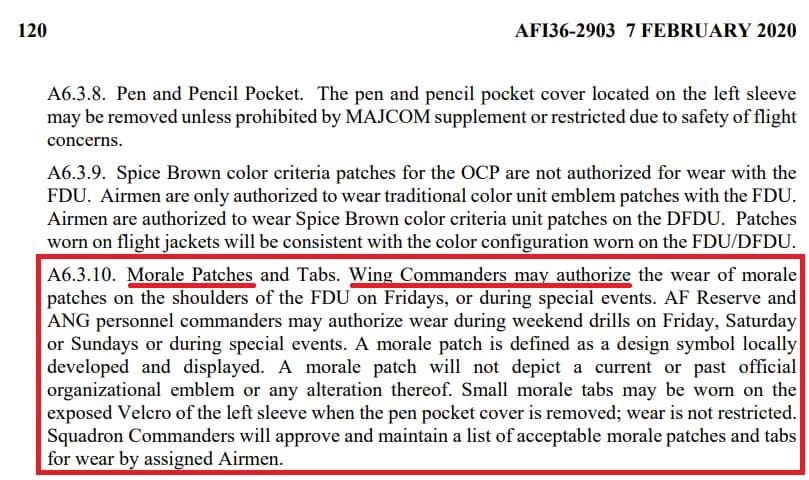
The Department of the Air Force directed commanders to conduct a comprehensive review of official and unofficial unit emblems, morale patches, mottos, nicknames, coins and other forms of unit recognition and identity to ensure an inclusive and professional environment within 60 days from Dec. 23, 2020.

Commanders, at the squadron level and above, will remove any visual representation, symbols or language derogatory to any race, gender, sexual orientation, ethnicity, religion, age or disability status to ensure an inclusive and professional environment.

The directive came in the form of a memorandum from Secretary of the Air Force Barbara Barrett, Air Force Chief of Staff Charles Q. Brown, Jr., and Chief of Space Operations John W. Raymond.

“It is critical for the Department of the Air Force to embody an environment of dignity, respect and inclusivity for all Airmen and Guardians,” the memo stated. “Our core values demand we hold ourselves to high standards and maintain a culture of respect and trust in our chain of command.”

According to Air Force Instruction 84-105, “Organizational Lineage, Honors and Heraldry,” emblem designs and mottos should reflect favorably on the United States Air Force, be original, distinctive, dignified, in good taste and non-controversial.

“Their continued use (of derogatory symbols and language) ostracizes our teammates undermining unit cohesion and impeding our mission readiness and success … Our diversity of experience, culture, demographics and perspectives is a force multiplier and essential to our success in this dynamic global environment … We must ensure all our Airmen and Guardians are valued and respected,” the memo emphasized.

Commanders should consider emblem and motto guidance in AFI 84-105 and consult their historians, staff judge advocates and equal opportunity specialists during the review.

Always Ready: 86th Aeromedical Evacuation Squadron Executes Negatively Pressurized Conex-Lite Training Mission

Tuesday, January 5th, 2021

RAMSTEIN AIR BASE, Germany (AFNS) —

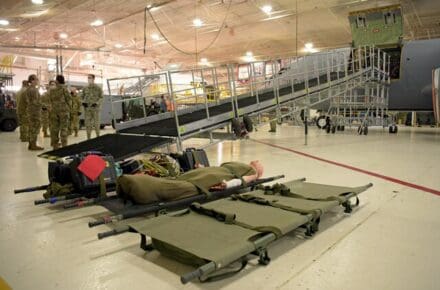
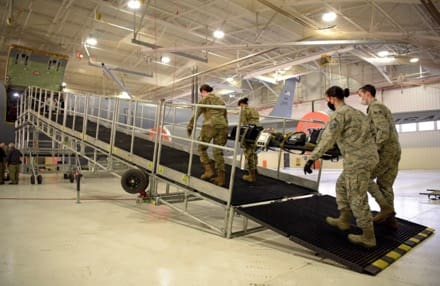
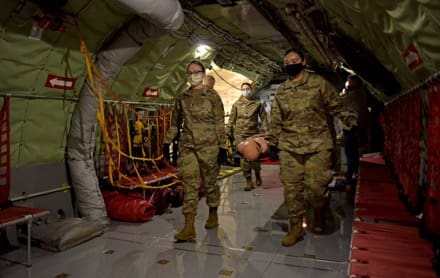
The 86th Aeromedical Evacuation Squadron held a COVID-19 patient movement training using the Negatively Pressurized Conex-Lite at Ramstein Air Base, Dec. 14-18.

The week-long training ended with a proof-of-concept flight on a C-130J Super Hercules, solidifying the entire process of U.S. Air Forces in Europe and Air Forces Africa COVID-19 patient transfer capabilities for the 86th Airlift Wing.

“It was the first time an NPC-L has taken off, at least in U.S. European Command, having a training mission on it, all the assets, and coordinating the integration from the ground piece to the in-flight piece,” said Capt. JD Pilger, 86th AES training flight commander. “Previously, everything was done on the ground, so this is a big deal. The capstone for the week was getting this thing airborne and proving this concept and capability for EUCOM.”

Operations such as these are historically placed within the Air Mobility Command, specifically at Joint Base Charleston, South Carolina. The initial force training was only conducted there for the entire Air Force, which would then piece together teams and send on deployments to provide this capability operationally.

In July, however, AMC started a flagship initiative to send certified trainers to Ramstein AB to certify 86th Medical Group and 86th AES personnel to be the initial cadre on the NPC-L. This established an organic capability located overseas, therefore widening the pool of certified personnel to the force, said Maj. Josh Williams, 86th AES operations flight commander.

From the 721st Aerial Port Squadron, loading the NPC-L onto the aircraft to the 86th MDG and 86th AES infectious disease team ensuring proper personal protective equipment was worn during each scenario, multiple units were called upon to contribute to the training.

“The training was for developing another force package for the 86th AW, to enable us to move COVID-positive patients utilizing the NPC-L,” Pilger said. “The force package entails members from the 86th MDG, the 86th AES and additional folks over at Landstuhl Regional Medical Center, such as our Critical Care Air Transport Team.”

The NPC-L is a smaller version of the Negatively Pressurized Conex, an isolated containment chamber intended to transport individuals with infectious diseases like COVID-19. While the NPC is used on C-17 Globemaster III, the NPC-L was developed for use on a C-130J.

“Pursuant to a U.S. Transportation Command joint urgent operational need request, (the NPC) was fielded, and the follow on to that was the NPC-L,” Williams said. “That is what we’ve now developed our teams and force packages within the 86th AW to support. (The NPC) is actually loadable on a C-130 and can transport patients in EUCOM, as well as U.S. Africa Command.”

Up to nine ambulatory patients, four litter patients, two CCATT critical care patients, or variations thereof, can be transported in the NPC-L.

During the training, Airmen were presented with various patient-transfer scenarios and worked together to execute the mission both on the ground and in the air.

“It was a true team sport throughout the whole thing,” said Capt. Zachary Gooch, 86th AES operations support flight commander. “We could not have done it without the support from Air Terminal Operations Center, maintenance or the medical group.”

Having this organic capability enables Ramstein to provide COVID-19 patient movement overseas without the need for assets deployed from AMC.

“I think we proved that this can be done without having a deployed asset that rolls in and sets up shop,” Gooch said. “We did it, basically, from grassroots.”

By SrA John R. Wright, 86th Airlift Wing Public Affairs

USAF Issues New Physical Fitness Program Manual Which Includes Waist Measurement, Four Days After Eliminating Waist Measurement From Assessment

Monday, January 4th, 2021

Nothing could be more 2020 than the Air Force publishing a new version of AF Manual 36-2905 “Air Force Physical Fitness Program” on 11 December with a four component test, just four days after fundamentally changing the program by issuing guidance to eliminate the waist measurement component.

The test will still consist of a 1.5 mile run, 1 minute of pushups and 1 minute of situps. However, the composite score will be calculated with full points for the waist measurement portion until system changes can be made.

On the upside, the AFMAN is only 77 pages instead of the 147 pages in the old Air Force Instruction issued in 2013. Hopefully, it won’t take another seven years to update the latest, outdated guidance.

‘A Tribute to Persistence:’ SecAF Presents Air Force Cross to Special Tactics Airman

Monday, January 4th, 2021

CANNON AIR FORCE BASE, N.M. (AFNS) —

Snapped awake by the sound of belt-fed machine gun fire, then-Senior Airman Alaxey Germanovich, a 26th Special Tactics Squadron combat controller, surveys the compound he had dozed off in after several sleepless days of combat.

“I look around and I don’t see any of my American teammates,” Germanovich said. “(At that moment I said to myself) I need to find my friends right now.”

Grabbing his helmet and rifle, Germanovich bolted out of the compound and into the fight, where he saw several of the Army special forces Soldiers he was embedded with huddling for cover from behind a small rock.

“I knew then that I had to go get to my teammates and help them,” he said.

Germanovich’s base instinct would quickly turn into a grueling battle for survival, but it was those selfless impulses to save and protect his teammates that proved to be the difference between life and death for many of his teammates on that fateful day.

SecAF commends combat controller for valor

Secretary of the Air Force Barbara Barrett presented the Air Force Cross to now-Staff Sgt. Germanovich during a ceremony at Cannon Air Force Base Dec. 10.

Germanovich was awarded the medal, second only to the Medal of Honor, for his actions April 8, 2017, during combat operations against enemy forces in Nangarhar Province, Afghanistan.

“This Air Force Cross is a tribute to your persistence (Staff Sgt. Germanovich),” Barrett said. “You risked your life and weathered blistering enemy fire to save the lives of others.”

In attendance were Col. Matthew Allen, 24th Special Operations Wing commander, the 7th Special Forces Group (Airborne) team Germanovich was attached to during the combat operations, and Germanovich’s family and friends.

Following the ceremony, Germanovich led those in attendance in memorial pushups to commemorate the event, the firefight and the ultimate sacrifice paid during the clash by Army Staff Sgt. Mark De Alencar, a special forces Soldier assigned to 7th SFG (A) and a member of the team Germanovich was assigned to.

“This battle was a case study in toughness and extraordinary competence,” Allen said. “But it was also a case study in love. The type of love that demands teammates fight for one another and give everything they have.”

Germanovich’s actions as the air-to-ground liaison for his special operations forces team were credited with protecting the lives of more than 150 friendly forces and the lethal engagement of 11 separate fighting positions.

Facing hell, calling for fire

A native of Boiling Springs, South Carolina, Germanovich enlisted into the Air Force in November, 2012, with two goals in mind.

“I always knew I wanted a challenge,” Germanovich said. “I wanted to have a direct impact on the battlefield wherever I went.”

Five years later, both of those wishes would be granted when he deployed to Afghanistan and embedded with 7 SFG (A) Soldiers and their Afghan partners.

During his tour, the joint force was tasked with clearing several valleys in Nangarhar of fighters. As the multi-day operation progressed and the coalition forces pushed the insurgents closer to the Afghan border of Pakistan, the fighting became more and more violent. It reached a head as Germanovich sprinted through heavy enemy fire to help the Special Forces Soldiers on that fateful day.

After reaching the rock his teammates were pinned down behind, Germanovich began to call in airstrikes to try and suppress the attack.

“It was working to a degree,” Germanovich said. “But we were still receiving extremely effective fire, and one of our partner force members had gotten shot.”

To evacuate the wounded Afghan commando, Germanovich began to call for strikes extremely close to their position in order to create more separation between the coalition forces and the insurgents.

“As the bombs were falling out of the sky, I started screaming at everybody to run for cover,” Germanovich said.

After the partner force member was evacuated, the special operations forces team launched their counter-attack. A separate unit from across the valley was able to pinpoint a key enemy bunker during the firefight, and Germanovich’s element, led by De Alencar, crawled their way towards the position.

Once the fire team reached the top of the bunker, Germanovich and De Alencar dropped grenades into its entrance. Then, as Germanovich secured the opening and De Alencar and the other Special Forces Soldiers began to breach the bunker, insurgents ambushed the team from hidden positions to the south, mortally wounding De Alencar.

“The situation just became complete and utter chaos,” Germanovich said. “The team and I had expended all of our ordnance engaging enemy targets. We expended all of our grenades, there was no more pistol ammunition, and we were out of ammo completely.”

Lying prone with no cover from the attack, Germanovich put out a call to an AC-130W Stinger II gunship aircraft that was leaving the area in order to refuel.

“As they were leaving, I said ‘if you don’t come back, we’re dead.’” Germanovich said.

The gunship did return and began to fire on the enemy fighters, which gave Germanovich and the soldiers the opportunity to move away and evacuate De Alencar.

“All the while, we’re still taking effective fire from the enemy,” Germanovich said. “We began dropping ordnance and basically bombing up this mountainside until we got to safety.”

Germanovich’s actions proved decisive on that battlefield and demonstrated the enormous impact of Air Force Special Operation Command’s precision strike mission, which provides ground force with specialized capabilities to find, assess and engage targets.

“You (Germanovich) told me earlier that you did what any one of your teammates would have done in the same situation,” Allen said. “But we don’t know that. We do know what you did that day: face and devastate a numerically superior enemy … this is why America’s enemies do not take us head on.”

Germanovich’s ability to enable precision strike operations and his bravery in the face of hostile fire are incredibly courageous in their own right, but it was the reason behind his valiant performance that makes him an unquestionable hero.

“It was 100% my teammates,” Germanovich said. “If I’m in danger, I know without a doubt in my mind that my teammates are going to do everything in their power to make sure that I come back, and I would do everything that I could possibly do to make sure that they come back.”

Article by SrA Maxwell Daigle, 27th Special Operations Wing Public Affairs

Photos by SSgt Michael Washburn and A1C Drew Cyburt

Royal Air Force Officer Brings Skills to Moody AFB

Thursday, December 31st, 2020

MOODY AIR FORCE BASE, Ga. (AFNS) —

After nearly 14 years of service in the Royal Air Force, Flight Lieutenant Chris Bradshaw has traveled 4,300 miles from the Force Protection Force of the RAF Regiment to share his expertise with the 820th Base Defense Group at Moody Air Force Base.

As part of a larger exchange program between the RAF and U.S. Air Force that encompasses positions from the Pentagon down, Bradshaw currently holds the position of director of operations at the 824th BDS.

“The relationship that the Royal Air Force has had with the base defense group is longstanding because we are likely to operate together,” Bradshaw said. “Every year there is a tri-service exercise between the U.K., the French and the Americans. The position here is to help develop that exercising program to make sure relationships are maintained and that we can be interoperable as we move forward into next-generation warfare.”

The position is filled on a volunteer basis. Applicants volunteered about a year and a half early and the RAF chose from that list. After being chosen, Bradshaw still had to complete a number of tasks to secure his position in the 820th BDG.

“I’ve moved over my family as well,” Bradshaw said. “So to bring my wife, who is an active-duty Royal Air Force officer and my son – that was a bit more tricky, (but) fortunately, the (Royal) Air Force managed to give her a three-year career break. We had to jump through that hoop initially to make sure we could continue on the process.

“Then, it was all the visa applications, making sure that I came out here and got to meet who I was going to work for. Then, it was just bouncing back and forth to sort out schooling and education for my son. There was a lot, but it’s been worth it.”

The Force Protection Force’s role is to mitigate vulnerabilities and ensure end-to-end protection of air and space power, at home or deployed. Bradshaw previously worked in Train Advise Assist Command – Air, in the air-to-ground role as a joint terminal attack controller.

“(A few years ago), that’s what I did for (about) four and a half years,” Bradshaw said. “Having that experience and then working for the 93rd Air Ground Operations Wing, I understand what they’re talking about because I speak the language, too.

“I became the director of operations for the 824th BDS because they wanted to plug-and-play some experience of mine. I’ll sit in that position for 18 months. Then, the plan is to move up to the group where I’ll conduct work directly for the colonel in an area of his choosing.”

Bradshaw isn’t the only one bringing unique opportunities to the table. The BDG offers multiple capabilities such as air assault, airborne, ranger and jungle courses that Bradshaw will be able to participate in and learn from.

“That will be good for me operating as an entity on the ground, protecting and defending our RAF assets and infrastructure,” Bradshaw said. “To have that link would be quite beneficial. I’m not going to get the opportunity again and I need to prove the concept for future exchange personnel that it’s open; the door is there. You need to step in and jump out.”

The tactical skills Bradshaw has and will have learned are not the only things he’s taking away from his time with the BDG. Bradshaw says his favorite experience from the program has been seeing people from diverse backgrounds and he’s looking forward to meeting more as he moves to new positions.

“The U.S. is so huge compared to the U.K. that even at the squadron level, you’ve got people from so many different backgrounds, so many different life hurdles and obstacles they’ve had to overcome, that the breadth of individual is vast,” Bradshaw said. “I’ve been extremely well integrated, well looked-after. Everyone is extremely friendly. I still get treated equally, which is as expected.

“It’s been a big change for us having to come across to make this leap, but it’s been made easier by that fact that people have been so welcoming.”

By SrA Hayden Legg and A1C Taryn Butler, 23rd Wing Public Affairs

Nellis AFB’s 24th Tactical Air Support Squadron Inactivates, Leaving Mark on Joint Integration, Close Air Support Training

Thursday, December 24th, 2020

NELLIS AIR FORCE BASE, Nev. —

The 24th Tactical Air Support Squadron was inactivated during a ceremony at Nellis Air Force Base, Nevada, Dec. 23, 2020.

The inactivation is part of an overall Air Force strategy to reactivate the 65th Aggressor Squadron.

“Our era of great power competition is highlighting the need to integrate across domains – air, land, sea, space, cyberspace and information,” said Lt. Col. Jesse Breau, 24th TASS commander. The force that is able to effectively and consistently accomplish that integration will win against peer adversaries. Forces who are unable or who choose not to integrate in training will become obsolete.”

The Air Force is repurposing the F-16s assigned to the close air support-focused 24th TASS and moving them to an aggressor role as part of the 65th AGRS to enhance air-to-air training and provide adversary aircraft that will better replicate peer adversary military forces.

The 24th TASS was activated at Nellis in March 2018. Its primary mission was to train forward air controllers (Airborne) and joint terminal attack controllers. The squadron’s pilots flew F-16 Fighting Falcons, more commonly known as the “Viper.”

As part of the inactivation ceremony, a 24th TASS Viper conducted a fini flight, celebrating the unit’s rich history.

During the Vietnam era, the 24th TASS’ operators wore non-standard headgear known as Saigon Cowboy hats that link them to the rich heritage of USAF forward air controllers.

While activated at Nellis, the unit’s tactical air control party members hosted JTACs and meshed them with pilots from the combat air force. Pilots who completed a demanding seven-week course were then qualified to control CAS airstrikes from the cockpit of their fighter jets.

The 24th TASS’s mission was unique in that it was the only centralized FAC (A) training course in the United States Department of Defense. The former students and instructors from the 24th TASS will carry on the unit’s legacy of air-ground integration and CAS expertise as they move on to other assignments throughout the CAF.


“There are very few fighter pilots in the U.S. Air Force that know Army or Marine Corps doctrine and tactics. So in that sense, I think one of the key outputs of the forward air controller training course is an officer who can integrate joint fires,” said Breau. “Graduates of our course are focused on close air support and integrating airpower with surface forces’ maneuver and fires. They graduate as close air support subject matter experts, and bring that knowledge back to their combat units.”

The 24th TASS’s training leveraged the Nevada Test and Training Range and the wide range of aircraft types stationed at Nellis to provide premier CAS training. The course immersed fighter pilots into the TACP members’ mission through planning, briefing, executing the mission on range and debriefing with the JTACs.

“To integrate with the ground scheme of maneuver, our philosophy that’s written into joint fires doctrine is that a forward air controller should always be an extension of the tactical air control party,” said Maj. Andrew Bolint, 24th TASS director of operations. “So the JTACs on the ground with the special operations teams just need us to support their objectives and extend their capabilities, whether that’s firepower, sensors or communication.

“What I took away as a forward air controller pilot that completed and eventually managed the course is an understanding of the ground scheme of maneuver and the ground force commander’s objectives for each mission,” he added. “This taught me to better predict where and how to allocate weapons and sensors that would best support friendly forces on the ground.”

The result was a high level of trust and rapport between the JTACs and fighter pilots, along with an in-depth understanding of the purpose and role of all of the air and ground players involved in the training mission scenarios.

“The in-person planning and debriefs isn’t common for JTACs and pilots, however it is an invaluable way to increase the lethality of the CAS team,” said Master Sgt. Andrew MacDonald, 24th TASS TACP flight chief and JTAC instructor.

Although there will no longer be a centralized USAF F-16 FAC(A) training course, the future of air-ground integration is in good hands, according to Breau. Several Nellis Combat Training Squadrons are dedicated to joint integration exercises, and the USAF Weapons School continues to produce expert weapons officers.

“What will always be useful in large-scale combat operations will be the ability to mesh across domains, and the forward air controllers and JTACs that we’ve helped to train have the expertise to do that,” said Breau.

Additionally, the Congressional decision to maintain the A-10 platform ensures that Close Air Support focus and institutional knowledge remains.

“I think the 24th TASS has done an exceptional job of training for what a major conflict will look like, in terms of threats,” said 1st. Lt. Benjamin Harris, 24th TASS intelligence officer in charge. “Some of our training audience are unfamiliar with advanced integrated air defense systems and ground force tactics that we expect to face in a fight with peer adversaries.


“Since we plan, brief, execute and debrief every tactical air support mission as an air-ground team, our student pilots and operators completed the course with the ability to cover each other’s blind spots and leverage each other’s strengths,” he added.

The decision to inactivate the squadron was finalized in May 2020 by Gen. Mike Holmes, former commander of Air Combat Command.

Story by 2nd Lt Nicolle E. Mathison, 57th Wing Public Affairs

Photos by TSgt Alexandre Montes

First USAF Members Complete RCAF Sentinel Program

Monday, December 21st, 2020

This article is almost a year old and discusses United States Air Force participation in a Royal Canadian Air Force program to train personnel to serve as links between service members and the Royal Canadian Chaplain Service in order to combat suicide. The RCAF has about 1400 Sentinels out of just 14,500 active service members. That’s quite an investment.

The goal of the Sentinel Program, a growing initiative within the Canadian Armed Forces (CAF), is to use wingmanship and tactical-level supervisors as mental health advocates. The program is designed to empower junior leaders to be the first line of defence against real and serious threats such as mental stress, work-centred exhaustion, and suicide.

Staff Sergeant Sierra Rathbun, Technical Sergeant Sheryl Ubando and Master Sergeant Jonathan Miller are the first United States Air Force (USAF) members to have completed the Sentinel Course. They were nominated for the training by their leadership to represent the USAF and build relationships, bringing our two countries closer together. 

“I am honored to have a chance to serve side-by-side with my Canadian military family,” said Master Sergeant Jonathan D. Miller, a Detachment 2, First Air Force, operations superintendent. “This opportunity is truly unique, one that I will cherish for years to come. This training opportunity is a bridge between the USAF Resiliency Program and the CAF Sentinel Program, and is a huge step toward bi-national integration.”

Offered by the 22 Wing/Canadian Forces Base North Bay, Ontario, chaplains, “The Sentinel course is a valuable asset for strengthening the spiritual resiliency of our forces,” explained Captain Justin Peter, a wing chaplain.

During training, the volunteers were asked to remember how important it is to “just listen”, to ask open-ended questions, and to be an extension of the chapel as “eyes in the lines”.

The Sentinel Program was introduced at 22 Wing in 2018 by Lieutenant (Navy) Timothy Parker, also a 22 Wing chaplain. Currently, the wing boasts 66 trained Sentinels who must undergo a full day of training every year to maintain their readiness.

By Staff Sergeant Patrick Bisigni

Staff Sergeant Patrick Bisigni serves as public affairs representative and unit photographer with Detachment 2, First U.S. Air Force Unit.

505th Command and Control Wing Supports Largest US Army Warfighter Exercise on Record

Saturday, December 19th, 2020

The 505th Command and Control Wing supported the U.S. Army’s Mission Command Training Program during its execution of Warfighter Exercise 21-1, the largest WFX ever conducted.

The exercise directly trained over 5,300 joint warfighters and accomplished training objectives for 12 training audiences using more than two dozen different systems connecting seven sites across the country.

WFX 21-1 was not initially planned for 12 TAs, but when WFX 20-4 and 20-5 canceled due to the COVID-19 pandemic; their TAs moved to WFX 21-1. To ensure U.S. Army warfighters were adequately trained for current and emerging mission sets, WFX 21-1 increased its training audience by over 2,300 personnel.  

The 505th CCW, Detachment 1, Fort Leavenworth, Kansas, served as the U.S. Air Force’s liaison during WFX 21-1 and replicated doctrinally correct air component capabilities to the U.S. Army warfighters. 

“The purpose of the WFX is to train U.S. Army two & three-star division and corps commanding generals and their staffs on LSCO [large-scale combat operations]; an Army Chief of Staff directive to ready Soldiers for great power competition after 19-years of counterinsurgency,” said U.S. Air Force Col. Michael Goodman, 505th CCW, Det 1 commander.  

WFX 21-1 trained three U.S. Army primary training audiences. The XVIII Airborne Corps, 82nd Airborne Division, and the 1st Cavalry Division, and their respective subordinate units were trained to meet National Defense Strategy requirements. 

WFX events are geared toward the tactical level of war during LSCO using a hybrid near-peer adversary. While the adversary’s name doesn’t match any known country, the terrain, equipment, and tactics used are based on real-world places, assets, and capabilities. WFX 21-1 was designed to train, rehearse, team build, and contribute to the Army’s overall combat preparation.

“Approximately 200 Airmen participated in WFX 21-1 from five locations throughout the CONUS,” said Goodman. “Perhaps most importantly, was the support of the 505th Combat Training Squadron, and 505th Communications Squadron, who provide the Air Operations Center RC [response cell] and communication infrastructure.”

Goodman continued, “an RC is a small team that has the capability to replicate a much larger entity, often by a factor of ten or even 100; e.g., a 60-member AOC RC replicates a 1000-member AOC to include some of the fighters and multi-place aircraft.”

Additionally, U.S. Army partners from the Army Joint Support Team and XVIII ABC leveraged the 505th CS’s Joint Targeting Toolbox to create a joint targeting database for future WFXs. Using this targeting database, the training audience could conduct legitimate target development in the pre-STARTEX phase of a WFX using the appropriate Army Battle Command System and doctrinal processes.

“During execution, training audiences will be able to use those same doctrinally correct ABCS and processes to nominate targets, both dynamic and planned, to the joint force for execution,” said Goodman. “This capability enables Army warfighters to practice how they fight. WFX 21-1 was the first WFX to leverage and test this new targeting database.”

Based on WFX 21-1’s training objectives and audience locations, the 505th CS designed and connected a realistic cyberspace environment that could seamlessly exchange mission and model systems data between U.S. Air Force and U.S. Army warfighters across seven training locations. This data exchange is critical to any desired interactions and overall exercise fidelity.

Additionally, with three major training audiences, there was a requirement to apportion airpower in line with the Joint Force Commander vision, which required the TAs to communicate more with one another and request capabilities instead of specific assets, enabling more efficient use of limited airpower.

“Ultimately, this [environment] allowed USAF participants to provide air injects and role player responses to U.S. Army warfighters undergoing critical operational-level command and control exercise execution,” said U.S. Air Force Lt. Col. Veronica Williams, 505th CS commander, Hurlburt Field, Florida. “The 505th CS’s C4I [command, control, communications, computers, and intelligence] and modeling and simulation systems created a common operating picture which allowed the U.S. Army training audience to view and train in a realistic cyberspace environment as close to what they would be viewing during real-world operations while interacting with an Air Operations Center.”

While this was the ‘largest Warfighter exercise on record,’ the TA’s increase presented few challenges to the 505th CTS. 

“They proved up to the challenge with our professional control force, and pilot role players, handling several aircraft and integrations simultaneously. This is why while they are not the only option available for capability sourcing, they are always the training audiences’ first choice,” said U.S. Air Force Lt. Col. Patrick Applegate, 505th CTS director of operations, Hurlburt Field, Florida.

The Model and Simulation team takes over the Air Tasking Order in execution and includes model controllers and Professional Control Force and Pilot Role Players. Model Controllers oversee the virtual battlespace and all the entities it contains and the physical system connections that allow it to be seen by the TAs. The Professional Control Force and Pilot Role players provided the fidelity and physical representation of tactical units and systems that enable realism and human interactions across the full spectrum of military operations, including high fidelity and responsive command and control, deliberate or dynamic strike, Close Air Support, intelligence collections, and reporting, Air Mobility, Personnel Recovery, and Combat Search and Rescue. 

Applegate continued, “Air Doctrine, which relates directly to AOC Replication, focuses on large force conflict and COCOM [combatant command] to global span of command and control. For this reason, our involvement and participation largely remained unchanged as the AOC processes and outcome in the Air Tasking Order are the same whether planning small scale regional engagement or large force action. The Part Task Trainer air simulation system was designed to handle this level of detail and is in the baseline for the AOCs attached to the geographic combatant commands.”

WFX 21-1 met all training objectives for the U.S. Army major combat units involved and senior leaders from both services.

Debbie Henley, 505th Command and Control Wing (ACC) Public Affairs