FirstSpear TV

Archive for the ‘Army’ Category

President Biden to Award Four Soldiers the Medal of Honor

Saturday, July 2nd, 2022

WASHINGTON — Four Vietnam War Soldiers who repeatedly put themselves in harm’s way to defend injured comrades will be awarded the Medal of Honor during a ceremony at the White House on July 5, 2022, according to the White House.

Two of the recipients, Spc. 5 Dwight Birdwell and Maj. John Duffy, rebuffed multiple enemy attacks while leading fellow Soldiers and allies to safety. Both Birdwell and Duffy sustained wounds but continued to engage the enemy.

Spc. 5 Dennis Fujii, a combat medic, refused rescue attempts after facing a wave of enemy fire, remaining on the ground to treat the wounded.

Staff Sgt. Edward Kaneshiro, an infantryman, who will receive the medal posthumously, helped rescue trapped survivors of two U.S. squads who had been ambushed by enemy forces in a Kim Son Valley village. Kaneshiro later died while continuing his service in Vietnam.

KANESHIRO

In a village near Phu Huu 2, a large North Vietnamese contingent ambushed two squads from Kaneshiro’s platoon on Dec. 1, 1966. Kaneshiro, a squad leader with Troop C, First Squadron, 9th Cavalry Regiment, 1st Cavalry Division, was scouting land east of the village at the time of the attack.

Kaneshiro directed his squad toward the sound of the fire, where enemy forces had killed his platoon leader and several other Soldiers, and had his two sister squads pinned down. Kaneshiro swiftly read the situation and realized that the fire from a machine-gun bunker and large concealed trench had to be stopped if anyone were to survive. Kaneshiro deployed his men to cover, then crawled forward, alone, to attack the enemy force.

While flattened to the ground he was somehow able to throw a grenade through the aperture of the bunker, eliminating it as a threat. Next he leapt into the trench and single-handedly worked his way down its entire 35-meter length, destroying one group of enemies with his rifle and two more enemy groups with grenades.

Kaneshiro’s assault allowed the pinned-down squads to survive and prepare their casualties for evacuation. His actions enabled the orderly extrication and reorganization of the platoon.

Kaneshiro would continue his tour in Vietnam until his passing on March 6, 1967, when he died by enemy gunshot wound at the age of 38.

BIRDWELL

On Jan. 31, 1968, a large North Vietnamese element attacked Birdwell’s unit — Troop C, 3rd Squadron, 4th Cavalry, 25th Infantry Division — at Tan Son Nhut Air Base, just outside of Saigon on the first day of what would later become known as the Tet Offensive. Birdwell’s unit bore the brunt of the initial attack, which destroyed many of the unit’s vehicles and incapacitating Birdwell’s tank commander. Under heavy small-arms fire, Birdwell moved his commander to a place of safety and slid into the commander’s hatch.

Armed with the tank’s machine gun and cannon and his M16 rifle, Birdwell fired upon the North Vietnamese. When he exhausted all of his ammunition, Birdwell dismounted and maneuvered to his squadron commander’s helicopter, which had been downed by enemy fire, and retrieved two machine guns and ammunition, with which he and a comrade suppressed the enemy. His machine gun was struck by enemy rounds and exploded, injuring his face and torso.

Birdwell refused evacuation and moved amongst the disabled vehicles and defensive positions, collecting ammunition to distribute to the remaining defenders. While under harassing fire, Birdwell led a small group of defenders past the enemy force and engaged the enemy with hand grenades, disrupting their assault until reinforcements arrived. Birdwell continued to treat wounded until he was ordered to seek medical attention.

FUJII

As a crew chief serving with the 237th Medical Detachment, 61st Medical Battalion, 67th Medical Group, Fujii engaged in rescue operations that transported injured South Vietnamese personnel over Laos and the Republic of Vietnam on Feb. 18, 1971. During a second approach to a hot landing zone, the enemy concentrated a barrage of flak at Fujii’s helicopter, causing it to crash in the conflict area, injuring Fujii.

A second helicopter was able to land and load all of his fellow downed airmen. However, Fujii was not able to board because the enemy directed fire on him. Rather than endanger the lives aboard the second helicopter, Fujii waved it off to leave the combat area. Subsequent attempts to rescue him were aborted due to the violent anti-aircraft fire. Fujii secured a radio and informed the aviators in the area that the landing zone was too hot for further evacuation attempts. Fujii remained as the lone American on the ground, treating the injuries of South Vietnam troops throughout the night and the next day.

On the night of Feb. 19, their perimeter came under assault by an enemy regiment and artillery fire. He called U.S. gunships to aid their small force in the battle. For more than 17 hours, Fujii repeatedly exposed himself to hostile fire as he left his entrenchment to observe enemy troop positions and direct air strikes against them. At times the group’s survival was so tentative that Fujii was forced to interrupt radio transmittal in order to place suppressive rifle fire on the enemy while at close quarters.

Though wounded and severely fatigued, Fujii’s actions led to the successful defense of the South Vietnamese troops and their encampment.

Then, after a helicopter was finally able to airlift him from the battle, enemy rounds pierced its hull forcing it to crash-land at a friendly camp, where Fujii would spend another two days before being evacuated.

DUFFY

During April 14-15, 1972, Duffy, part of Team 162 Military Assistance Command-Vietnam, was senior advisor to the South Vietnamese 11th Airborne Battalion at Fire Support Base Charlie in South Vietnam. In the days before, the enemy had destroyed the battalion command post, and the 11th’s commander had been killed; Duffy himself was twice wounded.

But instead of being evacuated, Duffy led a two-day defense of the surrounded FSB against a battalion-sized enemy force.

During the attack Duffy moved himself close to the enemy, to an exposed position, in order to call in air strikes. Despite being injured again after being struck by fragments from a recoilless rifle round, Duffy stayed and directed U.S. helicopter gunships onto enemy anti-aircraft and artillery positions.

After a severe, 300-artillery-round attack on the base, Duffy personally ensured the wounded troops were moved to safer positions and distributed ammunition to the remaining defenders.

That afternoon, the enemy began a ground assault on the firebase from all sides. Duffy moved from position to position to spot targets for artillery and to adjust fires. The next morning, after the 11th survived an ambush, Duffy led wounded to an evacuation area while in continual pursuit by the enemy.

By Joe Lacdan, Army News Service

Army Melds Virtual Technology with Real Weaponry to Optimize Soldier Training

Thursday, June 30th, 2022

AUSTIN, Texas – To address the need to simulate the effects of key weapons systems more accurately during live training exercises, the Army recently developed the Synthetic Training Environment Live Training System (STE LTS) program.

The STE LTS program will accelerate the evolution of cutting-edge equipment and software to amplify and expand the realism of the operational training environment.

The program specifically seeks to offer improvements to engagements – known as the 12+5 – involving direct and indirect fire; counter-defilade; dropped, placed and thrown objects; guided and autonomous weapons; directed and radiant energy weapons; chemical, biological, radiological and nuclear / plume; and information warfare. It plans to accomplish this task through implementation of enablers in the categories of calculations, network, sensors, terrains and transmitters.

Creation of the STE LTS spans multiple stages from concept development to final product fielding and is thus a collaborative endeavor of Army Futures Command’s Synthetic Training Environment Cross-Functional Team (STE CFT), the Program Executive Office for Simulation, Training and Instrumentation (PEO STRI), the U.S. Army Operational Test Command and the U.S. Army Training and Doctrine Command Project Office Live, among other Army training experts and stakeholders.

The system, which is being built out as part of a five-year, middle-tier acquisition rapid prototype authority managed by the PEO STRI Agile Acquisition Response (STAAR) Team, has been evolving swiftly since its 2021 inception in large part due to the Army’s strategic execution of STE LTS Soldier touchpoints and STAAR Testbed engineering assessments of vendor prototypes.

Soldier touchpoints provide a unique, hands-on venue for Soldiers to test and offer honest feedback on vendor prototypes designed to fulfill STE LTS 12+5 requirements.

Soldier feedback and STAAR assessments often translate into iterative adjustments and upgrades that bring training capabilities closer and closer to meeting Soldiers’ needs.

The opportunity to conduct rigorous testing early in the acquisition life-cycle allows the Army to invest in – or divest from – new technologies more efficiently.

Funneling energy and resources into an improved live training system is important because constraints in training can become constraints on actual battlefields.

“There are two primary objectives for this program. Modernization of existing live training capabilities due to performance constraints and component obsolescence is key, but equally important is the representation of weapons that cannot be trained during force-on-force engagements due to legacy technology limitations,” explained Curtis Leslie, Director of the STAAR Team.

“We’re collaborating with the Army’s science and technology community, traditional and non-traditional industry partners and a bevy of stakeholders to push the limits and provide next-generation technologies that will enable the Army to effectively represent kinetic and non-kinetic battlefield effects, to include near-peer adversary systems for OPFOR units, and ensure the Army maintains overmatch across current and emerging warfighting domains,” Leslie said.

Currently, roughly 60 percent of the Army’s weapons portfolio is being exercised in force-on-force live training environments. The STE LTS program aims to increase the percentage of weapons being used – particularly those that capitalize on breakthrough technologies – to enable a more dynamic training experience for Soldiers.

By combining promising technologies with robust end-user feedback, the Army is improving its ability to develop and implement training that imitates real-life missions.

“We’re making training more realistic,” summarized Lt. Col. T.J. Naylor of the STE CFT.

Naylor, who leads STE LTS capability development, explained that the Army is “looking to improve the amount of weapons the warfighter is able to bring to their training that they could actually use in combat.”

While previous live training mechanisms introduced new-at-the-time simulation enablers, such as lasers, recent advances in terrain imaging and virtual reality ecosystems have opened the door to more precise and interactive technologies.

These next-generation technologies include devices that can be appended to or integrated into existing weapons to enable a digital fire – one that can be traced and evaluated in a manner akin to that of a real fire, but that is visible only to computers and the individuals using those computers.

Such technologies can enhance a Soldier’s ability to operate and maneuver with real weaponry, as well as the Army’s ability to create realistic surrogates when necessary.

The capacity to analyze the digital impact of a weapon’s deployment also means unit commanders can provide more nuanced direction and adjustments during and after live training scenarios.

Equipped with these new resources and a focus on strengthening future readiness, the Army is “at the forefront of pushing the boundaries of technology to improve the capabilities of training, whether that’s through improved laser or non-laser systems, such as geo-pairing or geo-optic training solutions,” Naylor said.

By Maureena Thompson, Army Futures Command

European Exercise Pushes Stryker Communications Ahead

Wednesday, June 29th, 2022

GRAFENWOHR TRAINING AREA, Germany — When conducting mounted to dismounted missions, Stryker Brigade Combat Teams cannot let a little steel get in the way of their network communications.

The 3rd Squadron, 2nd Cavalry Regiment is the first unit equipped with Capability Set 23’s — or CS23 — Integrated Tactical Network. This network, shortened as ITN, is providing Soldiers with flexible network and situational awareness capabilities from inside the hull out to the area of operations on the ground.

The unit recently completed a live-fire training event at Grafenwohr Training Area, with additional events held at Rose Barracks, during which program developers and evaluators from the Program Executive Office Command, Control, Communications Tactical, Combat Capabilities Development Command C5ISR Center and the Army Test and Evaluation Command assessed and measured the operational effectiveness, suitability, and survivability of ITN, including cyber capabilities, as part of their operations demonstration phase 1 with the unit.

The team will use Soldier feedback from the event to incrementally enhance the capability in preparation for Ops Demo Phase 2 in January, 2023. They will assess CS23’s ITN in a force-on-force regimental level exercise with 3rd Squadron.

“It certainly isn’t lost on me that 3rd Squadron has been presented with a once-in-a-lifetime opportunity to blaze the trail of ITN integration for not just our Regiment, but for other Stryker Brigade Combat Teams across the Army,” said Lt. Col. Mark Bush, 3rd Squadron, 2nd Cavalry Regiment. “I believe our squadron possesses a myriad of talent at every echelon that is capable of providing cogent and applicable feedback regarding process for fielding and tactical implementation.”

The ITN provides a simplified, independent, mobile network solution comprised of a commercial solutions kit that can be rapidly inserted into the existing tactical network. These capabilities provide commanders with flexible, secure and resilient communications across echelons and will be pivotal to the 3rd Squadron’s mounted, on-the-move and at-the-quick-halt missions as part of their arsenal within the European Command area of operations.

“I am extremely excited that we were able to deliver the latest CS23 networking technologies to the Wolfpack squadron,” said Matt Maier, Project Manager for Interoperability, Integration and Services, assigned to Program Executive Office Command, Control, Communications Tactical. “I think mounted capabilities will be a game changer for units as we achieve the capacity, resilience and convergence goals for the Army’s Unified Network.”

The ITN has been a major component to the Army’s Capability Sets, which began fielding in fiscal year 2021, and are continuing to field in FY 2023, 2025 and 2027. In this end-to-end tactical network approach, each capability set builds off the previous and relies heavily on Soldier feedback.

CS23 ITN includes new capabilities that provide cellular hotspots for vehicles, which allow mounted Soldiers to connect to cloud-based resources with a secure VPN over host nation cellular services as part of their Primary, Alternate Contingency and Emergency Plan. Additional CS23 capabilities provide new Wi-Fi and updated GPS vehicle routing capabilities and multiple-input and multiple-output radios for high-speed command post data exchanges, with both mobile and static command posts.

As did the Infantry Brigade Combat Teams that received CS21’s modernized network systems over the past year, 3rd Squadron is now experiencing firsthand the difference between conducting operations using existing systems versus newer commercially enhanced networked capabilities.

“The biggest thing about ITN is that it is truly an integrated tactical network,” said Staff Sgt. John Mock, 3rd Squadron, 2nd Cavalry Regiment network communications officer in charge of network integration for the unit.

“We aren’t using independent systems that are great on their own but ultimately don’t talk to one another. Now, we can share [ ], messaging services and graphics to allow ease of communications on the battlefield to improve the site picture for our commander for better decision making.”

Radios are the primary capability used for ITN communications across the echelons, and for this exercise, the Wolfpack platoons used the PRC-163 Leader Radio for dismounted operations and the PRC-162 Manpack for both dismounts and inside the vehicles.

Spc. Elliott Mazner, who has served in numerous 3rd Squadron, 2nd Cavalry Regiment platoon positions from rifleman to squad leader, covered down as squad automatic weapon gunner for this event. His familiarity with ITN during previous exercises provided him with a strong base to evaluate and provide feedback on these network communications.

“I’m impressed with 163’s ability to communicate outside the truck,” Mazner said. “It’s a radio sitting in someone’s kit with an antenna [outside], but it’s still able to get past the armor in the truck, reach another truck through that armor and communicate with another 163 inside that truck.”

The Android Tactical Assault Kit end-user device is the sister component to the radios for overall situational awareness. It displays real-time friendly and enemy location information, which allows leaders better decision-making capabilities.

“Using the ITN displays details just like it was a Tinder profile for the enemy, where we’re able to see what we’re looking at and the commander can make instant decisions,” Bearden said. “If you don’t have this capability there will be more casualties on the battlefield, which is why this capability is amazing.”

The primary waveform used with ITN is the TSM waveform, which is a commercial mesh waveform that requires line-of-sight and provides a barrage relay, where every radio is a repeater for all network traffic. Providing simultaneous voice, data and position location information, TSM operates in the Secure-But-Unclassified enclave, which enables encrypted data to be transmitted over military or commercial networks, the Internet, cellular networks or compatible but non-military waveforms.

The unit relied heavily on TSM during the multi-national exercise Saber Strike 22 exercise conducted last October, which required movement from Rose Barracks, Vilseck, to Latvia.

“Most useful to our participation in Saber Junction was the voice-over-distance function enabled by the mesh network of our mission command systems,” Bush said. “Experiencing the clarity in communications over long distances, all enabled by individual radios acting as repeaters for each other, was extremely impressive.”

Not that the capabilities performed flawlessly; between the distance covered coupled with early Soldier ITN adopters, the unit faced some challenges as it continued to train on the various ITN components.

“I am very aware that introduction of unfamiliar technology always comes with a steep learning curve,” Bush said. “However, our squadron’s experience of implementing the ITN capability providing very real assurance to NATO allies has been second to none. The situational awareness provided for across digital and voice mediums, for both mounted and dismounted combat troops, has been one of efficiency [that] I have not experienced in 18 years of active service.”

According to Mock, his unit understands that there will be growing pains employing ITN in large scale deployments, but thus far, with every growing pain they have run into, they have come out stronger by identifying the fault and coming up with a plan of action to resolve it.

3rd Squadron received an initial ITN fielding in 2021, and since then it has had many opportunities to see how its feedback has impacted network capabilities.

“Between the initial ITN fielding and CS23 Ops Demo, the key points we brought up, whether large-scale problems or small, such as placing a button in a certain place, have been implemented,” Mock said. “The training was leaps and bounds better. The equipment has adapted to us very well and we have adapted to the equipment significantly.”

Now that the exercise has concluded, the Army’s Operational Test Command will gather the instrumented data, surveys and round table information collected during the daily After Action Review meetings to prepare an initial findings report, with a full report planned following Ops Demo Phase 2, noted Maj. Greg Stueve, Operational Test Command test officer for ITN.

The unit will continue to train on ITN at home during low density training events, where Soldiers will go through battle drills using their radios and end-user devices, all the while continuing to provide critical feedback to the ITN team, Bearden said.

“Soldier feedback in support of Army network communications modernization is a must,” Bush said. “We wouldn’t ask our Soldiers to fight with a weapons system that the end-user hasn’t tested. I believe the same principle applies when considering platforms that enable the Soldier’s ability to communicate.”

Bearden agreed.

“This is what survivability on the modern battlefield looks like,” he said. “This is what modernization looks like.”

By Kathryn Bailey, PEO C3T Public Affairs

Army Invites Innovators to Enter 7th Dragon’s Lair

Monday, June 27th, 2022

FORT BRAGG, N.C. — For the first time ever, the XVIII Airborne Corps will partner with Army Futures Command to co-host the seventh installment of the innovative series Dragon’s Lair. This next edition of the “Shark Tank”-style competition will take place Aug. 16 in Austin, Texas.

In August 2020, the XVIII Airborne Corps, known as America’s Contingency Corps, developed Dragon’s Lair as a way to give soldiers of any rank across the corps a platform to convey their innovative ideas and concepts to civilian technical experts and senior military leaders. This new partnership with AFC will now bring ideas to the forefront of the Army’s premier institution, which is charged with modernizing the Army and its future readiness at a faster rate.

After five successful iterations of the program, the XVIII Airborne Corps realized that Dragon’s Lair could go beyond the Army’s reach and decided to open it up to all military service members across the Defense Department to seek more innovators and diversity of ideas across the joint force.

The partnership with AFC brings an opportunity to unlock new ideas for the advancement of the U.S. military. In the past, Dragon’s Lair has taken the previously unsought ideas of a cooling apparatus for body armor, an algorithm to predict a building’s layout, an app for the exceptional family member program, and an armored vehicle safety system, and it has elevated them to the next level for the betterment service members.

DOD service members can submit their innovative ideas on the Dragon Innovation website. Users must create an account, which does not require a Common Access Card and is available from civilian systems. All concepts must have a description of the innovation and the problem being addressed. Ideas must be submitted to the site by July 24, 2022, to be eligible for consideration for Dragon’s Lair 7.

Story by SGT Maxine Baen

Photos by SGM Alejandro Licea and SGT Marygian Barnes

Walkie-Talkies and “Operation Gold Rush”

Saturday, June 25th, 2022

ABERDEEN PROVING GROUND, Md. —Seventy-years ago this month, in April 1952, the Signal Corps Engineering Laboratories (SCEL) sent a team of Soldiers and specialists to California Army, Navy, and Marine bases to introduce new equipment and train Soldiers on how to use and maintain the latest innovations, dubbed “OPERATION GOLD RUSH.”

The equipment included something that would go on to become a common-place in civilian life – the walkie-talkie portable radio, also known as the SCR-300.

In an era where we carry small computers in our pockets, it’s difficult to comprehend the innovations behind the new “light weight” equipment for military use. The walkie-talkie, originally weighing in at 40 pounds, was first used at the end of World War II, in both the European and Pacific theaters, to high praise from Soldiers. Carried as a backpack, the VHF (40 to48 MHz) FM transceiver could reliably reach out 5 miles in the field.

The set was used in amphibious landings in the Pacific, over water for distances up to 15 miles. It was actually the “handie-talkie” (SCR-536) that would take the form of a hand-held unit that is commonly thought of today.

Radio Set SCR-536 was a first in the military communications field. The designers incorporated the microphone, earphone, batteries, antenna, and all of the electronics in a single case with a total weight of less than 6 pounds. The earphone and microphone were so situated that by raising the case to the side of his face, the operator could talk and listen comfortably. Raising the antenna turned the set on; a push-to-talk button, placed approximately where an individual’s finger tips would naturally rest, made the change from receive to transmit mode easy.

The earliest portable radios were designed with no particular miniaturization techniques in mind; however, the equipment was compact and reliable by the use of excellent engineering principles, consistent with the technology of that period. This compact equipment pioneered a number of technical advances and demonstrated a field usefulness which sparked later demands for miniaturization, mass production, and the wholesale distribution of communication facilities to the smallest military units.

For the first time, units as small as a squad, or even an individual Soldier, could communicate with an intelligence center and coordinate activity without having to drag a telephone wire through all types of terrain, or leave ammunition, arms, and survival equipment behind in order to carry heavy, bulky radio gear. In spite of the technical limitations of this radio set, it was such an asset in the field that it keyed a strong demand for miniaturization in the other varieties of military equipment which followed.

After the war, SCEL development personnel were convinced that the size and bulk of electronics had to shrink, particularly in the portable and vehicular categories. This miniaturization requirement assumed major importance in the light of the anticipated postwar expansion of electronics as the principal medium of communication, surveillance, fire control, countermeasures, intelligence service, meteorological soundings, and other such areas. In 1946, an ad hoc committee reported that “miniaturization should and will be a major objective in the design of future Signal Corps’ equipment.”

By 1952, the weight for the walkie-talkie (AN/PRC-10) had been reduced to half its original weight. Other improvements in the 1950s included reduction in static, the ability to use four or more sets in a communication net, up from the previous maximum of two, and a developing “homing beacon,” which allowed for an operator to tune in to a friendly transmitter and proceed to it, or identify positions of forward observers. Using quartz crystal tuning to hold the frequency stable, these radios began to usher in the era of continuous innovations and improvements coming out of the Signal Corps Engineering Laboratories and making their way down to the Soldier.

The development of a process to produce industrial-quality synthetic quartz crystals, also worked on in the Signal Corps Engineering Laboratories in this time period, ensured a steady availability of necessary supplies to meet military requirements.

“OPERATION GOLD RUSH” would introduce not only the improved walkie-talkies and handie-talkies to the field, but also new vehicular radios and radio teletype sets, radiation monitoring sets, switchboards and teletypewriters and field wire. All of these newer pieces of equipment owed their improvement to the efforts begun in the mid-1940s towards miniaturization. The invention of dip-soldered printed wiring in the Signal Corps in 1948 aroused the interest of the electronic industry in this new concept of construction and led to the first practical, mechanized, electronic production lines in the United

States. The almost simultaneous invention of the transistor by the Bell Telephone Laboratories in 1948 spurred the subsequent creation by the Signal Corps of entirely new families of compatible miniature electronic parts, transistors, and diodes which, together with printed wiring, made possible still newer plateaus of miniaturization achievement in the 1950’s.

By Susan Thompson, CECOM Command Historian

US Army Updates Tattoo Policy

Thursday, June 23rd, 2022

Hat tip to @usawtfm for this:

Army Directive 2022-09 changes the Army tattoo policy to allow certain tattoos on hands, back of neck, and behind ear. There are specific limitations that are outlined in the memo.

‘Tropic Lightning’ Contributes to Soldier Performance Study

Saturday, June 18th, 2022

SCHOFIELD BARRACKS, Hawaii — Recently, Soldiers from the 25th Infantry Division volunteered for U.S. Army Combat Capabilities Development Command Soldier Center Measuring and Advancing Soldier Tactical Readiness and Effectiveness, or MASTR-E, program baselining study and 72-hour field study efforts.

The MASTR-E Baseline Team is comprised of members of the DEVCOM Soldier Center and partners at Aberdeen Test Center, Center for Applied Brain and Cognitive Sciences, DEVCOM Data and Analysis Center, Naval Health Research Center and Walter Reed Army Institute of Research, or WRAIR.

Soldiers with the 2nd Battalion, 27th Infantry Regiment, 3rd Brigade Combat Team, 25th Infantry Division volunteered to help the study, which objectively and holistically measures Soldier and squad performance by using a diverse set of metrics in order to capture and track cognitive, physical, social, emotional, and health status during extended live training exercises. The data collected will be used to identify the human dimension X-factors that reliably account for dismounted Soldier and small unit performance on fundamental warfighting tasks during sustained operations.

“Building a ready and resilient Army is a top priority. MASTR-E is a tool that helps the Army achieve this by providing vital information about our formations assisting leaders to optimize total Soldier performance,” said the Principal Deputy Assistant Secretary of the Army (Acquisition, Logistics & Technology), Mr. Young Bang. “Kudos to the 25th ID, DEVCOM [Soldier Center] and WRAIR Team for collaborating within the Army, industry and academia, to fit innovative solutions to help accomplish the Army’s priorities.”

As the partner of choice for multiple nations across — not just one or two time zones but over multiple time zones — leadership within the 25th Infantry Division is excited to participate in an innovative program that can provide tools to combat issues related to jet travel.

“The Wolfhounds are exceptionally excited and eager to work with the MASTR-E program to help gather and analyze small unit performance analytics that will help increase lethality and readiness across our fighting force,” said 2-27 Infantry Battalion Commander, Lt. Col. Michael Haith. “We recognize the importance of this study and how it will facilitate more focused and specific training progressions that will better prepare us for combat. As our environments and threats are ever-changing, it is crucial to remain adaptive and agile; this study will better equip us for these variations and we could not be more honored and motivated to lead the way.”

During this week’s baseline data collection, Soldiers performed a variety of tasks paired with training from WRAIR scientist Dr. Tina Burke and colleagues on strategies to combat jetlag. “Taking the proper steps to mitigate the risk associated with sleep loss, circadian misalignment, and fatigue can make the difference between mission success and failure,” said Dr. Burke.

“We have all these tools out there to measure Soldiers’ performance and by getting a better measure of performance we can get a better prediction of performance,” said DEVCOM Command Sgt. Maj. Bryan D. Barker. “Collaboration events like this give us a good solid baseline that provides important data that we can reference later in the program and in other studies.”

Data that will continue to be collected over the next few weeks as participants will wear a specifically designed watch up to the 72-hour field study taking place at Fort Devens, Massachusetts in June.

The DEVCOM Soldier Center is committed to discovering, developing and advancing science and technology solutions that ensure America’s warfighters are optimized, protected, and lethal. DEVCOM Soldier Center supports all of the Army’s modernization efforts, with the Soldier Lethality and Synthetic Training Environment Cross Functional Teams being the DEVCOM Soldier Center’s chief areas of focus.

The center’s science and engineering expertise are combined with collaborations with industry, DOD and academia to advance Soldier and squad performance. The center supports the Army as it transforms from being adaptive to driving innovation to support a multi-domain operations capable force of 2028 and a multi-domain operations ready force of 2035. DEVCOM Soldier Center is constantly working to strengthen Soldiers’ performance to increase readiness and support for warfighters who are organized, trained, and equipped for prompt and sustainable ground combat.

The 25th Infantry Division, ‘Tropic Lightning’, is America’s Pacific Division. Tropic Lightning provides the U.S. Indo-Pacific Command a uniquely tailorable force with the ability to rapidly respond to contingencies across the Pacific. Tropic Lightning soldiers – a reliable, credible, and disciplined force —– continuously work with partners and allies to prepare for shared challenges.

By Oliver Schuster

Soldiers Get Hands-On Experience With New Tech During Combined Resolve

Friday, June 17th, 2022

GRAFENWOEHR, Germany — Combined Resolve 17 put an Army brigade and multinational units to the test on more than just their combat readiness and interoperability — the exercise brought future capabilities into the current fight.

Combined Resolve is a U.S. Army exercise consisting of 5,600 service members, Allies and partners from more than 10 countries, and is designed to assess units’ abilities to conduct combat operations effectively in a multi-domain battlespace. Combined Resolve 17 is scheduled to take place from May 20 to June 19, 2022.

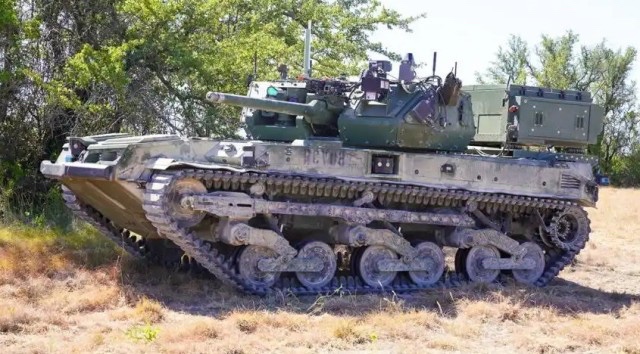
The 1st Battalion, 4th Infantry Regiment — serving as the opposing force in Combined Resolve — pitted robotic combat vehicles, or RCVs, against the 1st Armored Brigade Combat Team, 3rd Infantry Division and their partner nations in simulated combat.

The RCVs are part of Project Origin, an initiative in development as part of the Army’s modernization efforts from the Ground Vehicle Systems Center, or GVSC, under the Army Combat Capabilities Development Command. The program tests and experiments with autonomous ground vehicles to support Army maneuvers and provide a variety of load packages, depending on the situation.

This training provided Project Origin engineers with real-time feedback on the capability, utility, and combat effectiveness of the latest generation of RCVs. The vehicles are remote or autonomously controlled and designed to assist with a wide range of operations including long-range reconnaissance, concealment, electronic warfare, and autonomous resupply operations.

“Anytime we can get technology in [Soldiers’] hands and find out, right away, what they like, what they don’t like, helps us to not expend resources in the wrong areas,” said Todd Willert, an engineer with GVSC. “Being out here with the [Soldiers] is the most productive thing for the Army’s Robotic Combat Vehicle Program.”

Soldiers with the 1st Battalion, 4th Infantry Regiment have been working with Project Origin since the beginning of Combined Resolve 17, however the current iteration of RCVs they are training with have already been through two weeks of hands-on experimentation with the 1st Special Forces Group at Dugway Proving Ground, Utah.

“This is something I didn’t think we would be seeing in the [Infantry] as soon as we are,” said Sgt. Andrew Carmichael, Sniper section leader with 1st Battalion, 4th Infantry Regiment. “It’s definitely here to stay, so the quicker we can expose our allies and our own forces to this technology and how to implement and defend against it, is crucial in the next fight.”

Soldier feedback within multinational exercises inform Army modernization on requirements operating in the coalition environment, promoting interoperability and communicates strength of a combined U.S., Allied and partner force to shape the security environment. At the conclusion of Combined Resolve the RCVs will be taken to Grafenwoehr Training Area in order further test their capabilities and conduct live fire training.

For more information on visit the Combined Resolve DVIDS page.

By Spc Garrison Waites