GORE-TEX Professional

Archive for the ‘Army’ Category

Changes to Army’s Retention Program Slated to Begin Soon

Wednesday, September 29th, 2021

WASHINGTON – Three changes to the Army’s retention program are scheduled to take effect Oct. 1, as the Army looks to simplify aspects of the reenlistment process and give Soldiers more flexibility before their expiration term of service date.

A modification to the Career Status Program, formerly known as the Indefinite Reenlistment Program, an adjustment to the Reenlistment Opportunity Window, or ROW, and to one of the extensions will all take effect starting fiscal year 2022, said Sgt. Maj. Tobey J. Whitney, the Army’s senior career counselor.

“These changes are being made with the intent of increasing predictability for Soldiers and their families while also reducing turbulence within Army organizations,” Whitney said.

Career Status Program

Soldiers ranked E-6 and above and with 10 years or more of active service will now be eligible for the Career Status Program, reducing the time in service threshold from 12 years, Whitney said.

“We found through collected data that staff sergeant and above with more than 10 years of service were required to reenlist at least twice to make it to retirement,” Whitney said. “That doesn’t seem like a logical solution to keep Soldiers in the Army.”

The update to the CSP will not change any of the Army’s voluntary separation policies, which allow Soldiers to request a discharge or enter into the Career Intermission Program, he added.

Under CIP, Soldiers can take a break in service while receiving their benefits and a portion of their pay for up to three years, Army G-1 officials said earlier this year.

“We want to ensure that [qualified] Soldiers understand their eligibility for the Career Status Program,” Whitney said. “If Soldiers can just reenlist for an indefinite term of service, they can go and continue with their careers.”

ROW changes

The change to the ROW policy will give Soldiers 12 months before their ETS to review their reenlistment options and make a final decision, Whitney said.

“The ROW is currently set at 15 months, but we are changing it to 12 for two main reasons,” he said. “First, it is simple for Soldiers, leaders and families to understand when they are 365 days from their ETS.

Second, “the analytics over the past several years [show] that the vast majority of Soldiers wait until they are between eight to 11 months before they reenlist.”

The adjustment to the ROW extension would increase the minimum term length from 12 to 18 months, Whitney said.

The transition process can create a lot of turbulence in a Soldier’s life, he said, as well as impact their organization as they navigate the Soldier for Life program and finish their out-processing tasks.

As the Army continues to operate during the COVID-19 pandemic, he said the ROW extension change would remain a short-term retention option for Soldiers. Further, changes to the program will not impact those who need to reenlist for promotion, reassignment, selection, or other requirements.

“We found that it is pretty common for Soldiers to extend,” Whitney said. “We are adding six additional months to provide a little more predictability for Army units, the Soldier, and their family.”

Many other short-term extension options remain available for Soldiers who need additional time and meet the requisite qualifications, he added.

By Devon L. Suits, Army News Service

Army EOD Soldiers First to Field Test Unmanned Aerial System

Tuesday, September 28th, 2021

JOINT BASE LEWIS-MCCHORD, Wash. — Explosive Ordnance Disposal technicians from the 707th Ordnance Company (EOD) were among the first U.S. Army EOD Soldiers to conduct field testing with the Skyraider Unmanned Aerial System.

EOD Soldiers from the company put the UAS through its paces from a village in Training Area 4 on Joint Base Lewis-McChord, Washington, Aug. 23 – Sept. 2.

According to Capt. William R. Hartman, the commander of the 707th EOD Company, the UAS provided greater visibility of the heavily forested training area.

“They can mostly be used for reconnaissance of terrain and to identify possible explosive hazards,” said Hartman, a native of Reading, Pennsylvania, who has deployed to the U.S. Central Command area of operations.

Hartman said the UAS was also used to deploy lightweight robots called Throwbots that helped his EOD Soldiers to identify hazards in less accessible areas and structures.

The 707th EOD Company is part of the 3rd EOD Battalion, 71st EOD Group and 20th Chemical, Biological, Radiological, Nuclear, Explosives (CBRNE) Command. Based 19 installations in 16 states, 20th CBRNE Command is home to 75 percent of the Army’s EOD and CBRN units, as well as the CBRNE Analytical and Remediation Activity, 1st Area Medical Laboratory, Nuclear Disablement Teams and Weapons of Mass Destruction Coordination Teams.

Soldiers and civilians from the Aberdeen Proving Ground, Maryland-headquartered command work with joint, interagency and allied partners to defeat CBRNE threats around the world. Since 2003, 20th CBRNE Command EOD Soldiers have partnered with U.S. Navy EOD technicians to disable hundreds of thousands of improvised explosive devices in Iraq and Afghanistan.

Hartman said the highlight of the fielding was connecting Light Detection and Ranging or LDIR technology to the UAS system and using it to map terrain.

The EOD company commander said the UAS could be a great use in a combat zone.

“We could definitely benefit from its capabilities in that environment,” said Hartman.

By Walter Ham

Special Operations, 82nd Airborne Snipers Test New Modular Precision Rifle at Bragg

Saturday, September 25th, 2021

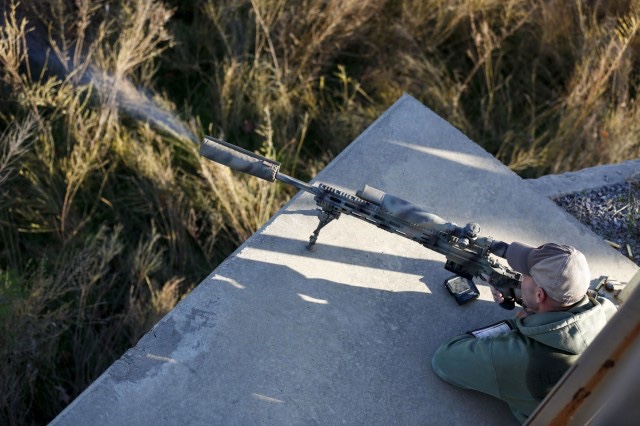
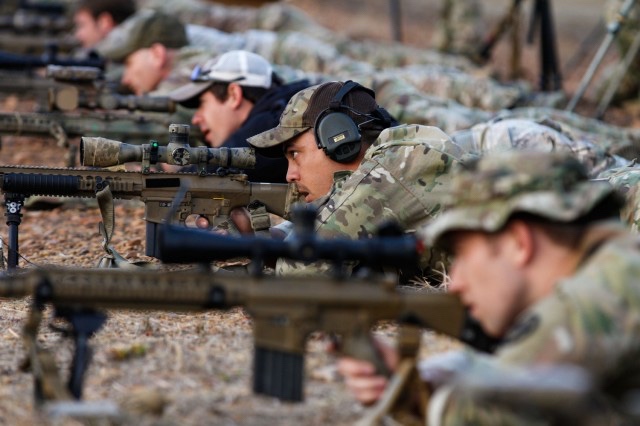
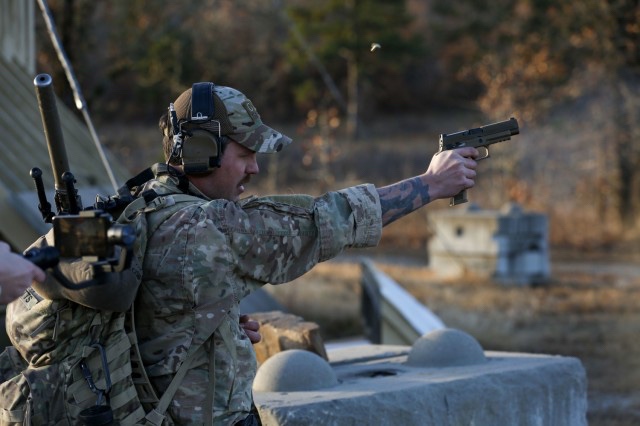
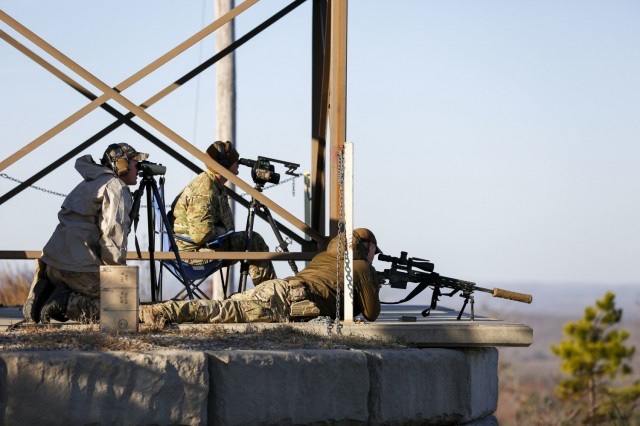
FORT BRAGG, North Carolina — Operational testing of the Army’s newest generation sniper system — the MK-22 Precision Sniper Rifle (PSR) — marks the project’s final hurdle before fielding.

“The modular nature of the PSR allows it to be tailored to meet mission requirements and is appealing to airborne Snipers who are typically armed with long-barreled precision rifles of a single caliber offering,” said Sgt. 1st Class Marcus Love, Airborne and Special Operations Test Directorate, Test Noncommissioned Officer.

Because of the single-caliber offerings, snipers requiring additional capabilities must deploy with additional weapons. The PSR can be configured for multi-calibers by the Sniper in the field and requires no higher level maintenance to reconfigure. It will also extend engagement ranges for both anti-material and anti-personnel target engagements.

“The increased engagement range will keep Snipers safer and increase the options for the local commander employing these combat multipliers,” said Sgt. Austin Stevens, a Sniper assigned to the 1st Battalion, 325th Airborne Infantry Regiment, 2nd Brigade Combat Team, 82nd Airborne Division.

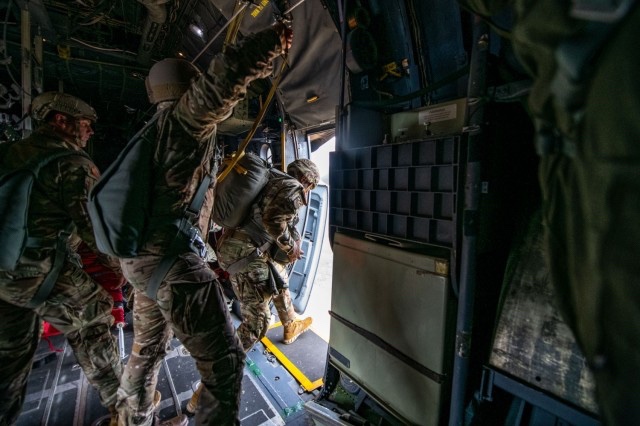
“With a folding stock and removable suppression system, the PSR will provide airborne Snipers a more compact load during airborne infiltration operations without reducing their lethality while providing a precision rifle platform more conducive to their combat environment,” said MK-22 Project NCO Sgt. 1st Class Jonathan Copley.

Spc. Michael Liptak, a Sniper with Headquarters & Headquarters Company, 2nd Battalion, 325th Infantry Regiment immediately identified the attributes of accuracy in regards to the MK-22. “I was surprised at the accuracy and the straightforward approach to testing the PSR,” he said.

Prior to testing, Snipers from across the airborne and special operations community took part in new equipment training which included familiarization with the system, maintenance, target engagement, system configuration and zeroing procedures.

For Spec. Nathanael Keffer, a Sniper with 2nd Battalion, 508th Infantry Regiment, the PSR’s versatility to adapt to multiple mission sets was a marked advantage. “The PSR is a very versatile weapon system that can be tailored to meet multiple mission requirements,” said Keffer.

Mr. Larry Harris, ABNSOTD Deputy Chief of Test said, “The critical task in testing any small arms platform intended for use by airborne forces is ensuring zero retention of the primary optic subsequent to airborne insertion. “This is a critical gauge of the Paratrooper’s lethality during airfield seizure and other follow-on operations.”

To evaluate this performance measure of the PSR, the ABNSOTD test team applied the organization’s mobile weapons boresight collimator to the rifle after jumping to make sure the Sniper’s pre-mission zero was not degraded by shock during the jump.

“This process establishes a baseline for sight reticle locations prior to and post airborne insertion,” said Miles Crawford, Test Technology Branch Chief, ABNSOTD. “Testers can monitor any shift in the weapon sight reticle that may have been induced by shock associated with static line parachutes,” Crawford said.

Story by Mr. Mike Shelton, Airborne and Special Operations Test Directorate, U.S. Army Operational Test Command

Photos by Mr. James Finney, Audio Visual Production Specialist, Base and Test Support Services contractor

Elbit Systems of America Awarded $54 Million Order as Part of the U.S. Army’s Enhanced Night Vision Goggle – Binocular (ENVG-B) Program

Friday, September 24th, 2021

FORT WORTH, TEXAS – September 23, 2021 – Elbit Systems of America has been awarded a second production order worth approximately $54 million to supply Enhanced Night Vision Goggle – Binocular (ENVG-B) systems, spare parts, logistics support, and test equipment for the U.S. Army.

“Elbit America’s ENVG-Bs provide warfighters with unprecedented situational awareness during limited visibility conditions, increased lethality through faster target acquisition, and other game-changing advantages on the battlefield” said Raanan Horowitz, President and CEO of Elbit Systems of America.

These systems will be produced in Roanoke, Virginia, and will be supplied through February 2023.

“We are eager to support the U.S. Army’s transition to higher ENVG-B production rates, which will create additional jobs at our Roanoke facility, and throughout our extended US-based supply chain, generating a positive economic impact in the communities they reside,” Mr. Horowitz added.

This order is part of an Other Transaction Authority (“OTA”) contract announced by Elbit America on October 22, 2020, that could reach a maximum of approximately $442 million. The U.S. Army did not define an overall time frame for performance of the OTA contract.

The Army’s Promised “Ike”Jacket Is Happening

Thursday, September 23rd, 2021

Recently, USAFRICOM released this photo of Commanding General, Gen. Stephen J. Townsend, U.S. Army, wearing a prototype Ike Jacket as part of the World War Two-inspired Army Green Service Uniform. The optional item has been promised since the AGSU’s adoption along with a “bomber jacket.”

Last week, I saw MG Anthony Potts, PEO Soldier wearing one at DSEi in London but his aide kept him moving when I attempted to ask him about the jacket.

It’s happening; helpfully we’ll know the timeline soon.

Army Modernizes Tactical Power with Battery Interoperability

Wednesday, September 22nd, 2021

ABERDEEN PROVING GROUND, Md. — The Army is modernizing tactical power and reducing logistics costs by developing standardized batteries for Soldier-worn and handheld equipment such as radios, GPS, night-vision devices and weapons.

Army Futures Command (AFC) engineers are leading the project to deliver eight sizes of batteries that share a common mechanical and electrical interface — the key to unlocking interoperability.
The Small Tactical Universal Battery (STUB) is the Army’s latest approach to develop a standard family of batteries, according to Dr. Nathan Sharpes, a research mechanical engineer with the Command, Control, Communications, Computers, Cyber, Intelligence, Surveillance and Reconnaissance (C5ISR) Center — a component of AFC’s Combat Capabilities Development Command (DEVCOM).
“Now is an opportune time to standardize power sources as the Army is prioritizing modernization and fielding electronics with greater capabilities requiring more energy than current systems,” Sharpes said.

The C5ISR Center is leading the program that will benefit Soldiers, the acquisition community, logistics personnel and industry, Sharpes said. The goal is to avoid the current model of fielding a proprietary battery for each piece of gear as technology developers have historically delivered unique batteries for new capabilities.

Each battery size provides a different amount of energy, from which Soldiers could choose, depending on their mission needs. This interoperable battery system will seamlessly deliver the correct voltage and power level needs to any device.

“Currently when a Soldier is on a mission carrying five different pieces of gear that each have a unique battery form factor, along with spares, that’s extra weight and items to keep track of,” Sharpes said. “With this family of interoperable batteries, Soldiers will see benefits cognitively and physically.

“Any battery in the STUB family will be able to attach to any device designed for it because of the standard interface. We’re also incorporating eight attachment methods — such as slide on, clip in and twist on — so devices can use the universal battery in different ways. Soldiers can focus more on their missions and less on which types of batteries and how many of each to carry.”

Standardization also alleviates the burden of battery design from manufacturers of handheld electronics. As industry develops new C5ISR technologies, they will be able to concentrate on core competency areas while adhering to the already approved universal-battery specifications. All vendors would follow the same battery guidelines, Sharpes said.

The new standard universal-battery sizes will also simplify logistics and reduce supply chain costs, as the Army will be able to move away from procuring, storing, testing and shipping a wide array of unique batteries required for each piece of Soldier-carried equipment, Sharpes said.

The C5ISR Center’s STUB initiative follows in the footsteps of the Army’s development of the thin, flexible Conformal Wearable Battery (CWB) that Soldiers wear on their vests as a central power source for wearable electronic devices, according to Christopher Hurley, chief of the Center’s Tactical Power Branch.

The CWB development aimed to reduce the number of battery types needed by enabling a single power source to provide extended runtime to select pieces of kit. Current Army research would enable equipment to use smaller STUB batteries when not connected to the CWB.

“The end result is an overall lighter and more energy dense Soldier kit,” Hurley said. “The C5ISR Center is working across Army organizations to create battery standards and specifications. These efforts will meet the demands of the numerous pieces of equipment a Soldier uses and the diverse operating environments in which they conduct missions.”

——————-

The C5ISR Center is the Army’s applied research and advanced technology development center for C5ISR capabilities. As the Army’s primary integrator of C5ISR technologies and systems, the center develops and matures capabilities that support all six Army modernization priorities, enabling information dominance and tactical overmatch for the joint warfighter.

By Dan Lafontaine, DEVCOM C5ISR Center Public Affairs

The C5ISR Center is an element of the U.S. Army Combat Capabilities Development Command (DEVCOM). Through collaboration across the command’s core technical competencies, DEVCOM leads in the discovery, development and delivery of the technology-based capabilities required to make Soldiers more lethal to win our nation’s wars and come home safely. DEVCOM is a major subordinate command of the U.S. Army Futures Command.


——————-

Guest Post sponsored by EXO Charge, and published with permission from the U.S. Army. EXO Charge will be exhibiting the STUB series at the AUSA Annual Exposition on their booth, #860 in Hall ABC. www.exocharge.com


Small, Mighty Robots Mimic the Powerful Punch of Mantis Shrimp

Tuesday, September 14th, 2021

Robot models the mechanics of the strongest punch in the animal kingdom

RESEARCH TRIANGLE PARK, N.C. — Modeling the mechanics of the strongest punch in the animal kingdom, researchers with U.S. Army funding built a robot that mimics the movement of the mantis shrimp. These pugnacious crustaceans could pave the way for small, but mighty robotic devices for the military.

Researchers at Harvard University and Duke University, published their work in Proceedings of the National Academy of Sciences. They shed light on the biology of mantis shrimp, whose club-like appendages accelerate faster than a bullet out of a gun. Just one strike can knock the arm off a crab or break through a snail shell. These crustaceans have even taken on an octopus and won.

“The idea of a loaded spring released by a latch is a staple in mechanical design, but the research team cleverly observed that engineers have yet to achieve the same performance out of a Latch-Mediated Spring Actuator that we find in nature,” said Dr. Dean Culver program manager, U.S. Army Combat Capabilities Development Command Army Research Laboratory. “By more closely mimicking the geometry of a mantis shrimp’s physiology, the team was able to exceed accelerations produced by limbs in other robotic devices by more than tenfold.”

How mantis shrimp produce these deadly, ultra-fast movements has long fascinated biologists. Recent advancements in high-speed imaging make it possible to see and measure these strikes, but some of the mechanics have not been well understood.

Many small organisms, including frogs, chameleons, and even some kinds of plants, produce ultra-fast movements by storing elastic energy and rapidly releasing it through a latching mechanism, like a mouse trap. In mantis shrimp, two small structures embedded in the tendons of the muscles called sclerites act as the appendage’s latch. In a typical spring-loaded mechanism, once the physical latch is removed, the spring would immediately release the stored energy, but when the sclerites unlatch in a mantis shrimp appendage, there is a short but noticeable delay.

“When you look at the striking process on an ultra-high-speed camera, there is a time delay between when the sclerites release and the appendage fires,” said Nak-seung Hyun, a postdoctoral fellow at Harvard John A. Paulson School of Engineering and Applied Sciences and co-first author of the paper. “It is as if a mouse triggered a mouse trap, but instead of it snapping right away, there was a noticeable delay before it snapped. There is obviously another mechanism holding the appendage in place, but no one has been able to analytically understand how the other mechanism works.”



Biologists have hypothesized that while the sclerites initiate unlatching, the geometry of the appendage itself acts as a secondary latch, controlling the movement of the arm while it continues to store energy. But this theory had not yet been tested.

The research team tested this hypothesis first by studying the linkage mechanics of the system, then building a physical, robotic model. Once they had the robot, the team was able to develop a mathematical model of the movement. The researchers mapped four distinct phases of the mantis strike, starting with the latched sclerites and ending with the actual strike of the appendage. They found that, indeed, after the sclerites unlatch, geometry of the mechanism takes over, holding the appendage in place until it reaches an over-centering point and then the latch releases.

“This process controls the release of stored elastic energy and actually enhances the mechanical output of the system,” said Emma Steinhardt, a graduate student at Harvard John A. Paulson School of Engineering and Applied Sciences and first author of the paper. “The geometric latching process reveals how organisms generate extremely high acceleration in these short duration movements, like punches.”

The device is faster than any similar devices at the same scale to date.

“This study exemplifies how interdisciplinary collaborations can yield discoveries for multiple fields,” said co-author Dr. Sheila Patek, professor of biology at Duke University. “The process of building a physical model and developing the mathematical model led us to revisit our understanding of mantis shrimp strike mechanics and, more broadly, to discover how organisms and synthetic systems can use geometry to control extreme energy flow during ultra-fast, repeated-use, movements.”

This approach of combining physical and analytical models could help biologists understand and roboticists mimic some of nature’s other extraordinary feats, such as how trap jaw ants snap their jaws so quickly or how frogs propel themselves so high.

“Actuator architecture like this offers impressive capabilities to small and lightweight mechanisms that need to deliver impulsive forces for the Army,” Culver said. “But I think there’s a broader takeaway here – something the engineering community and defense research can keep in mind. We’re not done learning about mechanical performance from nature and biological systems. Things we take for granted, like a simple sprung actuator, are still ripe for further investigation at many scales.”

By U.S. Army DEVCOM Army Research Laboratory Public Affairs

Ft Bragg Airborne Troops Support R&D to Prevent Soldier Head Injuries

Monday, September 13th, 2021

FORT BRAGG, North Carolina – Airborne Soldiers here recently tested combat helmet sensors looking to help the Army lessen repetitive traumatic injuries to the head and neck while jumping from aircraft.

The 2nd Brigade, 82nd Airborne Division and the Airborne and Special Operations Test Directorate teamed up to do testing for the Army Research Laboratory’s (ARL) newest Head Impact Monitoring Sensors.

Ongoing research supported by the ARL over the last 10 years has developed improved monitoring devices and the implementation of many new protective gear developments.

“Ultimately our goal for the Rate Activated Tether (RAT) helmet suspension is to increase the blunt impact protection in all combat helmets for all Soldiers,” said Thomas Plaisted, the ARL Materials Engineer Research Lead.

He said whether Airborne or ground-based operations Soldiers, the goal is to achieve a comfortable and stable helmet fit with minimal added weight.

“The Impact Monitoring Mouthguard (IMM) is a ‘Check Engine’ sensor that provides understandable and objective head impact and blunt force data to line leaders regarding the readiness of their Service members,” said Dr. Adam Bartsch, Chief Science Officer for Prevent Biometrics.

For the past year, the IMM Team has been collaborating with the ARL to evaluate the RAT impact absorption system fitted into the Army Combat Helmet.

Testing of the IMM and RAT began mid-July with a day of ground training and familiarization, followed by combat-equipped jumps on Fort Bragg’s Holland Drop Zone.

“The findings from this test are vital in understanding the physical demands Soldiers encounter while conducting airborne operations,” said Capt. Tyler Miller, ABNSOTD Operations Officer.

“With this data, leaders and researchers can develop equipment and processes to better protect paratroopers.”

Ground training consisted of experts from ARL and Prevent Biometrics conducting training on proper wear and fitting of the RAT and IMM.

The test jumpers then tested the equipment on the ground with Sustained Airborne Training, Parachute Landing Falls on various surfaces, and then practicing jump commands and aircraft exits out of a mock door trainer.

That was followed by combat-equipped training jumps on Fort Bragg’s Holland Drop Zone from U.S. Air Force C-17 Aircraft, along with Paratroopers from 2nd Brigade, 82nd Airborne Division, who were already jumping for training for mass tactical airfield seizure insertions.

“The ability to test and put these new and emerging technologies directly into the hands of our Soldiers goes far too rapidly evolve technology for the future of the Army,” said Miller.

Data collected from post jump surveys and the head impact sensors will lead to further development of protective equipment for Paratroopers.

Soldiers from the 2nd Brigade, 82nd Airborne Division plan to assist medical researchers, by utilizing the IMM for further head impact data collection during training events over the coming months.

The data these Soldiers will gather will assist researchers in further development of protective equipment and techniques to prevent future mild traumatic brain injuries from combat and everyday training events.

By CPT Christopher Weber, Airborne and Special Operations Test Directorate, U.S. Army Operational Test Command