Celebrate 20 years of the TLR-1

Archive for the ‘Army’ Category

Secretary of Defense Pete Hegseth Renames Fort Moore to Fort Benning

Tuesday, March 4th, 2025

Today Secretary of Defense Pete Hegseth signed a memorandum renaming Fort Moore in Georgia to Fort Benning. The new name pays tribute to Corporal (CPL) Fred G. Benning, who was awarded the Distinguished Service Cross for his extraordinary heroism in action during World War I with the U.S. Army in France in 1918. This change underscores the installation’s storied history of service to the United States of America, honors the warfighter ethos, and recognizes the heroes who have trained at the installation for decades and will continue to train on its storied ranges.

Forging Lifelines: 5th SFAB’s Medical Mission in the Indo-Pacific

Sunday, March 2nd, 2025

The 5th Security Force Assistance Brigade (5th SFAB) plays a pivotal role in enhancing medical capabilities across the Indo-Pacific, fostering stronger partnerships and improving the readiness of allied and partner nations. Through collaborative training, operational support, and knowledge sharing, 5th SFAB’s medical teams help partner forces advance their trauma care, casualty evacuation, and medical logistics, ensuring greater resilience during both peacetime and large-scale combat operations (LSCO).

Building Medical Readiness Through Collaboration

Since 2023, the 5th SFAB has conducted over 70 medical assessments and numerous training events with nine Indo-Pacific partners. These engagements focus on improving tactical combat casualty care (TCCC), prolonged field care (PFC), whole blood programs, and medical evacuation systems. By introducing advanced trauma care techniques and refining medical processes, 5th SFAB advisors help partner forces reduce casualty fatality rates, increase return-to-duty rates, and enhance overall battlefield survivability.

Advancing Tactical Medical Training

One of the cornerstone initiatives is training partner forces in TCCC and PFC. These programs teach critical skills for stabilizing casualties and providing lifesaving care in austere environments, ensuring that medical personnel can sustain injured soldiers until evacuation. Additionally, the implementation of whole blood programs improves trauma survival rates, aligning partner force capabilities with proven U.S. military practices.

Enhancing Medical Evacuation and Logistics

Effective casualty evacuation is essential during crises. 5th SFAB advisors work closely with partner forces to optimize evacuation routes, establish Patient Evacuation Coordination Cells (PECCs), and ensure seamless coordination between military and civilian healthcare facilities. By embedding medical advisors within partner force headquarters, the brigade enhances real-time reporting and facilitates bilateral evacuation requests, strengthening interoperability and reducing response times.

Supporting Medical Logistics and Supply Chains

Sustaining medical operations during high-casualty scenarios requires robust supply chains. 5th SFAB advisors collaborate with partner force logistics teams to assess supply levels, forecast consumption rates, and address Class VIII medical supply needs. By establishing pre-positioned stockpiles and implementing walking blood banks, partner forces can maintain critical care capabilities even in contested environments. The brigade also advocates for agreements such as Acquisition and Cross-Servicing Agreements (ACSAs) to ensure reliable resupply during operations.

Building Sustainable Medical Capabilities

The 5th SFAB’s approach emphasizes long-term capacity building through train-the-trainer programs and Subject Matter Expert Exchanges (SMEEs). By empowering partner nations to develop and sustain their own medical training and operational systems, the brigade fosters enduring self-reliance and strengthens regional stability. Additionally, the use of tools like the Medical Advisor Specific Tool (MEDASAT) ensures consistent progress tracking and continuous improvement.

Strengthening Regional Resilience

Through its advisory efforts, the 5th SFAB is enhancing the medical readiness and interoperability of Indo-Pacific partner forces, ensuring they can respond effectively to both peacetime emergencies and combat operations. By sharing expertise, improving casualty care, and optimizing logistics, the brigade is helping to save lives and strengthen alliances across the region, reinforcing collective security and promoting long-term stability.

Conclusion

The 5th SFAB’s medical advising mission in the Indo-Pacific demonstrates the power of collaboration in strengthening regional security and resilience. By improving trauma care, enhancing evacuation systems, and supporting sustainable medical logistics, the brigade plays a crucial role in ensuring that partner forces are prepared to save lives and sustain operations during both crises and conflicts. These partnerships not only enhance the capabilities of individual nations but also contribute to the collective readiness of the Indo-Pacific region, fostering a network of allies capable of responding swiftly and effectively to any challenge.

By LTC Matthew Holtkamp

Integris and QinetiQ Collaborate on U.S. Army Helicopter Armor

Wednesday, February 26th, 2025

Integris and QinetiQ Join Forces to Enhance Survivability of Future Long Range Assault Aircraft (FLRAA)

Legacy Resource for Defense Prime Contractors

25 February 2025 – Integris Composites, Inc., a global leader in armor protection for military, police and security has become a Tier 1 supplier of military helicopter armor for defense departments and prime contractors.

Integris Composites, a leading supplier of advanced armor systems, recently announced it is partnering with QinetiQ US to provide armor systems for the U.S. Army’s Future Long Range Assault Aircraft (FLRAA)—the next-generation helicopter program that addresses the U.S. Army’s requirements for increased speed, range, and survivability.

“This collaboration builds upon Integris’ initial selection byBell Textron to provide armor systems for the FLRAA, further solidifying the positioning of Integris Composites in the cutting-edge military aviation sector,” said David Cordova, chief commercial officer of Integris, Inc.

ARMOR SYSTEM: Bell Textron, Inc. has selected Integris Composites to supply armor for the Future Long Range Assault Aircraft (FLRAA). The Bell V-280 Valor pictured here was chosen by the US Army as the winner of Future Long-Range Assault Aircraft Program. The new assault aircraft will fly twice as far and twice as fast as the current fleet.

Integris has awarded QinetiQ the contract to provide systems engineering and integration expertise for the materials technology that will be used on both the floor and wing of the advanced rotorcraft. Cordova said this is the latest collaboration in the history between QinetiQ and Integris.

The FLRAA program has entered the engineering and manufacturing development phase, with Bell reporting it has commenced detailed design work on six prototypes.

“We are extremely proud to be part of the team behind this innovative rotorcraft that is ushering in what will become the U.S. Army’s new long-range assault aircraft,” Cordova continued. The QinetiQ-Integris collaboration leverages Integris’ expertise in lightweight, fit-for-purpose composite military armor, which has been successfully applied to various aerospace projects.

Cordova said that Integris, in alignment with other industry partners, supports key program objectives, including Bell’s Modular Open Systems Approach (MOSA), increased survivability, and alignment with the broader Future Vertical Lift (FVL) initiative, as the FLRAA progresses toward prototype testing in 2026 and fielding by 2030.

Global Helicopter Armor Resource

“Integris is today entering its fourth decade of business as a reliable resource for major military commands as well as a robust partner of choice for the world’s top defense contractors. We are a credentialed tier one supplier to aerospace original equipment manufacturers (OEMs) and prime defense contractors throughout the world,” said Cordova.

The company is supplying armor kits for the new Boeing MH-139 Grey Wolf that will replace the UH-60 Black Hawk for the U.S. Air Force. “We are part of a storied lineage that traces its roots back to the iconic Vietnam-era ‘Huey’ (UH-1 Iroquois) and present-day Black Hawk, which since 1979 has been the Army’s Utility Tactical Transport Aircraft System (UTTAS),” Cordova continued.

Integris has provided ballistic protection for various international helicopter platforms, including:

Airbus H-125 – special lightweight, high-performance kits for U.S. Customs and Border Patrol

Airbus Military – H135, NH90, H145, H225M (Super Puma), H175, and potentially the H160

Leonardo Helicopters – AW159, AW101, and AW169

Trusted Resource

In addition to armor kits for rotorcraft, the company has been contracted to support Velocity Systems, the Battelle Memorial Institute, Mack Defense, American Rheinmetall Vehicles, and the Air Force Institute of Technology.

Integris also has a strong reputation for the body armor plates that protect military personnel around the world. “We are pleased to report that our Cratus™ Wave ballistic armor, an innovative thinner and heat stress-reducing body armor insert, was ordered by the U.S. Air Force 582nd Helicopter Group.

TacJobs – Army MOS 35P at 20th Group

Wednesday, February 26th, 2025

20th SFG(A) in Alabama is is looking to fill 35P slots.

You must already be MOS qualified and be E5-E6.

If you qualify, go to guardsf.com and use the registration link under “Special Forces Support”.

joinalguard.formstack.com/forms/35p_ala

Being on a SOT-A is one of the best jobs in the Army.

Have a question on how to earn the Green Beret? Or interested in becoming support?

Click “Contact a Green Beret” at guardsf.com.

JPMRC Forges Arctic Medical Warriors

Wednesday, February 26th, 2025

FORT GREELY, Alaska — Members of the U.S. Army Reserve’s 307th Forward Resuscitative and Surgical Detachment recently conducted annual training during the Joint Pacific Multinational Readiness Center 25-02 rotation in early 2025.

JPMRC 25-02 is designed to challenge roughly 10,000 joint, multi-component and multinational partners in remote and extreme Arctic winter conditions. The large-scale combat scenarios help refine tactics, techniques, and procedures.

Medical readiness is a critical component of combat effectiveness and JPMRC 25-02 provided an opportunity for the 307th FRSD to spread their knowledge and enhance their capabilities in a harsh environment.

During the exercise, the 307th FRSD augmented with Charlie Company, 725th Brigade Support Battalion, 2nd Infantry Brigade Combat Team (Airborne), 11th Airborne Division as a training enabler and allowed surgical capability to Role 2, or advanced medical care.

“This increased the fidelity of the simulated exercise by offering an additional level of patient care. It provided the C-Med team with additional training on patient triage, movement, and high-acuity patient hold scenarios,” said Capt. David Bold, commander of the FRSD.

By simulating real-world casualty scenarios, the 307th FRSD tested and stressed the Role 2 facility while displaying the full spectrum of military healthcare capabilities. Their presence emphasized that “a surgical element is a high functioning and mission capable unit but comes at the cost of being extremely resource heavy,” explained Bold. “The resources required are sourced and provided by C-Med/BSB. Our presence helped to emphasize this fact and provided critical training and education for the support battalion.”

Operating in the Arctic presents challenges beyond combat tactics.

“Being a unit from Wisconsin, we have experience training in the cold, but not to this degree,” Bold admitted. The extreme cold is both a physical and mental drain, impacting movement, equipment functionality, and patient care. For the 307th FRSD, training in Alaska was an invaluable opportunity to prepare for the realities of warfighting in subzero conditions.

“It is important for the FRSD to be here to display various levels of care that military healthcare provides,” said Bold.

The exercise provided ample educational opportunities. The FRSD’s subject matter experts in trauma surgery, orthopedic surgery, critical care and anesthesia conducted hands-on training for medics and junior officers. Topics covered included advanced trauma care, airway management, trauma operative care and care for brain-injured patients.

Sgt. Alexandria Schroeder, an operating room specialist shared that her last unit was a hospital augmentation detachment providing Roles 3 and 4 medical care, said, “they deal with more down the line surgery and capabilities. So yeah, this is new to me. The whole being this close to the front lines.”

Schroeder joined the FRSD a few months prior to coming to Alaska and noted the effective training. “It’s definitely a lot of the Army warrior tasks training that we all do but never really implement. So I feel like coming out here, we actually get to implement a lot of those trainings.”

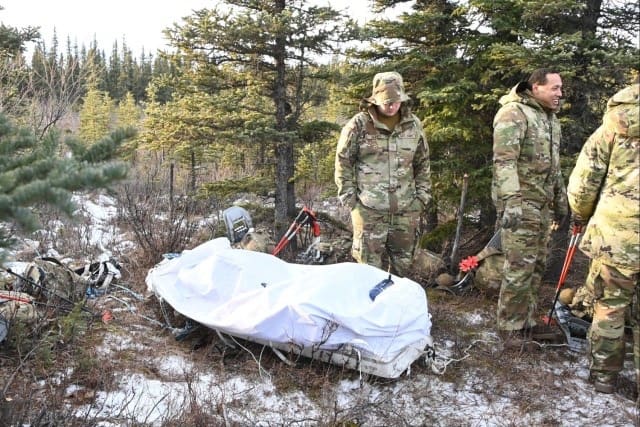
Not only did the FRSD focus on medicine, one of the highlights both Bold and Schroeder mentioned was the cold weather training they received by the 11th Airborne Soldiers before being sent to the notional battlefield.

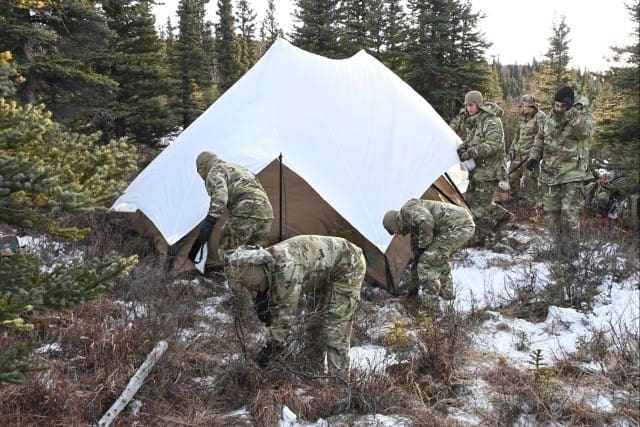
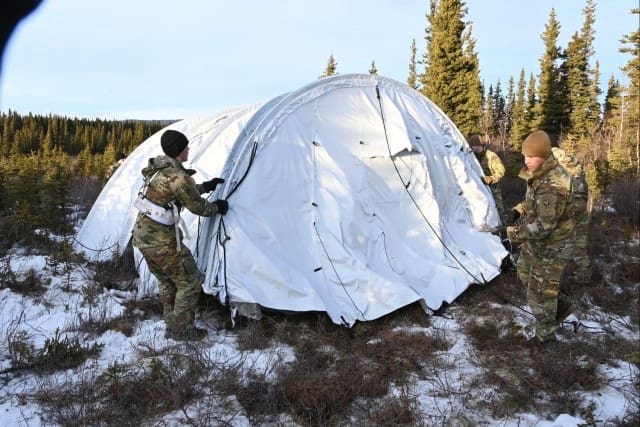
“I thought that was cool. Learning how to use the snowshoes, setting up those tents and learning how to get the heaters going,” said Schroeder.

Another highlight for Bold was the collaboration between the FRSD and the Role 2 facility, demonstrating the necessity of seamless coordination between echelons of medical care in combat scenarios.

One notable aspect of the exercise was the exclusion of the FRSD from the initial airborne assault at the drop zone. This decision reflected real-world operational considerations, as a surgical element would not typically be deployed ahead of the initial assaulting force.

Instead, the FRSD’s integration into JPMRC 25-02 focused on later-stage battlefield medical support, reinforcing logistical planning and patient evacuation procedures.

As the 307th FRSD refined their ability to provide life-saving care under the harshest conditions, JPMRC 25-02 stands as a testament to the power of deliberate training, adaptability, and joint force collaboration in securing the future of warfare in the world’s coldest and most challenging battlefields.

By SSG Mikayla Fritz

Transforming UAS Operations: UAS Summit at Fort Novosel Paves the Way for Future Innovations

Tuesday, February 25th, 2025

FORT NOVOSEL, Ala. — The U.S. Army Aviation Center of Excellence hosted its Unmanned Aircraft Systems Summit at Fort Novosel, from Feb. 10-13, 2025. The summit brought together subject matter experts and operators from around the world to discuss the future of UAS operations.

The summit, which included representatives from agencies such as Army Futures Command, DARPA, DEVCOM, the Department of Defense and the Army’s various Centers of Excellence, aimed to provide a platform for the sharing of lessons learned and the discussion of strategies to inform requirements moving forward.

Col. Joshua Ruisanchez, director of the U.S. Army Futures Command Aviation Capability Development Integration Directorate, highlighted the importance of air-ground integration as the Army continues to transform. The event provided a venue for discussing strategies and approaches moving forward, informed by current global conflicts and future military engagements. Different agencies working within the UAS space showcased their capabilities, which will inform future requirements.

“We’re learning from all the formations that brief this week on how they’re employing UAS, and we’re capturing those lessons learned,” said Col. Scott Shaw, Maneuver Capabilities, Development and Integration Directorate director from the Maneuver Center of Excellence. “We’re also learning from industry about the capabilities that are out there, and how they can help augment our operations.”

The summit included a range of units, including the 101st Airborne Division, the 82nd Airborne Division and the 75th Ranger Regiment, as well as representatives from Special Forces and other agencies.

“This is a great venue to bring in the air-ground integration as we continue to transform the Army,” said Shaw. “We’re seeing what’s happening in Ukraine and what we think the future of UAS operations will look like.”

The summit also included static displays of UAS systems by over 40 industry partners, as well as flight demonstrations.

“This is super important for the Army as a whole,” said Tyler Booth, the small UAS lead at Fort Novosel. “We’re bringing units from all over the UAS enterprise, and this event is a huge information-gathering and disseminating event. It’s also a chance for industry partners to showcase their UAS systems and demonstrate their capabilities.”

The event marked the first time that commercial UAS systems had been flown in such large numbers at Fort Novosel and required significant coordination and planning to ensure its success.

“It’s a large administrative task, and a lot goes into working with all these companies to ensure that we meet the requirements to be able to do this,” said Booth. “But it’s really great that we can do this here, and it’s a testament to the Army’s commitment to innovation and the development of new technologies.”

The summit was seen as a key step in the Army’s efforts to develop and integrate UAS systems into its operations, and to provide its warfighters with the capabilities they need to succeed on the battlefield.

“Robots, in and of themselves, are moderately interesting,” said Lt. Col. Michael Brabner, the Maneuver Center of Excellence’s Robotics Requirements Division chief. “But the effects they help commanders achieve, that’s the compelling piece of all this. We’re trying to give our warfighters the most lethal, apex-predator, robotic and autonomous systems that they can have to simply and intuitively employ on the battlefield to achieve the desired effects.”

Brabner explained that the Army must innovate during peacetime to avoid being reactive in combat situations. By partnering with industry, the Aviation Center of Excellence, and focusing on the end user — the maneuver warfighter — this summit allows the Army to capitalize on opportunities to innovate, learn, and form requirements. These efforts ensure that the Army can effectively fight and win large-scale combat operations.

The summit was part of a larger effort by the Army to develop and integrate UAS systems into its operations, and to provide its warfighters with the capabilities they need to succeed on the battlefield. As the Army continues to transform and adapt to new technologies and threats, events like the UAS Summit will play a critical role in shaping its future.

By Leslie Herlick, Fort Novosel Public Affairs Office

JPMRC Shapes the US Army’s Only Arctic Division for the Frozen Battlefield

Monday, February 24th, 2025

FORT GREELY, Alaska — As U.S. Air Force C-130s and C-17s pierced the cover of clouds, stars, and the northern lights, they delivered equipment, packages and paratroopers across two drop zones, marking the start of Joint Pacific Multinational Readiness Center 25-02 into the early morning hours of Jan. 23, 2025, near Fort Greely, Alaska,

As the clock ticked past midnight, the paratroopers of 2nd Infantry Brigade Combat Team (Airborne), 11th Airborne Division, descended upon Army Allen Airfield and Buffalo Drop Zone, met by the deafening silence of the frozen Alaskan wilderness. Their objective: seize control of the airfield and establish a foothold against the elements, with temperatures below freezing, and the opposing force — their comrades from the division’s 1st Infantry Brigade Combat Team.

“It was chaotic at first, which is typical of a joint forcible entry,” said 1st Lt. Jason Douple, a paratrooper with 3rd Battalion, 509th Parachute Infantry Regiment, 2nd IBCT (A).

“After we got our feet under ourselves, it was game on,” he said.

JPMRC is the U.S. Army’s newest combat training center, a coliseum of ice and snow where the division’s Soldiers train and fight against their fellow Arctic Soldiers, building the division’s warfighting capability in an Arctic environment and beyond.

The paratroopers wasted no time moving off the drop zone and seizing to their first objective, said 1st Lt. Joseph Watkins, a Battle Captain with 3rd Bn., 509th PIR.

“Our logistical support was executed well, being able to get ammunition, supplies, and gear to paratroopers is especially difficult in an austere, Arctic environment,” he added.

In addition to validating the 2nd IBCT’s readiness, JPMRC 25-02 was also a testament to the interoperability of the joint force and partner and Allied nations, including the U.S. Air Force, U.S. Marines, Canadian and Mongolian armies, and others from partner nations and across the U.S. Department of Defense.


As the temperatures continued to drop, the 2nd IBCT assembled defensive positions, engineered fortifications and patrolled through snowy-covered miles of fields and forests as the two Arctic elements continued their fight against the environment, and each other.

“Whether it comes to a big, collective task or even the smallest, simplest one, it takes much longer to execute in the Arctic,” said Command Sgt. Maj. David Hanson, eenior enlisted leader of the 11th Airborne Division.

Across the exercise, the two forces met often, with flares illuminating the frosty battlefield, while orange and yellow muzzle flashes lit up the tree lines.

Paratroopers from 2-11 continued the fight and sustained it, despite temperatures below minus 30. It’s a skill set that the 11th Airborne Division and the JPMRC rotation in Alaska are uniquely able to provide to Soldiers and service members across partner nations and the joint force.

“We can’t just survive out here in the Arctic, we have to thrive,” Hanson said. “We are America’s only Arctic division and no one else is going to do it.”

By SGT Jaidon Novinska

Corvias Partnership Accelerates Army’s Fort Riley Energy Resiliency, Cost Savings

Sunday, February 23rd, 2025

New solar array part of program to offset 40% of annual consumption costs

Fort Riley, Kan. (February 19, 2025) – Corvias, a leading energy and infrastructure solutions provider, in collaboration with Sunstone Energy Development and City, Light & Power, completed Phase III of an ongoing energy independence and security effort at U.S. Army Garrison Fort Riley, recently marking a month of successful operations as part of its broader mission to support the U.S. Department of Defense’s operational resilience and readiness goals.


The project supports the DOD’s goal to provide 100% of the energy load required to sustain the critical mission of each U.S. military installation by the end of fiscal year 2030. 

This latest phase consisted of two solar PV arrays, both of which finished interconnection in December and provide rate stabilization and energy security to Fort Riley housing communities. The program offsets nearly 40% of annual electricity consumed by the housing community and also contributed to the $2 billion of community economic impact recently announced by Fort Riley’s Garrison Commander, Col. Jerry Nunziato.

“This work continues to ensure a reliable and secure supply of energy to on-post housing and the surrounding area,” said Jim Champagne, Corvias Senior Vice President of Asset Management at Fort Riley. “Along with our partners, Corvias continues to implement strategies to mitigate vulnerabilities and potential disruptions that may affect the readiness of service members and their families.”

Over the past 10 years, Sunstone Energy Development, a joint venture between Corvias Solar Solutions and Onyx Renewables, has provided renewable energy solutions across the Corvias Army housing portfolio.

“For Onyx, delivering quality, resilient clean energy solutions is at the core of our mission,” said Kevin Cox, SVP of Origination at Onyx Renewables. “These onsite solar installations at Fort Riley not only enhance energy security and reliability for service members and their families but also underscore the long-term benefits of renewable energy in strengthening critical infrastructure.”

Corvias’ industry-first Solutions Through Partnerships approach is built on a shared commitment to assisting the Department of Defense in sustaining the critical mission of each U.S. military installation by supporting readiness.

The newly completed solar arrays add to two previously completed rooftop phases for the of the Corvias-led solar program at Fort Riley – already one of the largest in the state of Kansas.

For more information on Corvias improvements on Fort Riley, visit our website.