XC3 Weaponlight

Archive for the ‘C-UAS’ Category

Two Companies Selected to Support DIU’s Counter Unmanned Aerial Systems – NEXT Project

Tuesday, September 30th, 2025

The DOW and tech companies are leveraging commercially derived components and solutions to rapidly prototype and develop Counter UAS interceptors.

Mountain View, CA (September 29, 2025) — The Defense Innovation Unit (DIU) has started prototyping commercial and dual-use technology solutions to provide Counter UAS solutions that defeat group 3 and above adversarial threats, ensure the sovereignty of our national airspace, and protect our personnel, equipment, and facilities at home and abroad. Focus areas of the Counter NEXT project include providing a deeper interceptor magazine for our forces while preserving exquisite interceptors for exquisite threats, simplifying and accelerating the reloading process, addressing the cost asymmetry of the current threats and interceptors in use, and integrating with the existing combat systems. 

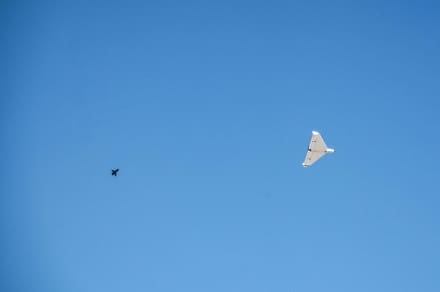
Image taken during flight testing of Zone 5’s interceptor. (Source: Zone 5 Technologies)

DIU and our DoW partners selected Anduril Industries and Zone 5 Technologies to develop prototype solutions for the Counter NEXT program in fall 2024. These vendors were selected from more than 65 commercial and dual-use technology company applicants.

Less than a year later, both vendors completed initial design and developmental sprints and successful baseline flight testing of their proposed solutions. Based on the data gathered, warfighter feedback and knowledge gained during the first sprint, iterative improvements are being made to both systems to ensure the solutions address the capability gap before additional flight testing and safety/qualification testing occur in the months ahead. 

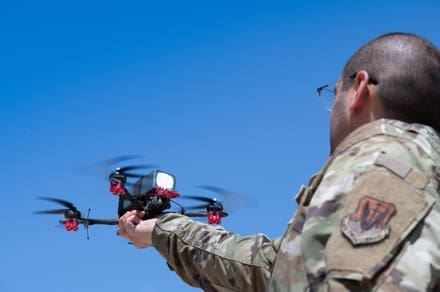
Image taken during flight testing of Anduril’s AAV. (Source: Anduril Industries)

Counter NEXT vendors are incorporating commercial off-the-shelf (COTS) components wherever possible to mitigate potential supply chain bottlenecks and keep costs low. The vendors are also leveraging modern air vehicle design concepts, ensuring air vehicles are not over-engineered for their intended mission but that they also minimize the use of expensive materials and enable high-rate production that is not possible with the more exquisite interceptors available today. 

To enable future design improvements and rapid integration of subsystems and components as they improve, the Counter NEXT prototypes are utilizing a modular open systems architecture and being designed for mass production using modern manufacturing techniques. Additionally, all components of the solution will be qualified and certified to some of the most stringent military standards in order to provide an enduring capability to the warfighter wherever the solution is deployed.

“The Counter NEXT project is focused on leveraging the best-in-breed commercially derived technology and processes to accelerate the development, production, and fielding of these vital Counter UAS interceptors to our warfighters,” said Joshua Zike, Counter NEXT Program Manager for DIU.  “While this solution is focused on a specific, pressing subset of the counter UxS problem set, variants for all domains should be developed and deployed to provide this vital layered kinetic counter UxS defeat capability to all our warfighters.” 

Following Anduril and Zone 5’s recent successful flight demonstrations, both vendors received additional funding to further refine their rapid prototypes, integrate their systems with the mission partner’s combat systems, and conduct the safety testing required prior to a live fire test event in the summer of 2026.

Drone Busting: Smart Devices Work Together to Knock Out UAS Threats

Sunday, September 28th, 2025

FORT SILL, Okla. — What’s harder to shoot down than a small drone in the sky? Students at the War Department’s only joint training center for countering aerial threats will likely say it’s what they practice on — balloons attached to those small drones.

Drones can fly at racecar speeds, making them difficult targets to hit by an individual on the ground. At the Joint Counter-Small Unmanned Aircraft System University, located at Fort Sill, students use handheld smart devices to help them increase their probability of scoring a hit.

Known as the Dronebuster and Smart Shooter, these two handheld systems work in tandem as a layered defense that uses electronic and kinetic warfare to do the hard work for the shooter.

Students who attend JCU learn about various drones and the intricate service-specific systems used to engage with them. The Dronebuster and Smart Shooter, however, are two of the few used by service members on the ground, such as patrol members or personnel guarding installation towers.

So, how do these tandem devices work?

When service members are warned of a drone presence, the Dronebuster can be held up like a weapon to scan the area. Once it identifies a hostile target, the service member simply presses a button on the device to disrupt the target using electronic warfare.

Joint Counter-small Unmanned Aircraft Systems (C-sUAS) University Instructor U.S. Army Sgt. 1st Class Alan Buhl and JCU Operators Course Supervisor Fred Hill talk about the smart shooter optic for the M4 and the JCU operators course at Fort Sill, Oklahoma, Aug. 19-20, 2025. (DoW video by U.S. Air Force Staff Sgt. Madelyn Keech)

“It’ll start jamming the command and controls, severing that connection between the drone and the operator,” explained JCU operator’s course instructor Paul Bliefernich.

The drone remains frozen in the air. That’s when a second operator picks up the Smart Shooter, an optic system that attaches to a weapon to control how it fires.

“Typically, when you pull the trigger, you’re used to a gun going ‘bang.’ [The Smart Shooter] doesn’t do that,” explained JCU operator’s course supervisor Fred Hill. “It calculates, and then it shoots when it’s ready to shoot.”

“When [shooters] get to the target they want, they’ll hit the ‘lock’ button … and start squeezing the trigger,” Bliefernich explained. However, the weapon doesn’t immediately fire. Instead, its computer takes over and displays a set of crosshairs in the scope that the operator aligns with the target. When the computer decides there’s a good probability of a hit, it sends a command to the pistol grip, allowing the operator to complete the trigger pull and fire the weapon.

Bliefernich said it can take from a few seconds up to two minutes. “It’s doing calculations and taking a lot into consideration,” he added.

Since shooting down several drones per class isn’t cost-effective, JCU students mostly shoot balloons attached to drones. It’s a more challenging target, but with practice, it can make them a better shot.

“The balloons are harder to shoot than the drone,” Hill said. “Once the shooter gets toward the end of the training, we’ll put up the aircraft and let them shoot at the aircraft.”

“It takes a lot of time and practice,” Bliefernich said.

The students are also able to train on the Smart Shooter in the virtual reality lab beforehand, which instructors said is both cost-effective and safer.

“It’s getting the Soldiers, airmen and sailors familiar with the equipment before they ever come and start shooting on the ground,” said Army Sgt. 1st Class Alan Buhl, JCU instructor.

The school teaches Soldiers, sailors, airmen and Marines much more than just how to operate handheld drone equipment. Students also learn how to use various fixed-site counter-small UAS systems, as well as how to plan strategies, train others and better prepare their installations for future threats.

Joint Counter-Small Unmanned Aircraft System University became operational in 2023. Fort Sill is home to the Army Field Artillery School, the Army Air Defense Artillery School, the 75th Fires Brigade and the 31st Air Defense Artillery Brigade, all of which have nurtured counter-small UAS strategies since the threat first emerged.

By Katie Lange, Pentagon News

Drones 101: Welcome to DOW’s Joint Counter-Small UAS University

Tuesday, September 23rd, 2025

FORT SILL, Okla. — In the subtropical landscape of Fort Sill, those who are up early can often hear a constant buzzing coming from part of the installation. But it’s not their tinnitus acting up, or a swarm of killer bees. That low droning sound is likely coming from the Joint Counter-Small Unmanned Aircraft Systems University.

The school is the War Department’s only joint training center aimed at countering the growing number of aerial threats against U.S. troops and coalition forces. It teaches Soldiers, sailors, airmen and Marines how to operate drone equipment, plan counter-small UAS strategies and train others to defend their comrades from harm.

“Coming out of a long period of counterterrorism … we’ve really seen the proliferation of drones [that] we call small-UAS … at low altitudes that have speed and accuracy that we’ve never seen before,” explained Army Lt. Col. John Peterson, JCU director. “That alone has changed the landscape.”

The urgent need to understand how to counter these threats is obvious from the conflicts unfolding in Ukraine, the Middle East and the Indo-Pacific region. Enemy drone tactics, techniques and procedures change almost daily, JCU officials said, leaving experts to constantly search for ways to update their defenses.

“Just understanding how easily these drones can be converted for malicious intent — that was something that was very surprising [to] me,” said Marine Corps 1st Lt. Jacob Ceglenski, JCU student.

Joint Counter-small Unmanned Aircraft Systems (C-sUAS) University Director U.S. Army Lt. Col. John Peterson and JCU Student U.S. Marine Corps 1st Lt. Jacob Ceglenski speak about the JCU at Fort Sill, Oklahoma, Aug. 20-21, 2025. DoW video by U.S. Air Force Staff Sgt. Madelyn Keech.

However, air defense is nothing new to the U.S. military. American short-range air defense has been dominant for decades, so despite the new threats that are persistently cropping up, it’s nothing the U.S. can’t handle.

“For our [counter-small] UAS battle drills, they’re really not any different than anything our air defenders have already been doing,” said Army Sgt. 1st Class Alan Buhl, JCU instructor. “Everyone else is just now learning entry-level air defense doctrine.”

“[We are] making sure that we’re sustaining the training for joint partners,” Peterson said. “That they have the understanding and they’re comfortable using the equipment that they’re being provided.”

Courses Cover Operation, Planning and Protection

The JCU couples lessons learned in the field with intelligence assessments and other capabilities to give deploying service members the knowledge they need to mitigate ever-changing threats. About 30 experts run the school, which offers three courses that can last from one to three weeks.

The operator’s course goes in-depth to teach service members, most of whom are enlisted, how to use counter-small UAS equipment and understand the technicalities. The planner’s course teaches officers and staff how to place and employ those assets. Those students gain an understanding of U.S. systems and enemy tactics, then develop defensive plans to protect critical capabilities and assets. The installation protection course teaches post leaders how to sharpen their defenses, including how to tell the difference between potential threats and benign hobbyists’ drones.

Each course starts in a joint classroom environment where students from all career fields learn the basics: the types of aircraft they may see downrange, where they come from, how to identify them, and how to employ passive air defense measures, such as aircraft shelters, camouflage to hide assets and dispersion to spread them out.

“Looking up in the air — the third dimension — is not a requirement for most jobs in the military. But now everyone — the infantrymen, the artillerymen, the logistician — all have to look up,” explained Army Maj. Dennis “Chip” Stanford, JCU executive officer and a career air defender. “People [have to] adopt the mindset that everything is being observed from multiple angles, and it’s realistically a transparent battlespace.”

After a few days, the classes are split into service-specific tracks. At the JCU’s training range, they’re taught how to operate and maintain various systems and pieces of equipment, depending on what their service uses downrange.

Students also gain an understanding of 24 types of commercial off-the-shelf UASs. Many are known as “blue air” drones, which are used by DOW during operations. Others, known as “red air” aircraft, are used by countries perceived as our enemies.

Air Force Capt. Sarah Dahlke, assigned to Air Forces Central Command Force Protection at Al Udeid Air Base in Qatar, took the planner’s course in August. Approaching the UAS problem from the intel side, Dahlke often monitors aerial threats from a desk, so it’s good for her to see all the various aircraft up close.

“It looks a lot different when you’re out here on the ground, especially when you’re talking about visually identifying things,” she said. “Working in intel, you see all the red [adversary threats], but you don’t really get into the intricacies of the blue side. So, for me, that’s been the most valuable thing.”

All of the students know how important the curriculum is to the current global environment.

“We need to learn, and we need to be able to train people, as well as have knowledgeable planners,” said Army Chief Warrant Officer 2 Jilliene Huffman, air and missile defense systems tactician assigned to the 82nd Airborne Division. “[The 82nd] did just stand up the 3rd Battalion, 4th Air Defense Regiment. They’re going to be one of the first air battalions under a division that has actual counter-UAS systems … which is why it’s important that I came here.”

The Threat Detection Systems

When it comes to students in the operator’s course, there are 15 fixed-site systems they may learn, each of which identifies, tracks and mitigates drone threats using a combination of components.

One of the main fixed-site systems students train on is the Fixed-Site Low, Slow, Small Unmanned Aircraft Integrated Defeat System. It includes components to counter electromagnetic attacks, as well as ground-based radar and an electro-optical/infrared camera that can identify potential threats. The FS-LIDS can detect and even shoot down missiles, school officials said — a scenario students practice during simulations.

The simulations operate from trailers on the compound that mimic forward operating base command and control centers. Students learn the roles of each player in the room so they can understand the capabilities and limitations of every portion of the process, from the camera systems to the radar and the Forward Area Air Defense System.

“[FAADS] controls everything that’s supposed to happen … from shooting a rocket to electronic warfare,” explained Fred Hill, manager of the JCU operator’s course. “Everything the service member does — how he would do it downrange — he’s going to do it that exact way right here.”

While Army students heavily focus on FS-LIDS, the Navy and Air Force both use a fixed-site system known as a Counter-Remote Control Model Aircraft Integrated Air Defense Network. Other systems taught include the Negation of Improvised Non-State Joint Aerial system, used to counter small UASs; the Drone Restricted Access Using Known Electromagnetic Warfare system; and the Tactical Intelligence Targeting Access Node, a next-generation intelligence ground system.

The culmination of the classes is a joint exercise, during which all the students work together to counter a simulated threat.

JCU Staff: Going Above and Beyond

Before any students can be taught, the JCU staff has to get spun up on each piece of equipment, and commercial partners help with that. To repay the favor, instructors keep manufacturers in the loop on new technology they see on the battlefield so those drone builders can adapt, too.

Many of the staff go above and beyond their daily roles by doing all the flying, maintenance and aircraft development. For example, one staff member has created intricate manuals for each aircraft, while another works with 3D printers to create drones and replacement parts.

“The cost of [having] drones to shoot is unrealistic — at least $1,000 a pop. And when we’re talking 36 students a class, we can’t keep up with that cost,” explained JCU staff member Richard Stairs, who runs the compound’s 3D printing lab. “By using 3D printing, we minimalize that cost and basically cut it in half, based on what components we’re using.”

Peterson said it’s not a big team, but they are all passionate, adding, “The adaptation and innovation that they’ve been able to do on their own time … it’s remarkable what this team at the JCU is doing and will continue to do to help support the joint force.”

The JCU shares a lot of its products with DOW drone forces so they can develop their own capabilities in the future. The school also partners with federal agencies and academia and even trains foreign service members of partner militaries.

“Each country has a little bit of a different environment and theories behind [counter-small UAS strategy], so it helps give us a more well-rounded experience,” Peterson explained.

While drone warfare is perpetually changing, the school is determined to keep pace.

“We are constantly evolving — that’s with the new equipment, new threats and new student input that comes through,” said Jacob Cameron, JCU air boss. “No matter what the threat is, the JCU is adapting.”

The JCU, which became operational in 2023, falls under the Army’s 30th Air Defense Artillery Brigade. Fort Sill is home to the Army Field Artillery School, the Army Air Defense Artillery School, the 75th Fires Brigade and the 31st Air Defense Artillery Brigade, all of which have nurtured counter-small UAS strategies since the threat first surfaced.

By Katie Lange, Pentagon News

DroneShield Expands U.S. R&D Operations to Drive Next-Gen Counter-Drone Solutions

Monday, September 22nd, 2025

Company announces major U.S. expansion following closely on the heels of Australian and European expansion – a clear signal of DroneShield’s push to lead and reshape the global counter-drone landscape

Warrenton, Virginia – September 22, 2025 – DroneShield, a global leader in counter-uncrewed systems (CUxS) technology, today announces it is significantly expanding its research and development (R&D) operations in the United States.

This move emphasizes DroneShield’s commitment to expand its R&D and testing capabilities and will result in more than doubling its workforce in the U.S. Over 30% of the new roles will be dedicated to software development and further strengthening its artificial intelligence (AI) team and capabilities.

As part of this strategic investment, DroneShield will also double the square footage of its U.S. headquarters in Virginia, reinforcing its dedication to breakthrough technology and better positioning the team to meet rapidly growing global demand for advanced CUxS solutions.

This U.S. expansion follows the company’s recent announcement of its expansion of production facilities in Australia and new office established in the European Union. DroneShield’s global strategic investments are part of a concerted effort to broaden its international footprint and establish a stronger physical presence near customers in key markets.

“As we continue to scale our operations globally, this expansion in the U.S. plays a crucial role in enhancing our ability to innovate and deliver advanced solutions for the evolving defense industrial base right here in the U.S.,”said Matt McCrann, CEO of DroneShield LLC. “We’re investing in the future of defense, and our growing footprint and impact in the U.S. market directly supports that effort.”

The expanded U.S. facility will enable DroneShield to accelerate its product development cycles and better service its growing customer base. The addition of key personnel to the R&D team will help drive forward-thinking technological advancements and ensure the company remains responsive to the needs of its customers.

“We’re not just expanding our operations, we’re doubling down on our commitment to providing best-in-class counter-drone solutions,” said Tom Branstetter, Vice President of Sales and Business Development, DroneShield LLC. “This investment enables us to be more responsive to the growing needs of our U.S. customers across the various sectors we serve.”

Combined with expanded R&D and planned U.S. production initiatives, the robust growth positions DroneShield to support U.S. Department of Defense’s push for fast, risk-embracing acquisition of cutting-edge counter-drone solutions.

“Expanding our U.S. technology team strengthens our ability to support critical programs and deliver advanced solutions with greater speed and precision. This investment ensures end users benefit from responsive, real-time support and the depth of expertise required for mission success,” said DroneShield’s Chief Product and Technology Officer, Angus Bean.

This expansion supports DroneShield’s bold strategy for global growth. With a commitment to innovation and leadership in counter-UxS technology, DroneShield is positioning itself to meet the increasing global demand for advancing security solutions. These strategic moves ensure that the company remains at the forefront of the industry, ready to address the evolving challenges of an interconnected and rapidly changing world.

DroneShield Surpasses 4,000 Systems Sold, $7.9m orders

Saturday, September 20th, 2025

DroneShield (ASX:DRO) is pleased to announce it has surpassed 4,000 systems sold worldwide with the receipt of a package of 2 standalone contracts totalling $7.9 million for handheld systems for delivery to the U.S. Department of Defense. DroneShield expects to deliver all equipment in Q4 2025, with cash payment expected in Q4 2025. No additional material conditions need to be satisfied. There is no obligation for any additional contracts from this customer.

DroneShield has previously received standalone orders from this customer. These repeat orders strengthen DroneShield’s position as a trusted provider of mission-critical solutions to address the growing challenge of drone threats on the modern battlefield and the civilian sector.

The latest orders build on existing Department of Defense programs already deploying DroneShield systems. With this milestone, more than 4,000 DroneShield solutions are now fielded globally, highlighting sustained end-user confidence and the solutions’ effectiveness in operational environments.

“Passing 4,000 systems in service is an important milestone for our team and our customers,” said Matt McCrann, U.S. CEO of DroneShield. “It underlines the performance and dependability of our solutions in the field, and the trust placed in DroneShield by those who rely on them.”


Image: DroneShield DroneGun Mk4 utilised by the U.S. Army at a training exercise

DroneShield’s handheld solutions form a cornerstone of its wider counter-drone portfolio, which spans dismounted, vehicle-mounted, and fixed-site solutions that fuse multiple sensors and effectors integrated through DroneShield’s advanced software. Together, they provide a layered defense architecture enabling operators to detect, track, identify, and defeat hostile drones with speed and precision. Customers enrolled into the SaaS-based AI software updates receive new firmware quarterly through the Company’s secure portal.

The entire order is expected to be fulfilled within 30 days from existing stock. This is important for this and other DroneShield customers due to their urgent operational requirements, and is an important factor of securing more orders.

The milestone comes as DroneShield reported a record 1H2025 revenue of $72.3 million (up 210% vs. 1H2024), 1H2025 Profit Before Tax of $5.2 million for the June 2025 period.

3Q25 recognised revenue to date (with significant additional deliveries and further revenue anticipated prior to September month end) is currently standing at $77 million and growing, already in excess of the previous two record quarters combined. The quarterly revenue and cash receipts will be released in October as part of the 3Q25 4C investor report.

DroneShield CEO, Oleg Vornik, commented, “As our customers seek to step up from their early small-scale evaluation purchases into full scale procurement, we are seeing rapidly rising customer demand. Counterdrone is still at its nascency with our customers requiring very significant additional purchases to progress to the required levels of counterdrone defence. DroneShield is a well regarded industry leader globally, and we expect to continue to benefit from this rising demand.”

Operational Excellence

The 4,000 devices sold, includes over 2,200 RfPatrols, produced by an Australian contract manufacturing partner, following rigorous in-house quality assurance testing. The RfPatrol has featured in multiple high-profile programs, including:

The Company’s all-time record $61.6 million European contract in mid-2025

The recent $5 million order for the Australian Government’s Land 156 Line of Effort 2 program, delivering handheld drone detection and neutralisation equipment to the Australian Defence Force

A $10.4 million contract to Ukraine in 2023, through the Australian Government’s only Ukraine counter-drone aid package


Image: DroneShield RfPatrol Mk2 utilised by the U.S. Army at a training exercise

The RfPatrol is a passive (non-emitting) lightweight, intuitive, and reliable drone detection device, designed to enhance situational awareness by alerting users to the presence of drones in real time, without requiring specialist training or complex setup. The device receives quarterly AI-firmware updates for customers enrolled into its SaaS plans. 

Production of the significant volume of the complex devices, underscores DroneShield’s advanced manufacturing and production capability, underpinned by a robust Australian supply chain. Around 85 per cent of the device’s components are sourced from local manufacturers across New South Wales, Victoria, Queensland, South Australia and Western Australia.

US and European-made versions of RfPatrol will be available in those markets from 2026, as the Company expects local production to further boost sales in those geographic segments. 

DroneShield remains focused on advancing its current and next-generation counter-drone technology solutions, leveraging export success, deep counter-drone technology expertise, and a strong manufacturing base, to deliver sustained growth.

Learn more at droneshield.com.

Wrap Enters U.S. Army xTechCounter Strike C-UAS Competition with Project MERLIN Innovation

Thursday, September 18th, 2025

The patent pending Merlin platform and Wide Area Kinetic Anti-Drone Cassette are anticipated to meet or exceed DOD and U.S. Army requirements by providing scalable, low-cost, and rapidly deployable defense against unmanned aerial threats, reinforcing Wrap’s long-term growth strategy in military and allied markets.

MIAMI, Sept. 17, 2025 — Wrap Technologies, Inc. (NASDAQ: WRAP) (“Wrap” or the “Company”), a global leader in innovative public safety and defense solutions, today announced the successful submission of its C-UAS as a technology solution for the U.S. Army’s xTechCounter Strike1competition.

The U.S. Army initiative seeks innovative C-UAS technologies to help protect U.S. and allied forces against the rapid proliferation of small drones on the battlefield. Selected participants may be eligible for cash prizes, invitations to live experimentation events, and potential follow-on contracting opportunities with the Department of Defense and NATO partners.

Wrap’s submission, Project Merlin-1KC, introduces our patent pending modular, platform-agnostic defeat solution designed to physically disable hostile Group 1 drones. The system deploys lightweight, tethered projectiles that entangle drone rotors, with the goal of neutralizing threats without reliance on electronic warfare or directed energy. We believe these capabilities are particularly valuable in contested environments where traditional countermeasures are less effective.

The Merlin-1KC system is engineered for rapid integration across multiple platforms, including unmanned aerial and ground vehicles, turrets, vehicle mounts, and soldier-worn launchers. Demonstrations have shown cost-effective multi-shot capabilities, enabling multi-shot ratios of up to 6:1 against low-cost hostile drones. Supported by an 85% U.S.-based supply chain today with a desirable DOD goal of 100% Made-In-USA roadmap, Wrap’s current production capacity can deliver up to 18,000–20,000 units, with a surge potential to 75,000 units monthly.

“We believe our MERLIN system represents a breakthrough in C-UAS offensive and defensive battlefield capacity,” said President and Chief Operating Officer of Wrap, Jared Novick. “It is designed to flip the cost curve by providing the Army and allied forces with a sustainable and scalable solution against the growing threat of unmanned systems. We believe our entry in the xTechCounter Strike aligns with our long-term strategy to expand Wrap’s technology portfolio beyond law enforcement, potentially creating new opportunities in defense while leveraging our proven cartridge manufacturing expertise.”

Key Highlights of Project Merlin-1KC:

Scalable, Low-Cost Defense: With an anticipated retail cost of less than $60 per shot, 1KC sets a roadmap to reverse the current cost imbalance of drone warfare.

Proven Manufacturing Capacity – Backed by Wrap’s track record of producing over 150,000 BolaWrap® cartridges worldwide.

Flexible Deployment – MERLIN system integrates across drones, vehicles, turrets, and soldier-worn systems with a simple plug-and-play architecture.

Rapid Scalability – Surge potential of up to 75,000 monthly units within 90 days of award.

Operational Effectiveness – Projected multi-kill capability, providing 6:1 or greater effects ratios in testing.

Participation in the xTechCounter Strike competition underscores Wrap’s broader vision to support domestic and international defense markets while securing R&D funding partnerships and programs. By adapting our cassette-based technology to counter-UAS applications, we believe Wrap is uniquely positioned to deliver innovative and mission-ready solutions for today’s contested environments.

“We intend for this submission to be the first step in extending Wrap’s proven technology ecosystem into defense,” added Novick. “Our goal is to provide the Army with a reliable, scalable counter-UAS solution while continuing to drive long-term value for our shareholders.”

Epirus’ Leonidas High-Power Microwave Defeats 49-Drone Swarm, 100% of Drones Flown at Live-Fire Demonstration

Wednesday, September 17th, 2025

Leonidas neutralized 61-of-61 drones, culminating in a 49-drone swarm kill with one pulse of electromagnetic interference

Los Angeles, Calif—September 10, 2025—Epirus announced today the results of an August 26 demonstration of the company’s Leonidas high-power microwave (HPM) system that delivers weaponized electromagnetic interference to counter swarms of robotic, asymmetric threats.

The live-fire demonstration tested Leonidas against 61 drones across five operationally relevant flight scenarios. Leonidas’ suite of capability differentiators

was on full display as the system disabled 61-of-61 drones—a 100% success rate. The event was capped off by the defeat of a 49-drone swarm consisting of two threat representative drone types all with one instant and low-collateral pulse of high-energy electromagneticinterference.

Leading up to finale, the prior flight scenarios were:

?Multi-angle counter-swarm engagement

Two groups of three drones were flown in from opposite directions. Leonidas engaged and defeated the first trio of drones to the left then re-directed its HPM beam to engage and defeat the trio of drones to its right.

Selective targeting

Two drones were flown into the engagement area in close proximity to one another. An audience member chose the right drone to be targeted before Leonidas engaged and defeated the right drone and left the other drone unaffected, demonstrating the system’s software-defined, precision-controlled waveforms. Leonidas then engaged and defeated the remaining drone.

Precision intercept

A single drone flew into the fire zone. Leonidas engaged and defeated the target and dropped it to the ground within a software-defined, pre-identified safe zone. Leonidas is a low-to-no collateral counter-drone solution and uses software to defeat drones exactly when and where operators need to allow for designated safety zones to protect assets and personnel.

Multi-target engagement

Three drones flew into the fire zone at different ranges. Leonidas engaged and defeated all three drones simultaneously, demonstrating its one-to-many aerial defeat capability.

“This is a watershed moment for Epirus. We believe showcasing our weaponized electromagnetic interference is the most effective way to communicate that Leonidas is the only mission-capable, counter-swarm solution for the one-to-many fight,” sai Andy Lowery, Epirus CEO. “Those who joined us witnessed this first-hand as 61 drones went up—and 61 went down.”

The invitation-only demonstration took place at Camp Atterbury, Indiana, and was attended by representatives from throughout the U.S. Department of Defense, other U.S. Government agencies and nine allied countries. The event was conducted within site range restrictions and optimized for in-person viewing.

The event demonstrated the first generation of Leonidas, which was designed and developed using internal research and development funds in 2022. Epirus unveiled its latest version of Leonidas in July 2025, which is expected to more than double the operational range and lethality over the 2022 system in the same form factor. 

Origin Robotics Unveils BLAZE, a Cost-Effective Drone Interceptor with AI-powered Computer Vision

Wednesday, September 10th, 2025

RIGA, Latvia (May 6, 2025) – Defence tech startup Origin Robotics has launched BLAZE, an autonomous counter-unmanned aerial system (C-UAS) interceptor designed to neutralize fast-moving aerial threats with precision and speed. As drones become an increasingly dominant force on the modern battlefield, BLAZE offers a cost-effective solution to counter them, filling the gap between traditional gun-based air defence and high-cost missile interceptors. The interceptor is aimed to strengthen the defence capabilities of European countries amid rising threats and geopolitical uncertainty.

Drones have reshaped modern warfare, dictating battlefield strategies and shifting the balance of power. Their widespread use, particularly in Ukraine, has demonstrated both their effectiveness and the high cost of countering them. In January 2025 alone, Russia launched over 2,500 drones into Ukrainian territory – an average of 80 drones per day. This escalation underscores the urgent need for advanced yet cost-efficient air defence solutions.


Agris Kipurs, CEO and co-founder of Origin Robotics, said, “In asymmetric warfare, drones are relatively inexpensive and widely deployed to overwhelm air defenses and strike targets both at the frontline and deep behind it, making it challenging and costly to counter. We designed BLAZE specifically to address this threat—a fast, intelligent, and cost-effective addition to existing air defense systems. We remain committed to delivering cost-efficient and adaptable solutions to support Europe and NATO allies in addressing existing and future security challenges.”

BLAZE is a man-portable, rapidly deployable interceptor designed to defeat fast-moving aerial threats, including loitering munitions and hostile UAVs. The system combines radar-based detection with AI-powered computer vision, delivering autonomous target acquisition and operator-approved interception. Equipped with a high-explosive (HE) fragmentation warhead, it ensures precise and effective threat elimination, even in contested environments.

The system autonomously detects, acquires, and locks onto targets using a combination of radar tracking and AI-powered computer vision. Upon operator confirmation, the system executes a precisely calculated attack—either destroying the target on direct impact or engaging it with an airburst fragmentation detonation.  BLAZE delivers high mobility, scalability, and cost-efficiency for modern armed forces.

As an operator-supervised autonomous system, it ensures the operator retains final-stage control, including the ability to issue a wave-off command that directs the BLAZE to either return safely or self-destruct. This capability allows immediate deployment even in scenarios with uncertain target identification, significantly reducing the risks of friendly fire and minimizing collateral damage.

The interceptor is designed for quick deployment and high-intensity operations. The first drone can be launched in under five minutes, with subsequent launches taking less than a minute. Compact and portable, BLAZE’s transport case doubles as a launch station and charging dock. Its tool-less setup ensures it is flight-ready in under ten minutes.

Following the battlefield-proven success of its flagship drone system, BEAK, currently deployed by the Ukrainian and Latvian Armed Forces, Origin Robotics continues to develop scalable, next-generation technologies for modern warfare. Thanks to BEAK’s rapid deployment and proven capabilities, Origin has quickly earned recognition for its technology and built trust in its autonomous aerial systems—reflected in an R&D contract from the Latvian Ministry of Defence and a grant from the European Defence Fund.