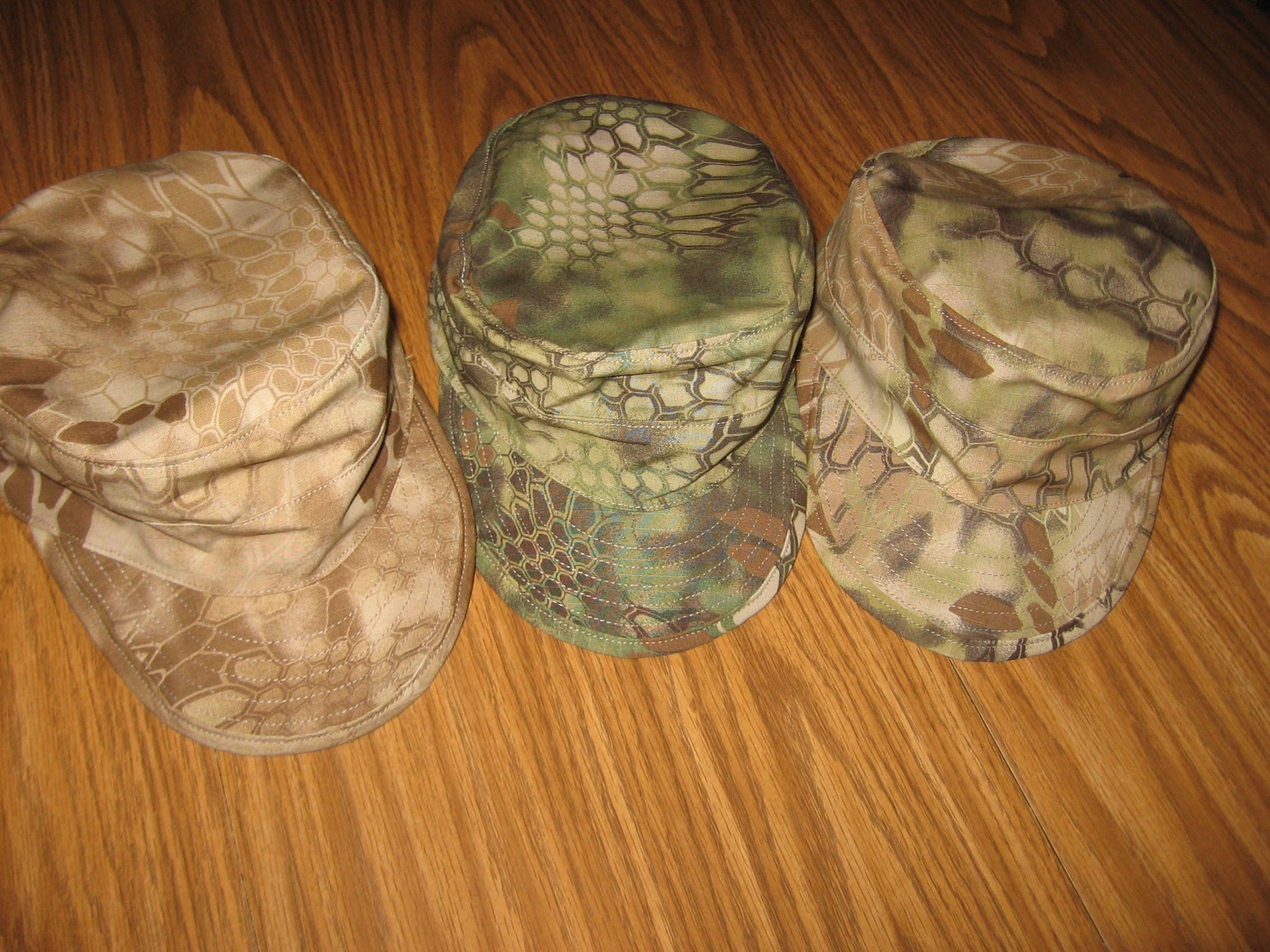
Slangvel has his line of M43 and Recce hats now available in Highlander, Nomad, and Mandrake Kryptek patterns on his eBay store. Additionally, he’s started production on patrol caps, examples shown above, which will be available soon.


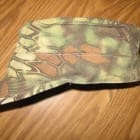
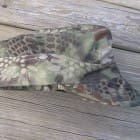
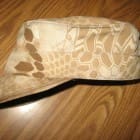
Slangvel has his line of M43 and Recce hats now available in Highlander, Nomad, and Mandrake Kryptek patterns on his eBay store. Additionally, he’s started production on patrol caps, examples shown above, which will be available soon.
Over the past 100 years thousands upon thousands of camouflage patterns have been developed and issued to various military, paramilitary, law enforcement and other groups around the world.
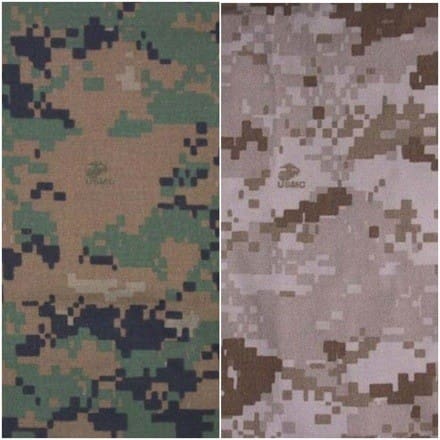
But, ever since the United States Marine Corps began fielding MARPAT in 2003, kicking off the US military camo wars, commercially produced patterns have been all the rage. Adding fuel to this explosive growth has been a multi-front war with troops looking for a better mouse trap as well as the US Army’s Camouflage Improvement Effort that looked to industry to fulfill their concealment needs into the 21st century.
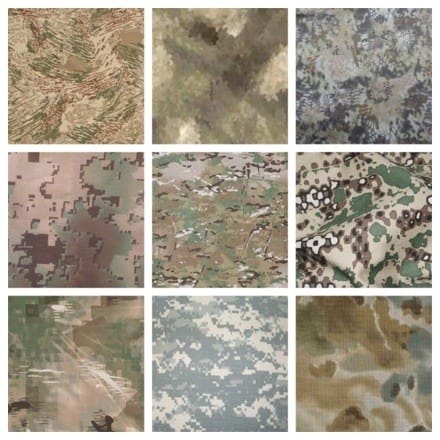
It’s a bubble all right and we Americans love bubbles. Name an industry that hasn’t had one. Shoot, there wasn’t even a camouflage industry until about 10 years ago and it grew itself right into a bubble. The question is, if and when it will burst.
Between the Army’s upcoming announcement of a new family of camouflage and Congressional interest in forcing all of the US services to adopt the same pattern(s) an argument could be made that the market for camouflage is getting ready to stovepipe.
But I would make the opposite argument. The genie is out of the bottle. Aside from patterns that perform very well in virtually any environment imaginable as well as some really cool looking patterns, the age of the digital printer is upon us. Companies like HyperStealth Biotechnology Corp offer their Ghostex and Deceptex custom camouflage print on demand services. Additionally, Special Ops Apps offer a mobile device app called CamoScience that allow you to design you own camouflage for the environment you are in and can print the new pattern on demand.
In addition to the availability of these custom solutions, military, law enforcement and even tactical and outdoor enthusiasts offer a sophisticated consumer base that demands performance. And that’s not to mention the consumer market that wears camouflage just because it can.
Will the camo bubble burst? Not anytime soon.
This is the full text of what I will from here on out refer to as the Enyart Amendment to the House version of the 2014 National Defense Authorization Act (HR 1960). The original idea and hence the name of the amendment comes from Rep William Enyart (D-IL) who happens to also be a Retired Major General and former State Adjutant General of the Illinois Army National Guard.
The “Requirement to Establish Policy on Joint Combat Uniforms” passed yesterday 32-30 in a session of the House Armed Services Committee. As I am told the waiver for SOCOM was added after opposition to a blanket requirement for all of DoD to adopt the same uniform. Additionally, you will note that the 2010 legislation regarding joint combat uniforms will be repealed by this act. As I have read multiple accounts of what it says or doesn’t say I felt it best to offer the actual language.
Enyart Amendment to the 2014 NDAA (HR 1960) by solsys
And as I published earlier today, this is still far from law.
First off, for those of you unfamiliar with the legislative process, this is just the first hurdle and it’s still quite a way from becoming law. It’s not as bad as I had feared but I’m concerned it still ham strings the individual services. Below is a simplified version of what still has to happen.
In order to become the law of the land, it must first pass a vote in the full House of Representatives. Then, the Senate will vote on their version of the NDAA which may or may not include similar language. Either way, the two versions of the NDAA will most assuredly contain differences which will have to be hammered out in Conference Committee made up of members of both chambers of Congress. Once those differences are worked out, a conference report detailing what is in the final legislation is voted on by both the Senate and House of Representatives. After approval, it goes to the President to be signed. Barring a veto it becomes law. At any point in this process expect the services to weigh in.
This is by no means a quick process. The NDAA will become law some time after the Army’s anticipated June 14th announcement of a new family of camouflage patterns.
I still feel that it isn’t the job of Congress to dictate to the Services which uniforms to wear but I understand the frustration felt by many (although those that yell the loudest are oftentimes unaffected by the issue). Ultimately, the individual Services have brought this oversight upon themselves by not complying with earlier legislation.
As we understand it, Retired Major General (IL ARNG) and Rep William Enyart’s (D- IL) amendment to the 2014 National Defense Authorization Act was introduced to the full House Armed Services Committee and passed 32-30. If enacted it will…
require all military services to use a joint combat camouflage uniform, including color and pattern variants designed for specific combat environments.
First off, for those of you unfamiliar with the legislative process, this is just the first hurdle and it’s still quite a way from becoming law. It’s not as bad as I had feared but I’m concerned it still ham strings the individual services. Below is a simplified version of what has to happen.
In order to become the law of the land, it must first pass a vote in the full House of Representatives. Then, the Senate will vote on their version of the NDAA which may or may not include similar language. Either way, the two versions of the NDAA will most assuredly contain differences which will have to be hammered out in Conference Committee made up of members of both chambers of Congress. Once those differences are worked out, a conference report detailing what is in the final legislation is voted on by both the Senate and House of Representatives. After approval, it goes to the President to be signed. Barring a veto it becomes law. At any point in this process expect the services to weigh in.
This is by no means a quick process. The NDAA will become law some time after the Army’s June 14th announcement.
I find this language shortsighted. Service leaders need the latitude to accomplish their mission and at some point, that may require different uniforms. Despite assertions to the contrary, prior to the adoption of the MARPAT MCCUU in 2003, the services did not all wear the same uniform. For example, the Navy wore a work uniform that was not camouflaged and was unlike anything the other services used. But, It was the right uniform for their mission.
And lastly, while the services should work together, Congress telling them that they have to use the same individual equipment to accomplish their missions sets a bad precedent. In the past we have seen Congress force unwanted combat systems on the various services that place undue burdens on force structure and readiness. The services are the experts at defending the Nation and they should decide what tools are required to make that happen.
I’ve been mulling this over all day. I don’t think it’s a good idea for Congress to tell the military services which camouflage they should be using or how they should equip their troops.
First off, they’ve got more important things to worry about. That’s a given.
Second, they have their lane in the road and the military services have theirs. Even retired two-star General turned Congressman William Enyart, (D-IL) doesn’t seem to have the bubble on camouflage. If a guy with that kind of pedigree doesn’t understand the issues at hand, how can we expect someone to who has never served? Representative Enyart has stated that he plans to introduce an amendment to the National Defense Authorization Act that would require all services to adopt the same camouflage pattern by 2018 and would ban the services from developing new camouflage patterns for their own use.
While I’m all for the separate branches of the US military adopting the same camouflage patterns for a variety of reasons, doing it because Congress said so is not even on the list. Aside from the operational and logistical advantages of a common uniform, this budget environment alone should be the precursor to a more common sense approach to field uniforms. Dress uniforms Remain a great way for the services to express their individuality. I’m advocating for the military to do the right thing for the right reasons.
As for a moratorium on camouflage development, I strongly disagree with this idea. Based on the poorly written legislation I see coming out of Washington, such a move will assuredly have negative second and third order effects. For example, what about USSOCOM? While it isn’t a service, it has service-like budget authority and regularly has unique requirements. It uses its budgetary and acquisition authority to fulfill those requirements under MFP-11. Would a poorly written law preclude SOCOM from the fulfillment of unique camouflage requirements that are not shared by conventional forces? Based on Congress’s batting average, my guess is “yes.”
Congress needs to put the services in the hot seat for sure and make them explain why they can’t play nice together but telling them how they should equip individual service members oversteps their mandate.
You literally cannot make this stuff up. Apparently, Illinois Freshman Congressman Rep. William L. Enyart (Dem), came up with a great idea. He read an article last month in the The Washington Post about the US military’s multitude of camouflage patterns and intends to introduce legislation today that will require all of DoD to share a common camouflage pattern.
Apparently, living in a city where you regularly see military personnel from all services strutting around in their individually branded uniforms like so many third world militaries didn’t attract his attention. It took a newspaper article to garner his attention. Ironically, Rep Enyart retired just last year as a Major General from the Illinois Army National Guard where he served from 1982 – 2012. Prior to that, he served in the US Air Force from 1969 to 1973. Somehow, that didn’t wake him up either.
And it seems, he is oblivious to previous public law regarding camouflage and field uniforms. His proposed amendment to the National Defense Authorization Act would require all of the services to adopt a common pattern by 2018 and would forbid any of them from producing a pattern for its own sole use. Horse left the barn on that one I’m afraid.
On one hand, I’m glad to hear about this new found interest Rep Enyart has for camouflage but I’m deeply saddened that, as usual, a Congressmen is going to run blindly uninformed into introducing redundant legislation. Instead, hopefully he’ll do a little research, take a look at what comes out of the Army Camouflage Improvement Effort and perhaps hold DoD’s feet to the fire on previous legislation.
I appreciate where his heart is, but I wish he was better informed, especially as he is a retired GO.
A lot of people look at the US Military’s camo wars and ask themselves, “Why not just adopt MARPAT?” That’s a fair question, especially when you take it one step further and ask, “Why bother with camouflaged PPE when using Coyote is good enough?”
HyperStealth’s Guy Cramer takes a look at the history and data available to explain why MARPAT isn’t the best answer. This is well worth the read.