FirstSpear

Archive for the ‘Contracts’ Category

Army Announces Camouflage Improvement Effort Finalists

Tuesday, January 10th, 2012

After several delays, the Army has chosen four finalists in their Army Camouflage Improvement Effort. The Army conducted an exhaustive down select using a picture-in-picture technique with 900 Soldiers viewing the patterns in 45 environments. There was a candidate pool of around 20 families of patterns each sharing common pattern geometries but with individual colorways for Woodland, Desert, and Transitional environments with a possible fourth pattern for Organizational Clothing and Individual Equipment. This optional OCIE pattern would blend in with the other patterns so that separate sets of PPE would not have to be purchased to match each pattern. Some developers satisfied this requirement with their Transitional pattern.

The finalists are:
ADS Inc as Prime, partnered with Guy Cramer
Brookwood Companies
Crye Precision
Kryptek

(Please note that the contract award figures are ceiling amounts. Total funds will not be awarded unless all contract options are enacted. The disparity in award amounts is driven by offeror bids and is for the total non-exclusive Government license if the vendor is selected and optioned as the new Army camouflage provider.)

Additionally, there will be an Army developed family of patterns entering the field trials which should commence in about 6 months according to the plans overall timeline which has already slipped several times.
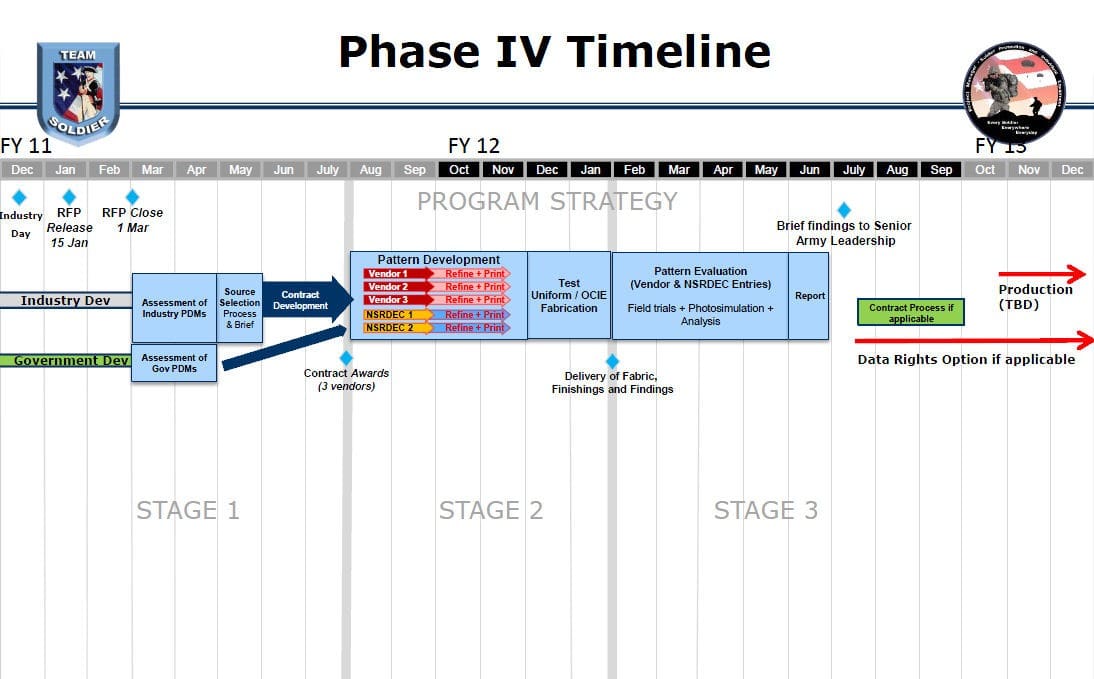
This next set of testing will include blending tests, probability of detection, and a live Developmental Test with an Operational Test flair. This latter event will put the patterns through their paces with squad size elements pitted against multiple observers from numerous points of view. Another interesting aspect of this testing is that the Army will also assess how long it takes for an observer to reacquire a test subject after he takes cover and comes back into view. During the industry day, there was an indication that they may also assess the pattern’s performance in both dry and wet conditions. This was a major issue during the development of the AOR patterns so we hope they integrate it into the test plan.

We’ve also heard that the candidate patterns may also be evaluated using OCP (MultiCam) PPE since the Army has made such a large investment in this equipment and it may well have to continue to serve, at least with some units as long it remains serviceable. The interest is to see if OCP equipment can be effectively used in conjunction with the new patterns. Testing of varied PPE against unmatched uniforms in Afghanistan indicated that the contrast can be so great as to work against the camouflage effect.

After the testing ends, a finalized report will be presented to the Army leadership for action. Based on a variety of factors, they will decide how the Army will be camouflaged in the foreseeable future. We also hope that the other services consider the investment the Army has made in this process and make this a joint effort.

SSD applauds the selectees and the Army’s PEO Soldier and RDT&E community for taking on this herculean effort.

Congress Directs DoD to Conduct Market Research on Made in USA Athletic Footwear

Monday, January 9th, 2012

Have you ever asked yourself why your combat boots have to be made in the USA but not your running shoes? If so, you’re not the only one. It seems that some members of Congress have been asking the same thing of our military services. The answer? In a nutshell, “We don’t buy them because they don’t make them.”

As we are sure you are aware, the Berry Amendment requires that any textile and footwear related item procured by the DOD be manufactured within the United States, and made of domestically produced materials. However, as it currently stands, the procurement of athletic footwear varies by service, and in general, members of the military are either required to purchase their own athletic footwear, or are given a taxable cash allowance as part of their compensation. As a result, many US troops are wearing foreign-made running shoes.

Pursuant to this, on March 30, 2011, the Department of Defense (DOD) submitted an interim response to the requirement of the Committee Print Number 10 of the Ike Skelton National Defense Authorization Act for Fiscal Year 2011 (Public Law 111-383), regarding DOD’s change in policy on athletic footwear for members of the Armed Forces. Under the new policy, DOD provides members an increased clothing allowance in order to purchase footwear, rather than purchasing it on their behalf. The interim report indicates that the new policy `provides new recruits the ability to buy commercially available running shoes of their choice, in consideration of the uniqueness of their individual physiology, running style, and individual comfort and fit requirements’ and `ensures that recruits are able to select and wear the type and size athletic shoe that provides the greatest comfort and reduces lower extremity injuries.’

But there’s an even bigger issue here. Last year’s FY11 National Defense Authorization Act (NDAA) included a directive that required DOD to issue a report to Congress outlining its rationale for policies regarding distribution of athletic footwear for service members. Rather, DLA’s report back to Congress states that `A single model of athletic shoes which meets all of these requirements, at the selected price point, from a US supplier has not been identified.’ However, DOD does not appear to have conducted any market research or other systematic review to support this conclusion.

To ensure DLA has an accurate read on the industry’s abilities, the FY12 NDAA contains a directive requiring market research on potential sources of athletic footwear for members of the Armed Services. This includes pricing of domestically produced athletic footwear that could be made available to meet DOD needs. It is important to note that DOD is instructed to conduct a survey of all major athletic footwear manufacturers and an assessment of the extent to which the supply of such athletic footwear could be increased if a domestic non-availability determination (DNAD) were made, as it has been in the past, for certain materials incorporated into such footwear.

Accordingly, the committee directs DOD to conduct market research, as provided in Part 10 of the Federal Acquisition Regulation (FAR) and Part 210 of the DOD Supplement to the FAR, to assess the variety and pricing of domestically-produced athletic footwear that could be made available to meet DOD needs. The market research should include a survey of all major athletic footwear manufacturers and an assessment of the extent to which the supply of such athletic footwear could be increased if a domestic non-availability determination were made, as it has been in the past, for certain materials incorporated into such footwear. The committee directs the Secretary to provide an updated report on the need for the new policy, in light of the data provided by such market research, by no later than 120 days after the date of the enactment of this Act.

This is where industry becomes critical to making this effort a success; industry needs to illustrate to Congress and DOD that it is ready and willing to support the warfighter, and create American jobs, by confirming their ability to manufacture Berry compliant athletic footwear.

What Congress and the DOD need to see in the survey is:
– What Berry compliant athletic footwear can industry produce?
– Does this capability include a variety of shoes and models great enough to meet the demands of service members?

The FY12 NDAA passed Congress and was recently signed into law by President Obama. We anticipate this survey will be conducted within the coming months, as it has been marked a high priority to the Armed Services Committees. Participate. It is imperative that footwear manufacturers who are interested in potentially manufacturing athletic footwear and footwear components respond to this survey. There is no other way to show DoD and Congress that this can be done by American workers.

The Mother of All Afghan Camo Solicitation

Friday, January 6th, 2012

The synopsis for this solicitation entitled, “Organizational Clothing and Individual Equipment, uniforms and field jackets for the Afghanistan National Security Forces to include the Afghanistan National Army and Afghanistan National Police” is almost shorter than the title, “Contractor shall provide Organizational Clothing and Individual Equipment (OCIE) uniforms and field jackets for the Afghanistan National Security Forces (ANSF) to include the Afghanistan National Army (ANA) and Afghanistan National Police (ANP).”

Initially released over the holidays and updated today, the “Mother of All Afghan Camo Solicitation” as we are calling it, originated with US Forces in Afghanistan and has a pretty short response time. Offerors must reply by Jan 20, 2012 at 7:00 am Eastern. But with a contract ceiling of $150 Million, the juice definitely looks to be worth the squeeze if you have the contacts in country to make this happen.

Now, here’s the kicker, assembly of the uniforms and equipment must be accomplished in Afghanistan but materials can be imported…from any country. However, due to proprietary restrictions there is a directed source (ADS) for 3 of the 6 camouflage patterns required to complete the contract such as the GHOSTEX Kilo-1 seen above. It is important to note that ALL 6 patterns are Afghan patterns and already in use by their forces so they aren’t looking for new camo.

“SHOT Show? What’s That?”

Thursday, January 5th, 2012

Yeah, I know…who would utter such a blasphemy? Why, an Army KO, of course. Sure, it’s a paraphrase, but it covers the basic premise of the conversation. The fact that an Army contracting officer who works with Soldier Systems commodities doesn’t know about what has easily become the largest trade show of the year for our industry, is pretty indicative that the system is broken. See my article on the delay of the Army Camouflage Improvement Effort finalist announcement for further information.

Government must become a better partner with industry. For its own sake, if for no other reason.

Army Seeking Advanced Combat Helmet Maxillofacial System

Tuesday, January 3rd, 2012

The US Army dropped a presolicitation over the holiday break for an “Advanced Combat Helmet Maxillofacial System.” According to the FBO posting it is a set aside for small business and must not change the standard ACH:

“Product Manager Soldier Protective Equipment (PM SPE) is looking for a commercially available product that can provide ballistic, blast and blunt impact protection in the maxillofacial region to increase soldier survivability. The system must be able to integrated on the current Advanced Combat Helmet and provide modularity which allows for commanders in the field to either wear the face shield or ballistic mandible separately or as an integrated system. The maxillofacial system shall not change the current form, fit, function of the helmet and maintain the current helmet sizing profile.”

Sounds like it might just be written for MTek Weapon Systems’ G-Series Faceshields. Their FAST G3A has been purchased in limited numbers by the Rapid Equipping Force and used by cupola gunners in combat.

The Army intends to procure only one type of system with an initial quantity of one hundred and sixty (160) systems will be procured with options for an additional two thousand (2,000) systems. The actual RFP will come out on 13 January and offerors will have until 14 February to reply.

Skedco Comes Off The Debarred List

Monday, January 2nd, 2012

Skedco is no longer on the Excluded Parties List System and is no longer debarred from doing business with the US Government. No further details are available.

www.skedco.com

Jonathon Long Talks Federal Prison Industries

Friday, December 30th, 2011

My friend Jonathon Long has a blog that frequently discusses government contract and procurement issues. This time he takes on the issue of set asides for the Federal Bureau of Prisons and their business (yes business), UNICOR that is a protected source of procurement for many products used by military personnel including uniforms and helmets. We discussed this issue over the summer. It is our position that incarceration of those convicted of crimes is a burden that must be borne by society through its government administered institutions. The moment incarceration becomes a profit generating enterprise it becomes vulnerable to corruption. UNICOR uses prison labor to produce a wide variety of products. They pay prisoners pennies for their work. Oftentimes, UNICOR products cost more than their commercial counterparts. You do the math. What’s more, PPE produced by UNICOR has failed in the past. Set asides, that guarantee contracts to UNICOR should stop. If they want the business, they should competitively bid like everyone else and be required to pay a minimum wage for their laborers.

Read his blog post here jonathandouglaslong.wordpress.com.

Army Camouflage Improvement Effort Down Select Delay – The Consequences

Monday, December 19th, 2011

Unintended or not, the Army’s most recent delay in announcing the down select is going to hurt those firms currently in the competitive range for the Army Camouflage Improvement Effort. The program has slipped several times since its inception but this latest delay, with announcement coming “during the second week of JAN 2012” is the most troubling.

Unfortunately, this new deadline butts right up against the annual Shooting, Hunting, and Outdoor Trade Show, 17-20 January in Las Vegas. SHOT Show is THE trade show of the year for those in the camo business, regardless of hunting or tactical and many of the candidate families of patterns will do well in both markets.

This is the first time we can think of in the Soldier Systems industry that a company is penalized for being a possible contract winner. These companies can’t conduct any marketing activities or even share their designs with potential customers for fear of influencing the source selection authority.

With a Government announcement as late as the 13th of January, companies are already enroute to Las Vegas. There is no way that they could print new signage or marketing materials in time to use them at SHOT. What’s more, with the 10 day protest window bracketing both SHOT Show and Outdoor Retailer, a formal announcement by a company that they are a finalist could very well, still be premature.

Conversely, companies that have already been informed that they are not in the competitive range can on about their business and market their patterns without any encumbrances. They are probably all jumping for joy at the Army’s decision.

We don’t believe that this decision was made with the intention of making things difficult for industry. But, it does. We urge the Army to make its announcement soon so that industry can do the things it needs to do, to sell its wares. That is what a good partner would do.