Register Now for SOF Week

Archive for the ‘Forces Focus’ Category

First of the First: 11th Air Task Force Becomes First Air Task Force To Deploy

Monday, September 8th, 2025

SAIPAN, Northern Mariana Islands —  

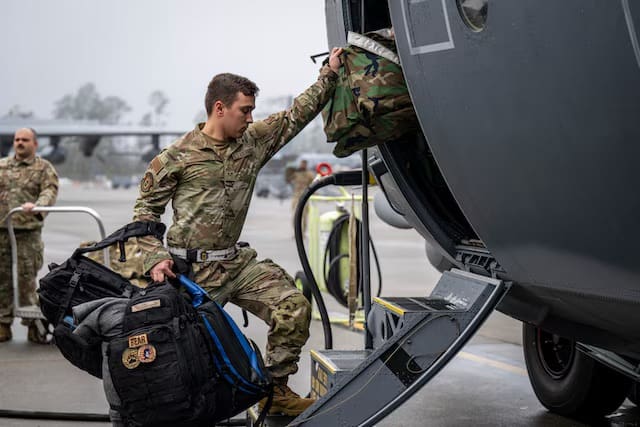
The 11th Air Task Force became the first U.S. Air Force air task force to deploy in July, starting with its participation in exercise Resolute Force Pacific (REFORPAC), the Air Force’s largest contingency response exercise in the Pacific, in Saipan, Northern Mariana Islands.

Based in Davis-Monthan Air Force Base, Tucson, Arizona, the 11 ATF is one of six task forces activated across the Air Force in 2024. It is composed of about 350 Airmen from a handful of units, including Davis-Monthan; Nellis Air Force Base, Nevada; and Holloman Air Force Base, New Mexico.

The 11 ATF has spent the last nine months completing training requirements in an expedited Air Force Force Generation cycle, which is built to enable Airmen to train and exercise together before being operationally employed together as part of a team. This is a change from how the Air Force traditionally has filled deployment billets, when Airmen were pulled from bases across the force and often didn’t meet until they arrived downrange.


According to U.S. Air Force Col. Brett Cassidy, 11 ATF commander, the ability to train together during deliberate field training exercises and unit events was a critical factor in the team’s mission readiness when they arrived on the field.

“It was a unique opportunity for the team to come together over the entire year to get to know one another, dive into the challenges on the ground here immediately and tackle them with success, because we had that background built up over the previous year of training,” Cassidy said. “We were ready and capable as soon as we arrived to get right into the mission.”

REFORPAC served as the 11 ATF’s final 400-level certifying exercise, allowing the 11 ATF to utilize all its training as a team before continuing the rest of its six-month deployment in the Pacific. Conducted through the month of July, REFORPAC was part of the first-in-a-generation Department-Level Exercise series, a new way the Air Force is exercising to conduct large operations in contested, dynamic environments. The aim was to improve interoperability and multilateral cooperation, leading to a stronger, more capable, deterrent force.


The DLE series encompasses all branches of the Department of Defense, along with allies and partners, employing approximately 400 U.S. and coalition aircraft and more than 12,000 members at more than 50 locations spanning 3,000 miles.

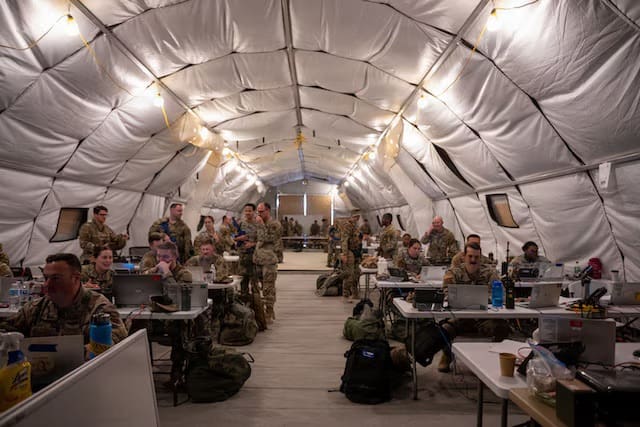
During the exercise, the 11 ATF, alongside the 11th Combat Air Base Squadron, supported the 563rd Rescue Group’s efforts as a mission generation force element. Their mission was twofold:provide Command and Control and base operating support-integration. This included logistics, operational setup, special staff functions such as the chaplain and medical support, security forces, airfield management and more.

All these teams came together to prepare for and react to exercise mission injects that ranged from a simulated downed F-22 pilot to a simulated Small Unmanned Aircraft System attack that knocked out part of the task force’s communication system, forcing members to implement contingency plans to ensure critical actions were still taken and relayed to the broader team.

Building from the ground up with the aid of local contractors and partners, the 11 ATF established internet communications within hours and supported aerial missions within days. Airmen also integrated with local authorities to utilize a civilian runway, enabling the 563rd RQG’s HH-60W Jolly Green II helicopters and HC-130J Combat King II aircraft to land and take off whenever necessary.

Another challenge was the sheer distance involved in some of the exercise injects, especially when the 563rd RQG was tasked with supporting efforts off the island.

“When we look at the long distances in the Pacific, the huge range that’s require for logistics and sustainment, it was a unique opportunity for our Airmen to work really dynamic problems in more isolated, austere locations over these long distances,” Cassidy said. “They had to figure out how to make the mission work in this large integrated whole of hundreds of aircraft and thousands of Airmen working through this contingency scenario.”

Besides the exercise injects and other training, 11 CABS Airmen also dealt with real-world challenges that included a tropical storm, a tsunami warning and a responding to humanitarian scenarios.

Ultimately, REFORPAC refined the 11 ATF’s ability to execute dispersed operations and generate airpower under challenging conditions, while giving its Airmen the chance to practice the Mission Ready Airman concept.

“The Mission Ready Airman concept is about trust,” said U.S. Air Force Chief Master Sgt. Sharreen Taylor, 11 ATF command chief. “It goes back to that teaming concept, where the Airmen have gotten to work together, learn how to trust each other and then really jump in. Airmen work together, building trust and taking initiative. They don’t wait to be told what to do; they proactively step up and fill in where they’re needed.”

Taylor pointed to several instances of Airmen stepping out of their primary job duties throughout REFORPAC, from finance Airmen helping establish a perimeter fence to airfield management Airmen helping with logistics. This also occurred as the 11 ATF integrated with squadrons from the 563rd RQG as Airmen from both groups worked together to solve problems and achieve the mission.


“Our Airmen nailed it during REFORPAC,” Taylor said. “We were able to come into an environment that we’ve never been in, and set up a camp in minimal time, along with a complete communication structure. Every task our Airmen were given, they succeeded; they were ready to overcome any contingency. They truly embraced the Mission Ready Airmen concept, and they truly embraced the things that the Air Force asked us to do.”

The 11th ATF’s role in REFORPAC highlighted its ability to function as a deployable, self-sustaining force, showcasing its adaptability and capability to operate similarly to a traditional Air Force wing. REFORPAC also gave the Department of the Air Force the chance to see air task forces in action, especially as the 11 ATF practiced Agile Combat Employment in a dispersed, austere environment. ATFs, which replace the Expeditionary Air Base model, are the next evolution of the Air Force’s progress toward the Deployable Combat Wing and a significant milestone in the Air Force’s journey toward modernization and readiness to ensure and maintain a competitive advantage over the pacing challenge.

“Air task forces like the 11 ATF are critical because they help us glean the lessons and observations necessary to continue improving our force generation concepts, ultimately helping make sure that the future combat wings are designed and ready to get after missions that help our joint forces and joint commanders who need them in the theater,” Cassidy said. “We’re not going to get it perfectly right as we work through these iterations, but we’re moving forward, and we’re doing it in a way that’s going to pull lessons for the Air Force at a critical time when we need to make sure that the Air Force is continuing to shift forward and be prepared for the next major contingency.”

By 2nd Lt Grace Brandt, 11 ATF

The Air Force Combat Air Base Squadron – Sarah Bodenheimer Builds the Blueprint

Sunday, August 17th, 2025

When Lt. Col. Sarah Bodenheimer, commander of the 355th Civil Engineer Squadron, was tasked with leading the Civil Engineering effort behind the Air Force’s Combat Air Base Squadron, there was no blueprint, only a concept. In less than a year, a first-of-its-kind unit had to be created from the ground up.

“We didn’t know what would work, but we knew we had to try,” Bodenheimer recalled. With no precedent to follow, she forged the way forward. “I made sure the team knew that the ‘do nothing’ course of action wasn’t an option.”

The CABS model brings together a cross-functional team spanning multiple specialties, all trained from the start to operate as one lean, agile, deployable element. “Traditional base operating support models weren’t built for the speed or posture demanded by today’s pacing threat,” Bodenheimer explained. “This unit is designed to project airpower from austere, contested environments quickly, independently, and with precision.”

Davis-Monthan Air Force Base, Arizona, was chosen to stand up the 11th CABS unit in 2024. As planning progressed, the team had to define structure, mission tasks, and readiness requirements. Establishing a dedicated CE CABS flight became the clearest path to meeting the demands of the new concept.

For Bodenheimer, the mission wasn’t just about building the structure, it was about empowering the people she led. Her role was to provide the ‘why’ and trust her team to execute, shouldering the institutional risk so they had the space to try, fail, and innovate. “If it’s successful, it’s all you. If something goes wrong, it’s all me,” she said. “I took this risk. I own it.”

She cultivated an environment where every Airman had a voice and a stake in the outcome—essential for blending individuals from different backgrounds and specialties into a cohesive team. Leadership wasn’t reserved for rank. “You don’t have to have all the answers to lead,” she emphasized. “Be honest, be clear about what matters, and don’t be afraid to make a call when others are frozen.”

Bodenheimer credits her parents with shaping the values that guide her leadership and work ethic. “They set the foundation: hard work, humility, and doing the right thing even when no one is watching.” She also comes from a family with deep military roots, including a grandfather in the Air Force, a grandfather in the Marines, and a Marine cousin who was critically wounded in Iraq.

That foundation was refined over the years by mentors, both in and out of uniform, who helped shape her leadership philosophy. “I’ve had leaders who taught me the importance of clarity, presence, and owning the impact you have on others,” she said. “At the end of the day, they all taught me to empower and take care of your people. Everything else will follow.”

Bodenheimer and her CE leads wrote new Concepts of Operations, established initial Standard Operating Procedures, identified training requirements, and navigated coordination with Major Commands and Combatant Commands stakeholders. She selected Airmen for the 11th CABS not just based on specialty, but on mindset and potential, forming a team with a balance of technical expertise and leadership capacity. Many junior members stepped into leadership roles for the first time—and delivered.

Standing up the unit also meant pulling 48 personnel from the 355th Civil Engineer Squadron, all while daily operations at Davis-Monthan continued without pause. Those who remained shouldered the extra weight, and it was important to Bodenheimer that they knew their work was essential to the larger mission. “That kind of quiet excellence often gets overlooked,” she noted. “But not by me.”

For Bodenheimer, success wasn’t measured by perfection, but by progress. Looking ahead, she doesn’t see what they built as a finished product, but as the beginning of something larger. “Are we getting it perfect? Who knows,” she said. “But I know the 355th CES Airmen on that team are doing everything they can to find a path and lead the way.”

She also views the effort as a long-term commitment to the CE enterprise and to the future of deployed operations. “I believe deeply in CE’s role as an enabler of airpower,” Bodenheimer emphasized. “Getting this right meant giving the Air Force a credible, deployable solution for base ops in the pacing threat environment. It also meant getting it right for our future CE Airmen who will be on the front lines of the next conflict. That mattered.”

Bodenheimer hopes that when all is said and done, her Airmen remember that she had their back. That she expected a lot but gave just as much. And, that she cared about the mission, but cared more about the people doing it. “I pushed them to lead boldly and think bigger because they’re capable of more than they realize.”

The construct of CABS will continue to evolve. The people may change, and the structure may shift. But when there was no blueprint, Bodenheimer helped draw the first lines and ensured her team had the trust, clarity, and support needed to succeed.

“We didn’t just prove the concept, we made it operational,” Bodenheimer said proudly. “We took theory and turned it into reality.”

Story by Alexandra Broughton 

Headquarters Air Force, Office of the Director of Civil Engineers

Air Force Stands Up A6 for Warfighter Communications, Cyber Systems

Friday, August 1st, 2025

ARLINGTON, Va. (AFNS) —

The Department of the Air Force has created a new AF/A6 Deputy Chief of Staff office dedicated to warfighter communications and cyber systems. This structure is designed to address operational communications and cyber needs effectively throughout the force.

The creation of the AF/A6 office separates the responsibilities for communications and cyber systems from the previous A2/6 framework, marking one of the most significant reorganizations of the Air Staff in over 30 years.

According to Air Force leaders, the change is designed to improve readiness, resilience and operational effectiveness by aligning resources and risk management with mission requirements.

“We created the A6 to ensure communications and cyber systems are available, secure and aligned with warfighter priorities,” said Air Force Chief of Staff Gen. David W. Allvin. “This office will help us focus resources and oversight where it matters most — supporting the mission in contested environments.”

The AF/A6 aligns with broader Department of Defenseefforts to advance command and control capabilities, including the DAF Battle Network and Combined Joint All-Domain Command and Control. The office is also expected to provide enterprise-level advocacy on requirements, architecture and funding decisions.

Lt. Gen. Leah Lauderback, former Deputy Chief of Staff for Intelligence, Surveillance, Reconnaissance and Cyber Effects Operations, said the A6 will serve as a critical link between operational feedback and strategic planning.

“Standing up the A6 allows us to manage risk, prioritize limited resources and advocate for warfighter needs using data from across the enterprise,” Lauderback said. “It’s a necessary step to treat communications and cyber as the operational enablers they are.”

Maj. Gen. Michele Edmondson has been appointed to serve as the first standalone Deputy Chief of Staff for AF/A6. Her experience in operations, training and strategic planning is expected to help the office’s focus on delivering integrated, resilient communications capabilities across domains.

“Our mission is to ensure warfighters have the reliable, secure communications they need to succeed in a complex and contested environment,” Edmondson said. “We’re building an enterprise that connects people, systems and decisions at the speed required by today’s operational demands.”

The office will coordinate with various stakeholders, including the department’s chief information officer, the principal cyber advisor, major command A6 offices, acquisition program offices and other operational and functional communities.

Officials emphasized the AF/A6 will be organized around a warfighter-centric model, designed to support current capabilities while informing future investment decisions and force design initiatives.

Story by SSgt Emmeline James, Secretary of the Air Force Public Affairs

Photos by SSgt Stuart Bright

What is a Reconnaissance Operations Commander?

Saturday, July 5th, 2025

This video by 2 Lt Mathieu Sly discusses the Reconnaissance Operations Commander course, one of the most challenging and rewarding training programs in the Canadian Army.

Sky’s the Limit: 200th Combat Weather Flight

Friday, June 27th, 2025

SANDSTON, Va. —  

Weather can be one of the most unpredictable and impactful elements of warfare. Whether it’s a rainstorm that delays the launch of an aircraft, or a sudden snowstorm that hampers mobility on the ground, the 200th Combat Weather Flight’s role in forecasting and analyzing weather conditions directly contributes to military operational effectiveness.

As experts in meteorology, personnel within the 200th CWS, 192nd Wing, Virginia Air National Guard, provide essential weather information to commanders, pilots and state leaders to mitigate weather-related risks. Geographically separated from the 192nd Wing and based in Sandston, the 200th CWS  provides support for both state and federal missions forecasting for Army National Guard aviation and hazardous weather domestic response operations.

“They see the weather forecast and meteorological information we provide as a form of intelligence to lean on and help define operational movements,” said Master Sgt. Walter Raymond, 200th CWS superintendent. “Weather conditions can affect so much of flying operations; commanders rely on us to deliver accurate, location-specific assessments that shape logistical and tactical decisions.”

In January 2025, after a blizzard swept the state leaving roads impassable and thousands without power, the 200th CWS once again demonstrated their expertise and readiness. Snowfall and temperatures plunged below freezing causing flooding at Richmond’s water treatment plant and leaving residents in Richmond and surrounding areas without water for days. As the state prepared to mobilize resources, the 200th CWS provided critical data that allowed the state to plan effective response strategies.

“The blizzard was a great demonstration of the team’s adaptability to the variety of situations they face,” said Lt. Col. Michael Johnson, 200th CWS commander. “Each winter storm or hurricane is different in what its impact can be. It’s driven a lot by our joint force leaders, and our people are able to react and recognize which weather information is pertinent in each scenario based on what the demands are on the commonwealth.”

Senior Airman Victoria Tuell has been a weather forecaster with the VaANG for four years and has provided critical support during major weather events, including Hurricanes Helena and Milton. She also emphasized the unique and rewarding opportunity to partner with sister services.

“I love collaborating with the Army,” said Tuell. “ Being able to work alongside another branch of service really helps to build those relationships. That collaborative effort really shines through, especially when helping our local community.”

From natural disasters to daily mission support, the 200th Combat Weather Flight remains at the forefront of operational readiness—proving that when it comes to safeguarding lives and achieving objectives, weather is far more than just a forecast.

By SSgt Nilsa Garcia, 192nd Wing

116th IBCT to Field Test New Mobile Brigade Combat Team Organization

Wednesday, June 18th, 2025

RICHMOND, Va.  –  

The Virginia National Guard’s Staunton-based 116th Infantry Brigade Combat Team will be the first Army National Guard brigade to test and evaluate a prototype task organization for a mobile brigade combat team during their 21-day eXportable Combat Training Capability rotation in June 2025 at Fort Barfoot, Virginia. The MBCT concept is part of the U.S. Army’s transformation initiative with the goal of making units more agile and lethal.

Virginia National Guard Soldiers assigned to the Bedford-based Alpha Company, 3rd Battalion, 116th Infantry Regiment, 116th Infantry Brigade Combat Team conduct a movement to contact situational training lane June 9, 2025, at Fort Barfoot, Virginia. The 116th is the first Army National Guard brigade to test a prototype task organization for a mobile brigade combat team, and it will be evaluated during a 21-day eXportable Combat Training Capability rotation. The MBCT concept is part of the U.S. Army’s transformation initiative with the goal of making units more agile and lethal. (U.S. National Guard phtoo by Cotton Puryear)

“The 116th has an incredible opportunity to be at the forefront of the Army’s transformation initiative, and I am confident the Soldiers of the Normandy Brigade will rise to the occasion,” said Col. Jared Lake, commander of the 116th. “There are still many variables in the transformation process, but our Soldiers are going to focus on their core warfighting skills that will make us a more ready and lethal organization by the end of XCTC.”

XCTC is a series of field training exercises simulating realistic combat scenarios including live fire, situational training lanes and force on force with a dedicated opposing force intended to increase the skills and readiness of National Guard units. 

The 116th will be configured as the MBCT during the XCTC rotation, and it will be an opportunity to continue testing and evaluating the proposed force structure, Lake said.

The mobile brigade combat team force structure focuses on three infantry battalions with organic logistics support and the addition of a multi-purpose company in each battalion and a multi-functional reconnaissance company in the brigade.

Battalion scout, mortar and assault platoons move to a battalion MPC to provide ground and aerial reconnaissance, indirect fire support, launched effects, counter unmanned aerial systems and deception capabilities to fix and attrit enemy forces that allows for infantry companies to close with and destroy the enemy.

The MFRC provides reconnaissance and surveillance with the brigade deep area to enable targeting and provide timely, accurate reporting of enemy activity, detect and target enemy high payoff targets and shape the brigade deep area to enable operations.

The MPCs and MFRC will be employed along with the 116th’s three infantry battalions during the culminating field training exercise near the end of the XCTC rotation.

The cavalry squadron and the brigade engineer battalion are not a part of the prototype MBCT task organization. Future force structure for those organizations is still being analyzed at the U.S. Army level. Soldiers assigned to those units will still focus on honing their MOS-specific skills during XCTC.

The field artillery battalion will conduct live fire during XCTC in addition to other MOS-specific training. Long term, the artillery battalion will align under the 29th Division Artillery as that force structure comes online in the coming years.

A key piece of equipment for the MBCT is the infantry squad vehicle designed to transport infantry squads across the battlefield. The 116th has not fielded the ISVs, but they will still be able to train on employing the new MBCT formations with their existing equipment.

The official 116th IBCT force structure has not changed and is not scheduled to change until the Army validates and finalizes the new MBCT structure, and then approves that change for the 116th IBCT, Lake said. This process is anticipated to occur over the next three years. 

“Every Soldier still has a home in the 116th IBCT and every opportunity to continue their service with the Virginia Army National Guard,” he said. 

Lake explained that while some Soldiers may be attached to other units for XCTC, there are no plans for permanent reassignments until the new official force structure is approved. Some Soldiers may get the opportunity to change military occupational speciality and career field, but most of Soldiers will not need to change MOS.

The Army’s 101st Airborne Division (Air Assault)’s 2nd Brigade Combat Team was first mobile brigade combat team, and they conducted a Joint Readiness Training Center rotation to experiment, test and collect Soldier feedback on the MBCT concept in July 2024 at Fort Johnson, Louisiana.

By Cotton Puryear | Virginia National Guard Public Affairs

Georgia Guard Activates First-Ever Electromagnetic Warfare Company

Thursday, June 12th, 2025

FOREST PARK, Ga. — The Georgia Army National Guard made history with the activation of the 111th Electromagnetic Warfare Company, the first unit of its kind in the U.S. Army.

The ceremony, held at the Fort Gillem Enclave, also included the assumption of command by Capt. Caleb Rogers.

Lt. Col. Luke Gurley, commander of the 221st Intelligence and Electronic Warfare Battalion, the parent command of the 111th EW, presided over the ceremony.

“Today we activate the 111th Electronic Warfare Company, a unit that will be at the forefront of our capabilities in the electromagnetic spectrum,” Gurley said.

The activation of the 111th EW Company marks a significant step in modernizing the Army’s capabilities within a domain that is increasingly critical to national security. This new formation will provide capabilities to detect, recognize, locate and identify signals of interest, supporting combatant commanders.

During his remarks, Gurley said the activation aligns with the philosophy of U.S. Army Chief of Staff Gen. Randy George, who advocates for rapidly modernizing units and equipment based on emerging needs and technology. He also believes every unit will need to master the electronic warfare fight.

“The legacy of the 221st Intelligence and Electronic Warfare Battalion and the Georgia Guard to lead from the front and provide those critical capabilities to support the warfight both locally and abroad is going to be driven by Georgia Soldiers,” said Brig. Gen. Theodore Scott III, commander of the 78th Troop Command. “And that means the world to me.”

Scott, once the leader of the 221st IEW, has watched the formation grow over the years.

“As the battlefield continues to evolve, the 221st IEW is ready,” Scott said. “It’s one of the most deployed units in the state and has been for a number of decades. And so that continues to articulate the relevancy of 221st and now the 111th.”

The 221st IEW has deployed Soldiers to Afghanistan, Iraq, Kuwait, Syria, Jordan, Turkey, Qatar, United Arab Emirates, Kosovo, Cuba and the southern border, and has supported U.S. Central Command and U.S. Indo-Pacific Command activities.

The 111th EW Company traces its lineage to the 1st Battalion, 111th Signal Battalion, the only Georgia Army National Guard unit mobilized during the Berlin Crisis in 1961 and the first unit mobilized since the Korean War.

“Today is not simply about activating a new unit. It’s about recognizing and honoring a proud legacy,” Gurley said.

Rogers, the newly appointed commander, acknowledged the unique challenges and opportunities associated with leading this pioneering unit. He said he is charged with coordinating with relevant schools and units to train on developing systems as the Army continues to identify and finalize the necessary training for the unit’s capabilities.

“No Soldier in the 111th ended up here through recruiting,” Rogers said. “They knew what they wanted when they came to the 111th. They knew that they wanted to rebuild Army EW.”

Rogers said the company will provide division commanders with four platoons of electromagnetic warfare teams, with a total of more than 80 Soldiers.

“All of our Soldiers are expected to keep up with evolving technology, and the unit as a whole is remaining flexible with the expectation of receiving a growing number of mission types,” Rogers said.

He also confirmed that the 111th EW Company will conduct its first field exercise in August at the Chattahoochee National Forest, focusing on electromagnetic support training and identifying and locating static and moving targets, including helicopters provided by the Georgia Guard’s 78th Aviation Troop Command.

“It’s a great time to be in military intelligence and electromagnetic warfare,” Scott said. “I am excited for the future.”

By Charles Emmons, Georgia National Guard

Maximizing Infantry Battalion Enablers: Effective Employment of the Multi-Purpose Company Commander

Saturday, May 3rd, 2025

In 2024, as part of the Army force structure (ARSTRUC) transformation, the Army Chief of Staff identified the 2nd Brigade Combat Team, 101st Airborne Division (Air Assault) as a transformation in contact (TiC) unit. The Army tasked the brigade with testing new formations through a full training cycle, culminating in a combat training center (CTC) rotation. In response, 2/101 transformed into a mobile brigade combat team (MBCT) to evaluate the Infantry Squad Vehicle (ISV). Under the new ARSTRUC, the Army moved enabler battalions to division-level control, leaving three infantry battalions in the brigade. The TiC initiative allowed 2/101 MBCT to establish a multi-functional reconnaissance company (MFRC) and three multi-purpose companies (MPCs). The brigade designated the MFRC as its primary reconnaissance and targeting asset while the MPCs will conduct security and counter-reconnaissance operations for the infantry battalions.

The MPC replaced the heavy weapons company within the infantry battalion. In the past, the battalion’s enablers — such as the scout platoon and mortar platoon — were organized under the headquarters and headquarters company (HHC). However, the establishment of the MPC centralizes these assets under a single command, consolidating the battalion’s enablers and adding new capabilities such as the anti-tank platoon and robotics and autonomous systems (RAS) platoon. This reorganization provides a significant advantage. Historically, the HHC commander was burdened by the conflicting demands of both staff sections and specialty platoons in garrison. In the field, the HHC commander was delegated to oversee the combat trains command post (CTCP) while the battalion commander and staff managed the enablers. With the advent of the MPC, a dedicated maneuver company commander now ensures that enablers are fully integrated into the battalion’s operations, thereby giving the battalion commander greater freedom to make informed decisions and command and control (C2) the fight more effectively.


Figure 1 — MBCT Task Organization


Figure 2 — Multi-Purpose Company Task Organization

The MPC Commander as a Staff Officer

The role of the MPC commander extends beyond tactical leadership on the battlefield. In both garrison and operational environments, the MPC commander must function as a staff officer, closely collaborating with key battalion staff members. This collaboration begins in garrison, where the MPC commander develops a strong working relationship with the S-2 (intelligence), the fire support officer (FSO), and the protection officer within the S-3 (operations) shop. Together, they form a fusion cell, ensuring that all of the battalion’s enablers are integrated into the mission. This coordinated approach prevents the stove-piping of information within specific sections, guarantees that no assets are overlooked, and provides a maneuver commander with the ability to validate the feasibility of how the staff intends to integrate enablers into the battalion’s overall maneuver plan.

In preparation for Joint Readiness Training Center (JRTC) Rotation 24-10, the MPC commander of 1st Battalion, 26th Infantry Regiment worked closely with members of the fusion cell. The MPC holds most of the battalion’s short-range and medium-range unmanned aerial system (UAS) assets in addition to its scouts. Collaboration with the S-2 was critical in developing realistic collection plans and clearly defined priority intelligence requirements (PIRs) that would lead to actionable decisions by the battalion commander. The MPC and S-2 shop also played a key role in devising 2/101 MBCT’s tactical deception plan, which utilized Wi-Fi and Bluetooth decoy emitters to mislead the enemy. In coordination with the FSO, the MPC commander developed a shared understanding of key considerations such as mortar section displacement times, standard fire mission round counts, and load configurations for each mortar section. Additionally, the often-overlooked warfighting function of protection became a priority as we developed techniques on planning the integration of Stingers and counter-UAS systems prior to the rotation.


A 2/101 MBCT drone operator conducts reconnaissance.

In the field, the MPC commander contributes significantly to the military decision-making process (MDMP). Upon receiving a mission, the MPC commander should immediately move to the battalion’s main command post (MCP) to analyze the mission and advocate for the effective use of enabler platoons. By working with the fusion cell and the battalion commander, the MPC commander helps develop reconnaissance guidance, PIRs, an information collection matrix, an initial fires plan, and the scheme of protection. This collaboration ensures enablers are fully integrated into the mission.

During 1-26 IN’s preparation for JRTC 24-10, the MPC commander participated in the Leader Training Program to solidify the MDMP process. This coordination paid dividends as the MPC commander consistently moved to the MCP upon receipt of a mission, helped develop essential planning outputs, and then returned to lead the platoons in tactical operations. This system ensured that 1-26 IN maximized the effectiveness of its enablers in shaping the fight for the rifle companies.


Figure 3 — Multi-Purpose Company Commander’s Role in the Military Decision-Making Process

The MPC Commander as a Maneuverist

While the MPC commander serves a vital staff role, he/she is also a maneuverist who leads the company on the battlefield. The MPC is a modular unit that can fight in various configurations depending on the battalion commander’s vision. The platoons may operate independently as organic enablers, as a consolidated company, or as multi-functional reconnaissance teams (MFRTs) that combine reconnaissance and anti-tank capabilities. The MPC commander’s experience and leadership are best utilized forward with the enablers to deal with friction points and consolidate reports for the battalion.

At JRTC 24-10, 1-26 IN ensured that the MPC commander remained forward during operations. Upon the initial joint forcible entry, the MPC as a whole established a screen for the battalion, kept platoons organic during defensive operations, and organized MFRTs to conduct counter-reconnaissance during offensive operations. The MPC commander’s forward presence allowed him to resolve issues related to communication and sustainment quickly and make tactical decisions in alignment with the battalion commander’s intent.

Conclusion

In conclusion, having a company commander solely dedicated to the training, employment, and maneuver of a battalion’s key enablers is critical in modern warfare. As technology continues to advance, the integration of innovations in UAS, advanced software, and artificial intelligence will become increasingly essential to improving both the lethality and survivability of military forces. A dedicated maneuverist who can effectively balance the staff work and tactical maneuver will maximize the multi-purpose company’s ability to sense, kill, and protect. This will ensure infantry battalions are better equipped to face the dynamic challenges of contemporary battlefields, ultimately enhancing mission success and operational efficiency.

Notes

1 This graphic is a modified version of Figure 5-1 in Field Manual 5-0, Planning and Orders Production, November 2024.

By CPT Philip S. Tateyama – He currently serves as the commander of the Multi-Purpose Company for 1st Battalion, 26th Infantry Regiment, 2nd Mobile Brigade Combat Team, 101st Airborne Division (Air Assault), Fort Campbell, KY. He graduated from the George Washington University in 2015 with a degree in political science and environmental studies. He attended Basic Combat Training in October 2017 and commissioned as an Infantry officer from Officer Candidate School in April 2018. His previous assignments include serving as rifle platoon leader, headquarters and headquarters company executive officer, and assistant S-3 with 2nd Battalion, 27th Infantry Regiment at Schofield Barracks, HI.

This article appeared as a bonus article in the Winter 2024-2025 issue of Infantry. View this issue at www.moore.army.mil/Infantry/Magazine/issue