Phantom Lights

Archive for the ‘Industry’ Category

Team MultiCam – Baja 1000 Post Race Report

Wednesday, December 2nd, 2015

MultiCam Brand recently posted a post race report on the 48th SCORE International Baja 1000 and the efforts of Team MultiCam rider Jeff Benrud. The starting paragraph can be read below:

DSC07669-486x300

The 48th SCORE International Baja 1000 is in the record books and it proved to be a very successful one for Team MultiCam rider, Jeff Benrud. The Baja 1000 is the longest point-to-point off-road desert race in North America where the participants will race from start to finish throughout the approximately 1000 mile distance only stopping briefly for pit stops. This was Jeff’s 3rd Baja 1000 with the previous 2 as part of a relay team on a dirt bike. This year, however, he soloed the entire race. Jeff is an Army Special Operation veteran and now teaches defensive and offensive driving capabilities to the military special operations community at American Offroad with his business partner and off-road racing legend, Ricky Johnson.

You can read the full report at multicampattern.com/baja-1000-post-race-report

TRU-SPEC Announces Winner of History Channel’s ALONE, Alan Kay As Brand Ambassador

Wednesday, December 2nd, 2015

AlanKay_1

Marietta, GA – TRU-SPEC, one of the leading suppliers of uniforms and personal equipment to the military, law enforcement, public safety, and shooting sport markets, is proud to announce that Alan Kay, winner of History Channel’s Alone, is now part of the brand’s family.

Kay, who starred in and won the first season of the survival show, serves as a corrections officer and survival expert, will promote the TRU-SPEC and 5IVE STAR GEAR® brands through various brand initiatives, marketing and appearances throughout the year.

“There is a very natural relationship between Alan, TRU-SPEC and the different industries we represent,” stated TRU-SPEC Vice President of Marketing, Darrel Jacks. “This partnership is both a pleasure and a tremendous value for our partners and our versatile community of loyal customers. Alan is honest and real, with a passion and spirit that resonates with everyone fortunate enough to meet him. He is as authentic and down to earth as you can get. We look forward to collaborating with him and in his support of the TRU-SPEC brand.”

TRU-SPEC has a proud history supporting Law Enforcement and First Responders, survivalists, military, the shooting community and outdoors enthusiasts; understanding the importance and demand for protection against the elements in any situation.

Kay spent most of his childhood in the forests of Georgia, building forts and honing his skills. After some time, his knowledge became so vast that he could successfully survive in virtually any environment. In an effort to increase his understanding of edible and medicinal plants, Kay sought out and studied under several different educators. He also spent time developing proficiency in the combative arts, including barehanded, stick and knife fighting. In his role as a corrections officer, Kay has been trained in tactical medical care.

Kay will be appearing on behalf of the brand at the TRU-SPEC booth, at the 2016 SHOT Show, January 19-21, in Las Vegas, NV.

www.truspec.com

Warrior Protection And Readiness Coalition (WPRC) Commends Approval Of FY 2016 National Defense Authorization Act And Welcomes New Members

Monday, November 30th, 2015

WARRIOR PROTECTION AND READINESS COALITION COMMENDS APPROVAL
OF FY 2016 NATIONAL DEFENSE AUTHORIZATION ACT AND WELCOMES NEW MEMBERS

Warrior Protection and Readiness Coalition Secures Critical Legislative Successes for Domestic Industrial Base and Grows Membership

MARBLEHEAD, MA (November 30, 2015) – The Warrior Protection and Readiness Coalition (WPRC) commends the United States Congress and President Barack Obama for adopting meaningful reforms and important legislative initiatives to maintain the strength of the domestic industrial base in support of our warfighters and peacekeepers. WPRC members advocated tirelessly for several provisions that were included in the final 2016 National Defense Authorization Act (NDAA), signed into law by the President on November 25, 2015.

The WPRC successfully advocated for and secured an important provision (Section 884) that discourages the use of “lowest price technically acceptable” (LPTA) contracting methods for items of personal protective equipment (PPE) and critical safety items. The NDAA states that the service branches, overseen by the Secretary of Defense, shall “use source selection criteria that is predominantly based on technical qualifications of the item and not predominately based on price to the maximum extent practicable if the level of quality or failure of the item could result in death or severe bodily harm to the user.” Items of concern include combat helmets, body armor, ballistic eye protection, and other similar individual equipment issued to U.S. military personnel and manufactured in the United States by members of the WPRC.

Senator Kelly Ayotte (R-NH), Chair of the Senate Armed Services Committee-­Readiness and Management Support Subcommittee and Representative Rob Wittman (R-­VA), Chairman of the House Armed Services Readiness Subcommittee joined to lead the effort in Congress to maintain this important provision in the final NDAA text. This language is critically important to ensuring that our soldiers, sailors, airmen, Marines, and operators are equipped with the safest, highest performing equipment and that the American taxpayer is receiving the best value for their dollars.

Ensuring that technical qualifications and capability take precedence over lowest possible pricing ensures a combat advantage for U.S. service members and consistently higher quality equipage. Best Value contracting is the most appropriate acquisition tool to prevent unnecessary injuries or casualties for those in harm’s way. WPRC members will continue to advocate for the use of Best Value contracting methods and ensure that the Department of Defense recognizes the importance of this provision to the health and safety of our service men and women.

In addition to this achievement, WPRC also successfully ensured the inclusion of language directing the Department of Defense to comply with previously passed directive language from the FY 2014 NDAA requiring the Secretary to “submit, as part of the defense budget materials for each fiscal year, a consolidated budget justification display that covers all programs and activities associated with the procurement of personal protection equipment (PPE).” The report states, “The committee expects the Department [of Defense] to comply with section 141 of the fiscal year 2014 NDAA and strongly encourages the Department to consider including similar budget displays for environmental and fire resistant clothing, footwear, and organizational clothing and individual equipment [(OCIE)] as well.”

Providing this information, as directed by Congress, will allow Program Managers and Project Officers, as well as WPRC member companies to better plan for the future needs of our Armed Services and properly allocate, budget, plan, and deliver superior clothing and equipment. A letter was also recently sent from several members of the U.S. House of Representatives, led by Rep. David Rouzer (R-­NC) requesting a detailed plan for how the Department of Defense will comply with this reporting requirement in the FY 2017 budget. The implementation of this simple yet critical step in the Department of Defense budget process ensures that the U.S. industrial base that supports our armed services is provided the essential information needed.

Another priority for WPRC members is ensuring that the U.S. Department of Homeland Security (DHS) is complying fully with the Kissell Amendment, which requires the Department to purchase American-­made clothing and individual equipment where applicable. Earlier this year, the WPRC requested that the Department conduct an internal audit to identify how DHS has implemented and complied with this law. This process is ongoing, however Senator Jeanne Shaheen (D-­NH) has called for a Government Accountability Office (GAO) independent audit of DHS to study how the Department has implemented the Kissell Amendment. WPRC leaders are working with Senator Shaheen and other Members of Congress to hold DHS accountable and ensure compliance with the law.

WPRC Executive Director David Costello said, “The legislative success our Coalition has achieved is a result of the bi-­?partisan recognition of the need to sustain innovative American manufacturing that supports our troops. This national asset provides our service members with a distinct advantage in both training and combat and is increasingly essential to the readiness of our warfighters and peacekeepers. The WPRC is grateful for the support of our congressional champions who have ensured this collective effort becomes effective legislation.”

As the WPRC continues to expand its advocacy efforts, new companies continue to join the organization as members. Recently, Bluewater Defense, D3O Impact Protection, Navajo Fabrics, and Worthen Industries have joined with 40 other companies to add their voice to the WPRC. The added impact of these industry leaders will be critical to advancing the WPRC mission to support the equipment and advanced clothing needs of the Armed Services and Department of Homeland Security.

Bluewater Defense – Bluewater Defense is a leading manufacturer of uniforms and equipage for the U.S. Department of Defense. During the past 28 years, the company has focused on manufacturing labor intensive, sewn items per military specifications ? successfully completing 74 large contracts totaling $800 million in revenue. www.bluewaterdefense.com.

D3O Impact Protection – Located in North Carolina and Virginia, D3O is a groundbreaking impact protection solutions company that licenses a range of unique patented smart materials. The market-­changing D3O technology is used to produce a shock absorbing material that can be found in a range of products across the motorcycle, sport, footwear, electronics, military and workwear sectors. Military forces benefit from head-­to-­toe D3O technology solutions that range from combat helmet liner systems to footwear insoles. www.d3o.com.

Navajo Fabrics – Navajo Fabrics is a Westerly, RI based diversified manufacturer of military uniform, police, tactical and equipage fabrics. Navajo is a leading supplier of fabric for the military, law enforcement, public safety, medical, and security markets. Navajo’s business focus is to produce fabrics for OCIE (Organizational Clothing Individual Equipment) as well as unique solid colors and camouflage patterns for specialty missions and specific environments. www.navajo-­fabrics.com.

Worthen Industries – Worthen Industries’ UPACO Footwear Products Group has been custom compounding, reacting, and extruding products for every operation of footwear, including military and law enforcement products, and allied trade manufacturing for over 40 years. Based in Nashua, NH, the UPACO group offers systems for waterproof footwear, film adhesives for both sole (in-mold) and upper footwear applications. In addition, UPACO offers liquid bonding adhesives (both solvent and water-­based, natural, and synthetic), standard hot melts, and polyurethane reactives. www.worthenindustries.com.

The WPRC supports the readiness of the United States by providing a unified industry voice to the U.S. Congress, the Department of Defense (DOD), Department of Homeland Security and other stakeholders. We work at the intersection of the Personal Protective Equipment and Organizational Clothing/Individual Equipment industry, the federal legislative policy process, and the Departments of Defense and Homeland Security. Our membership includes companies throughout the equipment and clothing industry and with companies at every point in the industrial supply chain who represent the best in American manufacturing.

About WPRC

WPRC is the unified voice of advocacy for the individual and unit level equipment needs of the warfighter and peacekeeper. The leading tactical equipment, apparel, materials, and technology companies of the WPRC are committed to ensuring that American service members and Homeland Security personnel are provided with superior products built by a robust industrial base, now and in the future. For a complete listing of WPRC member companies, please visit www.warriorprotection.net.

The L-3 Communications Settlement With The US Government Over Fraud Charges Stemming From EOTech Holographic Weapon Sights

Friday, November 27th, 2015

For those interested in details of L3’s settlement with the US Government.

show_temp (8)-1

Click to view .pdf

The Details – UNITED STATES OF AMERICA v. L-3 COMMUNICATIONS EOTECH, INC., L-3 COMMUNICATIONS CORPORATION, and PAUL MANGANO

Wednesday, November 25th, 2015

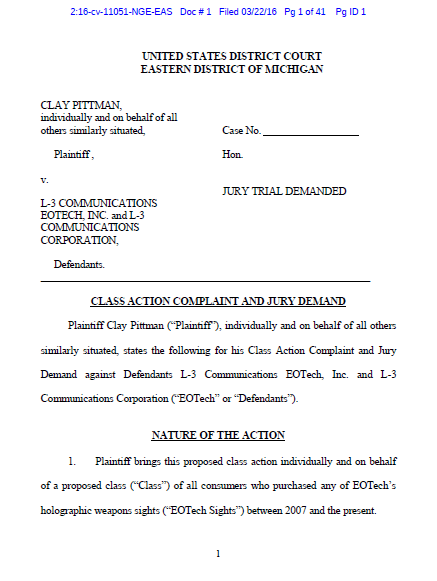
As most of you know by now, the US Government sued L-3 Communications and its subsidiary EOTech as well as EOTech’s CEO, Paul Mangano for fraud regarding issues with their Holographic Weapon Sights which have been purchased by the Departments of Defense, Homeland Security, and Justice. While we have provided a copy of the case, many won’t take the time to actually read it so we’ve extracted some of the pertinent information for you. What the Government’s attorneys have done is demonstrated a pattern of fraudulent behavior on the part of L-3 on how the sights work in various environments. In particular, they’ve named EOTech CEO Paul Mangano due to his part in the scheme.

This is a civil fraud action by the United States of America (the “United States” or the “Government”) against Defendants L-3 Communications EOTech, Inc. (“EOTech”), L-3 Communications Corporation (“L-3”), and EOTech’s President, Paul Mangano (“Mangano,” and collectively with L-3 and EOTech, “Defendants”), to recover treble damages and civil penalties under the False Claims Act, 31 U.S.C. § 3729 et seq., and damages under the common law theories of mistake of fact and unjust enrichment, arising from a scheme to defraud the United States Department of Defense (“DoD”), the Department of Homeland Security (“DHS”) and the Federal Bureau of Investigation (“FBI”) in connection with EOTech’s knowing sale of defective holographic weapon sights (also referred to herein as “combat optical sights” or “sights” and sometimes abbreviated “HWS”).

The suit shows that EOTech knew about issues as far back as 2006 and failed to alert the Government. Rather, the Government had to discover the issues on their own.

Since at least 2006, Defendants knew about defects in their weapons sights that caused product failures, particularly in the extreme environmental conditions in which Special Forces operate. Instead of making a prompt disclosure of the defects, Defendants delayed disclosure for years, until they believed they had a fix or were compelled to make a disclosure because of employee or other complaints.

By 2006, Defendants knew that the sights failed to perform as represented in temperature extremes. Specifically, they learned that the sights experienced a condition referred to as “thermal drift,” meaning that the sight’s point of aim differed from its point of impact (or “failed to hold zero”) when subjected to hot or cold temperature. Although EOTech was contractually required to disclose any information concerning the reliability of the sights, EOTech waited nearly a decade to disclose the defect. In more recent years, as EOTech subjected new models of the sights to qualification testing, the test engineer documented thermal drift in every sight tested in report after report. Finally, in March of 2015, the FBI independently discovered the thermal drift defect and presented EOTech with the very same findings that the company had documented internally for years. Shortly thereafter, EOTech finally disclosed the thermal drift defect to DoD.

By early 2007, Defendants knew of a separate performance failure in cold temperature. Beginning around 32 degrees Fahrenheit, the sights’ aiming dot became significantly distorted, affecting the accuracy of the sight and worsening as the temperature approached -40 degrees. At sub-zero temperatures, the distortion of the aiming dot affected the accuracy of the sights by more than 20 inches for every 100 yards. EOTech delayed disclosing the defect for more than a year, and until it had a fix in place. Even then, EOTech presented its fix to DoD as an upgrade to a quality product that already conformed to specifications.


By 2008, Defendants also knew that their sights failed to perform as represented in humid environments. Defendants knew that the sights leaked, allowing moisture to enter and causing a degradation of the reticle (i.e., the circle and aiming dot in the sight necessary for acquiring a target). Although the sights were always sensitive to humidity, in 2008 EOTech inspected a large shipment of returns from DoD and noticed damage caused by moisture in nearly every sight. In the years that followed, moisture-related complaints (typically dimming or disappearing reticles) became the number one reason for EOTech’s customer returns, and EOTech’s own testing repeatedly confirmed that the sights were not properly sealed and quickly degraded when exposed to moisture.

Defendants, however, waited to disclose the problem until 2013, when, once again, they believed they had arrived at a solution. And again, EOTech pitched its fix as an upgrade to a
quality product that conformed to specifications.

Once again, EOTech never disclosed these issues to the Government. Instead, internal testing at the FBI brought them to light.

Finally, in March 2015, the FBI discovered what EOTech had known for years. In conducting its own testing of the sights for zero stability, the FBI exposed the sights to normal temperature variations for the state of Virginia, a temperature range much narrower than -40 to 140 degrees Fahrenheit. A ballistics team then tested the sights for point of aim/point of impact accuracy, or zero stability, and similarly found significant drift at both higher and lower temperatures.

After discovering the problem in March 2015, the FBI immediately presented its findings to EOTech. Shortly thereafter, EOTech disclosed the issue to Crane, but stated that the problem was only recently discovered and that it was devoting substantial efforts toward finding a solution.

When asked about the company’s previous efforts at finding a solution for thermal drift, a former EOTech optics engineer explained that the company knew for years that thermal drift was an inherent design flaw with the “Generation II” model of the product that was specially designed for military use, and that no fix existed without substantial modification of the product.

Many have wondered why CEO Paul Mangano was specifically named. The key is in this passage from the suit:

Both Mangano and EOTech’s contracting officer acknowledged that EOTech was contractually obligated to notify Crane if the sights deviated from the contractual specifications. Mangano also testified that L-3’s ethics policy requires disclosure of quality issues to the Government.

And this:

The decision maker on disclosure of quality-related defects was Mangano. As the Co-founder testified, until a solution was in place, Mangano “did not want this [defect] disclosed to the marketplace at all and he specifically communicated that.” According to two EOTech employees, the Co-founder fought repeatedly with Mangano over whether to disclose the distortion defect, with the Co-founder supporting immediate disclosure and Mangano opposing it. Moreover, Mangano admitted at a deposition that the decision to disclose a quality issue to a customer ultimately was his.

Mangano’s decision to hide defects goes back to at least 2007.

By email dated September 16, 2007, Mangano reported to other senior managers that “[t]he take-away from this past Friday’s Red Review is that we will not be in a position to fully disclose to Crane and Colt/Canada [a Canadian EOTech customer] until November at the earliest.” Mangano added that “[w]e will only disclose to Crane and Colt/Canada. Given that we have no product returns over the years from other military customers reporting the issue, we see no need to communicate the patent defect.”

Internally at EOTech, employees knew this course of action was wrong. This statement may be the most damning of all.

Shortly thereafter, a sales and marketing employee wrote to the Co-founder “in confidence” about Mangano’s email, stating, “I have an issue with this . . . Is it worth risking one person’s life on this? What if there is a guy in the mountains in Afghanistan, and he brings up his sight picture on the enemy who has the drop on him with an AK[?] He takes aim as quickly as possible and puts a shot that misses wide due to the distortion of the reticle. He’s dead a fraction of a second later from a 7.62 mm round. This is a dramatic example, but this is the risk that is posed the longer the end-user is unaware of the risk.”

The sales and marketing employee added that “[w]e have been sitting on this issue for a long time and it makes me very uncomfortable that we have still done nothing about this to protect soldiers and LEOs [law enforcement officers] of both this country and those across the globe from getting killed. What if it has happened already?

Another issue that comes up in the suit is that Naval Surface Warfare Center Crane, which acts as Program Manager for Special Operations Forces Weapons on behalf of USSOCOM needs to institute a more robust testing and quality control regimen. I believe that they relied too heavily on the vendor (L-3 Communications) to self monitor for adhering to specifications. While this may have made sense early in the war, in order to quickly field equipment to troops in the field, there has been plenty of time to allow acquisition best practices to become the norm. Additionally, if EOTech is an ISO certified company, someone needs to conduct a thorough audit.

While L-3 Communications was quick to settle the suit with a $25.6 Million fine, we wait to see if the Government will recommend debarment for L-3 Communications, just EOTech, or not at all. Additionally, there are several other user groups not represented in this suit, such as State and Local government agencies, domestic consumers and international customers.

We have extracted some of the most significant sections of the suit, but we still encourage you to read the entire filing which is available here.

UPDATED – US Government Sues L3 Communications for Fraud Involving EOTech Sights – L3 Settles for $25.6 Million

Tuesday, November 24th, 2015

We can finally tell you the rest of the story regarding L3 Communications’ EOTech Sights.  The Department of Justice has been investigating EOTech for some time and has finally filed suit (US v. L-3 Communications EOTech Inc., 15-cv-09262) in US District Court, Southern District of New York (Manhattan).

Specifically, the Government’s allegations concentrate on the performance of the Holographic Weapon Sights at temperature extremes as well as in high moisture environments. The Government also claims that EOTEch failed to disclose testing that demonstrated the inaccuracy issues in those environments.

In addition to naming L-3 and EOTech as defendants in the Government’s suit, they also named EOTech’s president, Paul Mangano which isn’t very common. They are seeking unspecified triple damages plus civil penalties of as much as $11,000 for each fraudulent claim.

L-3 has been aware of the pending action, having mentioned the issue in their July 2015 SEC filing as well as setting aside $26 million.

Update – By mid-afternoon, L-3 had settled with the government for $25.6 million which clearly indicates L-3 has known since summer how much the US Government would be willing to accept in relief. Their quick action helped turn a drop in stock value of more than 6% at mid-day, yet they still closed the day down from opening prices.

What remains, is for L-3 to answer to domestic consumers, state and local governments as well as international customers.

Below is the filing. In suggest you read it. The Government’s case is compelling.

United States v. L-3 Communications Eotech, Inc., et al-1

Click to view .pdf

FirstSpear At Milipol Paris 2015

Monday, November 16th, 2015

Milipol2015

FirstSpear is displaying their latest Personal Protection Equipment with TR-Equipement at Milipol this year. If you’re at the show, stop by at Booth 5 L 195 and check them out.

www.first-spear.com

Crimson Trace Receives PNDC Recognition

Sunday, November 15th, 2015

  
(Wilsonville, OR)— The Pacific Northwest Defense Coalition (PNDC) recently recognized Crimson Trace with a prestigious 10-year Membership Award. The honor was bestowed during the Coalition’s annual awards banquet held in Oregon.

“Crimson Trace is honored to receive this recognition for its support of the Pacific Northwest Defense Coalition,” stated Lewis Danielson, Crimson Trace Founder and Chairman of the Board. “Our employees are proud to help and support the many men and women who work in the defense industry to protect America.” Crimson Trace manufacturers several laser sighting products available to the US Defense Department and NATO Allies around the world.

 During the past decade, Crimson Trace has supported the PNDC by hosting on-site tours at the company manufacturing facility in Wilsonville, Oregon, sponsoring several annual range day activities, and participating in other defense industry related events.

 The PNDC also celebrated 10 years as an organization during the banquet and awarded several honors. The organization has more than 150 member organizations, represents companies across Oregon and Washington, and is an association of Northwest defense and security industry businesses. PNDC focuses on strengthening members’ business growth, the region’s economy, and America’s security through training, one-on-one counseling, business-to-business networking and advocacy. Member businesses create goods and services ranging from helicopter repairs to providing bomb-proof curtains to US embassies. In addition to Crimson Trace’s Department of Defense supplied laser sighting systems, local PNDC member companies also manufacture: knives, optics, scope mounts, thermal imaging systems, gun parts, footwear, tracking devices and other products to be used around the globe in defense and security services