Sidewinder Compact III

Archive for the ‘Profession of Arms’ Category

The Baldwin Files – Assessing Potential Leaders

Sunday, December 15th, 2019

Someone asked last time about the “Traits that you look for when selecting personnel for a role or team?” A number of things to consider came to mind immediately. First, it would be accurate to say that all of us are constantly assessing those we work with; and, in turn, we are assessed by them. Sometimes, in the military especially, the professional assessment (testing) or “selection” process is formalized and fairly objective; but most often, it is informal and more subjective. In any case, both formal and informal professional assessment criteria should directly relate to the work for which a candidate is being considered. Ultimately, those who meet or exceed those criterions will be “selected” at the culmination of the process. In so many words, professional assessment is always a job interview.
Obviously, if a candidate is available who has already satisfactorily demonstrated the requisite basic character traits and skills for the job the choice is easy. If a Staff Sergeant joins an Infantry Platoon, it is reasonable to expect that an infantry NCO of that grade – even if just promoted – has already demonstrated at least the potential to lead a squad successfully. Therefore, unless there is evidence to the contrary, we can have trust and confidence that the individual is qualified to get the job done. If that is not the case, a leader choses someone else judged suitable for the task, or – if there is no other option – takes a risk or even a gamble on someone who is untested. Consequently, while the original question (above) sounds simple, it begs a bit deeper dive into the continuous process of assessment, selection or non-selection, teambuilding, and – as always – the role of leadership.

In the Bible, Gideon assessed soldiers for the coming battle based primarily on how they individually drank water from a stream. As the story goes, the 300 he selected (with divine guidance) went on to achieve a decisive victory against an enemy many times larger. Military leaders throughout history have found it useful to develop and apply some form of assessment criteria to sift presumably better quality fighters – or those with special talents – from whatever untested quantity of personnel might otherwise be available. Those so selected tended to be considered “elite” soldiers, often organized into “special” units, with exceptional and often higher-risk mission sets. In every case I can think of, and regardless of whatever assessment method might have been used to find them, those select few never formed the bulk of any army.     

In 1899, Elbert Hubbard wrote a short and thought provoking ode to personal initiative and the rare individuals who can be counted on to get hard jobs done called “A Message to Garcia.” Hubbard concluded by saying, “Civilization is one long anxious search for just such individuals. Anything such a man asks shall be granted; his kind is so rare that no employer can afford to let him go. He is wanted in every city, town and village – in every office, shop, store and factory. The world cries out for such: he is needed, & needed badly – the man who can carry a message to Garcia.” Hubbard’s version of assessment and selection criteria. I would say that he was certainly right about at least two things; result or mission oriented and purpose driven people are habitually in short supply and they are always of great value. Especially in battle.

“Show me a man who will jump out of an airplane and I’ll show you a man who will fight.”

LTG(R) James M. Gavin

I have often spoken with admiration of the assessment and team-building process paratroopers of World War II went through. It is an excellent example for leaders today to study. Commanders of those paratroopers had to build winning combat teams while simultaneously assessing individual paratrooper candidates. In most cases, the nascent Parachute Infantry Regiments (PIRs) were formed around a small cohort of relatively experienced officers and NCOs – only a handful of whom were already parachute qualified. That assigned cohort became the primary trainers of the unit. The PIRs ran their own infantry-centric training programs for approximately five months before going in turn to Fort Benning for what we now know as “Jump School.” The school was the only major portion of the training with assigned instructor cadre. Completing the four weeks of Jump School was essentially the final crucible event for the new paratroopers. At the end of Jump School, they were awarded their wings, allowed to blouse their boots, and call themselves paratroopers. It was a big deal.

Shortly thereafter, the PIR would conduct one or more maneuver exercises involving parachute assaults and be declared fully “combat ready” for deployment. It is unfortunate but true that we no longer give basic airborne qualification the kind of respect it carried in the days when few Americans – and practically none of the airborne candidates – had even flown in a plane. Those paratroopers and their leaders were being evaluated, organized, and trained, to do two highly risky things: individually jump out of an airplane in flight and collectively seek to take and hold key terrain usually behind enemy lines. The toughest of tough jobs. Stephen Ambrose’s book about the 506th PIR and Kurt Gabel’s about his experience in the 513th PIR give good accounts of the training regimens for the PIRs. The first episode of the Band of Brothers miniseries provides a good approximation of the training as well. In short, while practicing modified airborne specific infantry tactics and receiving U.S. weapons training, the aspiring candidates were subjected to intense physical conditioning, taught foreign weapons employment, demolitions, survival skills, and combatives.  

The training program was refined and changed over time, but was never just a random hodgepodge of tasks. The expectation was that paratroopers would likely be widely scattered; critical equipment lost or destroyed; key leaders missing or killed. Small groups and even individual paratroopers were supposed to take those contingencies in stride and still move aggressively to seize their objectives. In training and then later in combat, PIRs made it SOP to brief every trooper on the operational and even the strategic plan – not just on his platoon or company’s small  part of it. Airborne leaders concluded that troopers had a need to know the bigger picture and the intent of the mission in order for the PIRs to succeed in combat. They were right. It also becomes obvious that if individual troopers were expected to take mission lead when necessary, then each one had to also be assessed and their leadership potential developed as much as possible in support of the team effort.

That is why large parts of the Army leadership then – and even now – are generally not fans of any specialized units. They recognize that those units tend to siphon off and concentrate that rarest of commodities – soldiers with leadership potential – stolen as they see it, from “regular” units. If you think of talent management as only a zero sum game, there might be some truth to that perspective. However, I would argue otherwise. In World War II, with the fullest mobilization of American manpower in history, the PIRs had an initial surplus of candidates applying for the job. However, even with that abundance, the U.S. was only able to field about a dozen PIRs. In the final 18 months of the war, those last PIRs formed were destined to serve as training units only. At the completion of the training cycle, their troopers deployed forward as individual replacements for the PIRs and separate Parachute units already in combat. We never got to the point where we had “too many” paratroopers; or too many aviators or any of the other myriad specialties we needed people to fill in large numbers. Even then, talent was in short supply.

Let us transition to a formal assessment program established more recently and that I am personally familiar with. That is Special Forces Assessment & Selection or SFAS. Although it has evolved over the years, the program we use was initially based in large part on the Australian SAS selection program of the mid-1980s. It started out as a three week event in 1988, was reduced to two weeks just before 9/11, and was later re-extended to three weeks. Before anyone asks, I will explain why it was reduced in length for a time. However, as usual, I will take the long way to get there. There is an old saying that “there would be no Special Forces if not for the 82nd Airborne.” That is actually more literally true then most people might realize. In 2000, some 70% of the enlisted candidates for SFAS were already Airborne qualified. While there are a handful of exceptions every year, enlisted soldiers (unlike officers) only get a slot at Jump School if they are on orders for an Airborne assignment.

That means that the majority of our enlisted candidates – who make up the bulk and backbone of Special Forces – were coming from another Airborne unit like the 82nd or the Ranger Regiment. Furthermore, if you add the candidates from the 101st, 25th ID and the 10th Mountain that accounted for some 96% of all the enlisted candidates that volunteered to try out at SFAS. In short, our practical in-service recruiting pool is fundamentally just four Divisions of the Army. For reference, officers – all of whom are Captains – are 100% Airborne qualified and some 85% that show up are Ranger qualified. Moreover, the preponderance of all in-service candidates have an infantry background. I have met the occasional exception, but the fact is that statistically we get practically zero from the Armor Community, Aviation, Intelligence, Combat Support, or Combat Service Support units. If we get a Messkit Repairman, it is likely because he served in an infantry or engineer battalion rather than a Corps’ Messkit Repair Brigade. Many intel soldiers want to serve in SF Groups – as Intel Analysis not as (SF) 18 Series MOSs. The same is true of most of the so-called “support” MOSs in Group.

Make no mistake, we absolutely need those highly skilled soldiers and officers to function, and they are appreciated – but they do not fill A-Teams. In 2000, the Special Forces Regiment was in a statistical “death spiral.” We were losing more 18s from ETS and Retirement then the schoolhouse was producing. Many reasonable and some outlandish ideas were floated that year to address the problem. One retired former Group Commander suggested that we get the Army to “levy” soldiers to go through SFAS – some percentage of those pressganged soldiers were bound to pass he opined. He was serious. He was crazy, but he was serious. A better idea was to find another pool to fish in. That is where the 18X-Ray Enlistment Program came from. It was not that radical really, the Ranger Regiment had been using a similar enlistment option for some time. However, it would be almost a year before any of those 18Xs even got to SFAS and at least another year before even one would get to an ODA; so it was not a quick fix. Moreover, while it briefed well, no one had any real feel for how many people “off the street” would go for a program of multi-year length. There was some anxiety at first, but I would say that particular initiative turned out well in the end.

I have said many times that no good decisions are likely to be made out of fear or in a panic. Unfortunately, some people were panicking. They decided that the best way to get more green hats on heads was to “adjust” the standards. It was an emergency they reasoned and bold action was required to save the SF Regiment. These well-meaning but tragically misguided leaders started to look at the assessment gates where the most attrition occurred. In SFAS it was during the third or “team” week. Therefore, they dropped the third week. Just like that. The SFAS cadre was not consulted, no study was conducted – they were just told to execute. The premise behind this change was wrong on many levels. Standards and assessment criteria can and should evolve over time. Doing something simply because “that is the way we have always done it” is never a good excuse not to at least periodically reevaluate. Yet, before any chance is made, the first question that needs to be asked and honestly answered is whether the current criterion are still valid. If the answer is “yes” then no change is warranted – regardless of the numbers.

In this case, there was nothing wrong with the existing three week program. It was doing exactly what it was supposed to do. Now, here is the funny part; making SFAS shorter did not result in any noticeable change in the attrition rate. The cadre does not control assessment or the outcomes; the candidates control it – although most do not realize it at the time. The candidate volunteers to show up. The candidate chooses how much effort he is willing to exert, and he decides when to quit or not. The cadre simply set up the conditions and then observes the candidate’s performance. If the candidate came to stay, came to win, he will keep at it for two or three or as many weeks as it takes. If he did not show up with that attitude, it is just a matter of when – not if – he will quit. It is also worth remembering that the finest soldiers and leaders that have ever served in storied special units in history were never subject to a formal individual selection program, as we know them today. Darby never experienced anything like the current Ranger School and never wore a Ranger Tab. Anybody doubt he was a fully qualified Ranger? Early Green Berets went through some tough training. However, none ever went through something like our current SFAS. They earned their tabs – before there were tabs – in different but just as legitimate ways. 

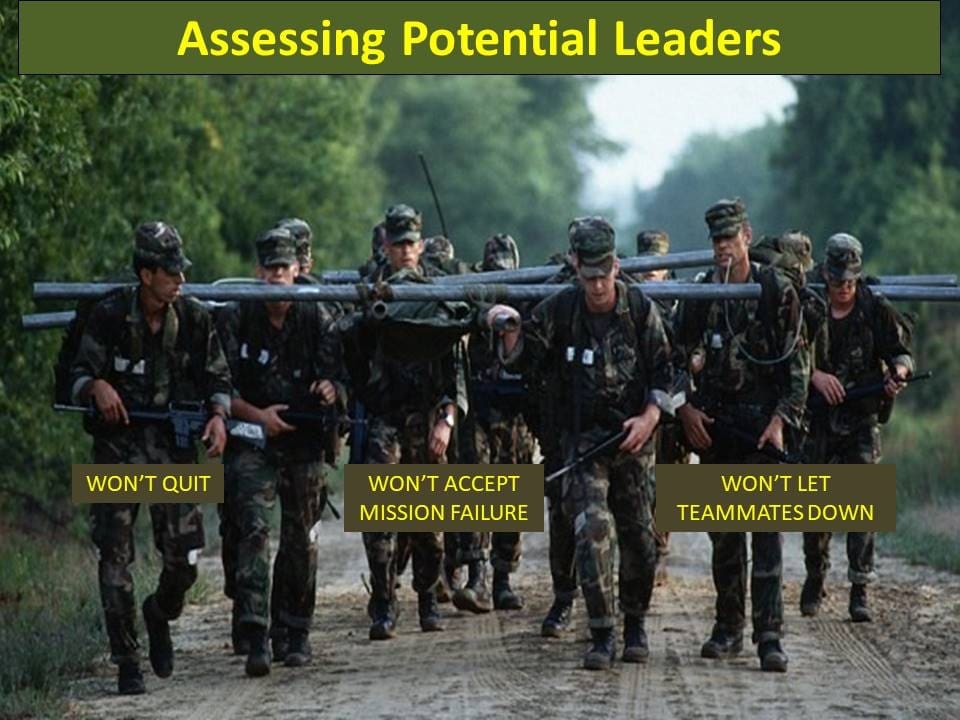
To answer the original question, I have found that it comes down to the three credos on the attached picture. I look for people who won’t quit, won’t accept mission failure, and won’t let their teammates down. I try to be that kind of leader myself and set the right example. I want to know if a candidate has internalized that ethos – or at least has the potential to. In other words, I am looking for leaders. That is it. Everything else comes down to training. There is a scene in the football movie “The Replacements” with Gene Hackman and Keanu Reeves. The Coach (Hackman) askes the Quarterback (Reeves), “What’s it going to be?” Reeves replies, “I want the ball, Coach!” Hackman says, “Winners always do.” I do not think anyone can be a leader that does not have an innate desire to win. That means in military units that a true leader’s first instinct is to claim ownership of the mission. Real leaders seek to take control of the proverbial ball. When a subordinate has shown the desire and / or the potential to take on additional responsibilities, a good leader will challenge them, test them, and be an accelerant not a retardant to their ambitions to take up the yoke of leadership. 

By now, some of you might be saying, that is fine, but my unit does not have the luxury of a formal assessment program and I have to deal with whatever the Army sends me. I can assure you that the principles are the same. It just falls to the individual leader to conduct those job interviews and make those professional assessments for themselves. It is an innate part of the job. With practice, leaders learn to do it almost instinctively. We routinely recommend select people for schools or promotions. We test our subordinates and make judgements about whether or not they are ready for tasks or assignments that are more difficult. In conclusion, it has been said, that an army of lambs led by a lion is more to be feared than an army of lions led by a lamb. Clearly, what is best in life is to have an army of lions led by a lion. That goal requires no magic or luck, just continuous and rigorous assessment, engaged and tenacious leadership, and focused and effective teambuilding. In the end, good leaders must get the best out of all their soldiers, and the most out of all the lions they can find or develop on their teams. De Oppresso Liber!
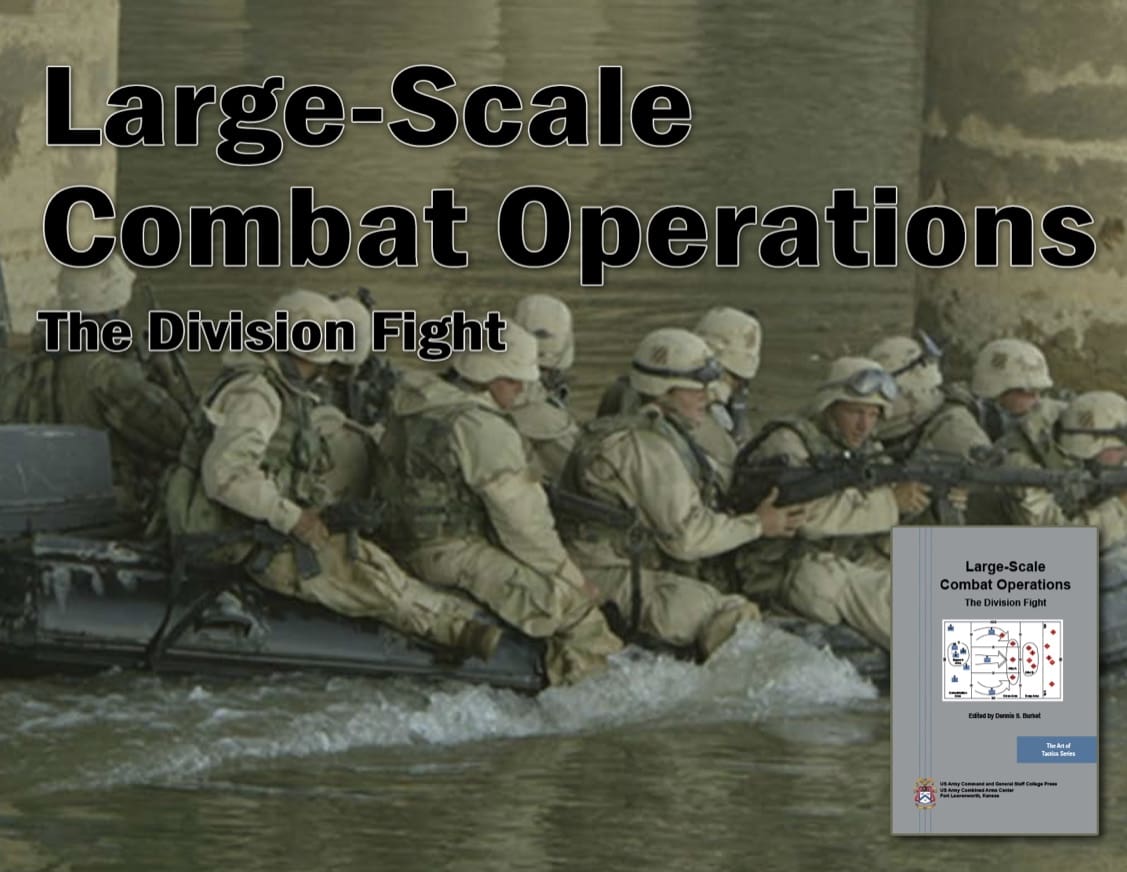
Army University Press – Large Scale Combat Operations

Sunday, December 1st, 2019

This new compendium is the first volume in the Art of Tactics series, sponsored by the Department of Army Tactics, US Army Command and General Staff College. This collection examines various aspects of division-level operations, to include Fires, Wet Gap Crossings, and Consolidating Gains, as part of the Army’s effort to refocus the force on large-scale combat against near peer and peer adversaries.

Download your copy here.

Infantry Officer Achieves Perfect Score, “True Blue” Status In EIB Competition

Sunday, November 17th, 2019

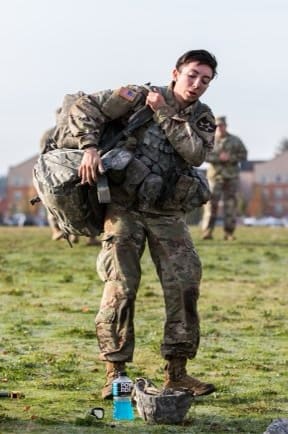
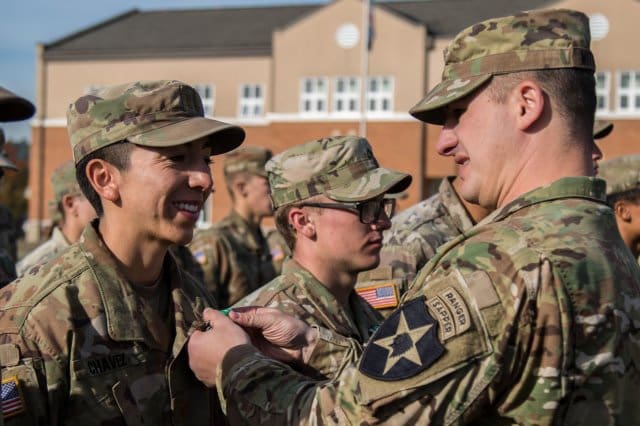
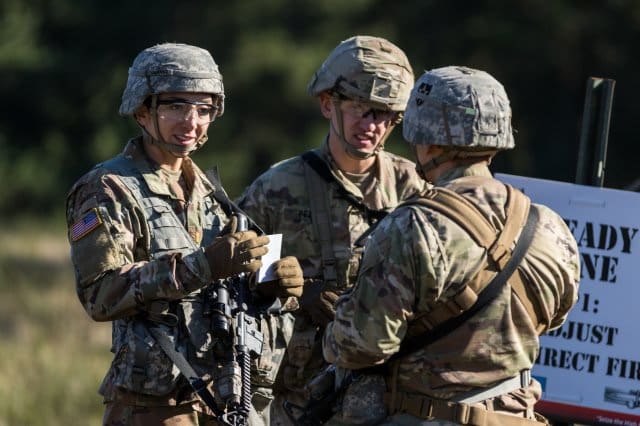
JOINT BASE LEWIS-MCCHORD, Wash. — “I was so nervous in the morning,” said 2nd Lt. Elena Chavez, shaking her head. “You train for an entire month, so you don’t want to mess it up in the final hours.”

Chavez, an infantry officer from Kansas City, Missouri, assigned to Charlie Company, 1st Battalion, 17th Infantry Regiment, 2nd Stryker Brigade Combat Team, 2nd Infantry Division, had spent the last four weeks training and testing for her Expert Infantryman Badge.

Now, as she approached the morning’s final two events for 2-2’s EIB testing, it wasn’t just her badge on the line – it was also her perfect score and coveted status as “True Blue.”

“It really had to be right on – everything had to be perfect, the stars had to align,” Chavez said. “It’s the small things that get people on the lanes.”

During the three weeks of train-up, her squad was one of the first out on the lanes and last to leave, drilling through the rain and cold to ensure they had each task down.

It was through working as a squad that Chavez had come so far, a fact she kept in mind going into the final 12-mile road march and weapons disassembly and functions check.

“We’re Buffaloes – we’re a herd and we keep each other accountable,” she said. “I got out there and saw my guys and it was just like any other day when we were training. I lost all my nerves, gained my composure, and it was just another day.”

All those days of training certainly paid off, as Chavez soared through the morning’s final events, earning her EIB and an Army Commendation Medal for clearing all 34 EIB events with a perfect score and achieving “True Blue” status.

Of the 151 infantry Soldiers earning their EIB, only 59 were designated as a “True Blue.” Chavez was one of two female infantry Soldiers to earn the coveted status, along with 1-17 Inf. Reg.’s 2nd Lt. Natalie Bulick-Sullivan.

Sgt. Tracker Sines, Chavez’s squad leader, knew that getting out on the lanes and drilling together would prove instrumental for his young team’s success during testing week.

“I wanted them to train as much as possible, but not burn themselves out,” Sines said. “It’s as simple as going back, going over it again and again. Having your peers watch you, having (your squad leader) watch you, training each other, walking somebody else through the task and reinforcing what you know – that’s a big thing.”

Sines felt confident that Chavez was “True Blue” material after watching her in the weeks leading up to testing.

“She doesn’t waste her time out here,” he said. “She has her own system of talking herself through it. Whatever she needs to do to help learn it.”

2nd Lt. Benjamin Hinkle, Chavez’s squad mate who also earned his EIB, agreed.

“She’s definitely been the workhorse of the group,” Hinkle said. “She arrived straight after NTC, was assigned a platoon, and then came straight here for her EIB.”

Chavez said now that the EIB is done, she looks forward to getting back to her platoon and getting to know them better.

“I’ve learned so much by training and participating, and can take it all back to my Soldiers,” she said.

It might be a bit before she gets the chance, though.

“I’ll be leaving on Wednesday for Yakima Training Center,” she said, shaking her head and laughing. “I’m really going to try to enjoy this weekend.”

By Spc. John Weaver

First US Navy Warrant Officer 1 Grads in Decades Hailed at LDO/CWO Academy

Tuesday, November 5th, 2019

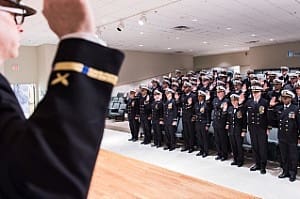
NEWPORT, R.I. (Nov. 1, 2019) (NNS) — The first eight Navy warrant officer 1 (WO1) Sailors in decades graduated from the Limited Duty Officer/Chief Warrant Officer (LDO/CWO) Academy at Officer Training Command, Newport (OTCN), Nov. 1.

The new warrant officers are Benjamin Nichols, Jonathon Wynn, Brent Gray, Ryan Snyder, Devan Sorenson, Nicholas Drenning, Kevin Koller, and Brian Ruzin.

“I’m enthusiastic for this new program because we can pave the way for the future of the Navy’s cyberwarfare efforts,” said Warrant Officer Devan T. Sorenson, from Bozeman, Montana. “The unique world of this career field is modeled like a meritocracy where it is a collaborative environment to be effective. The evolution of technology outpaces the training so it is important to stay current.”

“Our expertise comes from the enlisted ranks and we can better assist officers to make those necessary decisions through our experience,” said Warrant Officer Ryan C. Snyder, from Hollis, New Hampshire. “It is essential to be innovative and always strive to be the subject matter experts in this fast-paced field of cyberwarfare.”

The LDO/CWO Academy is a four-week course designed to prepare these prior enlisted Sailors for their new roles in the wardroom per the Navy’s Officer Professional Core Competencies. The class officers at the schoolhouse develop these newly commissioned officers morally, mentally, and physically, and imbue them with the highest ideals of honor, courage, and commitment in order to prepare them for the Fleet. Additionally, the academy will prepare these officers to become effective leaders by developing fundamental skills in leadership, written and oral communication, career management and administration.

“The new WO1 program opens up more advancement and designator opportunities,” said Cmdr. Zeverick L. Butts, the Director of the LDO/CWO Academy. “These new students bring unique skillsets and perspectives, increasing the dynamic interaction in the classroom for problem solving.”

The eight WO1s along with the 45 LDOs and CWOs of class 20010 graduated during a ceremony on Nov. 1, 2019. Graduates of this academy, nicknamed “Mustang University,” will join the LDO/CWO community to support the war-fighting capability and readiness of Naval Forces through leadership, technical proficiency and experience.

NAVADMIN 140/18 announced the implementation of the WO1 pay grade (W-1) for cyber warrant officers, and solicited applications for the FY-19 and FY-20 WO1 Cyber Warrant Selection Boards, the first since 1975. The rank was reinstated through the Cyber Warrant Officer In-Service Procurement Selection Board as the result of increasing threat of cyberwarfare on the modern battlefield. To be eligible, E5 and above applicants must be in the Cryptologic Technician Networks (CTN) rating, possess at least one of the following Interactive On-Net (ION) Operator naval enlisted classifications (NEC): H13A, H14A, H15A, or H16A, and meet time-in-service requirements.

Officers appointed as cyber WO1 incur a six-year service obligation from the date of appointment, shall serve a minimum time in grade of 3 years and must complete a minimum of 12 years of time in service prior to promotion and commissioning to Chief Warrant Officer 2.

The distinctive insignia worn on the WO1 cover of two cross-fouled anchors makes them easily recognizable in place of the traditional officer badge worn by other Naval Officers.

Headquartered in Newport, Rhode Island, OTCN oversees Officer Candidate School, Officer Development School and Limited Duty Officer/Chief Warrant Officer Academy.

Get more information about the Navy from US Navy facebook or twitter.

For more news from Naval Service Training Command, visit www.navy.mil/local/greatlakes

Story by Lt Cdr Frederick Martin, Naval Service Training Command Public Affairs

Photo by Darwin Lam

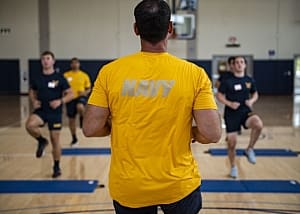
Hawaii-based Sailors Test Changes During Physical Fitness Assessment Study

Thursday, October 31st, 2019

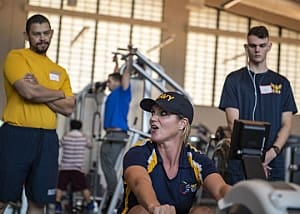
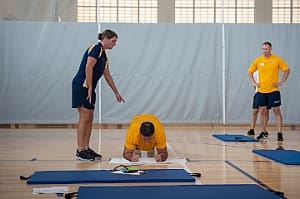
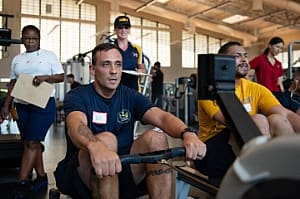
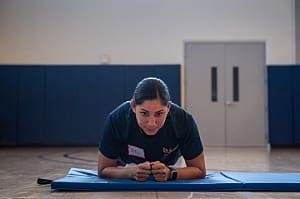
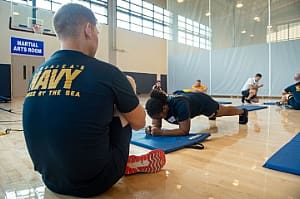
PEARL HARBOR, Hawaii (NNS) — Ladies and gentlemen, it’s that time of the year again: physical fitness assessment season. As we’re surrounded by the unwavering dedication of command fitness leaders and the Sailors within each command, one can’t help but get in to the fitness spirit. On May 29, the former Chief of Naval Operations Adm. John Richardson visited Joint Base Pearl Harbor-Hickam and announced the addition of the 2-kilometer row cardio option and forearm plank that will replace the curl-up. On Oct. 7, Sailors gathered in the fitness center on base to commence the testing of the new workout metrics.

The study consisted of three different days of exercise. Day one focused on introducing Sailors to the 2-kilometer row, practicing the correct rowing technique. On day two, the Sailors performed pushups, the forearm plank and the 12-minute bike assessment. Day three focused on pushups, the forearm plank and the second trial of the 2-kilometer row. A big focus during this study was how Sailors perform the new plank as opposed to the curl-ups.

“The plank allows you to build that core strength,” said Lt. Cmdr. Melissa Laird, the work sponsor of the study from the 21st Century Sailor office. “It’s really a better test and better modality to assess that core strength than the curl-up is. It works on giving you good posture and it also has less chance of aggravating low back injuries which you can see with the curl-up.”

Laird also said that adopting a new form of cardio within the PFA allows Sailors an alternative to the standard 1.5-mile run. The rower uses approximately 70 percent of the body’s musculature so it provides a good cardiovascular workout that is low impact.

Sailors representing multiple commands volunteered to be the test subjects for this study. A seamless transition into adopting these two modalities for the PFA in the year 2020 is the end goal according to Laird.

Mr. Jay Heaney, a research physiologist from the Naval Health Research Center and the principle investigator for the study, explained the process of gathering the information from the Sailors’ performance and how it will be applied to the new PFA.

“We try to get as many people as we can within the age groups by gender,” said Heaney. “Then we look for what the norms are; what the high, medium and low scores are. From that, we will develop what the scoring metrics are for the different categories of the PFA.”

Heaney said that the Navy is trying to put a bigger emphasis on physical fitness as ship-based Sailors are required to climb ladder ways and do a lot of heavy lifting throughout their workday.

“I volunteered because I wanted to see what the new PFA would look like,” said Cryptologic Technician (Interpretive) 3rd Class Amanda Zwiebel. “Not only to prepare myself but to prepare my peers and my command.”

According to Heaney, at the end of the day, it is important that our service members have complete physical readiness. The addition of two new workouts to the PFA helps the U.S. Navy move in the right direction.


By Mass Communication Specialist Seaman Aja Bleu Jackson, NPASE West det. Hawaii Public Affairs

US Air Force Announces Criteria for New Remote Combat Effects Campaign Medal

Monday, October 28th, 2019

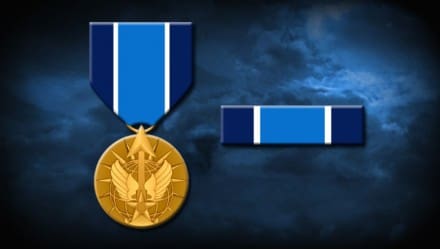
US Air Force Remote Combat Effects Campaign Medal

WASHINGTON (AFNS) —
Air Force officials announced nomination criteria for the new Remote Combat Effects Campaign Medal following the official establishment of the decoration May 22.

The new medal, established by then-Secretary of the Air Force Heather Wilson, is part of a continuing effort to recognize U.S. Air Force military members in a non-deployed status who directly participated in a Department of Defense combat operation from a remote location.

“Our remote operations community makes vital contributions to our national security and the security of our allies,” said Air Force Chief of Staff Gen. David L. Goldfein. “These Airmen play a crucial role in every campaign we undertake, and this medal is for them.”

The RCECM will be awarded to Airmen serving in remotely piloted aircraft, cyber, space and intelligence, surveillance and reconnaissance career fields, who create direct combat effects from remote locations and lead to strategic outcomes or the delivery of lethal force. In some circumstances, Airmen from other career fields may be considered for the RCECM, which will be considered on a case-by-case basis.

Service members may be awarded the RCECM for actions completed on or after Sept. 11, 2001, while also serving under the following conditions:
1) Was assigned or attached to a unit directly in support of a DoD combat operation as approved by the chief of staff of the Air Force (listed below)
2) Was serving in a remotely piloted aircraft; cyber; space or intelligence, surveillance and reconnaissance career field
3) Personally provided hands-on employment of a weapon system that has direct and immediate impact on combat operations
4) Was not physically exposed to hostile actions or at risk of exposure to hostile action

Qualifying DoD combat operations:
• Enduring Freedom, Sept. 11, 2001 – to be determined
• Iraqi Freedom, March 29, 2003 – Aug. 31, 2010
• New Dawn, Sept. 1, 2010 – Dec. 31, 2011
• Nomad Shadow, Nov. 5, 2007 – TBD
• Freedom’s Sentinel, Jan. 1, 2015 – TBD
• Inherent Resolve, June 15, 2014 – TBD
• Odyssey Lightning, Aug. 1, 2016 – Dec. 19, 2016
• Pacific Eagle – Philippines, Oct. 5, 2017 – TBD

Airmen who have received a DoD or Air Force campaign or expeditionary medal or ribbon for the same period of service are not eligible to receive the RCECM.

For more information and full eligibility criteria or submission procedures, visit myPers at mypers.af.mil and enter “RCECM” in the search window. A fact sheet and graphic is also available on the Air Force’s Personnel Center website.

Secretary of the Air Force Public Affairs

TacJobs – Navy Information Warfare

Sunday, October 27th, 2019

First Soldiers Awarded Expert Soldier Badge

Saturday, October 19th, 2019

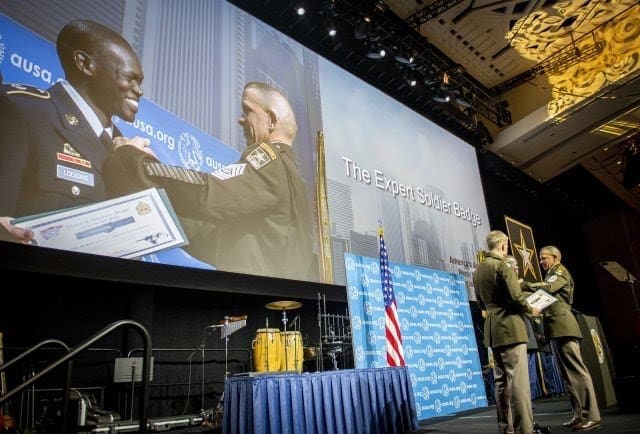
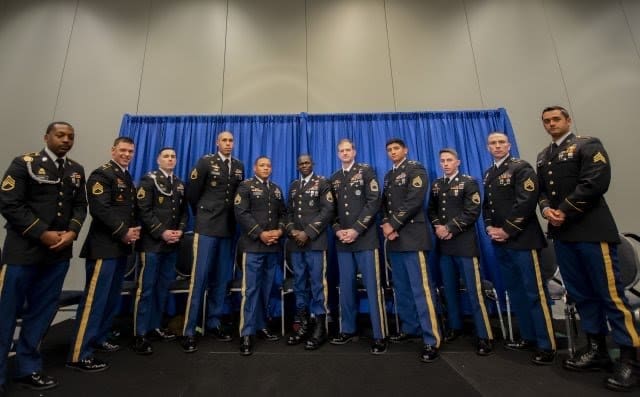
WASHINGTON — Eleven top-performing Soldiers from around the Army came together Tuesday to receive the Army’s first-ever Expert Soldier Badges.

Army Chief of Staff Gen. James C. McConville made the presentation during the Eisenhower Luncheon at the Association of the U.S. Army’s Annual Meeting and Exposition.

“I’m really proud of what these Soldiers have accomplished,” Sgt. Maj. of the Army Michael A. Grinston said. “At the time, the [ESB] was a new challenge not only for them but for the Army. These 11 individuals can now proudly wear a badge that firmly recognizes them as experts in their profession, something all Soldiers should strive to be.”

Announced on the Army’s 244th birthday in June, the ESB is a proficiency badge designed to recognize a Soldier’s lethality outside of the infantry, by measuring their “mastery of physical fitness, marksmanship, and other critical Soldering skills necessary for combat readiness,” said Sgt. 1st Class Dennis Moore, the badge’s noncommissioned officer in charge at the Army Center for Initial Military Training.

“[The ESB] recognizes the next generation of competent, committed leaders who thrive in chaos, adapt, and win in a complex world,” said Master Sgt. Norbert Neumeyer, a U.S. Forces Command master gunner who oversaw the first ESB test.

In April 2017, 56 Soldiers were selected from FORSCOM units across the Army during the pilot phase of testing. Of those who tested, 12 passed, making the pass-fail rate on par with the Expert Infantryman Badge and Expert Field Medical Badge.

Spc. Mahrubius Ledford, released from active duty March 2019 , was unable to attend Tuesday’s ceremony.

For Staff Sgt. Tyler Lewis, a field artillery firefinder radar operator out of Fort Bliss, Texas, earning the ESB “represents all aspects of being a Soldier,” he said.

“Being a Soldier means being a tactical and technical expert from the level of basic Soldiering skills to the advanced levels of your [military occupational specialty],” he said. “A Soldier learns to be adaptable, disciplined, and master and steward of his or her profession in every situation.”

SHARPEN YOUR SOLDIERING SKILLS

For Sgt. Michael Ostrander, armament shop noncommissioned officer at Joint Base Lewis-McChord, Washington, he said he had to touch up his land navigation skills in order to earn his ESB.

The small arms repairmen said he relied on the Soldering skills he learned during basic combat training and throughout his military career during the test. He also suggested Soldiers planning to test for the badge “brush up on things they’re rusty on.”

For many Soldiers, the ESB tasks may seem like “common ones that have been taught before,” Lewis said. But, “[Soldiers] need to ensure that their knowledge is accurate to each standard tested. Practicing each skill until it becomes second nature is the key to success.”

Staff Sgt. Mike Mata, joint fire support specialist at Fort Sill, Oklahoma, echoed his fellow recipients when he credited “hands-on training and mock repetitions” to earning the ESB.

“It’s important to remember that testing is intended to be rigorous, mission-focused, and conducted under realistic conditions,” Neumeyer said.

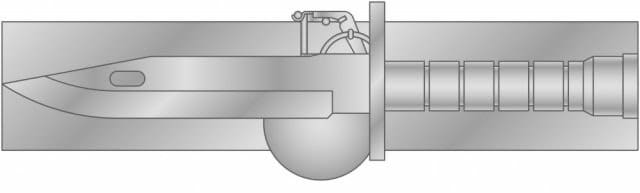
The new skill badge is an equivalent of the EIB and the EFMB. It’s nearly a spitting image of the Combat Action Badge, minus the wreath. The badge displays the same M9 bayonet knife and M67 frag grenade inlaid against a solid, gray rectangular bar.

The test includes various commander-selected tasks essential to their respective units, like how to respond to an improvised explosive device attack, forging fighting positions, finding Soldiers in a tactical environment, and how to mark chemical, biological, radiological, and nuclear-contaminated areas. Other tasks include a day and night land navigation test, a 12-mile ruck march, and a series of individual assessments.

The test also contains a variety of events, sharing roughly 80% of the tasks in the EIB and EFMB, and takes five days for Soldiers to complete. Standards for the test will not be adjusted based on age, gender, or any other criteria.

“The [ESB] will increase overall readiness and lethality, and the first recipients are among the top-qualified Soldiers in the Army,” Moore said.

To qualify, Soldiers must first pass the new Army Combat Fitness Test, slated to be the official fitness test for the Army by October 2020. Soldiers must also qualify as expert on the M16 or M4 and be recommended by their chain of command.

“The ESB gives units a baseline and ability to measure their Soldiers’ physical fitness,” Neumeyer said. “It also ensures Soldiers perform to standard all the critical tasks they’re supposed to have knowledge of, and measures their abilities to an expert level.”

Grinston said today’s awards are only the beginning for the Expert Soldier Badge, adding it will increase readiness and Soldier lethality across the force.

“We have ESB testing that will be underway later this month at Joint Base Lewis-McChord and next month at Fort Eustis,” Grinston said. “I look forward to seeing the results. This is a truly challenging badge to earn with training along the way that will help better prepare our Soldiers for combat.”

The first-ever recipients of the ESB include:

Staff Sgt. Joseph Alcorn, Joint Base Lewis-McChord, Washington

Staff Sgt. Freeman Harris, U.S. Army Garrison Stuttgart, Germany

Sgt. 1st Class Christopher Harvey, Joint Base Lewis-McChord, Washington

Staff Sgt. Thomas Jacobsen, U.S. Army Recruiting Office, Gretna, Louisiana

Staff Sgt. Tyler Lewis, Fort Bliss, Texas

Staff Sgt. Anthony Lodiong, Fort Bliss, Texas

Staff Sgt. Julio Macias, Fort Campbell, Kentucky

Staff Sgt. Mike Mata, Fort Sill, Oklahoma

Staff Sgt. Evan Neilson, Fort Jackson, South Carolina

Sgt. Michael Ostrander, Joint Base Lewis-McChord, Washington

Staff Sgt. Bradley Sherman, Fort Benning, Georgia

Spc. Mahrubius Ledford, released from active duty March 2019

By Thomas Brading, Army News Service