FirstSpear

Archive for the ‘Robotics’ Category

Sigma Defense Announces Sponsorship and Technical Partnership for GEAR Lab Grand Opening at Museum of Aviation

Monday, May 11th, 2026

WARNER ROBINS, Ga., May 7, 2026 — Sigma Defense is proud to announce its sponsorship and technical partnership supporting the grand opening of the Georgia Engineering, AI & Robotics (GEAR) Lab at the Museum of Aviation in Warner Robins, Georgia. The GEAR Lab is a cutting-edge, hands-on innovation space designed to inspire the next generation of engineers, programmers, and problem-solvers by connecting classroom learning with real-world applications.

The GEAR Lab integrates artificial intelligence, robotics, and advanced engineering concepts into interactive experiences that provide students and visitors with direct exposure to emerging technologies shaping the future. Through partnerships with leading universities across Georgia, the lab will serve as a hub for collaboration, workforce development, and STEM engagement across the region.

“Sigma Defense is proud to be a sponsor and technical partner for the GEAR Lab at the Museum of Aviation,” said Scott Ritchie, Co-Founder of Sigma Defense and Executive Vice President of the Sigma Integrated Solutions Division. “Since 2006, we have been part of the Warner Robins community, developing and deploying leading-edge C5ISR and CJADC2 solutions for the Department of War. We are grateful for the opportunity to invest in the next generation of the STEM workforce and to continue supporting innovation in Middle Georgia.”

Over the past six months, Sigma Defense has collaborated closely with the Museum of Aviation Foundation’s IT team to support development of an AI-enabled technology platform for students, educators, and local businesses. Through hardware donations and systems integration expertise, Sigma Defense has helped establish a modern, on-premise capability that serves as a foundation for ethical AI education and hands-on technical learning.

In addition to its technical contributions, Sigma Defense serves on the GEAR Lab advisory committee, helping guide the facility’s mission as an engineering launchpad for high school students and future innovators.

“The GEAR Lab represents the kind of forward-looking investment required to prepare students for the demands of tomorrow’s workforce,” said Ritchie. “By bringing together education, technology, and community, this initiative reflects a shared commitment to innovation and long-term impact.”

Sigma Defense’s involvement underscores its broader commitment to advancing innovation – not only in support of national defense, but also through meaningful investment in the communities where its employees live and work.

FlyTrap 5.0 Puts Emerging Tech in Warfighters’ Hands

Tuesday, May 5th, 2026

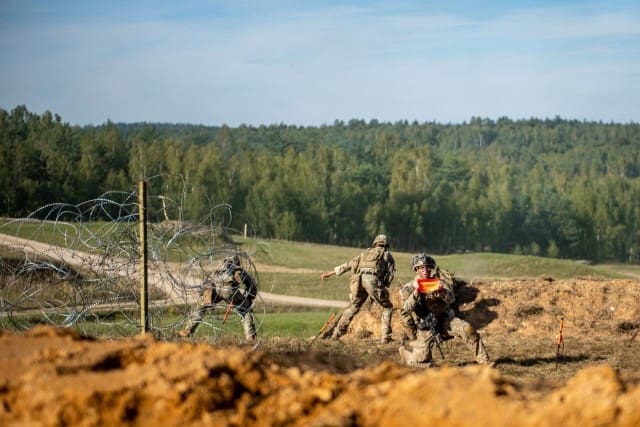
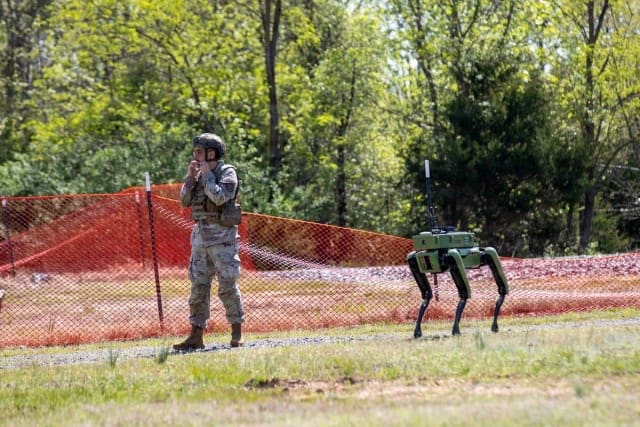
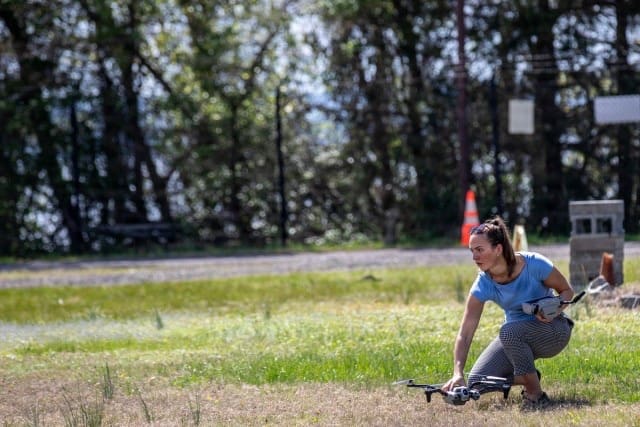
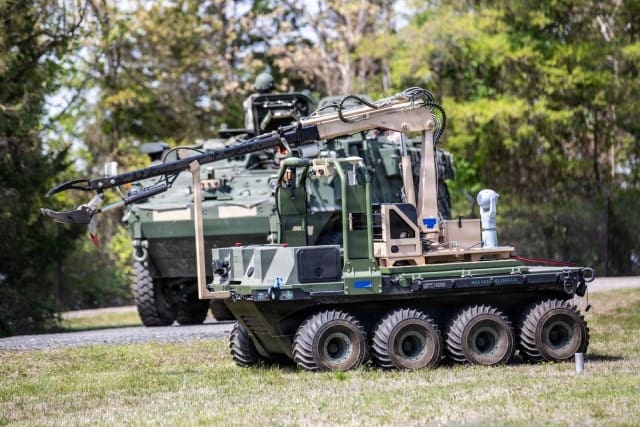
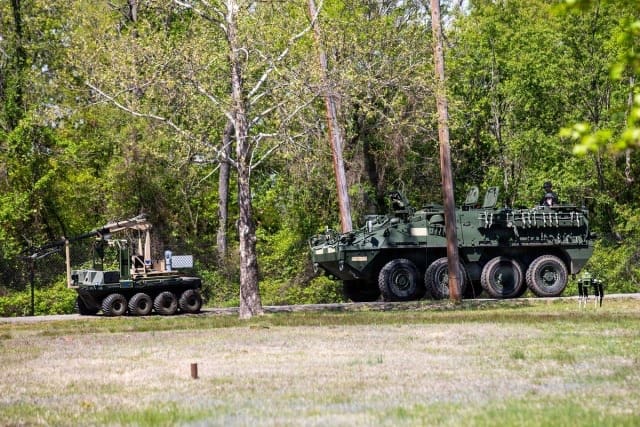
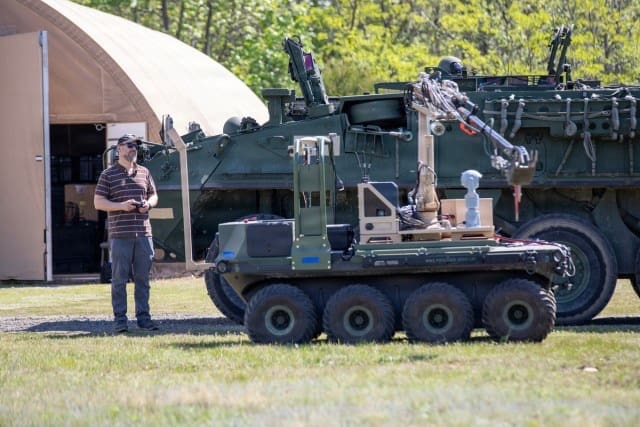
PABRAD? TRAINING AREA, Lithuania – U.S. infantry Soldiers from the 2nd Cavalry Regiment and paratroopers from the U.K. Parachute Regiment prepare for the force-on-force phase of Project FlyTrap 5.0 at Pabrad? Training Area, Lithuania, May 2. FlyTrap 5.0 integrates autonomous and unmanned ground vehicles, first-person view drones and counter-unmanned aerial systems on the simulated battlefield.

The day marked the third consecutive day of preparation and system integration for the exercise, which included an exercise briefing attended by U.S. Soldiers and U.K. paratroopers participating in the force-on-force portion of FlyTrap 5.0. Soldiers spent the remainder of the day conducting drone familiarization, operating unmanned ground vehicles and rehearsing C-UAS procedures in preparation for the upcoming engagement.

Among those preparing was Spc. Arthur Tugman, an infantryman assigned to 1st Squadron, 2nd Cavalry Regiment, who has taken on the role of unmanned ground vehicle operator for the exercise, a mission set outside his traditional infantry duties.

“My role in FlyTrap 5.0 is to serve as an unmanned ground vehicle operator, where I operate various unmanned ground vehicle platforms to transport equipment, Soldiers, unmanned aerial systems and counter-unmanned aerial systems to wherever they are needed,” Tugman said.

The integration of infantry Soldiers into UGV operations reflects a broader theme running through FlyTrap 5.0; placing emerging technology directly in the hands of warfighters regardless of their primary specialty, and using their feedback to drive rapid improvements across the force. FlyTrap 5.0 hopes to organically assimilate these new duties to Soldiers already assigned to units.

Tugman said the speed at which his unit has been able to absorb and operate the new systems has been one of the more surprising aspects of the exercise.

“Something I learned that I didn’t expect was how fast the United States Army is able to integrate new systems into warfighting tactics,” he said. “I’d say this equipment is very easy to use. I’m able to pick it up, turn it on, and send it wherever it needs to go, as far as it needs to go, as fast as it needs to go.”

That ease of use, Tugman said, has direct implications for how the soldiers could employ these systems at scale across the force.

“If all our technology works the way it’s supposed to, we will preserve manpower as well as accomplish the mission faster and more effectively,” he said.

For Tugman, the measure of success extends beyond the exercise itself. He described his goal as helping establish repeatable, standardized procedures for integrating C-UAS and UGV capabilities into 2nd Cavalry Regiment’s formations; procedures he hopes will eventually be adopted Army-wide.

U.S. and Allied forces conduct Project Fly Trap 5.0 as part of a series of linked exercises, including Sword, Saber Strike, Immediate Response, and Swift Response, which transform experimentation into capability. During Flytrap, Soldiers integrate counter-unmanned systems, AI-enabled command and control, and live data networks to move faster, decide faster, and fight more effectively across all domains.

Story by SGT Max Elliott

196th Mobile Public Affairs Detachment

Rheinmetall Kraken GmbH Launches Series Production of Maritime Unmanned Systems in Hamburg

Friday, April 24th, 2026

Series production of the Kraken K3 Scout has begun at Rheinmetall’s Blohm+Voss site in Hamburg. With the market-ready unmanned surface vessel (USV), Rheinmetall’s new Naval Systems division—together with its British joint venture partner Kraken Technology Group—offers a surface platform for both military and civilian applications. Depending on the configuration, the vessels can be used for maritime surveillance, protection of critical infrastructure, or as weapons carriers in military operations. 

The joint venture established last year between Rheinmetall Naval Systems and the British tech company Kraken Technology Group will now operate under the name “Rheinmetall Kraken GmbH.” The partnership addresses the growing global demand for market-available unmanned platforms of various sizes.

Production of the systems—which are capable of speeds of up to 55 knots, measure 8.4 metres in length, and are individually configurable—takes place at Rheinmetall’s shipyard Blohm+Voss in Hamburg, a site that the Düsseldorf-based company is developing into Germany’s leading test and technology centre for unmanned and autonomous marine systems.

“Production of the Kraken K3 Scout is initially designed for around 200 units per year. Depending on the order volume, we can scale up production to as many as 1,000 units annually,” says Tim Wagner, CEO of Rheinmetall’s Naval Systems division. With five locations in Germany, the Naval Systems division specialises in the construction of complex naval and coast guard vessels and is a pioneer in the development of unmanned and autonomous surface systems.

Mal Crease, CEO of Kraken Technology Group said: “The formation of Rheinmetall Kraken GmbH combines the scale, expertise and reach of a longstanding defence leader with an agile, innovative maritime technology company.  This will ensure that production of Kraken’s K3 Scout can scale to meet exponentially growing operational requirements.”

Kraken Technology Group develops high-performance and cost-efficient unmanned maritime systems. Through the joint venture, they benefit from the extensive production and integration capabilities of the Rheinmetall Naval Systems division.

US Army Seeks Unmanned Ground Vehicle for “Last Tactical Mile”

Thursday, April 23rd, 2026

Researching for a presentation I gave last summer at the National Defense Industrial Association Future Forces Conferences on robotics and drones I realized that while the US Army is working diligently to field drones in large numbers, it’s just a drop in the bucket once they figure out how many ground robotic systems they’ll need. To illustrate my point I explained that at the time, the US Army had an inventory of around 3,900 aircraft and 700 enduring capability drones. Meanwhile, there were ~420,000 ground vehicles making it about 11:1 ground to air systems. I expect we’ll see a similar ratio of ground to air robotics once the capability fully settles into the enterprise and those ground robots will take many forms and perform many duties. This capability is just the beginning.

According to a Special Notice released last week, Capability Program Executive (CPE) Mission Autonomy is actively pursuing a UGV designed to autonomously support maneuver formations in the critical “last tactical mile”. This advanced UGV, owned by maneuver formations, will both sustain Platoon and Company formations by delivering essential supplies/energy and will evacuate wounded personnel from the point of injury to a casualty collection point. This dual use UGV shall feature a configurable payload to meet the dynamic needs of maneuver formations.

The UGV must be capable of teleoperation, autonomous navigation, and beyond-line-of-sight communications, and execute resupply and CASEVAC missions with minimal reconfiguration.

The modern battlefield is characterized by persistent enemy surveillance and rapid application of lethal effects at and behind the forward line of troops (FLOT), making any movement to and from the FLOT highly vulnerable. This environment challenges commanders’ ability to resupply units and evacuate casualties. The Army refers to the critical distance between the FLOT and supported units as the “Last Tactical Mile” – the final segment of ground over which supplies, equipment, or personnel must be moved under the greatest threat from enemy observation and fires. This phase is often the most dangerous and logistically complex, requiring innovative solutions to ensure mission success and force protection.

The UGV should be capable of supporting the sustainment needs of a dismounted Rifle Platoon or Company Headquarters for extended operations (reference ATP 5-0.2-1 Staff Reference Guide Volume 1, Unclassified, for Battalion weight needs). It should be able to transport various classes of supply and operate autonomously across diverse terrains and environments, maintaining reliable communications with supported units. The UGV should be able to navigate both on- and off-road routes, including areas without GPS, and support situational awareness. It should minimize detectable signatures and emissions during operations, including in the final approach to supported units.

The UGV should be capable of being reconfigured by the maneuver unit for multiple roles, including casualty evacuation. It should be able to autonomously transport at least two (2) casualties from the point of injury to a designated collection point, without causing additional harm to the patient. The cargo area should be modular and provide accessible power and data connections.

The UGV must support integration and collaboration within networked operational environments and be interoperable with current and future command and control systems. The solution must provide open and exposed APIs for integration with common control and mission autonomy applications.

Interested parties have until 28 April to respond. Learn more at www.sam.gov

Photo above: A Hunter Wolf unmanned ground vehicle assigned to Charlie Battery, 3rd Battalion, 320th Field Artillery Regiment, 3rd Mobile Brigade, 101st Airborne Division (Air Assault), holds a steady overwatch position with a mounted remote operated .50-caliber machine gun during a combat simulation exercise at the Joint Readiness Training Center, Fort Polk, Louisiana, April 13, 2026. (US Army photo by MSG Anthony Hewitt)

Milrem Robotics and PGZ Sign MoU to Strengthen Estonian–Polish Defence Industry Cooperation

Friday, March 20th, 2026

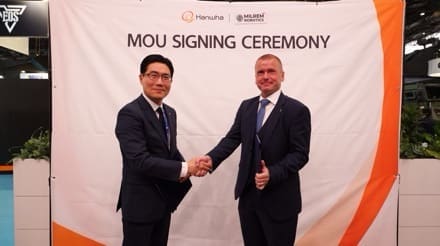
Milrem Robotics, the world’s leading developer of robotics and autonomous systems, and Polska Grupa Zbrojeniowa (PGZ), Poland’s largest defence industry group, have signed a Memorandum of Understanding (MoU) to explore potential areas of collaboration and bolster strategic defence relations between Estonia, Poland, and Central & Eastern Europe.

Under the agreement, Milrem Robotics and PGZ will work together to accelerate the development of advanced defence technologies by leveraging each other’s expertise, industrial capabilities, and technological resources. One focus area includes payload integration on unmanned ground vehicles (UGVs), supporting the rapid adaptation of innovative systems to meet evolving operational requirements.  The cooperation will also explore integrating Milrem Robotics’ autonomous technologies into PGZ’s vehicles, further enhancing the capabilities of next-generation defence platforms.

The MoU also serves as a foundation for future detailed agreements covering research and development, production, deliveries, services, and overhauls.

“By combining Milrem Robotics’ leadership in autonomous ground systems with PGZ’s extensive manufacturing base and defence portfolio, we aim to foster innovation, enhance interoperability, and strengthen regional security capabilities,” said Kuldar Väärsi, CEO of Milrem Robotics.

Milrem Robotics Poland Managing Director Marcin Sobieraj added: “By joining forces with PGZ, we can accelerate the development and integration of advanced unmanned systems to better serve allied armed forces.”

Marcin Idzik, Vice President of PGZ added: “Collaboration with Milrem Robotics opens new opportunities for advancing innovative unmanned solutions within Poland’s defence ecosystem. Together, we aim to strengthen our industrial base and deliver cutting-edge capabilities to meet current and future defence challenges.”

The MoU reflects the shared commitment of both organisations to contribute to European defence innovation, industrial resilience, and closer cross-border cooperation.

US Army Activates CPE Mission Autonomy

Monday, March 16th, 2026

FORT BELVOIR, Va. – Last month the Army officially activated the Capability Program Executive Office for Mission Autonomy, in a ceremony at the U.S. Army National Museum. Presiding over the ceremony was the Portfolio Acquisition Executive for Maneuver Air, Maj. Gen. Clair Gill.

Gill kicked off the event by remarking on the newly established CPE Mission Autonomy’s mission and its eventual impact across the Army.

“CPE Mission Autonomy is working to revolutionize U.S. Army operations, and by extension the very art of maneuver,” said Gill. “Teams from across the CPE are set to work with every portfolio in our Army.”

CPE Mission Autonomy is preparing to transform military operations by developing interconnected unmanned systems that can operate autonomously. Gill went on to discuss the benefits of developing autonomous platforms and the potential to revolutionize planning tools, ground vehicles, and unmanned systems, among others.

“The technological advancement created by CPE Mission Autonomy will impact the life of every soldier and provide our Army with a much-needed edge in the future fight,” said Gill.

Taking the helm of CPE Mission Autonomy is Brig. Gen. Anthony Gibbs, who is tasked with leading the organization into a future where the global battlefield is rapidly shifting.

“We are living in a time of unprecedented technological change where the character of warfare is changing right before our eyes,” said Gibbs. “To maintain our edge, we must not only keep pace but set the pace. This organization is our commitment to doing just that.”

Gibbs also emphasized the organization’s commitment to taking care of the Army’s number one resource – the men and women that make up its force.

“Ultimately, our mission is about one person – and that’s the American Soldier – the centerpiece of what we do,” said Gibbs.

As the centerpiece of what CPE Mission Autonomy does, a primary goal is to take soldiers out of harm’s way when possible and help them be a more effective force on the battlefield. Gibbs highlighted

multiple situations for which the CPE is looking at applying autonomous platforms, such as conducting reconnaissance, delivering smoke, and cueing suppressive fires in support of a fully autonomous breaching operation.

“We envision a future where these operations could be done without the humans in those dangerous situations,” said Gibbs. “Our aim is not to replace them but to empower them. It’s about reducing their cognitive load and providing them with force-multiplying capabilities that allow them to dominate any adversary on any battlefield.”

To provide our Soldiers with overmatch to dominate on the battlefield, the delivery of cutting-edge technologies and capabilities must accelerate. This is where partnerships with industry will prove vital, as the Army aims to revolutionize and streamline the acquisition process.

One example of this partnership on display is the upcoming CPE Mission Autonomy Industry Day. Held in Arlington, Va, this event allows industry leaders and Army stakeholders an opportunity to foster collaboration and innovation. Click here for more information on this event.

By Ashley John

Strategic Acquisition in the Field of Uncrewed and Autonomous Systems: Rheinmetall to Gain Majority Stake in DOK-ING

Friday, March 6th, 2026

The Düsseldorf-based technology group Rheinmetall is expanding its portfolio with an acquisition in the field of uncrewed systems. Rheinmetall has now signed a contract in Zagreb to buy a majority stake of Croatian uncrewed ground system solution provider DOK-ING. Rheinmetall is acquiring 51% of the company, which was founded in 1991, Vjekoslav Majeti?, the founder and previous sole owner of the company, will retain the remaining shares (49%). Rheinmetall’s entry into DOK-ING is subject to approval by the relevant regulatory authorities. Both parties have agreed not to disclose the purchase price.

Following the completion of the transaction, DOK-ING will continue to operate from its headquarters in Zagreb, with the existing management team remaining in place to ensure strategic continuity and operational stability, an arrangement aligned with and endorsed by Rheinmetall.

In the presence of  Ivan Anuši?, Croatia’s Deputy Prime Minister and Minister of Defence, the contract was signed today by Vjekoslav Majeti?, founder of DOK-ING and the CEO of Rheinmetall’s Vehicle Systems Europe division, Dr Björn Bernhard. 

Dr Björn Bernhard said, “The combination of Rheinmetall’s expertise in tactical vehicles and DOK-ING’s capabilities in uncrewed systems will create a strong market position for us with considerable potential for the future. At the same time, we are establishing a foothold in Croatia, being an EU and NATO member, and we will be gaining access to this highly interesting customer country”.

“Our competence centre for uncrewed and autonomous systems for military applications is now being established in Croatia. With this new set-up, it is our goal to obtain a strong market position in the segment of uncrewed combat support and armoured military engineering systems. We do see the potential for significant growth in this market and believe that we are entering the global market at the proper time with our new products. This is underlined by ongoing and planned procurement projects in many other countries”, as Dr Björn Bernhard continues.

DOK-ING has a strong market position in uncrewed solutions for mine clearance and operations in hazardous and high-risk environments in civil and military domain. Since its foundation, the company has delivered around 500 platforms to customers in over 40 countries. At present, DOK-ING’s mine clearance solutions are highly effective in Ukraine. 

Already in October of 2024, the two companies agreed on a partnership, which initially focussed on jointly developing uncrewed ground systems for mobility, countermobility (mine clearing and laying) and combat support operations. A notable aspect of the partnership between Rheinmetall and DOK-ING is its entirely European origin and value creation. 

These activities are based on DOK-ING’s newly developed Komodo, a modular heavy duty hybrid uncrewed platform, which has a payload capacity of over 8,5 tonnes. Rheinmetall is contributing with various capability modules and equipment kits, including those for direct and indirect fire, mine clearing and laying, autonomous capability and logistics.


Dr Björn Bernhard said: “DOK-ING and Rheinmetall are two leading European suppliers in their very special field, and by joining forces, we can realise challenging projects. Together, we are aiming at setting new standards and hence, pave the way for uncrewed ground systems (UGS) which are ready for mass production and deployment”.

Vjekoslav Majeti?, founder of DOK-ING said: “This partnership with Rheinmetall marks the next phase in DOK-ING’s development. Over more than three decades, we have built strong technological capabilities and established a solid international presence in demanding markets. We have now reached a stage where further value creation and production scaling require a partner with substantial industrial capacity, system integration expertise and global market access“.

„DOK-ING’s development, engineering excellence and core competencies will remain in Croatia. By joining forces with Rheinmetall, we are creating the conditions to expand production capacity, accelerate the development of next-generation uncrewed specialised systems, and strengthen our long-term competitiveness“, Majeti? added. „This strategic step positions DOK-ING for sustainable growth and reinforces Croatia’s role within the European defence and technology landscape.”

In the new constellation, DOK-ING and Rheinmetall plan to develop a variety of solutions for combat and combat support operations. This includes a project for an uncrewed armed support system (known as ‘Wingman’) to be used with battle tanks and infantry fighting vehicles for reconnaissance and fire support purposes. These systems will also be used alongside existing Rheinmetall products, such as the Panther KF51 Main Battle Tank, the Büffel/Buffalo recovery tank, and the Kodiak armoured engineer vehicle.

Rheinmetall AG is an integrated technology group, with its headquarters in Düsseldorf. Founded in 1889, it is a leading international systems house for the defence industry and operates within land, air, sea and space domains. A focus on sustainability is an integral part of Rheinmetall’s strategy. With around 44,000 employees at about 180 sites worldwide, the company has been listed on the DAX 40 since March 2023 and generated sales of €9.8 billion in the 2024 financial year.


DOK-ING is a technology-driven company specialising in the development and manufacture of advanced uncrewed systems designed for operations in hazardous and high-risk environments. Its core portfolio includes remotely operated and progressively autonomous platforms supporting humanitarian and military demining, military engineering operations, CBRN response, and the protection of critical infrastructure. The company’s solutions are based on modular and scalable architectures, enabling rapid mission-specific configuration for mine clearance, IED disposal, route clearance, firefighting, and other complex operational requirements. With a strong commitment to safety, reliability, and operational excellence, DOK-ING delivers field-proven systems that enhance force protection and reduce human exposure to risk, serving armed forces, civil protection authorities, and specialised security operators worldwide.

Robotic Systems Transform Chemical Defense Training, Enhance Capabilities

Tuesday, February 24th, 2026

FORT LEONARD WOOD, Mo. — While man transportable robotic systems, MTRS, aren’t new to the U.S. Army, the way instructors at the Maneuver Support Center of Excellence’s Chemical Defense Training Facility, CDTF, are incorporating the robots into training is transforming the way chemical Soldiers perform site exploration.

According to Master Sgt. Rolando Silguero, CDTF noncommissioned officer in charge, the facility began a three-phase integration process of the man transportable robotic system in the summer of 2025 to professional military education curriculum, specifically the CBRN Senior Leader and Captains Career Courses.

“The primary focus is to include operating procedures as well as tactics, techniques and procedures during actual exploitation operations,” Silguero said.

Soldiers are learning to use the MTRS by remotely deploying it on a fixed site target to detect, identify and in some applications neutralize, weapons of mass destruction materials from a safe distance.

“The MTRS offers stand-off protection to minimize risk to personnel and can carry multiple payloads for detection, including systems for live video and still photography,” Silguero said, and these skills will “increase Soldiers’ lethality and speed in complex, multi-domain operational environments.”

During training on Feb. 4, senior leader course students gathered around a monitor to watch the MTRS make its way through another part of the building. The Soldiers pointed out items as they identified them and noted key information they were gathering via the robot’s camera.

Sgt. 1st Class Dean Barney, CBRN SLC senior small group leader, said his students used the information to create a site sketch to visually organize and consolidate information reported by the MTRS.

“The sketch translates raw observations, such as hazard location, potential contamination and contamination spread, into a clear operation picture that leaders can quickly understand and act on,” Barney said. “This will support faster decision making, accurate reporting and effective follow-on actions, such as isolation, decontamination, maneuver and medical response in a CRBN environment where time and clarity directly impact mission success and troop survival.”

Barney said he was impressed with how his students seamlessly integrated the MTRS into their training.

“It’s a testament to their ingenuity, critical thinking skills and resilience as noncommissioned officers,” Barney said. “Their willingness to learn, problem-solve and push beyond their comfort zones reflects the kind of leadership today’s Army needs.”

According to Silguero, the CDTF has plans to make MTRS training available to other U.S. operational units training at the facility.

“As the global leader in live chemical agent warfare training, the CDTF is committed to the cutting edge of training realism by providing the highest quality, most immersive and exceptionally challenging training capability replicated nowhere else in the world,” Silguero said.

By Melissa Buckley, Fort Leonard Wood Public Affairs Office