Circle Dog Productions has released this unofficial look at the proposed changes to the Army rifle qualification. It is a challenging course of fire. Don’t be caught unaware. This may take effect as early as this summer.


Circle Dog Productions has released this unofficial look at the proposed changes to the Army rifle qualification. It is a challenging course of fire. Don’t be caught unaware. This may take effect as early as this summer.
MARINE CORPS AIR STATION NEW RIVER, N.C. – Every Marine is a rifleman but soldiers stole the shooting awards from recent students of the Scout Sniper Course 1-18 who graduated at Camp Geiger on Marine Corps Air Station New River, April 13.
The SSC normally only teaches Marines, but among the graduates of Course 1-18 were two soldiers who became the “high shooter” and “high stalker” of the class.
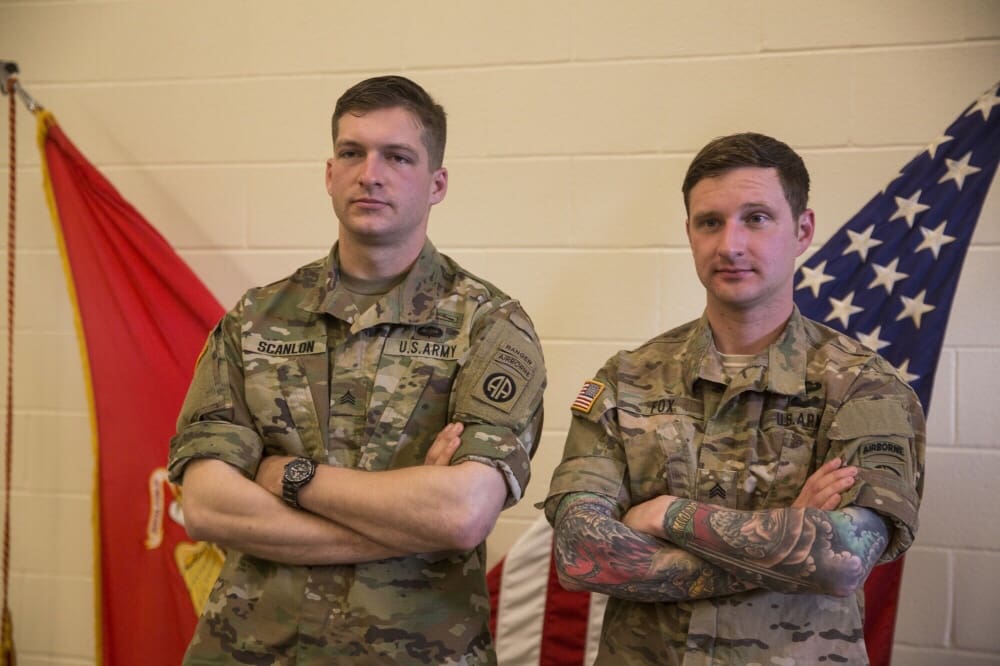
Army Sgt. Clinton Scanlon, left, stands next to Army Sgt. Bryce Fox, right, after graduating the Scout Sniper Course at Camp Geiger on Marine Corps Air Station New River, April 13. The graduating class of 1-18 hosted the two Soldiers who became the course’s “high shooter” and “high stalker.” Scanlon and Fox are Soldiers from the 2d Battalion, 505th Infantry Regiment. (U.S. Marine Corps photo by Cpl. Madrigal)
“Sgt. [Clinton] Scanlon and Sgt. [Bryce] Fox were both previous Army sniper graduates and we had an expectation that they would at least be familiar with the skills that we teach in this course,” said Staff Sgt. Craig Chandler, acting chief instructor, SSC 1-18. “They were both extremely easy to work with and they shared their knowledge with the other students in the class who aren’t as familiar. Some of the things that were different to them that they had to adapt to was that they don’t shoot the M40A6. They shoot the M2010 and they don’t shoot known marksmanship.”
Although the Soldiers had to adapt to the way Marine snipers operated, it didn’t stop them from being the best in the class.
“I scored the highest point average on the ten graded stalks we do,” said Fox. “Stalking is when you put grass, leaves and any natural vegetation around you on your body and then you sneak up [on a target] using individual movement techniques. You take a shot without being seen and then you shoot again. The [instructors] do a walking sequence to try and lock on you. If you don’t get found, you pass.”
Scanlon graduated the class as “high shooter” for scoring the best overall score on the rifle ranges.
“We did go through U.S. Army Sniper School so I think we definitely had a leg up on some of the fresh Marines right out of the fleet,” said Scanlon. “It was clear that everyone here knew what they were doing and the instructors were able to get the guys here shooting very well.”
Both soldiers enjoyed working alongside Marines and look forward to future opportunities to train together.
“It was a great course that has all the information to get a sniper going in any community, Army or Navy,” said Scanlon. “After this, I’d like to attend one of the advanced Marine Corps Sniper courses, but for now I’m going to go back to my unit to get my guys trained up on the things I learned here.”
Story by Cpl. Juan Madrigal
SureFire Field Notes is a multi-segment informational video series with tips and techniques from subject matter experts of all backgrounds. In this episode, Travis Haley of Haley Strategic Partners discusses light discipline.
Travis Haley is a veteran Force Reconnaissance Marine with 15 years of dedicated real world experience including: combat tours in Middle East, Africa and Central Asia. After leaving the military, Mr Haley served as a special operations and security contractor before partnering with Magpul as founder and CEO of their training division, Magpul Dynamics. Mr Haley also served as CEO of the parent company, Magpul Industries, before breaking off to form the endeavor that would become Haley Strategic Partners.
Safety solutions provider Survitec is showcasing the launch of the newly designed, rapidly inflating SONICS Milpod at the 12th annual Special Operations Forces Exhibition and Conference (SOFEX) show in Amman, Jordan on the 7-10th May 2018.
The show will provide a showcase for Survitec’s CBRN range of products including the Bio Skin and Bio Shell protective suits, with the MilPod personal isolation chamber set to take pride of place.
The specialist man portable stretcher can be used for the rapid extraction and treatment of injured individuals in CBRN environments and inflates in under 15 seconds, providing a completely contained environment suitable to treat any casualty, from minor flesh wounds to chemically contaminated personnel.
In line with Survitec’s proud heritage and technological expertise across a number of sectors, the MilPod is entirely inflatable, robust enough to cope with the demands of the most inhospitable environments, and can even float.
The stand will portray a simulation of a wounded Special Forces operator getting placed into the MilPod and being treated by a medic dressed in Survitec CBRN products.
The medic mannequin will be displaying Survitec’s complete CBRN offering including a non-carbon protective hood, respirator, protective over gloves, socks and over boots and medical equipment.
The four-day event will be attended by international delegates including defence ministers, chiefs of armed forces, special operations commanders and defence procurement directors.
SOFEX is one of the world’s leading and fastest growing special operations forces, homeland security and counter terrorism exhibition and conferences.
Paul Parry, Survitec Group CBRN Business Manager, said: “The threats facing the protection of civilians and military personnel from chemical, biological, radiological and nuclear dangers continue to evolve and so too must the equipment they rely on to stay safe. Protecting individuals in such scenarios is only half the battle – the gear they use must be comfortable and functional enough for them to remain operational and alert to further threats.
“We’re not just another me-too manufacturer making comparable kit to what already exists on the market; we genuinely want to move the needle when it comes to the defence sector and launch innovative products that have never been seen before. Using cutting-edge design and the latest lightweight fabrics gives users extra performance gains that could make all the difference in mission-critical scenarios.”
Hershey, PA – April 30, 2018 – Rockwell Tactical Group (RTG) is proud to announce its Tactical Trauma Care course is now approved for clinical patient care hours by the Pennsylvania Department of Health Bureau of Emergency Medical Services (EMS). RTG, Pennsylvania’s top training group, is recognized nationwide for its principle-based firearms training capabilities and instructor knowledge and experience.
“We’re truly honored by the trust the State has put in Rockwell Tactical to best prepare its law enforcement officers for duty,” said Jared Ross, owner, Rockwell Tactical Group. “All of our instructors are veteran or active duty military and law enforcement officers. We provide the same level of expert training that we learned from and used while operating and training in the US and around the world.”
The RTG Tactical Trauma Care course was created by a Special Operations Combat Medic and a former Greenside Navy Corpsman, now New York City Paramedic. The course will teach basic trauma management using the MARCH Protocol, different than standard EMS. The course is hands-on and concludes by giving each student a practical exercise. The course will cover management of the following topics in a tactical setting:
• Massive bleeding
• Airway
• Respiration
• Circulation
• Hypothermia
• Patient stabilization
There are two upcoming Tactical Trauma Care courses (course number 1000000404).
Dates and locations:
Friday, May 18 at Tripwire Operations Group. 1685 Baltimore Pike, Gettysburg, Pennsylvania 17325. For more information and to register, EMS providers can go to www.tripwireops.org.
Saturday, June 23 at F3 Tactical. 14231 Willard Road #300, Chantilly, Virginia 20151. For more information and to register, EMS providers can visit the RTG Training Schedule.
Kit Badger produced a video and a write up on the KTAK Reactive Steel Target.
Read the full post here.
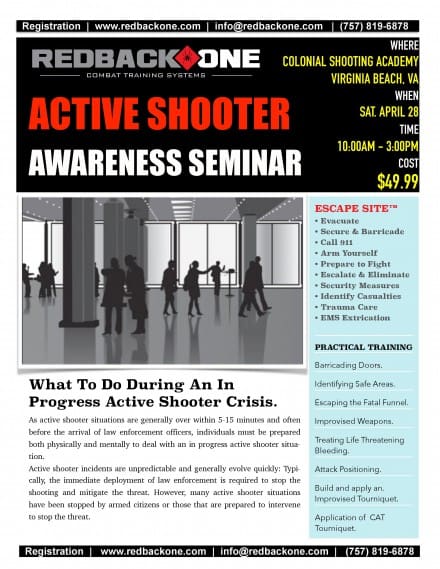
Redback One Active Shooter Awareness Seminar
Presented by Jason Falla
When: April 28, 2018
Time: 10 a.m. – 3 p.m.
Where: Colonial Shooting Academy, VA Beach, VA
Cost: $49.99
Registration: www.redbackone.com or email info@redbackone.com
In Gettysburg on 4/25, two major companies who support the first responder community – Tripwire and Rockwell Tactical – are hosting an open house. Details below. These companies have announced a joint partnership to give first responders the knowledge, tools and training they need to protect themselves and the country.
Tripwire provides explosive products, inert ordnance training aids and training courses in partnership with Rockwell Tactical. At the open house you’ll receive a tour of their facility where those products are made and time with both owners to learn more.
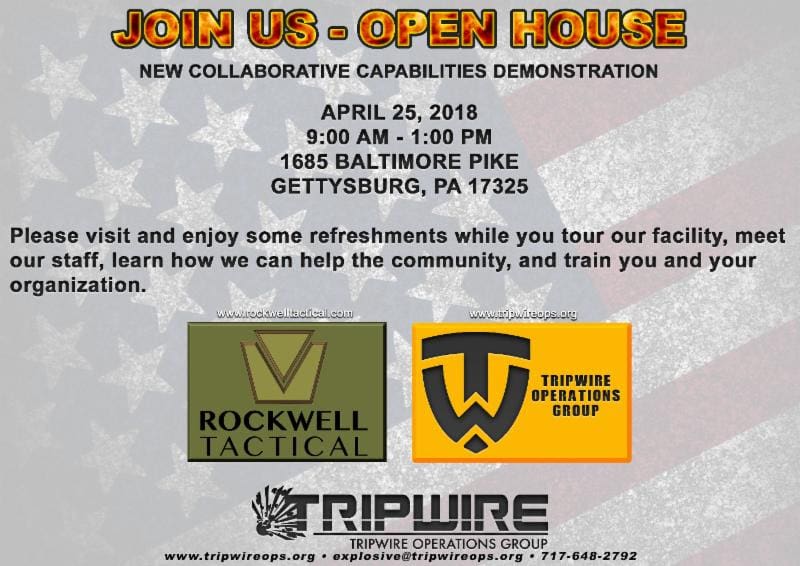
Who: Tripwire Operations Group and Rockwell Tactical Group
What: Open House and New Collaborative Capabilities Demonstration
When: April 25, 2018 from 9:00am – 1:00pm
Where: Tripwire office: 1685 Baltimore Pike, Gettysburg, PA 17325
Why: Tripwire and Rockwell Tactical have now come together to support military, law enforcement and first responders, giving them the knowledge, tools and training they need to keep themselves and our country safe. The companies will co-host an Open House on April 25 to welcome the first responder community and the public to tour the facility, meet Tripwire and Rockwell staff and introduce their shared missions. Refreshments will be served. No tickets or registration required – just stop in and say hello.