Aquaterro

Archive for the ‘UAS’ Category

USArmy Awards AeroVironment $146 Million Lethal Miniature Aerial Missile Systems Contract Funded at $76 Million for First Year of Switchblade Systems Procurement

Friday, May 15th, 2020

·       AeroVironment’s combat proven Switchblade with patented wave-off feature provides operators with increased lethality, reach and precision strike capabilities with low collateral effects

·       First year of funding approved through Joint Urgent Operational Need Statement, reflecting high-priority requirement and strong user demand from the frontline

·       AeroVironment provides full system solution, including Switchblade systems, operator training, support and logistics

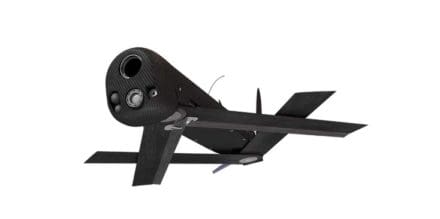
AeroVironment’s Switchblade is a back-packable, rapidly deployable, loitering precision strike missile designed for use against beyond-line-of-sight (BLOS) targets, from either mobile positions in the field or from fixed defensive positions for base security.

SIMI VALLEY, Calif., at vSOFIC, May 14, 2020 – AeroVironment, Inc. (NASDAQ: AVAV), a global leader in unmanned aircraft systems (UAS), announced the receipt of a one-year, $75,930,901 funded contract award on April 30, 2020 from the United States Army for procurement of the company’s Switchblade® loitering missile system. The contract award was funded for the first year of procurement through a Joint Urgent Operational Need Statement from the United States Army Tactical Aviation and Ground Munitions (TAGM) project office. Start of deliveries is anticipated by September 2020. Two additional one-year options, currently unfunded, would extend the period of performance through April 2023 on a sole-source basis.

“For nearly a decade, AeroVironment’s Switchblade has delivered unmatched force protection and precision strike capabilities at the battlefield edge to the U.S. Army,” said Brett Hush, AeroVironment senior product line general manager of Tactical Missile Systems. “We will continue to enhance the capabilities of this battle-proven product, and stand ready with a proven supply chain and customer support system in order to respond effectively to U.S. and allied customers’ needs.”

AeroVironment’s combat proven Switchblade is back-packable and rapidly deployable from ground platforms including a 6-pack launcher, providing warfighters with rapid-response force protection and precision strike capabilities up to 10 kilometers (6 miles) from its launch location. Its high precision, combined with specialized effects and patented wave-off feature, results in Switchblade’s ability to minimize or even eliminate collateral damage.

Northrop Grumman is a key partner on the Switchblade system, providing single purpose and multimode warheads for the program.

Learn more about Switchblade at the AeroVironment, Industry Showcase at vSOFIC www.sofic.org/vsofic or at www.avinc.com/switchblade.

AeroVironment Awarded $2.6 Million Contract from U.S. Ally to Enhance Existing PumaTM Fleet with Puma LE Capabilities, Plus Existing Fleet Support

Tuesday, May 12th, 2020

• Contract includes spares to support customer’s existing fleet of tactical unmanned aircraft systems (UAS) and adoption of Puma LE (Long Endurance)

• Puma LE provides Group 2 features in a Group 1 footprint, 5.5-hour endurance and

• Customer is one of more than 45 allied governments employing AeroVironment’s innovative family of tactical UAS

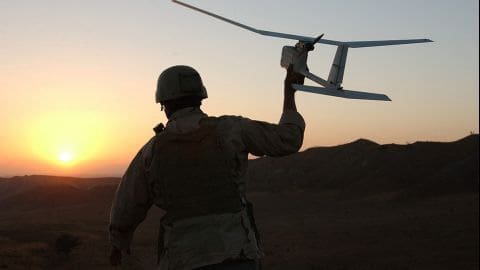
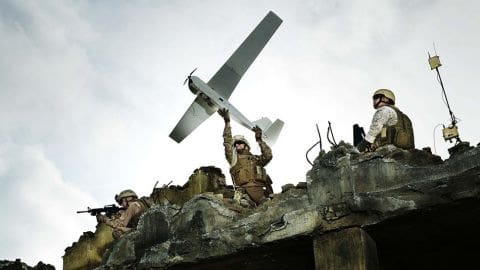
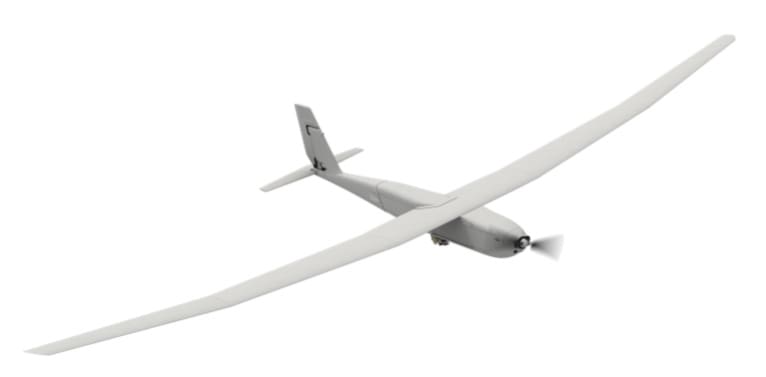
AeroVironment’s Puma LE tactical unmanned aircraft system is rapidly deployable and hand launchable with 5.5 hours of flight endurance and interoperable line-replaceable unit (LRU) components that can be shared with other Puma AE aircraft.

SIMI VALLEY, Calif., at vSOFIC, May 12, 2020 – AeroVironment, Inc. (NASDAQ:AVAV), a global leader in unmanned aircraft systems (UAS), today announced that a U.S. ally and longtime customer awarded the company a firm-fixed- price contract valued at $2,685,057 on February 20, 2020 for AeroVironment’s recently introduced PumaTM LE. The order also included spares to support the customer’s existing fleet of AeroVironment tactical UAS. The contract award period of performance is one year.

“Puma LE is the newest member of our combat-proven family of tactical unmanned aircraft systems,” said Rick Pedigo, vice president of sales and business development for AeroVironment. “Puma LE provides customers with Group 2 UAS endurance capabilities, nearly doubling the time on station of Puma 3, with cost savings and the footprint of a Group 1 unmanned aircraft.”

The AeroVironment Puma LE weighs only 22.5 pounds (10.4 kilograms), is launchable by hand or bungee and provides a dedicated secondary payload bay in addition to its Mantis i45 gimbaled EO/IR sensor. On-board batteries provide 5.5 hours of flight endurance with an operational range of 37.2 miles (60 kilometers) when used with AeroVironment’s Long-Range Tracking Antenna (LRTA). Puma LE’s economical dual- case mission pack contains everything needed to perform two complete 5.5-hour missions with a single aircraft and Ground Control System (GCS). Puma LE utilizes plug and play, interoperable line-replaceable unit (LRU) components that can be shared with other Puma AE aircraft.

AeroVironment’s family of tactical UAS comprises the majority of all unmanned aircraft in the U.S. Department of Defense (DoD) inventory and its rapidly growing international customer base numbers more than 45 allied governments.

Learn more about Puma LE by attending a virtual product presentation at vSOFIC www.sofic.org/vsofic, Tuesday, May 12th at 1 PM (EST) in the AeroVironment, Industry Showcase.

DroneShield Releases RfPatrol MKII

Monday, April 27th, 2020

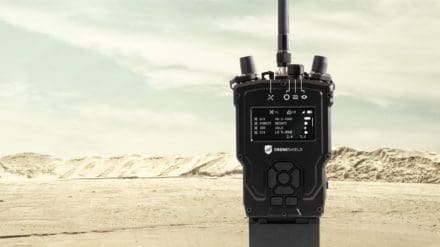
DroneShield Ltd (ASX:DRO) (“DroneShield” or the “Company”) is pleased to announce the release of the next generation version of its body-worn drone detection device, RfPatrol MKIITM.

The original RfPatrolTM was released in May 2019, having proven to be a well-regarded product, with purchases by a number of high profile customers around the world.

The device is completely passive (non-emitting), substantially broadening the range of customers to whom the product is lawfully available, and also appealing to use cases where the device cannot be detectable to the enermy forces due to having no emissions.

The next generation of the product is approximately 40% smaller in size, with a reduced weight of 800g (including battery), further ruddedization, as well as a range of further enhancements requested by the end users following last 12 months of in-field deployments.

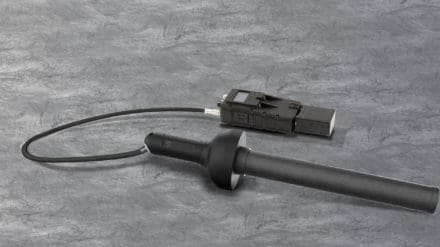
Image: RfPatrol MKII

The product summary is available here.

The product is available for purchase now to qualified customers.

The device also enables to determine direction of the incoming threat, though the Directional Antenna Unit (DAUTM) an optional accessory:

Image: RfPatrol DAU optional direction-finding accessory

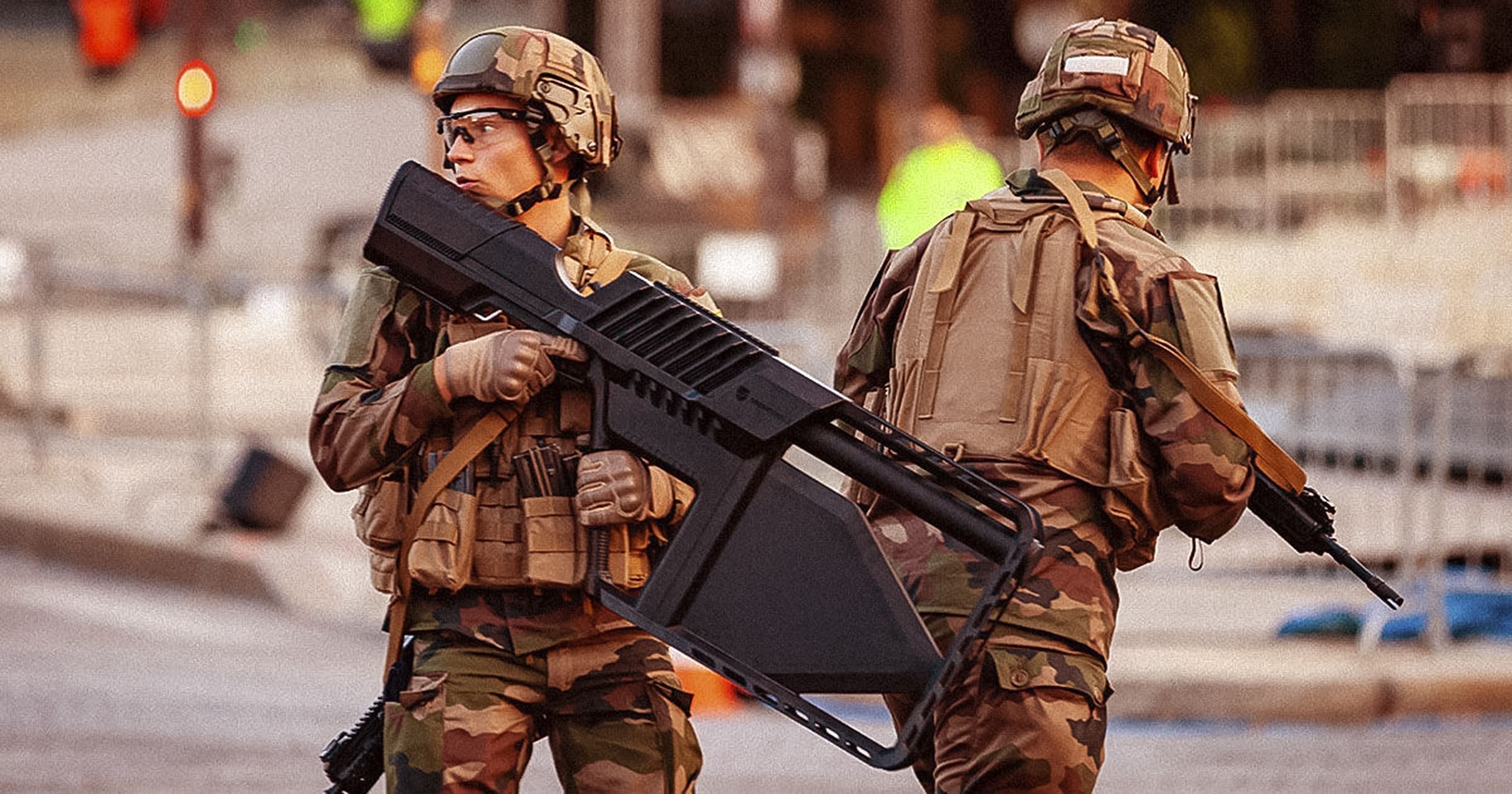
DroneShield’s CEO Oleg Vornik commented, “RfPatrol MKIITM continues our successful RfPatrolTM product line, providing dismounted personnel a lightweight drone detection device. The product is future-proof, being compatible with additional drone frequency channels which will be enabled with future software releases. As with our other counterdrone products, customers receive regular software updates of threat databases which can be deployed on the devices remotely in the field in a secure manner. Further, in addition to being able to be used as a stand-alone, it is a perfect companion to our DroneGunTM product”.

For enquiries, please contact info@droneshield.com.

Fort Riley Brigade Combat Team Kicks Off Unmanned Aircraft System Assessment

Monday, April 13th, 2020

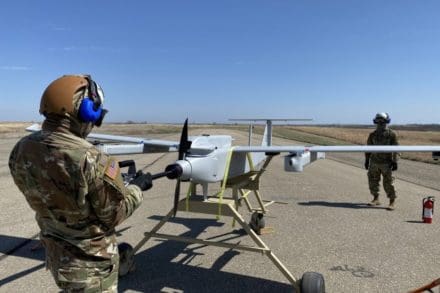
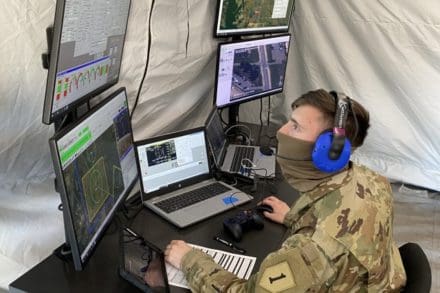
FORT RILEY, Kan. – The 1st Armored Brigade Combat Team, 1st Infantry Division conducted the first Soldier-operated flight during the Army Futures Command-directed Future Tactical Unmanned Aircraft System capabilities assessment, April 7, 2020.

Announced in December 2019, the assessment will evaluate selected unmanned aircraft systems to define the capabilities needed in the next generation UAS for brigade combat teams.  Data gathered during the assessment will be critical to determining the requirements for the RQ-7 Shadow replacement.

Future Unmanned Aircraft Systems is a signature effort within the Army’s Future Vertical Lift Modernization priority. The Program Executive Office for Aviation’s Unmanned Aircraft Systems Project Office in collaboration with Army Futures Command is leading the capabilities assessment.

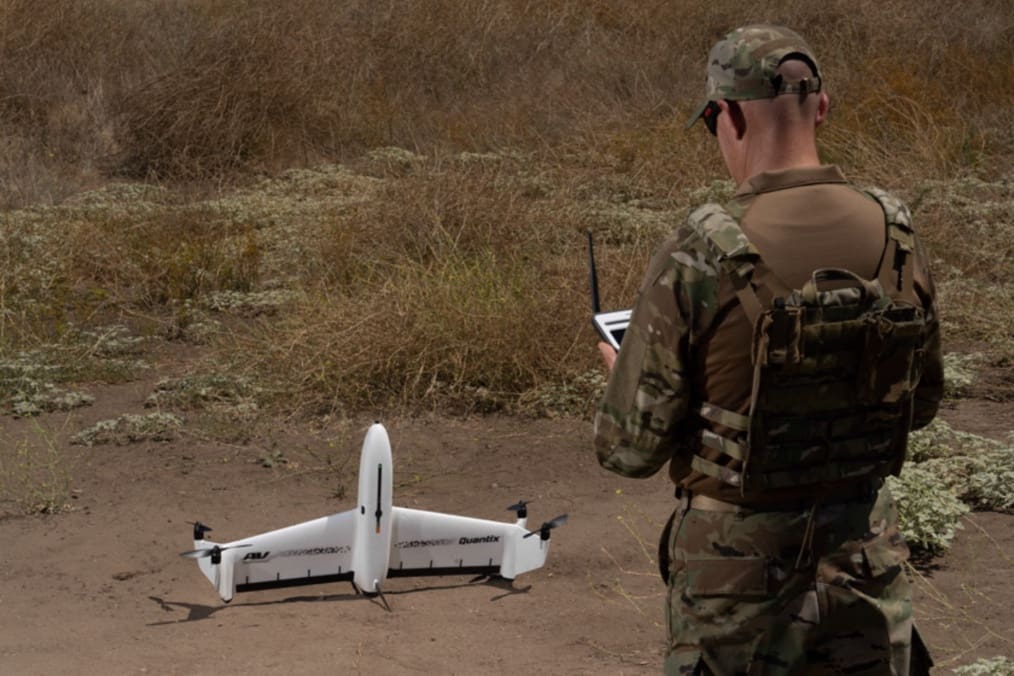
The “Devil Brigade” is the first U.S. Army Forces Command unit to demonstrate one of the four vertical take-off and landing unmanned aircraft systems procured for the assessment.

Assigned the Arcturus UAV JUMP 20, it is the largest of the selected systems weighing 210 pounds with an 18-foot wingspan. Despite the size, its reduced acoustic signature compared to the Shadow is appreciated by the entire crew. “We’re used to screaming at each other and having to use radios in order to communicate,” said Spc. Christopher McCoy, a crew chief assigned to 1st Engineer Battalion, 1st Armored Brigade Combat Team. “You can stand right next to this aircraft and not even raise your voice,” said McCoy.

According to Spc. Nicholas Miller, an unmanned aircraft systems operator also assigned to 1st Engineer Battalion, the JUMP 20 maintains the ability to launch and recover from a confined area with minimal ground support equipment. “Currently, we need a runway for launch and recovery of the Shadow. With the VTOL system on the JUMP 20, we don’t need any of that, we’re working with half the equipment,” he said.

The extended endurance of the system allows multiple operators to take turns training on the payload at altitude, while a second aircraft conducts repeated launches and recoveries to train operators and crew chiefs on critical modes of flight.

Over the next five months, the Big Red One Soldiers will operate the system as a surrogate for their RQ-7 Shadow, performing similar tactical tasks for the BCT, but with the added vertical take-off and landing capability and control while on the move. The assessment utilizes a crawl, walk, run mentality, progressing through operator and collective training, then culminating in brigade level field training exercises and a Combat Training Center rotation.

Under increasing COVID-19 precautions, it was uncertain whether the assessment would remain on schedule. Maj. Gen. John Kolasheski, commanding general of the 1st Infantry Division determined the assessment could continue with proper mitigations. The Army is following CDC and DoD guidelines to combat the spread of COVID-19.

The four other FORSCOM units participating in the assessment are assigned the Martin V-Bat, Textron Aerosonde HQ, L3 Harris FVR-90, and a second Arcturus UAV JUMP 20 are scheduled to begin in the coming months. These assessment schedules are under regular re-evaluation as COVID-19 conditions change.

For updates throughout the FTUAS assessment, visit: www.dvidshub.net/feature/FTUAS

By Sarah Tate

DroneShield Ships Remainder of DroneGuns to Middle Eastern Customer

Wednesday, April 8th, 2020

DroneShield Ltd (ASX:DRO or DRO.AU) (“DroneShield” or the “Company”) is pleased to have released the following ASX announcement today.

The Company advises that, following a request by its governmental customer, it has shipped the remainder of the DroneGun Middle Eastern Ministry of Defence order.

Oleg Vornik, DroneShield’s CEO, commented, “Middle Eastern customer order flow processes are often less structured than those involving their Western counterparts, however DroneShield has a close relationship with this governmental customer and has received multiple payments from this governmental customer before, and therefore has a high degree of confidence in the process. DroneShield’s supply chain and manufacturing capabilities have remained intact through the current global crisis, and in fact have ramped up, following the opening of a new manufacturing facility in western Sydney earlier this quarter. We are continuing to see a strong level of engagement with our customers, as defence and security remain key priorities of Governments around the world.”

Milrem Robotics to Deliver UGVs to UK Defence

Sunday, April 5th, 2020

Milrem Robotics is to deliver two unmanned ground vehicles to the Defence Science and Technology Laboratory (DSTL) of the United Kingdom.

DSTL whose purpose is to maximise the impact of science and technology for the defence and security of the UK, is procuring the unmanned vehicles to explore the capabilities and limitations of these autonomous systems in areas such as mobility, vulnerabilities and safety.

Milrem Robotics will supply the vehicles to DSTL in partnership with leading defence technology company, QinetiQ, who will integrate autonomous functions to the vehicles and arrange transfer to the end user.

In cooperation with QinetiQ, Milrem Robotics is participating in two UK large-scale robotics programs – JTARR (Joint Tactical Autonomous Resupply and Replenishment) and RPV (Robotic Platoon Vehicle).

“The United Kingdom has a clear view on the importance of robotics on the battlefield and its impact on defence capabilities. This is illustrated by the two large-scale robotics programs in which Milrem Robotics is currently participating in the UK,” said Kuldar Väärsi, CEO of Milrem Robotics.

DSTL follows similar organizations in the Netherlands, Norway and Germany who have also opted for the THeMIS platform. For example, the German Federal Office of Bundeswehr Equipment, Information Technology and In-Service Support has acquired one platform for similar testing and evaluation by the German armed forces.


In addition, the THeMIS UGV has been delivered to France, US and Indonesia in logistics configuration intended to provide combat support and carry supplies with an option to integrate additional kinetic or non-kinetic payloads.

More information from DSTL: www.gov.uk/government/news/dstl-acquires-first-fleet-of-autonomous-ground-vehicle-systems

Liteye Earns Additional CUAS Contract as Part of Critical US Defense Industrial Base

Friday, March 27th, 2020

Colorado Manufacturer promotes stability in Defense Industrial Base, provides key Counter UAS (CUAS) Systems during turbulent times 

Centennial Colorado — Liteye Systems, Inc, a world leader in Counter Unmanned Aerial Systems (CUAS), announced the receipt of an add-on specialty production order for $3M.  The contract will ensure delivery of hardware for US Government urgent requirements during this unprecedented time dealing with COVID-19.

The Defense Industrial Base (DIB) is identified as a Critical Infrastructure Sector by the Department of Homeland Security. 

“This contract, and the recent deliveries of Liteye’s US configured AUDS system continues a three-year run of consistent performance, delivering life-saving technology to our warfighters,” said Kenneth Geyer, CEO of Liteye Systems.  “This order from the US Government, and designation as part of the Defense Industrial Base Sector during this difficult time is an example of the trust Liteye has garnered with the US Government to deliver much needed capability.”

“Liteye is operating at full capability and has NOT been impacted.  We are taking all appropriate steps to mitigate risk to employees while ensuring Liteye can meet ALL customer demands,” said Geyer

While many companies are already feeling the economic impact, the recent contract award and previously delivered product to the US Government, positions Liteye to remain a stable and trusted leader within the Defense Industrial Base.  COVID-19 is having a dramatic and dynamic impact on our lives, businesses and on the global economy.   Liteye Systems is committed to lead through this pandemic, and related recovery, and take aggressive action to mitigate the impacts on employees while meeting the needs of Customers. 

www.Liteye.com

First Vertically Integrated, End-to-End UAS Manufacturer Launches

Thursday, February 13th, 2020

CP Aeronautics Offers American Built Combat Proven Unmanned Aerial Systems for Defense, Homeland Security, and Civil Applications

San Diego, Calif. – CP Technologies today launches a new division, CP Aeronautics, to provide integrated turnkey solutions based on unmanned aerial systems (UAS) platforms, payloads, data links, ground control stations (GCS), and communications for defense and civil applications.

Designed as leading-edge UAS-based solutions, CP Aeronautics’ systems offer operationally proven solutions for Intelligence, Surveillance and Reconnaissance (ISR) systems requirements. CP Aeronautics’ broad product portfolio has demonstrated excellent performance and operability in very demanding environments. Backed by continuous research and development, these systems are built on three decades of technological and operational experience.

Brad Pilsl, Vice President Of Business Development at CP Aeronautics, shares, “Through our in-house capability as a UAS manufacturer and integrator with specialist subsidiaries and technology partners, we offer a complete range of subsystems including air vehicles, inertial navigation and avionics, electro-optical payloads (EO), communications, propulsion systems, launch and retrieval systems, command and control units. We also offer high-end training solutions for our partners and customers.”

CP Aeronautics will support government and commercial customers with the entire infrastructure necessary for development, production, integration, flight-testing, certification, and operational support of UAS throughout their service.

The combat-proven operational systems include:

Orbiter 2 Small-UAS (SUAS)

Orbiter 3 Small Tactical UAS (STUAS)

Orbiter 4 Small Tactical UAS (STUAS)

Aerostar Tactical UAS (TUAS)

Dominator XP (MALE UAS)

Pegasus 120 High-performance Multi-Mission Vertical Takeoff and Landing (VTOL) UAS

For more information on CP Aeronautics’ systems, please visit: cp-aeronautics.com