Celebrate 20 years of the TLR-1

Archive for the ‘UAS’ Category

AeroVironment Receives $45 Million Raven B Unmanned Aircraft Systems Contract Award for U.S. Army Security Force Assistance Brigades

Monday, August 19th, 2019

• Contract award funded by U.S. Government fiscal year 2019 appropriations

• Raven systems support U.S. Army, Marine Corps, Air Force, Special Operations Command, National Guard and more than 25 defense forces around the globe

• Raven lightweight small unmanned aircraft system is designed for rapid deployment to deliver real-time tactical situational awareness

SIMI VALLEY, Calif., Aug. 19, 2019 – AeroVironment, Inc. (NASDAQ:AVAV), a global leader in unmanned aircraft systems for both defense and commercial applications, today announced it received a firm fixed-price contract award on July 25, 2019 valued at $45,190,881 for RQ-11B Raven® small unmanned aircraft systems (UAS) and initial spares packages. AeroVironment received the contract award from the United States Army for its Security Force Assistance Brigades (SFAB). Delivery is anticipated by January 2020.

The SFAB are specialized units with the core mission to conduct training, advising, assisting, enabling and accompanying operations with allied and partner nations.

“Raven is the most widely deployed small unmanned aircraft system in the United States Department of Defense’s fleet,” said Rick Pedigo, vice president, sales and business development for AeroVironment. “Our family of small unmanned aircraft systems supports all U.S. military services and more than 45 allied nations.  Every day, AeroVironment small UAS provide the actionable intelligence our customers need to proceed with certainty.”

In a report published by the United States Army on July 24, 2019, Sgt. Jordan Aguiar, a cavalry scout assigned to Alpha Troop of the 2nd Squadron, 101st Cavalry Regiment, said the Raven is more agile and less detectable than larger and more costly unmanned aircraft.  Soldiers use it to conduct battlefield reconnaissance and provide their units with a greater level of security.  Sgt. Foluke Marsh added, “If you need to have eyes on a target, or eyes on a convoy to make sure everything is safe, it’s good to send out the Raven instead of risking someone getting hurt or killed.”

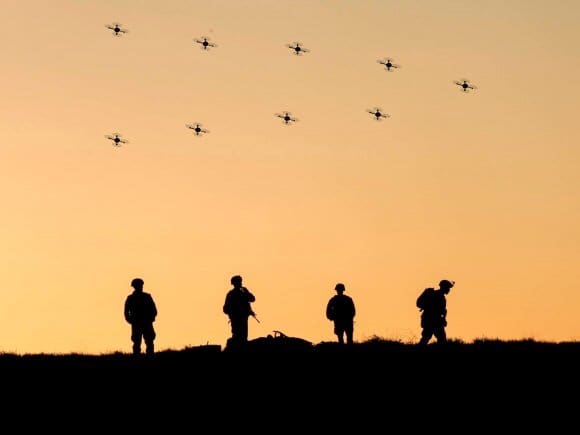
(Photo: TSgt John Winn)

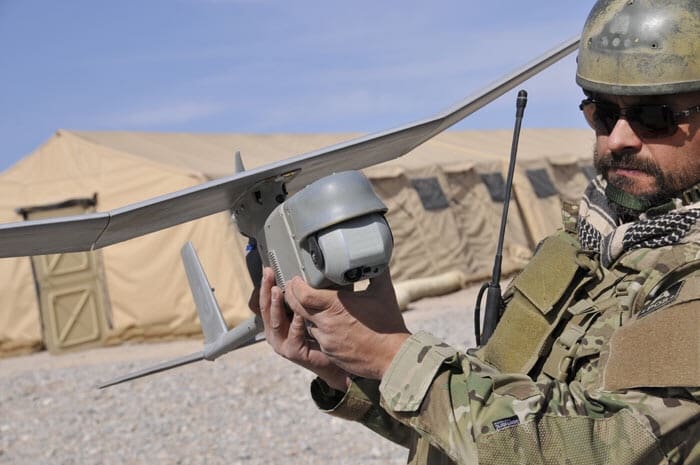
AeroVironment RQ-11B Raven Small Unmanned Aircraft System designed for land-based operations (Photo: AeroVironment)

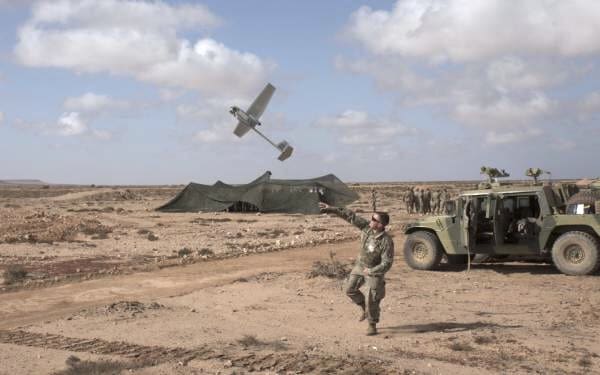
AeroVironment’s Raven is a fully man-portable, hand-launched small unmanned aircraft system designed for land-based operations. First adopted by the U.S. Army in 2005, Raven is now used by more than 25 countries across the globe. Weighing just over four pounds, with a wingspan of 4.5 feet and with a flying range of 10 kilometers, it is the most prolific small unmanned aircraft system deployed across the U.S. Department of Defense.  The Raven system provides operators with real-time intelligence, surveillance and reconnaissance, delivering color or infrared video and still imagery to its operator via a hand-held ground control unit and to remote viewing stations, and uses a GPS system for pre-programmed or manual navigation.

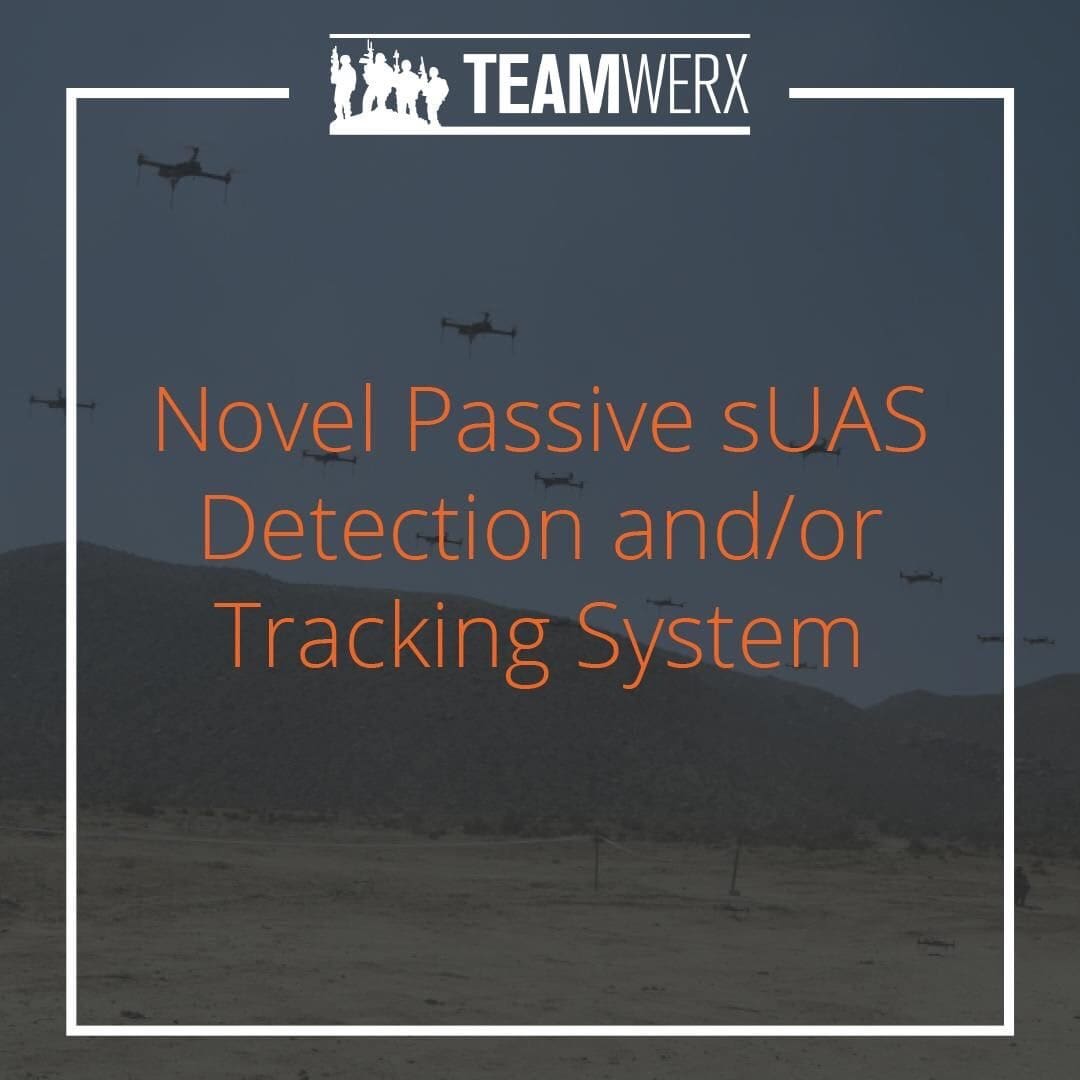
SOFWERX Novel Passive sUAS Detection and/or Tracking System

Friday, August 9th, 2019

What does 5 days, drones and $120K have in common? They all add up to SOFWERX’ fastest prize challenge to date. Submit your novel passive solution to detect and/or track sUAS 14 August at teamwerx.org/detect for your chance to win!.

DroneShield Releases RfZero Product

Thursday, August 8th, 2019

Sydney, Australia – 2 August 2019 – DroneShield Ltd (ASX:DRO or DRO.AU) (“DroneShield”) is pleased to release a breakthrough new product, RfZeroTM, following extensive development in response to end-user feedback. The product is available for purchase from today to qualified end-users.

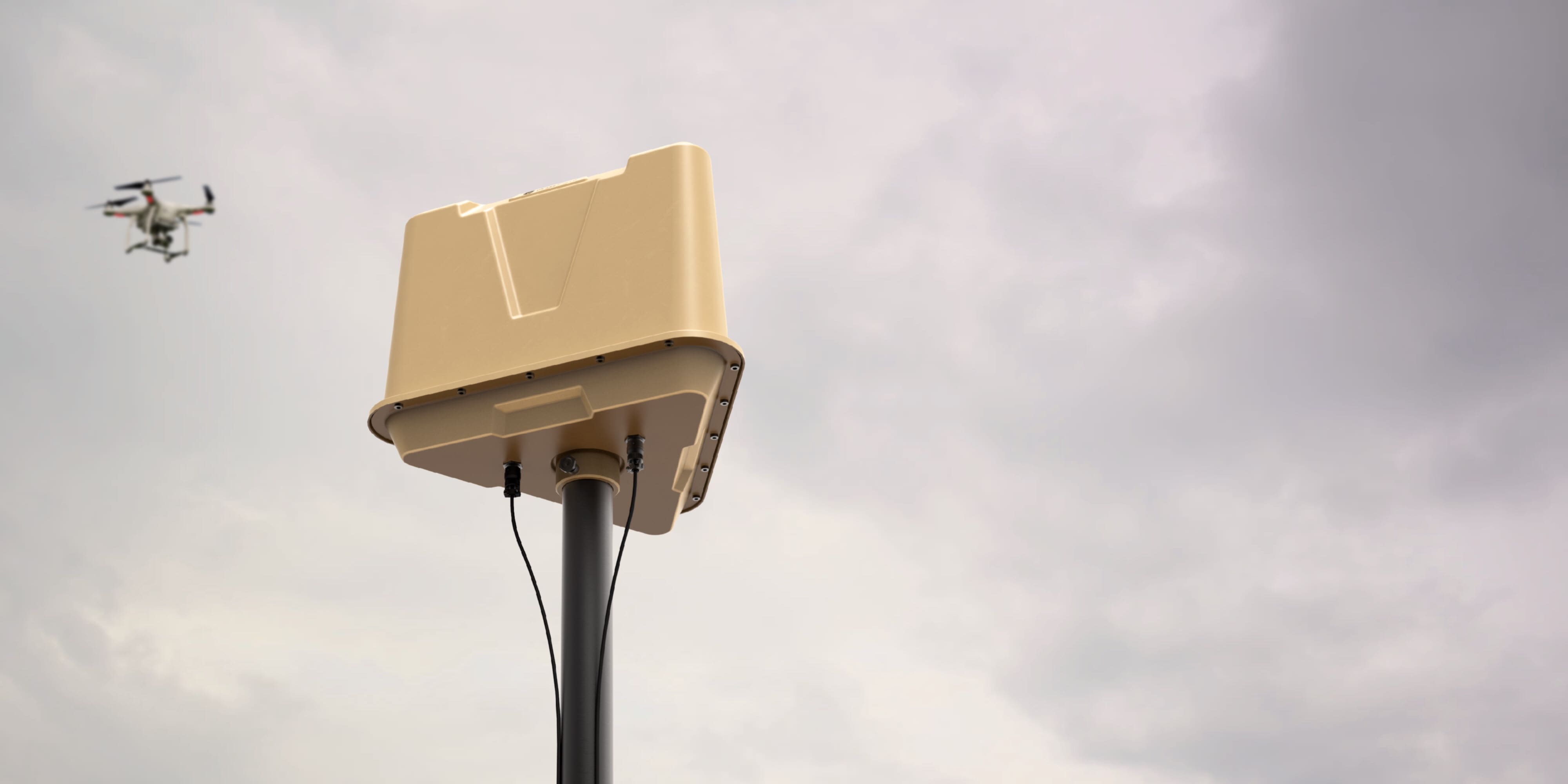
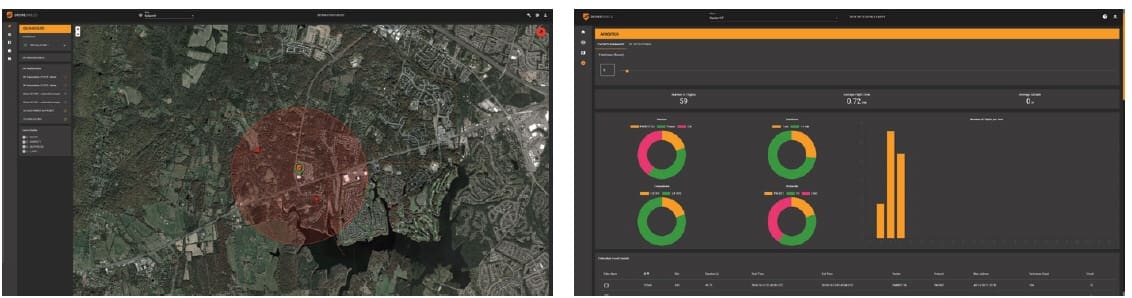
RfZeroTM is an omnidirectional drone detection device with a 1km range. It is designed to be a cost-effective fixed site alternative to DroneShield’s higher end product, RfOneTM (a 5km radiofrequency direction finder). As such, RfZeroTM responds to the needs of users with more substantial budgetary constraints. As is the case with the rest of DroneShield’s fixed site product family, RfZeroTM uses DroneShieldCompleteTM, DroneShield’s proprietary counterdrone software user interface. It is also able to integrate with the rest of the fixed site DroneShield product suite, such as DroneCannonTM for either automated or manual drone defeat, once RfZeroTM detects the drone.

Image: RfZeroTM

RfZeroTM is completely non-emitting, thus allowing for a substantially larger customer universe. Given that the product thus lacks this regulatory constraint, and is marketed at a lower price point, the product is expected to be of a substantial appeal to a wide array of customers.

Image: DroneShieldCompleteTM user interface and analytics capability

DroneShield’s CEO Oleg Vornik commented, “RfZeroTM is expected to appeal to a wide range of users looking for a more cost effective fixed site solution, complementing our RfOneTM high performance product. Typical target customers for RfZeroTM include prisons, VIPs, commercial sites, mining industry, events, and qualified corporate users, while airport and military customers generally find RfOneTM to be the more suitable offering. Following the recent releases of the pistol-shaped drone mitigation device DroneGun MKIIITM and the body-worn RfPatrolTM detection device, DroneShield is pleased to have the most extensive product offering on the market, developed based on the extensive customer feedback we received to date”.

Schiebel Camcopter S-100 to Perform Coast Guard Services for European Maritime Safety Agency in the Republic of Croatia

Friday, July 26th, 2019

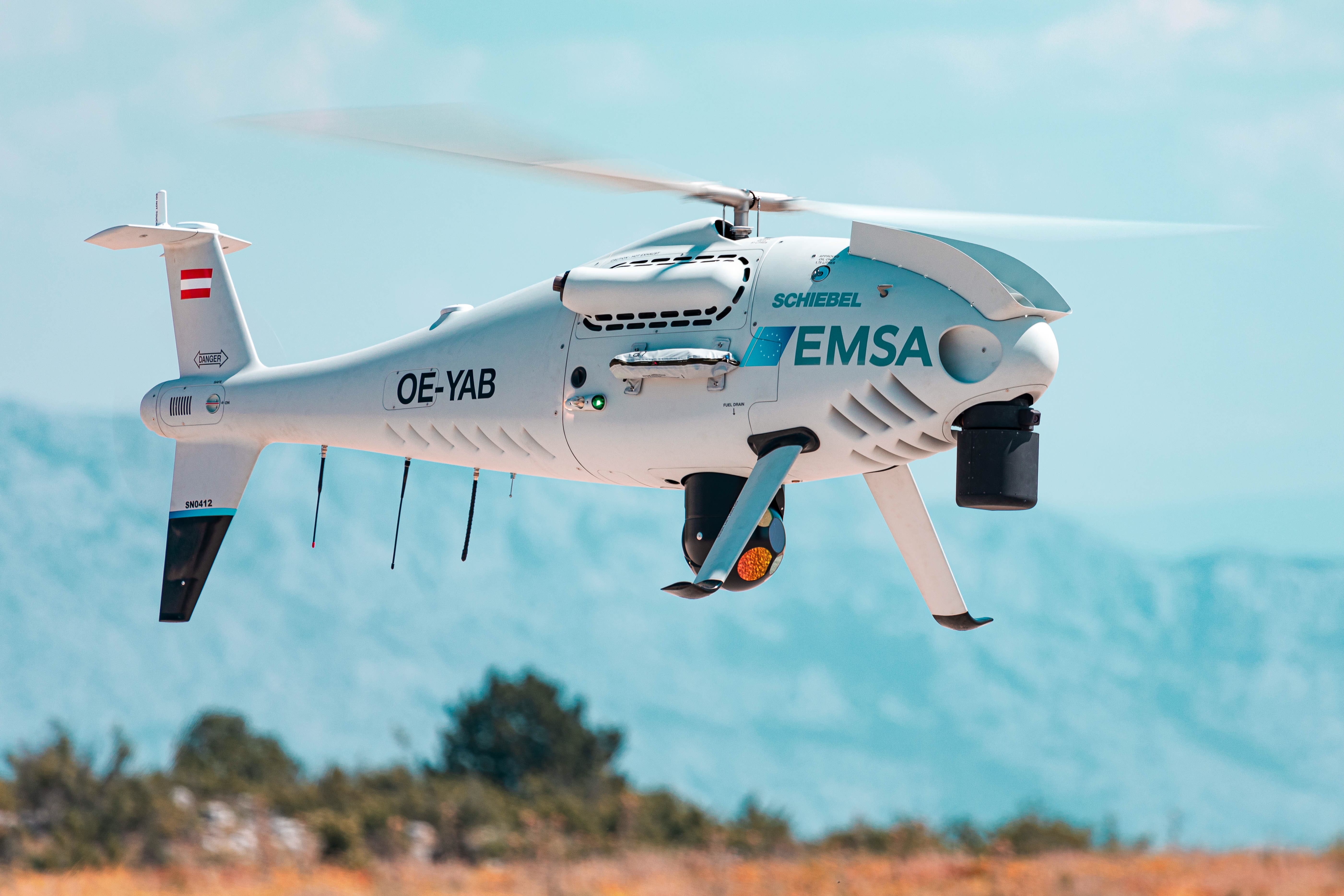
Vienna, 23 July 2019 – The Maritime Safety Directorate of the Ministry of Sea, Transport and Infrastructure of the Republic of Croatia issued the first mobilization request to the European Maritime Safety Agency (EMSA) for CAMCOPTER® S-100 maritime surveillance services.

Starting in the summer of 2019, the service provision for Croatia will assist in maritime Coast Guard functions such as search and rescue, monitoring and surveillance, ship and port security, vessel traffic, environmental protection and response, ship casualty assistance, as well as accident and disaster response. For these purposes, the CAMCOPTER® S-100 Unmanned Air System (UAS) will be based on the island of Brac? and will carry out regular patrolling flights, on-demand incident monitoring missions and specific inspection operations. The S-100 will execute these tasks equipped with an L3 Wescam Electro-Optical / Infra-Red (EO/IR) camera gimbal, an Overwatch Imaging PT-8 Oceanwatch payload and an Automatic Identification System (AIS) receiver.

EMSA awarded the multi-year maritime surveillance contract for a Vertical Takeoff and Landing (VTOL) Remotely Piloted Aircraft System (RPAS) to Schiebel in November 2018. In execution of this contract, Schiebel will provide simultaneous maritime surveillance services to several European Union (EU) member states and EU bodies.

“The CAMCOPTER® S-100 is the perfect Vertical Takeoff and Landing UAS to perform these Coast Guard functions,” notes Hans Georg Schiebel, Chairman of the Schiebel Group. “Backed by an impressive service record in the maritime domain, the S-100 has established itself as the best choice whenever sophisticated maritime surveillance is required.”

DroneShield Wins Defence Innovation Network Scheme Grant

Wednesday, July 24th, 2019

DroneShield Ltd (ASX:DRO) (“DroneShield” or the “Company”) is pleased to have been selected for a grant-based collaboration program by Defence Innovation Network (DIN), in conjunction with Innovation Connections. 


NSW Defence Innovation Network (DIN) is a university-led initiative of the NSW Government and the Defence Science and Technology Group to enhance NSW Defence industry capability through collaboration with government and academic research institutions. Supported by seven leading NSW universities, DIN focuses on bringing world-class research capabilities and innovation to the defence sector, supporting the Australian defence export industry.


Under the program, DroneShield will draw on the NSW universities’ resourcing, in combination with own engineering team, to design and develop a real-time optical drone-detection capability using recent

advancements in machine Deep Learning and Convolutional Neural Networks. The collaboration is expected to result in a product that will be taken to market by DroneShield by 1Q 2020, further enhancing its existing suite of market-leading technologies.


DroneShields’s CEO Oleg Vornik commented “DroneShield is pleased to continue our collaboration with the Australian and NSW Governments to further strengthen our position as a leading Australian defence exporter in this highly innovative sector. This grant secures access to some of the best minds in the world, based here in Australia, to complement our best in class engineering team in continuing to stay at the forefront of the counterdrone space, as it rapidly grows.”

DroneShield Releases DroneGun MKIII

Friday, July 19th, 2019

DroneShield Ltd (ASX:DRO) (“DroneShield” or the “Company”) is pleased to release a breakthrough new product, DroneGun MKIIITM, following extensive development in response to end-user feedback. The product is available for purchase from today to qualified end-users, where lawful (refer to note below).

DroneGun MKIIITM is a portable pistol-shape drone jammer, weighting under 2kg. The Company believes this product is peerless globally, for its combination of size and effectiveness.


Image: DroneShield’s DroneGun MKIIITM

DroneGun MKIIITM is designed to be an alternate rather than a replacing product for its highly successful DroneGun TacticalTM unit, having a shorter effective range of 500m versus 1-2km for DroneGun TacticalTM.


DroneGun MKIIITM can also be used in combination with other DroneShield products, including the RfPatrolTM body-worn detection device and the DroneSentinelTM stationary multi-sensor detection system.


Product overview can be found here.

Operational Footage of French Military Using DroneGun

Wednesday, July 17th, 2019

Operational footage of DroneShield’s products in action is rare because of the security and secrecy concerns of its end-user militaries and security agencies. In a rare instance of publicly-available footage, our friends at the French military have released the footage of their demonstration of DroneGun Tactical™ at the Bastille Day (France’s national holiday) celebrations in Paris on 14th July.  You can see the footage here.

You can see from the video that the DroneGun is being deployed in a demonstration approximating a real deployment in front of the dignitaries (this is not an actual live deployment). DroneShield’s products were deployed among other cutting-edge defence technologies being used by the French military. Incidentally, you can also see that, illustrating the product’s usability, one of the units is being operated, with ease, by a soldier of slight physical build. 

We are proud of this, and many other, deployments of our products in mission-critical environments around the world. 

New Cyber-Enabled System Provides a Key Countermeasure to Drone Threats

Sunday, July 14th, 2019

MOJAVE DESERT, Calif. — In the desert of the National Training Center, Soldiers got an opportunity to try something completely new. Along with the challenges of 14 grueling days of force-on-force and live-fire training exercises, the 3rd Brigade Combat Team, 1st Cavalry Division (3/1 CD) tried out a cyber-based prototype that complements electronic warfare systems to combat enemy drones, which are a growing threat to U.S. ground troops.

Using the Army’s enhanced cyber-enabled Counter-Unmanned Aerial System (C-UAS) capability, Soldiers with the 3/1 CD were able to detect and counter common small drones during their training. The new prototype alerted Soldiers to the presence of a drone and provided a means to target it, for protection across the brigade.

This integration of cyber-enabled prototypes with existing signal, intelligence and electronic warfare capabilities allowed the Soldiers to fix on a target and engage their fires cell, said Capt. Christopher Packard, electronic warfare and cyber electromagnetic activities chief for the 3/1 CD.

“That’s the goal right there, to reach the commander’s end state and to meet his intent for lethal targeting–those are some of the main concepts to focus on,” Packard said. “I think we’ve done well here, getting intelligence information as it’s passed …. that we can use for targeting. I’m looking forward to seeing where this goes in the future.”

CYBER SOLUTION SOUGHT

While the Army has a wide variety of solutions to counter drones, the new capability focused on bringing precision cyber techniques to bear as a complement to those other C-UAS systems. A small group of software developers within the U.S. Army Cyber Command (ARCYBER) and the Defense Digital Service custom-built software, developed a user-focused design and modified commercial off-the-shelf equipment to create pilot systems in early 2018.

Growing demand for a more robust and scalable solution generated a need for a rapid prototype. The Defense Digital Service completed the specialized software of the pilot system and transitioned development of a prototype to the Army Rapid Capabilities and Critical Technologies Office (RCCTO), which crafted an acquisition approach that integrated software and hardware. Working with Tobyhanna Army Depot and ARCYBER, RCCTO launched prototype production in November.

In less than three months, the integrated team sprinted and surged to deliver the new cyber C-UAS capability to the 3/1 CD. The new system is an interim solution that will continue to evolve as the Army applies direct Soldier feedback to improving design and performance. The integrated team is incorporating feedback from the unit’s rotation at the National Training Center (NTC) at Fort Irwin, California, which took place Jan. 7-25, as they develop a phase two prototype, to be delivered later this summer.

“This effort allowed the 3/1 CD to receive valuable C-UAS training ahead of their upcoming mission set,” said Jack Dillon, RCCTO’s cyber lead. “It also provided critical feedback that we are already feeding into the next version.”

A FAST-MOVING TEAM

Receiving a request to produce a never-used-before, cyber-enabled C-UAS on Aug. 22 and delivering it by Nov. 12 is not business as usual. However, ARCYBER, RCCTO and Tobyhanna, working in lockstep, were able to deliver.

“The RCCTO and Tobyhanna helped out with taking it from an advanced prototype and turning it into an engineering design model,” said 1st Lt. Aneesh Patel, with ARCYBER’s Cyber Solutions Development Detachment — Georgia, 782nd Military Intelligence Battalion, 780th Military Intelligence Brigade. “We designed our own hardware and schematics, but what we didn’t have was the proper ability to scale, and I think that’s important in a bridging strategy and for any prototype.”

The ability to turn a concept into a small package of operational prototypes for use by a unit required a proper yet flexible acquisition strategy that would also set the foundation for increased production later. In turning a concept into an operational prototype, Tobyhanna had to put together a complete drawing package using items from the depot and create the prototype while keeping to strict quality standards.

“We must do everything per Army regulations,” said Joe Lynn, a project manager for Tobyhanna Army Depot, located in Pennsylvania. “So, once everyone came on-site and saw what we do here, and that we’re basically a one-stop shop from concept to combat, it brought a better understanding.”

The process also required constant communication. This came in the form of coordination on the ground during the NTC rotation with the unit’s electronic warfare Soldiers, and during biweekly technical and synchronization meetings involving Tobyhanna, ARCYBER, the Defense Digital Service and RCCTO. Tobyhanna also hosted multiple face-to-face meetings to expeditiously solve technical questions and challenges. On the project management end, RCCTO worked in parallel to address typical program, legal and budget reviews. Of particular note, in addition to constructing the prototype from an engineering concept, the RCCTO, ARCYBER and Tobyhanna put in place a training plan for the 3/1 CD.

SOLDIER INPUT, ON THE GROUND

This rapid approach unfolded on the ground at NTC, as Soldier input went directly to engineers on-site so that they could make changes quickly, sometimes within hours.

“Having that agility really made it possible to have mission success and also to get a lot of feedback to better the system,” Patel said. “Being a newer system and a new tool for a maneuver unit, there are going to be a lot of things we don’t know as [cyber] engineers, and a lot of their specific needs for the capability that may not have gotten through to us. So being out there was very important to this and any other project like it.”

For example, to enhance the overall training experience, RCCTO, Tobyhanna and ARCYBER were able to quickly design and deliver custom mounting systems consisting of cables, brackets and other hardware for vehicle and fixed-site implementation during the prototype deployment at NTC. This fixed-site configuration, part of the unit’s tactical operations center (TOC), was a new design put together days before the unit received it, and proved paramount to Soldiers’ effectiveness in using the system.

“We fielded a completely new configuration kit, the TOC kit,” said Capt. Adam Schinder, commander of the Expeditionary Cyber Support Detachment, 782nd Military Intelligence Battalion. “It was perhaps the most successful implementation of the C-UAS solution. As a result of being statically configured and continuously monitored and plugged in, the unit found the TOC kits extremely successful.”

During the 3/1 CD’s rotation, ARCYBER embedded five Soldiers with the NTC’s opposing force who had the ability to attack the unit with their own “enemy” drones, thus providing more realistic training.

“The system was able to give the supported unit situational awareness of drones that threatened the formation across a wide front,” Schinder said. “It alerted the unit to the presence of the drone, and then it provided automated force protection at the request of the operator. Simply put, we flew the drones, we deployed the devices and we successfully defeated the threat.”

CONCLUSION

This phase-one cyber precision drone detection system will be followed by an upgraded phase-two version slated for delivery to the U.S. Special Operations Command for an operational assessment this summer. Phase two will maximize the capability’s operational life span by incorporating multiple software updates to improve performance. Both efforts will begin to help inform the Army’s overall requirements for cyber-based C-UAS.

Already, RCCTO and ARCYBER are coordinating with partners in the C-UAS community to optimize investments and share technical cyber approaches. They are also advancing new versions that are software-based for easy portability into mounted and dismounted C-UAS platforms.

“Ultimately, the momentum gained through this partnership will increase cyber integration into equipping efforts within the multidomain operations paradigm,” Dillon said. “It’s a great example of the type of partnership that can produce meaningful operational prototypes while setting conditions for transition to programs of record.”

By Nancy Jones-Bonbrest

This article is published in the Summer 2019 issue of Army AL&T magazine.