XC3 Weaponlight

Archive for the ‘UAS’ Category

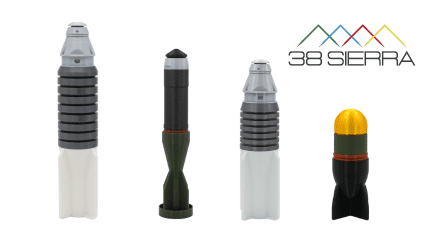
38 Sierra LLC Releases Inert Ordnance for Counter- Unmanned Aircraft Systems Training

Monday, July 14th, 2025

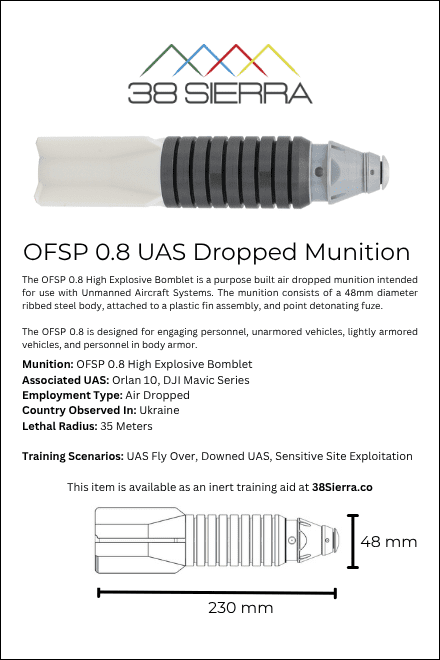
38 Sierra LLC is proud to announce the release a new line of inert ordnance training aids to support Counter- Unmanned Aircraft Systems (C-UAS) training and readiness. Designed by Explosive Ordnance Disposal Veteran Patrick McCrone, the size, weight and, appearance of each ordnance items has been faithfully replicated in our training aids. These products are ideal for a full spectrum of training, from classroom instruction to Field Training Exercises.

38 Sierra also offers free technical resources to promote awareness of UAS related explosive hazards and examples of UAS training scenarios are also available on our website 38Sierra.co

Check out our entire lineup of Weaponized Unmanned Aircraft System training aids today at 38sierra.co.

First Army, Army Reserve and National Guard Team Up in Counter-Unmanned Aircraft Systems Fight

Saturday, July 12th, 2025

FORT BLISS, Texas — First Army has assumed a crucial role in countering the threat posed by unmanned aircraft systems. It is working with Army Reserve and Army National Guard units to ensure that Component 2 and 3 Soldiers have the tools and skills to win on an emerging battlefield.

Being able to neutralize these threats is an obligation First Army takes seriously, said Col. Douglas Serie, 5th Armored Brigade commander.


“As the Army’s Counter-Unmanned Aircraft System Center of Excellence, we’re the tip of the spear when it comes to developing, validating and delivering the most up-to-date effective training available,” he said. “We’re shaping doctrine, informing procurement and ensuring that the force is equipped not just with the right gear, but the right mindset and tactics to counter drone threats.”

Doing this successfully means working closely and regularly with partnered units, added Maj. Jason Sierakowski, 2-289 Field Artillery executive officer: “We train the First Army OCs in the brigade and then we train the partnered organizations in Compos 2 and 3.”

Sierakowski has seen the mission grow and adapt over the years.

“In 2019, we mobilized the first battery for counter-UAS for compo 2,” he recalled, “2020 was when we mobilized the first unit, where we didn’t have any METS at all.”

That has changed substantially, and as the mission has grown more complex and crucial.

“The biggest thing is coming up with a solid uniform training strategy,” Sierakowksi said. “There are always new things coming out, new tools and techniques, so this just gets added onto it. The biggest success has been the evolution of the training timeline.”

Of note, many of the Soldiers being trained are going beyond their normal areas of expertise.

“The learning curve is very unique because these are troops that can be any MOS,” Sierakowksi said. “They can be anything from a mechanic to a Military Police to anything that you can imagine, and now we tell them, ‘You’re not going to do that role, you’re going to do counter-UAS and you’re going to work in a base defense operations center.’ So they start from the beginning and the learning curve is very steep.”

But they adapt and carry on with the mission, he added: “As we get into repetitions, they become a subject matter expert very quickly, especially when they go forward and deploy on these systems, and that just inherently makes them better.”

Meanwhile, First Army continually adapts and refines its C-UAS role and mission.

“First Army … has become extremely evolutionary and revolutionary within the past two to three years,” Sierakowski said. “Division East has been developing and acquiring different UAS, even 3D printing. The support from the top has been nothing but positive and how can we support the OC/T at the battalion level.”

This success is important on the battlefield, because as Serie noted, the drone threat continues to grow.

“It’s no longer theoretical. It’s real, it’s persistent, and it’s evolving rapidly,” he said. “There are adversaries that are using not only commercial but military grade UAVs to gather intelligence, disrupt our operations, and even deliver kinetic effects. Counter-UAS training is critical to staying ahead of that threat.”

That’s where the continual work and refinement with Reserve Component units pays off.

“It’s a team effort. Our partners are preparing, even before they come to Fort Bliss in a post-mobilization…on how they are going to set up their teams and task-organize their formations so when they get to the center of excellence for counter-UAS, we can go right into training,” Serie said. “We replicate real-world drone threats so our Soldiers face the same challenges in training that they’ll encounter on the battlefield. It’s not just about knowing how to push buttons. It’s about understanding the threat landscape, ROE considerations, and how to integrate C-UAS into a layered defense strategy.”

One reason the threat continually adapts and evolves is because drones are readily available and can be used in a variety of ways.

“These are things being bought off Amazon and used,” Serie said. “You can use it in an observation mode, you can use it in intelligence gathering, you can use it to disrupt operations just by flying it over, because how are you supposed to know what is on that drone? And it can be used to deliver kinetic effects.”

As such, Serie said that the center of excellence does more than react to drones, it trains “to deter, deny and defeat them before they can impact a mission. The UAS threat changes monthly, sometimes even faster. That means our training has to evolve constantly. We’re constantly refining our curriculum based on threat trends, feedback from the field, and lessons learned from combat theaters. Being a center of excellence doesn’t mean we have all the answers. It means we’re constantly asking the right questions and staying agile in our approach to training counter-UAS operations and in getting Soldiers the repetitions to build confidence to go forward.”

The stakes are enormous, Serie added: “This is the future of warfare and if we don’t figure it out know and get it right, Soldiers are going to get hurt.”

As such, the precision approach and attention to detail are paying big dividends. “We’ve trained thousands of warfighters, from infantry squads to brigade staffs, on how to detect, track, and neutralize UAS threats,” Serie said. “Units that come through our pipeline deploy with confidence and a proven playbook for dealing with UAS.”

By Warren W. Marlow

Metis Wins Contract to Supply Skyperion Drone Detection Systems to a NATO Ally

Friday, July 11th, 2025

Metis, specialists in providing innovative technologies to detect a wide range of Radio Frequency (RF) threats across diverse sectors, has won a contract to supply a number of Skyperion drone detection systems to a NATO customer to provide the drone detect function as part of an integrated Counter Uncrewed Air Systems (C-UAS) capability. This purchase bolsters the customer’s current capabilities helping safeguard their airspace, key installations and critical infrastructure against the threats posed by rogue drones and is the fourth NATO ally to purchase Skyperion. Due to the sensitive nature of the capability, and to maintain operational advantage, it is not possible to disclose the customer or quantity purchased. However, there are now over 80 Skyperion systems in operation with NATO partners, or deployed supporting their national security interests, in current operations globally.

Metis has its roots in sophisticated signals intelligence gathering technology development and operational experience, which more recently has been increasingly focused on countering the rising asymmetric drone threat. For over 10 years, Metis has been at the forefront of C-UAS RF detection capability development, having originally received government backed research funding to help develop their innovative RF detection technologies, including Skyperion. The Skyperion product range captures RF emissions of varying strengths across the spectrum, filtering out background noise and known entities before rapidly analysing them to identify and locate potential threats.

Metis is an ideal choice for the RF drone detect component because not only do they produce technically superior RF detect products, but they also design and manufacture modular systems with an open architecture, enabling seamless integration with other electronic warfare capabilities and systems. This allows sovereign nations, large primes or systems integrators to easily incorporate Metis products with other best in class technologies, to deliver world leading detection, tracking, identification and defeat of rogue drones.

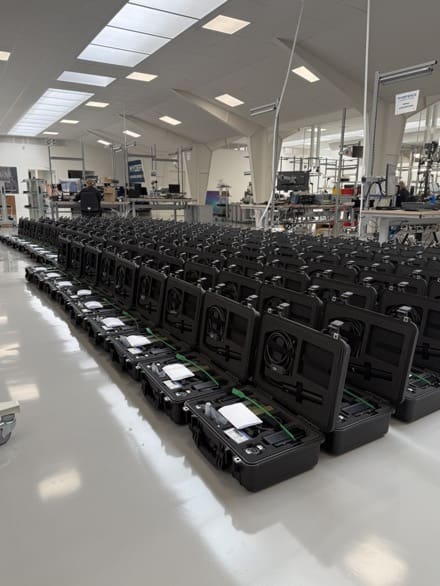
Unlike many systems, Metis has combined an Open ESM AI enhanced waveform analysis algorithm with a more traditional library database to deliver a self-learning comprehensive RF detect function across a vast array of frequencies. The system can detect a drone signature out to 2.5km and depending on the target, environment and other factors successfully identify a rogue drone out to 10km. The customer will be using these systems in a fixed site role, but the Metis Skyperion Rugged version can be easily transported in its military grade rugged cases, can operate in a mobile role if required and is designed and constructed to survive in the most austere of conditions.

Tony Burnell, CEO of Metis said: “I am extremely proud of the unique RF detect capabilities we field. The ability of our products to detect RF signatures beyond that of our competitors has been proven operationally and during various trials with reassuring regularity. We are very pleased to again have been selected by a major prime to deliver the drone detect function and are proud to be supporting a NATO partner nation with enhanced security. Looking to the future, our diverse capabilities have much greater utility beyond just drone detection and because we maintain an agnostic open architecture, seek to be the provider of choice for RF detection across defence and government organisations globally.“

SECDEF Signs Drone Dominance Directive

Thursday, July 10th, 2025

Late this afternoon, Secretary of Defense Pete Hegseth signed a memorandum entitled, “Unleashing U.S. Military Drone Dominance” which is on the heals of last months’s Executive Order, 14307 “Unleashing American Drone Domination.”

Here it is in full:

When I became the Secretary of Defense, I committed to rebuild our military to match threats to capabilities. Drones are the biggest battlefield innovation in a generation, accounting for most of this year’s casualties in Ukraine. Our adversaries collectively produce millions of cheap drones each year. While global military drone production skyrocketed over the last three years, the previous administration deployed red tape. U.S. units are not outfitted with the lethal small drones the modern battlefield requires.

On June 6th, President Trump issued Executive Order 14307 to support the American drone industry and arm our warfighters. The Department of Defense is going above and beyond this order. I am rescinding restrictive policies that hindered production and limited access to these vital technologies, unleashing the combined potential of American manufacturing and warfighter ingenuity. I am delegating authorities to procure and operate drones from the bureaucracy to our warfighters.

Our mission is threefold. First, we will bolster the nascent U.S. drone manufacturing base by approving hundreds of American products for purchase by our military. Leveraging private capital flows that support this industry, our overt preference is to Buy American.

Second, we will power a technological leapfrog, arming our combat units with a variety of low-cost drones made by America’s world-leading engineers and Al experts. Drone dominance is a process race as much as a technological race. Modem battlefield innovation demands a new procurement strategy that fuses manufacturers with our frontline troops.

Finally, we’ll train as we expect to fight. To simulate the modern battlefield, senior officers must overcome the bureaucracy’s instinctive risk-aversion on everything from budgeting to weaponizing and training. Next year I expect to see this capability integrated into all relevant combat training, including force-on-force drone wars.

Emergent technologies require new funding lines. To address the urgent need for drones, investment methods outlined in Executive Order 14307 are being investigated.

The directives detailed in the attached memorandum support our industrial base, reform acquisition, and field new technology for the warfighter. Lethality will not be hindered by self-imposed restrictions, especially when it comes to harnessing technologies we invented but were slow to pursue. Drone technology is advancing so rapidly, our major risk is risk-avoidance. The Department’s bureaucratic gloves are coming off.

Signed

Peter Hegseth

Secretary of Defense

SECDEF also released this video:

It seems that all of my Drone wishes are coming true.

-Eric Graves

Founder

*emphasis added by editor

DroneShield Receives $9.7m Latin American Contract

Thursday, July 10th, 2025

– A $9.7 million package of three standalone contracts for a defence end customer in a Latin American (LATAM) country

– Delivery and payment due Q3-Q4 2025

DroneShield (ASX:DRO) is pleased to announce it has received a package of three standalone contracts for its handheld and on-the-move counter-drone systems. The contract sum is $9.7 million, with DroneShield’s privately owned in-country reseller that is contractually required to distribute the products to a defence end customer in a LATAM country. DroneShield expects to deliver all equipment throughout Q3 and Q4 2025, with cash payment expected in Q3 and Q4 2025. No additional material conditions need to be satisfied.

DroneShield has previously received two standalone contracts from this reseller for this defence customer in December 2024 and January 2025 totalling approximately $10.8 million, with all imports, deliveries, and payments handled on-time and in a highly professional manner. There is no obligation for any additional contracts from this reseller or the customer.


Pictured: DroneShield DroneSentry-X Mk2 counter-drone system

Oleg Vornik, DroneShield CEO, commented: “In 2025, DroneShield has successfully delivered products, capability, and training into the Latin American market. With a substantial pipeline, diversified over multiple countries and customers, DroneShield is anticipating further developments in 2025 in this region.”

Learn more at droneshield.com.

Robotican Announces Delivery of Dozens of ROOSTER Hybrid Drone Systems to European Special Forces

Wednesday, July 9th, 2025

Combat-proven ROOSTER system recently secured official NATO registration, reinforcing its operational credibility and alignment with allied defense standards.

Omer, Israel – 8 July 2025 – Robotican, a leading Israeli pioneer in the development of autonomous robotic and drone technologies, proudly announces the successful delivery of dozens of ROOSTER hybrid drone systems to European special operations forces, intervention units, and infantry teams.

These deliveries represent a significant operational milestone for Robotican’s flagship system. Building on this momentum, the ROOSTER has recently secured official NATO registration, reinforcing its status as a trusted solution that meets the requirements and standards of NATO military forces.

The ROOSTER is a compact, hybrid tactical drone that merges aerial agility with robotic ground mobility, making it uniquely suited for indoor, subterranean, and GPS-denied environments. Its ability to rapidly shift between flying and rolling allows for energy-efficient operation in complex and confined spaces. The integrated protective cage enables a unique robotic rolling capability, allowing the ROOSTER to maneuver across challenging terrains and access confined areas that are inaccessible to conventional drones. The system is capable of extended missions, with a typical 90 minutes of overall active operation and up to 5 hours in standby mode. It features robust MESH communication that enables up to three ROOSTER units to work together as a team—even in environments with no external communication. The Rooster is equipped with a built-in day/night IR sensitivity camera and visible/IR illuminators.

Designed for flexibility, the ROOSTER supports a range of swappable sensor payloads, including thermal imager, oxygen and radiation detectors. These capabilities make it ideal for a wide range of missions, including tactical reconnaissance, urban search & rescue, hazardous materials response and industrial safety inspections. Lightweight, rugged, and operable by a single user, the system can be deployed quickly from a tactical backpack, offering forces immediate situational awareness with minimal exposure.

“The ROOSTER was developed as a strategic response to the growing need for precise intelligence in challenging environments where access is limited and situational awareness is critical” said Hagai Balshai, CEO of Robotican. “By enabling forces to gather critical data before operational breach, it significantly reduces risk and enhances mission planning. Its adoption by the Israeli Ministry of Defense and Home Front Command, alongside elite European & US

Special Operation Forcess, reflects its field-proven value. NATO registration further positions the ROOSTER as a trusted asset for allied operations in the modern battlespace.”

US Army Seeks Suppliers for up to 10,000 Low-Cost Drones per Month

Wednesday, July 9th, 2025

Last week, Army Contracting Command, on behalf of Program Executive Office (PEO), Aviation, released a Sources Sought notice entitled, “Uncrewed Aircraft Systems (UAS) for the United States Army.” It complements an earlier RFI which was issued in April for Purpose Built Attritable Systems (PBAS).

This is great news. While the acquisition system has been slow to adapt to this requirement, Brigade and Division commanders are creating the capability out of hide, using Soldiers who have off-duty experience with drones, paired with 3D printing. Unfortunately, none of it is effectively resourced in manpower, training, or O&M funding. An acquisition of this magnitude will get the Army on its way to learning how to use this capability and incorporate it across the entire formation. Soldiers will adapt quickly and soon be able to employ FPV drones along with other systems to enhance ISR, precision targeting, EW, and low-cost mass effects via swarms.

This new Sources Sought focuses more on cost without the constraints of performance, payloads, and other requirements in the previous announcement. The goal of this Sources Sought is to deliver low-cost UAS solutions into Army formations rapidly and reduce “gold plating.” The Army understands UAS production capacity must expand across the industrial base.

As I mentioned when the PBAS RFI was released, I refer to attritable drones as the “155 shell of the future.” The reason I use that comparison is that a 155mm shell is about $3000. The Army is looking to pay up to $2000 for each of the proposed PBAS but I think that’s a bit low. The availability of these systems, built with US sourced parts (or reliable allied country), is a national imperative.

From the Sources Sought Notice:

“The Army requires low-cost unmanned aerial systems for immediate fielding with up to 10,000 air vehicles within 12 months. The ability to deliver systems at or below our threshold cost is the primary weighted measure.  The system performance characteristics will distinguish systems meeting this core requirement.  The production capability as well as the ability for Soldiers to modify and repair are additional distinguishing characteristics. The intent for modifications is to ensure Soldiers are able to add simple payloads (such as 30mm mortars, grenades, or other lethal payloads) and non-lethal capabilities based on mission needs without vendor involvement in the field. These systems may also be utilized as targets during Counter Unmanned Aircraft Systems (C-UAS) training and other training exercises. Likewise, Soldier repair is needed to allow units to fully understand their equipment and stay in the fight while waiting for additional systems / spare components.”

The number of 10,000 per month is also significant as it is the low end of the number of attritable drones Ukraine claims it expends each month in operations against Russia. This number can surge to 30,000 per month or even higher. The question is, how can the US Army consume that many drones per month during peacetime? Well, for one, 10,000 is the surge capacity and they don’t pan to get there immediately, although I think the requirement will be far beyond just 10,000 per month of we end up in Large Scale Combat Operations. While FPV drones aren’t as capable as exquisite precision guided systems, they are a fraction of the cost and can be produced in a fraction of the time. Ukraine enjoys federated production of drones in workshops and cellars as much as in factories and produces hundreds each night. Second, the Army will use these drones for Counter Unmanned Aerial System training. So far, there hasn’t been much opportunity to go after live systems. This is an opportunity for the Army (and others in DoD) to conduct some simultaneous live training for both offensive and defensive UAS capabilities.

Accessing to the request, potential vendors of PBAS must be able to deliver the following:

  • Unit cost for air vehicle less than $2,000.00.
  • Additional dependent equipment to include ground control station/controller, communications equipment, goggles, batteries, and charging station for one to many controllers to UAS. Cost for these items will be fairly considered during response evaluation.
  • Production capability to deliver an initial quantity of systems by 30 September 2025 with the ability to quickly ramp production and deliver larger quantities up to 10,000 air vehicles within 12 months.
  • The ability for our Soldiers to modify, within reason, the system with a variety of third-party payloads, armaments, and munitions without vendor involvement
  • The ability for our Soldiers to repair the system without vendor involvement
  • Furthermore, systems must be 2020 NDAA Sec 848, 2023 NDAA Sec 817 and American Security Drone Act of 2023 (2024 NDAA, PL 118-31, DIV A, Title XVIII, Subtitle B, SEC. 1821) compliant or demonstrate a path to compliance.

    Most important about this action? Funding is available to achieve this capacity expansion. Lack of capital has held many manufacturers back.

    The Army is seeking white papers which are due by 1600 hours CST 18 July 2025.

    Visit for sam.gov full details.

    I am concerned that there still isn’t a PBAS Interface Control Document which would help both DoD and industry create Modular Open System Architecture drones which become plug and play for the integration of end effectors, comms, guidance, and motors. This would alleviate the concern over which components will work with which drones as everything would work together. Executing this scale of acquisition before establishing these standards is putting the cart before the horse.

    Despite my concern, I am very excited about this action and look forward to the Army executing and obtaining an attritable FPV drone capability at the smallest units and all across the formation.

    Eric Graves

    Founder

    SSD

    AV-14 Infantry FPV Goggle

    Monday, July 7th, 2025

    Introducing the AV-14 from Ascend ISR, the First American-Made FPV Goggle System.

    The Ascend ISR Systems AV-14 is a rugged, low-profile FPV monocular developed at the request of a U.S. Army Special Warfare Group seeking a combat-ready FPV solution that integrates directly into their equipment ecosystem. Designed for drone operators and dismounted teams alike, it delivers unmatched situational awareness in a compact, durable package.

    Built from aerospace-grade 7075-T6 aluminum, the AV-14 is machined for the unforgiving tempo of light infantry operations. Integrated dovetails are cut directly into the housing, enabling native compatibility with Wilcox G24 mounts, J-Arms, PanoBridges, and virtually all industry standard PVS-14-style mounting systems. Powered by a single 18650 rechargeable battery, the AV-14 delivers five hours of continuous runtime.

    The AV-14 is compatible with ALL analog FPV systems currently on the market. Operational with a flick of the switch, the AV-14 offers instantaneous boot-up and can toggle on the fly between RGB and thermal views when paired with upcoming our aerial platforms.

    ascendisr.com/products/av-14-infantry-fpv-goggle