TYR Tactical

TURBOVETS Names Medal of Honor Recipient and Navy SEAL MASTER Chief Britt Slabinski as President

July 5th, 2026

Special Operations Leader to Champion AI-Powered Platform Transforming Veterans’ Benefits Access and Confronting the Veteran Suicide Crisis

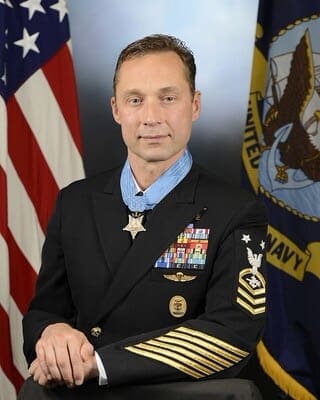
DALLAS, July 1, 2026 — TurboVets, Inc., the AI-powered platform dedicated to automating and accelerating veterans’ full lifecycle benefits management, today announced the appointment of retired Command Master Chief Special Warfare Operator (SEAL) Britt Slabinski, Medal of Honor recipient, as President. Slabinski will lead the company’s operational strategy, veteran community partnerships, and engagement with the VA. This mission execution and leadership are critical as TurboVets scales its technology-driven approach and focus to surpass VA.gov in securing the benefits America’s veterans have earned.

Britt Slabinski stands among the most decorated figures in the history of U.S. Special Operations. On May 24, 2018, President Donald J. Trump presented him the Medal of Honor for his actions at the Battle of Takur Ghar on March 4, 2002 – one of the most intense engagements in modern special operations history. Under withering enemy fire on a snow-covered Afghan mountain at 10,000 feet, Slabinski led SEAL Team Six through a fourteen-hour firefight, made life-or-death decisions under impossible conditions, and demonstrated the kind of courage and leadership that defines the Special Operations community at its best.

Slabinski retired in June 2014 as Command Master Chief Petty Officer of U.S. Naval Special Warfare Command after more than 25 years of service – including nine overseas deployments and 15 combat deployments in direct support of the Global War on Terrorism. Few have served longer, harder, or at greater personal cost and sacrifice.

“The VA has failed veterans for generations. Not because veterans aren’t worthy – they are – but because the system was built to be complex, expensive, antiquated, and adversarial. People have died waiting. That is unacceptable, and it ends now. TurboVets was built to cut through every bureaucratic bottleneck standing between a veteran and the benefits they earned. Britt spent his career doing the hardest things imaginable alongside the best teams in the world – and earning their absolute trust in the process. That’s not a credential. That’s a calling. Paired with TurboVets’ technology and team, it becomes something this country has never seen: a real solution to veteran suicide and benefits management, led by people who will not quit until it’s solved.”

– Joseph Loomis, Founder & CEO, TurboVets

As President, Slabinski will direct TurboVets’ enterprise growth strategy, build and deepen relationships with veteran service organizations, and lead the company’s engagement with Congress, the VA, and U.S. Government stakeholders. Alongside the TurboVets’ leadership team, he will champion the company’s mission and drive accountability within the Department of Veterans Affairs, which has proven to be a difficult relationship to formulate.

“For too long, veterans have had to fight a second war just to access the benefits they earned and were earned by the Department of Veterans Affairs,” said Slabinski. “After more than a year starting with TurboVets as an advisor, I saw firsthand that this team changes that equation. The technology this team has built cuts through the bureaucratic noise and puts veterans in a position to manage their benefits – faster, with better evidence and structure, and without the predatory middlemen or claim sharks who have exploited our community for years. That’s a mission I’m proud to lead.”

– Britt Slabinski, President, TurboVets

TurboVets was built to change history. By automating the benefits process end-to-end and eliminating the costly intermediaries who have long profited from veteran confusion – at the expense of both veterans and taxpayers – TurboVets puts veterans in control of their claims: faster, with stronger evidence, and, more importantly, free of charge.

Veterans kept their promise to America. It’s time for America to keep its promise to them.

The team behind TurboVets spent a decade deploying advanced cybersecurity automation through their former company, CyberSponse, across Fortune 500 enterprises and the highest levels of the U.S. Government – the NSA’s US CyberCommand, the Pentagon, the Department of Energy, and the U.S. Senate, to name a few. They know what it means to build mission-critical technology where failure is not an option. Now they’ve reassembled the team again with a new mission: fixing one of the most broken systems in America.

About TurboVets, Inc.
TurboVets automates the full veteran benefits journey – disability, education, vocational rehabilitation, healthcare, suicide prevention, and VA loans – serving veterans directly and through every state and accredited VSO partner in America. Currently in beta, TurboVets launches nationwide in Q3 2026 and is free of charge to unify the US on a single enterprise solution, with an enterprise team to make enterprise-level impacts. For more information, visit www.TurboVets.com.

NSA, DEVCOM Army Research Office Launch QuantumEAGLe Initiative

July 5th, 2026

FORT MEADE, Md. (June 30, 2026) – The Laboratory for Physical Sciences (LPS) at the National Security Agency (NSA), in close collaboration with the U.S. Army Combat Capabilities Development Command (DEVCOM) Army Research Office (ARO), announces the launch of the Quantum Ecosystem Advancement, Growth & Leadership (QuantumEAGLe) initiative in support of the President’s Quantum Executive Order. This new program aims to accelerate the U.S. quantum computing ecosystem and strengthen the nation’s leadership in quantum technology.

QuantumEAGLe focuses on five key areas to drive innovation and growth in the U.S. quantum industry:

1. Industry Engagement: Foster strong collaboration with the quantum industry to align research efforts with commercial needs and opportunities.

2. Commercial Roadmaps: Enable the development of commercial roadmaps by working directly with industry partners to identify and address key challenges.

3. Supply Chain Advancement: Enhance the performance, manufacturing, and commercial availability of specialized components essential for building quantum computers, ensuring a robust U.S. supply chain.

4. Algorithmic Applications: Discover novel algorithms that provide a quantum advantage and develop error correction techniques to make fault-tolerant computation a reality.

5. Foundational Research: Support research to solve fundamental challenges in qubit performance, simulation tools, and system characterization, laying the groundwork for future advancements.

“Building on LPS’s rich history in Quantum Information Science, which includes decades of foundational research and collaboration with the Department of War, QuantumEAGLe represents a significant expansion of NSA’s quantum computing efforts,” said Liji Samuel, NSA chief of the Laboratory for Physical Sciences. “This initiative is designed to cultivate a resilient U.S. industrial base capable of delivering on the promise of quantum computing for national and economic security.”

According to ARO Acting Director Dr. Purush Iyer, by combining the strengths of LPS and ARO in fundamental research and technical innovation, QuantumEAGLe will accelerate progress toward fault-tolerant quantum computing and ensure the United States remains at the forefront of this critical technology.

“Together, we are building the foundation for future breakthroughs that will benefit both national and economic security and the broader scientific community,” he said.

Dr. Michael Metcalfe, NSA chief of Quantum Information Science, emphasized that the QuantumEAGLe initiative represents a significant step in strengthening America’s quantum computing capabilities.

“By working closely with the quantum industry, we aim to enhance our supply chain, develop cutting-edge algorithms, and overcome fundamental research challenges,” he said. “This collaborative effort will help us maintain U.S. leadership in quantum technology and ensure the security and prosperity of our nation.”

The initiative will leverage flexible contracting authorities and work directly with the U.S. quantum industry to help align research with commercial needs and support stronger domestic capability.

The QuantumEAGLe Special Notice has been posted by the Army Contracting Command on SAM.gov.

To learn more about how you can support this mission or to join the effort, visit www.nsa.gov/careers.

Staccato 2011 Introduces the All-New Staccato HD P4X

July 4th, 2026

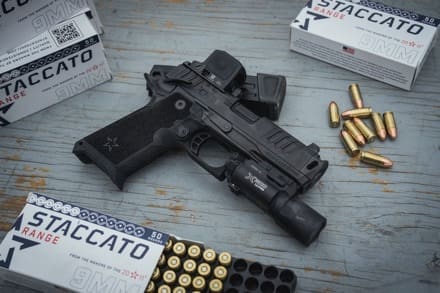
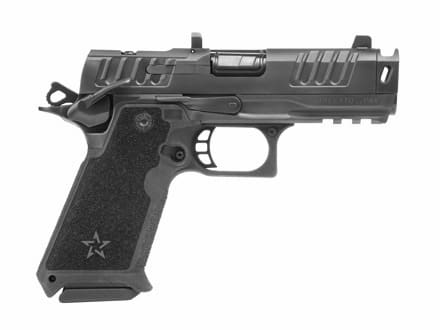
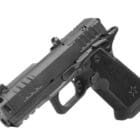
Optimized for professional use, the latest Staccato 2011 HD pistol features a steel frame, full-size grip and compensated barrel for enhanced control and shootability.

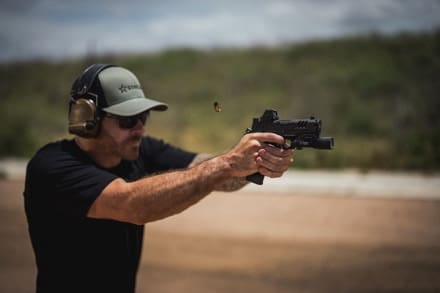
FLORENCE, Texas – (July 4, 2026) – Staccato 2011®, creator of the 2011® pistol platform and a leading developer of precision firearms, ammunition and shooting facilities, today announced the introduction of the Staccato HD P4X, the brand’s most advanced mission-ready pistol.

Built on the same 4-inch compensated platform as the widely popular Staccato HD C4X, which is optimized for concealed carry with a compact aluminum frame, the HD P4X features a precision-machined steel frame and full-size grip, making it ideal for professional deployment, duty belts and overt carry.

Key features of the Staccato HD P4X include a 4-inch DLC flush-fit compensated barrel that reduces muzzle rise and improves shootability, a 4140 DLC steel frame that absorbs recoil and improves shot-to-shot consistency, and a full-size Staccato HD grip that enhances stability and capacity with 18-round magazines. The result is a duty-ready pistol built for control and hard use, delivering the performance and confidence the Staccato HD line is known for.

“Every Staccato product is built to elevate human performance, and the HD P4X is the clearest expression of that yet,” said Paul Smith, Senior Vice President of Product at Staccato. “We engineered a hybrid full-size grip, 4” compensated pistol that delivers more control, more rounds and the kind of shootability the world’s most elite professionals demand. This configuration was one of our most requested, and the result is the most shootable, reliable, mission-ready handgun we’ve ever built.”

The Staccato HD P4X, like all models in the Staccato HD line, represents the most advanced evolution of the 2011 pistol platform. It’s crafted in Texas with American steel and offers exceptional versatility to match its performance. Strategic design features include ambidextrous controls with a dual-sided safety and slide stop, a reversible magazine catch, Glock®-pattern magazine compatibility, an active firing pin block, and Staccato’s HD HOST™ optic-mounting system.

Additionally, every Staccato HD pistol delivers proven performance by passing the federal Ballistic Research Facility standards, a rigorous set of protocols developed to simulate real- world defensive encounters that are the benchmark for evaluating handgun ballistic performance.“Everything we make is aimed at elevating the standard,” Smith added. “From the materials and technology to our development and testing teams, every piece works to give Staccato customers the reliability and shootability they count on.”

The Staccato HD P4X is chambered in 9x19mm and will be available in three configurations, with a starting MSRP of $3,599. It will be offered through Staccato authorized dealers beginning July 13, 2026.

To learn more about the Staccato HD P4X or to locate an authorized Staccato dealer, visit www.staccato2011.com or follow @staccato2011 on social media.

Party Like It’s 1776

July 4th, 2026

This is a big one for the United States…250 years of independence. In this day in 1776, the formal text of the Declaration of Independence was ratified by the Continental Congress. A total of 56 delegates from the 13 colonies signed the document which still inspires freedoms around the world.

I was around for the bicentennial celebration in 1976 and everyone was had the patriotic spirit.

Enjoy the day! We earned it!

Silent Professionals Set the Conditions for Red Flag Success

July 4th, 2026

EIELSON AIR FORCE BASE, Alaska — In the brisk Alaskan air, on a steep hillside overlooking the vast terrain, U.S. Army Special Forces Soldiers assigned to 3rd Special Forces Group (Airborne) are preparing for one of the region’s most demanding combat training exercises: Red Flag-Alaska.

For decades, Red Flag-Alaska has provided aircrews with the opportunity to train against realistic threats under contested conditions, building experience and confidence before facing real-world adversaries. Yet while fighter aircraft streak across the sky above the Joint Pacific Alaska Range Complex, another fight begins long before the first jet takes to the air.

Inside a nondescript room on Eielson Air Force Base, Green Berets huddled around maps, terrain imagery and mission graphics covering nearly every available table and wall space. Tactical communications equipment fills the corners of the room while planners refine timelines and routes. A briefing slide advances across a wall-mounted television, detailing the next day’s mission.

The ground force commander spoke with precision, pointing to a route displayed on the screen. It was a surprising shift. Moments earlier, the team had been smiling, joking and laughing with each other. Now, they were all business, shifted into attentive and deliberate professionals. Routes, contingencies and communications plans were discussed with the matter-of-fact tone of a team who had rehearsed the process countless times before. The mission is part of Operation Close Shave, the ground component executed by the Green Berets in support of the large scale combat operations exercise scenario.

While fighter aircraft may be the most visible element of Red Flag, they are rarely the spearhead of the operation, Green Berets shaping the battlefield before they leave the runway.

Before aircraft can operate freely in contested airspace, special operations forces work deep within contested or enemy territory to identify threats, gather intelligence and create conditions that allow the joint force to maneuver. An ODA, or Operational Detachment-Alpha, the foundational unit of action for U.S. Army Special Forces, provides commanders with the information required to help clear a path for the aircraft and paratroopers that follow.

A two-hour trip south, near Delta Junction, brings the ODA to a pothole-filled side road, Denali’s peak reaching out of the horizon like someone painted it onto the sky. Alaska’s natural beauty served as a somewhat dangerous distraction while in the opposing force’s territory; the simulated country borders indicated that the team was well behind “enemy” lines.
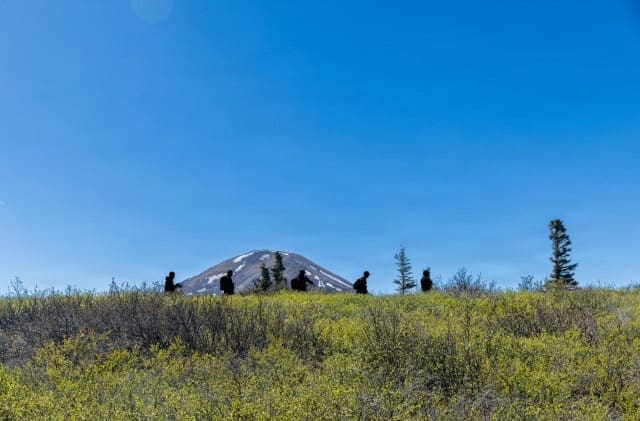
A group of individuals on the roadside approached the lead vehicle, the driver became cautious before realizing these were allied counterparts, operators and paratroopers from the Belgian 3 PARA (Regiment). From wary to relieved, all are smiling as introductions were exchanged and the Belgians offered to show the way to the “safe house.” Safe houses act as bases of operations for Special Forces operators; while not necessarily a house in many cases, they act as both a command center, shelter, cover, and concealment from enemy forces and civilian populations, respectively.

This particular safe house, The Alaska Flour Company is a real-world business and working farm that would function as the team’s base of operations for the next week, playing into their scenario simulated cover story as seasonal farm workers in the area; an effort to blend in with the local populace. Equipped with fake IDs and cover stories, the option to fight was only ever considered as a last course of action.

The wooden structure housing the teams was not much more than a long, wide, dark, open corridor used for grain processing, the structure being colder inside than it was out. The Belgians had set up a barrel fire outside to warm their extremities from the frigid interior of the flour plant. One of them said something in Dutch as the others around the fire laughed, stoking the flames. It was a moment of relaxation and comfort before the long days ahead.

Hours later, vivid colors painted the Alaskan sky as the multinational team of special operators moved quietly along a riverbank, carrying the equipment they would need for days of reconnaissance.

The absence of darkness during the far north’s summer nights increased the risk of detection during their no-fail reconnaissance mission. Heavy animal activity in the form of large predator’s leftover meals served as constant reminders of the dangers posed by the wildlife surrounding them. With the high-risk environment in mind, the operators set up fallback positions, established communications with rear command elements and edged toward their objectives.

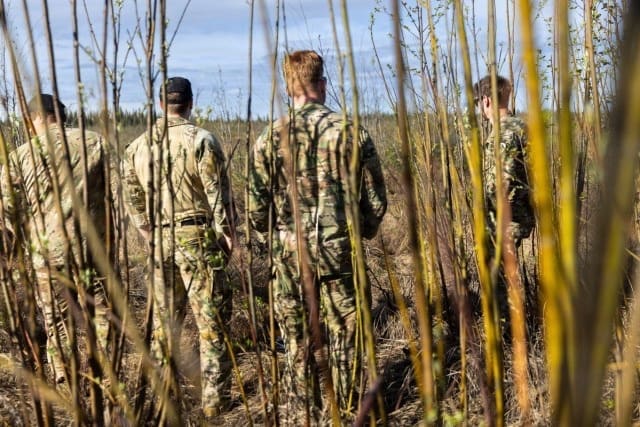
Using a mix of fieldcraft and technology, the teams split into two-man elements and traversed through thick woods toward the scenario’s air defense objectives.

Through the brush, a fenced-off compound emerged ahead, revealing large mockup integrated air defense systems depicting surface-to-air missile launchers, radars and other mobile air defense equipment. The mock missile launchers hidden among the trees represented exactly the type of threat Red Flag planners wanted the ODA, and their allied counterparts, to confront.

In the exercise scenario, a network of integrated air defense systems, radar sites and command-and-control nodes formed layered barriers, designated to deny access and maneuvering capability to coalition aircraft. These systems force pilots to contend with threats capable of detecting and engaging their aircraft long before they reach critical objectives.

Finding those threats is where special operations provide a critical advantage. Small teams, specializing in operating in hostile, denied and contested environments, infiltrate challenge areas to observe targets, evaluate and/or confirm intelligence and develop a comprehensive picture of the operational environment. The information they collect helps commanders distinguish between suspected targets and verified threats, reducing uncertainty before air assets are committed.

In an era increasingly defined by technological advantages such as satellites, drones and electronic sensors, it may be tempting to assume technology alone can provide every answer. However, modern battlefields remain environments of constant adaptation, where adversaries actively employ camouflage, deception, electronic warfare measures/countermeasures and other techniques designed to obscure themselves and their operations. A target detected by one sensor may prove to be a decoy when observed from the ground. Even the most advanced collection platforms can produce incomplete or conflicting information when confronted by a determined adversary. In the end, commanders often still rely on someone physically confirming at the target site and reporting accurate and timely information.

“The problem with satellite sensors is they have a harder time maintaining eyes on,” said one of the Special Forces Soldier. “If we are able to get behind enemy lines and conduct an operation like this, there’s a constant ground sensor.”

For ODAs, fieldcraft, observation and direct confirmation remain indispensable tools. The ability to physically verify with eyes on a target provide joint forces commanders a level of certainty that technology alone cannot always deliver. In a contested environment, that assurance can mean the difference between a successful air campaign and aircraft flying into unknown threats.
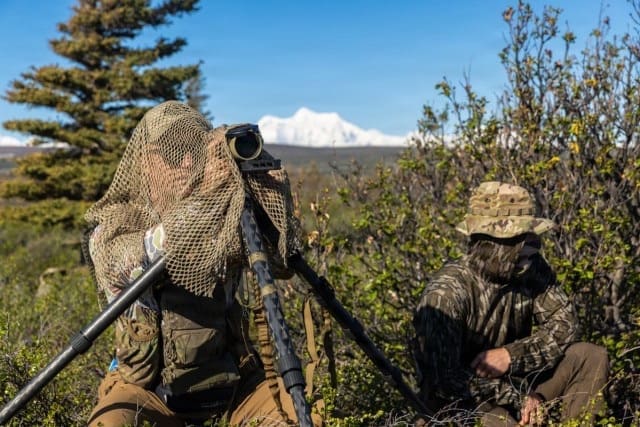
“We are deep behind enemy territory trying to open the air corridor and allow conventional forces to parachute in and gain control of this area,” the Soldier said. “We’re here in support of the main effort, which is the joint force entry of the 11th Airborne Division, so they can jump in, get boots on the ground and begin taking control of key terrain or infrastructure.”

The ODAs remained concealed among moss-covered logs and dense vegetation bordering the clearing, quietly observing and transmitting information while remaining mindful of OPFOR operating in the area.

“No troop transport planes, C-17s or anything like that, can gain access to this airspace to conduct an air operation until these are taken out,” the Soldier declared. For the next several days, reconnaissance and observation remained the primary mission. Operators relied on their advanced knowledge of wilderness survival skills, keeping fire going, supplementing field rations with food gathering and demonstrating basic shelter construction. Despite the constant sunlight, temperatures plunged into the low 30s overnight. Frigid hours bundled in waterproof clothing without a heat source were but a glimpse into the conditions special operations personnel endure during real-world operations.

Although they had not yet encountered OPFOR, the implications of doing so remained top of mind.

“… The risk is detection and compromise,” the Soldier explained. “A mission like this in real life is extremely dangerous.” The Soldier emphasized, in no uncertain terms, just how perilous a task this can be. It was a sobering assessment. But how do operators mitigate that risk? “That’s why we do training like this,” he continued. “To figure out where our gaps are. Figure out where we need to improve. The only way you can infiltrate this deep, in my opinion, is by blending in, maintaining a very low signature and a very low pattern of life.”

During a quiet moment of the perpetual daylight, around 3 a.m., coffee simmered in a portable carafe one operator had carried into the field. A reminder that even among highly trained professionals, caffeine remains less a luxury than a necessity.

It was much the same for the next few days — observing and reporting — though it was hardly monotonous in the beautiful Alaskan wilds, especially when broken up by the appearance of wandering wildlife in the distance.
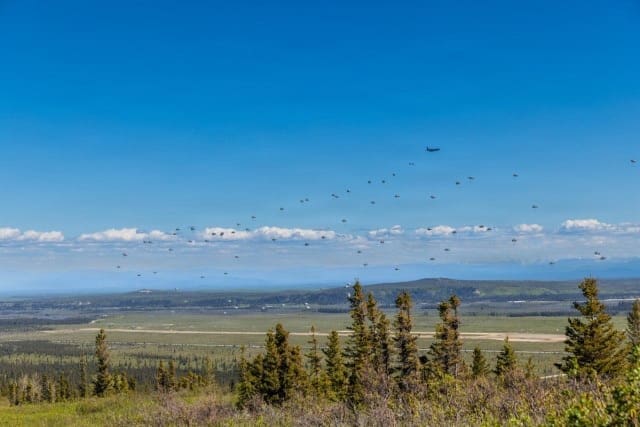
The day of the culminating event arrived, having moved to a mountainside near Fort Greely. Another Special Forces Soldier sat at an observation post overlooking an FLS, or field landing strip. Although runway-sized, was more or less a stretch of dirt that had been flattened and cleared of the pervasive brush that blanketed the rolling terrain.

The Soldier could see the opposing forces’ vehicles moving along the strip, ant sized from the nestled vantage point amongst the thick shrubbery adorning the mountainside. Crouched still while waiting for word on a strike mission, he discussed the role of the Belgian counterparts.

“So they’re going to be at the north end of the [drop zone]. Their leadership right now is co-located with [ground force commander] out here at the MSS,” the other ODA team member said, referring to the mission support site. “But they’re going to be at the north end of the DZ and they’re going to try to take a sniper shot to take out a guy with a man-portable air defense. He’s carrying an SA14. Going to try to find him… and then that way we can bring in [combat air support] and we can facilitate close air support, and help enable the joint forcible entry by the 11th Airborne Division.”

Put simply, the mission was to remove the threat preventing joint force aircraft from entering the area of operations — a task that was certainly easier said than done. Less than an hour later, the answer arrived with the roar of an F-16 Fighting Falcon overhead as it rolled in on its targets.

With the air defense systems neutralized, the spread-out teams gathered on the sloping overlook to watch the dozens of transport aircraft — American C-130s and Belgian A400Ms — begin to drop paratroopers by the score along the FLS. The ground forces’ mission was complete. Fighter jets and transports successfully reached the objective, and as the crack of the infantry’s weapons rang out over the peaks, the hasty exfiltration back to the vehicles began.

But the TACP, or tactical air control party, had one last surprise in store for the rest of the ODA. Confirming the transport craft had cleared the airspace, they radioed yet again, this time to the F-16s still circling the area and requested a “show of force.” While discussing what grid coordinates to give, one of the ODA members grinned and pointed. The unsuspecting range control contractors had been parked in their pickup trucks nearby for quite a while, breaking the illusion of the war game with their necessary presence. Still smiling, the TACP suggested, “How about them?”

Moments later, the F-16s screamed directly overhead, buzzing by the unsuspecting 4x4s, the frames of the trucks rattling as the contractors within suddenly jolted from their seats.

Descending toward the mountain pond vehicles were parked next to, Alaska revealed one last pleasant surprise. Grazing across the small body of water, a herd of caribou had come into the open, looking up and regarding the team with vague interest.

In the distance, the roar of jet engines was still audible, and as the ground forces’ role in Red Flag came to a concluded, the forces in the air were now free to dominate the battlefield, the conditions for success already set by the operators on the ground.

By SGT Nicholas Riccio

Freedom Atlantic Introduces FPV Training Drones

July 3rd, 2026

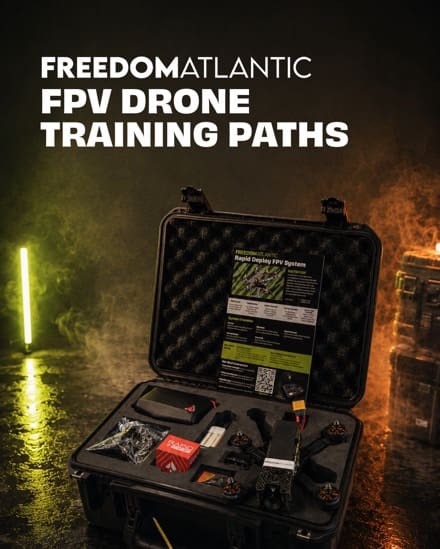
Freedom Atlantic now offers three 5″ FPV drone packages designed to meet you your mission.

1. Build it yourself. Receive the kit, follow the training path, and learn every component along the way.

2. Ready-to-fly. We assemble and configure the system so it’s ready to fly right out of the case.

3. Full immersion. Choose the location and our team will train you to build, program, train, and fly your FPV platform.

Ready to fly.

Ready to build.

Ready to become an operator.

Learn more at www.freedom-atlantic.com

#FreedomAtlantic #FPV #DroneTraining #UAS #MilitaryTechnology

SOFWERX – Warfighter Radio Industry Day

July 3rd, 2026

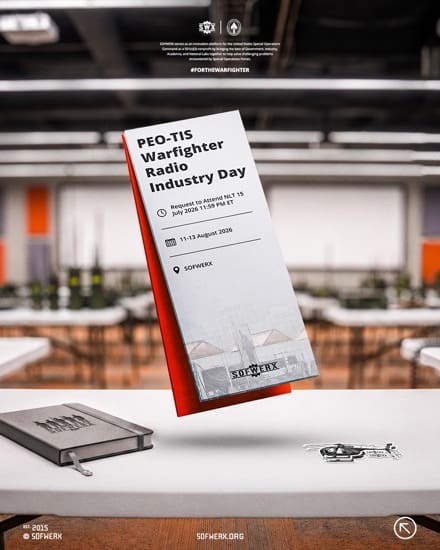
SOFWERX and USSOCOM PEO-TIS are hosting a Warfighter Radio Industry Day August 11 to 13 at SOFWERX to gain a better understanding of the current market and the technical capabilities of a Key Leader Radio (KLR), an Intra Team Radio (ITR), and a Team Networking Device (TND).



USSOCOM has a critical need for reliable and secure communications for dismounted warfighters operating in a variety of challenging environments, including those that have denied, degraded, intermittent, and low-latency communication operational areas. Key Leader Radios (KLR), Intra Team Radios (ITR), and Team Networking Devices (TND) provide a multi-platform communications strategy enabling resilient, self-healing, and autonomous solutions for voice transmission, data transmission, and networking capabilities at the team and leadership levels.

This effort is for informational and planning purposes only and does not constitute a Request for Proposal (RFP).

U.S. Companies Only. Submit NLT 15 July 2026 11:59 PM ET.

events.sofwerx.org/peo-tis-radio-industry-day

BDS Tactical Gear Partners with Qore Performance to Bring ICEFLASK Cooling Canteens to Exchange and Selected MCX Stores Overseas

July 3rd, 2026

Oceanside, CA and Knoxville, TN — July 2, 2026 — BDS Tactical Gear has partnered with Qore Performance, Inc. to launch a complete, mission-ready hydration and thermoregulation setup directly onto the shelves of military Exchange (AAFES) and selected Marine Corps Exchange (MCX) locations overseas.

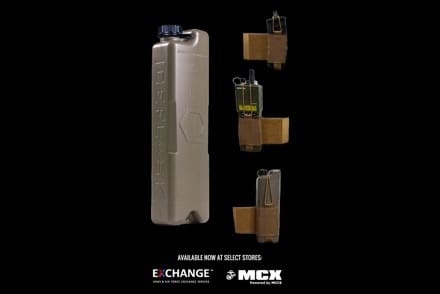
By pairing the Qore Performance ICEFLASK® canteen with the BDS Tactical Gear Inner Cummerbund Winglet system, this partnership puts wearable cooling, heating, and hydration right where service members shop on post, making it immediately accessible for standard plate carrier setups.

“We at BDS Tactical Gear are excited to build on the long-term relationship with Qore Performance, bringing quality American-made products to the brave patriots that defend our nation every day,” said Mike Bornfriend, President / CEO of BDS Tactical Gear.

System Capabilities & Performance Specs

The combined system integrates directly into service members’ existing plate carrier setups, providing high-retention utility without adding bulky, shifting pouches to the exterior of the kit.

Qore Performance ICEFLASK®: A rugged, 0.5L (16.9 oz) rigid hydration canteen designed to be frozen or filled with hot water to provide active temperature management alongside hydration. It is built specifically to match the slim form factor of a standard PRC-152 tactical radio, allowing it to slide into space-saving radio pockets rather than heavy, traditional round bottle pouches.

BDS Tactical Gear Inner Cummerbund Winglet Pouch: Built using heavy-duty hook-and-loop fields to mount securely underneath a plate carrier’s cummerbund in a ‘radio wing’ configuration. The premium elastic construction offers tight, zero-slop retention. This multi-role pouch is highly versatile, engineered to securely carry the ICEFLASK®, standard NATO radios, or standard 30-round M4-style 5.56 magazines.

Immediate Global Availability

The ICEFLASK® and BDS Tactical Gear Winglet setups are available now. Service members can find them stocked at the following Exchange and selected MCX locations overseas and stateside:

Stateside Locations:

  • JBSA-Lackland (South Troop)
  • Fort Cavazos (Hood AMCSS)
  • JAC Coleman Troop
  • Fort Sill (Cons Quarry Hil)
  • JBLM-Lewis (New AMCSS)
  • BLSC AMCSS
  • Fort Riley (Riley AMCSS)
  • Fort Liberty (Bragg Army MCS)
  • Fort Carson (Carson AMCSS)
  • Fort Leonard Wood (Leonardw AMCSS / Trp St 744)
  • Joint Base San Antonio (JBSA-Sam AMCSS)
  • Camp Atterbury (Atterbury AMCSS)
  • Nellis AFB (Nellis AFMCSS)
  • NASJRB AFMCSS

OCONUS & Forward Deployed Locations:

  • Camp Humphreys, South Korea (Hump MCSS)
  • Camp Buehring, Kuwait (KW Buehring Z2 Store)
  • Camp Arifjan, Kuwait (KW Arifjan Z6 Store)
  • Vilseck, Germany (Vilseck AMCSS)
  • Novo Selo Training Area, Bulgaria (BG Novo Selo)
  • Al Udeid Air Base, Qatar (QA Al Udeid MCSS)
  • Camp Bondsteel, Kosovo (Kosovo MCSS)
  • Andersen Air Force Base, Guam (JRM-Andersen Main St)

Selected Marine Corps Exchange (MCX) Overseas Locations:

  • Camp Hansen (MCX Hansen MMCSS / Branch St)
  • Camp Schwab (MCX Schwab MMCSS)
  • Camp Foster (MCX Foster MMCSS)
  • Camp Kinser (MCX Kinser MMCSS)

Beyond these exchange locations, Qore Performance thermoregulation equipment is available at BDS Tactical Gear’s brick-and-mortar stores in Oceanside and Twentynine Palms, California, and online at BDStacticalgear.com. The complete ICEAGE ECOSYSTEM can be found at qoreperformance.com.