To promote their line of tactical nylon manufactured in the popular Multicam camouflage pattern, Tactical Assault Gear has launched www.tagmulticam.com.


To promote their line of tactical nylon manufactured in the popular Multicam camouflage pattern, Tactical Assault Gear has launched www.tagmulticam.com.
Down Range Gear recently launched their website and offers several innovative designs at low prices. In particular is the Night Vision Retention lanyard. At $2.50 it is a steal for those who require a simple leash for their NODs.

Available in Coyote and Foliage from Down Range Gear.
This report comes from one of our readers currently deployed to the CENTCOM AOR. He also tell us that the Z-mask from McNett that we previously reported on is a “lifesaver for night shift guys”.
Not every cool, Soldier friendly textile gadget is made by a tribe of retired SOF operators in a basement workshop with long lead times. Some are available from pedestrian sporting goods suppliers. Case in point: The Cabelas’ Cotside Nightstand.
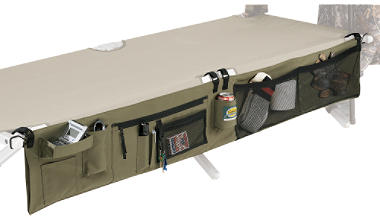
The standard green folding cot is a fact of life at staging bases and most primitive FOBs. Be it 150 troops in a circus tent in Kuwait or up on the 4th floor of a JSS in Baghdad, every military member sleeps on a cot at some point. One of the constant problems is where to put “the little things†that one normally sticks on a nightstand, such as travel alarm clocks, flashlights, reading material, eye mask (link McNett eyemask here), or iPod. Sitting them atop an assault pack or duffel bag inevitably ends up with some of your treasures on the floor on getting stepped on by your tentmates, especially if you are packed in.
A simple, inexpensive solution is the Cabela’s Cotside Nightstand. When rolled up, it takes up about as much room a Nalgene bottle but unrolls to 74 x 11.5 and attaches to any standard cot or metal framed bed with Velcro straps and shockcord loops at the ends. When attached to a cot, there is still 3 or so inches of free space below the edge to access your high speed ninja flipflops or more pedestrian shower shoes and running shoes.
Numerous pockets allow stowage of books, sidearms, flashlights, small “netbook” laptops, and a clever fold down shelf for travel alarms is near the head. In addition, there is a full length sleeve for long guns but it’s impractical to use with protuberance laden M16/M4 type weapons. The can holder will hold a Green Beans coffee cup or a 500ml bottle of water but isn’t big enough for the standard 1L water bottle.
It’s made of a Cordura-esque texutrized polyester and the construction is on par for its price and purpose. It could be made more robustly out of 1000D Cordura but that would needlessly increase weight, packed bulk, and cost.
For tent/primitive FOB living, it is definitely a “must have†and is worth cramming in your duffle or load-out bag.
About $25 from Cabelas.
In an update to the NY Times story of Finnish concerns over Russia’s purloining of their Army’s camo pattern, Strike Hold has published a photo of Russian troops in Georgia wearing the Finnish m05 camo as well as a copy of Brit DPM.
Recently some photos of PECOC trials webbing appeared on the net. MOD still has not settled on a camo scheme but the Hybrid Cam for load carriage seems to be catching on. In fact, as you will see in the photos, the actual nylon webbing is in the pattern and there are plans to offer camo buckles and Hypalon as well.
On the load carriage side, there are currently 14 MOLLE-style (yes, we said MOLLE) pouches associated with the PECOC program in addition to a new set of webbing, assault vest, patrol sack, rucksack (bergan), plate carrier, and armor vest. The armor vest has been slimmed down a bit from the current Osprey design in order to improve the agility of the wearer. However, an improved Osprey is in the works for use when there is a need to go in heavy.
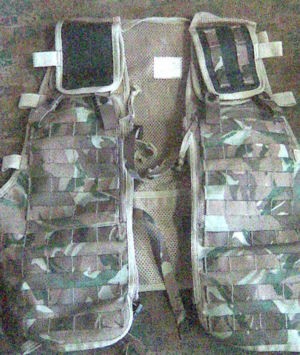
One of the most interesting features on the assault vest is the use of Hypalon. This can be seen in the photo as Black surfaces. Non-skid has been in use for some time on the shoulders of vest in order to “lock” the buttstock in place. However, the concept’s application in PECOC goes one step further. Hypalon is also sewn to the underside of straps in order to provide improved purchase. Additionally, a large MOLLE grid is supplied in order to customize the vest.
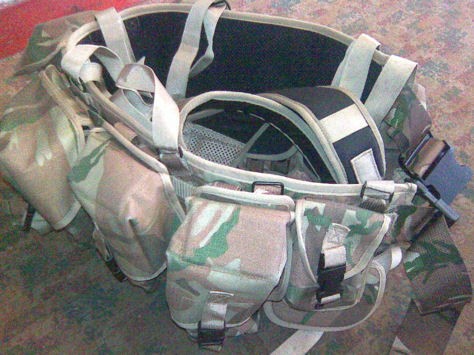
Similar to the current Soldier 95 webbing, the new PECOC variant relies on a “Hippo” padded belt as a foundation. Added to this is a yoke with Hypalon patches on the shoulders and a family of pockets. One item still requires some additional development and that is the closure system for the pouches. Apparently, they are having difficulty establishing a consensus on which style is preferable.
It seems several years ago a paintball team in the UK commissioned a custom camo pattern to commemorate their name; the Vulcans. We will let the pics speak for themselves.

Yes, that’s Spock’s face on that smock. Thanks to a reader for the pics!

New from Bushnell Outdoors comes the Backtrack, a new take on GPS receivers. Intended as a low cost alternative to more complicated GPS systems, simplicity was key in it’s design. The Backtrack stores up to three locations and uses an onboard digital compass to guide you back to one of the stored points. The device has only two buttons. Simply turn it on and then mark a point such as your truck on a hunting trip. In the event you need to return to a stored point, the Backtrack will give you a direction and distance to the waypoint. Our only concern for military use with this device is that there is no simple way to zeroize it on the event of capture. However, it is a simple and inexpensive GPS receiver for many applications and would not only be a good choice for personnel who would not normally have access to a GPS receiver but also for use off-duty or for family members when away from home.
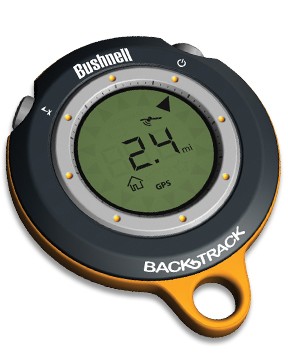
The Backtrack uses two AAA batteries and contains a SiRF Star III GPS receiver chip. It can be dummy corded utilizing the integral lanyard loop and comes in Yellow, Green, Woodland, Grey, and Pink.
To order visit Bushnell.
Photo from Bushnell.
As you enjoy your Thanksgiving meal take a moment to consider what our Astronauts on the International Space Station are eating. Its a turkey dinner with the trimmings but conventional, it ain’t. But fortunately for NASA crew, rations have come a long way since the tubes used on the Apollo program.
A reporter from Discovery News got a chance to sample some of the cuisine last week. His opinion? Bland. io9, a science fiction blog also has a few photos.