GORE-TEX WINDSTOPPER

Archive for August, 2025

VLTOR Weapon Systems Brings Industry Veteran Ash Hess Onboard

Monday, August 4th, 2025

Tucson, AZ — VLTOR Weapon Systems is proud to announce the addition of Ash Hess to its leadership team, where he will play a key role in business development and military sales.

Hess brings nearly 30 years of combined military and industry expertise. A retired U.S. Army Cavalryman and respected marksmanship instructor, he was instrumental in the authorship of multiple small arms training manuals and doctrinal updates, including TC 3-22.9. His recent work in military sales at Knight’s Armament Company focused on fulfilling end-user requirements by bridging the gap between engineering, operational needs, and product delivery.

“Bringing Ash onto the team is a strategic move as VLTOR enters its next chapter,” said Nick Wantland, Manager of VLTOR Weapon Systems. “His insight into end-user needs, especially in military contexts, will be key as we develop the next generation of VLTOR platforms.”

Since its founding in 2001, VLTOR has built its reputation on producing duty-grade components trusted across civilian, military, and law enforcement communities.

“I’ve had the privilege of working with some of the most respected names in the industry,” said Hess. “What drew me to VLTOR was its legacy — gear built for professionals, by professionals. It’s a quiet powerhouse, responsible for many of the innovations and systems that have become industry standards. Being part of the team is truly an honor.”

The Terminal List Gear Guide

Monday, August 4th, 2025

If you’re an SSD reader, you’re into kit. Likely, you’re probably a fan of author Jack Carr’s books because of his keen attention to detail. He’s well known for dropping some of the best gear out there into the hands of his hero James Reece.

Carr has published a gear guide to go along with his latest work, “The Terminal List”, complete with links to get your own.

Read it at www.officialjackcarr.com/gear-guide-the-terminal-list.

US Army Tests ULTRA AI Unmanned Ground Vehicle During Ex Agile Spirit 2025

Monday, August 4th, 2025

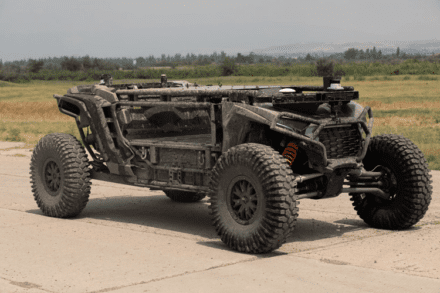
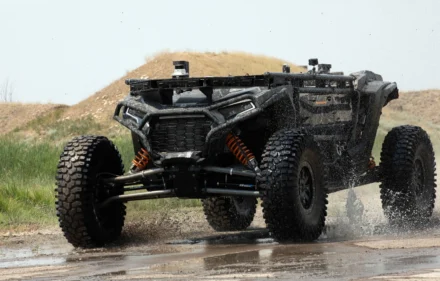
During exercise Agile Spirit 2025 at the Combat Training Center, Vaziani Training Area, Georgia, members of the 1st Squadron, 91st Cavalry Regiment, 173rd Airborne Brigade, tested the Uncrewed Long-range Transport Autonomy (ULTRA) Fully Autonomous Tactical Vehicle.

Manufactured by Overland AI, ULTRA relies on their OverDrive autonomy software to negotiate terrain using inputs from the vehicle’s suite of onboard sensors which include, stereo cameras, light detection and ranging tech, thermal imagers, inertial measurement units, and GPS-denied localization tools.

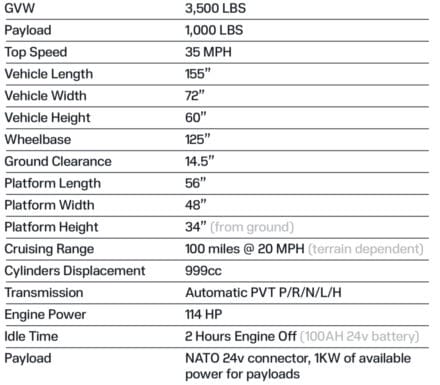
ULTRA is an all-wheel, off-road drive vehicle with a maximum speed of 35 miles per hour. It can deliver up to 1,000 pounds with a cruising range of 100 miles at 20 miles per hour (terrain dependent).

Their TAK compatible command and control system is called OverWatch which allows one-to-many control by humans in the loop enabling them to task and execute missions while keeping their focus on immediate threats and tactical objectives.

ULTRA accepts modular mission payloads and can be configured for a variety of applications:

1. Reconnaissance and strike
2. Layered counter-UAS protection
3. Breaching
4. Resupply & logistics
5. Rapid and decisive maneuver
6. Spectrum and terrain shaping
7. CASEVAC
8. CBRN detection and decontamination

Specs:

This month, Overland AI personnel will demonstrate a C-UAS and intelligence, surveillance, and reconnaissance (ISR)-enabled ULTRA for Under Secretary of Defense for Research and Engineering (OUSD R&E), as well as the Army and United States Special Operations Command (SOCOM).

US Army photo at top by SGT Alex Lopez

Lower Army photo is by SGT Cameron Boyd

U.S. Army National Guard video by SGT Ehron Ostendorf

Werewolf Tactical – M 11 Alpha Ballistic Facial Shield

Monday, August 4th, 2025

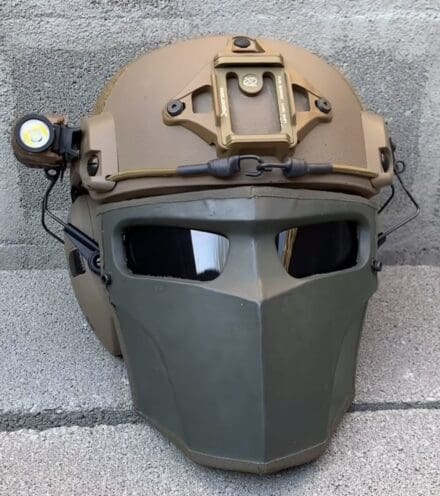
Introducing the M 11 Alpha Ballistic Facial Shield – A New Standard in Integrated Protection.

Werewolf Tactical has unveiled the M 11 Alpha, the first fully integrated facial protection system of its kind. Designed for those who demand uncompromising safety, the M 11 Alpha delivers Level IIIA ballistic protection to the maxillofacial region, safeguarding critical areas without compromising mobility or visibility.

Engineered with precision, the M 11 Alpha also features high-performance polycarbonate eye protection that exceeds military specifications, ensuring clarity, durability, and enhanced impact resistance in the field.

Key Features:

Full maxillofacial ballistic coverage (Level IIIA)

Above mil-spec standard polycarbonate eye shield

Seamless integration for tactical operations

Lightweight, ergonomic design for comfort and performance

Whether you’re operating in high-risk environments or preparing for mission-critical situations, the M 11 Alpha sets a new benchmark for facial defense.

Protection. Innovation. Confidence. – That’s the M 11 Alpha.

Available soon…

Werewolf-tactical.com

U.S. Army Continues to Streamline Procurement and Financial Processes with Release of New Interface

Monday, August 4th, 2025

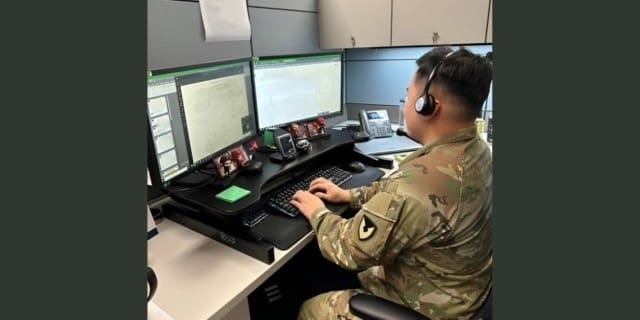
U.S. Army Program Executive Office Enterprise (PEO Enterprise) and the Office of the Deputy Assistant Secretary of the Army for Procurement (ODASA(P)) have successfully implemented the Logistics Modernization Program (LMP), Army Working Capital Funds (AWCF) and Army Contract Writing System (ACWS) interface. The new interface provides better automation for transmitting contract awards and financial data from ACWS to LMP, helping streamline procurement and financial processes across the Army enterprise.

With the LMP-ACWS integration, ACWS users who receive AWCF-funded LMP purchase requests can now award all new actions in ACWS that support sustainment, logistics and supply management and maintenance. LMP users now can enter both the item and service requests on one purchase request, rather than creating multiple purchase requests. The new interface helps save time, reduces paperwork and links the service to specific parts for better tracking and auditability.

“This is a noteworthy step forward as the new LMP-ACWS interface reduces manual entry, improves data accuracy and supports timely obligation and contract execution tracking,” said Kevin Stoddard, an ACWS lead for ODASA(P). “It also eliminates duplicate data entry, where any updates — particularly for purchase requests — are synced bi-directionally, so there are no duplicate changes. Users enter data once in ACWS, and the data is automatically mapped to LMP/AWCF fields.”

The new LMP-ACWS interface is a major enhancement initiative to implement purchase request and procurement data standards and handshake interfaces as ACWS prepares to replace the Army’s Procurement Automated Data and Document System (PADDS) and Standard Procurement System (SPS) legacy contracting systems.

Lt. Col. Camille Morgan, product manager for ACWS at PEO Enterprise, says the successful implementation of the LMP-ACWS interface is part one of a two-phased approach in its ongoing modernization and readiness efforts.

“We are pleased with the successful release of phase one, which enables AWCF execution with ACWS and supports SPS sunset scheduled for December 2025,” said Morgan. “By standardizing purchase requests and procurement data, LMP and ACWS can more easily talk to each other, reducing errors across systems and delivering purchases faster.”

In October 2025, PEO Enterprise is expected to begin phase two, which will enable general fund and customer fund execution with ACWS, as well as support PADDS sunset.

Through these integrated advanced capabilities, ACWS is supporting Army readiness by helping to reduce lead times, making the procurement process faster and getting equipment and services to Soldiers as quickly as possible.

By partnering with LMP, an enterprise resource planning system that uses one of the largest, fully integrated supply chain and maintenance, repair and overhaul solutions in the world, ACWS remains committed to delivering a more effective and modernized contracting experience that meets the Army’s mission of transformation and readiness.

By Carolyn Martino, PM DIBS Strategic Communications

Preparing for Air Force Special Warfare: Inside the Athletic Leadership Boot Camp

Sunday, August 3rd, 2025

The 330th and 331st Recruiting Squadrons, teamed up to host an Athletic Leadership Boot Camp at 17 Springs Complex, Millbrook, Alabama, July 18, 2025. The ALB featured teamwork-focused drills designed to build strength, resilience and camaraderie. Exercises included navigating with blacked-out goggles, sandbag sled pulls and a sandbag walk across the end zone. Staff Sgt. Andrew Hestley, 330th Recruiting Squadron special warfare scout, emphasized the importance of teamwork and physical fitness in preparing recruits for the challenges of Special Warfare. (U.S. Air Force video by Airman 1st Class Nelvis Sera)

Army Chaplains Mark 250 Years of Ministering to Soldiers

Sunday, August 3rd, 2025

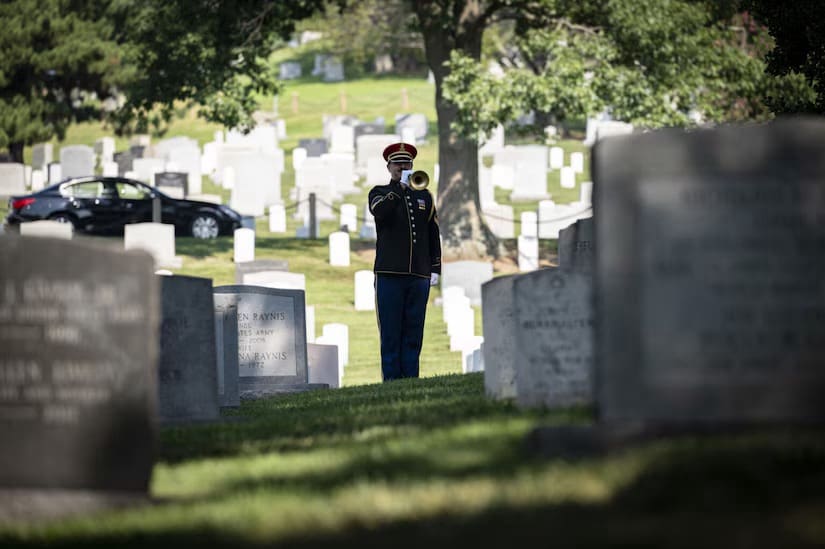
The Army recently celebrated its 250th birthday — two and a half centuries of defending the nation since standing up, June 14, 1775. Not long after, on July 29, 1775, the Army Chaplain Corps was established to provide ministerial support to those soldiers.

“The members of today’s Army Chaplain Corps are sustaining and enriching a sacred legacy, which our predecessors began building even before our nation was founded in 1776,” said Army Chaplain (Maj. Gen.) William Green Jr., the 26th Army chief of chaplains. “Gen. George Washington requested that chaplains be added to the Army to meet soldiers’ religious and spiritual needs, and to support good morals and morale.”

At the request of Washington, the Continental Congress authorized one chaplain for each regular regiment of the Continental Army, Green said, adding that many of the militia regiments that served alongside those in the Continental Army also had chaplains.

Today, he said, the role of the Army Chaplain Corps remains as important as it was 250 years ago. The Chaplain Corps has evolved to include more than 3,000 chaplains, nearly 3,000 religious affairs specialists, more than 500 chaplain candidates and more than 50 directors of religious education across the regular Army, Army Reserve and Army National Guard. They continue to provide important religious support and advice on spiritual matters to soldiers of all ranks.
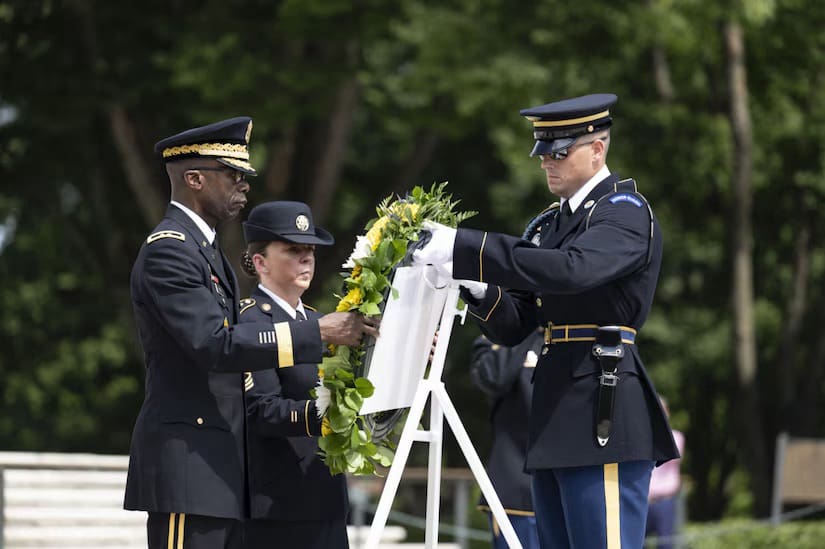
“Our U.S. Army Chaplain Corps is the most multifaceted and capable chaplaincy in history, and we will remain so, to support our Army’s preparations to win during multidomain and large-scale combat operations in the years ahead,” Green said. “Our corps is a unique branch of the total Army that remains a necessary, critical contributor to our nation’s success on the battlefields of the future, just as it was on the battlefields during our nation’s war for independence.”

Army Chaplain (Capt.) Bryce A. Wiltermood, a Protestant chaplain assigned to the 7th Special Forces Group at Eglin Air Force Base, Florida, didn’t start out as an Army chaplain. Back in 2005, he enlisted in the Army as an indirect fire infantryman serving in the 75th Ranger Regiment and the 101st Airborne Division.

“It was a four-year enlistment,” he said. “In those four years, I spent 18 months in combat zones as a mortarman. I went to Iraq … multiple deployments, but a total of 18 months.”
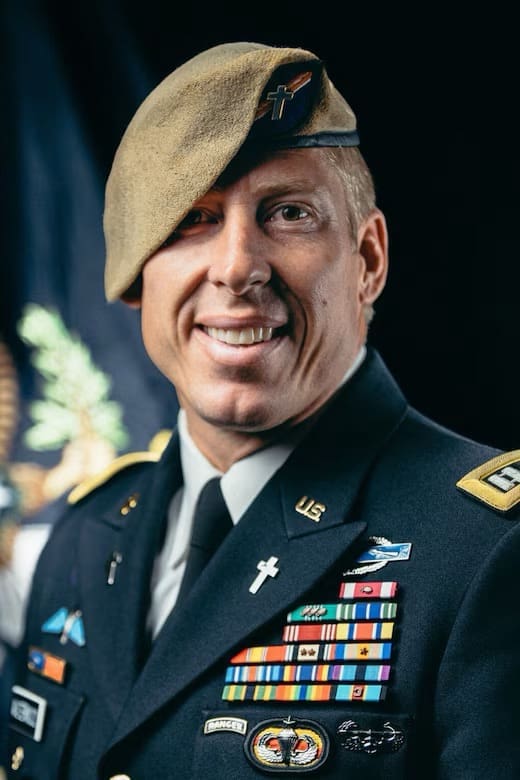
Following his initial enlistment, Wiltermood left the regular Army, transferred into the Army Reserve and completed a degree in psychology. But by that time, he said, he was thinking about donning the uniform again.

“I knew I wanted to continue serving, but I wanted to serve, I guess, in a different aspect,” he said. “If I had to pinpoint it, it was from just really good chaplains that made a big impact on me. And so, after prayer and talking with my wife about it, this was a calling that I just pursued, kind of toward the end of getting my bachelor’s degree … [I] went from there and got my master’s in divinity.”

After completing his master’s degree, Wiltermood reenlisted in 2016 as an Army chaplain. He is back on the front lines, this time without a weapon but instead ministering to the soldiers who do the fighting.

“I’ve had a few more deployments,” he said. “I went into combat zones in Iraq, Syria and Jordan. The chaplain is there to provide for this free exercise of religion for the troops, but also to advise commanders. Some key responsibilities or roles for chaplains include conducting religious support, spiritual or emotional care to the troops … advisement is a big one, crisis response, casualty care, taking casualties, and just general resilience and readiness to … soldiers. [Through] spiritual fitness events or counseling or helping to prevent suicide … the chaplain is a commander’s tool to help ready the force.”

The best chaplains seek out soldiers, Wiltermood said; they don’t wait for soldiers to come to them.
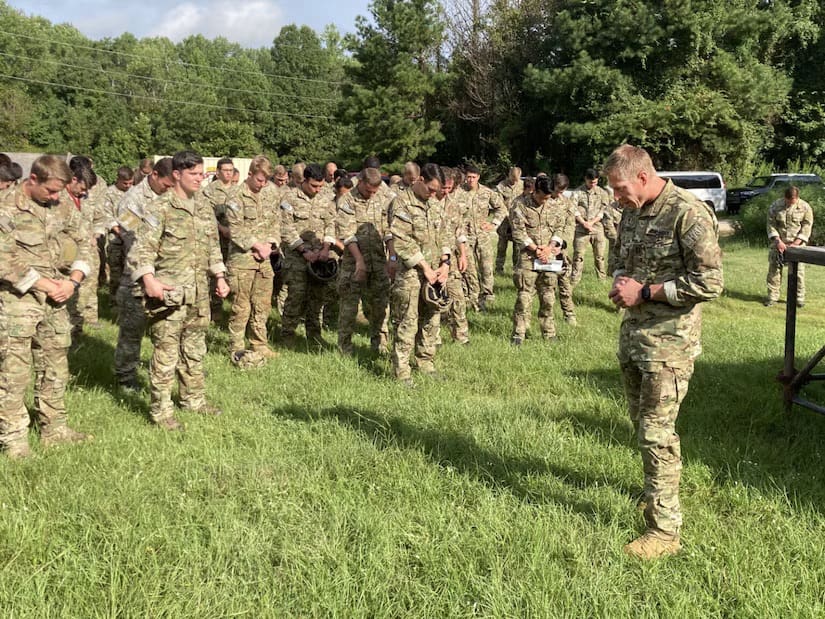
“I think the chaplain should be out there and provide opportunities … whether on a patrol or gate guard, the shooting range, or PT in the morning,” he said. “Wherever soldiers are, the chaplain should be there building relationships of trust.”

Wiltermood said he plans to stay in the Army for as long as he can and continue to serve soldiers wherever the Army sends him.

“I think … after 20 years of Army service, I kind of see … a little bit of myself in each [soldier],” he said. “I think what everybody needs is … a nonjudgmental, listening ear, someone who shows up, someone who’s willing to listen and to just be a calming presence and a reminder of the holy.”

While serving soldiers, Wiltermood is helping troops stay strong and contributing toward the Army’s spiritual support of soldiers, which has been happening since before the United States became a country.

“One of the best things about this country is the ability for people to practice according to the dictates of their own conscience,” he said. “And the chaplain, no matter what faith or nonfaith, is there to perform or provide.”
By C. Todd Lopez, DOD News


Trained, Tested, Lethal: SSC’s OTTI Working to Deliver Space Test and Training Capabilities to Prepare Combat-Ready Forces


Sunday, August 3rd, 2025

EL SEGUNDO, Calif. —  

In a time of increasing threats to the space-based assets of our Nation and its allies, U.S. Space Force Guardians need realistic, threat-based training that out-paces the United States’ adversaries.
 
Space Systems Command’s (SSC) Operational Test and Training Infrastructure (OTTI) is ramping up to do just that.
 
“Space operator training previously focused on Guardian proficiency to operate a particular system – GPS satellites, receivers and ground systems, for example – in mostly benign environments,” said Col. Corey Klopstein, program executive officer for SSC’s OTTI organization. “Today, our Guardians must operate space systems in dynamic, contested environments that are rapidly evolving. We need to ensure U.S. Space Command has the ability to control the domain, not just operate in the domain, so our Guardians can gain and maintain space superiority.”
 
SSC’s OTTI organization, which stood up in May 2023, is responsible for integrating and synchronizing the acquisition, development and sustainment of integrated test and training capabilities to ensure the delivery of fully burdened force designs to the Space Force.
 
Its area of responsibility encompasses the collection of distributed, enterprise-wide test and training systems and processes that establish and sustain combat readiness across the spectrum of conflict. OTTI systems include live ranges, models and trainers, model opposing forces to train against, synthetic test and training environments, and secure facilities and assured networks.
 
“When you look at the OTTI Strategic Requirements document, a key part of it is the service’s recognition that the previous way we did space operations is no longer sufficient in our current threat environment,” said Lt. Col. Scott Peeples, materiel leader for Digital Test and Training for OTTI.
 
“You need a place to train that can replicate threats to train against, you need to test systems against surrogates for those threats – an immersive arena to achieve space dominance,” Peeples said.
 
OTTI is a hybrid organization. It is one of SSC’s six Program Executive Offices and its personnel come from SSC, the acquisition field command of the U.S. Space Force. OTTI requirements and funding come from Space Training and Readiness Command (STARCOM), the field command responsible for USSF’s education, training, and testing. The OTTI Integrated Program Office is jointly manned by STARCOM and SSC personnel.
 
“OTTI provides Guardians model-based mission environments that simulate real world scenarios to test and train, to build both proficiency and confidence against evolving threats,” said Maj John Simkus, OTTI’s Digital Test and Training Synthetic Environments branch chief.
 
“When Guardians show up to a weapon system, they use a procedures trainer to learn the weapon system,” Simkus explained. “This has historically been an emulation of the ‘button-ology’ needed to operate the system. It also has a handful of typical anomalies, so operators can learn appropriate responses.”
 
“OTTI is charged with developing an integrated system that emulates what a satellite operator would experience when the system is being attacked by a red threat,” said Lexie Inman, synthetic environments program manager for OTTI’s Digital Test and Training team. “The system would allow operators to protect their own systems. It would also train multiple USSF systems operators simultaneously, as the response would require coordinated operations involving National Space Defense Center (NSDC) and the weapon system operators.”
 
Some of the challenges include: high fidelity red threat models; accurate blue models; and ensuring coordinated operations at multiple locations and multiple security levels. Weapons and tactics officers for each weapon system is critical to development. Several thousand operators across SpOC are among the target audience for this training.
 
“The ideal state is highly trained and prepared forces capable of achieving space superiority under the Commander of U.S. Space Command,” Simkus said. 
 
Within OTTI, there are four materiel leaders: Lt. Col. Curtis Babbie, Physical Test and Training; Peeples, Digital Test and Training; Lt. Col. Kade Ewert, Infrastructure; and Lt. Col. Jessica Mahoney, Readiness.
 
“Test and training is an essential enabler; with a focus on making Guardians highly skilled and efficient with respect to their mission weapon systems,” Peeples said. “Someone’s going to have to test the electronic warfare systems. Someone’s going to have to train the electronic warfare operators.”
 
Digital Test and Training
 
When it comes to training tomorrow’s Guardians, “how real is real?” becomes a critical factor.
Peeples said OTTI is taking a dual-track approach to training using both low-fidelity and high-fidelity models.
 
Models reflect our knowledge/understanding of the problem. To that end, we are continuously learning, which results in greater model sophistication. Peeples explained, “OK, I told my satellite to move this much on orbit, and I observed it, and it moved that much. If I do the same thing in my simulation, did the satellite behave the same way? And if it didn’t, I need to update the model to more closely reflect reality.”
 
“So, you do a few event repetitions on orbit and you collect data to ‘buy down’ risk for your high-fidelity model to maximize the confidence that the model is close to accurate,” Peeples said. “You gain confidence that your high-fidelity models actually represent your space vehicle.  Critical elements of that high fidelity model are used to construct the medium-fidelity simulations so you can train hundreds of Guardians all at the same time. You iterate on these models as you learn more and more about the actual capabilities of the design.”
 
Models with lower fidelity, which are easier to model, are used for training, in a partnership with the 392nd Combat Training Squadron, which has a medium-fidelity distributed simulation environment used to support Space Flag Exercises.
 
What are the decisions to make in a space war scenario? Peeples explained. “You’re going to be looking at a digital Earth with some representation of orbiting satellites. The crew responsible for a mission would face a certain set of threats and would need to be trained on how to respond to those threats to optimize survival and continued mission.”
 
But OTTI also has a need for high fidelity models and is currently working with the U.S. Air Force and U.S. Navy to create those models, based on their framework, which includes systems such as virtual F-35s and F-22s.
 
“When that pilot is in that simulator ‘flying,’ their inputs are going to a rack of servers that process the entire flight software in an F-35,” Peeples said. “It’s radar, it’s Inertial Navigation System (INS), it’s fire-control system, and eight of them are flying together in a combined scenario to discover whether a TTP (Tactics, Techniques, and Procedures) that we want to do, will work with the F-35 and F-22 in a wartime scenario.”
 
“We need to have a similar high-fidelity environment for the same reasons F-35 has one,” Peeples added. “We cannot perform many TTPs on orbit because it’s cost prohibitive, because of policy limitations, or to preserve the element of operational surprise until needed. We need this Digital Range to allow operators to execute and validate that TTPs will be useful against Intel-validated threats.”
 
Physical Test and Training
 
The digital environments are just one element of the OTTI portfolio. “The live range is necessary to ensure USSF can safely exercise operations of new systems and collect essential test information to validate performance. That test information is needed to validate the digital models,” Lt. Col. Babbie said.
 
Delta 11, the Space Force’s Range and Aggressors Delta, is responsible for ensuring safe operations of new capabilities by exercising range control and safety. They support operational testing of systems through a network of ground and space sensors capable of “watching” an on-orbit event, “capturing and characterizing” an electronic emission, and other activities needed to witness an on orbit event. Delta 11 uses systems procured by the OTTI Integrated Program Office that range from on-orbit sensors, ground-bases optics, radars, as well as cyber ranges.  These systems primarily support testing but also are used for training Guardians.
 
“We are also working with lab and university mission partners to validate some of the foundational elements of our models,” Babbie said. “While it gets technical, in some instances, we need to get scientific evidence to ensure we’re anchoring our models correctly.  These mission partners are all over the U.S.”
 
Infrastructure
 
To efficiently exchange information, both within USSF and the Joint Force, USSF must have the right infrastructure in place to do that.  Infrastructure consists of the right facilities, equipment, communication systems, at the right security levels needed to execute the test and training mission. Many teams require access to data to efficiently exchange it, driving OTTI to efficiently manage the infrastructure procurement through a dedicated materiel leader, Lt. Col. Ewert.
 
“We are working across the Space Force and mission partner community to ensure we understand key infrastructure needs, and the most efficient and effective way to procure those critical elements to ensure USSF is successful,” said Ewert.
 
Readiness
 
All the systems delivered to STARCOM must be sustained, and Lt. Col. Jessica Mahoney is responsible for that, as well as ensuring that STARCOM’s Exercises and Wargames materiel needs are met. 
 
“We’ve been adding more and more to STARCOM’s “kit” every day,” Mahoney said. “Earlier this year, SSC turned over operations of several Long Duration Propulsive EELV Secondary Payload Adapter assets to STARCOM for the purposes of on-orbit training and experimentation.”
 
“STARCOM has also system accepted multiple Transportable Range Operations Centers (TROCs) used for electromagnetic operations training and testing in multiple theaters,” Mahoney added. “As STARCOM’s operational footprint of Range and Advanced Training assets like these grows, I’m responsible to ensure those systems are sustained.”
 
Delivering “wins” for USSF
 
In addition to defining what a modern test-and-training organization should look like, OTTI has also achieved numerous deliverables in the past two years, including orchestrating several Reverse Industry Days to learn what commercial space industry partners have to offer.
 
In less than four months, OTTI stood up a cyber range for space operators with help from the U.S. Air Force’s 318th Cyberspace Operations Group in San Antonio. The cyber range supported 7 exercises in the first year, and over 50 the second year.
 
OTTI deployed its Transportable Range Operations Center (TROC) to USINDOPACOM at Travis Air Force Base in July 2024 to support combatant command joint exercise. The TROC supported the Pacific Deterrence Initiative’s (PDI) series of Pacific Multi-Domain Training and Experimentation (PMTEC) Exercises.
 
In November 2024, the OTTI team delivered new missile warning training capabilities to Delta 4, which manages three Overhead Persistent Infrared (OPIR) satellite constellations. OTTI also delivered a major critical update to the Space-Based Infrared System (SBIRS) mission trainer at Buckley Space Force Base to upgrade existing readiness training capabilities on to-be- delivered operational software for Enhanced SBIRS Operational Agile Response functionality.
 
This release keeps pace with System block upgrades and builds upon the existing mission trainer, enabling new status monitoring and ground processing functionality for Mission and Ground Control operators as well as improving trainer crew performance to address more event-driven scenarios in real-world based missile warning.
 
Delta 4 Guardians validated performance on the latest release and continue to provide feedback ahead of the next release that will further improve readiness capabilities reflective of needs-based operational changes. These capabilities directly support ascension qualification and 2 Space Warning Squadron Guardian combat training via threat-informed continuous training in alignment with the CSO’s vision.
 
As part of a larger multiple modeling and simulation integration effort, OTTI in December of 2024, performed for the first time the integration of a mission trainer with a surrogate red threat model, developed by Space Dynamics Laboratory (SDL).
 
Using this mission trainer as a use case, the OTTI team was able to use modeled SATCOM to simulate a Rendezvous and Proximity Operation against a red threat. Additional capabilities continue to be developed and refined to meet user needs.
 
OTTI is also leading a new initiative to use commercial vehicles to support test and training needs. In February 2025, OTTI released a Request for Prototype Proposal (RPP) to integrate commercial space vehicle maneuvers into range activities. Vendors will maneuver space vehicles to provide a live, realistic test & training environment.
 
OTTI engaged directly with potential offerors to discuss project background, explain technical requirements, and answer industry’s questions in a “Project TALX” event hosted by SSC’s Space Enterprise Consortium and NSTXL in March of 2025. Project TALX was widely attended by industry – 115 participants from 78 unique organizations – enabling the government to effectively advertise the RPP, hedge against delays, and generate maximized competition.
 
This novel application of commercial technology will augment the use of organic Space Vehicles (SVs) and enable Guardians to test ground sensors and train Space Domain Awareness, without the costs associated with acquiring SVs or expensive data rights agreements.
 
Also in March, OTTI acquired and integrated a first-of-its-kind Peregrine Tactical Command and Control (C2) training environment with the Raptor operational toolset. This effort provided Delta 9 warfighters with the ability to execute their Orbital Warfare (OW) mission. 
 
The on-site workstations represent the first-ever OW training environment and enabled Delta 9 warfighters to support readiness events and train instructors ahead of full use of the simulators.  The delivery of the Peregrine simulator with Raptor software tools significantly increases readiness by enabling Delta 9 warfighters to train Tactical C2 operations against on-orbit threats. This effort leveraged existing operational products and training capabilities, providing an integrated solution to directly support Delta 9’s need to generate combat-ready orbital warfare forces.
 
“The OTTI team has accomplished amazing feats in a short amount of time, delivering the test and training capabilities our Guardians need.  We’re driven to ensure every system is tested, every tactic is validated, and every Guardian is ready,” Klopstein said.

By Lisa Sodders, SSC Public Affairs

A version of this article ran in the June issue of Milsat Magazine.