SIG SAUER - Never Settle

Archive for the ‘Air Force’ Category

LIFT Airborne Technologies Makes History with AV2 Vendetta – First Fixed-Wing Helmet to Pass USAF’s 600 KEAS Ejection Sled Test

Friday, August 1st, 2025

Six-year development journey leads to a new benchmark in military aviation safety and performance.

LIFT Airborne Technologies is proud to announce a historic breakthrough in aviation head protection with the AV2 Vendetta, the first fixed-wing flight helmet in history to pass the U.S. Air Force’s 600 KEAS ejection sled test — one of the most extreme and demanding milestones in military aviation. The AV2 also successfully completed over 50 additional MIL-STD tests, establishing a new standard for fixed-wing helmet systems. The AV2 Vendetta is the result of a six-year collaboration between LIFT Airborne and the U.S. Air Force through the AFWERX innovation program. Designed from the ground up to meet the needs of modern aircrews, AV2 reimagines the fixed-wing helmet from shell to optics – delivering unmatched safety, comfort, and mission adaptability. “We didn’t set out to make history,” said a LIFT Airborne spokesperson. “We set out to build a helmet worthy of the mission — and the people who wear it.”

AV2 Vendetta: Key Performance Highlights

+ 600 KEAS ejection sled certified — an industry first

+ 21% weight reduction over legacy systems

+ 22% improvement in center-of-gravity, reducing pilot fatigue

+ 2.6° increase in field of view for enhanced situational awareness

Constructed with 12K aerospace-grade carbon fiber, Koroyd®/EPS hybrid impact liner, and a MIL-STD-43511 magnetic visor system

Driven by a shared passion for flight and deep respect for those who serve, LIFT’s team of engineers, aviators, and test pilots embraced every challenge – from concept failures to design overhauls – with the belief that aircrews deserve the best protective gear possible.

The AV2 Vendetta represents more than a helmet. It is the foundation of a new generation of fixed-wing aviation equipment built for today’s flight environments and tomorrow’s missions.

Air Force Stands Up A6 for Warfighter Communications, Cyber Systems

Friday, August 1st, 2025

ARLINGTON, Va. (AFNS) —

The Department of the Air Force has created a new AF/A6 Deputy Chief of Staff office dedicated to warfighter communications and cyber systems. This structure is designed to address operational communications and cyber needs effectively throughout the force.

The creation of the AF/A6 office separates the responsibilities for communications and cyber systems from the previous A2/6 framework, marking one of the most significant reorganizations of the Air Staff in over 30 years.

According to Air Force leaders, the change is designed to improve readiness, resilience and operational effectiveness by aligning resources and risk management with mission requirements.

“We created the A6 to ensure communications and cyber systems are available, secure and aligned with warfighter priorities,” said Air Force Chief of Staff Gen. David W. Allvin. “This office will help us focus resources and oversight where it matters most — supporting the mission in contested environments.”

The AF/A6 aligns with broader Department of Defenseefforts to advance command and control capabilities, including the DAF Battle Network and Combined Joint All-Domain Command and Control. The office is also expected to provide enterprise-level advocacy on requirements, architecture and funding decisions.

Lt. Gen. Leah Lauderback, former Deputy Chief of Staff for Intelligence, Surveillance, Reconnaissance and Cyber Effects Operations, said the A6 will serve as a critical link between operational feedback and strategic planning.

“Standing up the A6 allows us to manage risk, prioritize limited resources and advocate for warfighter needs using data from across the enterprise,” Lauderback said. “It’s a necessary step to treat communications and cyber as the operational enablers they are.”

Maj. Gen. Michele Edmondson has been appointed to serve as the first standalone Deputy Chief of Staff for AF/A6. Her experience in operations, training and strategic planning is expected to help the office’s focus on delivering integrated, resilient communications capabilities across domains.

“Our mission is to ensure warfighters have the reliable, secure communications they need to succeed in a complex and contested environment,” Edmondson said. “We’re building an enterprise that connects people, systems and decisions at the speed required by today’s operational demands.”

The office will coordinate with various stakeholders, including the department’s chief information officer, the principal cyber advisor, major command A6 offices, acquisition program offices and other operational and functional communities.

Officials emphasized the AF/A6 will be organized around a warfighter-centric model, designed to support current capabilities while informing future investment decisions and force design initiatives.

Story by SSgt Emmeline James, Secretary of the Air Force Public Affairs

Photos by SSgt Stuart Bright

919th SOW Ushers in New Chapter, Returns to Its Gunship Roots

Thursday, July 31st, 2025

HURLBURT FIELD, Fla —  

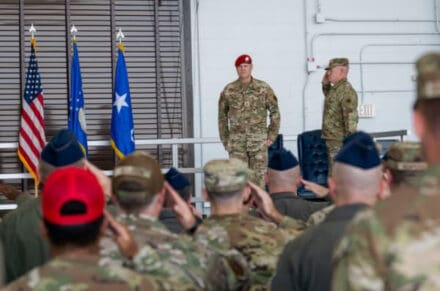
The 711th Special Operations Squadron began a new era of combat readiness during a change of command and mission conversion-ceremony at Hurlburt Field, Florida, July 11, 2025.

“This transition shows the strategic depth the Reserve offers to the warfighter,” said U.S. Air Force Col. Matthew Barry, 919th Special Operations Group commander and presiding officer. “Our members have a long history of being highly trained and ready to execute the mission when called upon. This legacy of service makes the 919th Special Operations Wing the perfect complement to the gunships already formidable capabilities.”

During the ceremony, Lt. Col. John Duke relinquished command of the 711th SOS to Lt. Col. Jason Fox, with Air Commandos, squadron alumnus and community partners in attendance to honor the unit’s rich heritage.

The event comes as the 711th SOS undertakes a major transformation transitioning to an operational AC-130J Ghostrider gunship mission and moving from Duke Field, Florida to nearby Hurlburt Field. The AC-130J Ghostrider is renowned for its precision strike capabilities, advanced avionics, and versatile firepower.

The move reinforces the wing’s partnership with active-duty AC-130J aircrews and reunites the unit with Reservists performing aircraft maintenance, ensuring seamless Total Force Integration. 

“What the men and women of the 711th have done over the last 12 years as combat aviation advisors is nothing short of extraordinary,” Duke said. “They took on missions in some of the most complex environments in the world—building stability, strengthening partnerships, and representing the very best of what our Air Force can be. I’m proud of what we accomplished and confident this next chapter will honor that legacy.”

During his command of the 711th SOS, Duke helped oversee the final chapter of the wing’s C-145A Combat Coyote operational mission, which included aviation foreign internal defense and special operations mobility training. That legacy now sets the foundation for the unit’s return to gunship operations. 

The transition marks a return of the AC-130 gunship mission to the 919th SOW. From 1975 – 1995, the 919th SOW flew the AC-130A Spectre gunship, supporting combat operations and NASA launch missions across the eastern U.S.

By Liz Easterling

919th Special Operations Wing

21st Air Task Force Sharpens Drone Capabilities with sUAS Training

Wednesday, July 30th, 2025

DYESS AIR FORCE, Texas —  

Eight Airmen assigned to the 21st Combat Air Base Squadron, part of the 21st Air Task Force, completed small Unmanned Aircraft System (sUAS) training at Joint Base Charleston, South Carolina, July 14-18, enhancing their technological capabilities and operational readiness ahead of their upcoming deployment.

Hosted by the 628th Civil Engineer Squadron sUAS program office, the weeklong training course prepared Airmen for practical integration of drone technology in support of operational planning and force protection. Training scenarios included search-and-rescue operations, dense forested terrain navigation, and nighttime reconnaissance using thermal imaging—simulating environments where sUAS platforms act as low-cost, high-value force multipliers.  

“I have a new appreciation for how critical sUAS technology is for the future fight,” said Tech. Sgt. Hunter Pryor, 7th Civil Engineer Squadron and 21st CABS station chief. “Now our team has several members, all from different career backgrounds, that can employ it effectively, which gives us a lot more flexibility in a contested environment.”

Upon completion of the training, each Airman received certification as a sUAS operator—a capability developed outside of their primary career field. Their newly acquired capabilities support broader sustainment and warfighting functions that will be tested throughout multiple exercises and training events.

“This kind of training is the Mission Ready Airmen idea in reality,” said Col. Thomas Walsh, 21st ATF commander. “Smaller, multi-disciplinary teams, using technology like sUAS, additive manufacturing and AI will be able to solve more problems faster and with less resources in contested areas. We are training how we expect to fight.”

The training aligns with Department of Defense guidance under the recent “Unleashing U.S. Military Drone Dominance” directive, which calls for all combat units to integrate uncrewed aerial systems into force-on-force training by 2027 and equips every squadron with low-cost, expendable drones by the end of 2026.

“Our adversaries have a head start in small UAS, but we will perform a technological leapfrog and establish small UAS domain dominance by the end of 2027,” said the Honorable Pete Hegseth, U.S. Secretary of Defense. “We will accomplish this urgent goal by combining the nation’s best qualities, including risk-taking.”

By integrating sUAS operations into traditional mission frameworks, the 21st ATF is pioneering new tactics, techniques, and procedures that will inform future Air Force operations. As one of only three Pacific Air Forces-aligned air task forces, the 21st ATF is postured to lead the Department of the Air Force’s shift toward Agile Combat Employment, consistently training to operate in contested and austere environments across the Indo-Pacific.

By 7th Bomb Wing Public Affairs

7th Bomb Wing Public Affairs

USAG Rheinland-Pfalz Partners with Polizei, Air Force to Test UAS Response Readiness

Sunday, July 27th, 2025

MIESAU, Germany – U.S. Army Garrison Rheinland-Pfalz teamed up with the U.S. Air Force 569th U.S. Forces Police Squadron and 86th Security Forces Squadron from Ramstein Air Base and German Polizei July 16 to test its counter-unmanned aircraft systems (cUAS) capabilities and interagency communication networks in a realistic drone threat training exercise.

During the exercise, operators from the U.S. Air Forces in Europe and Africa’s Combat Training School flew a DJI Phantom 4 drone over USAG Rheinland-Pfalz’ installation near Miesau to simulate a drone threat, testing the operational capabilities of systems and processes currently in place, said Emily Roemer, an antiterrorism officer with USAG Rheinland-Pfalz Directorate of Plans, Training, Mobilization and Security and the lead planner for this exercise.


The DJI Phantom 4 is a commercially-available small UAS, making it ideal for this type of training, Roemer said.

Staff Sgt. Michael Sopha, noncommissioned officer in charge of cUAS for the 569th USFPS, said the Air Force’s primary role in the exercise was to respond alongside USAG Rheinland-Pfalz in the joint environment, using the most current available cUAS technology to detect and disrupt small UAS in the exercise area.

Systems that were tested included small UAS detectors, signal disruptors and signal hijackers that protect friendly assets and render enemy systems ineffective, Sopha said.

“This exercise showed the importance of a joint force working together to combat small UAS threats. Our procedures are sound,” he said. “Future small UAS capabilities will be far greater, supporting the need for alternative systems to combat them on a large scale.”

Roemer stressed the importance of seamless communication between law enforcement teams from the garrison, the Air Force and the local community.

“Host nation response during a real-world event is critical,” Roemer said. “The Army likes to train how we fight, so we knew getting host nation participation for this exercise was a must.”

USAG Rheinland-Pfalz police chief DJ Diallo noted that working in partnership with German Polizei gives the garrison access to a wider network of security resources, ensuring a robust, resilient security posture.

“The lines between civilian and military airspace are increasingly blurred, demanding seamless information sharing and coordinated responses,” Diallo said. “Without robust international cooperation between Polizei and USAG Rheinland-Pfalz DES, we risk critical gaps in our ability to detect, deter, and respond to drone-related threats.”

He added that the garrison, Polizei and Air Force security forces routinely collaborate to improve response capabilities in the local area, leveraging the unique skills and authorities of each service through training exercises and a secure communication platform for real-time information sharing.

Roemer noted that planning the counter-UAS training event with so many joint partners was not without challenges.

“Ensuring that the exercise injects were realistic and involved all the joint partners was probably the biggest challenge,” Roemer said. “All the joint partners exhibited enthusiasm and eagerness to participate, which shows we have built positive relationships and shared trust between all parties.”

As part of the Army Transformation Initiative, the U.S. Army is investing in technologies including artificial intelligence, autonomy and counter-drone systems to outpace future threats faced at USAG Rheinland-Pfalz installations. Continuous transformation ensures the Army can deliver trained, cohesive and lethal teams to meet future challenges in complex operational environments like this one.

U.S. Army Garrison Rheinland-Pfalz advances the Department of Defense mission to achieve peace through strength as we serve, support and secure the total force community, enabling power projection for the European Theater.

By Jennifer Whitaker

SparkX Teams with Army Soldiers on Open-Source Drone Project

Saturday, July 26th, 2025

JOINT BASE ANDREWS, Md. – A small team of technicians at Joint Base Andrews is helping shape the future of battlefield innovation, one 3D-printed drone at a time.

The Andrews SparkX Cell Innovation and Idea Center partnered with the U.S. Army’s 1st Multi-Domain Task Force from Joint Base Lewis-McChord, Wash., to redesign Project SPECTRE (Small Printable-Engineered-Composites Tailorable Remote-Effect), an experimental effort to create rapidly deployable, customizable, small, unmanned aircraft systems.

The result of Project SPECTE was Blackbird, a fully open-source, government-owned drone platform that cut development costs by more than $1 million.

According to SparkX technicians, the Blackbird can be 3D-printed and assembled in 36 hours for about $200, offering a low-cost, modular sUAS solution for training and operational use in the field.

“Working within the government always provides an opportunity for quicker development that often times faces less roadblocks and is more cost-effective than the standard acquisition processes,” said a Soldier with the 1st MDTF.

With no formal aerospace engineering training, the SparkX technicians reverse-engineered a new platform from scratch. They developed an original airframe that met operational goals while avoiding intellectual property conflicts with the Army’s previous partner.

“It was what we envisioned the plane to look like,” recalled Staff Sgt. Stefan N. Sobiech, a former SparkX technician who is now stationed at Osan Air Base, Republic of Korea. “I oversaw creation of the wings, and I sought inspiration from the most efficient planes I could find.”

The project went through more than 10 variations, but Sobiech said the team kept pressing and learning from their mistakes.

“I don’t think there was ever an obstacle that we didn’t think we could work no past it,” he said. “We always went back at it from a different angle or researched how others got past a similar issue.”

The final design includes two propeller-driven motors, a wingspan of more than six feet and weighed approximately nine pounds. Its modular design features a push-to-connect fuselage and a customizable internal equipment tray, allowing for rapid swaps of mission-specific gear and easy to assembly in the field with no specialized tools.

In November, the team was invited to fly the drone during Titan Hoplite, a joint exercise hosted by the Air Force’s Task Force 99 at Shaw Air Force Base, S.C. The SparkX technicians showcased their airframe alongside other advanced sUAS technologies, drawing interest from units across the Department of Defense.

Sobiech said the team conducted a 30-second shakedown flight before heading to Shaw, where the Blackbird flew for more than two minutes during Titan Hoplite demonstration.

The drone unfortunately crashed after flying out of range of the hobby-grade motors and avionics.

Although, Sobiech was unable to attend the event, he mentioned receiving texts and video footage from observers of the successful flight.

“I was ecstatic! To see it sustaining flight, for that length of time, was an amazing feeling,” he said.

Earl Bagwell, Spark X director, said the Titan Hoplite demonstration sparked interest from several organizations in the Army and Air Force that wanted to get involved.

Bagwell released the 3D files as an open source to allow other units to 3D-print the components and integrate their own avionics and motors.

“We knew this would be a sought-after capability, but instead of going through the long patent process, we decided to open source it,” Bagwell said. “Whoever needs it can have it—because we need to innovate and move faster.”

The Air Force Research Laboratory, the Army Research Laboratory, Combat Innovation Lab, Tesseract, and 2nd MDTF are among the organizations that have accessed to the Blackbird files. Together, they support operational theaters across U.S. Indo-Pacific Command, Central Command, Europe, Africa, special operations, and the Army National Guard.

The 1st MDTF successfully deployed and tested the system in various environments, implementing rapid design updates on-site to improve both their understanding of the platform and its capabilities.

“Working in the joint force allows us to consider multiple angles and employment methods that might not be considered in an Army-only environment,” said an 1st MDTF Soldier. “It also gives us access to resources and diverse skill sets not inherent within individual services.”

Story by Patrick Griffith, 316th Wing

Air Force Global Strike Command Orders Pause In Use of M18 Modular Handgun System Following Fatality at FE Warren AFB

Wednesday, July 23rd, 2025

Following a fatality of a Security Forces Airman on 20 July, 2025, Gen Thomas Bussiere, the Commanding General of Air Force Global Strike Command has ordered a pause in use of the M18 Modular Handgun pending completion of Air Force Office of Special Investigations and Safety investigations.

In lieu of the sidearm, subordinate Wing Commanders will arm personnel with the M4 rifle in place of the M18. The M18 is manufactured by SIG SAUER and is based on the commercial P320.

While the Internet is rife with rumors, other than the fact that a Security Forces Airman (and by that the AF means a member of the service and not a rank) tragically lost their life in an incident involving an M18, we don’t know much more.

We’re not going to expect official findings for some time. The last fatality in that Squadron was in September 2023 and involved a roll over of an uparmoured HMMWV in inclement conditions and the report was released just last week.

While it would seem at its surface that the pause in use is significant, it has always been Air Force policy to pause training and operational use of systems which are involved in fatalities. This usually includes aircraft or hazardous activities such as diving or parachuting. During the pause, the command’s Combat Arms personnel, who conduct weapons training and maintenance, will wisely conduct 100% inspections of all Wing-assigned M18 weapons systems using:

Technical Order 11W-3-4-32 and additional supplemental inspection guidance in development by AFGSC/A3S. This latter guidance will be interesting to see.

So far, this stand-down is not Air Force-wide and only applies to the units involved in the nuclear enterprise. Aside from collaboration with the Air Force Security Forces Center, there are indications that other Major Commands within the Air Force are also considering a pause in the weapon’s use. This isn’t surprising as they seek guidance at the service level.

We have not yet reached out to the Small Arms program office of the Air Force or PEO Soldier’s Product Manager Soldier Weapons for comment due to this story breaking late yesterday afternoon. Manufacturer SIG provided us with this statement:

“Our hearts are with the service members and families impacted by the recent reported event at the F.E. Warren Air Force Base. We have offered assistance to the U.S. Military as they investigate the incident and remain willing to help in furtherance of their ongoing investigation.”

Below is a copy of the implementing AFGSC memorandum.

As soon as we know more, we’ll share it.

Specialized EOD Fitness Test Will Gauge Critical Task Ability

Tuesday, July 15th, 2025

ARLINGTON, Va. (AFNS) —  

Explosive Ordnance Disposal has been added as the next combat arms career field to require special sex and age neutral fitness standards.

EOD joins other fields with heightened entry level and sustained physical fitness requirements. These requirements acknowledge that sustained endurance is necessary to tackle long hours in physically and mentally-taxing conditions.

The other specialties that utilize occupationally specific physical fitness assessments are in the Special Warfare community. Both communities started developing their fitness standards in 2015.

Starting Aug. 1, EOD Airmen will begin taking the new assessment that will measure their ability to perform tasks necessary to accomplish critical mission objectives. During an adaptation period over the last year, EOD Airmen took an unofficial version of the test. Results after July 31 will be part of an EOD Airman’s official record.

The assessment will include four exercises to assess muscular strength and endurance, anaerobic capacity and cardiorespiratory endurance:

1000-meter row

20-lb. medicine ball toss

Trap bar lift

Gruseter drop-roll-lift-run maneuver

EOD Airmen with a 3E8XX Air Force Specialty Code and EOD-qualified officers assigned to a 32E3H duty position are currently exempt from the Air Force Physical Fitness Assessment and have begun training for the EOD OSPFA.

“Maintaining our strategic advantage is about building a ready force capable of engaging against any threat to the United States across the spectrum of operations from competition through crisis and if deterrence fails, to prevail in conflict,” said Brig. Gen. Brian Hartless, Civil Engineers director. “Our EOD Airmen are crucial to preserving our nation’s security.”

The 1000-meter row measures cardiovascular fitness, which relates to EOD operations such as bombing range explosive hazard removal and bomb suit operations to defeat improvised explosive devices.

The 20-lb. medicine ball toss to the back, side, and log measures fitness related to EOD operations such as robot employment and operations, ladder climbs, and cross-loading or evacuation of casualties.

The trap bar lift requires five repetitions ranging from 150 to 360 lbs. It measures fitness related to EOD operations such as construction of protective works, contingency airfield support operations and bomb suit operations to defeat improvised explosive devices.

The Gruseter is a drop-roll-lift lift-run maneuver with a 30-lb. vest, 50-lb. sandbag, and a 15-meter run for five rounds. This exercise is particularly beneficial for EOD operations, such as small unit tactics and bombing range explosive hazard removal, as it simulates the physical demands of these operations, where personnel may need to quickly and efficiently move heavy equipment in high-stress situations.

Component scores are measured at three levels: initial EOD training, intermediate level training, and graduate level/operational fitness.

For more information, see the OSPFA score charts and videos here and AFMAN 36-2930.

Secretary of the Air Force Public Affairs