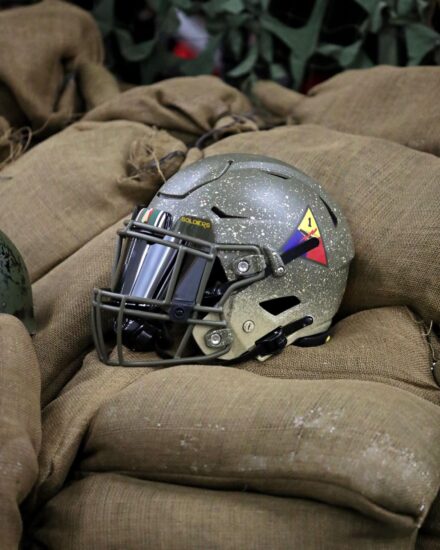
The uniforms for the Army vs. Navy game have been unveiled and are inspired by the 1st Armored Division and the 80th anniversary of Operation Torch.
#GoArmyBeatNavy
Photos by Army West Point Athletics


The uniforms for the Army vs. Navy game have been unveiled and are inspired by the 1st Armored Division and the 80th anniversary of Operation Torch.

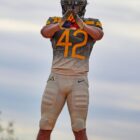

#GoArmyBeatNavy
Photos by Army West Point Athletics
Each week the 525th Expeditionary Military Intelligence Brigade presents a video showcasing moments in intelligent history. Here is the latest:
During the nation’s westward expansion after the Civil War, the U.S. Army fought a series of Indian Wars against the Native American Nations with whom white settlers had come into conflict.
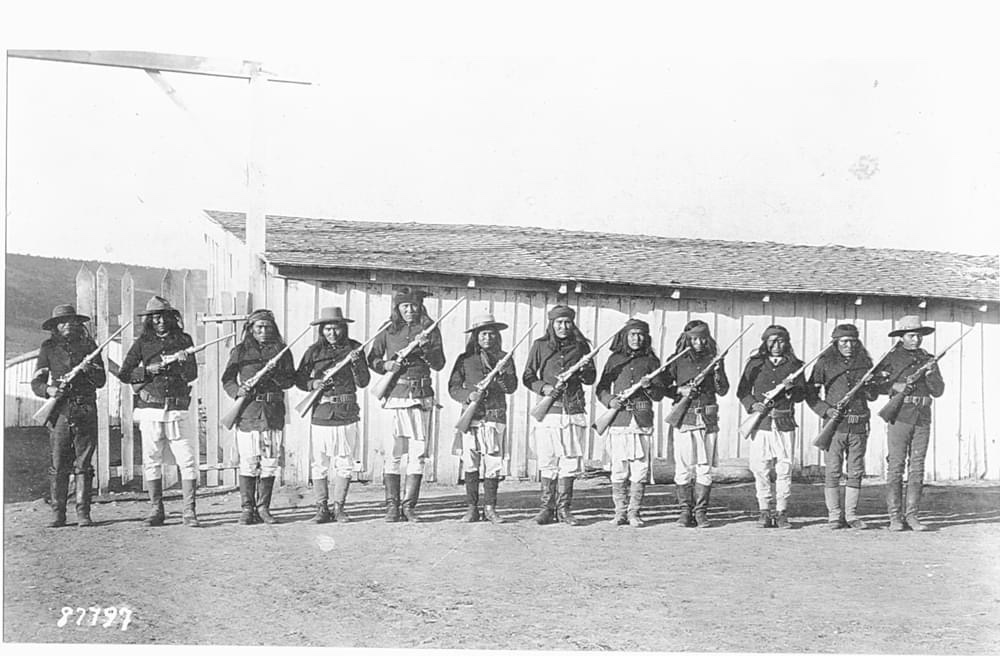
Instrumental to Army success in the post-bellum Indian Wars were the Indian Scouts, an enlisted cadre of Native American scouts often drawn from Nations with longstanding antagonisms toward the Nations at war with the United States.
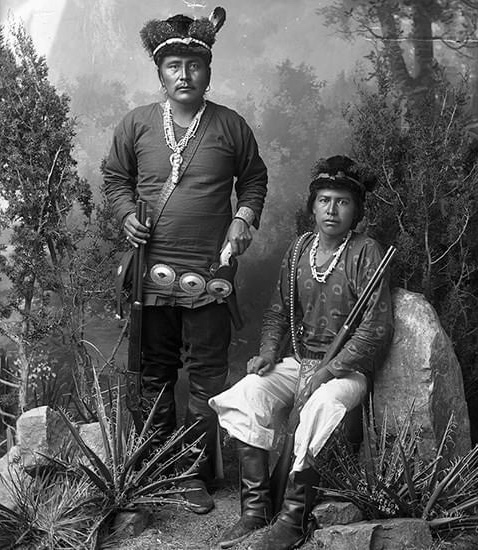
First formed in 1866, the Indian Scouts were a force of up to 1,000 men (although this slowly declined as the years passed) whose members were be compensated the same as a white cavalryman.
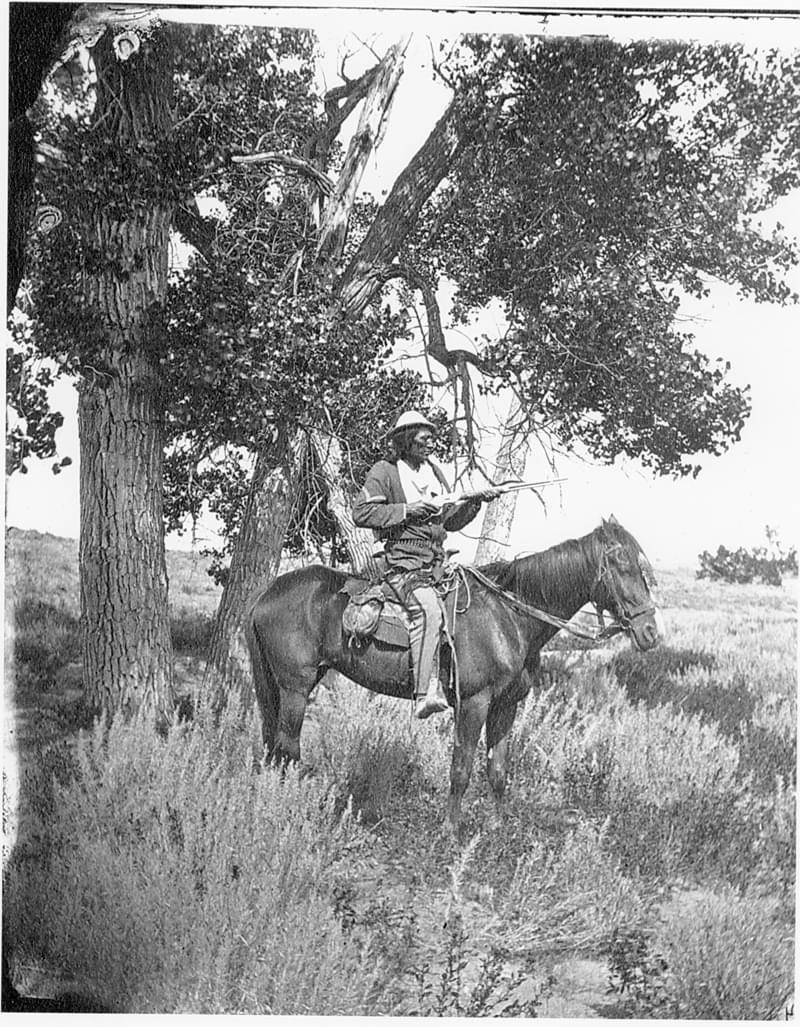
The Indian Scouts supplied desperately needed knowledge of the terrain and enemy belligerents to an Army short on expertise and struggling to accomplish its mission. Indian Scouts were essential to Army’s efforts across the greater frontier and played crucial roles in iconic conflicts like the Great Sioux War and the Apache Wars.
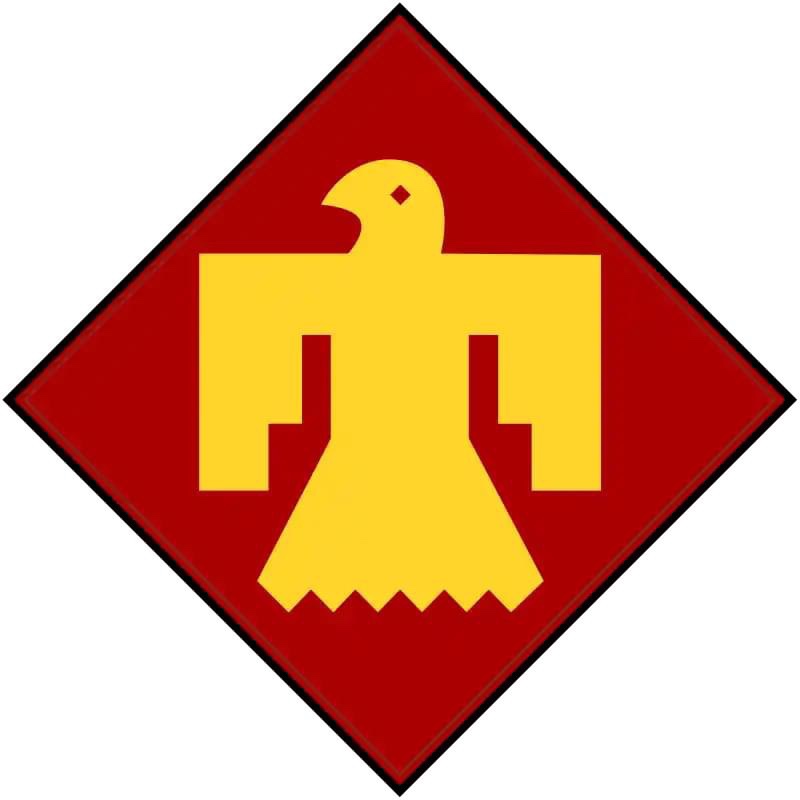
The settlement of the frontier by the close of the 19th century spelled the end for the Indian Scouts and their unique place in Army history; the service slowly declined until coming to a practical end by the beginning of World War One.
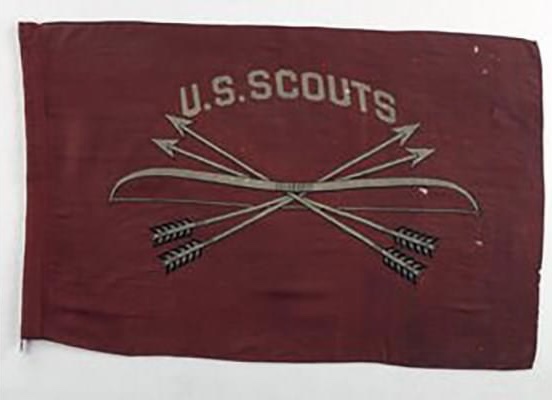
During their time in Army service, Indian Scouts earned 16 Medals of Honor; a small part of their legacy has been carried into the present day by U.S. Army Special Forces, whose crossed arrows insignia was originally designated for use by the Indian Scouts in 1890.
– US Army Center of Military History

The 82nd Airborne Division has established an Airborne Innovation Lab as a no-reservation-required makerspace to learn, research, innovate, build, and explore new ideas to solve tactical problems. However, the AIL also offers classes on how to use its various equipment.
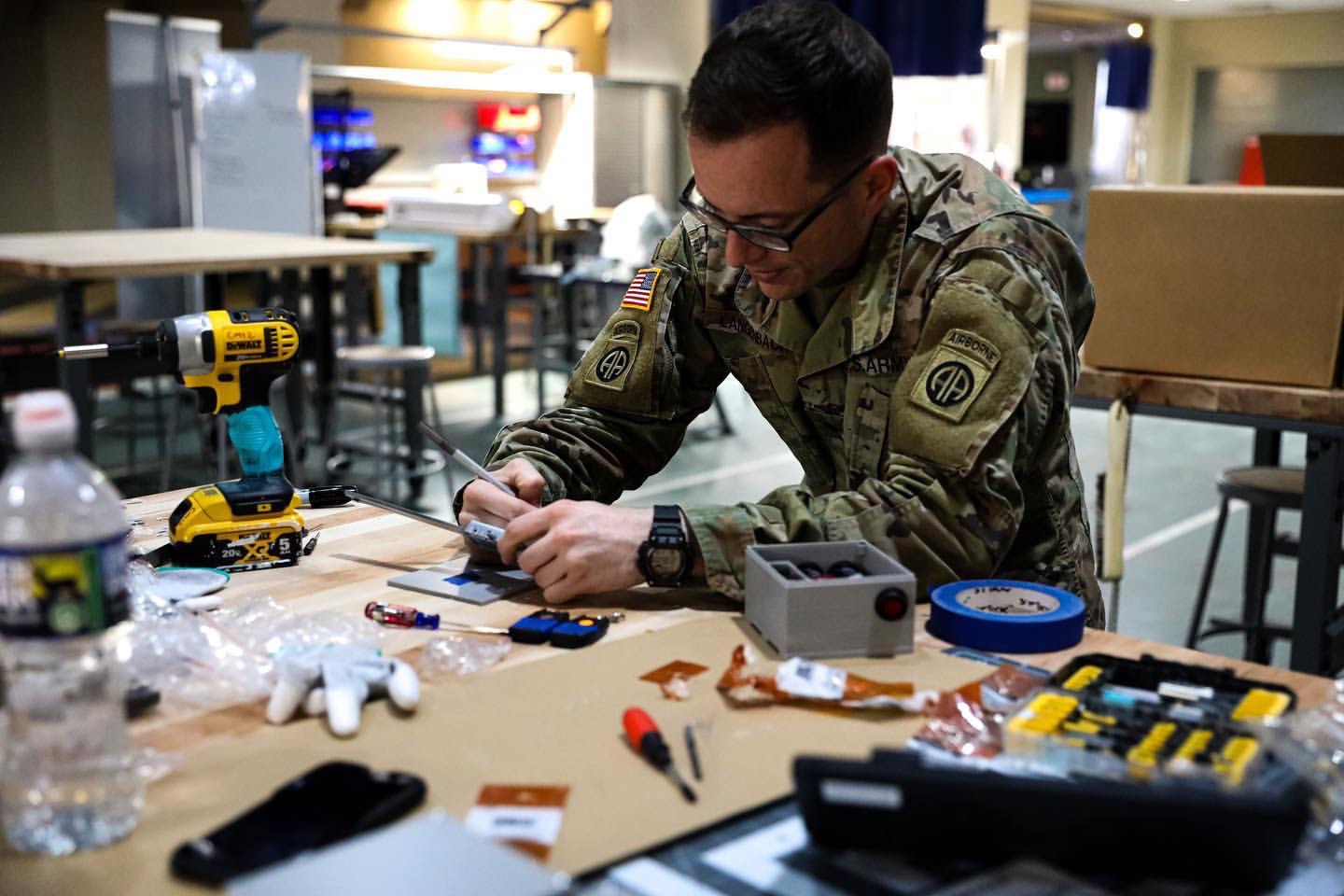
Located in Bldg. 3-2102 on Long Street, the lab boasts the following capabilities:
Digital Fabrication: 3D printers, 3D scanner, and workstations with Fusion360
Woodshop: CNC milling, laser cutting/etching, and other woodshop machinery/tools
Workshop: Robotics kits, soldering stations, electronics workstations with tools and components
Textile Station: Sewing machines, plotter cutter, heat-transfer vinyl, ironing station
Design Thinking and Collaboration: Space for facilitating design thinking workshops and project collaboration
The lab supports all of Fort Bragg, not just the All American Division. In fact, a Communications Sergeant from 1st Special Forces Command (Airborne) recently used the AIL to create new landing feet for a sUAS which interface with Weapon Holster adapters allowing Soldiers to easier access to the drone.
As projects are created by Soldiers in the AIL, the files are distributed to other Design, Innovation, Research, and Technology (DIRT) Labs across the Army and printed, providing the capability of these new prototypes to Soldiers across the country.
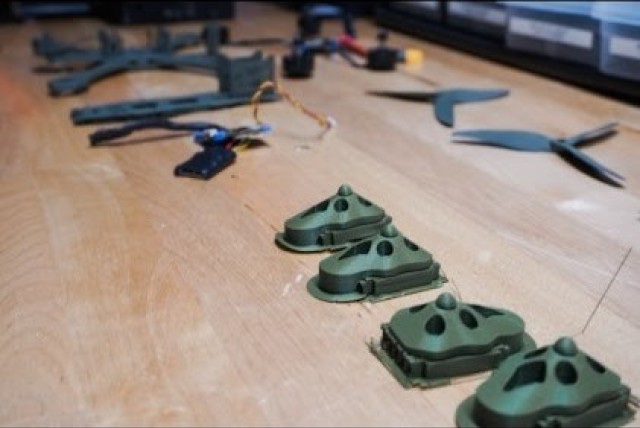
Other projects that have been shared across different DIRT Labs include breach-lane markers, chem light holsters, and Raven propellers.
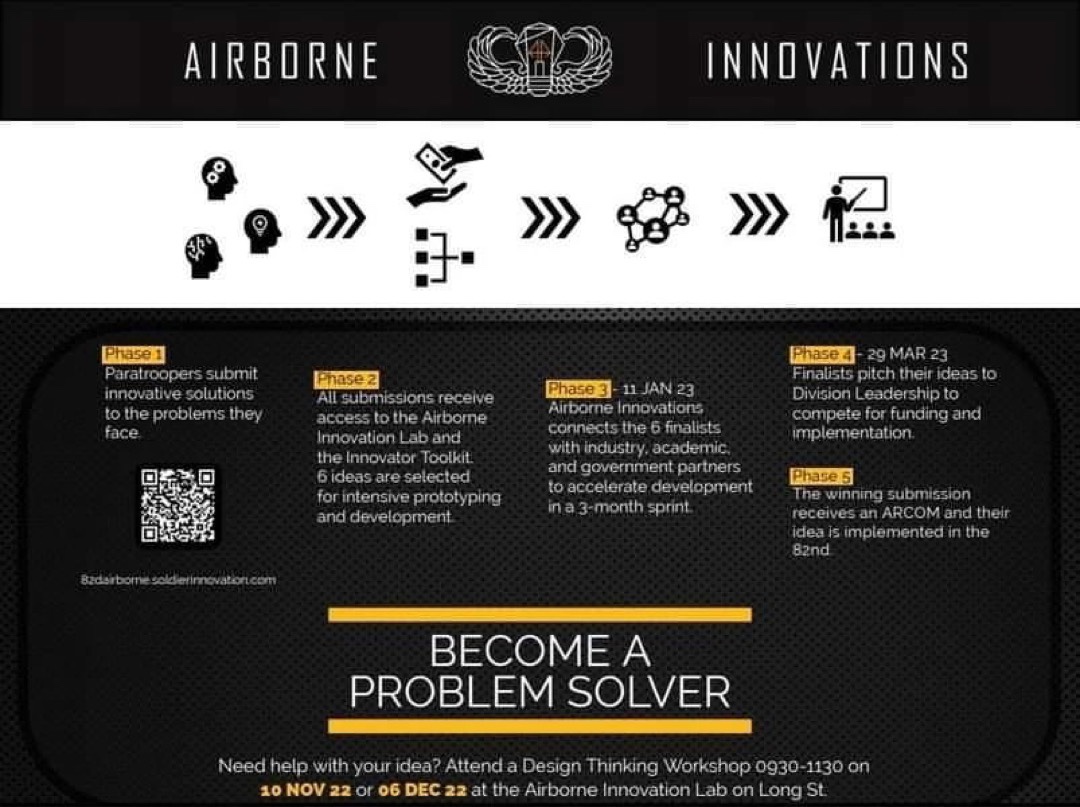
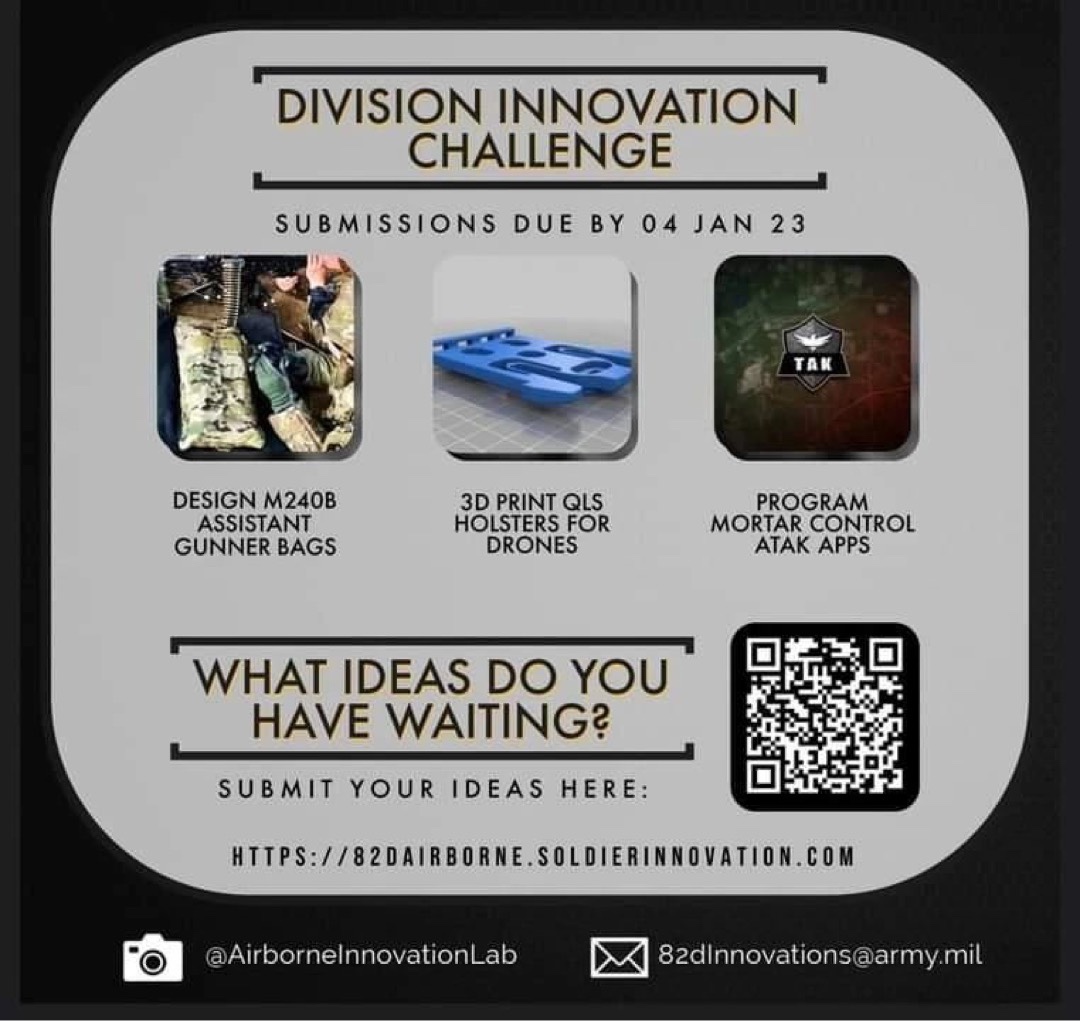
In addition to visiting the lab you can submit your ideas here.
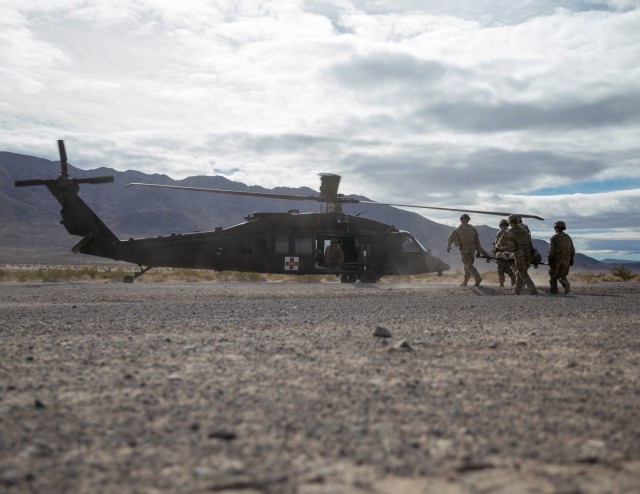
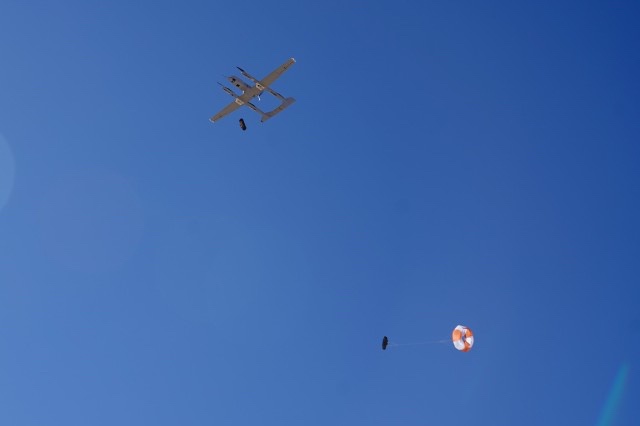
FORT IRWIN, Calif. — A buzz could be heard as a medical supply drone known as Project Crimson flew overhead to drop off packages of crucial medical field supplies to medics assisting wounded warriors. As the supplies hit the ground, a medic rushed to retrieve the packages, as many of the other medical warriors kept applying field aid to their Soldier counterparts.
The mass casualty scenario, part of Project Convergence 22, brought together medical personnel from the U.S. Army’s 1st Battalion, 7th Cavalry Regiment, and the Australian Army’s 2nd Health Battalion, to experiment with advanced field care technologies, including those enabled by artificial intelligence.
“Project Crimson is a project to take a common unmanned air system and adapt it to support a medical mission,” said Nathan Fisher, Medical Robotics and Autonomous Systems division chief at the U.S. Army’s Telemedicine & Advanced Technology Research Center.
“This drone supports medical field care when casualty evacuation isn’t an option. It can keep whole blood and other crucial items refrigerated in the autonomous portable refrigeration unit and take it to medics in the field with wounded warriors.”
Fisher explained how the drone is a vertical landing and take-off aircraft, therefore doesn’t need a catapult launch or runway to perform a lifesaving mission. This allows military personnel to preserve life in the critical phase of injury and facilitate rapid transport to an Army hospital for further treatment.
While Project Crimson sustained the medical field from the air, military medics used Medical Hands-free Unified Broadcast, or MedHUB, and Battlefield Assisted Trauma Distributed Observation Kit, or BATDOK, systems strapped to their arms and chests to input medical treatments digitally from the ground.
“MedHUB is used to enhance medical situational awareness,” said Philip Featherston, an Air-ground Interoperability and Integration Lab systems engineer. “At the point of injury, we can start hands-free documentation. All we do is place a sensor to the patient that will apply a broadcast to the treatment facility and control center.”
“The facility can see the patient’s status real-time using BATDOK, while the medics on ground can update treatments and medications for the patients as well. This allows the facility to be alerted, rally and prepare to treat the patient once they are transported,” explained Michael Sedillo, an integrated cockpit sensing program airman systems director with the Air Force Research Laboratory.
During the experiment, litters carrying casualties were taken from medical evacuation vehicles, while Army field hospital medics rushed to apply advanced medical care. As casualties were taken into tents, medics with BATDOK and MedHUB systems traded patient information with the previous medical personnel with the near field communication card.
“The ability to have these technologies on hand has enhanced medical field care tremendously,” said Capt. Morgan Plowman, a nurse with the 15th Brigade Support Battalion, 1st Cavalry Division. “To take a tablet or phone to input personnel data has increased the communication down the line and accuracy of field care. So much so that the rate of patient care has increased to the point that caring for a casualty start to finish has sped up drastically.”
The mass casualty experiment also highlighted the potential for allied nations to work together more closely on future battlefields in the area of emergency medical care.
“This is an excellent opportunity to come over here and work with multinational partners,” said Capt. Michael Harley, an Australian Army medical officer, of Project Convergence 22 experimentation. “It is eye-opening to see the initiative between everyone and see the interoperability between the nations.”
“I just came from [advanced individual training], so I didn’t know what to expect coming out here during this event,” said Pfc. Tyler Swanson, a 15th Brigade Support Battalion, 1st Cavalry Division field medic. “When I used this medical technology, it was easy to pick up and learn, even in a fast-paced field environment.”
“I am excited to see what the future of medical technology will look like a decade down the road,” Swanson added.
By SGT Trinity Carter, 14th Public Affairs Detachment
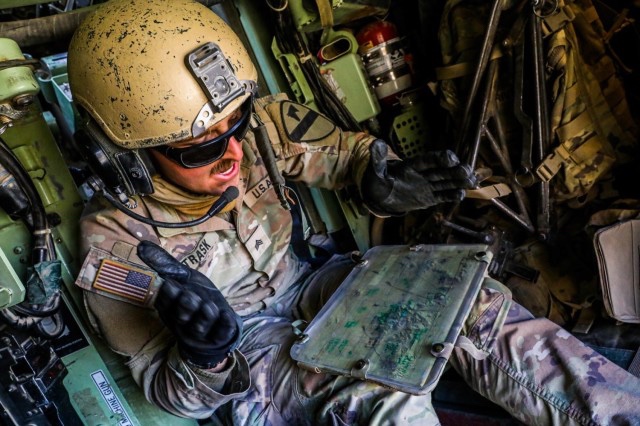
FORT IRWIN, Calif. — The 1st Cavalry Division recently participated in Project Convergence 2022 from Sep. 29 to Nov. 9 at Fort Irwin. Project Convergence is an Army-led experiment offering opportunities to access future warfighting strategies, including how the all-service and multinational force can work together to detect and defeat threats.
The First Team’s primary mission during the experiment consisted of forming attack positions each morning while moving to a landing departure zone in the M113 Tracked Armored Personnel Carrier, M1A2 SEP v3 Abrams Tank, M2A3 Bradley Fighting Vehicle, and the Joint Light Tactical Vehicle while fighting the opposing forces. Each day new technology was added to the mission to test its success and practicality when used in a lifelike scenario.
Electronic assets allowed the unit to conduct reconnaissance and bring out the enemy without endangering Troopers, preserve combat power of larger platforms, scan the battlefield in a minimal amount of time and allowed the commander to make decisions with less risk.
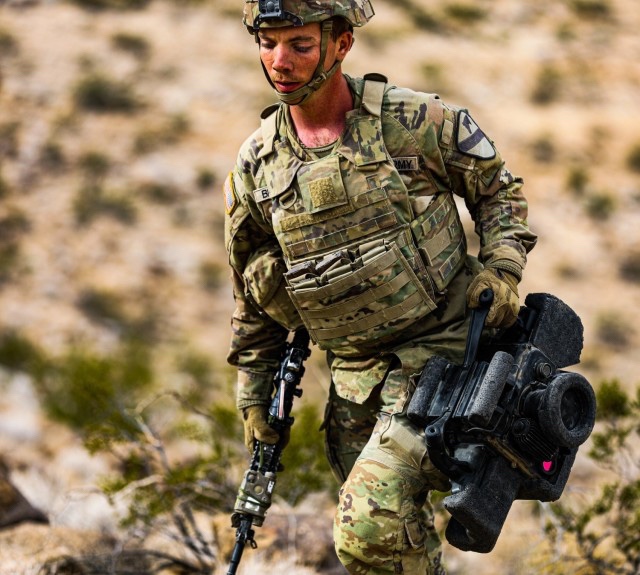
The assets also provided rapid communications with allied partners across the spectrum of operations, reducing the time needed for decision making and allowing for more rapid target engagement by the 1st Cav artillery.
The 1st Cav is transforming by integrating these new technologies across the formation to enhance their ability to compete globally, deter adversaries and win on all-domain battlefields.
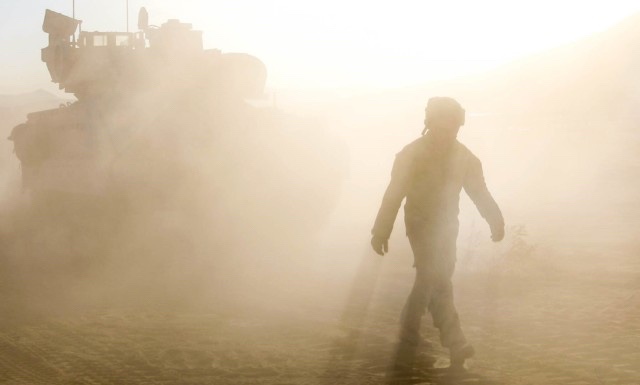
“I firmly believe that everything we do here is something that we’ll see throughout the Army over the next 60 years,” said Lt. Col. Brennan Speakes, 1st Squadron, 7th Cavalry Regiment commanding officer. “This is the equivalent of the Army moving from the horse drawn cavalry to the armored formations we know today.”
Army Futures Command established Project Convergence in 2020 as an opportunity for collaboration, experimentation and a way of informing how we fight, how we organize, the talent we need and what we fight with.
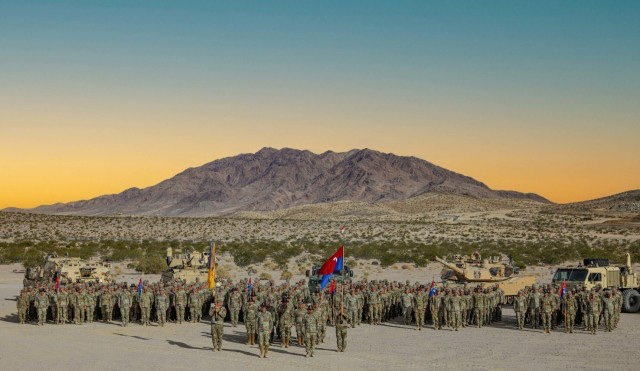
“1-7 Cav is going to be the best trained squadron in the Army by next summer,” said Maj. Gen. John B. Richardson IV, 1st Cavalry Division commanding general. “You are building an incredible reputation right now across the Army.”
Project Convergence is designed to aggressively advance and integrate the Army’s contributions to the joint and multinational force and ensure that the Army, as part of that force, can rapidly and continuously converge effects across all domains including air, land, sea, space and cyberspace, to overmatch our adversaries, increase operational tempo and generate decision advantage over our adversaries.
Convergence — the namesake of the project — refers to integrating efforts across all echelons, from the tactical to the strategic level, to deliver optimal lethal and non-lethal effects across all domains.
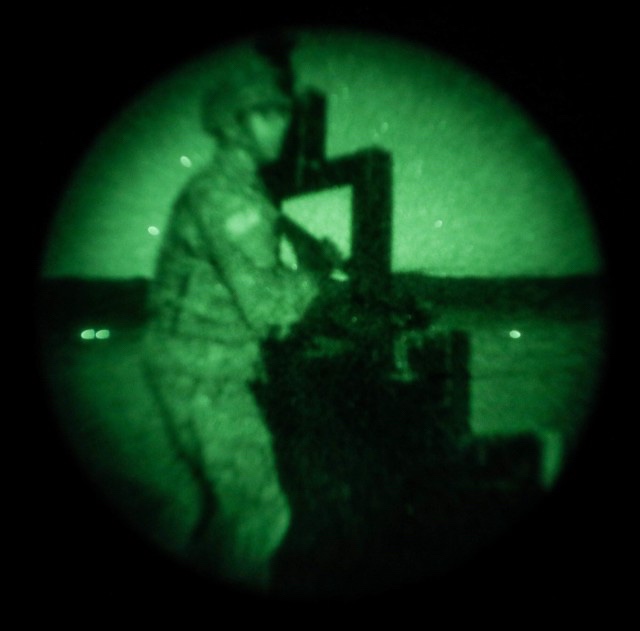
“Project Convergence 2022 is good for not only the training value for the squadron, but to learn the use and capabilities of this new technology,” said Sgt. Kyler Tackett, a Bradley gunner with 1st Squadron, 7th Cavalry Regiment, 1st Cavalry Division. “Hopefully PC22 will help with the further development of these vehicles, and to help solve problems for the future of the Army.”
Through Project Convergence, the Army is demonstrating new technologies continuously throughout the year to ensure we can fight and win as one team by framing objectives within the Joint Warfighting Concept and Joint All-Domain Command and Control network.
These experiment demonstrations and future modernization capabilities inform Army emerging technologies, future concepts and future formations.
“Hopefully we leave our mark as a contributor to future technologies that are going to help the Army fight our future wars,” said Cpt. Rannie Lintag, a human resources officer with 1st Squadron, 7th Cavalry Regiment, 1st Cavalry Division.
Looking to Project Convergence 2023 and beyond, the Army will continue to expand its alliances and demonstrate the impact modernization will have in various theaters of our geographic combatant commands.
“I couldn’t be prouder of the team that’s out here,” said Speakes. “This team is making things happen, and I’ve seen a stark improvement in not only their capabilities, but also their leadership potential.”
By SGT Brayton Daniel
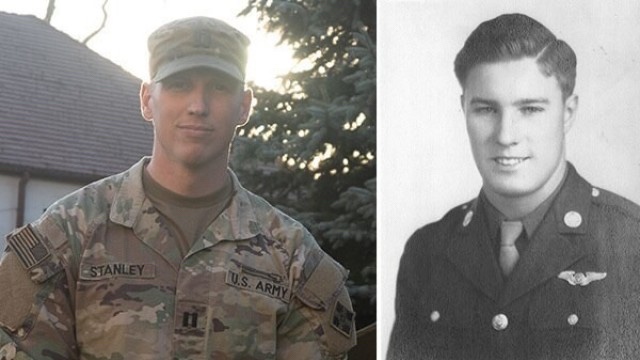
ZAGAN, Poland — Capt. Robert Stanley, the brigade assistant intelligence officer assigned to the 3rd Armored Brigade Combat Team, 4th Infantry Division always had an interest in history, and after learning of his great-uncle’s involvement in WWII, he was inspired to research it more.
“I love history, for me, all the sacrifices made by servicemembers put me in a position that I’m in,” said Capt. Stanley. “If I’m going to appreciate those things, I must investigate it.”
Capt. Stanley went on to say that this is a way to put a face to a story that he’s attached to. He encourages everyone to look into their family history because you may be impressed with what you find.
The Stanley family’s service to the United States armed forces date back as far as the Civil War. Although many people were drafted into the United States Army when the Nazis began their conquest of the world, Sgt. Everett W. Stanley continued his family’s legacy by enlisting into the U.S. Army Air Corps as a ball turret gunner with the 401st bomb group, 613th squadron.
“My great uncle volunteered after the beginning of WWII,” said Capt. Stanley.
At the beginning of WWII, there wasn’t an organic Air Force. It was part of the U.S. Army as the Air Corps, which was originally formed in 1917 during WWI. After enlisting, Sgt. Stanley was stationed at Deenethorpe Airfield in England where he flew the Boeing B-17 Flying Fortress.
While stationed at Deenethorpe Airfield, Sgt. Stanley met his crew consisting of 2nd Lt. Donald E. Butterfoss, pilot, 2nd Lt. Robert L. Westfall, co-pilot, Bernard J. Boyle, flight navigator, 2nd Lt. Robert C. Kerpen, bombardier, Sgt. Roger R. McCauley, radio operator, Sgt. Alfred J. Truskowski, engineer & top turret gunner, Sgt. William H. Lee, tail gunner, Sgt. William E. Watkins, left waist gunner and Sgt. John W. Reeves, right waist gunner. During their WWII deployment, they were known as “The Saint and Ten Sinners”.
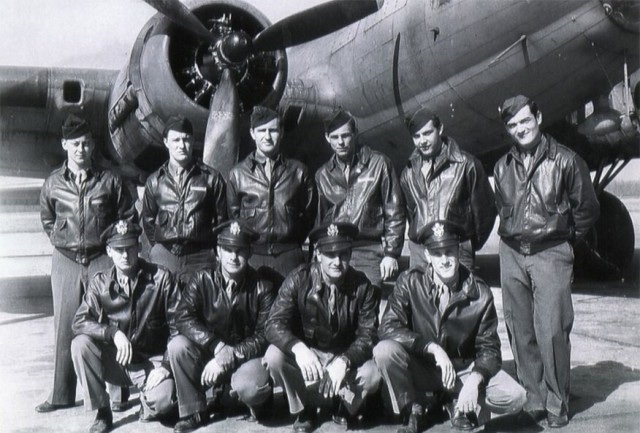
Sgt. Stanley and his crew conducted several missions out of Deenthorpe, their most significant being the largest bombing run during WWII during that specific timeframe.
“It was the largest daylight bombing mission of WWII up to that point,” said Capt. Stanley.
During their last bombing mission, Sgt. Stanley and crew were hit by Flak from a German 88mm anti-aircraft and both port engines caught fire. The crew noticed German fighters coming toward them, so they took cover in the clouds and decided to head home with the engines they had left.
As the crew flew over Arnhem, Holland, they received enemy fire which caused severe damage to the plane and the crew had no choice but to bail. After being shot down during mission, Sgt. Stanley was taken into captivity as a prisoner of war (POW) where he spent the next 11 months.
“There were thousands of POWs, that’s thousands of stories and thousands of experiences,” said Capt. Stanley.
Although Sgt. Stanley was a POW, he was allowed to send letters home to his family with the help of the American Red Cross. This made his family aware of the immense sacrifice he made for our great nation.
“If I have a rough day, I think to myself, my great uncle was a prisoner of war,” said Capt. Stanley. “If he can get through that, I can deal with whatever I have going on.”
During his time in Poland, Capt. Stanley took the opportunity to visit some of the historic sites in the area. He went to Berlin and Stalag Luft III, one of the locations it is believed his great uncle spent time as a POW.
“My great uncle served through the Korean War and Vietnam War,” said Capt. Stanley. “After retiring, he stayed with the Air Force as a Department of Defense civilian.”
Sgt. Stanley received a POW medal, European campaign medal and a WWII service medal among others before retiring after more than 20 years of faithful service to the nation.
“To understand Veterans’ Day, you have to know that those aren’t just names on a board, it’s an entire life that has been lived up to this point,” said Capt. Stanley.
As Capt. Stanley begins to transition from active duty service to National Guard, thinking back on his family’s sacrifice much like his ancestors before him, he looks to the future. Sitting on a ranch remembering those that came before him and starting a new tradition for the Stanley clan.
Capt. Stanley stated that all vets, even those who haven’t seen combat, have made great sacrifices. There’s a lot more to military service than just combat.
“My call to serve has been a part of what members of my family have done,” said Capt. Stanley. “Many people before me have died for something worth fighting for.”
As you go about your day conducting normal business during Veteran’s Day, take a moment to remember why we as Americans are provided with the freedoms we enjoy every day. Remember those that came before you and their sacrifices; remember “A Saint and Ten Sinners.”
By SGT Timothy Brokhoff and SFC Theresa Gualdarama
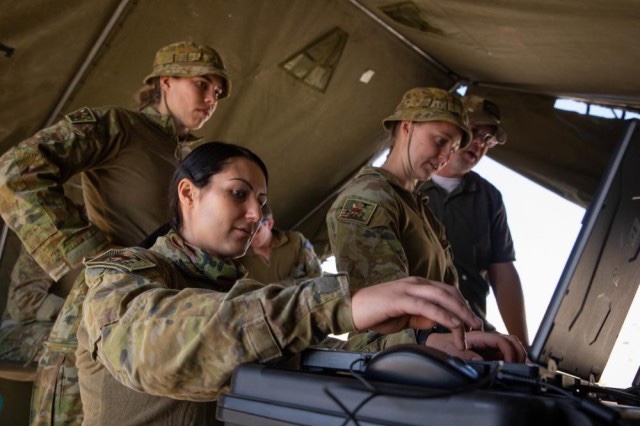
AUSTIN, Texas — As the U.S. Army transforms itself to ensure the all-service force can deter and, if necessary, win any future conflicts, it is engaged with allies and partners to develop new capabilities and foster leap-ahead warfighting advantages.
U.S. Army Futures Command plays a pivotal role in this effort by engaging regularly and meaningfully with partner nations, embracing a collective approach to warfare that aligns with the demands of multidomain operations to deliver speed, convergence and overmatch on the modern battlefield.
The command’s International Programs Team, part of the G-3/5/7 directorate, is spearheading AFC efforts to prepare for tomorrow’s joint and combined warfighting challenges in an adept and highly integrated manner, as exemplified by ongoing multinational experimentation being conducted through Project Convergence.
“The reality is, as we look to the future of warfare, we don’t do anything without our international partners,” said Newman Yang, AFC International Programs Team lead. “Whether it be Iraq, counterterrorism, Afghanistan, you name it — our operations are executed with our combined allies and partners; we don’t do it unilaterally.”
Yang joined AFC as a Department of the Army civilian after 30 years of active-duty service, in a career that included 20 years as an Army foreign area officer in locations such as Brunei, China, Hong Kong, Malaysia and Singapore. Due to increasing demand signal for greater engagement with AFC, the command recently expanded the International Programs Team to include personnel with diverse backgrounds in domestic and international Army experience, along with Department of Defense and Congressional engagement knowledge and foreign policy expertise.
Together, the team members help explain AFC’s Army transformation mission, structure and programs to international partners, many of whom have expressed an eagerness to stay abreast of new technologies and to engage in collaborative research and development efforts.
In the fall of 2021, for example, the International Programs Team assisted in the design and execution of a two-day modernization forum hosted by U.S. Army Europe and Africa; the forum, which took place in Germany and included the participation of 13 European allies and partners, offered an in-depth exploration of future opportunities, challenges and concerns related to transformation efforts.
The team also regularly supports engagement visits to AFC headquarters in Austin, recently welcoming senior military leaders from Europe, the Middle East and Asia to discuss shared future force plans and objectives.
Understanding what U.S. military equipment and warfighting systems will look like in the future enables allied and partner nations to make informed decisions about their own transformation requirements, Yang explained, and lays the foundation for future interoperability between allied country militaries.
The diligent work of the International Programs Team contributed to the multinational presence at this year’s Project Convergence event, Project Convergence 22, which brings together U.S., U.K. and Australian service members at U.S. military installations to explore the parameters and possibilities of future warfighting scenarios.
“U.K. and Australia have been full planning participants,” Yang said, noting the countries have incorporated their own service branches in the experiment in a realistic way. “This is a huge commitment on their part.”
Canada, France, Israel, Japan, Korea and New Zealand are also attending the experiment as observers, with the understanding that future iterations of Project Convergence may expand to include additional allied and partner nation participation.
The Project Convergence campaign of learning, experimentation and demonstration is accelerating the U.S military’s ability to transform rapidly and efficiently by identifying common preparedness gaps and assessing who might be best suited to address them across the various services and allied nations.
Yang described the mutually beneficial process as “part of that partnership fabric, where we can mutually develop technologies while also conserving resources to avoid duplication of effort where possible.”
“If we have proper agreements and policies in place, then we can work on sharing those technologies to ensure we persistently modernize our forces and equipment together to deter and defeat potential future adversaries.”
By Maureena Thompson, Army Futures Command