GORE-TEX Professional

Archive for the ‘Army’ Category

Nutrition Research Keeps Warfighters Ready, Lethal in Extreme Cold

Sunday, November 30th, 2025

WASHINGTON — As the race to control the Arctic intensifies, more research is focused on how to optimize service member performance in the extreme cold, where lack of sleep and appetite, altitude and equipment issues can all affect a warfighter’s ability to function.

Researchers at the U.S. Army Research Institute of Environmental Medicine’s Military Nutrition Division in Natick, Massachusetts, study physiological stressors that warfighters encounter. By manipulating dietary, exercise and environmental conditions, they’re working to determine the best way to deliver the right nutrition and energy to increase warfighter lethality.

How extreme cold negatively affects warfighters

In extreme cold environments, difficult terrain, bulky clothing, heavy equipment and the body’s own process for regulating internal body temperature can cause service members to expend more energy. Many also don’t get enough nutrition or sleep, said USARIEM research psychologist Harris Lieberman.

“Sleep deprivation is what usually occurs when you’re deployed,” he continued, “and service members don’t eat enough food [in the cold] to keep up with all the work that they do.”

The U.S. military has a cold-weather version of the meals ready to eat, which is dehydrated to keep the rations from freezing. But they need to be rehydrated at mealtime, which can take time — something not all warfighters have. Many just don’t eat during busy time periods. That lack of nutrition can lower the energy levels required to do the mission, explained Lee Margolis, a veteran-turned USARIEM nutrition physiologist.

“Energy expenditures can range anywhere from 5,000-7,000 calories per day [in extreme cold],” Margolis said. “For an average individual, normally you’re going to burn about 2,000-3,000 calories per day.”

High altitudes, where less oxygen is available, can also affect energy expenditure — even in the strongest special operators — and change the body’s ability to metabolize food for fuel.

“It’s critically important that we develop solutions to offset the impacts of altitude,” explained James McClung, chief of USARIEM’s Military Nutrition Division. “Nutrition can be a part of that.”

Other issues, such as equipment freezing up and losing its ability to function, can also affect productivity.

Mimicking Extreme Temps

Researchers visit cold-weather climates, such as Alaska and Norway, to perform studies, but they’re also able to do some at home. USARIEM’s Doriot Climatic Chambers allow experts to test the effects of extreme environments in two massive indoor chambers: one focuses on human-subject testing, while the other is used for equipment testing.

“Every climate you could possibly imagine … we can recreate,” said Facilities Manager Jeff Faulkner.

The chambers’ temperatures can range from 165 to minus 65 degrees, and they can create 40 mph of wind, rain and snow. Each chamber has inclining treadmills that can handle up to five Soldiers at 15 mph on a 12-degree incline. Smaller conditioning rooms have the same capabilities as the chambers, except they can drop to minus 72 degrees.

In one of the smaller conditioning chambers, Lieberman is leading a cold-weather study to analyze the behavior, physiology and performance of stressed, sleep-deprived Soldiers to determine what nutritional needs will increase their performance.

After various pretests and body composition measurements, the volunteers, who are part of the Natick laboratories’ Soldier Volunteer Research Program, spend two days and one night in the room at 16 degrees. While wearing cold-weather-appropriate gear, they undergo various physical activities, such as stationary bike rides and hand strength tests, to measure their reaction time and vigilance.

They take various cognitive performance tests to measure mental acuity, and they eat meals primarily consisting of military rations that dietitians tailor specifically to their needs. They also forgo sleep. “If something unexpected happens, can you effectively respond and correctly deal with it?” questioned Lieberman, referring to the study’s end goal.

Carbs, fat, protein: What’s best for energy balance?

Meanwhile, USARIEM researchers have been working to get a better understanding of the types of macronutrients that will help cold-weather combatants thrive. The goal: to keep warfighters from expending more energy than they’re consuming.

“We’re studying using macronutrients to avoid negative energy balance — the case where we cannot eat enough to maintain physical or cognitive performance — which is associated with poor performance and also an increased risk of injury,” McClung said.

“We’ve seen that there are decreases in lower body power specifically,” Margolis said of the negative energy balance. “Obviously, under a combat scenario, your ability to move very quickly, especially if you’re carrying a heavy kit, may be the difference in survival.”

The research, which has been years in the making, helped to develop a more energy-dense ration known as the close combat assault ration. The CCAR recently replaced the first strike ration for combat troops.

In 2016, in collaboration with the Norwegian Defense Research Establishment, known as FFI, USARIEM began studying Soldiers in the field to see how they metabolized prototypes of supplemental snack bars created by the Army Combat Capabilities Development Command Soldier Center’s Combat Feeding Division. One bar was higher in carbohydrates, while the other was higher in protein. The result: the volunteers liked and ate the bars, but they ate fewer of their actual combat rations, leading to energy deficits.

Further lab research in 2022 studied the amount of food Soldiers ate by feeding volunteers a higher-fat prototype product. Fat has more calories per gram than carbs and protein, so a bar with a higher-fat count could provide more energy in a smaller package, Margolis said — something that could help lighten warfighter load during combat operations.

By providing the volunteers with the higher-fat prototype product, researchers wanted to see if their energy intake would increase.

All of the volunteers ended up consuming more calories than in previous studies. However, most of their energy deficits remained at moderate levels, causing no adverse effects, explained Emily Howard, a USARIEM nutritional physiologist who helped carry out the study. The takeaway for researchers: the amount of food a warfighter consumes is the most critical factor in preserving their performance, not so much the composition of that food.

However, since Soldiers don’t typically eat a lot in cold-weather conditions, the research into how to optimize macronutrients in rations continues.

Evolving tactics

One upcoming study will monitor how warfighters on cold-weather ruck marches perform when eating two newer prototype ration bars: one that’s higher in fat and more energy-dense, and another that’s less energy-dense and higher in carbs. During the study, researchers plan to measure each volunteer’s oxygen and carbon dioxide levels.

“We’re able to actually calculate if their body is using primarily carbohydrate, primarily fat, or a mix while they’re doing exercise,” Margolis said.

The study will also look at glucose and insulin level changes, as well as hormone responses, to see how well that fuel sustains them on long marches and during moments when they might need to pick up the tempo.

Margolis’ team also plans to do some observational studies during the annual exercise Arctic Edge in Alaska in 2026 to see how service members are using the cold-weather MRE and its supplements.

Once the studies are concluded, USARIEM’s findings are shared with the Combat Feeding Division as recommendations for adjusting current rations or developing new ones.

By Katie Lange, Pentagon News

We Are Everywhere. Words Are Our Weapon.

Sunday, November 30th, 2025

We are Psychological Operations

Created by 4th Psychological Operations Group.

PEO IEW&S Drives Rapid Prototyping

Saturday, November 29th, 2025

The Army’s ability to adapt and innovate in real time is critical to mission success on the modern battlefield. That’s the driving force behind Transforming in Contact (TiC), an Army-wide initiative focused on delivering cutting-edge technology to units for immediate use, rapid experimentation and iterative improvement. Unlike long-term modernization strategies that can take years, TiC is designed for speed and flexibility. It puts emerging capabilities directly into the hands of Soldiers, allowing them to test new equipment, provide feedback from the field and help shape future Army solutions. TiC is about more than just equipment, it’s about creating an agile, data-driven and Soldier-informed approach to modernization.

“The American Soldier is innovative. They are smart. They are hungry for a change,” said Secretary of the Army Daniel Driscoll during a Fox News interview on May 1, 2025. This sentiment reflects the underlying philosophy of TiC. Soldiers must be empowered with technology and organizational flexibility to adapt on the fly. That’s why the Program Executive Office for Intelligence, Electronic Warfare and Sensors (PEO IEW&S) is focused not just on building systems but delivering them in a way that supports experimentation and rapid improvement.

FROM TIC 1.0 TO 2.0

TiC began with six initial units under what has since become known as “TiC 1.0.” These included elements from the 82nd Airborne Division, 101st Airborne Division, 1st Cavalry Division and others selected for their operational diversity and readiness. These efforts laid the foundation for the next phase of the program by identifying capability gaps, refining training requirements and informing changes in unit structure and concept of operations, or CONOPS.

One key lesson learned was the need for flexibility in how systems are configured and deployed based on mission type and terrain. Units provided direct feedback that led to redesigns, simplified interfaces and more modular capabilities—changes that directly shaped TiC 2.0.

“We’re not saying, ‘TiC 1.0 is done, now onto TiC 2.0,’ ” explained Maj. James Duffy, TiC lead at PEO IEW&S. “It’s a natural evolution. We’re expanding the types of units we engage with—aviation, fires, intelligence battalions, special forces, multidomain task forces—and we’re adding granularity to how and where capabilities are delivered.”

In TiC 2.0, the Army is pushing even further. It’s not just about issuing new equipment; it’s also about evaluating how formations are structured. This fall, the Army will test new force design concepts at Joint Pacific Multinational Readiness Center-Exportable. This will include experimentation with smaller, more mobile command posts that are easier to relocate and harder to target.

TiC’s unit diversity allows the Army to gather data across different environments, which in turn drives design decisions. For example, requirements in the Pacific marked by dispersed terrain and long-range operations differ from those in Europe, where maneuver and electromagnetic warfare challenges dominate. These operational realities influence form factors, network resilience and sustainment strategies. The goal is to avoid a one-size-fits-all approach and instead tailor capabilities to the mission.

DRIVING TIC FORWARD

Building on its foundational role, PEO IEW&S continues to support TiC by rapidly fielding and refining capabilities through a Soldier-centered lens.

Current PEO IEW&S systems supporting TiC units include:

  • Terrestrial Layer System (TLS) Manpack – A portable system for electromagnetic warfare and signals intelligence.
  • Mounted Assured Positioning, Navigation and Timing (PNT) System (MAPS) – A vehicle-mounted system that integrates multiple sensors and anti-jam capabilities to provide Soldiers with trusted PNT data in GPS-contested environments.
  • Dismounted Assured PNT System (DAPS) – A system that enables dismounted Soldiers to shoot, move and communicate when GPS is denied or degraded.
  • Spectrum Situational Awareness System (S2AS) – A software-defined capability that provides Soldiers with real-time visibility of the electromagnetic environment to support decision making and mitigate spectrum threats.
  • Micro High Altitude Balloons (mHABS) – Cost effective, deep sensing aerial platforms that can remain aloft for one to three days, part of a directed requirement fulfilled under TiC.

The capabilities are being deployed selectively to prototyping units. Not every Soldier or formation receives the same gear. Instead, the Army is tailoring delivery, collecting detailed user assessments and rapidly improving systems based on feedback.

As Duffy described, “Gone are the days where every Soldier gets the same equipment regardless of formation. We’re doing targeted fielding, getting feedback on a small scale and iterating quickly.”

RAPID FEEDBACK, REAL RESULTS

At the heart of TiC is the speed at which Soldier feedback influences development.

“At Joint Readiness Training Center (JRTC) we had experts onsite, helping a unit reconfigure their setup in real time,” said Duffy. “That kind of optimization doesn’t require an engineering overhaul—it’s something we can fix on the ground. But even when there is an engineering challenge, we’re documenting it, working with vendors and cycling it back into the next release. The whole point of TiC is innovation at the speed of relevance.”

User representatives and intelligence assessments teams are embedded with certain units, generating daily situation reports that go up the chain of command, all the way to the Army deputy chief of staff for intelligence (G-2), Lt. Gen. Anthony Hale. This feedback informs daily development and real-time fixes.

“We’re giving them equipment we know isn’t perfect, because if we wait for perfect, it’s too late,” Duffy said. “This is about progression over perfection. Get it in their hands, hear what works and what doesn’t and come back with something better.”

CONCLUSION

TiC isn’t just a modernization initiative—it’s a mindset shift.

“It would be a failure on our part if the first set of systems we deliver are exactly like the last ones we deliver,” said Brig. Gen. Ed Barker, the program executive officer for PEO IEW&S. “If we’re not learning from user events and rolling that feedback into future iterations, we’re not doing our job.”

Army leadership has made it clear: Modernization must happen faster and be guided by those closest to the mission. “The battlefield is changing as fast as the technology in your pocket, and we know we have to change,” said Gen. Randy George, Army chief of staff, during a recent Council on Foreign Relations panel held on May 19, 2025, in Washington.

As TiC continues to grow in scope and scale, PEO IEW&S remains committed to delivering capabilities that not only enhance mission success today, but shape a more agile, responsive Army for tomorrow.

For more information about PEO IEW&S and their products, go to peoiews.army.mil.

KAY EDWARDS is a public affairs specialist contractor for PEO IEW&S. She holds a B.A. in English composition from Florida State University.

Taking Flight: Pennsylvania Guard Expands Drone Usage

Saturday, November 29th, 2025

FORT INDIANTOWN GAP, Pa. – In a small aircraft hangar on the east end of the post, a makeshift obstacle course has been built primarily from leftover construction material such as wood and PVC pipes.

This isn’t an obstacle course for Soldiers to test their fitness or agility. It’s for operators of unmanned aircraft systems, commonly known as drones.



As seen in Ukraine and elsewhere around the world, drones are becoming more prevalent on the modern battlefield. Where once troops and manned vehicles reigned supreme, unmanned systems now perform numerous missions, including direct attacks, surveillance and target acquisition.

The Pennsylvania National Guard has been using drones for more than a decade, primarily for surveillance and reconnaissance. As tactics have changed in places such as Ukraine, Pennsylvania has strived to keep pace. Chief Warrant Officer 2 Nathan Shea, operations officer with the Unmanned Aircraft Systems facility, said he believes unmanned systems will play an even larger role in future warfare.

“Unmanned systems as a whole – whether that be unmanned aircraft, ground, naval, all of the above – are going to be a massive player in shaping future fights and how we fight,” Shea said. “The more we can remove humans from the front lines and direct combat, I think the more you’re going to see that.”

High-stakes training

The UAS facility at Fort Indiantown Gap dates to 2007 and originally housed the RQ-7 Shadow UAS, which the 28th Infantry Division used until January 2024, when the Army stopped using Shadows.

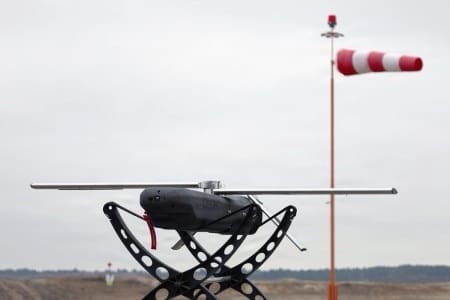
The Shadow was a fixed-wing UAS with a 20-foot wingspan that was designed for surveillance, reconnaissance and target acquisition, said Shea, who is a member of the 56th Stryker Brigade Combat Team, or SBCT.

Since the Army has not yet fielded a replacement system for the Shadow, the UAS facility is in a transitional phase. Shea and the other Soldiers who work there are experimenting with different kinds of drones, including first-person-view, or FPV, drones.

The obstacle course, built inside a former Shadow hangar, allows FPV drone operators to practice flying.

“It’s a great indoor, all-weather space that we get to utilize, and it focuses on building out tactics,” Shea said. “Every obstacle, as random as they may seem placed, has a very specific purpose. It’s meant to build accuracy for the pilots.”

Earlier this year, Shea returned from a deployment with the 56th SBCT to Germany, where the brigade assumed responsibility of Joint Multinational Training Group – Ukraine, which trains Ukrainian soldiers. His role was to oversee all UAS operations and the UAS training programs for the Ukrainian Armed Forces.

“We trained these operators from nothing to full-blown drone operators ready to go to war in about 45 days’ time,” Shea said. “It was a very high-stress program. The stakes were very high, and there was very little room for error on either party’s part.”

Shea said he built an obstacle course in Germany similar to the one at the UAS facility to train Ukrainian soldiers, and he plans to build an outdoor training course eventually.

Like other Army units – both active duty and National Guard – Pennsylvania is waiting for funding to build out its UAS capabilities, Shea said. He knows which systems he would like and which are needed to support the different missions.

“There’s no 100 percent answer on a system right now,” Shea said. “What works for the cav [cavalry] is not going to work for the engineers, probably. The advantage is we already tested a lot of these systems, so we know what systems we need, we know what modifications we need to make to those systems to make them fit more warfighting functions.”

‘UAS is the future’

At the 166th Regiment – Regional Training Institute, a U.S. Army schoolhouse on Fort Indiantown Gap that offers numerous courses, instructors are teaching students in several military occupational specialties about drones.

On a recent day, Soldiers from across the Army attending the infantry Advanced Leader Course, or ALC, received a drone familiarization class.

The class was split: half of the Soldiers conducted dismounted infantry operations and infantry tactics, while the other half discussed drone use and what’s happening on the front lines now. While half of the class had those discussions, an instructor used a small quadcopter drone to observe the other half of the class in the nearby woods.

“If we look at the operational environment and the battlefields around the world right now, UAS is the future, and we have to address that fight,” said Sgt. 1st Class Mark Thompson, course manager for the infantry ALC at the 166th Regiment. “These guys are going to be the ones on the front lines, whatever the next major engagement is, so we want them to be able to see drones and experience them for the first time here in a controlled environment, not on the front lines.

“It’s very, very important for them to be able to start encompassing that in the way that they train, the way that they operate,” Thompson added.

Thompson said the 166th Regiment is implementing drones on different fronts. In addition to the familiarization classes, the 1st Battalion also runs the Small Unmanned Aerial System Operator Course, in which students learn drone basics.

The 166th has been using UAS for several years, and the training is constantly evolving as new technologies and new tactics emerge, Thompson said.

“We have a fantastic staff who are all very dedicated to maintaining the most current up-to-date stuff coming off the battlefield right now, whether that be in the European theater or around the world, or down at the border in the United States, how drones are being implemented by friendly and by enemy assets,” Thompson said. “When we get that stuff, we pretty much have a working group as a staff, discuss the positives and negatives, and then we implement it to the students.”

Thompson said UAS familiarization is very important because it gives Soldiers a foundational knowledge base to operate drones efficiently.

“We want them to be able have that foundational knowledge in a training environment so that when they actually go to do it in real world, they are 10 times more proficient because they have that foundational base,” Thompson said.

Drones in the field

Across the Pennsylvania National Guard, Soldiers have increased their use of drones during training throughout the past year.

In August, Soldiers with 1-109th Infantry Regiment, 2nd Infantry Brigade Combat Team – along with Soldiers from 1st Battalion, 107th Field Artillery Regiment and representatives of Carnegie Mellon University’s Software Engineering Institute – used drones and artificial intelligence to make the process of requesting artillery fire less stressful for Soldiers on the battlefield.

The exercise, part of Project Shrike, used a software package developed by Carnegie Mellon University’s Software Engineering Institute in partnership with the U.S. Army Artificial Intelligence Integration Center. This artificial intelligence-enabled system enables artillery units to detect, target and engage threats faster and with greater precision. The project reduces the complex task of calling for fire to mere seconds.

“The system highlights targets and recommends firing solutions for operator decision,” said Chad Hershberger, a software engineer with Carnegie Mellon University’s Software Engineering Institute. “The human is in the decision loop in order to accept or reject the system’s recommendation.”

In a similar exercise in November 2024, instructors from the 166th Regiment’s 1st Battalion used quadcopter drones to gather target information and send it to students taking the artillery Advanced Leader Course under the guidance of instructors from the 2nd Battalion. The students then engaged the targets with howitzers.

They also used drones to observe the fall of the artillery rounds, make required adjustments and conduct battle-damage assessments.

“We’ve been seeing it through open-source intelligence, obviously in the conflict that’s going on in Ukraine, that they’ve been doing a lot of these things, so we’re adjusting with the times, and we’re developing procedures and efficiencies in order to conduct these tasks,” said Sgt. 1st Class Richard Hutnik, quality assurance noncommissioned officer for the 1st Battalion who was piloting a drone during the exercise.

Whether on an obstacle course, in a classroom or in a field training environment, the Pennsylvania National Guard is attempting to stay at the forefront of drone tactics and technology as drone usage continually increases on the battlefield.

By Brad Rhen

MatrixSpace Named Active Sensor Winner in US Army Operation Flytrap 4.5, xTechCounter Strike Competition

Friday, November 28th, 2025

Burlington, MA (November 24, 2025) –  MatrixSpace, a leader in portable AI-enabled radar for counter-UAS missions, is the winner in the U.S. Army’s xTechCounter Strike competition, part of Operation Flytrap 4.5. MatrixSpace was the only active sensing provider selected among 15 finalists, highlighting the company’s breakthrough capabilities in rapidly deployable airspace awareness.

Operation Flytrap is the U.S. Army’s key initiative to accelerate innovative, scalable C-UAS technologies through live soldier experimentation, rapid acquisition pathways, and transition to operational units.

MatrixSpace showcased its Expeditionary AI Radar and 360 AI Radar, powered by AiEdge software, demonstrating fast setup, seamless integration into Army FAAD-C2 via the NATO-standard SAPIENT protocol, and real-time situational awareness at the tactical edge.

Four companies were selected overall, each receiving a $350,000 award and placement into the new Global Tactical Edge Acquisition Directorate (G-TEAD) Marketplace, enabling streamlined procurement by U.S. and NATO partners.

“Operation Flytrap 4.5 gave us a powerful opportunity to show MatrixSpace’s tactical advantage,” explained Matthew Kling, VP & GM, AI Systems at MatrixSpace. “Our ultra-low SWaP-C radars with AiEdge software integrate effortlessly into existing Army C2 networks and deliver dependable, soldier-ready airspace security.”

MatrixSpace radar systems deliver affordable, all-weather, AI-powered detection and classification for airspace, perimeter, and object monitoring, enabling organizations to rapidly establish robust situational awareness in contested environments.

www.matrixspace.com

NATO Allies Demonstrate Counter-UAS Capability During Live-Fire Demonstration in Poland

Friday, November 28th, 2025

NOWA DUBA, Poland — U.S., Polish and Romanian Soldiers demonstrated a new counter-unmanned aircraft system capability on Nov. 18, underscoring how allies are adapting to the growing drone threat along NATO’s eastern flank.

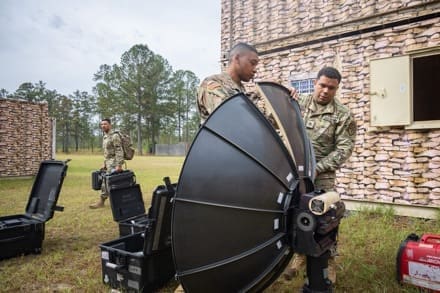
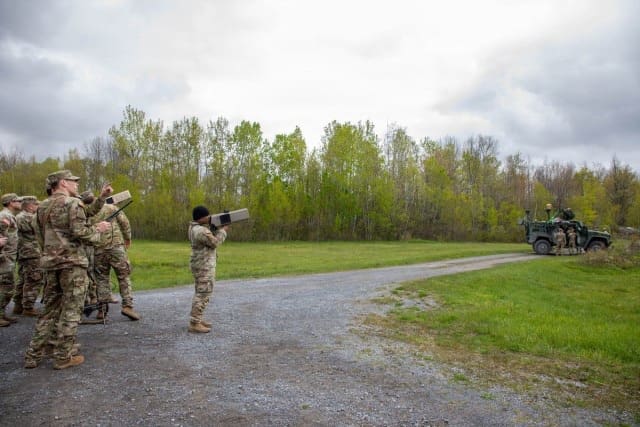
The live-fire event at the Nowa Duba Training Area capped a two-week course that brought together air defenders from all three nations. Soldiers trained on a mobile system that uses radar, electro-optical sensors and a small interceptor drone to detect, track and defeat hostile unmanned aircraft.

All major components fit on a light tactical vehicle or pickup truck, allowing a four-person crew to move, emplace and reload the system in minutes. During the demonstration, crews used a truck-mounted launcher to fire interceptors against surrogate “enemy” drones and recover them by parachute for reuse in training.

“It’s very lethal, very effective, but the key piece here is that it’s cost effective,” said Brig. Gen. Curtis King, commanding general of the 10th Army Air and Missile Defense Command.

King noted that the same type of interceptor has already been used in combat in Ukraine against Russian unmanned systems. There, he said, the capability has been “highly effective and lethal against one-way attack drones in Ukraine,” and is part of “the latest technology that’s being fought in Ukraine right now.”

Because the interceptor is designed as an expendable munition, the system allows commanders to engage low-cost drones without expending long-range interceptors needed for aircraft, cruise missiles or ballistic missiles. Combat use in Ukraine has provided Allies with real-world performance data before fielding the capability on NATO soil.

Polish and Romanian officers at Nowa D?ba said recent airspace violations and drone incidents over their territory accelerated efforts to field practical counter-UAS options.

The course followed a train-the-trainer model. U.S. Soldiers from 1st Battalion, 57th Air Defense Artillery Regiment trained alongside Polish and Romanian counterparts through classroom instruction, simulator work, and live launches. Graduates are expected to form the core of future national training teams.

The training and demonstration in Nowa Duba support NATO’s Operation Eastern Sentry and the Eastern Flank Deterrence Line, which seeks to link ground-based air and missile defense, aviation, sensors and fires into a layered architecture along NATO’s flank. Short-range counter-UAS systems like the one exercised in Poland provide a first line of defense against unmanned aircraft and help preserve higher-end interceptors for more complex threats.

By integrating this capability with allied training and planning, U.S., Polish, and Romanian air defenders are improving readiness and reinforcing deterrence, ensuring NATO can detect, track, and defeat the growing drone threat across the eastern flank.

By CPT Alexander Watkins

11th Airborne Division Conducts Groundbreaking UAS Experimentation in Alaska

Thursday, November 27th, 2025

FORT WAINWRIGHT, Alaska – The 11th Airborne Division recently conducted a groundbreaking electromagnetic warfare (EW) and counter-unmanned aerial system (C-UAS) training event at the Joint Pacific Alaskan Range Complex (JPARC) near Fort Greely, Alaska, integrating EW Soldiers from across the DIV alongside UAS and C-UAS vendors to experiment with technologies in Alaska’s arctic environment.

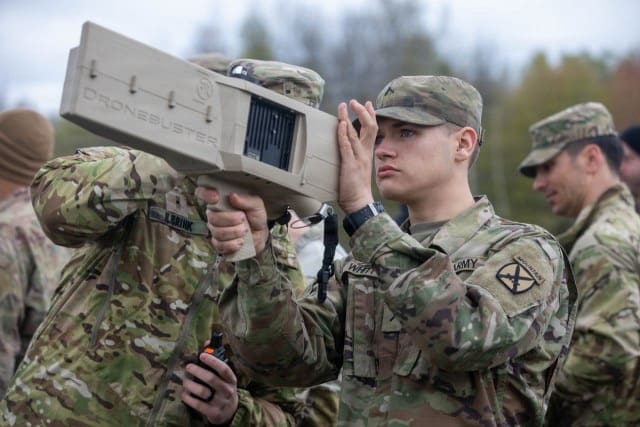
The training event, conducted in partnership with the Defense Innovation Unit (DIU), provided Soldiers with a unique opportunity to integrate EW systems with cutting-edge C-UAS technologies, refine tactics, techniques, and procedures (TTPs), and practice their ability to detect and counter enemy UAS threats in a contested electromagnetic spectrum (EMS).

“This [training] was a rare opportunity for our EW teams to work together and see firsthand how UAS systems operate in extreme cold weather,” said 1st Lieutenant Gunnar Moffitt, an EW Platoon Leader, 2nd Infantry Brigade Combat Team (Airborne), 11th Airborne Division. “We were able to detect Radio Frequency (RF) signatures, locate UAS command-and-control links, and assess how our systems perform in freezing temperatures and deep snow. This type of training is critical for preparing our Soldiers to operate in the invisible battlefield of Large-Scale Combat Operations (LSCO).”

Key highlights focused on detecting and analyzing the electromagnetic spectrum (EMS) signatures of various UAS platforms, including their command-and-control links. Soldiers used their organic EW systems to identify and locate enemy UAS operators and assess the effectiveness of their equipment in Arctic conditions.

“EW has been overlooked for the past 20 years, but the ongoing conflict in Ukraine has shown us how critical it is for LSCO,” said Staff Sgt. Clayton Wall, an EW Platoon Sergeant. “EW plays a huge role in modern warfare, and it’s exciting to be on the cutting edge of this technology. We’re not just training; we’re shaping the future of the Army and ensuring we’re ready to win the next war.”

The JPARC experiences extreme cold weather conditions, with temperatures routinely below freezing and receiving significant snowfall, providing a realistic environment for testing the durability and effectiveness of EW, C-UAS and UAS systems. Soldiers observed impacts to system battery life due to cold temperatures, gaining valuable insight into how these systems perform in Arctic environments.

“This [equipment] gave us the ability to see the invisible battlefield,” said Wall. “By analyzing our systems, we can understand enemy capabilities. This information allows us to advise brigade commanders and gain a tactical advantage in LSCO.”

Soldiers were also able to verify the visibility of UAS signatures within the EMS and assess the effectiveness of their systems in detecting and countering threats. Data collected during the training will inform future improvements to EW and C-UAS capabilities, ensuring the Army remains prepared to contest the air littoral, the airspace between the surface of the Earth and 10,000 feet above ground level.

“Electromagnetic warfare is the future of the Army,” said 1LT Moffitt. “It’s a field where we can have a real impact, and this training showed us how we can use new equipment to shape the battlefield and make a difference in LSCO.”

This event with EW and C-UAS systems is part of a broader experimentation effort by the 11th Airborne Division to address critical capability gaps identified in the Army’s Arctic Strategy, “Regaining Arctic Dominance.” The division’s work in Alaska highlights the importance of EW in modern warfare and the division’s role in ensuring readiness and survivability in extreme environments.

Story by MAJ Ian Roth 

Photo by MAJ David Nix

11th Airborne Division

US Army Revamps Direct Commissioning Program to Accelerate Recruitment of Applicants with Specialized Skills

Wednesday, November 26th, 2025

WASHINGTON — The U.S. Army announced updates to its Direct Commissioning Program, DCP, aimed at attracting top-tier professionals with specialized skills directly into its officer corps. The program offers qualified civilians and former service members the opportunity to be appointed as officers, potentially entering at ranks from second lieutenant to colonel, depending on their qualifications.

The overhaul, formalized in a recent execution order, centralizes the recruiting, screening, and selection process under the U.S. Army Recruiting Command. This move seeks to create a more unified and standardized approach to accessing talent, replacing a previously fragmented system where procedures varied by branch or component.

“The Direct Commissioning Program fundamentally changes how we bring specialized talent into the Army,” said Brig. Gen. Gregory Johnson, U.S. Army, Director of Military Personnel Management. “By reducing commissioning timelines across a wide range of emerging skills, cyber, technology, logistics, and beyond, the program directly enhances warfighting readiness and ensures we remain competitive in an evolving operational environment.”

A key objective of the revised DCP is to shorten commissioning timelines to approximately six months, a significant reduction intended to improve efficiency. The program also aims to improve transparency by consolidating applicant screening, waiver processes, and board procedures under USAREC.

The revamped DCP provides an alternative accession pathway beyond traditional routes like Reserve Officers’ Training Corps, the U.S. Military Academy and Officer Candidate School. It helps align civilian expertise with critical mission needs and potentially reduce costs associated with scholarships, permanent change of station moves, and training requirements.

Positions are available in both active duty and Army Reserve components. Applicants must meet specific criteria to be considered, including:

  • U.S. citizen (dual citizenship disqualifies applicants).
  • Meet Army medical, physical and fitness standards, including height and weight standards.
  • Clean moral background.
  • Bachelor’s degree from an accredited institution.
  • Match specific education and skill requirements, demonstrating leadership and technical expertise.
  • Able to obtain and maintain a security clearance (Secret or Top Secret, depending on the position).
  • Meet age requirements (waivers may be possible).
  • The program is not open to inter-service or inter-component transfers.

“Ultimately, the DCP is part of a broader effort to modernize the Army’s talent management strategies,” said Brig. Gen. Johnson. “The updated DCP provides a more adaptable model for accessing specialized skills needed now and in the future. We will be more lethal because of this effort’”

Interested individuals can find more information on the Army Direct Commissioning Program website.

By LTC William Lincoln, U.S. Army Directorate of Military Personnel Management