Register Now for SOF Week

Archive for the ‘Army’ Category

U.S. Army Continues to Streamline Procurement and Financial Processes with Release of New Interface

Monday, August 4th, 2025

U.S. Army Program Executive Office Enterprise (PEO Enterprise) and the Office of the Deputy Assistant Secretary of the Army for Procurement (ODASA(P)) have successfully implemented the Logistics Modernization Program (LMP), Army Working Capital Funds (AWCF) and Army Contract Writing System (ACWS) interface. The new interface provides better automation for transmitting contract awards and financial data from ACWS to LMP, helping streamline procurement and financial processes across the Army enterprise.

With the LMP-ACWS integration, ACWS users who receive AWCF-funded LMP purchase requests can now award all new actions in ACWS that support sustainment, logistics and supply management and maintenance. LMP users now can enter both the item and service requests on one purchase request, rather than creating multiple purchase requests. The new interface helps save time, reduces paperwork and links the service to specific parts for better tracking and auditability.

“This is a noteworthy step forward as the new LMP-ACWS interface reduces manual entry, improves data accuracy and supports timely obligation and contract execution tracking,” said Kevin Stoddard, an ACWS lead for ODASA(P). “It also eliminates duplicate data entry, where any updates — particularly for purchase requests — are synced bi-directionally, so there are no duplicate changes. Users enter data once in ACWS, and the data is automatically mapped to LMP/AWCF fields.”

The new LMP-ACWS interface is a major enhancement initiative to implement purchase request and procurement data standards and handshake interfaces as ACWS prepares to replace the Army’s Procurement Automated Data and Document System (PADDS) and Standard Procurement System (SPS) legacy contracting systems.

Lt. Col. Camille Morgan, product manager for ACWS at PEO Enterprise, says the successful implementation of the LMP-ACWS interface is part one of a two-phased approach in its ongoing modernization and readiness efforts.

“We are pleased with the successful release of phase one, which enables AWCF execution with ACWS and supports SPS sunset scheduled for December 2025,” said Morgan. “By standardizing purchase requests and procurement data, LMP and ACWS can more easily talk to each other, reducing errors across systems and delivering purchases faster.”

In October 2025, PEO Enterprise is expected to begin phase two, which will enable general fund and customer fund execution with ACWS, as well as support PADDS sunset.

Through these integrated advanced capabilities, ACWS is supporting Army readiness by helping to reduce lead times, making the procurement process faster and getting equipment and services to Soldiers as quickly as possible.

By partnering with LMP, an enterprise resource planning system that uses one of the largest, fully integrated supply chain and maintenance, repair and overhaul solutions in the world, ACWS remains committed to delivering a more effective and modernized contracting experience that meets the Army’s mission of transformation and readiness.

By Carolyn Martino, PM DIBS Strategic Communications

Army Chaplains Mark 250 Years of Ministering to Soldiers

Sunday, August 3rd, 2025

The Army recently celebrated its 250th birthday — two and a half centuries of defending the nation since standing up, June 14, 1775. Not long after, on July 29, 1775, the Army Chaplain Corps was established to provide ministerial support to those soldiers.

“The members of today’s Army Chaplain Corps are sustaining and enriching a sacred legacy, which our predecessors began building even before our nation was founded in 1776,” said Army Chaplain (Maj. Gen.) William Green Jr., the 26th Army chief of chaplains. “Gen. George Washington requested that chaplains be added to the Army to meet soldiers’ religious and spiritual needs, and to support good morals and morale.”

At the request of Washington, the Continental Congress authorized one chaplain for each regular regiment of the Continental Army, Green said, adding that many of the militia regiments that served alongside those in the Continental Army also had chaplains.

Today, he said, the role of the Army Chaplain Corps remains as important as it was 250 years ago. The Chaplain Corps has evolved to include more than 3,000 chaplains, nearly 3,000 religious affairs specialists, more than 500 chaplain candidates and more than 50 directors of religious education across the regular Army, Army Reserve and Army National Guard. They continue to provide important religious support and advice on spiritual matters to soldiers of all ranks.




“Our U.S. Army Chaplain Corps is the most multifaceted and capable chaplaincy in history, and we will remain so, to support our Army’s preparations to win during multidomain and large-scale combat operations in the years ahead,” Green said. “Our corps is a unique branch of the total Army that remains a necessary, critical contributor to our nation’s success on the battlefields of the future, just as it was on the battlefields during our nation’s war for independence.”

Army Chaplain (Capt.) Bryce A. Wiltermood, a Protestant chaplain assigned to the 7th Special Forces Group at Eglin Air Force Base, Florida, didn’t start out as an Army chaplain. Back in 2005, he enlisted in the Army as an indirect fire infantryman serving in the 75th Ranger Regiment and the 101st Airborne Division.

“It was a four-year enlistment,” he said. “In those four years, I spent 18 months in combat zones as a mortarman. I went to Iraq … multiple deployments, but a total of 18 months.”

Following his initial enlistment, Wiltermood left the regular Army, transferred into the Army Reserve and completed a degree in psychology. But by that time, he said, he was thinking about donning the uniform again.

“I knew I wanted to continue serving, but I wanted to serve, I guess, in a different aspect,” he said. “If I had to pinpoint it, it was from just really good chaplains that made a big impact on me. And so, after prayer and talking with my wife about it, this was a calling that I just pursued, kind of toward the end of getting my bachelor’s degree … [I] went from there and got my master’s in divinity.”

After completing his master’s degree, Wiltermood reenlisted in 2016 as an Army chaplain. He is back on the front lines, this time without a weapon but instead ministering to the soldiers who do the fighting.

“I’ve had a few more deployments,” he said. “I went into combat zones in Iraq, Syria and Jordan. The chaplain is there to provide for this free exercise of religion for the troops, but also to advise commanders. Some key responsibilities or roles for chaplains include conducting religious support, spiritual or emotional care to the troops … advisement is a big one, crisis response, casualty care, taking casualties, and just general resilience and readiness to … soldiers. [Through] spiritual fitness events or counseling or helping to prevent suicide … the chaplain is a commander’s tool to help ready the force.”

The best chaplains seek out soldiers, Wiltermood said; they don’t wait for soldiers to come to them.

“I think the chaplain should be out there and provide opportunities … whether on a patrol or gate guard, the shooting range, or PT in the morning,” he said. “Wherever soldiers are, the chaplain should be there building relationships of trust.”

Wiltermood said he plans to stay in the Army for as long as he can and continue to serve soldiers wherever the Army sends him.

“I think … after 20 years of Army service, I kind of see … a little bit of myself in each [soldier],” he said. “I think what everybody needs is … a nonjudgmental, listening ear, someone who shows up, someone who’s willing to listen and to just be a calming presence and a reminder of the holy.”

While serving soldiers, Wiltermood is helping troops stay strong and contributing toward the Army’s spiritual support of soldiers, which has been happening since before the United States became a country.

“One of the best things about this country is the ability for people to practice according to the dictates of their own conscience,” he said. “And the chaplain, no matter what faith or nonfaith, is there to perform or provide.”

By C. Todd Lopez, DOD News

Army Principal Cyber Advisor Commends ARCYBER Innovations in Electromagnetic and Cyberspace Dominance

Saturday, August 2nd, 2025

FORT GORDON, Ga. — The Army’s top cyber strategist, Mr. Brandon Pugh, principal cyber advisor to the secretary of the Army, concluded a landmark three-day visit to Army Cyber Command Headquarters in late July, signaling strong support for the command’s forward-thinking approach to cyber readiness and modernization.

Following his recent appointment in June, Mr. Pugh’s inaugural trip from July 21-23 included extensive briefings and firsthand engagement with ARCYBER’s top talent and trailblazing technology. His itinerary spanned operational hubs, innovation centers and tactical units — each reinforcing the Army’s commitment to digital superiority in today’s increasingly complex and contested battlespace.

Operational Insights and Talent Retention

Early in the visit, Mr. Pugh was briefed on the need for the Cyber Readiness Skills Pay initiative, designed to incentivize retention of high-demand cyber professionals. Leadership briefed him on ARCYBER’s mission, structure and ongoing readiness programs, emphasizing the strategic need to empower and sustain elite cyber forces.

Frontline Innovation at the 11th Cyber Battalion

A key highlight of Mr. Pugh’s visit was his in-depth engagement with the capability developers from the 11th Cyber Battalion, who showcased a range of innovative, in-house engineered devices tailored to meet the unique operational needs of the expeditionary cyber teams. These demonstrations featured customized solutions designed to bridge target network connections and identify adversary emitters across the battlefield.

Mr. Pugh observed demonstrations by expeditionary firing crews — five-person teams capable of delivering strategic cyber effects in support of theater-level objectives, combining cyber operations and electromagnetic warfare in ways previously unseen.

Drones and Dominance

The 11th Battalion is accelerating its Small Unmanned Aircraft System Training Program around the secretary of defense’s “Unleashing U.S. Military Drone Dominance” directive and now leads efforts to rapidly produce drone teams. With authority to directly acquire drones under 55 pounds, the battalion equips forces to execute electromagnetic reconnaissance and ISR missions across global theaters.

The SUAS capability promises full integration into beyond line of sight tactics, techniques, procedures and concept of operations by the end of 2026 — paving the way for drone-led data supremacy on tomorrow’s battlefields.

Driving Strategy Across Components

Beyond tech showcases, Mr. Pugh engaged ARCYBER leadership on key policy and structural enhancements, including:

Expanding the use of National Guard and Reserve cyber units

Strengthening electromagnetic warfare resources at the division level and below

Increasing strategic communications to highlight ARCYBER’s unique warfighting contributions

He concluded the visit by expressing a strong intent to continue collaborating closely with the team and aligning efforts to support their evolving mission needs. He announced an upcoming visit to the Cyber Center of Excellence, signaling enduring collaboration with cyber leadership.

Building the Future of Warfare

Mr. Pugh’s visit reaffirmed the Army’s vision for cyber dominance — one shaped not just by emerging technology but by mission-aligned innovation.

“Technology is critical in today’s battlefield, and it is imperative that our warfighters fully leverage and lead with it, from cyber to drones,” Mr. Pugh noted. “ARCYBER’s work is a blueprint for building capabilities that achieve that goal and sharpen our warfighting edge.”

By Lindsay Roman

DEVCOM CBC Assists in Showcasing Autonomous Decontamination at MSPIX 2025

Monday, July 28th, 2025

Aberdeen Proving Ground, MD – The U.S. Army Combat Capabilities Command Chemical Biological Center (DEVCOM CBC) attended this year’s Maneuver Support & Protection Integration eXperiments (MSPIX) to showcase its newest autonomous decontamination capabilities.

Held in Ft. Leonard Wood, Missouri, MSPIX provides the opportunity and space for emerging technologies and capabilities to be evaluated in a simulated battle environment with an emphasis on hands-on Soldier interaction, allowing direct feedback on future technology to improve the tools warfighters can use to stay ready and lethal. MSPIX is just one example of the various Advanced Technology Demonstrations (ATDs) that scientists and Soldiers alike attend to become familiarized with and further refine upcoming prototypes.

During this year’s event, which took place from May 5 to 16, DEVCOM CBC demonstrated its Autonomous Biological Critical Area Disinfection (ABCAD) system, which enables Soldiers and other end-users to remotely control an ATV-sized, 8-wheel vehicle equipped with applicators and tanks housing various liquid decontamination formulas. Matt Reber, a mechanical engineer from the Center’s Product Design and Development division, marked his second year attending MSPIX by training participating Soldiers and facilitating their further feedback into the next iteration of the system.

“We anticipate the use of this technology to be at places like airstrips, shipyards – any large area with a high volume of ground to cover for decon,” said Reber. “Our goal at this event was to train Soldiers before letting them loose with the equipment. The aim was to be mostly hands-off so that they can use the system armed only with some basic instructions to test how streamlined and user-friendly the system is.”

Soldiers were able to drive around the simulated battlefield, spraying water as a substitute for the decontamination formula to illustrate the large area capable. According to Reber, the main goal is not just to put this in their hands but to leverage the feedback they receive from the Soldiers during post-experiment Q&A sessions and questionnaires further to refine the end product into a mission-oriented capability.

“Knowing what Soldiers liked and didn’t like gives us the correct jumping-off point for when we return to the lab,” said Reber. “Their recommendations help us get closer to making this as autonomous as possible. Our end goal is to get Soldiers out of the field. Decon work can be hot, dirty and just an overall dangerous work environment.”

The ABCAD is designed and run in partnership with DEVCOM’s Ground Vehicle Systems Center (GVSC). While CBC dials in the autonomous applicator, GVSC further refines its 8-wheeled transport, as well as the respective software and hardware. As the project begins to attend more scheduled ATDs, GVSC and CBC collaborate every two to three months for weeklong tests that make additional tweaks to the system.

This year’s MSPIX is the first that the ABCAD system has attended, marking an important steppingstone for the technology. It provides the ever-crucial Soldier feedback that will hone this technology into a more warfighter-focused prototype.

“We don’t get a lot of time to interface with Soldiers,” said Reber. “Sometimes, I’ll work on a project from start to finish without interacting with the end-user at all. But, if what we’re making is going to end up in the Soldier’s hand at some point in time, then it only makes sense for us to test, train and learn from these guys. In the end, they’re the ones that know what is needed to win the fight.”

Story by Parker Martin,

U.S. Army Combat Capabilities Development Command Chemical Biological Center

USAG Rheinland-Pfalz Partners with Polizei, Air Force to Test UAS Response Readiness

Sunday, July 27th, 2025

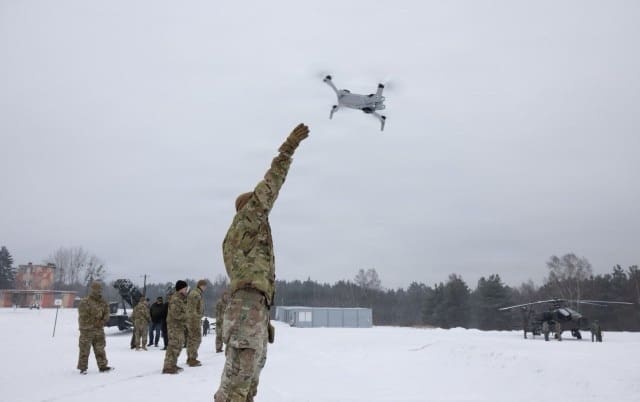
MIESAU, Germany – U.S. Army Garrison Rheinland-Pfalz teamed up with the U.S. Air Force 569th U.S. Forces Police Squadron and 86th Security Forces Squadron from Ramstein Air Base and German Polizei July 16 to test its counter-unmanned aircraft systems (cUAS) capabilities and interagency communication networks in a realistic drone threat training exercise.

During the exercise, operators from the U.S. Air Forces in Europe and Africa’s Combat Training School flew a DJI Phantom 4 drone over USAG Rheinland-Pfalz’ installation near Miesau to simulate a drone threat, testing the operational capabilities of systems and processes currently in place, said Emily Roemer, an antiterrorism officer with USAG Rheinland-Pfalz Directorate of Plans, Training, Mobilization and Security and the lead planner for this exercise.

The DJI Phantom 4 is a commercially-available small UAS, making it ideal for this type of training, Roemer said.

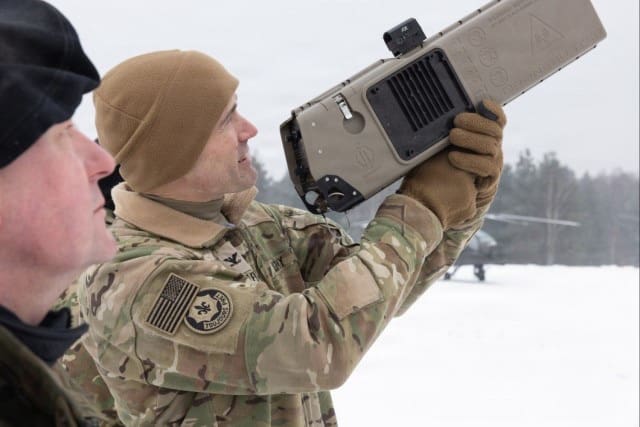
Staff Sgt. Michael Sopha, noncommissioned officer in charge of cUAS for the 569th USFPS, said the Air Force’s primary role in the exercise was to respond alongside USAG Rheinland-Pfalz in the joint environment, using the most current available cUAS technology to detect and disrupt small UAS in the exercise area.

Systems that were tested included small UAS detectors, signal disruptors and signal hijackers that protect friendly assets and render enemy systems ineffective, Sopha said.

“This exercise showed the importance of a joint force working together to combat small UAS threats. Our procedures are sound,” he said. “Future small UAS capabilities will be far greater, supporting the need for alternative systems to combat them on a large scale.”

Roemer stressed the importance of seamless communication between law enforcement teams from the garrison, the Air Force and the local community.

“Host nation response during a real-world event is critical,” Roemer said. “The Army likes to train how we fight, so we knew getting host nation participation for this exercise was a must.”

USAG Rheinland-Pfalz police chief DJ Diallo noted that working in partnership with German Polizei gives the garrison access to a wider network of security resources, ensuring a robust, resilient security posture.

“The lines between civilian and military airspace are increasingly blurred, demanding seamless information sharing and coordinated responses,” Diallo said. “Without robust international cooperation between Polizei and USAG Rheinland-Pfalz DES, we risk critical gaps in our ability to detect, deter, and respond to drone-related threats.”

He added that the garrison, Polizei and Air Force security forces routinely collaborate to improve response capabilities in the local area, leveraging the unique skills and authorities of each service through training exercises and a secure communication platform for real-time information sharing.

Roemer noted that planning the counter-UAS training event with so many joint partners was not without challenges.

“Ensuring that the exercise injects were realistic and involved all the joint partners was probably the biggest challenge,” Roemer said. “All the joint partners exhibited enthusiasm and eagerness to participate, which shows we have built positive relationships and shared trust between all parties.”

As part of the Army Transformation Initiative, the U.S. Army is investing in technologies including artificial intelligence, autonomy and counter-drone systems to outpace future threats faced at USAG Rheinland-Pfalz installations. Continuous transformation ensures the Army can deliver trained, cohesive and lethal teams to meet future challenges in complex operational environments like this one.

U.S. Army Garrison Rheinland-Pfalz advances the Department of Defense mission to achieve peace through strength as we serve, support and secure the total force community, enabling power projection for the European Theater.

By Jennifer Whitaker

Magazine Depth Wins Wars: The Future of NATO’s Arsenal

Saturday, July 26th, 2025

WIESBADEN, Germany – A strong defense isn’t solely about the quantity of weapons stockpiled, but the ability to adapt and rapidly produce what’s needed, experts asserted at the LANDEURO 2025 conference today. A panel discussion focused on the critical need for broadened production within NATO to secure global supply chains, enhance interoperability, and bolster strategic flexibility.

The conversation centered on lessons learned from the ongoing war in Ukraine, where sustained ammunition supplies and the ability to quickly repair and replace equipment have proven vital. Panelists emphasized the necessity of “magazine depth” – maintaining sufficient reserves – alongside collaborative production of munitions, repair parts, and entire weapon systems.

Panelists stressed that maintaining readiness requires a holistic approach, encompassing not only weapons systems and ammunition, but also a robust sustainment infrastructure. This includes ensuring sufficient repair parts, subassemblies and critical components are readily available. Experts agreed that the capacity and capabilities of the defense industrial complex are foundational to achieving this “magazine depth” and are a critical pillar for both deterring adversaries and winning conflicts – not just regionally, but globally. Furthermore, they noted that current economic and geopolitical conditions present an unprecedented opportunity to develop, expand, and scale the defense industrial complex, creating irreversible momentum for future security.

U.S. Army (Ret.) Gen. Edward Daly described his vision of the defense industrial complex in 2030.

“It’s an ecosystem that’s modern, globally responsive, interoperable, and produces capabilities and technologically advanced products at scale to support not only the commercial sector, but the military as well,” said Daly.

Lt. Gen. Miles Brown, deputy commanding general of U.S. Army Futures Command, highlighted the core goals of the Army Transformation Initiative (ATI) and the planned consolidation of the U.S. Army Training and Doctrine Command and U.S. Army Futures Command into the new Army Transformation and Training Command.

“This isn’t about bringing the family back together,” said Brown. “We’re building a 21st-century command – data-centric, collaborative, lean, agile, and adaptive. The whole point of the ATI is to take the opportunity we have now, with the national will and commitment to excellence, and to move out quickly, not to study for two or three years before we get after it.”

He emphasized that the ATI aims to fundamentally change how the Army operates, focusing on speed and innovation.

Ultimately, the panelists agreed that a modernized and adaptable defense industrial base, coupled with a streamlined and innovative command structure, is crucial for ensuring NATO’s readiness for prolonged conflicts and addressing the evolving landscape of global security threats. Investing in these areas, they said, will deliver a decisive strategic advantage for the alliance’s future arsenal.

See video remarks here.

By Aaron Smith

SparkX Teams with Army Soldiers on Open-Source Drone Project

Saturday, July 26th, 2025

JOINT BASE ANDREWS, Md. – A small team of technicians at Joint Base Andrews is helping shape the future of battlefield innovation, one 3D-printed drone at a time.

The Andrews SparkX Cell Innovation and Idea Center partnered with the U.S. Army’s 1st Multi-Domain Task Force from Joint Base Lewis-McChord, Wash., to redesign Project SPECTRE (Small Printable-Engineered-Composites Tailorable Remote-Effect), an experimental effort to create rapidly deployable, customizable, small, unmanned aircraft systems.

The result of Project SPECTE was Blackbird, a fully open-source, government-owned drone platform that cut development costs by more than $1 million.

According to SparkX technicians, the Blackbird can be 3D-printed and assembled in 36 hours for about $200, offering a low-cost, modular sUAS solution for training and operational use in the field.

“Working within the government always provides an opportunity for quicker development that often times faces less roadblocks and is more cost-effective than the standard acquisition processes,” said a Soldier with the 1st MDTF.

With no formal aerospace engineering training, the SparkX technicians reverse-engineered a new platform from scratch. They developed an original airframe that met operational goals while avoiding intellectual property conflicts with the Army’s previous partner.

“It was what we envisioned the plane to look like,” recalled Staff Sgt. Stefan N. Sobiech, a former SparkX technician who is now stationed at Osan Air Base, Republic of Korea. “I oversaw creation of the wings, and I sought inspiration from the most efficient planes I could find.”

The project went through more than 10 variations, but Sobiech said the team kept pressing and learning from their mistakes.

“I don’t think there was ever an obstacle that we didn’t think we could work no past it,” he said. “We always went back at it from a different angle or researched how others got past a similar issue.”

The final design includes two propeller-driven motors, a wingspan of more than six feet and weighed approximately nine pounds. Its modular design features a push-to-connect fuselage and a customizable internal equipment tray, allowing for rapid swaps of mission-specific gear and easy to assembly in the field with no specialized tools.

In November, the team was invited to fly the drone during Titan Hoplite, a joint exercise hosted by the Air Force’s Task Force 99 at Shaw Air Force Base, S.C. The SparkX technicians showcased their airframe alongside other advanced sUAS technologies, drawing interest from units across the Department of Defense.

Sobiech said the team conducted a 30-second shakedown flight before heading to Shaw, where the Blackbird flew for more than two minutes during Titan Hoplite demonstration.

The drone unfortunately crashed after flying out of range of the hobby-grade motors and avionics.

Although, Sobiech was unable to attend the event, he mentioned receiving texts and video footage from observers of the successful flight.

“I was ecstatic! To see it sustaining flight, for that length of time, was an amazing feeling,” he said.

Earl Bagwell, Spark X director, said the Titan Hoplite demonstration sparked interest from several organizations in the Army and Air Force that wanted to get involved.

Bagwell released the 3D files as an open source to allow other units to 3D-print the components and integrate their own avionics and motors.

“We knew this would be a sought-after capability, but instead of going through the long patent process, we decided to open source it,” Bagwell said. “Whoever needs it can have it—because we need to innovate and move faster.”

The Air Force Research Laboratory, the Army Research Laboratory, Combat Innovation Lab, Tesseract, and 2nd MDTF are among the organizations that have accessed to the Blackbird files. Together, they support operational theaters across U.S. Indo-Pacific Command, Central Command, Europe, Africa, special operations, and the Army National Guard.

The 1st MDTF successfully deployed and tested the system in various environments, implementing rapid design updates on-site to improve both their understanding of the platform and its capabilities.

“Working in the joint force allows us to consider multiple angles and employment methods that might not be considered in an Army-only environment,” said an 1st MDTF Soldier. “It also gives us access to resources and diverse skill sets not inherent within individual services.”

Story by Patrick Griffith, 316th Wing

US Army Leaders Discuss Vision for Future Armor Warfare at LANDEURO Conference

Thursday, July 24th, 2025

WIESBADN, Germany – At the inaugural LANDEURO conference, U.S. Army leaders from the 1st Armored Division and 1st Armored Brigade Combat Team, 3rd Infantry Division laid out a path for transforming America’s armored forces in an era defined by pervasive surveillance, lethal drones and rapidly evolving precision strike capabilities.

On July 17, during a Warrior Corner panel titled “Reforging the Armored Spearhead: TiC 2.0 and the Evolution of Large-Scale Combat Operations”, Maj. Gen. Curtis Taylor and Command Sgt. Maj. James Light, command team of the 1st AD, and Col. Bryan Bonnema, commander of the 1st ABCT, 3rd ID, delivered an assessment of the changing battlefield and how U.S. armored formations must evolve to win future wars.

Taylor opened the panel by citing a watershed moment: a Ukrainian brigade’s fully robotic assault north of Kharkiv.

“That battle indicates the time to reimagine armor has begun and we have got to think about what armor will look like in the future,” he said.

According to Taylor, the war in Ukraine is proving that increased precision strike capabilities, lethality being cheaper than protection—especially from First-Person View drones—and the pervasiveness of surveillance are reshaping combat. Over 70% of vehicle losses in Ukraine have come from FPV drone strikes.

These trends mean our future fights won’t be defined by direct fire alone, but by platforms that can sense, survive, and strike first in a contested electromagnetic spectrum.

Four Core Imperatives for the Future ABCT

From these battlefield lessons, Taylor laid out four key takeaways required to shape the Army’s evolving concept for the ABCT:

1. Sense and Strike Integration at All Echelons. From platoon to brigade, formations must have persistent sensing and strike capabilities, from short-range FPVs to long-range ISR.

2. Layered Drone Countermeasures. Units must organically embed counter-UAS capabilities, transforming into something akin to carrier strike groups with their own protective systems.

3. Embedded EW Capabilities. Formations need robust EW teams capable of operating independently, targeting enemy systems, and navigating the electromagnetic spectrum effectively.

4. Robotic Breaching. Future assaults on entrenched defenses will depend on unmanned breaching systems, inspired by the challenges seen in Ukraine’s assaults on Russian defensive lines.

Despite advances in robotics and automation, Taylor underscored a core truth, even in high-tech battles, humans are still required to hold ground. Soldiers are not attritable assets, and the Army must invest in protecting and sustaining troops in these new operational environments.

Before passing the discussion to Light, he shared a comment from an Estonian battalion commander he thought was profound, “He said the winning side in the next war will be the army that first perfects the use of drones in maneuver warfare.”

NCO Perspective: Innovation Starts at Ground Level

Light echoed that message, emphasizing that the current generation of armored Soldiers is highly capable—but must evolve.

“Our infantry squads and armored formations are very well trained and they are very good at what they do,” Light said. “The problem is we’ve been doing it pretty much the same way for the last decade or so.”

The key to transformation, he argued, is empowering Soldiers and noncommissioned officers to innovate within their current means. He called it innovation by requirement in a resource-conscious environment.

“They absolutely are the ones that are going to be able to contribute the most and influence those outcomes that determine where we go in the future as a force,” he said.

He also emphasized training discipline, citing the U.S. tank crew that won the Strong Europe Tank Challenge by focusing on fundamentals and standard gunnery—a reflection of how strong basics still dominate the battlefield.

TiC 2.0: Experimentation at Scale

Bonnema, whose brigade recently completed the first Transforming in Contact 2.0 rotation at the Joint Multinational Readiness Center, Hohenfels, Germany, provided a detailed look at how his brigade is integrating technology, Soldier ingenuity, and new tactics to meet modern threats.

“As a TiC 2.0 ABCT, there were three things that we thought that we needed to be able to do better than a non-TiC ABCT,” he stressed. “The first was accomplish our mission, task and purpose more effectively, more efficiently. The second was to maintain more and constant pressure on the enemy through multiple forms of contact and all domains. And the last was to become more lethal. So, increase that kill ratio as opposed to non-TIC ABCT.”

Some key initiatives from the ABCT’s rotation at the Joint Multinational Readiness Center:

1. Command and Control Redesign. The brigade leveraged basic camouflage and security, virtual collaboration, and emerging communications technology to enhance decision-making while avoiding detection.

2. Maneuvering in Electromagnetic Warfare Spectrum. Small EW teams were deployed forward to locate, sense, and target to disrupt enemy formations and shape conditions for the next close fight.

3. New Task Organization. The formation task organized for purpose, creating FAAT teams—combining FPV drone pilots, artillery forward observers, and anti-tank personnel—employing them in restrictive terrain to deadly effect.

4. Comprehensive Counter-UAS Defense. Throughout the exercise leaders emphasized the need for persistent UAS defense from breach point to support area, enabling safe maneuver for both sensors and troops.

“JMRC is an opportune place for us to operate, train and experiment,” Bonnema said. “It really helped us get after readiness. From the complex terrain to the professional OPFOR, it gave us some good lessons.”

Challenges Ahead: Battery Life, Training, and Launch Concepts

Despite progress, Bonnema and Taylor acknowledged hurdles. Battery limitations, inconsistent environmental performance, and the dangerous logistics of hand-launched FPVs remain issues.

A critical future requirement, Taylor said, is deploying drones from under armor.

“We’ve got to move beyond launching drones from tough boxes in dangerous forward areas,” he noted, calling on industry to help deliver solutions like vehicle-integrated launch systems.

With no formal FPV operator military occupational specialty, U.S. Army units are adapting UAS (15-series) operators and cavalry scouts for these roles. Simulators are being used for early training, and Soldiers are logging hundreds of flight hours to reach proficiency.

Light called FPV drone piloting extremely difficult, noting that mastery takes time and dedicated talent.

“You don’t just wake up, grab your controller, and go fly up and take out a tank,” he said.

Bonnema also emphasized the training proficiency required for FPV operators, “We’re using simulations to get after training, conducting hundreds of simulated missions before we get into live. And then once we get into the live training progression in our tables, it’s hundreds. Six hundred and sixty [hours] is what we’ve flown so far in preparation for our live fire.”

Europe: A Catalyst for Innovation

Taylor closed by highlighting how being deployed to Europe, so close to conflict, has supercharged innovation for the division.

“You have an opportunity because of your proximity to the theater, because the energy that is here in the NATO Alliance to innovate at a pace that I never thought was possible,” he said.

The division will return home, he said, better trained and more prepared to adapt to the changing character of war.

As the U.S. Army confronts a future battlefield dominated by drones, sensors, and electronic warfare, the 1st Armored Division and 1st Armored Brigade Combat Team, 3rd Infantry Division are leading the charge to modernize America’s armored spearhead. Their message is clear: the time to adapt is now—and the Soldier remains central to victory.

The 1st Armored Division and 1 Armored Brigade Combat Team, 3rd Infantry Division are forward-deployed to the European theater, working alongside NATO allies and regional security partners to provide combat-credible forces to V Corps, America’s forward deployed corps in Europe.

By Lt. Col. Jessica Rovero