XC3 Weaponlight

Archive for the ‘Army’ Category

RIA-JMTC Gears Up for the Future Under New Leadership

Wednesday, July 23rd, 2025

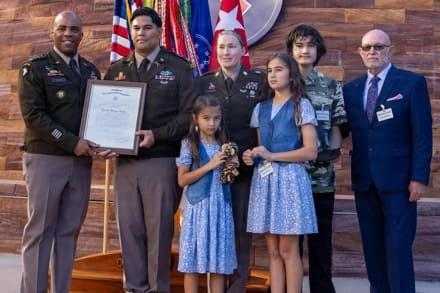
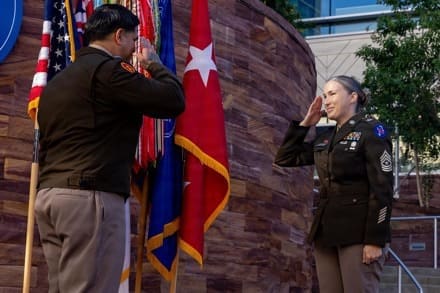
Rock Island Arsenal, Ill. – This week marked a significant changing of the guard at Rock Island Arsenal-Joint Manufacturing and Technology Center as Col. David Guida passed the command torch to Col. Eloy Martinez in a ceremony steeped in tradition and gratitude.

“I stand before you today with a deep sense of responsibility and a clear vision: to build upon the incredible legacy of RIA-JMTC, solidifying our position as the Army’s premier organic industrial base provider of readiness solutions for our nation’s Warfighters,” Martinez said. “This facility is a cornerstone of national defense, and a vital component of The Army’s global reach. To the dedicated men and women of RIA-JMTC — this facility is a national asset.”

Martinez, a leader with more than three decades of dedicated service encompassing aviation, transportation, special operations and strategic logistics, expressed profound humility and eagerness to lead the vital manufacturing hub. He acknowledged the weight of responsibility, but also the immense potential within the ranks of RIA-JMTC. Before outlining his strategic vision, he paused a moment to recognize the steadfast support system that has been instrumental in shaping his journey and career success.

“I’d like to express my deepest gratitude to God for His many blessings. Without Him, none of this would be possible,” Martinez said. “To my wife, Jennifer, thank you for thirty-two years of unwavering love and support. You are my foundation, and I love you dearly.”

After offering personal acknowledgements, Martinez turned his attention to the core of his new mission: leading the exceptional team at RIA-JMTC. He underscored the factory’s critical role and strategic importance in national defense.

“Over the past six months, I’ve had the privilege of meeting many of you, touring the facilities, and witnessing firsthand the incredible capabilities housed within these walls,” Martinez said. “I’ve seen your dedication, your ingenuity, and your unwavering commitment to excellence. These accomplishments are a testament to your hard work and your profound dedication to providing our Warfighters with the tools they need to succeed.”

Martinez demonstrated a keen understanding of RIA-JMTC’s expansive capabilities, highlighting the impressive ability to simultaneously manage more than 300 diverse projects, ranging from legacy system sustainment to cutting-edge technology development. He specifically acknowledged the recent achievement of AS9100 certification, a testament to the facility’s commitment to quality and continuous improvement within the aerospace industry.

“My commitment to you is simple. We will build upon this incredible foundation, embracing data-driven decision making, predictive maintenance and a relentless pursuit of efficiency,” Martinez stated. “Together, we will: streamline processes leveraging Lean Six Sigma principles, aggressively embrace advanced technologies like additive manufacturing and robotics, strengthen partnerships across the Department of Defense and with our industry partners, and fully leverage our full spectrum of capabilities, from initial design and prototyping to full-rate production and lifecycle support.”

He then laid out his vision for the future of RIA-JMTC, built on a foundation of continuous improvement and adaptation.

“We will anticipate challenges, pioneer solutions and maintain the highest standards of excellence to keep RIA-JMTC a cornerstone of military readiness.” Martinez said. “From alloying and casting, to forging and advanced manufacturing, all the way to final delivery, your work ensures Warfighters receive the equipment they need, when they need it.”

He pledged to anticipate challenges, pioneer solutions and maintain the highest standards of excellence.

“It’s an honor to join this team. I look forward to leading, learning and working alongside each of you,” Martinez said. “Let’s seize this opportunity. Together, we’ll shape the future of American manufacturing and continue strengthening our nation’s defense. Let’s get to work.”

By Kendall Swank

DIU, USNORTHCOM, US Army Announce Finalists for C-UAS Low-Cost Sensing Challenge

Tuesday, July 22nd, 2025

10 companies advance scalable, cost-effective solutions to bolster U.S. counter-sUAS capabilities and meet evolving DOD strategic priorities

Washington, D.C., July 21, 2025 — The Defense Innovation Unit (DIU), in close collaboration with U.S. Northern Command (USNORTHCOM), U.S. Army, U.S. Navy, U.S. Marine Corps, and U.S. Indo-Pacific Command representatives, today announced the selection of ten finalists to advance in the Counter-small Unmanned Aircraft System (C-sUAS) Low-Cost Sensing (LCS) challenge. These selected companies, chosen against a rigorous set of criteria from 118 outstanding submissions, will move forward to demonstrate their sensor technologies during USNORTHCOM’s Falcon Peak exercise in September.

“The evolving threat from unmanned aerial systems demands that we leverage every tool at our disposal – from cutting-edge commercial solutions to robust partnerships across government and industry,” said DIU Director Doug Beck. “This challenge directly supports DOD’s strategic priorities by tapping into non-traditional defense companies to develop scalable, cost-effective sensing solutions that help our forces at home and abroad to identify threats with the speed and fidelity needed to counter them.”

The solutions selected represent a diverse range of sensor modalities, including radio frequency passive detection, active radar, acoustic, optical cameras, infrared cameras, and several mixed modality technologies. The selected approaches have the potential to deliver significant value compared to current DOD systems for key coverage areas, at a potential cost savings of 50-80 percent in total cost of ownership. The ten finalists selected are:

  • BLUEiQ
  • CHAOS 1
  • Fortem Technologies
  • Guardian RF
  • Hidden Level
  • MatrixSpace
  • REVOBEAM
  • Squarehead Technology
  • Teledyne FLIR Defense
  • Thalrix

Launched in May 2025, the LCS challenge was designed to address a critical need: to complement exquisite sensor systems with affordable, distributed sensing technologies that can scale. Protecting the homeland from small UAS threats requires broad situational awareness with reach, redundancy, and resiliency. 

“These ten finalists represent the forefront of sensor innovation, demonstrating how diverse technological approaches can enhance our layered defense,” said Director of Replicator 2, David Payne. “Our collaboration with USNORTHCOM, the US Army, and other partners has been instrumental in aligning this effort with the Department’s most critical sensing needs. Ultimately, this prize challenge is about helping to provide the tools to extend cost-effective sensing capabilities to our most critical installations.”

Selected finalists now advance to live demonstration and testing at USNORTHCOM’s Falcon Peak 25.2 exercise. Falcon Peak will provide a real-world test of these low-cost sensing solutions and the prize purse will be distributed based on performance at the event. 

Beyond the prize money, top performers may also be considered for follow-on opportunities, including Other Transaction (OT) agreements, a Cooperative Research and Development Agreement (CRADA), and direct transition into operational use, accelerating the deployment of these capabilities and making the best tech available to the warfighter with the speed and scale required.

Australian and Japanese Soldiers Showcase Their Capabilities

Tuesday, July 22nd, 2025

One of the most crucial aspects of multi-national interoperability is a common understanding of the weapons, equipment and techniques of partner nations.

While the headquarters elements of the Amphibious Task Group 1 (ATG1) coordinated the upcoming activities during the transit from Cowley Beach to Bowen, the embarked Australian Army and the Japan Ground Self-Defense Forces (JGSDF) came together on the light vehicle deck of HMAS Canberra to showcase their different capabilities. 

Soldiers, marines and officers shared weapons, techniques, capability and a few laughs, that culminated in a leopard-crawl race across the deck. 

Providing insight into what an Australian standard infantry battalion (SIB) carries, Alpha Company, 1st Battalion, the Royal Australian Regiment (1RAR) were eager to showcase their weapon systems to their international counterparts. 

JGSDF soldiers inspected the Australian Minimi Light Support Weapon, General Support Machine Gun MAG 58, MDFSW 84, M72A6 LDFSW 66, and the EF88 Austeyr with SL40s attachment.

1RAR’s Direct Fire Support Weapons platoon introduced their heavy-weapons capability, which included the anti-armour Carl Gustav 84-millimetre recoilless rifle, the GSMG Mag-58 and HMG 12.7-millimetre machine guns (also known as a 50-Calibre) capable of firing armour-piercing rounds. 

Private Harrison Swan, 1RAR, observed that the Japanese also operated the 84-millimetre Carl Gustav.  

“I think it’s interesting to see that we are using the same weapon systems, there’s a lot of similarities but a lot we can learn from each other,” he said. 

1RAR’s mortar platoon explained the ranging controls of their weapons systems, complementing the battalion’s display of combat first aid kits, sniper rifles and other specialised gear. 

‘I think it’s interesting to see that we are using the same weapon systems, there’s a lot of similarities but a lot we can learn from each other.’ 

Sappers from the embarked elements from 3rd Combat Engineer Regiment demonstrated their specialist breaching equipment, demolitions and high-risk search equipment. 

These included a wide array of equipment that allows the combat engineers to support manoeuvre elements through the battle space. 

Despite all the hardware, the unchallenged fan-favourite of the day was Charlie the Explosives Detection Dog, who enjoyed pats and games of tug-of-war with multinational members on the deck. 

Overall, the morning was great success, since professional mastery and camaraderie both help to breach language barrier, as these highly capable units prepare for the upcoming amphibious raid in the Shoalwater Bay Training Area in the coming days.

Via Australian Army

DEVCOM Armaments Center Engineers Seek to Increase Soldier Safety by Reducing Blast Overpressure

Monday, July 21st, 2025

PICATINNY ARSENAL, N.J. – The harm to Soldiers from frequent exposure to weapons that cause blast overpressure (BOP) when fired has gained increasing attention, prompting Congress to pass a broad set of directives related to blast exposure and brain health.

Congressional mandates to the Pentagon include setting new safety limits for troops’ blast exposure, characterizing “Tier 1” weapon systems including the suite of ammunition for BOP and brain health impact and developing material solutions if required for current and future weapon systems.

According to the Army’s Medical Command, organs most susceptible to BOP include the middle ear, lung, brain, and bowel. The command notes that many of the long-term effects are still not well understood.

The DEVCOM Armaments Center is one of the main players in the collective effort to mitigate BOP because its engineers are involved in the design, development, fielding, and sustainment of many systems that have been identified as contributing to BOP: howitzers, mortars, shoulder mounted weapons, 50 caliber weapons, along with demolitions and breaching charges.

The first “Picatinny Weapons Community Blast Overpressure Summit” was held on October 22-23, 2024. In addition to the Armaments Center, other attendees included the Joint Program Executive Office Armaments and Ammunition; Program Executive Office Soldier; the Army Research Lab, the Medical Research and Development Command, and the Defense Health Agency Public Health Aberdeen.

“That was a great opportunity for the weapons community to come together,” said Jeffrey Kraft, who is the Armaments Center POC for the BOP initiative. “It was a way to basically level-set on what’s happening across the weapons community with respect to blast overpressure and also an opportunity to communicate what we’ve been learning at the larger forums that are happening at the Office of the Secretary of Defense level.”

Kraft said it was critical to develop close relationships with all the other stakeholders involved in mitigating BOP.

“From the weapons community side, we’re not doing this in a vacuum,” he said. “We’re working closely with the medical community to make sure that as they’re learning more about blast overpressure and what that means to the Soldier, we can apply that knowledge and incorporate that into our strategies as we try to solve it from the weapons community side. Building those relationships is key to making sure that we address this as a whole-of-Army, whole-of-DOD approach.”

At the Armaments Center, lines of effort (LOE) to address the BOP issue include baselining legacy and new munition and weapon systems, engineering solutions development for reduced BOP, data acquisition and analysis and blast sensors; modeling and simulation development; and improved ‘shoot house’ designs and ranges to reduce BOP. Another LOE is munition and weapon supportability, which includes personnel training, training packages, support equipment and human factors

“The technical challenges are how do we continue to maintain the weapon systems’ lethality and performance while also reducing and mitigating blast overpressure,” Kraft said. “For each weapon system, the technical challenges are going to be a little bit different depending on the attributes of the system.”

Kraft said a big first step in BOP mitigation is to gather enough data to get a clearer picture of the size and nature of the problem. “Once we understand what the problem is, then we can start to develop solutions. And we don’t know what we don’t know. As we start to get into this, we may learn where those limits are based on physics that we can only go so far. But right now, the goal is let’s try to get moving on this sooner than later to see where that point is.

“I think the other challenge right now is truly understanding what blast does to the Soldier’s health and developing a set of requirements that can be used for developing and implementing new engineering solutions.”

One solution that has received attention in the media is a new breaching charge form. The new charge form was developed at the Armaments Center by Mr. Greg Stunzenas and team, and can be used with legacy explosives to reduce/mitigate blast overpressure, such as when Soldiers breach doors or other barriers.

Also, an attenuating blast cone developed at the Armaments Center by Dr. Robert Carson and team can be used with a mortar system such as the 120 mm mortar. The cone redirects the blast wave so that the exposure level to the Soldiers is much lower.

Over the past years, blast overpressure from howitzers has been reduced through optimization of the muzzle brake design through numerical methods (computational fluid dynamics) and testing validation. Now, a team at the Armaments Center is also exploring the possibility of removing the muzzle brake from the howitzers and make adjustments to the recoil systems as a way to mitigate overpressure.

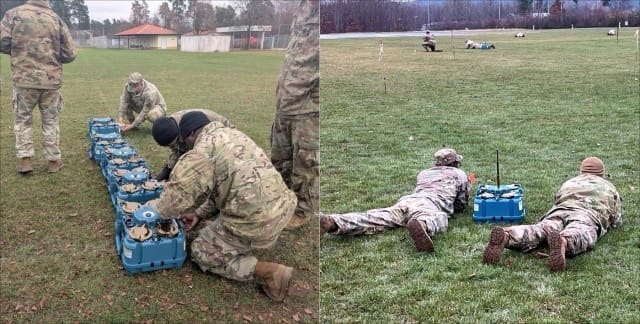
“There’s a big push right now within the blast overpressure community to understand how wearable sensors can be used to monitor what the exposure levels are to our Soldiers,” Kraft said. “Here at the Armaments Center, we have some technologies that we’re developing and adopting from large-caliber ammunition systems and applying that technology to blast sensors. The goal is to incorporate the blast sensors into the Soldier’s helmets to understand what their exposure profiles and limits will be from a blast event.”

Another initiative is to create workshops focused on individual weapons systems. Participants are digging deeper into what data is available for the systems, what new ideas might be brainstormed, and what might be done to either eliminate or mitigate blast overpressure.

“In the workshops, we can get the weapons community members together to really target a specific weapon system and figure out, how do we get after this?”

The BOP initiative is a key example of how the Armaments Center workforce is challenged to “Find a Way” through creative solutions while also collaborating closely with our partners.

By Edward Lopez and Timothy Rider

Electronic Warfare Leader Passes Responsibility

Sunday, July 20th, 2025

Kenneth Strayer, Project Manager (PM) for the Project Management Office Electronic Warfare & Cyber (PM EW&C) passed the reins of leadership to incoming PM, Col. Scott Shaffer in a July 10 change of responsibility ceremony at Aberdeen Proving Ground, Md.

As the ceremony’s host, Brig. Gen. Ed Barker, Program Executive Officer for U.S. Army Program Executive Officer, Intelligence, Electronic Warfare and Sensors (PEO IEW&S) presented the Superior Civilian Service Award to Strayer on behalf of the Acting Army Acquisition Executive, Jesse D. Tolleson, Jr. Barker also accepted the PM EW&C charter from Strayer and passed it to Shaffer signifying the official change of responsibility.

“Ken has been at the forefront of bringing EW capabilities back to the battlefield for this generation. The need to dominate the electromagnetic spectrum is more important than ever,” said Barker.

Under Strayer’s leadership since 2021, PM EW&C demonstrated the highest levels of excellence in the program management of urgently needed operational capabilities and priority requirements for U.S. Army Commanders. He instituted innovative acquisition approaches in a highly classified environment and tailored programs through rapid prototyping and flexible contracting to accelerate delivery and facilitate learning of the doctrine, organization, and training requirements necessary to reinvigorate electromagnetic warfare (EW) as a core competency.

Strayer spearheaded the development and fielding of the Terrestrial Layer System Manpack, Electronic Warfare Planning and Management Tool (EWPMT), Tactical Electronic Warfare System – Infantry (TEWS-I), Tactical Space Superiority systems, and many other EW capabilities to the force. He gained approval and chartered a new Colonel/GS-15 led Project Management Office for Cyber and Space to provide focused program management and stakeholder engagement for the joint cyber community. Additionally, he established a new GS-14 led Product Lead Office for Strategic Spectrum Warfare to provide responsive support for the growth in echelons above brigade requirements.

During his tenure, including his service as Deputy Project Manager EW&C from 2017 to 2020, PM EW&C received the 2019 Project Management Office Team of the Year (O-6/GS-15 level) award and the 2018 David Packard award for Acquisition Excellence.

“I am so proud of the more than 250 professionals on our team that equipped our Army to dominate the electromagnetic spectrum, ready for the next fight. It’s been amazing to watch the team’s creativity in development and delivery of capabilities. It has been the greatest privilege in my career to lead the EW&C team and family,” said Strayer during his remarks at the ceremony.

As the new Project Manager, Shaffer will guide a workforce of military and civilian professionals who develop and field integrated capabilities for spectrum warfare. He comes to PM EW&C after serving as the Executive Officer to the Principal Military Deputy to the Assistant Secretary of the Army (Acquisition, Logistics, and Technology) (ASA(ALT)) and after leading Product Manager Mission Command Cyber under the Program Executive Office for Command, Control, and Communications – Tactical (PEO C3T).

“This is an exciting time with changes to the operational environment and threat where we need to be more agile and creative to ensure we have the most lethal force with the right mix of capabilities and resources. Thank you for this great opportunity to serve as the next Project Manager for PM EW&C,” Shaffer said, concluding the ceremony.

By Matthew Schramm

New Multi-Service Nonlethal Munitions GTA & Pub

Saturday, July 19th, 2025

In April, DoD published Multi-Service Tactics, Techniques, and Procedures for the Employment of Nonlethal Weapons (ATP 3-22.40 for the Army).

It is available for download here.

This multi-Service tactics, techniques, and procedures (MTTP) publication for The Employment of Nonlethal Weapons is a single source, descriptive reference guide for commanders, staffs, and individual users to plan for and employ nonlethal weapons (NLW) across the range of military operations.

It also describes MTTP for consideration and use during the tactical employment of NLW in support of warfighting personnel conducting operations. This publication:

a. Provides an overview of NLW.

b. Discusses fundamental concepts and training requirements involved with NLW.

c. Provides a description of NLW and employment considerations.

d. Discusses the use of NLW gleaned from lessons

Additionally, the US Army Military Police School and the Army Nonlethal Scalable Effects Center have issued GTA 19-08-004, Nonlethal Munitions which is available for download here. This graphic training aid (GTA) provides Soldiers with the capabilities and characteristics of the nonlethal (NL) munitions currently in the Army Inventory.

Fort Lee Renamed for Buffalo Soldier, Medal of Honor Recipient

Saturday, July 19th, 2025

FORT LEE, Va. — Medal of Honor recipient Pvt. Fitz Lee was honored today during a ceremony renaming the installation after him.

The ceremony, which took place at the U.S. Army Ordnance Training Support Facility, featured the unveiling of new signage displaying “Fort Lee,” which will be installed at all garrison access control points. Additionally, the Sustainment Gate was renamed Lee Gate, and Sustainment Avenue was changed to Lee Avenue.

“Today, we gather not simply to unveil a new name for this installation, but to honor the full arc of service, sacrifice and commitment that has defined it for generations,” said Maj. Gen. Michelle Donahue, commanding general of the Combined Arms Support Command and Fort Lee. “We gather with respect, to celebrate the legacy of all who have served here and to look forward to the future.”

Donahue also acknowledged the installation’s previous namesakes, Lt. Gen. Arthur Gregg and Lt. Col. Charity Adams, praising their pioneering service, leadership and perseverance.

“Their stories will remain vital parts of this installation and our museum collections,” she stated. “We are committed to ensuring their legacies are preserved and honored as they helped shape this post into the center of excellence it is today.”

Lee enlisted in the Army as a private in 1889 and served with the 10th Cavalry, known as “Buffalo Soldiers,” during the Spanish-American War.

“We honor our installation with the legacy of Pvt. Fitz Lee who was a native of Dinwiddie County, a Buffalo Soldier and a Medal of Honor recipient,” said Col. Rich Bendelewski, Fort Lee garrison commander.

Lee earned the Medal of Honor for his exceptional courage during a daring rescue mission in Cuba in June 1898.

“We are proud and excited to be here today honoring our fellow Buffalo Soldier Pvt. Fitz Lee,” said Trooper Nina Amos, National President of the 9th & 10th (Horse) Calvary Association. “Lee was a Soldier who served with honor, integrity, valor and conviction.” Lee was awarded the Medal of Honor during the War with Spain.

As he was boarding transport ships bound for Cuba, Lee, along with 50 other troopers, was chosen for a special assignment behind enemy lines to reinforce and resupply Cuban fighters seeking liberation from Spanish rule, according to the National Park Service’s Charles Young Buffalo Soldiers National Monument website.

On June 30, 1898, Cuban freedom fighters and some American volunteers aboard the U.S.S. Florida attempted an amphibious landing at Tayacoba, Cuba. The landing party immediately engaged with Spanish soldiers from a nearby blockhouse. The Cubans and Americans retreated, leaving behind a group of wounded comrades. After four failed attempts, U.S. commanders decided to try one last time to retrieve the survivors.

Lee and three other Buffalo Soldiers answered the call. They rowed ashore amid intense small arms fire, and upon reaching the shore, located the survivors and brought them safely back to the U.S.S. Florida, the site stated.

“That kind of courage – deliberate, determined and selfless – defines the very best of our Army,” Donahue said. “Pvt. Lee didn’t act for recognition. He acted because it was the right thing to do. Because that’s what Soldiers do.”

Lee was born in June 1866 in Dinwiddie County, Virginia, which is only a few miles from the installation that bears his name.

“A name is never just a name – it’s a reflection of our values, our history and our aspirations,” said Kevin Massengill, Dinwiddie County administrator. “This base has always been more than a neighbor to Dinwiddie; it’s been a family.”

For more than a century, our residents have worn its uniform, worked its gates and supported its mission, he said.

“By bearing the name of our own, Fort Lee now tells a story rooted in this land – one that speaks not only of a history we inherited, but a legacy we choose to honor: a Dinwiddie son,” Massengill said.

Lee’s health declined quickly after the rescue mission. He received his Medal of Honor while he was in the hospital on June 23, 1899, at Fort Bliss, Texas, and was medically discharged from the Army on July 5, 1899.

Lee moved to Leavenworth, Kansas, after discharge to live with fellow retired Buffalo Soldiers. He died at the home of a friend on Sept. 14, 1899, and was buried with full military honors at Fort Leavenworth National Cemetery.

“By bearing his name, this installation deepens its connection to our local heritage and our Army’s enduring values,” Donahue said. “Fitz Lee’s legacy is one of bravery, humility and unwavering commitment – qualities we must all strive to embody.”

“Fort Lee will continue to be a place where Soldiers are forged, leaders are developed, and the strength of our Army is sustained,” Donahue concluded. “Let us carry that responsibility with pride, with humility, and with an unwavering commitment to excellence.”

By Ericka Gillespie and Jefferson Wolfe

Anduril Awarded $99.6M for U.S. Army Next Generation Command and Control Prototype

Friday, July 18th, 2025

As an Allied combined arms formation rolls quickly through a heavily fortified enemy area, the dangers they face are unknown. Enemy adversaries could be dug in, difficult to identify, and ready to open fire. A soldier launches a drone to perform reconnaissance of the area, spotting a series of dangerous enemy positions. But there are only minutes to convey that critical information to the Battalion and Brigade commanders and adjust tactics before large groups of soldiers advance. With the right software tools, commanders are able to receive and process this information from miles away on a mobile device, and then transmit new orders to their subordinates that integrates real-time intelligence before they engage the enemy. In a matter of seconds, the lethality and effectiveness of the advancing unit is significantly upgraded.

The information age is transforming the battlefield. Soldiers must be equipped to go into battle with the best technology American industry can muster, with connectivity from the outer edge to the operations center. As the battlespace becomes digitized — and timely data, information processing, and decision-making decide success or failure — a transformed, modernized Army will need transformed, modernized software, networking, and communications equipment.

Next Generation Command and Control (NGC2) is the Army’s answer to this challenge. It’s the principal Army initiative to modernize the service’s communications and networking technologies, equipping the warfighter with seamless and resilient connectivity at the edge while simultaneously supplying commanders with the best decision-making information available — all through a modular, extensible, and open architecture software platform.

Anduril Industries today announced that it was awarded a $99.6 million Other Transaction Authority (OTA) agreement by Program Executive Office Command, Control, Communications, and Network (PEO C3N) to lead the delivery of an NGC2 prototype, integrating partner capabilities from other technology-first companies like Palantir, Striveworks, Govini, Instant Connect Enterprise (ICE), Research Innovations, Inc. (RII), and Microsoft.

For NGC2, Anduril and its partners will create an ecosystem that can rapidly integrate a range of technologies into a singular architecture so that soldiers can access various kinds of compute, communications, and information processing capabilities all at once. Time-sensitive decisions will be faster, and soldiers will be more connected across Corps to Company. Critical data might include enemy locations, logistics and sustainment information, terrain mapping, tactical control measures, and weapons statuses. In turn, Lattice Mesh will enable machine-to-machine interfaces that deliver effects in a fraction of the time compared to legacy systems and networks.

Lattice Mesh is already the foundational edge platform that underpins several Joint and Service initiatives, including the DoD’s Chief Digital and Artificial Intelligence Office Edge Data Mesh. In the same fashion, Lattice will create immediate Joint interoperability for the Army’s Command and Control ecosystem. As a result, NGC2 will connect digital assets, remote sensors, command posts, and soldiers on the ground with real-time intelligence and systems. This solution is in stark contrast to the siloing of data and intelligence across classified and unclassified stovepiped systems that currently exists.

The announcement of OTA continuation follows an 18-month competitive experimentation process, which Anduril entered in late 2023. From the ground up, Army Futures Command has reimagined a new construct for command-and-control in just two years, considering multiple proposals from industry with the intent of standing up NGC2 at rapid speed. Contrasted with a typical five to seven year timeline, the Army moved from proof-of-concept to capability validation in just one year, a pace which Army CTO Alex Miller called “astronomically fast.” The Army established NGC2 as a program office in April 2025.

Anduril and its partners will deliver the NGC2 prototype to the 4th Infantry Division immediately upon award, working through a series of Soldier touchpoints and exercises to stress the performance of the software solution in operational environments at scale. The capability will be integrated onto compute nodes aboard multiple different types of mechanized vehicles throughout the 4th Infantry Division. Throughout the process, we will continue to evaluate new products, partners, and technologies that could strengthen the NGC2 ecosystem, contributing to continued improvement and evolution of NGC2. This prototype will serve as a proof-of-concept that with Anduril software, tactical units are better connected, informed, and more agile as they conduct real-time operations — precisely aligned with the Connected Warfare mission at Anduril as it works with customers across the Department of Defense.

This latest announcement from the Army is a reflection of Anduril’s commitment to delivering every conceivable battlefield advantage to the United States military — starting with the information they use and ending with the weapons they carry. And we’re still just getting started.

www.anduril.com