SIG SAUER - Never Settle

Archive for the ‘Army’ Category

Green Berets Leverage Immersive Simulator for Training

Thursday, February 15th, 2024

FORT CARSON, Co. — Members of the special forces community are utilizing training software that employs, to some degree, artificial intelligence. Operators with 10th Special Forces Group (Airborne) completed multiple iterations of VirTra simulation training at the Human Performance Training Center on the 10th SFG (A) Complex, Feb. 2, 2024.

Applicable for both law enforcement and military, the VirTra simulator is a program featuring technology that can present different scenarios to its users which helps sharpen shooting skills. The program is fully customizable, helping individuals prepare for real-life incidents, while also providing accurate ballistics and military weapons qualification courses.

10th SFG’s (A) cognitive performance specialist, Jake Blumberg, oversaw the training iterations that were conducted in the HPTC. Blumberg described the structure of the training and designed it to be as realistic and similar to combat as possible, explaining that the Green Berets were guided through a series of exercises to spike their heart rate before executing shooting scenarios.

“This allows us to pair marksmanship with a variety of different training environments where they are coupled with a strength coach to simulate physical stress,” said Blumberg. “[Operators] are then able to create a variety of different ranges and targets to really hone their craft.”

Blumberg mentioned that 10th SFG(A) is the only Special Forces Group in the U.S. Army that has full-time access to this sort of technology and to think of the VirTra simulator as a more advanced version of the U.S. Army’s already well-known Engagement Skills Trainer.

“This [technology] provides what the EST can in terms of weapons qualification and flat range practice,” Blumberg remarked. “But VirTra also incorporates different types of drills, from reaction drills to threat-not-threat scenarios.”

The different scenario options that VirTra features include active threat, hostage situation, threat recognition and high-risk entry. Through these scenarios, the VirTra simulator is actively analyzing the decisions that its users make and then adjusting what happens in the program based on those decisions.

Several Green Berets were afforded the opportunity to this unique training and one team captain commented that it gives him and his Soldiers unlimited opportunities to practice the fundamentals and increase their personal shooting skills, since using the simulator doesn’t use any live ammunition.

Since this technology is local to 10th SFG (A), this allows the operators to hone their craft at any time of the day and not spend time reserving ranges or acquiring other supplies.

“Everything comes down to increasing lethality, so the more triggers we pull in the correct manner, that’s what we want,” said the team captain. “Practice makes permanent — ultimately we want to be training the fundamentals all the time and this is another venue for guys to pull their personal weapon and become better at the basics.”

By SGT David Cordova

Top Army Generals for Cyber, Space and Special Ops Convene

Tuesday, February 13th, 2024

PETERSON SPACE FORCE BASE, Colo. — The U.S. Army’s top generals for cyber, space and special operations forces met to discuss the Triad partnership and how they can further develop, operationalize and institutionalize the collaboration.

Commanding Generals Lt. Gen. Maria B. Barrett, U.S. Army Cyber Command; Lt. Gen. Jonathon P. Braga, U.S. Army Special Operations Command; and Lt. Gen. Sean A. Gainey, U.S. Army Space and Missile Defense Command, met Jan. 31, 2024, for the third Triad 3-Star General Officer Steering Committee at USASMDC headquarters at Peterson Space Force Base.

Members of the committee emphasized the importance of the Triad due to the ever-changing character of warfare. Along with this evolution, the threats and the nature of deterrence are changing for the United States. The Triad looks to develop innovative and comprehensive solutions.

“The Cyber-Space-SOF Triad provides one of these solutions,” Braga said. “It is a ‘Modern-Day Triad’ designed to converge unique accesses, capabilities, authorities, understanding and effects in many of the same ways we have implemented combined arms operations. Additionally, the Triad provides operational and strategic advantage during active campaigning, crisis and conflict, while presenting options to senior leaders that are less escalatory than current strategic deterrence options.”

Gainey said that they must continue building upon the significant progress the Triad has already made in the development of concepts, capabilities and formations that enable exquisite operational preparation of the environment. The commands have already developed a unified exercise, experimentation and engagement plan for fiscal year 2024 and fiscal year 2025.

“We are working with the Theater Special Operations Command to ensure they know the space and high-altitude capabilities we can provide and to develop the operational concepts of employment,” said Gainey.

“(The Triad) is developing real-world employment concepts designed to enable Army and joint force objectives anywhere in the world at a time and place of our choosing,” Gainey said. “Additionally, the Triad will enable ‘Left of Launch’ trans-regional missile defeat and active campaigning to ensure the ability of our nation’s adversaries to strike the United States, as well as its partners and allies is prevented.”

The Triad is a major way we can contribute to multi-domain operations and for us, the potential it provides our Missile Defeat efforts, as well as the access, understanding, and effects it can enable for the Joint Force are undeniable, Gainey said.

“As such, the Triad provides flexible deterrent options that can shape the threat environment in ways our adversaries are unaware of and can provide flexible response options if they choose to break international norms and escalate tensions into conflict,” he said.

Braga said the Triad has an outsized impact against the adversary’s capabilities as it relates to SOF, space and cyber.

“That is why it is inherent we work together, experiment together and learn together,” Braga said.

Barrett said the Triad is coming up with solutions and tools together as a team.

“Triad operations disrupt adversary actions, demonstrate resolve, shape the adversary’s perceptions and gain advantage for warfighters when deterrence fails,” Barrett said. “ARCYBER has a track record of integrating cyber, electronic warfare and influence operations and can now deliver that to triad partners.”

By Dottie White, USASMDC

US Army Releases TC 3-12.2.98 HUNT Operations

Monday, February 12th, 2024

At the beginning of February, the US Army published TC 3-12.2.98, “Hunt Operations” which provides tactics, techniques, and procedures for defensive cyber forces conducting hunt operations as part of defensive cyberspace operations.

The tactics, techniques, and procedures contained in this publication are intended to be used as a guide and are not prescriptive.

The principal audience for this publication is cyber professionals in the United States Army Cyber Protection Brigade who conduct defensive cyberspace operations and the commanders and staffs of units who request and receive defensive cyberspace operations support from the cyber protection brigade.

Get your copy at armypubs.army.mil/epubs/DR_pubs/DR_a/ARN40178-TC_3-12.2.98-000-WEB-1

Soldier Wins Gold Medal at Event in Egypt

Sunday, February 11th, 2024

CAIRO — U.S. Army Sgt. Samantha Simonton won the Gold Medal in Women’s Skeet at the International Shooting Sports Federation World Cup in Cairo, Egypt, January 29, 2024.

The Soldier with the U.S. Army Marksmanship Unit Shotgun Team earned her place in the Final with a qualification score of 121 out of a possible 125, which beat 31 other competitors from around the globe and tied one from France.

In the final against five other international competitors, the Gainesville, Georgia native strongly represented Team USA in the cold and windy conditions. Simonton won the Gold with a score of 50 while Italy’s Martina Maruzzo earned the Silver with a 47 and Reem Al Sharshani from Qatar took the Bronze Medal with a 37.

With part two of USA Shooting’s Shotgun Olympic Trials coming up in March, the USAMU Soldier said a gold medal win in challenging conditions helps her prepare for the highly competitive match that determines which athletes will represent the United States at the Paris Games.

“I am just trying to use it as a training tool and move forward onto better scores like I have been training,” Simonton.

This gold medal win brings Simonton’s ISSF medal count to five. Her past medals are:

Bronze from the 2022 ISSF World Championships

Bronze from the 2022 President’s Cup

Silver from 2023 ISSF World Cup-Italy

Silver from the 2023 ISSF World Cup-Qatar

The Bronze World Championships Medal also came with a coveted Olympic quota for the United States in women’s skeet.

Though Simonton won one of the two possible Olympic Quotas for the Women’s Skeet event, that does not qualify her personally for the Games. It just ensures that an American athlete a ticket to the Games. Therefore, the U.S. Army Soldier will compete for a seat on Team USA at USA Shooting’s Shotgun Olympic Trials in Tucson, Arizona March 11-17. Until then, every match is training for her path to Paris.

Story by LTC Michelle Lunato

Photos by Andrea Caroppo

Next Generation Squad Weapons Undergo Arctic Testing

Saturday, February 10th, 2024

Soldiers from 1st Squadron – Airborne, 40th Cavalry Regiment, based out of Alaska, are supporting Project Manager Soldier Lethality with cold weather testing of the Next Generation Squad Weapons. Extreme environmental testing is critical to ensuring reliable systems. In addition to Arctic testing, the weapons, ammo, and fire controls will be subjected to jungle and hot weather testing.

Col. Jason Bohannon, PM SL, visited the testing site and shared his thoughts: “The Arctic environment is extreme and unforgiving to both the Soldiers and weapons. Our intent is for the weapons to perform in conditional ranges that exceed those which Soldiers would have to endure. I have been impressed with both Soldiers and weapon performance.”

Airborne Test Force Tests Field Radio Ruck to Survive Airborne Combat Missions

Saturday, February 10th, 2024

The U.S. Army Airborne Test Force (ATF) located at Yuma Test Center, Yuma Proving Ground, recently tested program of record Manpack radios, the AN/PRC-158 and AN/PRC-162, managed by the Product Manager Handheld, Manpack, Small Form Fit (HMS) inside the Army’s newest Radio Carrier Rucksack (RCR) solution. The RCR, developed and produced by the Natick Soldier Systems Center, was stressed in combat-realistic scenarios by the center to determine if the RCRs could safely support parachute operations without damage to radios or the ruck.

Soldier feedback using the legacy radio rucksack over several years of test events indicated that a solution with better weight balance, comfort, and heat dissipation was required for the user. PdM HMS initiated a competitive market research strategy, which brought a variety of industry and government rucksack solutions to Soldiers during 2022 and 2023 that led to the selection of the currently tested RCR solution.

“The competitive process really drove industry innovation, challenging the community to develop a best all-around rucksack solution in support of Army combat operations while carrying our modernized communications equipment,” said Derek Harberts, deputy PdM HMS.

“What we saw during this test are the results of a successful competitive process providing the all-around best-value to the Soldier and the taxpayers.”

The current design leverages modifications to the existing design of the Modular Lightweight Load-carrying Equipment assault pack currently fielded across the Army. Compared to the legacy RCR, the improvements allow securing the radio to the pack frame for better weight, balancing, and cooling. Modifications to the ruck allow better access if the radio needs to be carried and operated inside the bag as well as improved stowage and access for radio ancillary and mission equipment.

“The radio harness allows the radio to be connected to the existing assault frame, while the side pouches allow for individualized space to store antennas away from other equipment and gear,” explained Bob Cohen, HMS Manpack Lead Test Engineer.

“There’s additional space in the bottom compartment that can be used to individually store spare batteries and other ancillary equipment for ease of access.”

In all, the RCR will carry the radio, a battery, an antenna, and the Soldier’s basic load of individual equipment.

Leading up to the test, Soldiers with the ATF team started by packing the rucks as they would operationally under the direction of ATF Soldier Sgt. 1st Class Cody Lavalla.

“The configuration of these rucks is slightly different then the currently issued rucks,” tells Lavalla, “We are going through the process of figuring out how to rig the harness single point release to the ruck so all the equipment will survive the jump and is safe for the jumpers.”

The harness single point release is the equipment that secures the ruck close to the jumper’s body during most of the jump and is designed to be lowered on a release line away from the jumper by pulling a release handle just prior to landing.

When the Soldiers were about 150 feet from the ground, they lowered the rucksack carrying the radio using the lowering line, making it about 15 feet below them when they landed.

“We don’t want the ruck still attached to us when we prepare to land on the ground, or we risk injuries as we do our Parachute Landing Falls,” explained Lavalla. “We pull on the release handle and the ruck falls away from our body but is still attached to us via the lowering line so the equipment is out of the way when we are ready to land. It is nearby to have access to the equipment quickly if needed once we are on the ground.”

ATF Soldiers performed several jumps throughout the week for the safety confirmation tests. A team met them on the ground to ensure their safety and monitored the jumps.

Afterwards, Air Delivery Test Officer Faith Harbolt, ATF and members of the HMS team inspected the radios to see how they held up to the test.

“The test went well. The results of the test demonstrated that the rucksacks successfully secure and protect the radios during airborne operations. There was no damage to the rucks or radios observed during the inspection that occurred after the test was complete,” said Lavalla.

The improved rucksack will be fielded to units receiving Manpack radios starting early next calendar year. When fielded, these items will be used by units such as the 82nd Airborne during combat operations.

Story by Ana Henderson, U.S. Army Yuma Proving Ground

Army Announces Aviation Investment Rebalance

Friday, February 9th, 2024

Warfighting is changing more rapidly than it has in decades, and the Army is continuously transforming based on lessons learned and a sober assessment of the modern battlefield. To meet emerging capability requirements in a resource constrained environment, the Army today announced it will rebalance its aviation modernization investments across new and enduring platforms.

The Army will discontinue development of the Future Attack and Reconnaissance Aircraft at the conclusion of prototyping activities while continuing investment in the Future Long Range Assault Aircraft, and making new investments in UH-60 Blackhawk, and CH-47F Block II Chinook. The Army will also phase out operations of systems that are not capable or survivable on today’s battlefield including the Shadow and Raven unmanned aircraft systems. The Army will increase investments in cutting-edge, effective, capable and survivable unmanned aerial reconnaissance capabilities and the procurement of commercial small unmanned systems. These investments will be continuous and agile to stay ahead of emerging battlefield requirements.

“The Army is deeply committed to our aviation portfolio and to our partners in the aviation industrial base,” said Secretary of the Army Christine Wormuth. “These steps enable us to work with industry to deliver critical capabilities as part of the joint force, place the Army on a sustainable strategic path, and continue the Army’s broader modernization plan which is the service’s most significant modernization effort in more than four decades.”

“We are learning from the battlefield—especially in Ukraine—that aerial reconnaissance has fundamentally changed,” said the Chief of Staff of the Army, General Randy George. “Sensors and weapons mounted on a variety of unmanned systems and in space are more ubiquitous, further reaching, and more inexpensive than ever before. I am confident the Army can deliver for the Joint Force, both in the priority theater and around the globe, by accelerating innovation, procurement and fielding of modern unmanned aircraft systems, including the Future Tactical Unmanned Aircraft System, Launched Effects, and commercial small unmanned aircraft systems.”

As part of this transformational rebalancing, the Army will:

End development of the Army’s new manned reconnaissance helicopter, the Future Attack and Reconnaissance Aircraft (FARA), at the conclusion of FY24 prototyping activities.

End production of the UH-60V version of the Blackhawk, which extends service life of existing airframes by 10 years, after FY24 due to significant cost growth.

Delay entering production of the Improved Turbine Engine (ITEP) to ensure adequate time to integrate it with AH-64 and UH-60 platforms.

Phase out operations and sustainment of the legacy Shadow and Raven unmanned aircraft systems.

These decisions free up resources to make critical new investments in Army aviation. Going forward, the Army will:

Commit to a new multi-year contract to procure the UH-60M Blackhawk helicopter – a new airframe with a 20+ year service life – and invest in upgrades for the Blackhawk.

End uncertainty over the future of the CH-47F Block II Chinook by formally entering it into production, with a path to full rate production in the future.

Continue the Future Long Range Assault Aircraft (FLRAA) program as planned, ensuring the Army remains on a path to field the first operational unit in FY30.

Increase investments in research and development to expand and accelerate the Army’s unmanned aerial reconnaissance capability including future tactical unmanned aerial systems and launched effects.

In reviewing the FARA program in light of new technological developments, battlefield developments and current budget projections, Army leaders assessed that the increased capabilities it offered could be more affordably and effectively achieved by relying on a mix of enduring, unmanned, and space-based assets.

Moreover, without reprioritizing funds in its constrained aviation portfolio, the Army faced the unacceptable risk of decline and closure of production and sustainment lines for the Chinook and Blackhawk fleets. The Army’s new plan will renew and extend production of both aircraft, while also sustaining the experienced workforce and vendor base that underpin the Army’s aviation capabilities.

Although Army leadership had to make difficult tradeoffs between programs, this plan will allow the Army to continue building modern capability across its aviation portfolio while funding other critical priorities in future budgets. The Army remains committed to its most ambitious modernization effort in more than 40 years, which has seen significant successes such as the recent delivery and fielding of the Mid-Range Capability, M-10 Booker, Next Generation Squad Weapon, Armored Multipurpose Vehicle, Integrated Air and Missile Defense, Precision Strike Missile, Mounted and Dismounted Assured PNT, Maneuver-Short Range Air Defense, Lower Tier Air and Missile Defense Sensor, Enhanced Night Vision Goggle-Binocular, and entering the engineering and manufacturing development phase for FLRAA.

US Army Public Affairs

Opposing Forces a Key Element During Northern Strike 24-1

Thursday, February 8th, 2024

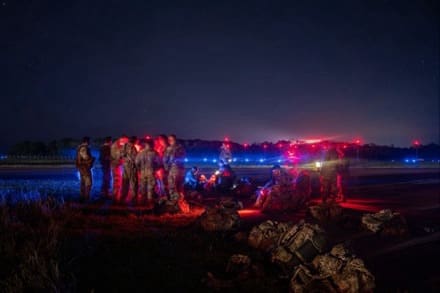
CAMP GRAYLING, Mich. – Snowflakes floated to the ground, bringing a hushed quiet to the darkened woods. Aside from the falling snow settling to the ground, the only sound was the muffled swishing of Soldiers as they pushed through knee-high snowdrifts toward their objective. That still quietness was vanquished by small-arms fire as muzzle flashes erupted in front of them.

“Contact right,” somebody called out and returned fire.

Movement commands were shouted as the Soldiers responded to the attack. The darkness, snow and cold were all elements they had to battle, and the Soldiers had just come across the other element they had to fight: the training exercise’s opposing forces, or OPFOR.

“The first role of the OPFOR is to give the rotational training units, the RTUs, a realistic look as to what they may see on the battlefield,” said Sgt. 1st Class Todd Teuling, the noncommissioned officer in charge of the OPFOR during exercise Northern Strike 24-1, a winter training exercise hosted by the Michigan National Guard at Camp Grayling Maneuver Training Center and the Alpena Combat Training Center in late January.

During the exercise, elements of the Army’s 5th Special Forces Group operated with close air support from Air Force and Michigan Air National Guard units while Michigan Army Guard units provided mortar and helicopter support.

Meanwhile, the Special Forces Soldiers had to plan and fight against the opposing forces, made up of Soldiers from Michigan Army Guard units.

“We work with the RTU’s leadership and kind of get an idea of what they want their Soldiers to see,” said Teuling. “We work together to plan — how many OPFOR, what kind of weapons and what kind of simulated pyro or explosives they want them to see, and they want their Soldiers to react to.”


Though the training scenario may be planned out — such as the RTU conducting a raid or an assault on target area — the Soldiers on the ground must plan for the mission and then react to the opposing forces’ tactics and movements as the scenario unfolds.

“Last night we were just doing a roving patrol,” said Teuling. “We kind of knew where were; the intent was to do a patrol and then to go attack them.”

Teuling’s team then moved in to where they thought the Special Forces team was positioned.

“Our OPFOR was in the woods with them and almost right on top of them, coincidentally,” he said. “It was just kind of perfect. And then they attacked them [using blank ammunition] and the RTU did exactly what they were supposed to do and got the training they wanted.”

Just as the Special Forces Soldiers must shift in response to the OPFOR’s action, their supporting elements must also do the same.

For Soldiers with Headquarters and Headquarters Company, 1st Battalion, 125th Infantry Regiment, Michigan Army National Guard, that may mean firing illumination rounds during a night mission before shifting to other types of rounds.

“The Special Forces guys, they’re on an objective or they’re maneuvering somewhere. They think they see something hundreds of meters in front of them. They’re not sure what it is. [They can] call in for illumination rounds,” said Staff Sgt. Alex Reams, a squad leader with the unit. The illumination rounds would then allow the observer on the ground to assess the situation and relay a follow-on fire mission.

“It gives the observer the option and the ability to see what’s on the ground and to then call in an effective fire [mission],” he said.

For the mortar teams, that means adjusting quickly to a changing situation. It may mean firing illumination rounds first, and then moments later following up with high explosive rounds on specific target areas. Making those adjustments can be taxing.

“The stress in the scenario is knowing that lives depend on your fire missions. Every second counts,” said Sgt. Michael Smith, a mortar team leader with HHC, 1st Battalion, 125th Infantry Regiment.

Taking part in exercises like Northern Strike helps strengthen the mortar team’s capabilities.

“The proficiency behind it is we train as we fight,” said Smith, adding that planning is a key element to being able to execute a fire mission.

“What do we have to do to mitigate and make it as safe as possible for our elements at the end of the day but be as deadly as possible to the opposition?” said Smith.

Planning is also key for the OPFOR, said Teuling.

“We have to plan months in advance how much blank ammunition we need and how much pyro we need, how many [opposing forces] uniforms we need,” he said. “So, there’s a lot of planning that goes into it, starts almost a year out before the exercise.”


Just as much planning goes into each OPFOR mission once the exercise starts, with the opposing forces team often basing their plans off those of the training unit.

“We build off from what they have to help plan ours so we know where to attack them or where we need to set up so we can ambush them, depending on what the mission or the objectives are,” he said. The OPFOR Soldiers then take those mission planning and tactical skills back to their home units.

But it’s executing those missions that are one of Teuling’s favorite parts of the exercise.

“I like getting out in the field and being part of the injects, you know, doing the attacks and just seeing how everything plays out and seeing how the RTUs and the Soldiers are reacting,” he said. “Even though it’s simulated, it’s training, you still get a bit of adrenaline going.”

By SFC Jon Soucy, National Guard Bureau