Colt

Archive for the ‘Army’ Category

C5ISR Center Modernizes Army’s Countermine Mission at Sandhills Project

Wednesday, February 21st, 2024

FORT LIBERTY, N.C. — Army researchers are teaming with operational units to define the future of countermine technology while developing solutions for Soldiers.

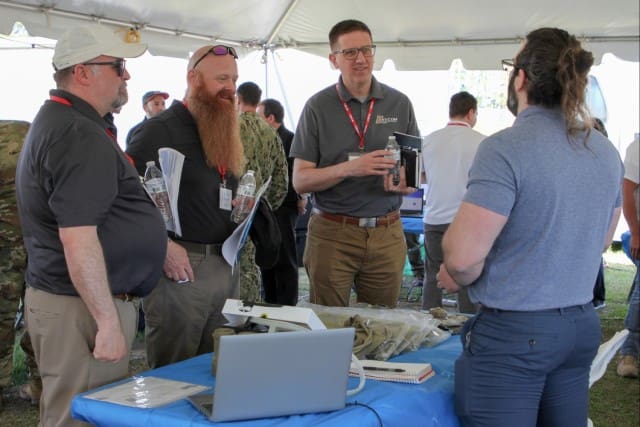
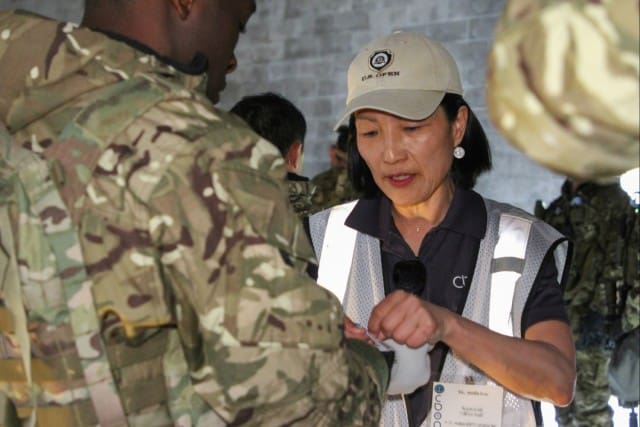
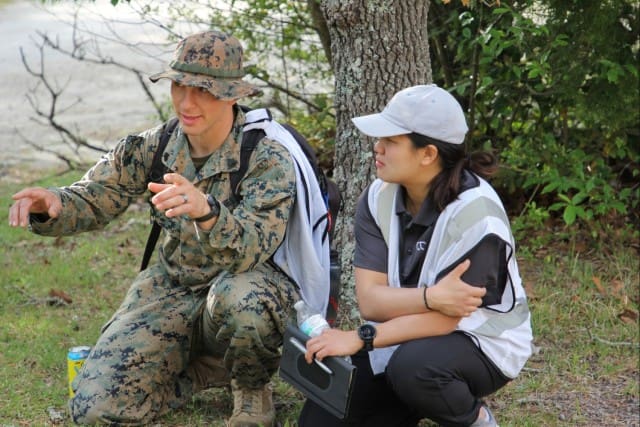
The Army’s C5ISR Center joined the 20th Engineer Brigade, 18th Airborne Corps and industry partners during the multi-day Sandhills Project experimentation event in December to demonstrate how Army Futures Command’s R&D community is shaping technological capabilities to meet Soldiers’ current and future needs.

C5ISR Center’s civilian engineers and scientists are modernizing the Army’s countermine mission space through investments in Aided Target Recognition, known as AiTR, with an emphasis on increased Soldier survivability. The Center was one of the first to develop and field AiTR during operations in Iraq and Afghanistan, primarily for counter-improvised explosive device applications in combination with ground penetrating radar sensors. Now, the focus turns to the next round of threats. The C5ISR Center is an element of the Combat Capabilities Development Command under AFC.

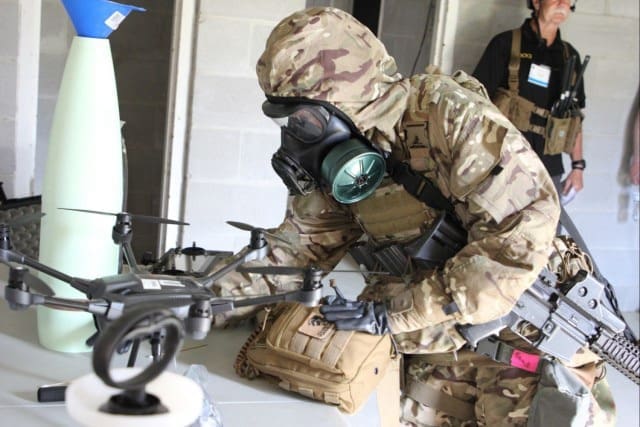
Mike Donnelly, an electrical engineer in the Center’s Research and Technology Integration Directorate, said the group is developing AiTR algorithms for integration into platforms such as remote and autonomous ground robotics, small unmanned aerial systems and handheld detection systems. Breaching operations must be as fast and precise as possible to maintain momentum and reduce the enemy’s ability to target friendly forces.

“We go to the field to provide live demonstrations with Soldiers and collect data from real targets,” Donnelly said. “This helps us develop a more robust algorithm so that when you give it to the Soldier, you know it’ll work in wide range of environments and conditions. That’s been the fundamental ideology behind our program. Build the best AiTR we can for Soldiers when it comes time to deploy.”

In addition to civilian subject-matter experts, the Army assigns noncommissioned officers to C5ISR Center as enlisted advisers to bridge the gap between lab-based research and operational use.

“Working with Soldiers gives researchers a different perspective because they have on-the-ground experience,” said Master Sgt. Cory Stepp, a combat engineer assigned to C5ISR Center. “As the R&D coordinator for C5ISR Center, I go out and find units, and we take this technology to Soldiers to get a larger amount of feedback. It’s important to involve Soldiers early on so we can help fix some of the problems in the very beginning stages.”

Col. Kenneth Frey is director of the Maneuver Support Capability Development Integration Directorate, which writes requirements for the future capabilities of Army branches that include combat engineers. His team works with DEVCOM Centers and other Army research organizations to understand the current state of the art and where technology is headed to define modernization requirements.

“I aim to modernize the engineer regiment, specifically toward the 2040 future,” Frey said. “What are our threats in 2040? Where do we need to be in 2040 to prepare regiments to operate in that time and space? I leverage the science and technology community to understand the minimums and maximums of technology now and in the future.

“The main obstacle that I see for Soldiers today in this experimentation is they still do this mission in the threat and are physically in the breach. For 2040 or nearer, we want to remove Soldiers from the hazard. Everyone here — S&T, industry, leadership — has come together with their skillsets. It gives a vision of what can be done.”

C5ISR Center electrical engineer Clare Yang said algorithms help to reduce the cognitive burden on Soldiers as they conduct missions as well as improve situational awareness by automatically detecting threats of interest. AiTR does not require a Soldier to continually monitor a sensor feed but merely confirm what the algorithm detects.

“Soldiers can push the ground robotic platform ahead of their units to conduct breach objectives such as cutting wires, moving obstacles and neutralizing explosive hazards while they stay behind,” Yang said.

“With an air platform, Soldiers can elevate their point of view, which allows them to see a farther distance and a wider area. Time is of the essence when it comes to obstacle breaching, and the ability to see as far and wide of an area as possible will help combat engineers gather intel quickly and make speedy decisions. In the coming decades, we’ll see more human-machine integrated platforms.”


Maj. Nick Rinaldi, a project manager at Army Applications Lab, is part of a team focused on working across the service to bring solutions to the front lines.

“There are great programs in place to get us where we need to be in the Army of 2030 and Army of 2040,” Rinaldi said. “In parallel, there are activities happening at an operational unit level across multiple organizations in Army Futures Command and Corps of Engineers. How do we deliver in parallel? How do our Warfighters take advantage of technology as it’s becoming available?”

C5ISR Center participation in experimentation venues such as Sandhills Project and brigade training rotations is instrumental for the Army S&T community to move lab work into the field, according to Marc Titler, a chief engineer in the Center’s RTI Directorate.

“Our engineers and scientists get immediate feedback on the current capabilities that will improve the next iteration of their prototype systems,” Titler said. “SMEs gain a broader appreciation and context of the real-world mission space challenges and problems that helps focus investments and technical investigations.”

By Dan Lafontaine, DEVCOM C5ISR Center Public Affairs

US Army Releases New TM for Target Audience Analysis

Wednesday, February 21st, 2024

TM 3-53.11 Influence Process Activity: Target Audience Analysis is the first of several new Technical Manuals to be released following the deconstruction of Special Text 33-01. The Influence Process Activity series includes TM 3-53.11, Target Audience Analysis; TM 3-53.12, Plan; TM 3-53.13, Prepare; TM 3-53.14, Execute; and TM 3-53.15, Assess. The others in the series are currently in the publication process with unknown, future publication dates.

TM 3-53.11 establishes techniques and procedures for Psychological Operations forces conducting analysis of foreign target audiences (TAs) in support of commander’s objectives and influence-based objectives.

Analysis provides requisite information for Psychological Operations Soldiers throughout each phase of conducting influence activities, to include the planning, development, delivery, and assessment of series.

Series focus on intermediate objectives toward a single supporting psychological objective (SPO) and TA combination in support of a psychological objective (PO). Multiple series may be required to support the achievement of each PO. Multiple POs support a program(s). Analysis further enables informed advice and increases behavior forecast accuracy. The principles contained in this publication are linked to Army Service doctrine in FM 3-53.

Read it at armypubs.army.mil/epubs/DR_pubs/DR_a/ARN40204-TM_3-53.11-000-WEB-1.

Rigorous Analysis of Future Operational Environment Informs Army Readiness

Wednesday, February 21st, 2024

AUSTIN, Texas – Army Futures Command is charged with transforming the Army to ensure war-winning future readiness.

A major effort underpinning this goal is the command’s extensive study and assessment of the future operational environment.

“It’s not about getting it right,” said AFC Commanding General Gen. James E. Rainey of the command’s efforts to forecast future likelihoods. “It’s about not getting it really wrong and seeing what you got wrong and adapting faster than your enemy.”

In late 2022, AFC leadership identified the need for a “running estimate” of what future challenges the Army of 2040 might face, including how it is likely to be shaped by rapidly evolving technologies and shifting global geopolitics.

An initial version of the document, which focused on the 2040 timeframe, was developed by AFC’s Directorate of Intelligence and Security in early 2023.

Referred to as the Future Operational Environment Running Estimate, the living document draws upon insights from previous iterations of future forecasts — among them AFC Pamphlet 525-2, Future Operational Environment: Forging the Future in an Uncertain World 2035-2050 — but was uniquely designed to be updated continually, offering the Army the ability to iteratively refine its understanding of future warfare.


“Army Futures Command’s critical mission is to transform the Army through new capabilities, formations and operational concepts that provide war-winning readiness. Understanding the conditions of the future operational environment and how adversaries may fight is necessary to inform the command so it can develop the capabilities, formations and concepts to achieve overmatch in those conditions,” said Jacob Barton, Ph.D., AFC’s future operational environment intelligence chief.

The running document explores types of conditions warfighters might encounter, technologies that could disrupt the status quo and implications of near-peer adversary activities.

Input for the document is derived from intelligence reporting, academic and scientific studies, and sustained engagement with experts from across the intelligence community, industry, academia and think tanks. The document also includes input from organizations across the command and other elements of the Department of Defense, resulting in comprehensive and in-depth analysis of information, Barton explained.

AFC uses the assessment of the future operational environment to inform all other critical functions performed by the command, including research, concepts, experimentation, requirements and integration.

The work is often extraordinarily complex, given how rapidly situations and technologies can change.

“Some of the most challenging aspects of preparing for the future operational environment involve the difficult nature of attempting to forecast the future,” Barton said.

“In assessing trends about the current operating environment, we attempt to envision the range of possibilities that exist in 10 and 20 years. Then we make assessments of what we believe at the time to be the most likely conditions within the range of potential possibilities.”

Despite the vastness of the challenge, Barton believes AFC is well-positioned to serve as a steward of the document for the Army.

“By having close collaboration with concepts and capabilities writers, engineers, scientists, technologists and integrators, AFC is uniquely suited to compare friendly and adversarial capabilities and provide useful analysis about what might be necessary to provide the Army advantages in the future,” Barton said.

AFC shares its analysis with other members of the joint force, helping to refine understanding of mutual challenges and opportunities related to future readiness.

The Army-specific lens of the running estimate also extends beyond what is typically provided by academia and industry, making it particularly useful to Army leaders and planners. Due to the sensitive nature of the document, it is not available for public consumption; however, its insights are directly contributing to the nation’s ability to protect its future.

“Ultimately, the Army must maintain its advantages,” Barton said. “Protecting the information and judgments inherent to the running estimate is a necessary step to maintaining this advantage.”

By Maureena Thompson, Army Futures Command

Army Expeditionary Warrior Experiment Tests Emerging Battlefront Advancements

Tuesday, February 20th, 2024

FORT MOORE, Ga. — Operational insights on the battlefront are crucial. The Army Expeditionary Warrior Experiment executes field experiments in real time, featuring live fires, simulations and force-on-force engagements to validate what will and won’t work for Soldiers amidst the conflicts of today and the challenges of tomorrow.

DRIVING CHANGE IN THE MANEUVER FORCE

The Maneuver Capabilities Development and Integration Directorate leads the Maneuver Battle Lab’s Live Experimentation Branch and sets the stage for the Army’s concept and materiel development for small unit modernization. As a key proponent on rising technologies, MBL hosts AEWE, an annual event held at the Maneuver Center of Excellence, a premiere showcase of innovations come to life. Each year, MBL partners with the science and technology community to submit ideas that can enhance the future of warfare.

Chris Willis, director of the MCoE Maneuver Battle Lab, shared this year’s experiment focus is “increasing the lethality of the infantry brigade combat team through robotic-enabled maneuver.” This means “taking capability, state-of-the-art technologies, and putting it into the hands of Soldiers, increasing the lethality to deliver the Army of 2030, and design the Army of 2040.”

AEWE

“For twenty years, AEWE has served as our Army’s premiere choice for modernization experimentation,” said Col. Scott A. Shaw, director of Maneuver CDID. “Vendors from all over the world, both industry and government based, submit to participate in the event to gather invaluable data, test their applications, and better yet, receive informative outcomes without the fear of failure when it really matters — in combat.”

Selected systems are presented for Army leadership interaction and put to the test throughout the experiment with Soldier touchpoints. Soldiers at the lowest tactical level can directly engage with the new technologies and various prototypes, and vendors receive invaluable feedback from experienced potential end users.

Willis noted, “AEWE brings together a live experiment and simulation. They are doing live field maneuvers that tie in, and a fighting simulation is simultaneously running.”

There have been a wide range of concepts showcased at AEWE, and some that incorporated feedback have been implemented into real Army applications.

“I remember seeing things like the Black Hornets, which are micro unmanned aerial vehicles, and the Nett Warrior system where Soldiers wear smartphones on their chest, and night vision goggles with infrared and thermal technology — they were all presented and tested here,” said Maj. Joseph Tague, Maneuver Battle Lab operations officer.

The AEWE runs from the beginning of the fiscal year in October, through second quarter, culminating in March with an insights brief. Outcomes and recommendations gathered during AEWE feed the Army Modernization Strategy, support the U.S. Army in Multi-Domain Operations, and this data informs leadership about the functionality and capabilities available. For many participating technologies, this means getting on the radar for future Army equipment decisions.

HERE AND NOW

“Inviting our partners and allies to collaborate on next-generation military warfare enhances our foreign relationships and underlines the significance of how enduring partnerships are a way our joint forces can deliver ready combat formations and strengthen the profession of arms,” said Shaw.

This year, AEWE has 48 participating concepts that will be put to the test over 50 days, which includes training and data collection conducted at Fort Moore. For AEWE, MBL brought together 182 Soldiers to comprise a multifaceted experimentation force of MCoE service members, foreign allies participating from the British Army, Dutch Army and German Army, and a platoon of Soldiers from Fort Johnson, Louisiana, who will serve as the opposition force acting as near-peer adversaries during Force-on-Force exercises.

“We need to be able to understand how we can integrate new technologies into both our infantry and armor formations,” Willis said. “From the experiment, we are trying to understand the operational effectiveness of new capabilities, looking at concepts, formations, or technologies, and how all three of these connect and could affect each other.”

Soldiers will evaluate components from seven categories — lethality, survivability, mobility, training, intelligence, surveillance, and reconnaissance, command and control, and sustainment — of these emerging technologies to gauge their potential effectiveness on modern battlefields. Experimenting and testing proposed concepts and capabilities can directly determine what tools could benefit the force and enhance tactical skills at the lowest echelon.

Shaw emphasized “Across multiple domains, innovation is key in warfighting and successful implementation of cutting-edge technology creates the overmatch necessary to win on future battlefields.”

By Camelia Streff

Gentex Corporation Announces Delivery Order for U.S Army Next Generation Integrated Head Protection System (NG IHPS) Helmet Program Agreement to Supply Helmets under the NG – IHPS Helmet Program

Monday, February 19th, 2024

CARBONDALE, PA, February 19th, 2024– Gentex Corporation, a global leader in personal protection and situational awareness solutions for defense forces, emergency responders, and industrial personnel, announced today that it has received its first delivery order to supply NG-IHPS helmets to the U.S. Army under the Next Generation Integrated Head Protection System Program.

“Gentex is proud of its near 130-year tradition of providing the best made products to the men and women of the American Military”, said Tom Short, Vice President for Ground Systems. “The NG-IHPS helmet system is just one example of the cutting-edge ballistic technology that Gentex consistently brings to the fight.”  

Swapping Skills and Patches at the Panzer Shooting Range

Monday, February 19th, 2024

STUTTGART, Germany – Ten soldiers from the German military, the Bundeswehr, earned U.S. Army Marksmanship Qualification Badges at Panzer Kaserne in Böblingen Oct. 18, while strengthening German-American friendship.

After a three-year hiatus caused by the pandemic, the USAG Stuttgart Headquarters and Headquarters Company (HHC) was finally able to host German Soldiers at the Panzer shooting range again, allowing them to earn the American marksmanship badges.

Capt. Andrew Horn, who assumed command of the HHC in early 2023, expressed satisfaction in hosting the Bundeswehr personnel and enabling their increased understanding of American weaponry.

“When we have these events, it keeps communication between us open, and therefore the friendship keeps going,” said Horn.

Following a round of practice shots, the invited German soldiers got the green light to demonstrate their shooting skills. Three Bundeswehr soldiers scored a perfect 40, earning the highly coveted ‘expert’ badge and the admiration of their colleagues.

Events like these provide opportunities for soldiers on both sides to bond, swap stories, and learn about each other’s cultures and military life. They sometimes include the chance to exchange keepsakes such as badges worn on their arms to symbolize their regiment or corps.

Sergeant Erik one of the Bundeswehr soldiers who scored a perfect 40, was eager to swap some of his patches for American ones. “It’s always fun to exchange badges. I love hearing the story behind them. I have some that have already caught my eye, and I hope to exchange them for some of mine,” he said.

Hauptfeldwebel (Sgt. 1st Class) Michel, who previously shot with American soldiers, always welcomes participation in these types of events.

“Days like these are always special as it’s like being together with brothers, and it increases the teamwork amongst ourselves,” Michel said.

These events are not only for bonding, but also serve practical purposes. “It’s helpful in case there is a real-world scenario, and we’d have to consider each other’s capabilities,” explained Horn. “We are familiar with it since we’ve already seen and practiced with each other’s equipment before.”

After a long and exhausting day, everyone gathered for a typical American barbecue, closing out with hamburgers and new patches from their counterparts.

Per Bundeswehr policy, German soldiers are identified only by rank and first name.

By BALMINA SEHRA

First Sky Soldier Earns Italian Jumpmaster Title

Sunday, February 18th, 2024

VICENZA, Italy – Few achievements stand out for a paratrooper as distinctly as earning foreign jump wings. U.S. Army Sgt. Mathew Pous, a paratrooper with 2nd Battalion, 503rd Infantry Regiment, 173rd Airborne Brigade, took this one step further, etching his name into history as the first ‘Sky Soldier’ to attain the title of Italian Jumpmaster.

Pous completed the Italian Jumpmaster School Dec. 18, 2023, in Pisa, a short distance from the city’s famed leaning tower.

The Sky Soldiers of the 173rd, forward-stationed in Vicenza, Italy, routinely conduct airborne operations alongside their Italian paratrooper counterparts of the Folgore Brigade, but Pous is the first to complete the rigorous Italian school. Paratroopers who successfully pass the course are certified to safely lead an airborne operation in the Italian Army.

“I’m extremely proud to have graduated from the Italian Jumpmaster Course,” said Pous. “Being the first from the 173rd Airborne Brigade and the third overall from the U.S. Army is an honor.”

As with its Italian counterpart, the U.S. Army Jumpmaster School is notoriously difficult. Candidates must memorize a series of intricate parachute inspection sequences to ensure paratroopers are safely rigged into their harness and able to exit the aircraft safely mid-flight.

“Immediately, they were surprised at how good my Italian was,” said Pous. “That I even use Italian slang and lingo to fit in. They appreciated my enthusiasm and respect for their culture, which lifted any barriers or reservations they had prior to meeting me.”

Pous shared that he started learning Italian at the dining facility in Vicenza on base, asking the Italian cooks how to say ‘eggs sunny side up’ and other words.

“I think it’s an added value to open up to another culture and understand their point of view and lifestyle,” he said.

After about a year of practice, he felt sufficiently fluent to tackle the difficult course.

The Italian Jumpmaster School emphasizes adaptability and cross-cultural collaboration. Soldiers are trained to execute their duties seamlessly together with international partners, reflecting Italy’s commitment to participating in multinational operations.

“Attending the school is not only about being a Jumpmaster and knowing how to speak Italian, but being a representative of the U.S. Army,” said Pous.

Prior to his experience in Pisa, Pous completed the U.S. Army Jumpmaster course just three months earlier, Sept. 18, 2023, after completing 35 jumps as a paratrooper. To assist himself and others with the finer details of airborne operations, Pous video documented his progress through the Italian course, as well as several of his multinational jumps.

He shared that one of the key differences between the U.S. and Italian schools lies in what each course emphasizes the most.

“U.S. Jumpmasters have a safety who swings the static lines and that is their primary focus as paratroopers exit the aircraft,” said Pous.

Pous explained that, instead of safeties, Italian Assistant Jumpmasters swing the static lines, then observe each jumper exit the aircraft, checking that the light is still green. Only then, in one fluid motion, does the assistant reach for the next jumper’s static line.

“It was challenging because I wasn’t used to that. I had to learn a new way and build new muscle memory,” said Pous.

Another difference Pous noted was both U.S. primary and assistant Jumpmasters jump out of the aircraft. In the Italian army, the Jumpmaster and assistant remain aboard the entire time, landing with the aircraft at the end of the airborne operation.

“Also, American pre-jump includes four pages of text that must be recited verbatim, whereas the Italian pre-jump consists of a number of bullet points you must convey, but you have the freedom to explain it in your own words,” said Pous. “The advantage is that Jumpmasters can emphasize certain parts in more detail if needed. In this way, jumpers are more attentive when they know something new might be shared.”

Both schools were very professional and meticulous, he added.

Over the three-week course, Pous successfully completed five different Jumpmaster duties, all conducted in Italian. He also served as the Jumpmaster to Italian airborne students, helping them graduate from airborne school.

“My best memory was probably having coffee right after morning formation every day. It was like a ritual,” said Pous. “Everyone would go, students and instructors alike. As their guest, they never let me pay for my own coffee and brioche!”

The morning coffee ritual served as a moment to start the day slowly, said Pous, talking about everything from the course to food to culture, vacation destinations and history.

But the course itself was all business, with the “difficulty level super high but achievable,” according to Pous. “I liked that they work hard and take their job seriously. They’re experts for sure.”

Pous’ graduation ceremony offered a glimpse into the close cooperation between the U.S. and Italian militaries.

“We know that it is an honor for him to graduate our Italian Jumpmaster School,” said Italian Army Col. Antonio D’agostino, commander of Centro Addestramento Paracadutismo, the Italian airborne school in Pisa. “Just know that it is also an honor for us, as Italians, to present this diploma to him as a representative of the United States of America and the U.S. Army.”

The motivation to excel is deeply ingrained in the ethos of airborne units, where precision and efficiency can be a matter of life and death.

“Sgt. Pous is a great example of someone who takes his job seriously and recognizes our role as ambassadors in a foreign country,” said U.S. Army Lt. Col. Sheldon Broedel, commander of 2nd Bn., 503rd Inf. Regt. “He was motivated to learn Italian, forged many lasting relationships along the way, and successfully represented the U.S. Army in earning Italian Jumpmaster status.”

Pous said the next stop for him might be U.S. Pathfinder School or Air Assault School because he would like to complete the circle on his airborne knowledge. He also will soon complete a divemaster course on his own time in Padova, Italy.

“My next goal would be to attend French Jumpmaster School since I also speak French,” he said. “But that’s going to take some coordination.”

For more information about the 173rd Airborne Brigade, visit www.skysoldiers.army.mil

By MAJ Joe Legros

PEO Soldier Equips First Unit with the Army’s Next-Generation Combat Helmet

Friday, February 16th, 2024

WASHINGTON – On Feb. 12, 2024, PEO Soldier fielded the Next-Generation Integrated Head Protection System to approximately 2,000 Soldiers from the 1st Brigade Combat Team, 82nd Airborne Division, marking the first-unit-equipped milestone in enhancing Soldier protection.

The NG-IHPS is the Army’s newest combat helmet, replacing the previously fielded Integrated Head Protection System, the Advanced Combat Helmet, and the Enhanced Combat Helmet. The combat-ready NG-IHPS consists of a retention system, suspension system, helmet cover and a night vision device bracket that is able to integrate a mandible protector, hearing protection, communications and heads-up displays like the Integrated Visual Augmentation System and the Enhanced Night Vision Goggle-Binocular.

“This fielding marks significant progress for Soldier protective equipment as it equips Soldiers with protection against relevant battlefield threats, and the innovative helmet design is a purpose-built platform for integration now, and with future Soldier-enabling devices,” said Lt. Col. Ken Elgort, product manager for Soldier Protective Equipment.

The NG-IHPS, which will be fielded to the close-combat force, interfaces with the next generation of night vision devices, while the mandible protector mounts onto the front of the NG-IHPS for additional protection. The mandible protector is fielded to 6% of the force operating in a mounted configuration.

“The NG-IHPS provides increased ballistic and fragmentation protection while reducing the weight required to previously reach this protection level by 40%,” said Maj. Matthew Nulk, assistant program manager of the Head Protection Team. “This is world-leading rifle threat protection we’re providing to our Soldiers.”

According to Alex de Groot, lead engineer for the Head Protection Team, “The boltless retention system and night vision device bracket mount on without compromising the helmet’s structural integrity, thus increasing protection.”

PEO Soldier will equip the 2nd and 3rd Brigade Combat Teams, 82nd Airborne Division, this quarter and will complete fielding to all close-combat force units over the next three years.

Program Executive Office Soldier is responsible for the rapid prototyping, procurement and fielding of equipment for Soldiers. NG-IHPS is part of the Soldier Survivability portfolio, the largest portfolio within PEO Soldier. The NG-IHPS is one part of the Soldier Protection System, which also includes the Modular Scalable Vest, the Ballistic Combat Shirt, the Blast Pelvic Protector and the Vital Torso Protection hard armor plates.

By U.S. Army Public Affairs

The photo is an Army photo of an IHPS, but not from this fielding.