Atrius Development Group

Archive for the ‘Army’ Category

20th Special Forces Group Military Intelligence Company Conducts Water Jump

Tuesday, February 7th, 2023

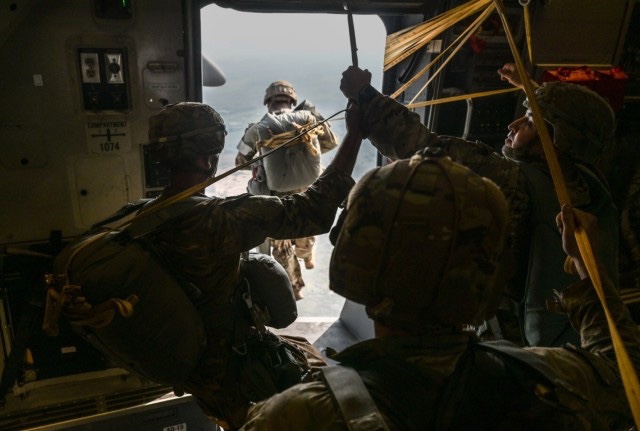
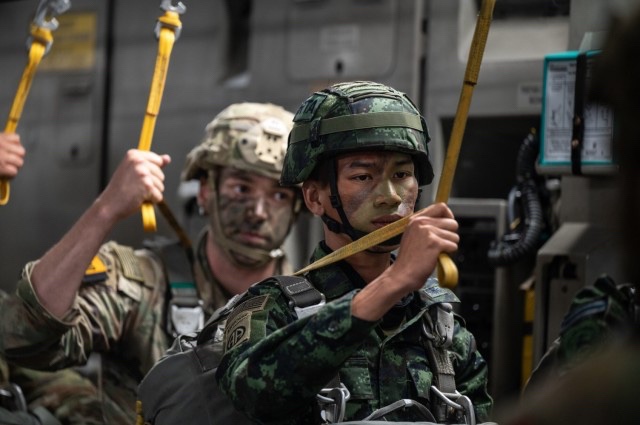
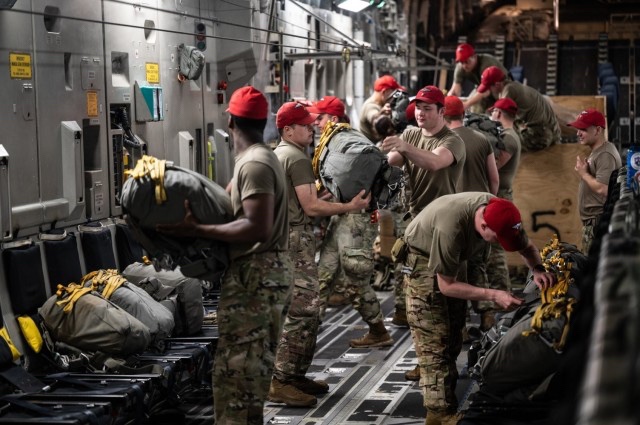
GREEN RIVER LAKE, KY – Soldiers of the 20th Special Forces Group Military Intelligence Company (MICO) conducted a water jump at Green River Lake near Campbellsville, KY, Aug. 6, 2022. The jump was conducted to enhance the company’s proficiency in conducting airborne operations that require a water landing.

“This type of training is important to ensure that when we conduct these sorts of operations over water that our soldiers remain safe.” Said Sgt. 1st Class Raymond Lunger, a jumpmaster with the 20th Special Forces Group MICO. As a facilitating jumpmaster in the training event, Lunger ensured that all soldiers participating in the jump had a thorough understanding of the jumping process, while also training the MICO on the survival swimming required to avoid entanglement or entrapment beneath a parachute in the water – both very real risks when performing airborne operations into water.

For a few soldiers in the 20th Special Forces Group MICO, this was their first time conducting this sort of airborne jump. As new soldiers arrive to the MICO from AIT, the importance of properly training and maintaining proficiency in this skill has only increased. Jumpmasters ensured that these soldiers understood the process of making the jump, the survival swimming required after landing in water, and how to handle their parachute as it becomes waterlogged.

“Today was a special day because you don’t have to worry about landing on the ground and any sort of impact there. It’s just nice and smooth into the water.” Said Spc. John Stark. This was Stark’s first time performing a water jump with the MICO. “It’s against human nature to jump off of something at fifteen-hundred feet with the faith that something is going to catch you… I love having these [training] exercises because for me personally, it stretches me.”

Solders’ families and the locals from Campbellsville gathered by the lakeshore to watch as the 20th Special Forces Group MICO conducted the training exercise. The soldiers made a total of 4 flights over the lake. During each pass, the soldiers defied human nature and jumped into the open air. The only thing standing between them and a fatal fall was a pack full of fabric and rope secured to their backs – their parachutes. After the thrill of jumping out of the aircraft, the soldiers enjoyed a steady descent down into the lake, where Zodiac rafts pulled them from the water and brought them to shore. For many, their families watched the training and welcomed them back to shore with cheers.

Story by SPC Caleb Sooter 

133rd Mobile Public Affairs Detachment

Army’s First Female Deep-Sea Diver Reflects on Career

Sunday, February 5th, 2023

FORT LEE, Va. — Andrea Motley Crabtree’s career can be lauded as a ground-breaking triumph.

Or, it could be noted as a tragic tale of lingering misery, a grim reminder such achievements often come with human tolls.

Crabtree is the Army’s first female deep-sea diver and the first African American female deep-sea diver in any branch of service.

The retired Army master sergeant was the guest speaker at the Martin Luther King Jr. observance Jan. 19 at the Lee Theater. She spoke in front of a few hundred people, including CASCOM and Fort Lee commanding general Maj. Gen. Mark T. Simerly, whom she has known 30 years.

During the speech, the 64-year-old laid bare her fight to pursue what she loved, the forces that undermined her ambitions and the deep, invisible wounds she suffered as a result.

Crabtree said she knew the journey to earning the Army Diver Badge would be fraught with difficulty — a classmate said she “belonged in the kitchen barefoot and pregnant” — but even she could not anticipate the malevolence exhibited by some classmates because she was black and female.


“I expected to go through a lot of hazing when I went through dive school and I did,” she recalled, “and I actually agree with the process. Once that diver badge is pinned on, any diver that sees that pin knows exactly what I went through and what I’m capable of, and I knew the same of them … If they were wearing that pin, I knew they knew what they were doing. That should have been enough. That should tell it all. For me, it never stopped. I had to prove myself over and over and over again every day.”

The Westchester, N.Y., native was the only Black person and the only woman among eight Soldiers and more than 20 others on day one of her 1982 class at the U.S. Navy Deep Sea Diving and Salvage School at Panama Beach, Florida. The three-month program of instruction awarded the Corps of Engineers’ military occupational specialty 00B to Soldiers, who go on to use their training to support underwater maintenance and construction projects amongst other missions.

To graduate, students were required to pass a health and fitness assessment that disqualified many. Other course challenges included requirements to rise from a seated position wearing the 198-pound Mark V deep sea dive suit, walking to a ladder, descending into the water and climbing back up. In the end, Crabtree was one of only two Soldiers and nine Sailors to earn the coveted diver badge.

Although Crabtree had accomplished what no female Soldier had in the predominately white, male career field, there would be no confetti drop. It became clear from her first assignment at Fort Belvoir.

“There were only about 39 divers total in the Unites States Army diving field at that time — all male — and the majority of them were not thrilled to have me,” she said.

Soldiers’ expressions of disapproval included pranks such as turning Crabtree’s air off underwater; placing a dead snake in the freezer; walking around naked following physical training; and “assigning me with what they thought were impossible tasks to complete,” she said.

Nevertheless, Crabtree dove head-first into her duties because the rewards were much greater than the efforts to stop her.

“For the most part, I could put up with it because I was a diver, I was diving, I was doing what I loved and I was learning,” said the Soldier of 21 years and mother of three adult sons. “I was learning to become a better diver. I loved what I was doing.”

Seeing she might rankle the dive community’s elitist culture, Crabtree said she was shipped off to South Korea after about eight months at Fort Belvoir. There loomed one Sgt. 1st Class James P. “Frenchy” Leveille, a renowned master diver who had enough juice to squeeze Crabtree out of the career field. He introduced himself to her via a boisterous, blustering tirade on who was in charge and how things would be run.

“He told me I was no different than any other diver, and if I couldn’t pull my weight, he’d be getting rid of me,” Crabtree recalled. “He went on and on and on and on.”

Leveille defied what many thought was his role in pushing Crabtree out of the career field, she said. Instead, he turned out to be no more or less than a hard-but-fair Soldier who took care of his troops no matter what and who was ready to challenge anyone questioning his leadership.

“He told all the divers that he would decide who dove, when they dove and who they would dive with, and anybody who wouldn’t dive with me wouldn’t dive at all and would be taken off of dive duty,” she added.

Leveille, now 75, said he staked his career on fairness and was not ignorant to Crabtree’s circumstance.

“As far as I was concerned, she was going to get the same treatment and same opportunity as everybody else,” said retired the sergeant major, “and she did very well for herself. She was a good diver, and she was a good Soldier. That’s the way I rated her.”

Leveille’s directive to his troops was clear — he called the shots and nothing was going to happen to Crabtree or anyone else unless he approved. He stood firm on what was right in the face of tense dissent, and the troops eventually fell in line, said Crabtree.

“It was only due to the respect they had for him, that they did as they were told,” she said. “Command climate is everything. It trickles down. No one was going to go against Frenchy.”

Crabtree, who remains friends with Leveille, said she grew under his leadership, learning more about diving than in dive school. Her proficiency eventually became a threat to earning diving’s most coveted honor. In the eyes of diving’s leadership at the time, it was one thing to be a female diver, but it was downright blasphemous for one to sport the Master Diver Badge, said Crabtree.

“I’m not trying to be conceited,” she said, “but I was a good diver. And the senior leadership knew it. They knew if I was allowed to continue, I would’ve made master diver. And they would be damned if that was going to happen on their watch.”

Crabtree at some point concluded leaders bet against her becoming a diver in the first place. When she questioned why she was accommodated prior to training and not so much during the course and afterward, one officer concluded, “We didn’t think you’d make it.”

Crabtree withstood powerful gales of hostility in doing so, but destructive storms were brewing on the horizon. Her orders for advanced schooling in California following the Korea assignment were cancelled; her 300-point Army Physical Fitness Tests were rescored as a male’s; and she later received notice her MOS would be closed to women due to changes in policy.

Deciding some of the actions directed against her were discriminatory, Crabtree filed complaints with her chain of command, the post inspector general, the specialized training branch sergeant major and the Department of the Army inspector general.

“They all wouldn’t help me,” she recalled. “They all said there was nothing they could do. I told my command they had won and requested to be relieved from dive duty. I’ve been angry every day since then.”

That was 1985. Crabtree finished out her career as a signal Soldier. Over the course of leaving dive duty, her indignation has grown into debilitating discontent, consuming every corner of her consciousness.

“That anger has taken its toll on every aspect of my life — on my marriage, my children. It’s affected my finances and, most of all, it’s affected my mental health,” she said.

Crabtree, who was accompanied by her service dog Buddy during the speech, said she could accept people resisting her for breaking new ground but has had difficulty reconciling why she was ill-treated.

“It didn’t bother me when I was the only woman; it didn’t bother me when I was the only Black,” she said. “What bothered me was the way they treated me because I am a Black woman.

“I know what it feels like to be hated because I’m a woman,” continued Crabtree, “and I know what it feels like to be hated because of my race. Yes, I’m sure a lot has changed for the good in the last 25 years, but many of the same issues are still hanging around as well as plenty of new issues that are not being addressed properly …”

Crabtree said a strong, values-driven command climate is a potent antidote for building foundations that are supportive of Soldiers.

“Soldiers will follow without question the leaders who take care of them,” she said to the audience. “Be a good leader. Take care of your Soldiers, and they will take care of you.”

Now living in the Augusta, Georgia area, Crabtree said she has spent considerable time trying to heal as a result of what she experienced in the Army. Engagements such as the Fort Lee MLK event at which she spoke have helped.

After the speech, Crabtree spoke with Soldiers and many were thankful she shared her story. One interaction with an officer was notable and even haunting because it proved to be powerfully restorative, if only in a small way.

“I get a little choked up when I think about it,” said Crabtree later of her exchange with a senior Soldier who had no hand in her ordeal. “He handed me a coin, took off his Sapper Badge (Tab) and apologized for the engineers. He’s an engineer officer. It’s the first apology I received from anybody associated with the Engineer Corps or the military. It’s really had an effect on me.”

The effect of offering glimmers of hope in an otherwise tragic tale of lingering misery.

By Terrance Bell

Army Editor’s note: In the U.S. Army today, males and females can sign up for the dive MOS — re-designated 12B — as well as many others that were only open to males when Crabtree enlisted. They include those in infantry, armor, field artillery and special forces. The U.S. Army also has initiated numerous efforts to ensure all Soldiers are treated with dignity and respect.

Serve and Succeed: The Story of Black Quartermasters in WWII

Saturday, February 4th, 2023

By Joe Reagan, Director of Military and Veterans Outreach at Wreaths Across America

At the entrance to the U.S. Army Infantry Museum, located in Ft. Moore, GA, (formerly Ft. Benning), visitors begin their journey by walking up a 100-yard ramp that shows the history of the U.S. Army Infantry. It is a symbolic representation of what is ingrained in every infantry soldier – you can have all the tanks, artillery, planes, trucks, and anything else in the world, but in battle the last 100 yards requires a soldier with a gun – the last 100 yards will always belong to the Infantry.

This mindset inspires great pride in Infantry Soldiers, and inspires the admiration of historians, filmmakers, and civilians alike – often lost is the story of those troops who comprise supply lines that often begin in the U.S. and extend thousands of miles to ensure that the infantry has everything it needs to fight their way across that last 100 yards. By some estimates standing behind each infantry soldier are six support soldiers – they are the lifeline and unsung heroes whose efforts are often overlooked. This was especially true in World War II.

World War II saw an increased level of mechanization – no longer did an army run solely on its stomach, fuel and spare parts were needed to keep the machines of war moving and that meant a supply chain extending back to industrial hubs in the United States. When comparing the success of campaigns like D-Day to failures like the German invasion of Russian in 1941 – it was logistics that determined success or failure – even the most tactically proficient army can’t win if it doesn’t have supplies. This required support soldiers to be better trained, and the U.S. Army needed more of them.

Nearly one million black men served in WWII, over 80 percent of them were assigned to logistics and service units, in fact by 1944 almost all black soldiers were assigned to these units. They were responsible for building bridges, roads, and runways, they moved beans, bullets, fuel, and the fallen – their efforts were critical to the allied success and were the embodiment of the modern military saying, “armatures study tactics, professionals study logistics.” To be historically accurate, all black units such as the 92nd and 93rd infantry divisions, the 861 Tank Battalion, and the Tuskegee Airman have impressive and well documented success in combat – the story of black quartermasters is important because it not only embodies the courage and valor of these Americans but demonstrates their ingenuity and how their service led to success on the battlefield and when they came home.

In Europe, allied preparations for the D-Day invasion required a massive movement of supplies, ships would have to be quickly unloaded to make room for the next load – this job fell to the quartermaster corps whose dockhands were primarily black GI’s. In prior conflicts much of this unloading would have been done by hand – a menial task – given the size of the loads, often exceeding 30 tons, it required skilled crane operators who worked non-stop during the 18-month build up to D-Day. In the final hours before the invasion these skilled operators would transfer loads directly from the supply ships to the invasion crafts.

Once the foothold was established in Normandy, the quartermasters were in a race to ensure the front-line troops they needed to continue to push the Nazi’s back. By July of 1944, allied troops were moving east at a rate of nearly 80 miles a week. With sea and rail infrastructure badly damaged – Normandy remained the sole point of entry for supplies entering the European theatre. Allied commanders were determined to prevent a lack of supplies from stopping the advances on the front lines, so they devised an ambitious plan that became known as the Red Ball Express. Nearly 75 percent of the drivers who made up this critical and constantly expanding supply line were black and not all of them were trained to drive trucks, never mind drive trucks filled with ammunition, at night, without headlights working in teams of two to complete the 54-hour round-trip journey. They succeeded in delivering roughly 12,000 tons of supplies per day – for 82 consecutive days.

The quartermasters played a huge role in the Pacific as well. While we typically think about the island-hopping campaign in the Pacific, crucial to the success of these missions was the work of our Chinese allies under Chiang Kai-shek. The Ledo Road, like the Red Ball Express, was a critical supply route connecting U.S. bases in India with allied forces in China – without these supplies Chinese forces likely would have been defeated allowing Japan to focus all its efforts on the Pacific. The building and maintenance of the Ledo Road was overseen primarily by these units. The roughly 1,000-mile road cut through many obstacles including Japanese snipers, dense jungles and of course the southern Himalayan Mountains. Running the route was treacherous, challenging even experienced drivers. Keeping the road open was an equally daunting task that fell on engineering units who would operate bulldozers and other specialized equipment in torrential rain to clear blocked portions of the road or reconstruct parts that washed out.

The legacy of black quartermasters in World War II is one of Service and Success. GI’s who quickly learned how to become skilled crane operators working non-stop to ensure the D-Day invasion had all the supplies needed to succeed. They became expert truck drivers and tirelessly kept the flow of supplies moving to the front during the Red Ball Express. They were engineers and drivers who crossed the Himalayan Mountains to ensure allied forces could keep pressure on the Japanese to allow U.S. forces to succeed in the Pacific. These quartermasters answered the call to serve, while in uniform they succeeded in quickly learning new skills, adapting to challenges, and committing themselves to mission success. After the war their service left an enduring legacy on our military. An after-action review of the war found that the contributions of black soldiers was instrumental to the success of the war effort. The report went on to recommend creating a desegregated force that was fully reflective of American society.

After the war these quartermasters continued to serve and succeed. Men like Medgar Evers, who was a driver on the Red Ball Express, saw what could happen when Americans worked together during the war. He returned home and became a highly influential part of the Civil Rights movement. Others like Harry Bellefonte who dropped out of high school to enlist in the Navy, while not part of the quartermaster corps he served as a crane operator loading and unloading ships. After the war Bellefonte used his GI bill to pay for acting classes in New York. He would find tremendous success on stage. Charity Adams, one of the first black female officers in the military who served in the Quartermaster Corps, continued to serve using her GI bill to earn a degree in psychology and then working at the Veterans Administration. This year the home of the Quartermaster Corps in southern Virginia will be renamed Ft. Gregg-Adams a fitting tribute to the legacy of service and success of the black soldiers who served in World War II.

What we can learn About World War II From Black Quartermasters?”; Douglas Bristol, Jr.; Aug. 27, 2021; World War 2 Museum.

Army veteran Medgar Wiley Evers a Foot Soldier in Struggle for Justice”; T. Anthony Bell; Feb. 25, 2020.

King of Calypso, Harry Belafonte Was WWII Sailor”; David Vergun, DOD News; Feb. 2, 2022.

To Learn more goto www.wreathsacrossamerica.org

Joseph Reagan is the Director of Military and Veterans Outreach for Wreaths Across America. He has almost 20 years’ experience working with leaders within Government, non-profit, and Fortune 500 companies to develop sustainable strategies supporting National Security, and Veterans Health. He served 8 years on active duty as an infantry officer in the U.S. Army including two tours to Afghanistan with the 10th Mountain Division. He is the recipient of multiple awards and decorations including the Bronze Star, Purple Heart, Combat Infantryman’s Badge, and the Ranger Tab. He is a graduate of Norwich University, the oldest private military college in the country.

US Army Air Defenders Complete Sling Load Operations in Romania

Saturday, February 4th, 2023

ROMANIA — U.S. Army air defenders from Charlie Battery, 5th Battalion, 4th Air Defense Artillery Regiment completed sling load training at their forward-deployed site near the Black Sea on Jan. 25, 2023. They are deployed in support of NATO’s enhanced Forward Presence Battle Group in Romania.

“Having our Soldiers train on sling load operations not only provides the commander some flexible employment options, but tactically it allows us to conduct some deep maneuver and air assault operations with the units that we are supporting,” said Capt. Nathan Jackson, the commander of Charlie Battery, 5th Battalion, 4th Air Defense Artillery Regiment.

The unit practiced sling loading both the Avenger and the Sentinel A3 radar variant, which is one of the first times this has been done with the Sentinel in theater.

The Avenger weapon system is an all-terrain, all-weather air and missile defense system that is capable against rotary-wing, fixed-wing, unmanned aircraft and cruise missiles while the Sentinel A3 provides early warning detection and identification of aerial threats.

Just days after the Russian invasion of Ukraine began, Avenger short-range air defense Soldiers and equipment from 5th Battalion, 4th Air Defense Artillery Regiment deployed to Romania to help assure our NATO allies that we are committed to our obligations under Article 5, and to deter any potential acts of aggression against NATO by providing short-range air defense of allied forces. Elements of 5th Battalion, 4th Air Defense Artillery Regiment have maintained deployments in Romania, Slovakia and Poland since early 2022.

“I think it’s a great opportunity for air defense Soldiers to see this side of air assault operations, to be able to build and expand their toolkits with these capabilities. I received a lot of positive feedback from the Soldiers as this is something they don’t get to do every day, to help build these capabilities for our future operations,” said Jackson.

Charlie Battery was supported by a Chinook helicopter crew from Bravo Company, 2-501, Combat Aviation Brigade, 1st Armored Division, who are also deployed to Romania as part of Operation Atlantic Resolve.

U.S. Army Europe and Africa has led the Department of Defense’s Atlantic Resolve land efforts by rotating units from CONUS to Europe since April 2014. There are four types of U.S. Army Atlantic Resolve rotations — armored, aviation, sustainment task force, and division headquarters. Rotational units conduct bilateral, joint and multinational training events across more than a dozen countries. Atlantic Resolve is funded by the European Deterrence Initiative, which enables the U.S. to enhance deterrence, increase readiness and support NATO.

By MAJ Robert Fellingham

Esports Soldier Hones Skills in Gaming Realm

Friday, February 3rd, 2023

WASHINGTON — A small tactical unit is deployed into a hostile environment. Their objective: dig in and defend until the end.

Each member of the unit has their specialty; the unit leader calls all the shots, his word is what goes, and he is the one whom decides where the last stand lies. The unit weapons sergeant defends the final location and protects the backs of the other members of the unit. The last member is the unit’s explosives expert. His main purpose is to cause as much damage as possible to the enemy forces.

Each member knows their primary objective and has been studying every aspect of it for several months with their team, investing hundreds of hours working through strategies and learning everything they can about their enemies.

Yet, this is not a special operations unit. This is the U.S. Army Esports Apex Legends Team stationed out of Ft. Knox, Kentucky, and Sgt. Sebastian “Ruszty” Ochoa, a 13F fire support specialist, is one of the professional gamers on the team.

“Initially, I thought it was an email for a bunch of guys playing games, but it’s very much not that!” Ochoa said. “It is a team and a community of competitive and, honestly, elite level esports athletes that are betting everything, every time they play, and that is the biggest misconception I had.”

Ochoa is a native of Gathersburg, Maryland and enlisted into the Army out of Boca Raton, Florida where he was playing baseball for Florida Atlantic University.

“I joined the Army for a sense of structure and to get a little bit more disciplined with myself, and the Army definitely provided me with that,” Ochoa said.

A few years ago, a mass email went out to the force looking for anyone who was interested in joining the Army’s new esports, or electronic sports, team. They were looking for esports athletes who wanted to compete at high levels, Ochoa said.

“I was incredibly excited because it coincided with the perfect time for me,” Ochoa said. “In more recent years, I just started rekindling that fire [for video games] and [the email] actually ignited a little bit of a competitive drive in me.”

His friend expressed that he had the potential skill to compete. So, he talked with his wife. They agreed he should reach out through email and join the Army Esports Team community Discord server, Ochoa said.

For the next six months, he started training in his game of choice, Apex Legends.

Apex Legends, or Apex for short, is a multiplayer, battle royale-style shooter game in which 20 three-person teams collect weapons and battle it out to the last team standing.

“I probably put in about 2000 hours,” Ochoa said. “I went to physical training like normal and worked my normal hours.”

After work, he would have dinner and spend time with his wife. She would head to bed, then he would get started on his nightly training. Typically, he would put in six to seven hours honing his skills and finding teammates. Then wake up and do it all over again.

Then in November of 2021, he submitted his application. He was selected, along with 45 other Soldier for tryouts.

“It was a month-long process of group tryouts,” Ochoa said. “And I was one of four people chosen out of that 45.”

The U.S. Army Esports Team focuses on five games; Apex, Rocket League, Overwatch, Call of Duty and Halo. Normally, there are over a hundred people on the Army’s esports team. These folks are called the at-large team. The at-large pro-gamers train and compete at their home station, on their own time. They also compete on a regular basis to see who will get on the competing teams. Only two of these titles have resident gamers, Apex and Rocket League.

“I know it may sound like a small number [of titles],” said Victoria McAdoo, the public affairs specialist for the Army esports teams. “But just because of the level of the competition and the time that goes into training for each of the competitions and each of the titles, they focus on quality and not quantity of the titles.”

Esports is highly competitive, and there is such a diverse group of players and titles. We want to be in the top ranks with the rest of the elite, professional esports athletes. Therefore, our in-house esports teams specialize on two titles, McAdoo said.

The few that have demonstrated the proper skill levels to delve into the world’s elite gamers could receive PCS, or permanent change of station orders.

In February 2022, he was selected for the in-house Apex team along with five other Soldiers and received PCS orders.

“First and foremost, I am a Soldier. So, I still must stay within Army regulations and standards,” Ochoa said. “Coming from Fort Bragg, I go for a run every morning and do some other sort of workout.”

Every morning the team comes together for a strategy meeting. These strategy meetings can last anywhere from one to four hours depending on what the team is going over.

We will usually talk about what we did the day prior, strategize on how we are going to play and which characters we are going to use. We will scrub through our game recordings to identify deficiencies and weaknesses. Then we figure out how to improve or better handle these areas, Ochoa said.

After their strategy meeting, if there is military training that needs done, that becomes the priority. If all military requirements are done, one of three things happen: they work with an at-large coach, conduct aim training or open the game and start working through scrimmages.

“Aim training is a program on the computer where you try to hit different target at different angles,” Ochoa said. “It helps honing your reflexes, honing your ability to hit targets at an ever-changing pace and in different areas.”

Some of the other aspects they must train on with the game is knowing the inherent abilities of each of the characters, studying the abilities of each of the weapons and understanding how each of the team members prefer to play.

“We have to learn, and we have to know, and it all comes from hours and hours and hours of playing with my specific teammates,” Ochoa said. “Without teamwork, we are not able to be competitive enough to compete with some of these guys that play for a living.

In Apex, there are two seasons per year. These start in October and April with the world finals in July. The U.S. Army Esports Apex Legends Team competes in the North American region. The five regions are based off the continents: North America, South America, Europe, Asia and Australia.

“[During a competition] it feels very, very overwhelming,” Ochoa said. “You get to play against some of the biggest names in the world in this video game. I think it’s currently the third most watched game on Twitch. It’s been an immensely popular game … the competitions we are playing are at an elite world level against these guys.”

So, one may think, what happens if the team wins a competition?

“These are professional athletes, so although they have the pride of wearing the U.S. Army star on their chest when they go out and compete, if they win, they get to keep what they win,” McAdoo said. “We have a Warrior Fitness Team and an Outdoors Team, in addition to the U.S. Army Esports Team and a rock band. One of our members of the Warrior Fitness Team, she was the strongest woman in the world, which comes with prize money, and she got to keep it because that’s what she trained for.”

The team is still part of the U.S. Army Recruiting Command, and Ochoa believes that the U.S. Army Esports Team helps promote recruiting in a different way.

Honestly, [the team] brings awareness to the fact that although we are Soldiers from a civilian aspect, it changes the views and perspective they have on us,” Ochoa said. “Not every Soldier is in infantry, not every Soldier sleeps with a rifle all the time. We are elite esports athletes. We can do things that we love at a very elite level.”

The Army won’t stop them from doing the things they love, it will support them,” Ochoa said. “The Army esports team is a good way to get a different perspective out there on way the Army can provide … and we are able to connect with so many people from it.”

The esports team could connect with a diverse group of people, some who may never have considered the Army because their goal is to become an esports athlete, and it helps to show that the Army will help to support people’s goals, Ochoa said.

The Army will train you up with skills and experience, while you serve your country and give you everything you need to compete. Then when you are ready to leave, you will be able to take all those skills, training and everything else with you for your life in the esports competitive world, McAdoo said.

“The Army has 150 jobs, and I’m living proof that you can serve your country and get paid to do the things you love to do,” Ochoa said. “We really want to start having people see the Army as an option and kind of a steppingstone to be able to reach any goal you want.”

By SSG Jacob Kohrs, Army News Service

Explosive Ordnance Disposal First Sergeant Earns U.S. Special Operations Command Award

Wednesday, February 1st, 2023

FORT BRAGG, N.C. – The senior enlisted leader for the U.S. Army’s only Explosive Ordnance Disposal company that supports the 75th Ranger Regiment earned the U.S. Special Operations Command Excalibur Award for NCO Leadership.

U.S. Army 1st Sgt. Chad O. Staples from the 28th Ordnance Company (EOD) (Airborne) was recognized for his service and leadership at the one-of-a-kind company.

The SOCOM commander established the Excalibur Award of Excellence to recognize enlisted leaders who demonstrate the “Warrior Ethos” with outstanding leadership, gallantry, integrity and moral courage during military operations or training.

Sgt. Maj. Shane W. Shorter, the U.S. Special Operations Command senior enlisted advisor, serves as the president of the Excalibur Award Board and the senior enlisted advisors from each of the SOCOM service components vote on the award.

The EOD first sergeant received the 2021 Excalibur Award in 2022 due to COVID-19 restrictions.

Staples earned the award for heroism during a compound clearance operation in Afghanistan. After an improvised explosive device (IED) detonated, he disregarded his own injuries to clear a safe path for 13 wounded U.S. and partner nation personnel. During the mission, Staples also identified three more pressure-plate IEDs and provided first aid to the wounded.

Maj. Stephen M. Knudsen, the commander of the 28th Ordnance Company (EOD) (Airborne), said it was a testament to Staples that SOCOM selected a noncommissioned officer from U.S. Army Forces Command and 20th CBRNE Command for the award.

“The company has hands down the best NCOs I’ve ever worked with,” said Knudsen, a native of Sutter Creek, California. “First Sgt. Staples is not only the company’s senior enlisted leader, he’s also a phenomenal example of the next-level leadership, mastery of craft and readiness to take the fight to the enemy that you see in every single NCO in this unit.”

Knudsen has known Staples since they were students at the EOD school more than 12 years ago when Knudsen was a 1st lieutenant and Staples was a sergeant.

“It was apparent then that he has a special, innate leadership quality about him and it’s paid huge dividends during his time as a leader at all levels in the 28th,” said Knudsen.

“In a unit that has had elements deployed in combat for the entirety of its existence, the NCO leaders are not just the backbone of the unit but the standard bearers who ensure the entire team is ready for war at a moment’s notice,” said Knudsen. “They provide motivation that keeps EOD techs moving forward to the sound of the guns. I’ve never seen Soldiers with more loyalty and trust in the first sergeant and it is 100 percent well-placed.”

A graduate of Cal Poly who has deployed to Iraq once and Afghanistan three times, Knudsen went to EOD school straight out of the U.S. Army Ordnance Corps Officer Basic Course. He said serving as the 28th EOD Company commander has been the highlight of his career.

“I enjoy working in dynamic environments and in a culture that places emphasis on problem solving and creative thinking,” said Knudsen. “I can’t think of another place in the Army that embraces those characteristics more than EOD. I can’t single out a moment in 28th as a highlight – they come every week. Just being in the building with these incredible NCOs is highlight enough. I already know I’m in the best job I’ll ever have.”

The Fort Bragg, North Carolina-based 28th EOD Company (Airborne) is part of the 192nd EOD Battalion, 52nd EOD Group and 20th Chemical, Biological, Radiological, Nuclear, Explosives (CBRNE) Command, the U.S. military’s premier all hazards command.

American Soldiers and U.S. Army civilians from 20th CBRNE Command deploy from 19 bases in 16 states to take on the world’s most dangerous hazards in support of joint, interagency and allied operations.

Staples initially enlisted as a Chemical, Biological, Radiological, Nuclear (CBRN) specialist with the Utah National Guard and served a Chemical Reconnaissance Detachment team leader in the 19th Special Forces Group (Airborne).

He decided to become an Explosive Ordnance Disposal technician and joined the active-duty U.S. Army in 2008.

“I have always had a desire to serve my country in the military but made the decision to go active as an EOD technician after talking to an Air Force EOD technician from Hill Air Force Base in Utah,” said Staples, a native of Riverton, Utah, who has deployed to Afghanistan eight times. “I felt that the 89D Military Occupation Specialty (Explosive Ordnance Disposal) would be technically demanding and fill a critical tactical role within the Global War on Terror.”

Staples spent his first deployment to Afghanistan in a conventional EOD company where he took photos and made assessments during IED post-blast analysis missions. Prior to joining the 28th EOD Company, he served with the 703rd EOD Company on Fort Knox, Kentucky, and the 759th EOD Company on Fort Irwin, California.

After being involved in multiple IED detonations and seeing the deaths of many coalition personnel and the destruction of many vehicles, Staples wanted to join an EOD company that was renowned for its professionalism and its ability to take the fight to the enemy.

Staples has served with the Fort Bragg, North Carolina-based 28th EOD Company for almost eight years.

“The 28th operates in a challenging, high-performance environment that demands consistently high standards. 28th EOD techs always operate in demanding roles while embedded with 75th Ranger Regiment. They are all specifically screened for a position within the company based on their ability to think critically while embroiled in life-or-death situations,” said Staples.

Built to support U.S. Army Rangers and other SOCOM units, the 28th EOD Company has quietly earned numerous awards during decades of combat operations. The unit’s EOD technicians have successfully conducted more than 5,200 operations in Iraq, Syria and Afghanistan to date. During the Global War on Terrorism, 28th EOD Company Soldiers have earned 32 valorous awards, including two Distinguished Service Crosses and 21 Purple Hearts.

The 28th EOD Company first sergeant said his EOD techs must be able to think on their feet and respond to ever-changing circumstances in the crucible of combat.

“As a leader, it is crucial to assist all personnel in growing already specified characteristics,” said Staples, who added that he hopes to become an EOD Group command sergeant major in the future. “One of the most critical areas to continue the consistent individual and team success is a decentralized command. Done right, it can promote initiative and creativity.”

Staples said there were many highlights to earning the prestigious SOCOM leadership award.

“First and foremost, it highlighted the extremely dynamic and dangerous mission set that everyone in the company is tasked with,” said Staples. “There is always an air of mystery to the 28th EOD Company due to the classified nature of the mission set. This allowed conventional EOD a chance to see and hear a small snip of what everyone in the company is capable of accomplishing any time they are tasked.

“Along with showcasing the company, the opportunity for my family to attend the award ceremony was paramount,” said Staples. “Time and time again my wife and children have watched me leave, never knowing where I was going or what the missions entailed. They have been and always will be the foundation of who I am and why I serve in the military.”

By Walter Ham

TacJobs – Ranger Mechanic

Tuesday, January 31st, 2023

Do you want to be a Ranger Mechanic?

There are no second-class support personnel in the Rangers. Every Ranger goes through Ranger Assessment and Selection Program (RASP) and is given the same training, equipment, and standards. Every Ranger wears the tan beret and scroll which creates a high level of pride and esprit de corps whether you’re an infantryman, medic, or mechanic.

Ranger Wheeled Vehicle Mechanics (MOS 91B) shoot, jump, and PT with the line infantry in addition to getting lots of quality, hands-on time turning wrenches on vehicles.

In addition to leadership schools like Ranger School, Pathfinder, and Jumpmaster, Ranger mechanics have access to cutting-edge training to maintain the most advanced vehicles in the Army.

There’s no better place in the Army to be a mechanic. Whether you are looking at joining the Army or have already enlisted, visit 75thrangerregiment.org for info on how to join.

American Rheinmetall Vehicles and GM Defense Win Contract for the First Phase of the U.S. Army’s Common Tactical Truck Program

Monday, January 30th, 2023

American Rheinmetall Vehicles (Sterling Heights, MI) and GM Defense LLC (Washington, DC) have won a contract for the first phase of the U.S. Army’s Common Tactical Truck (CTT) Program.

The aim of the multi-phased program is to replace the Army’s family of heavy tactical trucks with production of up to 40,000 trucks valued at up to $14 billion. The two powerhouse defense companies formed a strategic collaboration in 2022 to compete in the program; bringing together two world-class engineering and manufacturing giants to deliver a modern, tactical truck that enhances Soldier capability through advanced technologies including advanced driver assistance systems (ADAS) for safety, increased off-road mobility, cybersecurity, machine learning, artificial intelligence, improved survivability and fuel efficiency, among other emerging technologies.  

The team offered the HX3 Common Tactical Truck (HX3-CTT). The HX3 is the latest generation of trucks in the highly successful, combat proven, HX family of trucks which are in service with a number of NATO and U.S. allied nations. The HX family of trucks derives from MAN Truck and Bus commercial truck offerings bringing a high degree of commerciality to the fleet, a priority for the Army in the CTT program. The HX3-CTT next-generation system has enhanced on and off road mobility, integrated survivability, and an open digital architecture supporting ADAS and enabled for autonomous vehicle operation. Combined with the open architecture, the commercial backbone of the HX3-CTT will support persistent modernization and allow for rapid increases in capability as technologies mature. With a global footprint of both current military user nations and commercial dealer networks, the HX3-CTT provides a basis for optimized lifecycle costs and service support to the Army across the globe. 

“Both American Rheinmetall Vehicles and GM Defense look forward to providing competition to the Army’s CTT Program. We are committed partners to the Army, bringing tremendous operational capability coupled with advanced safety features, ensuring our Soldiers can achieve their mission safely and effectively. Together our team will deliver a transformational truck that leverages the commercial strenghths of our partners, Rheinmetall MAN Military Vehicles and General Motors, and the commonality of the HX3-CTT design,” said Matthew Warnick, Managing Director for American Rheinmetall Vehicles. 

“Winning the CTT prototype phase demonstrates the undeniable value that the strategic collaboration between GM Defense and American Rheinmetall Vehicles brings to this important, next-generation Army program,” said Steve duMont, president of GM Defense. “We are excited to bring our advanced technologies and manufacturing prowess into this important collaboration and deliver a proven, modern solution to enhance warfighter capability. We look forward to continuing our work with American Rheinmetall Vehicles to execute the first prototype phase, while gaining the necessary insights to strengthen our position to win future phases of the program.”

HX3 Common Tactical Truck
Technology for the future: The HX3-CTT features an advanced, interchangeable protected cab design, ADAS, and drive by wire operation. The new open systems electrical architecture allows rapid integration of leader-follower, tele-operation, and fully autonomous capabilities that focus on protecting our most valuable combat asset – the Soldier.

Common platforms and parts to support a family of vehicles: The HX3-CTT is the new, next-gen variant of the globally successful HX family of military-off-the-shelf tactical trucks. It possesses an extremely high level of commonality and modularity across variants: cargo, load handling systems, tankers, and line haul tractors. With an HX family that can scale from 4×4 to 10×10, the HX can meet any military need.

Commerciality in its DNA: The HX3-CTT leverages best-in-class advances in commercial truck technology, safety, fuel efficiency, and emissions reduction. Ruggedized for the stresses of military service, the HX family provides an “off the shelf” capability. This commercial backbone reduces obsolescence risk/cost, expands parts availability and reduces sustainment demands.

Allied interoperability: The HX family of trucks have been sold to 20 customers globally including an active allied user group consisting of United Kingdom, Australia, New Zealand, Germany, Austria, Norway, Sweden, and Denmark, creating common global supply chains, training opportunities, and integrated operations among key allies operating around the world.