Danner Reckoning GTX

Archive for the ‘Army’ Category

Challenge Fuels Transition for Army’s Newest Infantry Soldiers

Sunday, August 20th, 2023

FORT BARFOOT, Va. — A few times each year, the Virginia National Guard’s 1st Battalion, 183rd Regiment, Regional Training Institute, conducts an 11B Infantry Transition Course.

Some of the Soldiers who attend the course, all junior Soldiers and noncommissioned officers, want to test themselves. Others are fulfilling childhood dreams or chasing promotion opportunities. Whatever their reason, their goal is singular: to earn the 11B military occupational specialty and leave Fort Barfoot with a blue infantry shoulder cord.

“It is not an easy MOS, but it is a very rewarding one at the same time,” said Sgt. 1st Class Brian Cook, a long-time cadre member at the 183rd RTI.

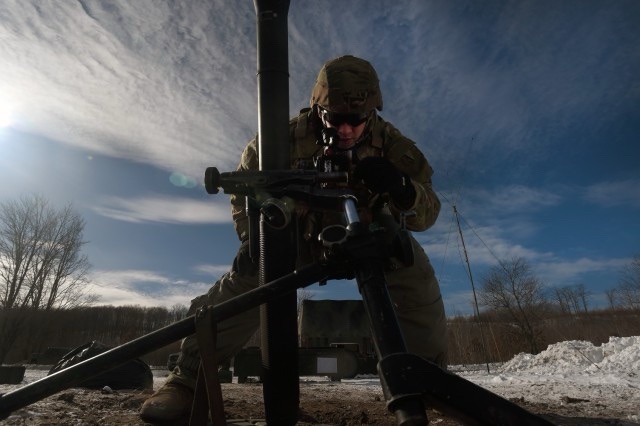
During the course, Cook and the rest of the cadre put Soldiers, who arrive as engineers, medics, intelligence analysts and mechanics, through three rigorous weeks of infantry training. Soldiers gain proficiency on weapons, improve their land navigation skills, learn how to communicate and move effectively across a battlefield. The days are long and often made more challenging by sweltering heat and humidity.

The challenge of becoming an infantryman motivated many of the students as they worked their way through the course.

“The reason I wanted to become an 11B is because I like to put myself to the test,” said Staff Sgt. Patrick Powers, a 91B wheeled vehicle mechanic in the Virginia National Guard. He said the course would also help prepare him for his next challenge, U.S. Army Ranger School.

Sgt. Allison Stanton, assigned to the 82nd Airborne Division as a 35F intelligence analyst, was also there to challenge herself.

“I wanted to become at 11B because it’s really the only MOS that I felt was out of my comfort zone,” she said. “I felt like the whole job would be very challenging for me, so that’s why I chose it.”

Spc. Alexander Wyatt started his military career as an infantryman in the U.S. Marine Corps. He was discharged due to an injury but rehabilitated himself and worked on an ambulance while out of the military. When he joined the Army, he returned as a 68W combat medic but felt pulled toward the infantry.

“I wanted to become an infantryman because it’s always been a dream of mine. I just always had the itch to still be an infantryman, and I finally scratched that itch,” Wyatt said. He’s now assigned to the 75th Field Artillery Brigade at Fort Sill, Oklahoma.

Spc. Steven Schmidt drove across the country to attend the infantry transition course. He started his military career as a medic.

“During my time in the military, I’ve met all sorts of people with different MOSs, but the 11Bs stood out to me in their brotherhood,” Schmidt said. “I’ve always believed that going through difficult times is what brings people together, and I think 11Bs go through that more than any other MOS. I just wanted to be a part of that.”

As the most recent course came to a close, after the Soldiers hauled themselves, their gear and their weapons through the forests, roads and fields of Fort Barfoot, after they tested their endurance with a timed 5-mile run and sent thousands of rounds down range from a variety of weapons systems, they gathered near a small pond. The cadre, decorated with an assortment of badges, tabs and scrolls, formed a corridor through the water. Tired and dirty from days spent in the field, the students were called forward into the water, guided through the protected passage formed by the cadre. Then, dripping pond water and steaming in the midday sun, they worked their way to the top of a hill.

The immersion and ascent served to mark the transition from what they were before to what they had become.

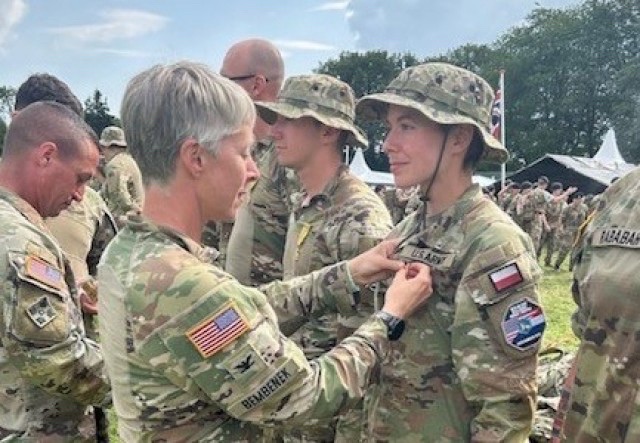
On top of a Fort Barfoot hill on July 26, 2023, 22 Soldiers received their blue infantry cords and officially became the newest infantry Soldiers in the U.S. Army.

By SFC Terra C. Gatti, Virginia National Guard Public Affairs Office

Army Kicks Off Network Field Experiments

Friday, August 18th, 2023

JOINT BASE McGUIRE-DIX-LAKEHURST, N.J. — Army scientists and engineers are kicking off the annual Network Modernization Experiment, or NetModX, as they move their capabilities from the lab to a field environment across the New Jersey installation.

The Army’s Command, Control, Communications, Computers, Cyber, Intelligence, Surveillance and Reconnaissance Center conducts NetModX at JB-MDL and Aberdeen Proving Ground, Maryland, over eight weeks as a capstone experimentation event. It creates an operationally relevant, threat-informed environment to prove out disruptive and transformative C5ISR technologies. The C5ISR Center is an element of the Combat Capabilities Development Command.

The center’s field experimentation builds upon its modeling and simulation work and lab research, according to Noah Weston, the C5ISR Center’s chief of strategic experimentation. The NetModX team partners with subject-matter experts from across the Army to design experiments that best address the Army’s needs and gaps.

“The Army needs data to make the right decisions at the right time to mature science and technology products to be deployable,” Weston said. “Experimentation allows us to obtain early data on system performance that can inform future Army requirements.”

The C5ISR Center conducts NetModX, which is composed of about 80 technologies for 2023, with the Army’s programs of record, cross-functional teams, other DEVCOM organizations and industry partners for an approach that ranges from science and technology to acquisition.

“NetModX expands our knowledge of emerging networking technologies in relevant field conditions and fosters critical early collaboration between government and industry partners,” said Stephen Blair, senior science and technology advisor for the Network Cross-Functional Team, part of Army Futures Command. “It informs our collective efforts to reduce network complexity at lower echelons; increase speed and survivability through mobile command posts; manage electronic signature; and improve interoperability.”

NetModX intends to deliver key insights to help transition capabilities from the “art of the possible” to the “achievable,” said Joe Saldiveri, NetModX project lead and C5ISR Center engineer.

“These experimentation opportunities enable the Army stakeholders to come together to spark collaboration and inform critical decisions,” Saldiveri said.

The C5ISR Center partners with the Army’s Program Executive Office Command, Control and Communications-Tactical during NetModX to provide technical and operational data on emerging technology.

“Experimentation events such as NetModX support our network design efforts for the Army of 2030 or to inform conditions as we look forward to how our programs will support Army of 2040 network modernization,” said Assistant Program Executive Officer Ward Roberts. “NetModX data supports our developers with integration and technical maturity insight on targeted capability that has transition potential into programs of record and informs formulation of design goals as we work with Cross-Functional Team community.”

By Dan Lafontaine, DEVCOM C5ISR Center Public Affairs

Leaders Give Update on ‘Modern Triad’

Tuesday, August 15th, 2023

HUNTSVILLE, Ala. — Space, cyber and special operations leaders said America and its allies continue to integrate capabilities in a triad intended to influence multi-domain and full-spectrum operations and provide the joint force with an enhanced capability to see, sense, stimulate, strike and assess across the spectrum.

The triad panel members: Lt. Gen. Daniel L. Karbler, commanding general of U.S. Army Space and Missile Defense Command; Lt. Gen. Maria B. Barrett, commanding general of U.S. Army Cyber Command; Lt. Gen. Jon Braga, commanding general of U.S. Army Special Operations Command; and United Kingdom Royal Air Force Air Commodore Adam Bone, U.K. Space Command director of operations, plans and training; participated on a panel discussing the triad during the 26th annual Space and Missile Defense Symposium at the Von Braun Center in Huntsville on Aug. 8.

“The combined use of space, cyber and special operations force capabilities provides other options to commanders that are less likely to cause escalation,” Karbler said. “When you look at what the triad demonstrates in its ability to integrate and synchronize space, cyber and SOF capabilities at the most effective, tactical echelon and then expand options for creative venues to exploit, that is what commanders and joint forces are looking for.”

Karbler said USASMDC is the Army’s force modernization proponent and operational integrator for global space, missile defense and high-altitude capabilities, and that space capabilities enable land operations in multiple ways in the same way that land capabilities enable space operations.

“We have explored countless opportunities and taken advantage of different exercises that all of us have gone arm-in-arm to demonstrate capabilities the triad brings,” Karbler said. “When you look at the complimentary, reinforcing nature of each capability and how they present multiple dilemmas for the enemy, the overall effect is greater than the sum of each individual effect.”

Bone said the UK is realistic about its current status as a military space power, creating the U.K.’s Space Command to help advance U.K. and allied equities in space.

“We are justifiably more confident of our established U.K. strengths in special forces, cyber and intelligence,” Bone said. “The obvious next steps are to leverage those strengths in the space domain. With that in mind, the innovation we see the U.S. Army leading is of significant interest.”

Bone said the U.K. Space Command recognizes the triad’s acknowledgment that the space domain provides a vital role in national defense. He added the U.K.’s capabilities across special forces and cyber domains are highly regarded by partners globally, and it is only rational to demonstrate ambition to leverage and support such potent resources in the space domain.

“By synchronizing effects, the layered output adds up to be greater than the sum of their parts — that’s what makes the triad concept so valuable,” Bone said. “And, it links neatly with the U.K. concept of multi domain integration. If space is recognized by the U.K. to be the most essential integrator, why wouldn’t we also want to make the most of those connections in mutual multi-domain support?”

Bone said in regard to U.K. Space Command’s connection with the U.S. Army, and in particular USASMDC, that there are synergies between the organizations, highlighting the scale, mindset and approach. He added that experimentation, innovation and operational integration are all second nature because of this.

“U.K. defense broadly understands the value of ‘space as an enabler,’ but we haven’t quite indoctrinated the joint force in the opportunity of ‘space as an effector’ in its own right,” Bone said. “The triad concept will act as a proving ground for this employment within a slightly smaller community of interest that has both the operational necessity and experience to drive this forward, particularly given the synergies between the space and cyber domains. In turn, we hope that the subsequent lessons and vignettes will help further the U.K. multi-domain integration concept — maximizing the value of the space domain within U.K. operations.”

These space, cyber and special operations experts said the synergy of these organizations help the joint force, Army and U.S. allies and partners to face the future. With space, special operations and cyber all possessing unique but independent capabilities, each component can rapidly gain intelligence and attack critical vulnerabilities.

Barrett said they are focused on synchronizing and converging each organization’s capabilities to create an effect and combining their unique capabilities and efforts to facilitate the use of these capabilities with either combatant commanders or their service commanders in the theaters.

She said the triad is a partnership that will help the Army and joint force commanders achieve information advantage. Barrett added the triad is more than an idea saying they are already coming up with solutions and tools together as a team.

“The triad brings an essential aspect of battlefield geometry that alone none of us can,” Barrett said. “We now have an understanding of what is happening in the competition’s space we previously did not have.

“We will never run out of challenges,” she added. “We have to provide the proof of concept that this works and that it’s worth the investment. Adaptation and innovation are imperative. We can see what the threat is and know we are going to have to do to adapt.”

Braga said during the last year, his command has started to change their organizational structures for tomorrow’s needs. He added they are integrating triad concepts into doctrine and exploring professional educational opportunities and the development of a new military occupational specialty to codify the focus and investment required to achieve success.

“Moving forward I would expect more adaption to technology,” Braga said. “Adaptation of technology and how you leverage them affects elements from SOF, space and cyber communities.

“Innovation is a mindset, and if not us, then who?” Braga asked. “Who is going to adapt the changing technology of all three legs of the triad? Who is going to embrace that technological change to their advantage the quickest and the fastest?”

Braga asked if space, cyber and SOF and its coalition partners were prepared to win if the country faces a high-end conflict.

“That is what’s before us,” Braga said. “Although the weight of that burden is not 100 percent on the legs of the triad, we certainly have a major role to play and an outsized ability to influence and prevent and contribute toward deterrence with this modern day triad.”

By Jason Cutshaw, USASMDC

B&T USA Announces Commercial Release of its APC9K SD2 US Army Submission

Monday, August 14th, 2023

Tampa, FL (August 14th, 2023) – B&T USA is excited to announce that due to continual requests by those familiar with the project, we have been persuaded to produce a limited number of integrally suppressed APC9K SD2 models complete with its scalable suppressor system. This variant was submitted for consideration during the United States Army Sub Compact Weapon (SCW) trials, with said branch ultimately selecting B&T USA’s APC9K and awarding it the SCW Contract.

“To win a US Government contract, you must submit a product that as closely meets their defined specifications as possible — not necessarily what you think the end user needs or even a product that is scalable to best suit its future needs — as was the case with the SD2; the advanced platform was not what the Army required in 2019, but one we anticipate it may in the future” said Chris Mudgett, Vice President of Marketing, B&T USA.

“At less than 15-inches in overall length, the APC9K SD2 is the shortest integrally suppressed submachine gun currently available. It is optimized for low visibility carriage and discreet deployment; while delivering unsurpassed accuracy, controllability, and ergonomics. With its advanced scalable suppressor system, the SD2 is a solution for your future mission.”

For more information on B&T USA, visit: www.bt-usa.com.

Army Modernizes Batteries to Boost Supply Chain, US Manufacturing

Friday, August 11th, 2023

ABERDEEN PROVING GROUND, Md. — Army researchers are advancing the capabilities of tactical batteries as a critical piece of the military’s comprehensive effort to improve U.S.-based manufacturing and strengthen the industrial supply chain.

Engineers at the Army’s Command, Control, Communications, Computers, Cyber, Intelligence, Surveillance and Reconnaissance Center are focused on integrating advanced cell chemistry into batteries as the next generation of modernized Soldier electronics are fielded. The team is focused on developing standardized form factors for use in Soldier-worn and handheld equipment such as radios, GPS, night-vision devices, and weapons.

“By standardizing battery form factors, the Department of Defense aims to aggregate demand throughout the services and improve buying power among the industry’s battery cell manufacturers,” said Dr. Ashley Ruth, a C5ISR Center research chemical engineer. In addition, standardization avoids the old model of fielding a proprietary battery for each piece of gear, as technology developers have historically delivered unique batteries for new capabilities.

The Center is an element of the Army Combat Capabilities Development Command, known as DEVCOM.

“The Army is working on forecasting a fully developed demand signal for a range of Soldier batteries,” said Dr. Nathan Sharpes, a research mechanical engineer with the Center. “This provides an incentive for industry to onshore battery manufacturing to the United States and support the domestic industrial base and secure the supply chain. The overall DoD goal is the ability to procure cutting-edge batteries affordably and reliably with a coordinated strategy.”

The C5ISR Center’s latest R&D effort in support of battery standardization is the Operational Single Cell for Accessory Readiness, or OSCAR. The program’s benefits include safety, performance, and cost, according to Sharpes.

OSCAR research originated from the need to develop a AA form-factor military battery capable of recharging.

New electronics in the Army’s R&D pipeline can require higher instantaneous power draw than current AA form-factor batteries can provide, according to Sharpes. OSCAR will be capable of performing like a AA battery in legacy applications but also enter a high-power mode to satisfy next-generation enabler devices such as night-vision scopes that are typically mounted to a rifle or helmet.

With the capability for recharging more than 100 times, OSCAR batteries represent significant cost savings compared with existing single-use options. The C5ISR Center anticipates prototypes available for lab and safety testing in the near future.

OSCAR follows the team’s successful development of the Small Tactical Universal Battery, or STUB, which is a standard family of batteries for handheld and small form factor devices, with eight sizes that share a common mechanical and electrical interface — the key to unlocking interoperability, Sharpes said. Each battery size provides a different amount of energy, from which Soldiers could choose, depending on their mission needs. This interoperable battery system seamlessly delivers the correct voltage and power level needs to any device.

Army project managers can now procure these batteries for integration into fielded Soldier-worn and handheld systems. The STUB program’s current emphasis is to mature manufacturing to ensure the Army has sufficient and consistent demand for industrial production.

These C5ISR Center’s research projects support the broader effort within the Defense Innovation Unit’s Family of Advanced Standard Batteries program, along with DEVCOM’s Ground Vehicle Systems Center and the Navy.

“We’ve committed our R&D to the collective goal of building a robust U.S.-based battery supply chain that incorporates the latest technological advancements,” Ruth said.

By Dan Lafontaine, DEVCOM C5ISR Center Public Affairs

First Annual Army Cyber Seminar to Help Recruit and Retain Talent

Wednesday, August 9th, 2023

WASHINGTON – A panel of Army senior leaders will select 12 Soldiers and civilians to learn the intricacies of cyber strategy and policymaking.

As part of the service’s broader effort to retain and recruit its top talent, the first annual Secretary of the Army’s Cyber Strategic Seminar will give participants the rare opportunity to receive exposure to top Army and government leaders.

The proposed activities in the nine-month session include meetings with officials from across the federal government, industry and academia, and practical exercises with Army senior leadership. The dozen finalists will also brief Army senior leaders at the conclusion of the program.

The seminar, jointly administered by Army Principal Cyber Advisor Michael Sulmeyer and Army Cyber Command commander, Lt. Gen. Maria Barrett, will also help identify and train the Army’s top talent in cyber security.

“What we’re looking for is to develop leaders who have a particular aptitude for cyber-related issues,” Sulmeyer said. “And hopefully, they will use this program to increase their awareness and creativity around how cyber operations fit into multi-domain operations, [and] how cyber operations can inform operations in other domains.”

As the Army competes for top talent in cyber security, the seminar will showcase career opportunities in the field.

The Soldiers and Army civilians will discuss topics that include weapons systems security, intelligence support to cyber functions, the defense industrial base and acquisition support to cyber operations. Participants will gain an understanding of partnerships with foreign allies to defend and secure critical data, as well as meet with leaders in cyber security across government, the private sector, and academia.

The dozen selectees will include Soldiers in the grades of sergeant to sergeant first class, warrant officer 1 through chief warrant officer 3, and first lieutenant to major, and civilians GS-9 through GS-13. Finalists must have a minimum secret clearance and be available to attend all sessions of the seminar.

The group will meet monthly for a different activity planned by Army Cyber Command. The application period began last month and ends Aug. 11. The participants will be announced at the Association of the U.S. Army annual meeting in October, with the seminar set to begin shortly after.

The search will not be limited to individuals in cyber or tech-related positions. Soldiers and civilians in all military occupational specialties and career fields can apply.

“What we wanted to do is to identify the Army’s top talent across enlisted [Soldiers], warrant officers and civilians and provide a way to broaden their exposure to strategic policymaking, to be able to take them to different venues,” said Sulmeyer, who previously served as senior policy advisor for U.S. Cyber Command. “Our hope is that [the seminar] is a tool not just to develop their careers and make them into even stronger Army leaders, but also to retain them in the force.”

Cyber and data centricity have increasingly become important factors in multi-domain operations. Secretary Wormuth has prioritized recruiting Soldiers with expertise in the field.

“[Secretary Wormuth] has placed such a premium on strategic recruitment and retention,” Sulmeyer said. “[The seminar] was a way that she thought the Army could lead in identifying our top talent and giving them exposure to strategic cyber issues.”

Interested Soldiers and civilians can apply at armyeitaas.sharepoint-mil.us/teams/CyberStrategicSeminar. Candidates must self-nominate to apply but will need a supervisor endorsement if they are selected for an interview. Finalists will be selected based on an interview and written application.

By Joe Lacdan, Army News Service

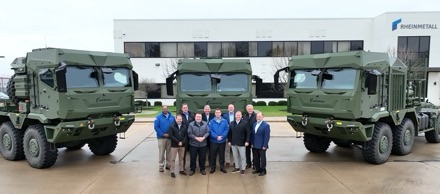
American Rheinmetall Vehicles and Team Lynx Awarded Contract for U.S. Army’s XM30 Mechanized Infantry Combat Vehicle program

Monday, August 7th, 2023

The U.S. Army has awarded American Rheinmetall Vehicles (Sterling Heights, MI) and the industry leading companies of Team Lynx – Textron Systems, Raytheon Technologies, L3Harris Technologies, Allison Transmission, and Anduril Industries – a contract for the Optionally Manned Fighting Vehicle (OMFV) Phase 3 Detailed Design and Phase 4 Prototype Build and Test phases of the five-phased program, now named the XM30 Mechanized Infantry Combat Vehicle program. The Army awarded a total of two contracts for Phase 3 and 4 performance. The two competitors will now complete the designs that began in the Phase 2 Concept Design phase and build at least seven and as many as 11 prototypes for Army evaluation with a full contract value in excess of $700 million.

“American Rheinmetall Vehicles and our teammates are excited about the award and we look forward to continuing our important work with the Army in this critical modernization program,” said Matthew Warnick, Managing Director for American Rheinmetall Vehicles. “Team Lynx brings together some of the finest defense technology companies in the world and will deliver a truly transformational, modern Infantry Combat Vehicle that ensures our Soldiers can fight, survive, and win on future battlefields.“

American Rheinmetall Vehicles and Team Lynx are developing a next-generation XM30 that achieves the Army’s requirements for a combat vehicle with superior protection, unsurpassed firepower, and unbeatable mobility. Operating with other units or independently, the vehicle can sense, move, and strike in a connected, rapidly changing, complex, and lethal operational environment unlike any Infantry Combat Vehicle before.

With its modular design and open architecture, the Army can tailor the Lynx OMFV to meet specific missions or threats, rapidly evolving to adapt to future requirements. These features also significantly reduce the training and logistics burden, leading to greater operational readiness. The Lynx OMFV’s Ground Combat Systems Common Infrastructure Architecture (GCIA) hosts an electrical, software, and structural architecture that results in a uniquely modular concept that reduces production and lifecycle costs. This open systems approach to the vehicle architecture, coupled with weight growth margin and electrical power reserve, delivers a transformational platform today that is prepared for rapid adoption and insertion of the emerging new technologies of the future – ensuring overmatch today and overmatch tomorrow.

“American Rheinmetall Vehicles has brought together remarkable companies, ideas, technologies, and approaches to deliver a truly next-generation, lethal, survivable, and enduring infantry fighting vehicle concept,” said retired U.S. Army Lieutenant General Bill Mayville, a member of the ARV Board of Directors. “This team is delivering on the Army’s highest and most ambitious priorities and I am confident it will continue to bring exceptional solutions as part of this important modernization effort.”

Design work for the upcoming phases will primarily take place at American Rheinmetall Vehicles’ facility in Sterling Heights, MI, with support from partners across the country. Final prototype assembly is slated to be done at the Textron Systems production facility in Slidell, LA. Upon completion of Phases 3 and 4, the Army plans to down select to one vendor for Low-Rate Initial Production in Phase 5 of the program near the end of 2027.

Summit Predicts Army of 2030, Future Designs for 2040

Sunday, August 6th, 2023

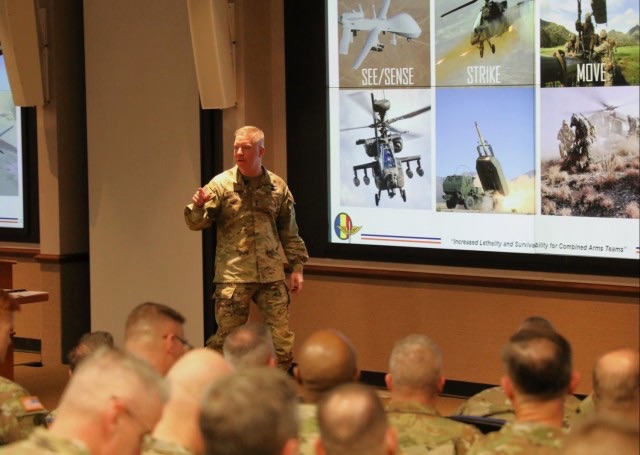
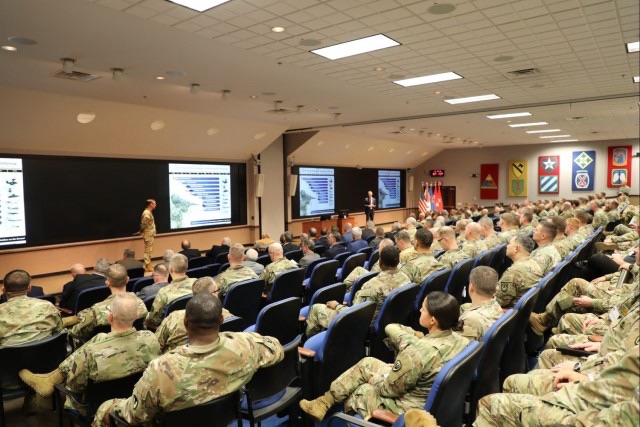
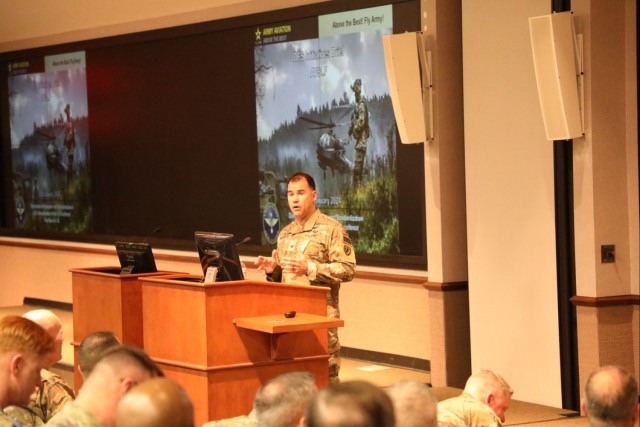
FORT LIBERTY, N.C. — Achieving the Army of 2030 and designing the Army of 2040 will require transformative vision, thoughtful leadership and sound investment, according to speakers at the July 26-27 Association of the U.S. Army Warfighter Summit and Exposition in Fayetteville, N.C.

Senior Army leaders from nearby Fort Liberty, N.C., across the U.S. Army and industry provided details and discussions on “America’s Army: Ready for Today, Modernizing for 2030 and Beyond.” The theme echoes the Army’s three priorities: people, readiness and modernization. This is the second year AUSA hosted the Warfighter Summit.

More than 800 attendees heard about the future of Soldier training and Army doctrine, Army modernization over the next seven to 17 years, the XVIII Airborne Corps’ role as America’s Contingency Force, the role of Army Security Force Assistance Brigades in 2030, insights from recent conflicts in Europe, training units at the Army’s Combat Training Centers and irregular war campaigning for 2030 with U.S. Army Special Operations Command.

The summit’s primary focus is the Soldier and the defense industry professionals who support the Army warfighter. The summit linked Fort Liberty Soldiers and senior leaders with industry partners to increase understanding of the Army’s emerging requirements and strengthen the partnership between Fort Liberty, AUSA and the surrounding community. Over 65 exhibitors highlighted organizations that provide Soldiers with educational and employment opportunities, military equipment and high-tech devices. The audience included active-duty Army, U.S. Army National Guard and U.S. Army Reserve Soldiers.

In addition to civilian, commercial vendors, the Warfighter Summit featured U.S. Army equipment, including: the Joint Lightweight Tactical Vehicle, the Infantry Squad Vehicle, the Polaris MRZR-D4, the Ground Mobility Vehicle, the MH-6M Light Assault Helicopter and the AH-64 Apache Attack Helicopter.

The Army has been consistent and persistent in pursuing modernization initiatives to deliver the Army of 2030 and design the Army of 2040.  It is committed to six modernization portfolios: long-range precision fires, next generation combat vehicle, future vertical lift, the network, air and missile defense, and Solider lethality.

Delivering the Army of 2030 and designing the Army of 2040 are priorities of Forces Command, Army Futures Command and Army Training and Doctrine Command. All three commands — as well as the U.S. Army Special Operations Command — were represented at the two-day professional forum.

The Warfighter Summit opened July 26 with a keynote presentation by Gen. Gary Brito, commanding general of Training and Doctrine Command.

“The Army’s most valuable asset is its people,” said Gen. Gary Brito, commanding general of U.S. Army Training and Doctrine Command. “This is a big, total-team effort and we will succeed at this,” Brito said. “To deliver the Army of 2030 and get ready for 2040, we are turning today’s recruiting challenge into an opportunity and continuing to innovate our talent management approaches.”

“From an acquisition lens, 2030 is really tomorrow,” he said.

Brito said the Army is at an “inflection point right now,” facing changes like those it made 50 years ago at the start of the all-volunteer force and the creation of TRADOC and FORSCOM.

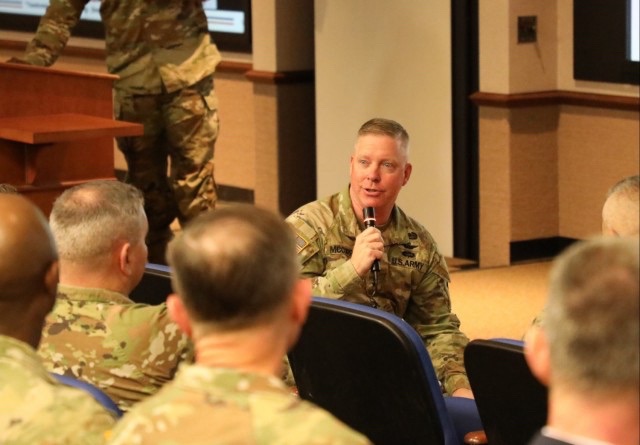
“I think from a technology perspective, this is probably the most disruptive period of time since World War II,” said Gen. James Rainey, Army Futures Command commanding general.

“War remains a contest of wills between human beings: people,” Rainey said. “You have to be able to impose your will. You have to be willing to pay the cost. Because of that, we are going to need the U.S. Army to be able to dominate the land domain … anywhere against any body as part of a joint force with partners and allies. To do that, we need people ”

FORSCOM Command Sgt. Maj. Todd Sims celebrated his 53rd birthday with a keynote speech at the AUSA Summit.

“Kids these days. I’ve seen you on the job … In training, on deployments and with your teams. I know what you are all about. When I travel around the force, I witness levels of insight and resourcefulness among junior Soldiers.”

“Kids today are smart,” Sims said. “They have unfettered access to all the world’s information. They know how to navigate and apply it in useful ways. Smart young Soldiers have always been one of the Army’s biggest competitive advantages.”

Sims also spoke about “Training the Force of 2030” — to include the Army’s premier Combat Training Centers: the National Training Center at Fort Irwin, California and the Joint Readiness Training Center at Fort Johnson, Lousiana.

Fort Liberty leaders emphasized the Army post’s role as America’s Contingency Force during a discussion by Lt. Gen. Christopher Donahue, commanding general of the XVIII Airborne Corps and Fort Liberty, and by XVIII Airborne Corps’ Command Sgt. Maj. Thomas J. “T.J” Holland.

“The XVIII Airborne Corps is really FORSCOM’s and the Army’s contribution to the contingency force,” Donahue said. “It’s made up of four separate divisions, but the ‘critical sauce’ is those separate brigades. That forms the Army’s contribution to any time we have to go anywhere to compete against any adversary across the globe. Fort Liberty is the strategic platform for the U.S. Army. It has every contingency Special Operations Forces; every contingency force on the larger capability is here.”

U.S. Army Special Operations Command’s deputy commanding general, Maj. Gen. Patrick Roberson, also highlighted Fort Liberty’s vital role in irregular warfare.

“USASOC provides all of the Army Special Operations Forces to the Joint Force,” Roberson said. Over the last 20 years, we were focused on irregular warfare campaigning throughout the world.”

Maj. Gen. Donn Hill, commanding general of the Army Security Force Assistance Command, also based at Fort Liberty, said “The adviser teams of today are designed to advise at the tactical level. We were all about counterinsurgency and stability operations, but the world has changed. The Army is changing.”

“We’re in 30 countries on any given day,” Hill said about the six security force assistance brigades. Additionally, the teams are on the ground persistently, spending six months with allied partner armies before they are replaced by another team of Soldiers.

Lt. Gen. Kevin Vereen, deputy Army chief of staff for installations, G-9, at the Pentagon discussed employment opportunities for Soldiers and spouses. “The G-9 enables readiness through our quality-of-life plans, programs and policies that help the Army recruit, train, fight and win,” he said.

A highlight of the Warfighter Summit was a discussion by Sergeant Major of the Army Michael Grinston, who spoke about the key leadership role of the U.S. Army’s Non-Commissioned Officer Corps. He also conducted a panel discussion with Fort Liberty NCOs and Soldiers about the 75th anniversary of the integration of the U.S. Armed Forces.

By FORSCOM Public Affairs