XC3 Weaponlight

Archive for the ‘C-UAS’ Category

Epirus’ Leonidas High-Power Microwave Defeats 49-Drone Swarm, 100% of Drones Flown at Live-Fire Demonstration

Wednesday, September 17th, 2025

Leonidas neutralized 61-of-61 drones, culminating in a 49-drone swarm kill with one pulse of electromagnetic interference

Los Angeles, Calif—September 10, 2025—Epirus announced today the results of an August 26 demonstration of the company’s Leonidas high-power microwave (HPM) system that delivers weaponized electromagnetic interference to counter swarms of robotic, asymmetric threats.


The live-fire demonstration tested Leonidas against 61 drones across five operationally relevant flight scenarios. Leonidas’ suite of capability differentiators

was on full display as the system disabled 61-of-61 drones—a 100% success rate. The event was capped off by the defeat of a 49-drone swarm consisting of two threat representative drone types all with one instant and low-collateral pulse of high-energy electromagneticinterference.

Leading up to finale, the prior flight scenarios were:

?Multi-angle counter-swarm engagement

Two groups of three drones were flown in from opposite directions. Leonidas engaged and defeated the first trio of drones to the left then re-directed its HPM beam to engage and defeat the trio of drones to its right.

Selective targeting

Two drones were flown into the engagement area in close proximity to one another. An audience member chose the right drone to be targeted before Leonidas engaged and defeated the right drone and left the other drone unaffected, demonstrating the system’s software-defined, precision-controlled waveforms. Leonidas then engaged and defeated the remaining drone.

Precision intercept

A single drone flew into the fire zone. Leonidas engaged and defeated the target and dropped it to the ground within a software-defined, pre-identified safe zone. Leonidas is a low-to-no collateral counter-drone solution and uses software to defeat drones exactly when and where operators need to allow for designated safety zones to protect assets and personnel.

Multi-target engagement

Three drones flew into the fire zone at different ranges. Leonidas engaged and defeated all three drones simultaneously, demonstrating its one-to-many aerial defeat capability.

“This is a watershed moment for Epirus. We believe showcasing our weaponized electromagnetic interference is the most effective way to communicate that Leonidas is the only mission-capable, counter-swarm solution for the one-to-many fight,” sai Andy Lowery, Epirus CEO. “Those who joined us witnessed this first-hand as 61 drones went up—and 61 went down.”

The invitation-only demonstration took place at Camp Atterbury, Indiana, and was attended by representatives from throughout the U.S. Department of Defense, other U.S. Government agencies and nine allied countries. The event was conducted within site range restrictions and optimized for in-person viewing.

The event demonstrated the first generation of Leonidas, which was designed and developed using internal research and development funds in 2022. Epirus unveiled its latest version of Leonidas in July 2025, which is expected to more than double the operational range and lethality over the 2022 system in the same form factor. 

Origin Robotics Unveils BLAZE, a Cost-Effective Drone Interceptor with AI-powered Computer Vision

Wednesday, September 10th, 2025

RIGA, Latvia (May 6, 2025) – Defence tech startup Origin Robotics has launched BLAZE, an autonomous counter-unmanned aerial system (C-UAS) interceptor designed to neutralize fast-moving aerial threats with precision and speed. As drones become an increasingly dominant force on the modern battlefield, BLAZE offers a cost-effective solution to counter them, filling the gap between traditional gun-based air defence and high-cost missile interceptors. The interceptor is aimed to strengthen the defence capabilities of European countries amid rising threats and geopolitical uncertainty.

Drones have reshaped modern warfare, dictating battlefield strategies and shifting the balance of power. Their widespread use, particularly in Ukraine, has demonstrated both their effectiveness and the high cost of countering them. In January 2025 alone, Russia launched over 2,500 drones into Ukrainian territory – an average of 80 drones per day. This escalation underscores the urgent need for advanced yet cost-efficient air defence solutions.

Agris Kipurs, CEO and co-founder of Origin Robotics, said, “In asymmetric warfare, drones are relatively inexpensive and widely deployed to overwhelm air defenses and strike targets both at the frontline and deep behind it, making it challenging and costly to counter. We designed BLAZE specifically to address this threat—a fast, intelligent, and cost-effective addition to existing air defense systems. We remain committed to delivering cost-efficient and adaptable solutions to support Europe and NATO allies in addressing existing and future security challenges.”

BLAZE is a man-portable, rapidly deployable interceptor designed to defeat fast-moving aerial threats, including loitering munitions and hostile UAVs. The system combines radar-based detection with AI-powered computer vision, delivering autonomous target acquisition and operator-approved interception. Equipped with a high-explosive (HE) fragmentation warhead, it ensures precise and effective threat elimination, even in contested environments.

The system autonomously detects, acquires, and locks onto targets using a combination of radar tracking and AI-powered computer vision. Upon operator confirmation, the system executes a precisely calculated attack—either destroying the target on direct impact or engaging it with an airburst fragmentation detonation.  BLAZE delivers high mobility, scalability, and cost-efficiency for modern armed forces.

As an operator-supervised autonomous system, it ensures the operator retains final-stage control, including the ability to issue a wave-off command that directs the BLAZE to either return safely or self-destruct. This capability allows immediate deployment even in scenarios with uncertain target identification, significantly reducing the risks of friendly fire and minimizing collateral damage.

The interceptor is designed for quick deployment and high-intensity operations. The first drone can be launched in under five minutes, with subsequent launches taking less than a minute. Compact and portable, BLAZE’s transport case doubles as a launch station and charging dock. Its tool-less setup ensures it is flight-ready in under ten minutes.

Following the battlefield-proven success of its flagship drone system, BEAK, currently deployed by the Ukrainian and Latvian Armed Forces, Origin Robotics continues to develop scalable, next-generation technologies for modern warfare. Thanks to BEAK’s rapid deployment and proven capabilities, Origin has quickly earned recognition for its technology and built trust in its autonomous aerial systems—reflected in an R&D contract from the Latvian Ministry of Defence and a grant from the European Defence Fund.

BLADE Cuts Down Drones at Project Flytrap 4.0

Tuesday, September 9th, 2025

BEMOWO PISKIE TRAINING AREA, Poland — Soldiers from the Army’s 2nd Cavalry Regiment detected, tracked, engaged and defeated multiple drones at ranges between 500 and 800 meters using the Ballistic Low Altitude Drone Engagement, or BLADE, system from a Stryker vehicle at the Bemowo Piskie Training Area in northeast Poland during a live fire event for Project Flytrap 4.0 on Aug. 1.

“Some of those (drone) threats were being flown simultaneously, so the system defeated one target then quickly targeted and defeated a second target in a matter of seconds,” said David Goldstein, counter-unmanned aerial systems (C-UAS) lead for the Combat Capabilities Development Command Armaments Center.

The Armaments Center ran the BLADE science and technology project from 2016-2019 to develop a capability to counter drone threats. BLADE leverages — and enhances — a system operated throughout existing Army formations, the Common Remotely Operated Weapons Station, or CROWS.

As a remote system mounted on different types of Army vehicles, CROWS allows an operator to fire a weapon while remaining protected inside. Using an array of optics, a viewing screen and motorized gimbals and controls, the operator can effectively select and engage targets.

With BLADE, a precision radar and C-UAS fire control software is integrated with CROWS hardware and software to assist operators in identifying, tracking and pointing the weapon to a continually calculated intercept point to enable the difficult challenge of destroying enemy drones.

Capable of functioning with numerous weapons, the BLADE/CROWS combination at Project Flytrap included an M2 .50 Caliber machine gun firing multi-round bursts.

BLADE also participated in several Project Flytrap non-firing training scenarios using the radar for detection, tracking and other simulated defensive actions, according to Goldstein.

Starting in late July, Project Flytrap 4.0 was the final iteration of the C-UAS training events where Soldiers from the 2nd Cavalry Regiment and 1st Royal Yorkshire Regiment, United Kingdom, tested new C-UAS capabilities in combined exercises meant to develop and inform the future of anti-drone tactics and technologies.

“Project Flytrap is part of a series of training events designed to test and refine new counter-unmanned aerial systems technologies and tactics to respond to the evolving threat of drone warfare,” said Col. Matt Davis, transformation chief and exercise director of V Corps, Project Flytrap, during a press engagement.

Previous Flytrap events were focused on command-and-control systems and countering small UAS sensors, said Goldstein. “We were invited to come out to the latest Flytrap with our BLADE and CNALT systems because they wanted to see more kinetic capabilities,” said Goldstein.

The CNALT software plug-in, also being developed by the Armaments Center, is an application that provides tactical fire control and visualization tools to reduce time in the kill chain — the cycle of finding and identifying targets, prioritizing and coordinating attacks. Time is critical in military operations with targets in constant motion and considering that potential targets threaten harm to friendly forces.

Soldiers took 15 minutes on new equipment training for CNALT operations, said Marc Sanzari, chief of the Armaments Center Networked Lethality & Collaborative Autonomy Branch. During various training scenarios, CNALT successfully ingested real-time sensor data from the BLADE Precision Fires Radar, classified UAV tracks, and generated actionable engagement recommendations for BLADE and the Stryker commander.

For BLADE, getting the components to Project Flytrap 4.0 and operational, tested the abilities of engineers and technicians to meet the Army and DoD challenge to get new drone capabilities into the hands of Soldiers quickly and with the fewest constraints.

“Within two weeks of request, the system was installed and operational and ready for Soldier touch point training,” said Jonathan Gann, an Armaments Center mechanical engineering technician specializing in autonomous weapons.

Gann was part of an Armaments Center team who shipped the BLADE components from Picatinny Arsenal, New Jersey to Poland and conducted a field expedient installation of an existing CROWS on a Stryker vehicle to make it operational as a BLADE system.

After the installation, Gann met with Soldiers to discuss the tactics, techniques and procedures for BLADE operations within unit formation while stationary and on the move. He noted that Soldier feedback from the live-fire event provided insights on future improvements for BLADE, but also, “it highlighted the possibilities of UAS engagement in a dynamic environment,” said Gann.

“I was able to understand the fundamental workflow for the system and gunner actions within one hour of seeing the BLADE for the first time,” said Maj. Jared Whitaker, deputy chief G-31 from V Corps, who as a leader observed the entirety of the drone engagements in a seat between the gunner and radar operator.

Whitaker, who is proficient in operating CROWS, said that compared to ground engagements there were added steps in counter-drone operations. Schooling on the radar was necessary, as was additional training to become fluid during rapid reactions while performing counter drone scenarios.

“I found that the ability to engage UAS using a CROWS has gone from impossible to possible with the addition of BLADE,” said Whitaker.

After achieving Technology Readiness Level Six in 2019, BLADE has participated in various C-UAS exercise and engagements, such as Project Convergence, the Maneuver Fires Integrated Exercise and Red Sands – Operation Hard Kill.

Operation Flytrap has become the latest BLADE knowledge builder.

“The Armaments Center continues gathering insights from participating in C-UAS events and is transitioning the technology to current programs of record for near-term fielding opportunities, said Goldstein.”

By Timothy Rider

Allen-Vanguard Launches SECURIS a Mobile Counter Drone Trailer as Part of a New Counter Drone Collaboration with Metis, Blighter, Openworks and EdeyFX

Thursday, September 4th, 2025

Allen-Vanguard, a global leader in providing customised solutions for defeating Radio Frequency (RF) based terrorist and extremist threats, is launching a new mobile counter drone trailer at DSEi 25 in collaboration with Metis, Blighter, Openworks and EdeyFX. This collaboration has been established to leverage the respective expertise (detect and defeat) and proven product capabilities (RF detection, radar detection, optical recognition and RF jamming) from each company to address the increasing threat to people, infrastructure and key locations from the nefarious use of drones.

Details on SECURIS, the new mobile counter uncrewed air systems (C-UAS) trailer system will be available at the Allen-Vanguard stand S5-540 at DSEi 25, Excel, London (9-12 September 2025).

The SECURIS C-UAS trailer is a rapidly deployable, mobile counter drone capability that has a best in class, multi-faceted detection suite combining the advanced RF detection capabilities of SKYPERION from Metis which is used globally by NATO allies in various integrated systems, the unique radar target acquisition capabilities of Blighter’s A400 series, which is also operationally proven globally and the advanced optical recognition system Vision Flex from Openworks; again sector leading for its long-range imagers, dynamic slew-to-cue capability, and twin-AI modules for detection, tracking and identification.

These aspects, along with Allen-Vanguard’s own operationally proven range of C-UAS RF Effectors (ANCILE), have been cleverly integrated onto a bespoke trailer chassis produced by EdeyFX accommodating operational input on design and layout coupled with the highest level of mobility. SECURIS delivers a scalable, fully integrated, comprehensive, easy to use, reliable and future proofed counter drone capability on an extremely mobile and robust platform. Its open architecture and modular nature also makes it highly suitable for the provision of Protection-as-a-Service (PaaS) where customers are provided the latest updates and technology innovations as part of a package rather than just purchasing a one-shot capability.

Bobby Strawbridge, President of Allen-Vanguard said: “I am delighted to formally launch our new fully integrated and scalable mobile counter drone trailer system SECURIS at DSEi 25. We have worked closely with our partners at Metis, Blighter, Openworks and EdeyFX all of whom are agile SMEs like ourselves, and who are acknowledged Domain Knowledge Experts (DKEs) in their respective fields. As specialists, with operationally proven products within our own areas of expertise, we have come together to produce exactly what the customer base has been demanding, a best of breed collaboration of capable systems packaged into a scalable and highly mobile package. SECURIS will help counter the rapidly evolving threat posed by drones and its modularity ensures future adaptability and therefore enables provision of Protection-as-a-Service rather than just product manufacture.”

AV Delivers First Two Multi-Purpose High Energy Laser Systems to US Army

Thursday, September 4th, 2025

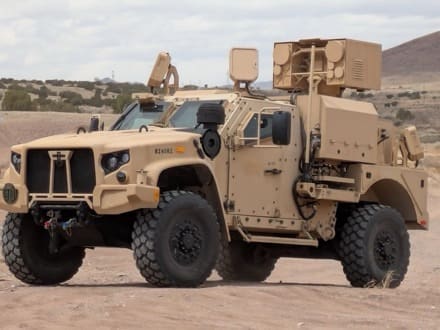
ARLINGTON, Va., August 31, 2025 –AeroVironment, Inc. (“AV”) (NASDAQ: AVAV) today announced the successful delivery of the first two mobile counter-unmanned aircraft system (C-UAS) prototype Laser Weapon Systems (LWS) to the U.S. Army Rapid Capabilities and Critical Technologies Office (RCCTO) as part of the first increment of the Army Multi-Purpose High Energy Laser (AMP-HEL) prototyping effort. The AMP-HEL prototype systems feature AV’s 20kW-class LOCUST™ LWS integrated on the General Motors Defense Infantry Squad Vehicle (ISV) platform–a significant advancement in mobile, frontline C-UAS capabilities.

“This milestone marks a major step forward in the Army’s pursuit of fieldable directed energy capabilities,” said Mary Clum, Senior Vice President for AV’s Space & Directed Energy Group. “Through the AMP-HEL program, AV is delivering our extensively validated LOCUST laser system–a technically sophisticated solution that has demonstrated reliability and operational readiness for the C-UAS fight. We are honored to support the U.S. Army RCCTO and, together, accelerate warfighter access to these critical capabilities.”

Following integration at AV’s Directed Energy (DE) manufacturing facility in Albuquerque, New Mexico, the AMP-HEL prototypes underwent rigorous government acceptance testing at Yuma Proving Ground in Arizona to validate performance, mobility, safety, and lethality. Subsequently, Army units performed new equipment training at Fort Sill, Oklahoma to prepare for potential employment of DE capabilities. Soldier feedback from the event is shaping ongoing enhancements to ensure warfighter readiness and operational relevance in dynamic threat environments.

The AMP-HEL prototyping effort is part of the Army’s broader modernization initiative to rapidly develop and field DE solutions to defeat a range of threats, including drones and other airborne systems. The integration of laser systems on the lightweight, highly mobile ISV platform reflects a commitment to scalable, adaptable, and expeditionary force protection solutions. Next month, AV is set to deliver the second increment of AMP-HEL–two Joint Light Tactical Vehicles with a 20kW class LOCUST LWS, radar, and command-and-control systems.

“The need for these systems from real world events is clear: the time is now for directed energy to get into the hands of warfighters everywhere and we are confident that LOCUST meets that need,” said John Garrity, Vice President of Directed Energy Systems for AV. “AV is committed to supporting the Army’s modernization and modularity priorities. We stand ready to meet the mission need through full-scale manufacturing of our LOCUST laser systems, including AMP-HEL and other mobile and fixed-site platforms, to increase lethality and continue to build on our extensively validated reliability and precision tracking and targeting technology to address the evolving threats.”