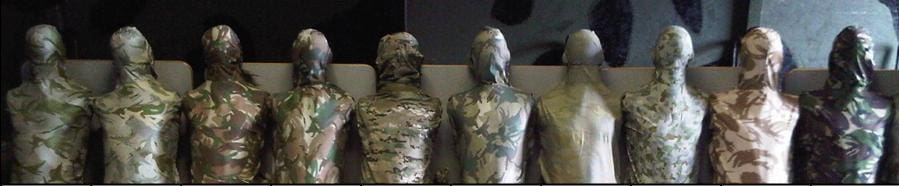
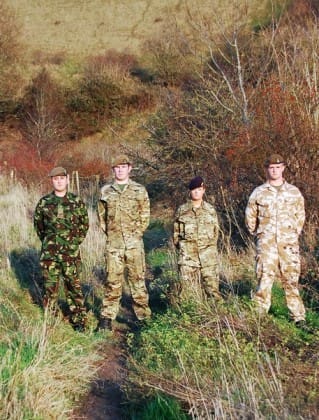
The UK MoD has released a photo that shows the new Multi-Terrain Pattern (MTP) with the currently issued Woodland and Desert Disruptive Pattern Material (DPM) patterns.
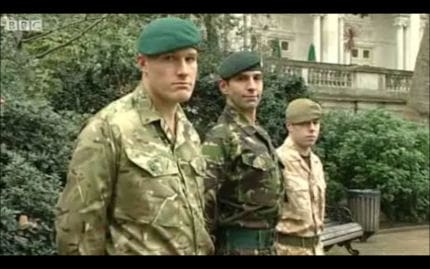
The BBC has reported on the new Multi-Terrain Pattern meant to replace the Woodland pattern found on No. 8 DPM uniform in service for the past 40 years. However, the No.5 Desert Combat Dress will remain in service. As we reported earlier, Crye Precision developed the pattern for the exclusive use of the UK Ministry of Defence.
In the BBC video Lieutenant Colonel Toby Evans identified as “a military advisor with the Government’s Defence Science and Technology Laboratory,” speaks quite a bit about the importance of the camo pattern as a “corporate image” and how it represented the “British Army brand.” In effect, the British Army has adopted a new woodland pattern that is more relevant in a wide variety of environments than the previous pattern which was more developed for use in Northern Europe. They will retain their desert pattern for specialist use so they will continue to have a two pattern system but with one of the patterns being more universal in nature rather than tuned specifically for verdant areas. Finally, in addition to uniforms in the CS95 cut, the British Soldier will receive armor and helmet covers, packs and webbing in MTP. However, this will happen over time while the new uniforms as soon as this Spring.
Soldier Systems Daily has received verification from Crye Precision that they developed the new Multi-Terrain Pattern exclusively for use by the UK’s Ministry of Defence. A Crye representative related to us that, “MultiCam® won all their trials so they wanted us to develop a pattern for them that performed like MultiCam® but had a distinctly British identity. UK-MTP is the result.”
Earlier today, unattributed information found its way to a popular military message board detailing plans to begin issuing this new pattern initially to troops on Op Herrick early next Spring and ultimately in 2011 to the entire military. As you can see from the photo, the unique MultiCam® color palette has been adapted to a pattern reminiscent of Disruptive Pattern Material (DPM) a pattern in use by the British military for 40 years.
As posted on StrikeHold! the UK’s Special Forces Support Group has been wearing combat uniforms in MultiCam® for some time.
The adoption of MTP seems to put to rest the limited use of Hybrid DPM which has seen limited use in Afghanistan on “Battle Bags” and assault packs.
Yes, a camo house; urban camo, naturally. Ok, so it’s supposed to be UCP, but their colors are a bit off.
The website “Apartment Therapy” recently featured this find in Austin, Texas. I wonder if UCP would blend in.
Thanks to StrikeHold! for the find.
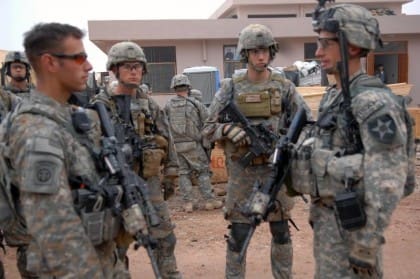
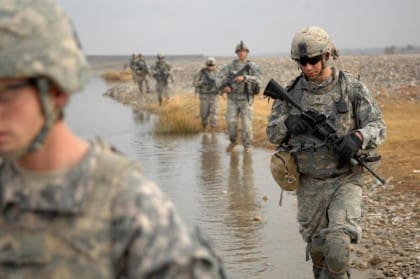
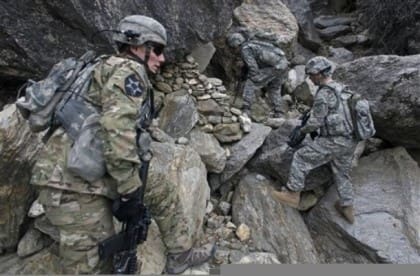
TF Mountain Warrior(3d Squadron of the 61st Cavalry of the 4th Brigade Combat Team, 4th Infantry Division) was featured earlier today on CNN. Seen here is the Battalion Commander, LTC Brown wearing ACUs in UCP-Delta along with UCP TA-50.
As you can see, the unit is wearing UCP-Delta on patrol.
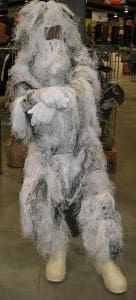
This article was published over a year ago but serves as an excellent option of those that want to camouflage their weapon without painting. Camo Form® tape has been included in the Ghillie Suit Accessory Kit for many years and offers a variety of patterns to match any terrain.
Technically it’s Camo Form® Self -Cling Camouflage, but most everyone just refers to it as Camo Form Tape. Whatever you call it, it works. As you can see in the depiction below, the Camo Form® is very effective at visually camouflaging your equipment. What you can’t show in a picture is that it also improves noise discipline by cushioning equipment. It also protects the finish and function of gear.


One roll will take care of most of an individual’s requirements (2″ wide x 144″ (4 yds) long). Camo Form is self-clinging and not affected by moisture. What’s more, it gives smooth items a little grip so that they don’t slide.
Available in Mossy Oak® New Break Up®, Mossy Oak® New Shadowgrass®, Mossy Oak® Obsession®, Mossy Oak® Brush®, Universal Camouflage, Digital Woodland, Digital Desert, 3-Color Desert, Woodland, Snow & more.
To order visit McNett.
The response to the article on camouflaged weapons has been extraordinary with readers contacting us via email, phone call, and text message with feedback on expedient methods of breaking up the outline of small arms.
Here are two examples of weapons camouflage. Interestingly, both are of foreign weapons although the first is expedient in nature and the second purpose built. When you look at the time frames of the two photos you may wonder like I do why it has taken so long for something so simple to become standard.
The first image depicts Rhodesian Soldiers in the mid-1970s with painted FN FALs and the second is a picture of the Australian F88A3 rifle based on the AUG. The finish of the F88A3 in a khaki color used in the Australian Disruptive Pattern Camouflage Uniform and is manufactured by Thales at the Lithgow Small Arms Factory. It is an interim solution until the A4 version has completed development.

DefenseTech published an article today on a subject we have been looking at for some time. This is our take on the issue.
Amid all of the ballyhoo surrounding the Congressionally directed adoption of a area-specific camouflage pattern for Afghanistan a major weak link remains. PEO-Soldier has worked diligently to camouflage virtually piece of a Soldier’s kit save one; his rifle. Probably the most important item issued to a Soldier, the Army has yet to fully come to grips with the “Black Rifle”. And it’s not just rifles. Grenade launchers, Squad Automatic Weapons, and crew served implements of destruction all come in basic black.
So, awhile back I queried PEO-Soldier about this and they provided me with this reply:
“Soldiers in the field do in fact camouflage their weapons based upon the situation and environment. For example, snipers may tie certain cloth materials to break up the outline/profile of their weapon. Moving forward, PM Soldier Weapons in conjunction with TACOM Rock Island will be writing up a procedure guide that details how soldiers could employ temporary paints to camouflage their weapons for field environments.”


I have some additional information about the first part of the reply. The Ghillie Suit Accessory Kit recently received a face lift including the replacement of burlap with a Fire Resistant yarn. Burlap catches fire easily so this is a much needed change. Available in Light Coyote, Light Green, and Madeira (Brown), hopefully, this material will be available for wider spread use soon.

There has been some light in this tunnel and there have been some changes to this long standing policy. SOCOM, in particular has adopted Flat Dark Earth (FDE) as a color for some of its Special Operations Peculiar Modification (SOPMOD) carbine accessories. Additionally, the SOF Combat Assault Rifle (SCAR) comes in a battlefield friendly FDE base color. Furthermore, industry is rife with both weapons and accessories in a variety of finishes. Additionally, S.O. Tech has developed a fabric suppressor cover designed to camouflage its shape and yet still resist melting.
Unfortunately, the other services can be even worse about the issue than the Army. The Air Force for example, has published specific guidance forbidding the painting of weapons or the use of non-issue accessories. Once again, it seems as though someone doesn’t realize there is a war on.
Hopefully, the new weapon camo guide from Rock Island will hit the field soon. Also, based on the same requirements facilitating the study of enhanced personal camouflage, we hope to see a requirement for a weapon color that does not contrast with the Soldier’s other equipment or battlefield environment.