Look for details soon on SSD!
Safariland’s TCI boasts an acoustic lab where they can replicate and work to mitiagte those sounds which threaten the hearing of military, law enforcement, other ar ed professionals and recreational shooters alike.
“There’s a few different ways we can use our equipment to confirm a reading, and we use it for both R&D and production, and getting certifications,” says Brad Medine, Category Director for TCI.
Additionally, they can record sounds created dueing ballistic testing and use those as samples for their work. This video gave you a quick overview of their efforts.
To read the full post, visit www.safariland.com/in-the-spotlight/inside-safariland-acoustics-lab.
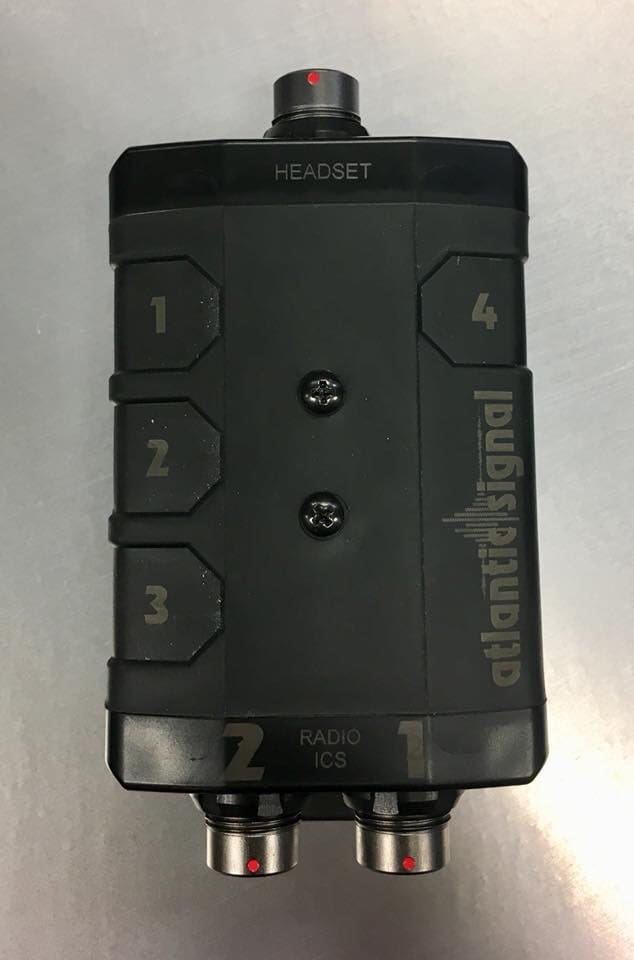
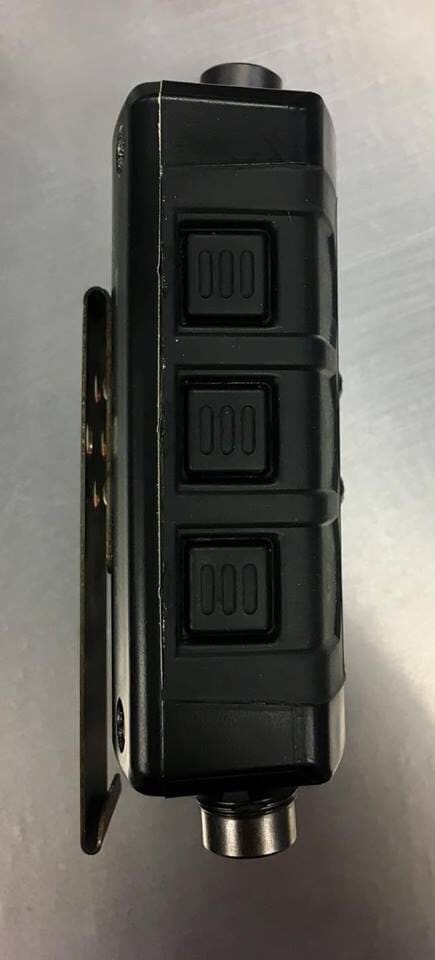
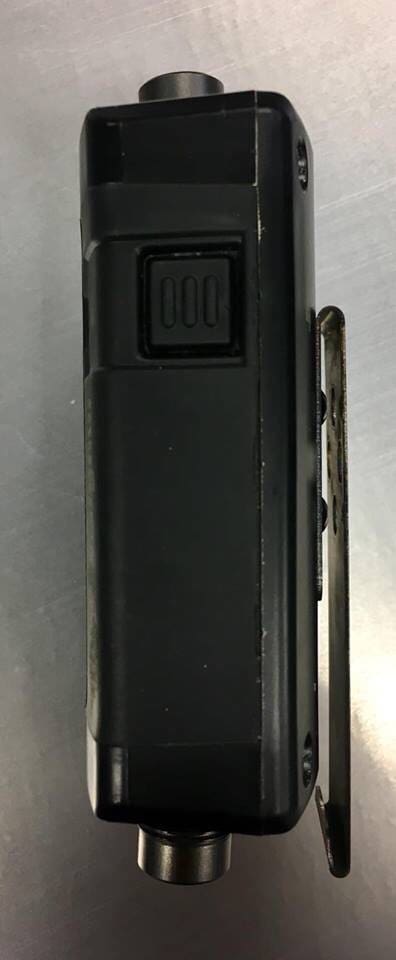
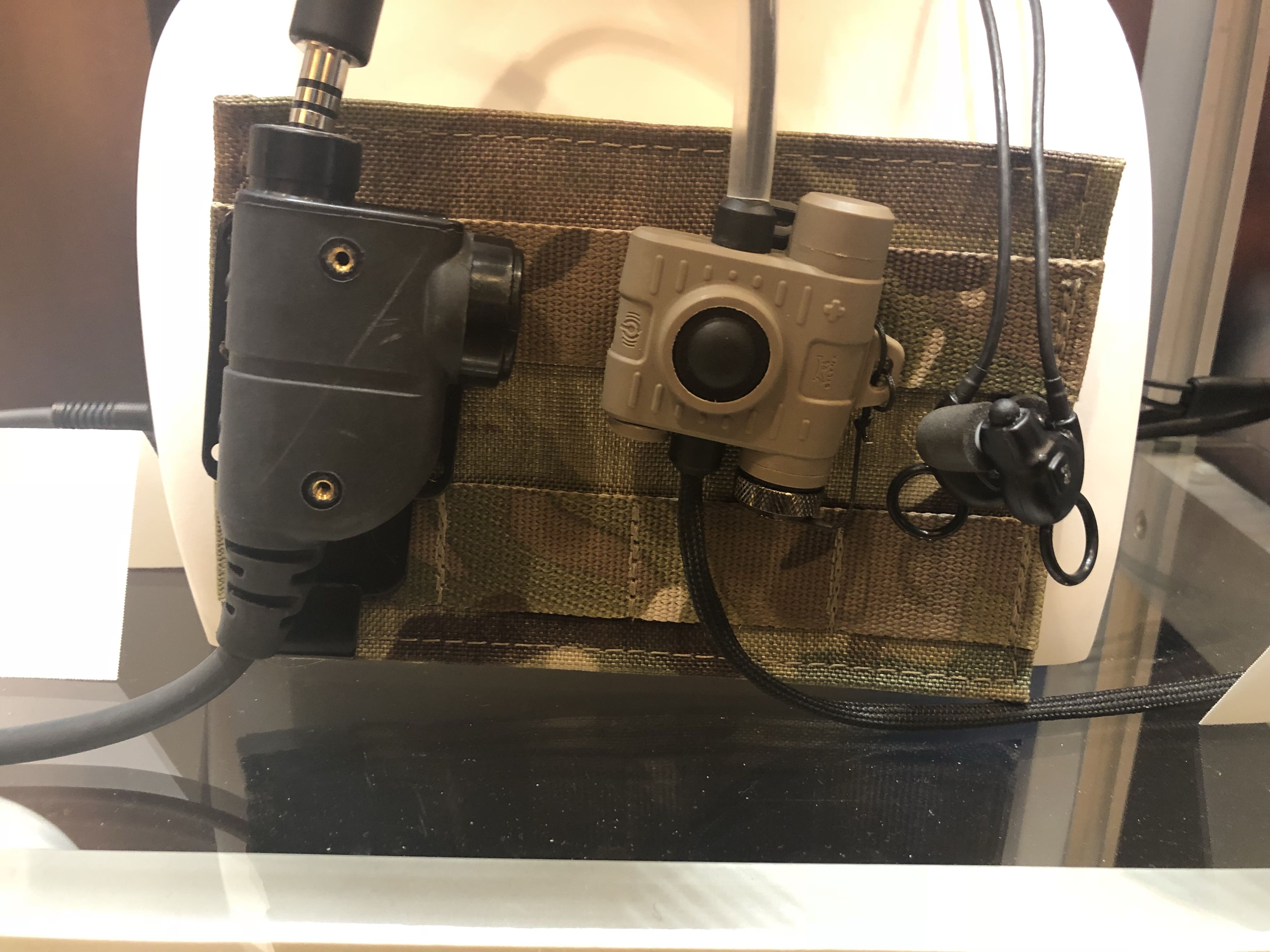
Working in conjunction with 3M, Atlantic Signal has developed their Next Generation Headset, in anticipation of an upcoming US Special Operations solicitation.
The system will offer the availability of transitioning the headset from rail mounting, to over the head band within in two minutes with laboratory certified hearing protection.
RE Factor Tactical has introduce their take on the VS-17 Marking Panel.
One side is Yellow with a silk screened American flag and the other side is Orange with a 4″ x 2″ Velcro section to add an IR light. In addition to the four removable bungees in the corners, there are rare earth magnets so it can be placed on a car roof, hood or trunk. Luke related he had one stay put at speeds up to 55 mph.
Currently only available for Government purchase, contact govsales@refactortactical.com to order.
QUANTICO, VA at Modern Day Marine, Sept. 19, 2017 – AeroVironment, Inc. (NASDAQ: AVAV), a global leader in unmanned aircraft systems (UAS) for both military and commercial applications, today announced that it has delivered M1/M2/M5-compatible Raven® and Puma™ AE unmanned aircraft systems (UAS) to two DoD customers, with more orders and deliveries scheduled. In addition, the company will begin taking orders in December 2017 for M1/M2/M5-configured Wasp® AE micro air vehicles (MAV) for delivery in spring 2018.
“Integrating the new M1/M2/M5 radio frequencies into our family of small UAS gives our customers the ability to seamlessly and securely conform to the Department of Defense‘s new frequency spectrum allocation and proceed with certainty,” said David Sharpin, vice president of AeroVironment’s Tactical UAS Business Unit. “By combining all three frequency bands in the same transceiver module, we’ve made it easy for users to select the frequency band associated with the part of the world in which they are operating without having to swap any hardware.”

AeroVironment today also unveiled its new Pocket DDL™ AE, a rugged, all- environment, next generation, secure digital video and data receiver that also integrates the new M1/M2/M5 radio frequency spectrum. The all-environment design of AeroVironment’s new Pocket DDL AE makes it significantly more rugged than its predecessor by offering a fully waterproof package (immersible to three feet) that supports tactical operations in a wide range of environmental conditions and difficult urban terrain.
Designed for simplicity and ease of use, the Pocket DDL AE facilitates rapid and secure access to a small UAS Digital Data Link (DDL) network. Each sleek unit has no exterior buttons or displays and is completely controlled through an App. Pocket DDL AE has a standard Glenair® Mighty-Mouse connector, making it compatible with the Army‘s Net Warrior system, so dedicated cables for Pocket DDL are not necessary. It can operate from any power supply, providing between 5 and 32 volts DC.
Pocket DDL AE implements an open-systems architecture, using a USB interface and XML messaging for control of the radio functions. This enables apps designed for special purposes, such as tactical operations, search and rescue, asset tracking, long- range communications, mission command, and targeting to use Pocket DDL AE to employ small UAS to help perform their tasks more effectively.
“Combined with the M1/M2/M5 upgrade to our Pocket DDL AE, this provides greatly enhanced capability across our entire family of small UAS product line for improved tactical operations,” Sharpin said. “This example demonstrates our ongoing commitment to upgrade our Family of Systems products and provide new capabilities to our existing and new customers around the world.”


AeroVironment will announce additional upgrades to its market-leading Family of Unmanned Aircraft Systems during the Association of the Army’s Annual Meeting next month.
New York, N.Y. — Persistent Systems, LLC (“Persistent”), a leader in Mobile Ad hoc Networking (MANET) Technology and developer of Wave Relay®, announced today that it was awarded an $8.9 million contract award to provide more than 950 MPU5 radios to the U.S. Army National Guard’s Weapons of Mass Destruction Civil Support Teams (WMD-CSTs).
The contract is in support of the U.S. Army’s Unified Command Suite (UCS) Program of Record, which is managed by the Joint Program Executive Office for Chemical Biological Defense (JPEO-CBD). The UCS program aims to provide communications interoperability between military emergency response elements and Federal, State, and Local authorities on the scene of an incident.
The Unified Command Suite is a self-contained communications vehicle that can either be driven to or be air-lifted via a C130 to an incident location. The MPU5 radios enable a high-speed communication network to be established on-the-fly, which empowers CST personnel to operate across the incident area while remaining connected both to the vehicle and to each other.
“Whether at a campaign rally or along a marathon route, National Guard Civil Support Teams run WMD detection operations to keep Americans safe,” said Louis Sutherland, VP of Business Development for Persistent. “That’s why it is so important that they have a robust wireless network.”

The MANET element of Persistent’s solution creates a vast, self-forming, self-healing radio network that does not require outside infrastructure to work. Should a node drop out of the network, sensor data collected by a Civil Support Team member will simply be routed another way. Using the MPU5 also means cutting down on the number of relay radios needed to push signals over and around obstacles.
The MPU5 provides push-to-talk audio, video encoding, and an integrated Android™ computing environment that allows the installation of 3rd party applications. It is a 6W 3×3 MIMO radio which provides extremely long range and throughput exceeding 100 Mbps. These capabilities enable National Guard Civil Support Teams to network their sensors and transmit data collected in the field to the UCS vehicle and then on to a national lab for analysis.
“MIMO radios thrive in urban environments, where standard radios have trouble,” Sutherland said. “This enables the CST personnel to extend their network further from the truck and operate effectively in urban, high-population-density environments that are the most likely targets of an attack.”
Persistent has customers in the Army, Air Force, and Department of Homeland Security.
“Some of our most passionate advocates come from the chemical, biological, radiological, nuclear, and explosives detection community,” Sutherland said. “In fact, our MPU5 radio is already embedded in QinetiQ’s Talon unmanned ground robot which is also used by Civil Support Teams.”
Persistent has already begun delivery of its radios and expects to make another delivery of 500 radios to the Unified Command Suite program this month. The radio integration is being performed by NAVAIR in Patuxent River, Maryland.
Silynx Communications, Inc. CEO Matthew Hein will depart his position in order to pursue other opportunities, effective September 15, 2017. “It has been a privilege to lead and work with the hardworking Silynx team that continues to develop industry-leading hearing protection systems. I look forward to hearing about the continued success of the company going forward,” stated Mr. Hein, who joined Silynx in 2013. He will remain in an advisory capacity to assist Matthew Hemenez as newly named President.
Mr. Hemenez is a longstanding industry veteran, with over 20 years of experience in telecommunications, most of which has focused on the tactical communications segment. He moves into this role after two years as Senior Vice President of Sales and Marketing with the company. Mr. Hemenez said, “The company is grateful for Matt’s years of service and his contributions. Personally, I am excited to begin serving as the Silynx President and driving profitable growth for the business.”
Launched at DSEI, Cobham’s new Integrated Communications Environment (ICE) products optimise the performance of multiple radios operating simultaneously on a single platform
DSEI, UK: Cobham today announced that they have launched a new Integrated Communications Environment (ICE) product range which provides major improvements to existing communications systems on platforms. The new ICE products include a multi-radio interference cancellation system and new high-performance multi-port V/UHF antenna.
The integration of multiple radios and other communications systems on a single platform or in a congested environment causes Radio Frequency (RF) interference which can dramatically reduce the effective radio range. This increasingly operational problem is being exacerbated by the increase of on-board communications systems which can mean they are competing for data and spectrum allocation.
David Bulley, VP and General Manager of Cobham Antenna Systems said “Cobham has been at the forefront of RF interference cancellation technologies for over 20 years with proven field performance. As communications systems on platforms have become increasingly complex our expectations of them has also heightened; Cobham’s new ICE products allow users to streamline their communications systems without affecting performance or range which makes a critical difference during operations.”
The ICE 7201 interference cancellation system not only restores radio performance and operational range, it also facilitates enhanced frequency planning for operations, enabling closer separation between channels resulting in a significantly greater number of useable radio channels for a given spectrum allocation. Simultaneously, the GD2049 high performance multi-port V/UHF antenna enables the overall antenna count on land platforms to be reduced through the introduction of two VHF ports with high port-to-port isolation.
The combination of Cobham’s two new market-leading technologies allows for optimised co-site integration of radios whilst also reducing the number of antennas required on a platform. The result is a significantly improved communication effectiveness and a reduction in the cost and ‘real estate’ of the antennas required.
The new ICE 7201 system and GD2049 antenna will be exhibited on the Cobham stand, S6-150, at DSEI London, 12-15 September 2017.
Cobham’s new GD2049 multi-port antenna installed on a Thales Hawkei vehicle at MSPO Poland. © Image supplied courtesy of Thales