XC3 Weaponlight

Archive for the ‘Contracts’ Category

USMC Snipers Select Mystery Ranch Packs

Wednesday, October 21st, 2015

Marine Corps Systems Command selects Mystery Ranch by way of DLA’s Tailored Logistic Support Program to provide the Overload pack

  
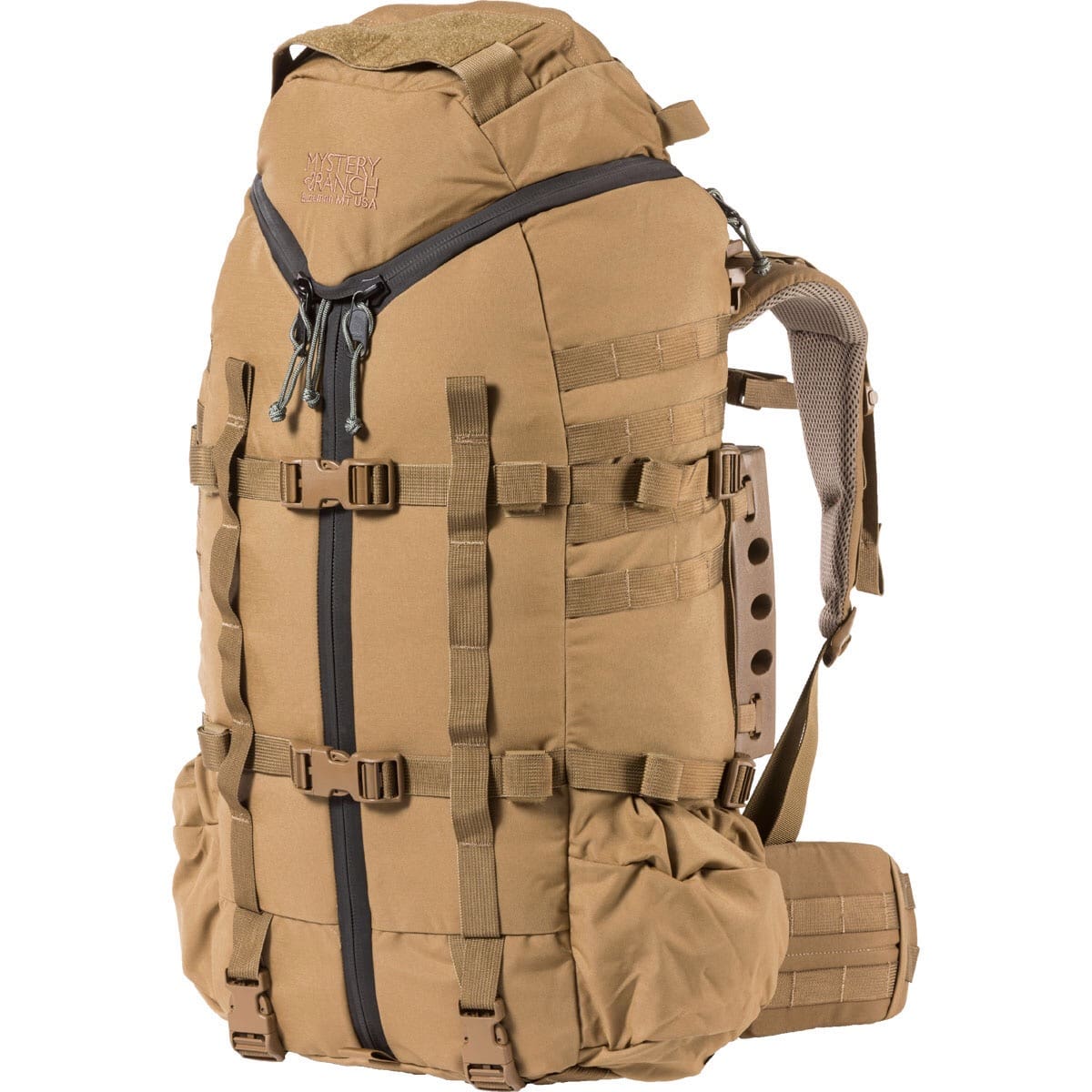
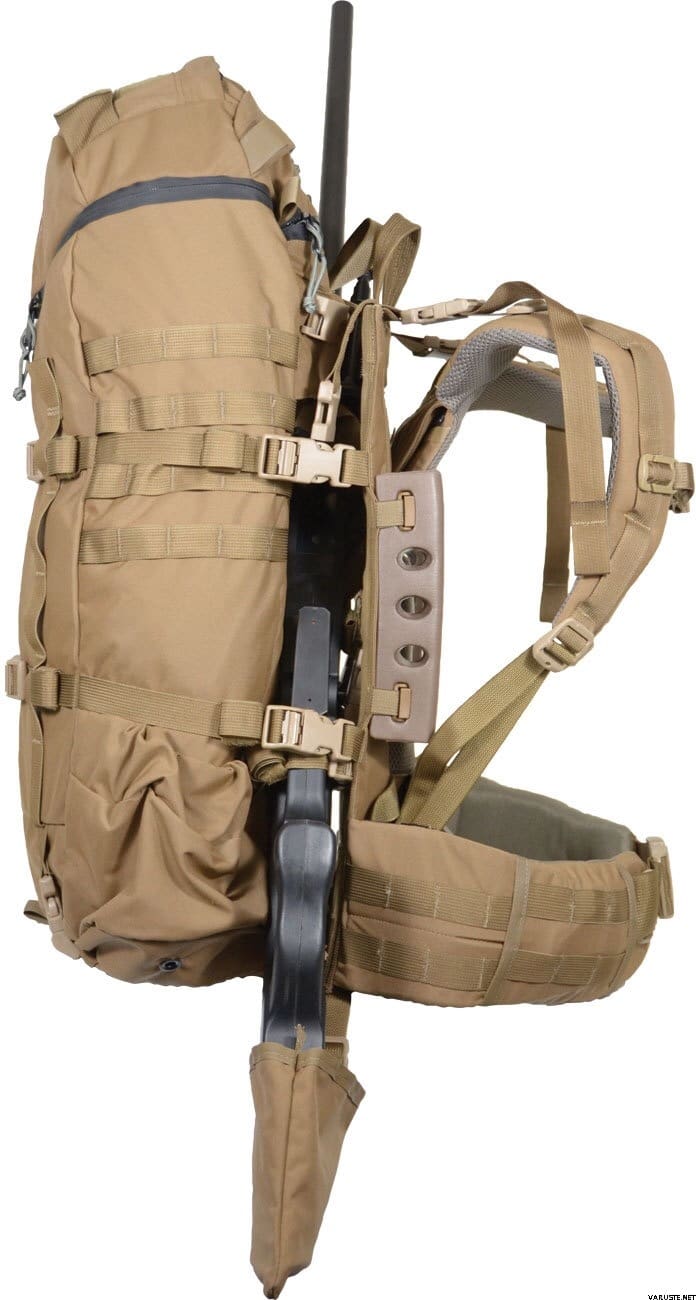
MYSTERY RANCH has been selected by Marine Corps Systems Command to provide their Overload pack for the Scout Snipers. The Overload pack is a unique carry system designed to securely transport all manner of crew-served weapons. Based on the carbon-fiber NICE frame, the pack folds away from the frame allowing weapons, etc to be attached close to the user’s back. Weapons are secured cross-carry, which allows for protection of a weapon’s optic while being transported and also helps conceal the sniper’s rifle from observation. Additionally, the pack can extend further to transport mortars, Pelican cases, ammo cans or larger gear.

  
“It’s great to see this come full circle for the Overload pack –its design began with the Scout Snipers. I’m proud that we’re able to help them be more combat effective.” said Kent Orms, Director of Gov’t Programs for MYSTERY RANCH.

The MYSTERY RANCH Overload has previous success with the Marine Corps; it and the 3-Day Assault pack have been the main issue packs for MARSOC since 2013.

www.mysteryranch.com/nice-overload-3zip-bvs-pack

US Army Releases MHS Q&A

Thursday, October 8th, 2015

The Army has released the first round of Questions & Answers pertaining to the Modular Handgun System solicitation.  I didn’t see anything earth shattering, but worth a look all the same.

www.fbo.gov

AQYR Technologies Awared A $100 Million Indefinite Delivery/Indefinite Quantity Production Contract

Wednesday, October 7th, 2015

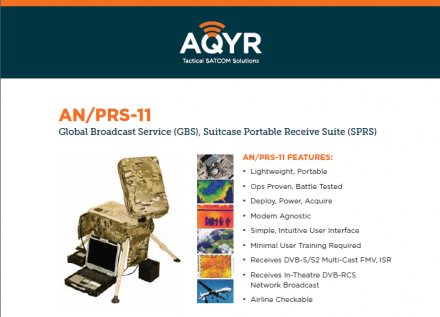
AN-PRS-11

Click to view .pdf

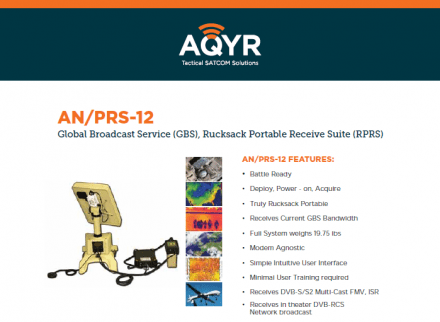
AQYR Technologies has been awarded a $100 million contract as a result of a Small Business Innovation Research granted by the Air Force Research Laboratories, with the Air Force Life Cycle Management Center being the contracting activity. This contract will allow AQYR to provide AN/PRS-12 and AN/PRS-11 Portable Receive Suites, spares, training, support, and engineering services to the US Air Force and other branches of the US Military.

AN-PRS-12

Click to view .pdf

These systems are portable, satellite receive suites capable of being deployed and operated by a single user. They allow Warfighters to receive crucial command center information and data, including Unmanned Aircraft Systems; video and imagery, weather, terrain, geospatial and mapping info; FLIR imagery; streaming video, web content replication, and other large files. The Portable Receiver Suites are also ruggedly built, able to withstand environmental conditions such as high humidity, blowing sand, rain, and extreme heat/cold.

aqyrtech.com

Source: www.satnews.com

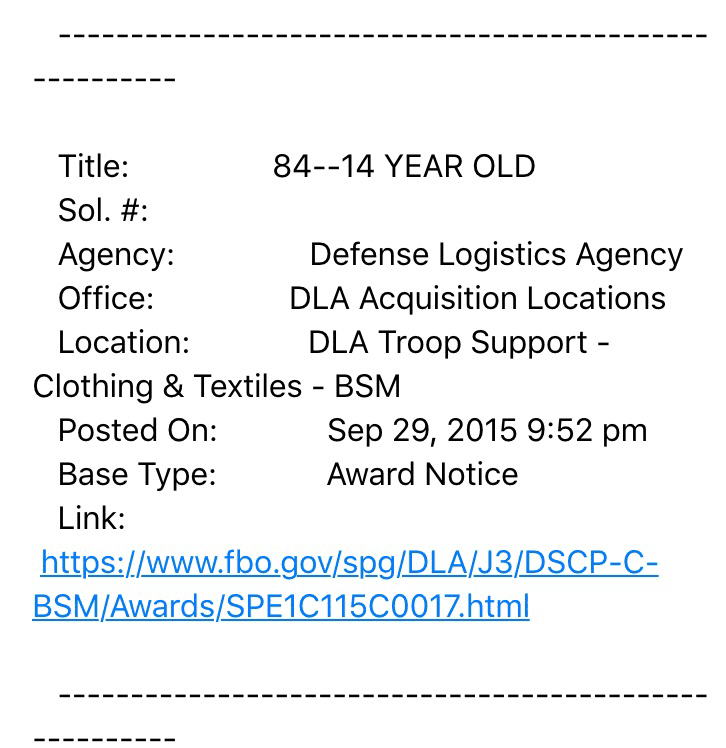
Gotta Be Careful With Those Titles on FedBizOpps

Thursday, October 1st, 2015

  
Stuff like this could give the term “solicitation” a whole new meaning.  

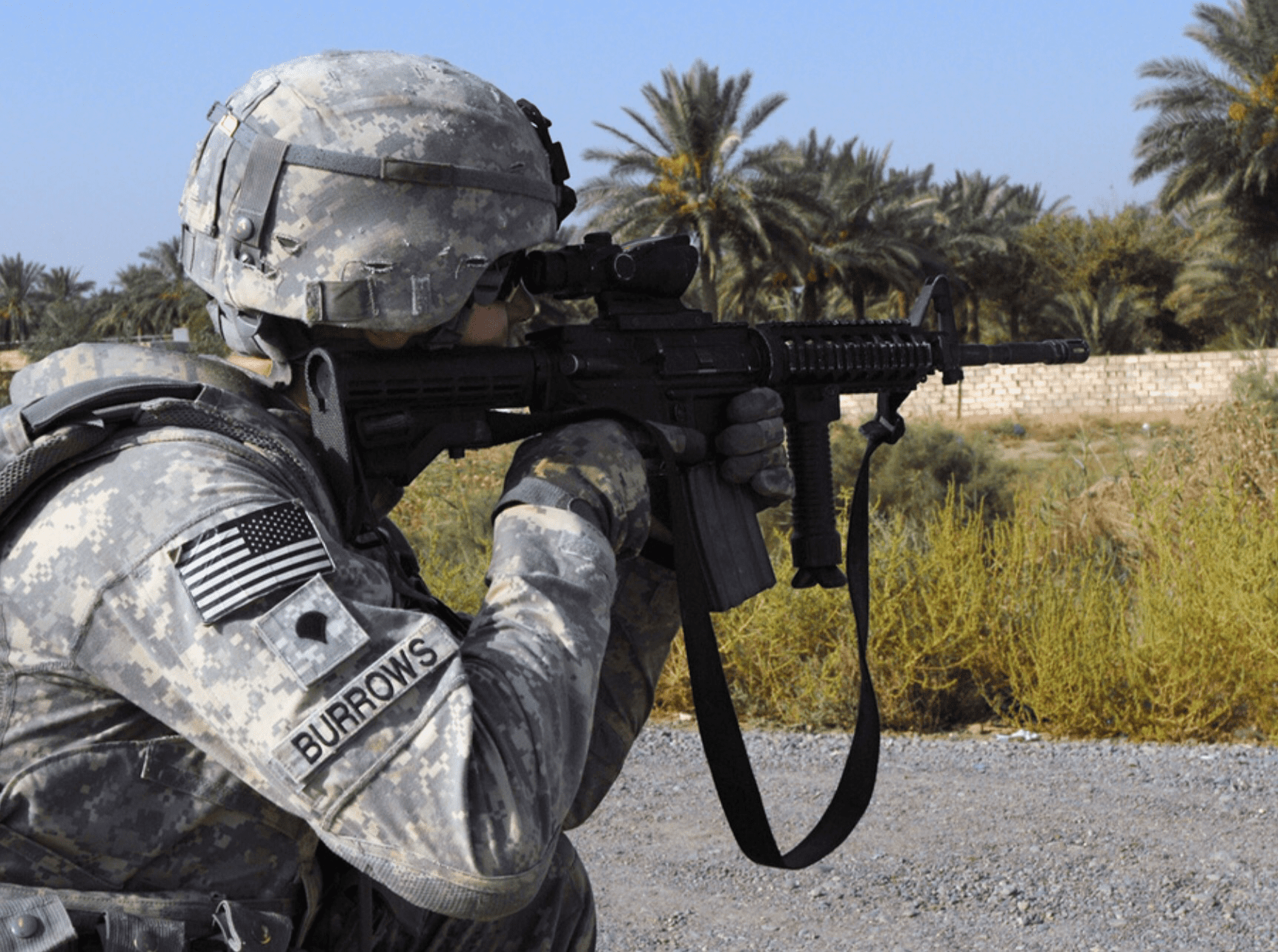
More M4s On The Way From Colt & FN

Sunday, September 27th, 2015

Announced by DoD on Friday.

  
Colt Defense LLC, West Hartford, Connecticut (15QKN-15-D-0102); and FN America LLC, Columbia, South Carolina (W15QKN-15-D-0072), were awarded a $212,000,000 firm-fixed-price multi-year contract for M4 and M4A1 carbines for the Army and others, with an estimated completion date of Sept. 24, 2020. Bids were solicited via the Internet with six received. Funding and work location will be determined with each order. Army Contracting Command, Picatinny Arsenal, New Jersey, is the contracting activity.

There’s a lot of conjecture out there about this contract, but keeping the lines open through 2020 is a good move, especially considering the USMC’s interest in the M4.  I don’t see this as a response by DoD to the Colt bankruptcy but rather indicates their faith in the brand as a reliable contractor. It is my assessment that the Colt portion of this contract is in spite of the bankruptcy, rather than in reaction to it.  

QinetiQ Wins DARPA Electric Hub-Drive Design And Development Contract

Wednesday, September 9th, 2015

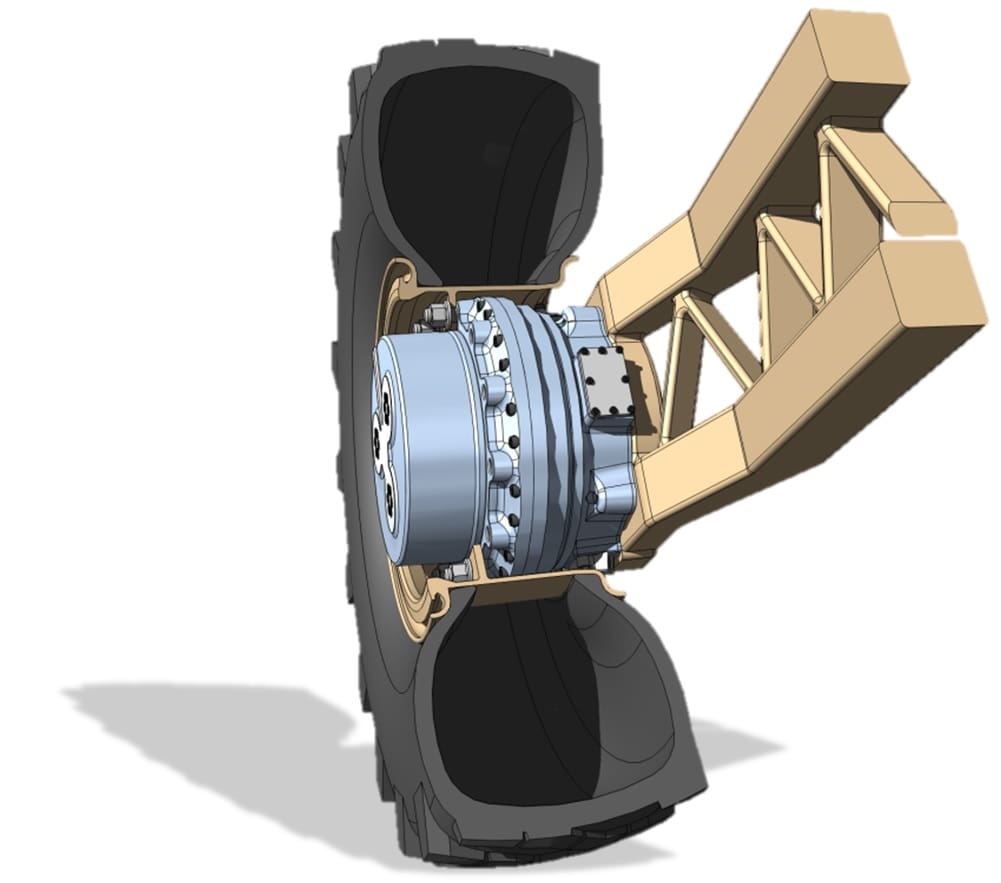
Hub_drive

7 September 2015: QinetiQ is to develop an electric hub-drive to improve survivability and mobility of future military ground vehicles for the US Defense Advanced Research Projects Agency (DARPA).

The contract, worth $1.5m with an option for a further $2.7m, is part of DARPA’s Ground X-Vehicle Technologies (GXV-T) programme. Under this programme, participants will investigate technologies that could help to significantly improve capability in the next generation of vehicles.

QinetiQ’s hub-drive seeks to improve mobility through enhanced power, torque, integral braking and high efficiency, in a unit that can be contained within a 20” wheel rim. It aims to increase survivability by removing drive shafts and gearboxes, which can become lethal to occupants in the event of an IED detonation beneath the vehicle. The absence of these components could also reduce weight and open up future design possibilities, such as fully independent suspension with significantly increased travel.

Dr David Moore, Director of Research Services at QinetiQ, said: “Like cavalry horses throughout history, vehicles risk becoming less mobile as they are loaded with more armour and weaponry to meet the evolving demands of warfare. Our hub-drive tackles that threat by combining optimum performance with a significant weight saving, which is critical for mobility. It also introduces a far greater degree of architectural flexibility, enabling vehicles to be configured in ways which offer greater protection to their occupants.

“For us, this contract offers an opportunity to show how our expertise, built through 17 years of developing electro-mechanical transmissions for tracked and wheeled vehicles, can help customers de-risk the future.”

www.qinetiq-blogs.com

My Thoughts On The XM17 Modular Handgun System RFP

Thursday, September 3rd, 2015

Before I even dive into this I’ve got to say that I’d really like to see the US military adopt a new pistol. However, having watched the process to replace the M9 stutter step for almost a decade, I’m a bit skeptical. First it was USSOCOM, then the Air Force took a shot at the issue, and now the Army is trying to find a new sidearm. I’ve read through the Request For Proposals but I’m not going to pick it apart. There are quite a few great concepts in there and I love the fact that they are doing full size as well as compact models out of the gate in addition to suppressors. There’s even consideration for UTM rounds and some creative thinking regarding the use of ‘Special Purpose’ aka hollow point ammunition. All awesome. But for me, the most troubling issue is this open caliber business. In my mind, it calls the entire enterprise into question.

The Army is so thorough in describing the attributes for this new pistol that this open caliber provision makes me wonder if they really want a new pistol at all. Lately, we’ve seen some solicitations, such as Individual Carbine, that have resulted in a big expenditure in dollars by industry with no adoption of new capability by the military. Interestingly, in the case of IC, the Army also included a provision for industry to introduce new ammunition (caliber as well as load) into the mix, and we know how that ended up.

Ammunition Placeholders
At the heart of issue are the XM1152 and XM1153 cartridges discussed in the RFP. They are placeholders for industry to propose ammunition. No matter that the industrial base that produces our military’s ammo is set up for 9mm Ball ammo or that we belong to a club called NATO that considers 9mm Ball its standard sidearm round.

The current 9mm Ammunition stockpile will most assuredly be an issue as the bean counters consider the transition to a new round. Take for example the USMC’s Shoulder-Launched Multipurpose Assault Weapon II program. Since they already had so many rounds of ammunition on hand, they were unable to consider a new weapon such as the M84 Carl Gustav, in use with the US Army and USSOCOM. Ironically, the SMAW II is incapable of firing from an enclosure so the Marines are at work to develop a such a round. To add insult to injury, the ‘Goose” has ammunition that can be fired from inside a building but they couldn’t consider it because they had too many SMAW rounds.

Do They Even Know What They Want?
We can’t even have a discussion about the technical merits of the Army’s decision for a new caliber, because they haven’t made one. Instead, they’ve made it a variable in the search for a new handgun. When the Army changed to the M855A1 round for the M16, it cost around $100 Million to retool the ammo plant and they weren’t changing calibers, so even a swap to a new 9mm round is cost prohibitive. Plus, I doubt we’ll get NATO on board with a switch to a new handgun caliber.

I can’t even imagine what’s going through industry’s minds. It’s a bit of a mystery what the Army actually wants considering the mixed messages they are sending. Publicly, there’s been this running theme that 9mm isn’t powerful enough, in spite of the FBI’s move back to the caliber after several years with .40. And then there’s this requirement in the RFP specifying a barrel for the M1041 9mm UTM round, but they never reference caliber for the Ball and Special Purpose ammo in the requirement. Are they telling industry to stick with 9mm? Or do they want something new, but the pistol to be agile enough to accept a special barrel and magazine (not in the solicitation) only for the marker rounds?

Big Guns Need Big Hands
There’s an ergonomics question as well. The associated real estate needed for double stack pistols in larger caliber pistols is also an issue as the military opens combat jobs to women, who tend to have smaller hands.
2-Mark-23-w-suppressor-and-LAM-AUG-19-2014

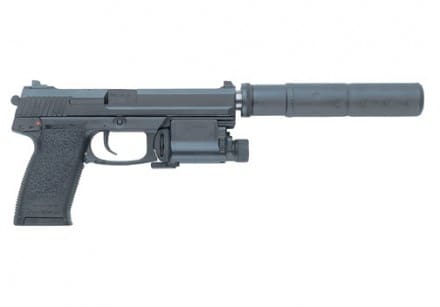
Let’s not forget how USSOCOM’s Offensive Handgun Weapon System (OHWS) turned out. The .45 H&K MK 23 ended up being a great gun, but one that nobody wanted to carry.

First The Caliber, Then The Gun
This should have been a two step process. What should have happened is that DoD should have asked industry to determine the best ammunition based on its requirements and then asked industry to develop handguns optimized for that round(s). Now, the Army will have to figure out whether the handgun is what is great about a proposal, or the ammunition. These variables make the task of choosing a pistol infinitely more difficult. NATO standardization and current military ammunition industrial base aside, what if the Army selects a handgun/ammo combination that is just dynamite but then realizes it cannot afford to actually manufacture the ammo? Don’t think that could happen? Let me tell you a little story.

Those Who Fail To Learn From History…
After playing around with it for a few years, the US Army adopted the M16 in 1965. In doing so, they made a few upgrades to the rifle but they also, as a cost saving measure, decided to unilaterally change the powder used in the M16 from the original IMR 4475 powder, to the less difficult to produce Olin powder. While cheaper for the tax payer, this option ignited poorly, leaving the weapon dirty and requiring additional field maintenance. Combine this issue with weapons arriving in Viet Nam’s tropical environment with insufficient cleaning equipment and Soldiers found themselves with jammed weapons in the middle of firefights. This frightful situation resulted in dead American service members and a general sense among Soldiers that the M16 was unreliable.

In Summary
I believe that, based on this insistence on open caliber selection, the Army will be unable to adequately determine which, if any, of the candidate handguns best fit their requirements. Or, they will choose a solution and then fix it until it breaks, as in the case of the original M16. In either event, how unfortunate for the American service member.

Polaris Defense MRZRs Now Delivering Under New $83 Million IDIQ Contract

Tuesday, August 25th, 2015

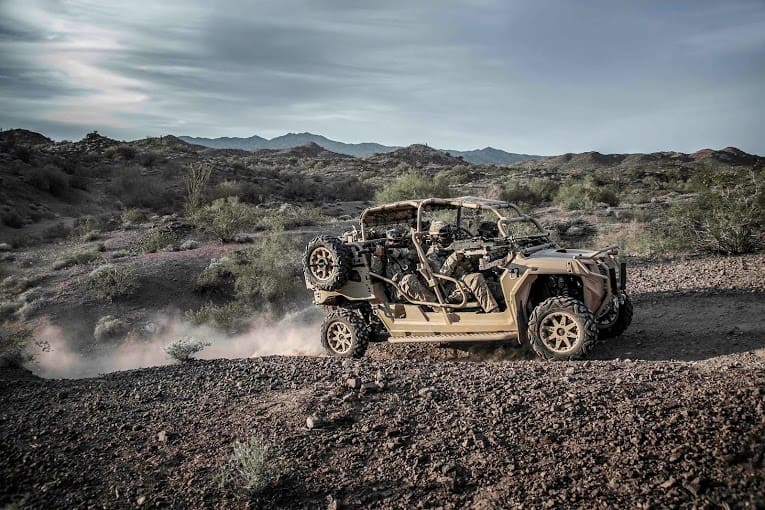
MRZR

MINNEAPOLIS (August 24, 2015) — USSOCOM has awarded Polaris Defense a new, sole source, firm-fixed-price contract for the MRZR off-road vehicle platform and vehicle delivery started earlier this month. The $83 million, five year, indefinite delivery, indefinite quantity (IDIQ) contract, signed in July, continues delivery order options on MRZR 2 and MRZR 4 vehicles – along with contractor logistics support (CLS) for spares, training and support as part of the light tactical all-terrain vehicle (LTATV) program. Since 2013, Polaris Defense has been delivering MRZR vehicles to USSOCOM under a blanket purchase agreement (BPA) against a GSA contract.

“We’ve been providing the MRZR for three years to USSOCOM and this contract reiterates that ultralight mobility is still a critical component of Special Operations Forces missions,” said Rich Haddad, Polaris Defense General Manager. “These are extremely configurable platforms, providing operators the ability to quickly prepare for missions even in the most extreme terrain. MRZRs provide extreme mobility SOF can count on, that deploys in tactical air, providing maximum flexibility.”


The MRZR is a highly mobile off-road platform that is CV-22 internally transportable and can be configured a number of ways to help expeditionary forces meet mission requirements for emerging threats, while forward deployed. Some common tactical features of these off-road platforms include increased payload, standard winch, electronic power steering, aircraft tie-downs, fold down rollover protective structures (ROPS), large cargo boxes, IR light capability and blackout mode.

“Our customers appreciate that we use robust commercial off-the-shelf components for intuitive operation and easier maintenance worldwide,” said Haddad. “Our MRZRs are in service in more than 20 countries, providing a high degree of interoperability and commonality among U.S. and allied forces.”

Polaris Defense brings game-changing resources to the military in the area of ultra-light off-road mobility as part of a larger, commercial company. Polaris provides a wealth of engineering, production and sustainability resources that come with being a recognized leader in the off-road vehicle industry. Polaris maintains a robust global network of dealers, distributors, and subsidiaries, providing dedicated full life-cycle support for these vehicles throughout the world. And with a proven and well-established Defense team, the company works closely with military customers to gain a thorough understanding of their off-road mobility needs, as well as their support requirements when they operate globally.

www.polaris.com/en-us/military