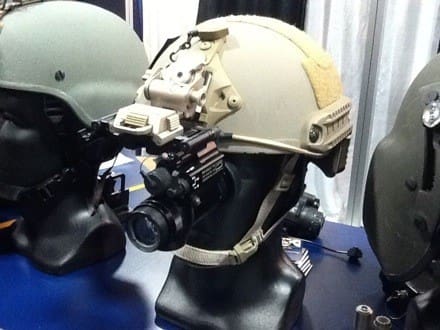
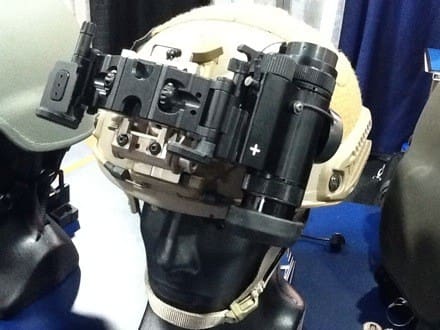
Wilcox Industries has developed a mount for the Mini-N/SEAS night vision monocular manufactured by ITL Optronics to combine two of them into a binocular. While this sample is Black they are also available in Tan.
Here you can see how low the NODs can be stored. It is connected to a Wilcox G24 mount.
The other day we told you about a new helmet under development for the US Army by Revision Military. Now, we know the internal development has been under the name Batlskinâ„¢ at Revision’s Composite Center of Excellence . Here are a couple of concept drawings to give you an idea of what they are up to.
Norotos Director of Manufacturing Rob Prendergast gave us a great rundown on three products during last week’s Warrior Expo West.
The Universal Shroud fits helmets with one or three holes and can be fitted with a strap for helmets that are not drilled. It also features a low profile as well as a breakaway tether plug.
Adaptable to the PVS 7,14,15,18,21, the Improved Night Vision Goggle Mount is backward compatible to any standard mount out there. Of all three of these products it is the most versatile and most applicable due to its compatibility with a variety of systems and unparallelled adaptability.
Finally, the Dual Dovetail Adapter allows you to rapidly transition the sight from right to left eye or vice versa. It also turns the PVS14 off when in the up position and turns it back on when lowered.
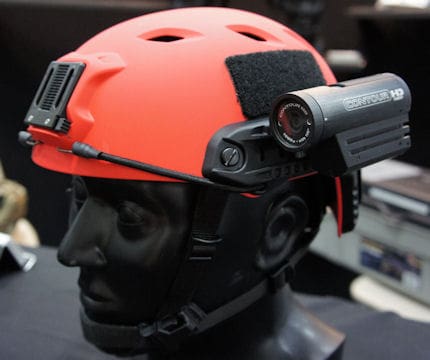
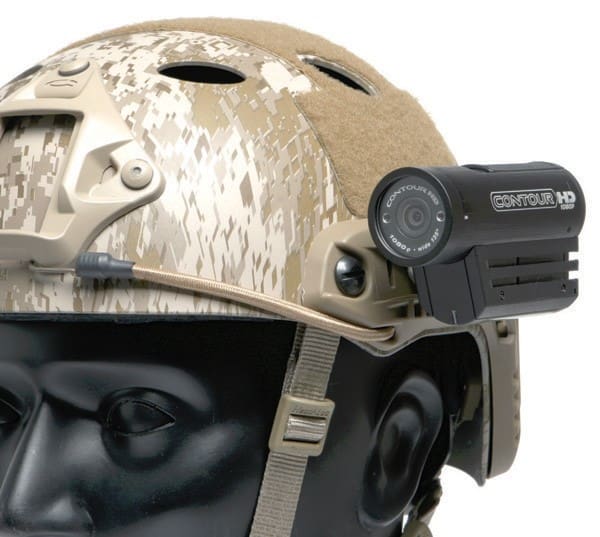
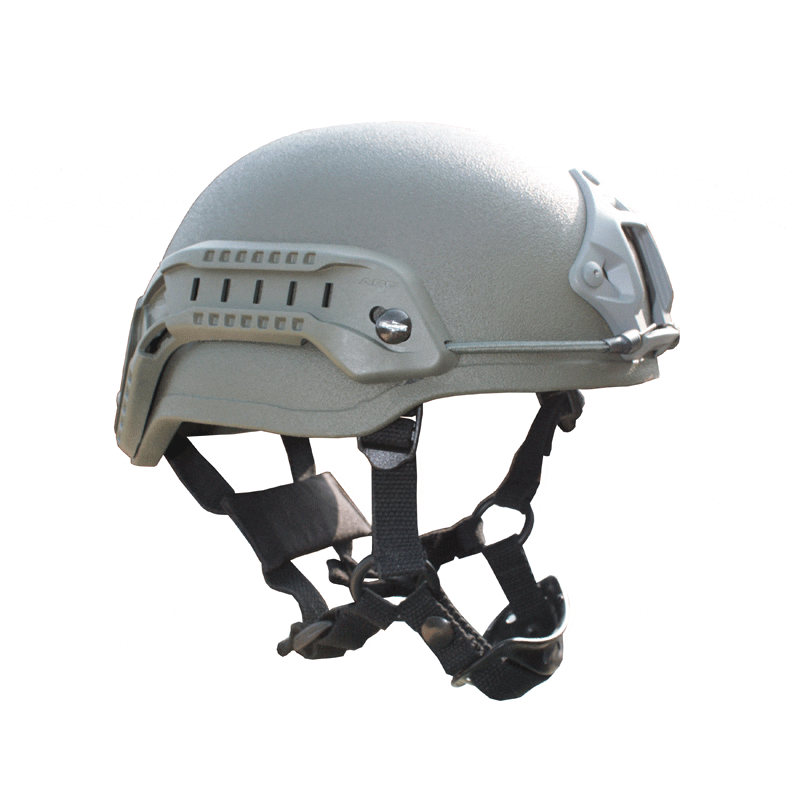
Up to now all I have seen are artist renderings of the Base Jump helmet in red. The colors weren’t coming out quite right, but Ops-Core had one fresh out of the mould on display today at the Warrior Expo West. Additionally, they attached the new Contour HD camera mount I recently wrote about. With its ARC rails and NVG mount, the Base Jump is unlike anything that has ever been available.
As you can see, it is a very vibrant red and will be perfect for locating bobbing heads in the water during water jumps or other MAROPS training as well as for high adventure and extreme sports use. You can configure the Base Jump helmet with a variety of lights, cameras and other accessories using the VAS shroud and ARC rails to suit your activity and it is a great lower cost alternative to the more expensive carbon fiber FAST Bump Helmet for many applications.
For more info visit www.ops-core.com. It is featured in their catalog which can be downloaded here.
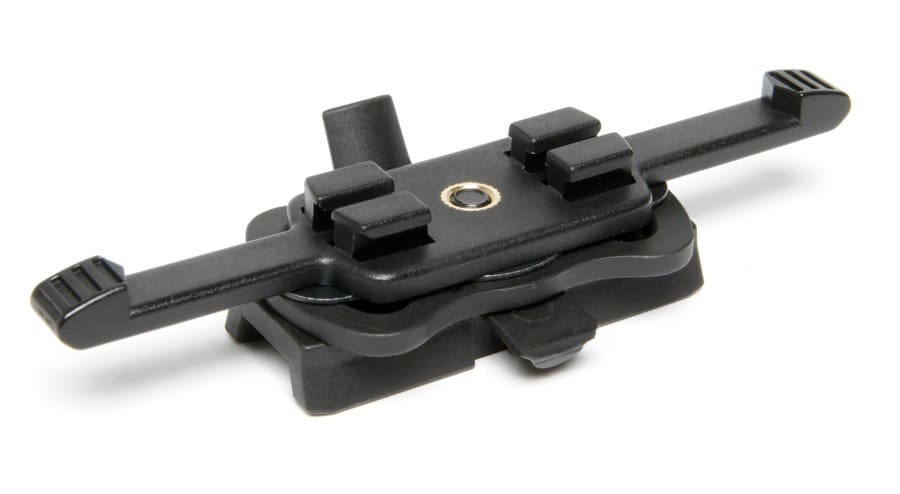
Ops-Core is introducing a new mount for the Contour HD camera at Warrior Expo West. Designed to adapt the popular helmet camera to an Ops-Core ARC rail, it affixes to the camera so it can easily be attached to and detached from the helmet. The design also facilitates where it fits on the rail in order to accommodate other items.
Ops-Core will also be exhibiting their full range of helmet solutions including the new Sentry which debuted at SHOT Show as well as the very popular BaseJump helmet.
UK Intelligent Armour has introduced new variants of their MACH 1, 2 & 3 series helmets that integrates Ops-Core rails and VAS shrouds. MACH stands for Military Advanced Combat Helmet and all three helmets offer NIJ IIIA protection. The MACH 1 is similar in shape to a US ACH while the MACH 2 takes a mid-cut approach similar to the TC-2002. Finally, the MACH 3 features a high cut like the TC 2001 to accommodate large comms/ear defender systems. The addition of the Ops-Core components adds a great deal of versatility to these designs although we are unsure why they didn’t go all the way and also include the excellent Ops-Core chin strap as well as an optional Occi-dial liner.
Additionally, Intelligent Armour Limited will be at the Counter Terror Expo in London this week in stand M50 in the National Hall at London Olympia. They will have reps from Blackhawk, 5.11 Tactical and Karrimor SF. Additionally, CEO Alex Bomberg will be giving a 20 Min lecture on Special Forces body armor during one of the workshops.
Start up Impakt Protective Inc will be featured on the CBC – “The National” at 10pm after the national news in a program called – “Hits and Head Injuries.”
Impakt Protective has been developing a new kind of sensor to detect concussions in hockey, football, ski and Lacrosse helmets. Very important implications considering the amount of Traumatic Brain Injuries our troops are experiencing.