XC3 Weaponlight

Archive for the ‘Load Carrying’ Category

Recon Chest Rigs from 215 Gear

Friday, April 30th, 2010

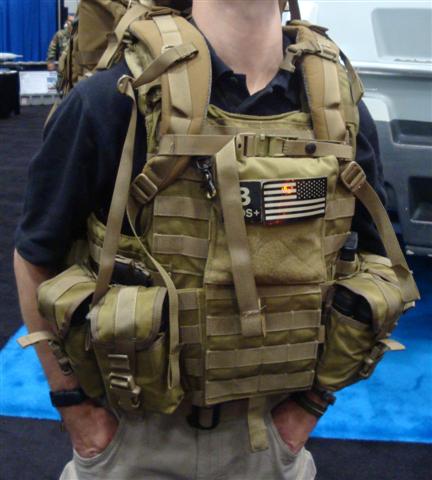
215 Gear has spent the week updating their site so if you haven’t been there in a while this is a great time to check it out and order one of their new Recon Chest Rigs. However, in case you aren’t yet familiar with 215 Gear, all of their products are designed with the Operator in mind and concentrate on being both lightweight and functional. The Recon series are built on a common platform with a unique adjustment system based on the tried and true H-harness that allows the Operator to self-adjust the rig snug-tight. Available in two flavors, one is a PALS variant that offers the most versatility and the other features two fixed GP pockets and two pistol mag pouches with protective flap and elastic retention as well as PALS webbing on the sides for additional items.



215 Gear RECON Chest Rig - MOLLE215 Gear RECON Chest Rig - Pockets

Regardless of style, the Recon Chest Rig integrates three internal pouches for a single 5.56 magazine held securely in place with an adjustable bungee system. Additionally, both designs come with a 215 Gear Tourniquet Holder mounted below the magazines. They also feature elastic loops for the stowing of communications cables and hydration tube routing and are Made in the USA from 500D Cordura and ITW Ghillie-tex buckles.

Available in Coyote and MultiCam now from 215 Gear and fine retail outlets.

Stuff Football

Tuesday, April 27th, 2010

Ever resorted to field expedients in order to play a game of ball? On a deployment, I once suffered a separated rib during a game of American ball played with a lightweight Gore-tex jacket stuffed into it’s pocket. Ah, the memories. As one of my friends recently pointed out, these days with all of the MWR in country you don’t have to use broken up pallets and a ball of duct tape to play softball but something as simple as the Stuff Football from Granite Gear Tactical is a great addition to the pack. It’s football shape features a low profile zipper where the laces usually are, allowing it to pull double duty as a stuff sack. At 1.3 ounces it’s light enough to keep in the pack and while it isn’t a full-size ball, it is pliant, allowing a firm grip and is perfect for impromptu games at an Intermediate Staging Base or just out in the quad on the weekend.

Stuff Football from Granite Gear Tactical

I first saw this at the SpecOps Warfighter Expo East 2010 in Fayetteville, North Carolina earlier this month and was able to purchase one at Extreme Outfitters in Jacksonville a week later. The Stuff Football is Made in the USA from 500D Cordura and available in Coyote as well as UCP. Hands down, users prefer the UCP as it sticks out during play or when being retrieved after a fumble. It is also available in assorted non-tactical colors (yes they do actually exist) but specify the color you need (Coyote or UCP) in the comments at check out.

To order click here.

ECLiPSE Giveaway Pouch Arrived

Wednesday, April 14th, 2010

ECLiPSE Giveaway PouchWe just received our free pouch from the BAE ECLiPSE giveaway. By now most everyone who signed up has received theirs. Our choice was the Single .45 Pouch. It is a snug fit with a front velcro closure as well as a more secure tab to make sure it remains closed when you need it to. BAE seems to be rocking and rolling, having picked up numerous contracts for ECLiPSE gear including pouches for the DAGR GPS unit, 7.62 SCAR Magazine, FM-53 pro mask with VPU, and PRC-152 radio. They are also adding MultiCam to their color options.

For all of our readers we would like to say Thank You to BAE!

www.eclipsegear.com

LBT Releases MultiCam Specialty Catalog

Wednesday, April 14th, 2010

London Bridge Trading Company has released a mini catalog detailing their MultiCam offerings.

London Bridge Trading Company MultiCam Catalog

Tactical Tailor Releases New 2010 Catalog

Saturday, April 3rd, 2010

To order the Tactical Tailor Catalog, Click Here

Tactical Tailor has been dropping not-so-subtle hints about their new Elite Operator series packs and they are finally here in their new catalog issued today. Also be sure to take a look at the Law Enforcement line which joins their full line of tactical products including armor systems. It’s a great catalog that becomes more of a resource than an ad. Not only does it feature a full NSN list of their products cross referenced to catalog page but TT has also included a guide for use of their patented MALICE Clip.

2010 Military & Law Enforcement Equipment Catalog

US PALM AK30 Magazine Now Available

Tuesday, March 16th, 2010

US PALM AK30 MagazineScottsdale Gun Club has just added the AK30 magazine from US PALM to their website. The name is pretty self-explanatory. It is a 30 round polymer magazine for the 7.62 x 39 AK family of weapons. The five sided box design eliminates a removable floor plate found on other magazines. The AK30 has a unique low-friction semi-floating follower that is slotted to allow for easy magazine cleaning and hassle-free maintenance. It can be cleaned with simple soap and water and dry material flows free through the vented follower design. The chromium-silicon spring that is heat treated, stress relieved and Mil-Spec corrosion resistant coated so cleanings or exposure to the elements won’t result in rust. Life expectancy for this spring is 100,000+ cycles. The AK30’s locking surfaces are reinforced by a stainless steel cage that has been molded into the entire top of the magazine. Additionally, the front and rear of the magazine integrate a serrated surface and the flat sides are molded in a waffle pattern. Another interesting feature is the angle on the toe of the AK30 making it possible to use a vertical fore grip. Available in Black and Flat Dark Earth from sgcusa.com.

AK Attack Rack

If you need a way to carry your new mags in style you might want to check out the AK Attack Rack (AKAR). It holds 4 AK30 magazines (or similar) as well as 4 pistol magazine which will also accommodate most high-cap pistol magazines, a folding knife, mini-gas canister, or similar sized items. Additional mags can be stored in the hidden universal pocket. Berry compliant and manufactured from Cordura and ITW buckles the AKAR is offered in Black, Coyote, Khaki, and MultiCam.

iSnuff Pouch

Monday, March 15th, 2010

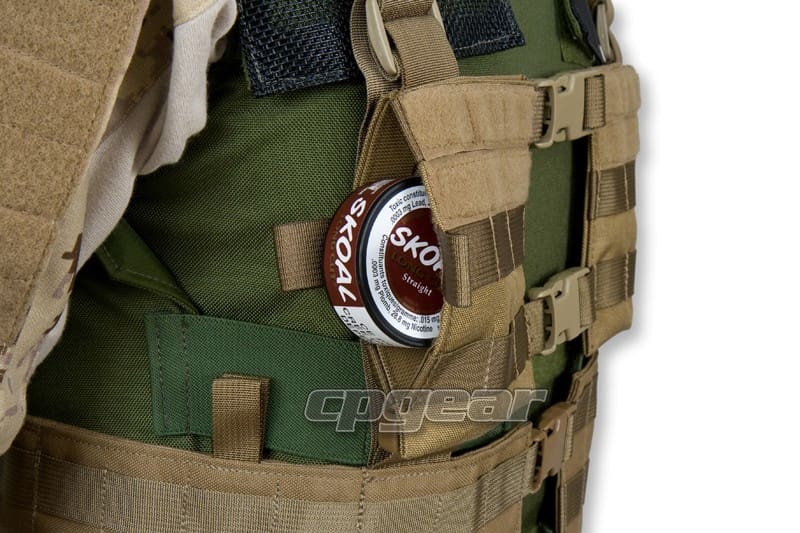
Snuff PouchWhen Granite Tactical asked troops what load carrying products they really need, a resounding answer was a means to carry a handy can of snuff. Working with this in mind, Granite Tactical came up with this solution. Manufactured from lightweight 500D Cordura, it features a secure half zip opening. While still only a prototype it will be available soon from Granite Tactical.

Internal Frame Load Bearing Armor Study

Wednesday, March 10th, 2010

Current “lighten the load” efforts focus on shaving ounces from the tactical load. The thinking follows that if you can decrease the actual load carried, you can decrease the rate at which you get tired. Inversely, this should result in increased performance. However, based on the current state of the art and desired protection levels, this approach may take some time to produce a significant difference. On the other hand, a recent load carrying study undertaken by North Carolina State University seems to validate an entirely different approach. The basic claim is that use of Archangel Armor’s Internal Frame Load Bearing Armor (IFLBA) removes the load from the neck, back and shoulders of the wearer, and redirects it to stronger load carriage muscles groups. The major effect indicated is a reduce rate of fatigue.

Redistributing the weight from the back neck and shoulders, prevents translating the weight through the neck back and spine in order to be carried by the strong load carrying muscles of the hips and legs. Many of the effects of fatigue can be felt between the neck and the hips. This system literally bypasses this sensitive area, and there fore the negative effects they suffer.

Defense & Security Technology Accelerator NC State University

The end state of redirecting the weight is to reduce the rate of fatigue. An objective measure of this was conducted at Fort Bragg, NC last November. The pilot study was sponsored by the Partnership for Defense Innovation, and conducted by NC State University, Ergonomics Center. Additionally, the data was peer reviewed by Dr Richard Kuhns who conducted an independent Medical and physiology review.

“The Archangel IFLBA re-directs the load bearing to a stronger, more secure area of the body, which will reduce injuries to the spine and its supporting structures. It allows greater range of motion in the head/neck/shoulder are regardless of loads carried. The nominal changes in total measured weight are negligible especially in light of the idea that the Archangel IFLBA creates less fatigue which equates to greater levels of job performance and decrease injury occurrence. The Archangel IFLBA also provides ergonomic support for the spine. The added benefit of this will be evident with prolonged periods of standing, sitting, walking, running, laying prone, and laying supine.” Independent Evaluation, Jan 2010, Dr Richard Kuhns

IFLBA Weight Measurement

During a measurement conducted at the NC State University, Ergonomics Center at Chapel Hill, NC, this graphic was produced to provide an objective measure of how the weight is removed from the back, neck, and shoulders. On the left is a Improved Outer tactical Vest (with soft armor and full plates), the right is that an IOTV – IFLBA retrofit. In addition to the armor load, the Soldier also carried a rifle and pack with 30 pounds. As you can see from the graphic, the use of the IFLBA retrofit resulted in over 80% of the load being removed from the shoulders.

400 meter Litter Carry

The study at Bragg used several objective events to measure a baseline load configuration against the IFLBA system. The Modular Body Armor Vest is fielded to SOCOM units.

Independent variables:
• 2 types of equipment (Fielded MBAV – Existing, IFLBA – New)
• 2 loads (armor + 25 lbs, armor + 40 lb pack)

Three tasks: (Average over 6 hours)
• Litter Carry (simulated casualty) – 400 m
• Fireman’s Carry – 100 m
• Soldier drag – 100m

Litter Carry
400M Litter Carry
This task was conducted more than 20% faster with the IFLBA than the MBAV.

Soldier Drag and Fireman Carry
Fireman’s Carry, 100M lane
This task was conducted more than 30% faster with the IFLBA than the MBAV.
Soldier drag, 100M Lane
This task was conducted more than 40% faster with the IFLBA than the MBAV.

Borg Scale of DiscomfortAdditionally, NC State researchers collected subjective data from study participants rating levels of discomfort experienced. Data is based on the Borg Rating Scale of Discomfort which is often used in the medical field to allow a patient to communicate pain levels to a physician. On the scales shown below, the MBAV is on the left as the baseline and the IFLBA on the right. The results shown are as the mean of multiple iterations over a 6 hour period. Also please note that the IFLBA team demonstrated a lower level of discomfort after 6 hours than the MBAV team showed on the first iteration.

Whole and Upper Body Discomfort

Upper Extremity Discomfort
This data set covers the muscle groups used to operate small arms

Back Discomfort
This shows Back Discomfort was lower for those wearing the IFLBA

Lower Extremity Discomfort
This shows how the fatigue in the legs and lower extremities was decreased as well. The decreased fatigue in the lower extremities is explained by Dr Kuhns.

“When unencumbered, the body is used for upright posturing, and the lower extremities are used for locomotion. When under load, the body must compensate for balance, starting and stopping, and more muscles are recruited for these tasks. This increases the amount of work placed on them constantly. The increased demand on these muscles makes them tire faster, and prevent recuperation, i.e. “fatigue”. “When carrying loads that increase spinal load bearing you can either remain upright and compress the spine itself or bend the upper body to take the pressure off the spine and use the lumbosacral muscles and waist as a fulcrum, especially when running, jogging, carrying something with the hands, as this only further compresses the spine and creates more discomfort. The decision to adjust body posture to minimize spinal impact is a self-preservation reaction that people will instinctively due as pain or pressure builds in bony structures. The resulting fatigue is due to the fact that the lower extremities are now tasked with using mostly the leg muscles to balance and carry the weight that is not evenly balanced over the core of the spine in a non-spinal bearing fashion. If the weight is balanced over the core structure on a non-spinal load bearing and spinal supporting method, then the person does not need to bend in any unusual manners to compensate for an unnatural fulcrum created out of discomfort or fear of injury.” Independent Evaluation, Jan 2010, Dr Richard Kuhns

In summary, the information presented in the study illustrates three main points:

1. The IFLBA redistributes the weight from the back neck and shoulders to the stronger load bearing hips and legs, as measured by the NC State University Study.

2. This decreased the rate of fatigue and increases performance as measured by the NC State Study.

3. An Independent Medical and physiology review by Dr Richard Kuhns provides scientific explanations for the enhancements exhibited during the study and how this system can reduce the number and severity of the spinal compression injuries suffered by the wearers of tactical equipment.

The final report for the study as well as the review by Dr Kuhns are available to Government acquisition officials in addition to select parties contact Archangel Armor.