Phantom Lights

Archive for the ‘Medical’ Category

Gen II D.A.R.K.

Wednesday, June 6th, 2012

Dark Angel Medical, LLC’s website is back up and with it comes the Gen II D.A.R.K. (Direct Action Response Kit) featuring a new pouch manufactured by FirstSpear. The pouch was changed slightly from the original model. Now, the pouch is a single color with no red in order to be a “non-identifier” and a non-snag design based on feedback from deployed end-users. Not only is it a new design but it’s also a lower price than the original.

The Gen II D.A.R.K still features the same vacuum packed insert as the original.

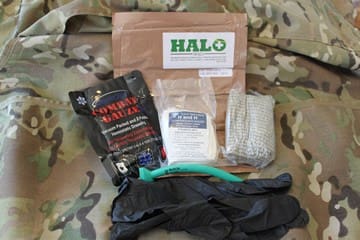
Kit includes:
– 1x 1 pair Nitrile Gloves, size L
– 1x 1pair HALO Seals
– 1x NPA, 28 Fr
– 1x Israeli Emergency Bandage
– 1x QuikClot Combat Gauze LE
– 1x H&H PriMed Compressed Gauze
– 1x CAT-T Tourniquet

Dark Angel makes a good point, “Magazines go in magazine pouches and med kits go in med kit pouches! Confusing the two during a life-threatening situation would be less than ideal.” Simply under stress is their mantra.

Multicam, Coyote Brown, Ranger Green and Black. Each pouch also comes with a 1″ PVC Medic Square Patch with a subdued cross/medical pouch identifier.

www.darkangelmedical.com

Legion D27 Tourniquet Pouch

Tuesday, June 5th, 2012

20120605-151957.jpg

Legion Firearms has just released their new D-27 Tourniquet Pouch. Pulling double duty as an admin pouch the D27 was designed by Army SFC Jason Crosby (callsign D-27) based on his experience in OIF and OEF. Notice the center pull design. The horizontal design and high chest mount is meant so that both hands can access the tourniquet without reaching to an awkward position. Additionally, the design accommodates the C-A-T and SOF-TT

It’s manufactured by FirstSpear and will also be available through Dark Angel Medical and War Sport. Offered in MultiCam, Coyote, and Ranger Green.

www.legionfirearms.com

SOFIC – Tribalco – SOCOM TCCC CASEVAC Program

Wednesday, May 23rd, 2012

The Tribalco Integrated Casualty Solutions kit will begin fielding next month as the SOCOM TCCC CASEVAC Program solution. Consisting of 4 modules; Extraction, Mobility, Transportation and Sustainment, this is the most comprehensive field medical ensemble ever fielded.

20120523-122743.jpg

Developed over the last year-and-a-half, it underwent comprehensive operational testing with medical operators from USSOCOM. It meets Tactical Combat Casualty Care guidelines and provides new capabilities to all SOCOM components.

20120523-123038.jpg

This system literally covers everything from point of injury to comprehensive, definitive care. The amount of technology included is unprecedented. We’ve sure come along way from an M-5 bag and a Surgeon’s chest!

20120523-123913.jpg

Tribalco serves as lead integrator for over 500 items from over 60 vendors. Look for a full series of articles in the coming weeks showcasing the technology and training that make up this ground breaking program.

www.tribalco.com

North American Rescue Sale Page

Monday, May 21st, 2012

Keep apprised of deals at North American Rescue on their new sales page.

www.narescue.com/sales

London Bridge Trading Co – T.E.R.R.A. Kit ADS Tactical

Monday, May 21st, 2012

The T.E.R.R.A (Trauma Emergency Rapid Replenishment Alert) Kit is a medical storage hanging bag which can be used to keep medical supplies close at hand or for rapid re-supply. Each internal pouch and compartment is removable making them handy for replenishment.

The T.E.R.R.A. Kit integrates both shoulder straps as well as top and bottom carry handles. Additionally, the hanging spine along the top of the kit features four mounting holes.

The LBT T.E.R.R.A Kit is available from ADS Inc for unit and agency purchases.

Ricci Ankle Medical System

Monday, May 14th, 2012

Strike Industries has introduced the Ricci Ankle Medical System. Designed by a SWAT officer, it is an ankle mounted medical pouch intended to ensure that every LE officer can have life saving medical gear on him at all times.

The pouch has three pockets, one of which is secured with a Velcro cover. The smaller pockets can carry the major tourniquets on the market with the main pocket able to carry hemostatic agents, gauze or chest seals.

strikeindustries.com

Warrior West – The Eliminator

Wednesday, May 2nd, 2012

The makers of the popular Decon Zone ozone sanitation system have come up with an innovative new product released today at Warrior West. The Eliminator is designed specifically to dry as well as sanitize hand wear, footwear, and other similar PPE with a combination of warm air and ozone pumped through the 40 mounting tubes.

20120502-122411.jpg

There are also elbow adaptors to get into the toe box of footwear. Additionally, each row of tubes can be turned on or off. Finally, The Eliminator is portable but must be used out of doors due to the generation of bacteria killing ozone.

www.deconzone.com

Intelligent Clothing for Rapid Response to Aid Wounded Soldiers

Tuesday, May 1st, 2012

Under this year’s Small Business Innovative Research topics from the Defense Threat Reduction Agency, there’s a rather interesting topic. According to the call for ideas, the object of Topic DTRA122-010, Intelligent Clothing for Rapid Response to Aid Wounded Soldiers is to “Develop uniforms with integrated sensors built into the fabric allowing for measurement of overall health, detection of bullet location, detection of exposure to CBRNE (Chemical Biological Radiological Nuclear and Explosive) agents, and communication capabilities to provide location via GPS coordinates as well as critical health assessment information to medical personnel regarding the wounded soldier.”

The point of the SBIR is to get the Soldier’s clothing to constantly assess the health of the Soldier and alert him (and headquarters) of any maladies, including exposure to CBRNE threats.

“With Intelligent Clothing, the location of a bullet can be determined with appropriately-embedded sensors within the clothing’s fibers that can estimate the depth of penetration and the effected surrounding organs. Additionally, if the person was in an environment where a CBRNE weapon had been stored, manufactured, or used, the Intelligent Clothing could identify the agents via specific biomarkers detected within the blood, saliva, sweat, urine, or could distinguish damage at the cellular, tissue, and/or organ levels post exposure. For example, individuals exposed to a commonly used explosives compound, 2,4,6-Trinitrotoluene (TNT), have been shown to have hemoglobin adducts within their blood and form the urine metabolites of TNT, 4-amino-2,6-dinitrotoluene (4ADNT) and 2-amino-4,6-dinitrotoluene (2ADNT), all of which can be utilized as biomarkers for TNT. In addition, radiation biomarkers include alterations in serum enzyme levels post exposure to ionizing radiation, such as modifications in serum amylase and diamine oxidase concentration levels, which are presently being considered as potential biodosimeters within the medical community. These biomarkers could then be linked to the appropriate array of sensors within the Intelligent Clothing material to detect CBRNE targets, and this information could then be transmitted immediately to emergency responders via communications devices weaved directly into the fabric. This aids in triage and preparation of first responders to be able to handle emergency situations in a critically timely and efficient manner. The collected remotely data would provide commanders venue battlefield awareness as to type of weapons, numbers of casualties and location of engagements.

DTRA requires an assessment of the suitability of various biosensors, communications options and means of integrating these with the appropriate clothing materials and also considering relevant characteristics of the Intelligent Clothing (i.e. – size, thickness, weight, robustness, power requirements, lifetime, as well as sensor sensitivity and selectivity) and the added burdens for the individual troop to manage.”

The investigation will consist of three phases –
“PHASE I: Identify appropriate types of the fabrics, sensors, and related components that are currently available and may be useful for intelligent clothing systems. This phase would also include the selection of biomarkers specific to each agent along with corresponding sensor, and a proof of concept demonstrating operability of components within the military uniform.

PHASE II: Design of selected sensor interfaces and conduct a demonstration of a uniform containing a sensor and communications network.

PHASE III DUAL USE APPLICATIONS: Other applications currently being researched include heart/muscle monitoring for athletes, vitals measurements for babies, and blood sugar levels for Type I and Type II diabetics. Dual Use may be possible for occupations involving hazardous work conditions, mobile diagnostic of life style (as in mobile heart monitors). Furthermore, identification of potential commercial partners and/or commercialization markets in which Intelligent Clothing technology could be transitioned to as an end-user or for further optimization/development. ”

If you’ve been cooking up something that might meet DoD’s needs visit www.acq.osd.mil to get the lowdown on how to submit your white paper.