Tropo Performance

Archive for the ‘Press Release’ Category

GA-ASI Completes First Flight of MQ-9B With AEW Pods

Thursday, May 21st, 2026

New Development Effort Will Enable Airborne Early Warning Capability for MQ-9B

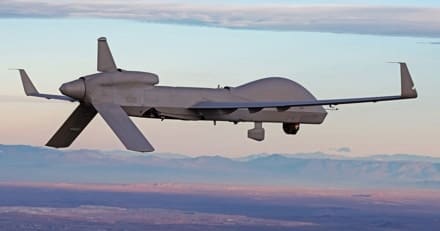
SAN DIEGO – 21 May 2026 – General Atomics Aeronautical Systems, Inc. (GA-ASI) flew its MQ-9B Remotely Piloted Aircraft for the first time with Airborne Early Warning (AEW) pods. The much-anticipated AEW capability is being provided through a partnership with Saab. Once the AEW sensor, named LoyalEye, is made available to MQ-9B operators and new customers, it will deliver persistent and cost-effective air surveillance capabilities in regions where it is currently unavailable. 

GA-ASI conducted a validation flight of MQ-9B using AEW radar pods on May 19 from GA-ASI’s Desert Horizon flight operations facility in Southern California using a company-owned aircraft. The flight signaled the first step in a development process that is expected to take several months and culminate with a full-capability demonstration later this year.

GA-ASI and Saab announced their partnership last year with the intention of bringing AEW capability to the MQ-9B platform.

MQ-9B models include the SkyGuardian®and SeaGuardian®, the United Kingdom’s MQ-9B variant known as Protector, and the new MQ-9B STOL (Short Takeoff and Landing) configuration currently in development for naval aircraft carriers.

“AEW for MQ-9B will offer critical aloft sensing to defend against tactical air munitions, guided missiles, drones, fighter and bomber aircraft, and other threats. Operational availability for a medium-altitude, long-endurance UAS is the highest of any military aircraft, and as an unmanned platform, its aircrews are not put into harm’s way,” said GA-ASI President David R. Alexander.

“This partnership integrates MQ-9B with LoyalEye, equipping operators with vital information for critical decision-making. LoyalEye extends the capabilities of manned systems, and it offers persistent surveillance and greater operational flexibility. This enhances situational awareness and boosts mission success,” said Carl-Johan Bergholm, Senior Vice President and Head of Business Area Surveillance at Saab.

GA-ASI and Saab’s AEW offering will span a wide range of applications, including early detection and warning, long-range detection and tracking, and simultaneous target tracking and flexible system integration, all over line-of-sight and SATCOM connectivity.

Red Cat Closes Acquisition of Quaze Technologies

Thursday, May 21st, 2026

ACQUISITION ADDS WIRELESS POWER CAPABILITY TO RED CAT’S ALL-DOMAIN SYSTEMS, REMOVING A CRITICAL BOTTLENECK TO PERSISTENT AUTONOMOUS OPERATIONS ACROSS AIR, LAND AND MARITIME ENVIRONMENTS

SALT LAKE CITY, May 20, 2026 — Red Cat Holdings, Inc.(Nasdaq: RCAT) (“Red Cat” or the “Company”), a U.S.-based provider of advanced all-domain drone and robotic solutions for defense and national security, today announced it has acquired Quaze Technologies Inc. (“Quaze”), a Québec-based developer of wireless power transfer technology for unmanned systems, drones and autonomous machines.

Quaze will operate as an independent Red Cat business unit, continuing to develop and scale its wireless power architecture for integration across Red Cat’s Family of Systems, while maintaining its platform-agnostic model supporting third-party OEMs across air, ground and maritime domains.

The acquisition addresses one of the most significant remaining barriers to true robotic autonomy: power. While unmanned systems have rapidly advanced in autonomy, navigation and mission execution, most still rely on manual battery swaps or precise, connector-based charging systems that are difficult to deploy reliably in contested or harsh environments. Quaze’s technology enables systems to recharge autonomously, extending mission duration while reducing operator burden and exposure.

At the core of Quaze’s platform is its QU6 electronic architecture, which enables large surfaces to function as wireless energy access points and can be embedded across a wide range of platforms and environments. Unlike traditional charging approaches, the system does not require precise alignment, physical connectors or direct contact between transmitter and receiver, allowing systems to access power even in the presence of debris, sand, ice or snow. By eliminating moving mechanical parts, the architecture reduces failure points and enables reliable operation in real-world field conditions where conventional solutions often break down.

“Autonomous systems are only as effective as their ability to stay in the fight,” said Jeff Thompson, CEO of Red Cat. “Quaze gives us a critical advantage by removing one of the biggest operational constraints, which is how systems recharge in the field. This enables longer-duration missions, supports distributed operations across air, land and sea, and strengthens our ability to deliver fully integrated, all-domain solutions for the warfighter.”

Quaze’s technology can be deployed across a wide range of environments and platforms, including vehicle-mounted systems, drone-in-a-box solutions, uncrewed surface vessels, fixed infrastructure and underwater charging stations. This enables new operational concepts such as vehicle-based “mothership” deployments, distributed charging networks and persistent operations across complex terrain, borders, infrastructure corridors and maritime environments.

Red Cat expects Quaze to play an important role in expanding its all-domain capabilities, particularly as the Company advances further into maritime systems and multi-platform autonomy. The ability to integrate wireless charging into uncrewed surface vessels and other mobile platforms creates new opportunities for persistent drone operations, including swarming, extended ISR missions and autonomous deployment cycles.

The acquisition also expands Red Cat’s addressable market by introducing a new revenue channel beyond its own platforms. Quaze’s technology is designed for seamless integration into third-party systems as an embedded power capability, enabling adoption across a broad range of robotics platforms. This platform-agnostic approach positions Quaze as a potential standard for wireless power across the unmanned systems ecosystem, allowing Red Cat to generate revenue from systems it does not manufacture while accelerating adoption of autonomous technologies.

“Robotics has made major advances in autonomy and intelligence, but energy has remained a limiting factor,” said Xavier Bidaut, Co-founder of Quaze Technologies. “Our goal is to make power as accessible and reliable as fuel is for traditional vehicles and something every drone or robot can tap into, anywhere, without friction. By joining Red Cat, we can accelerate that vision and help establish a common power infrastructure for autonomous systems across industries.”

Quaze’s technology has been demonstrated across multiple robotic platforms, including aerial drones, ground systems and autonomous underwater vehicles, and is currently being evaluated for a wide range of dual use applications. The Company’s focus on simplicity, ease of integration and operational resilience has enabled rapid adoption across early partners and positions it to scale alongside the newest innovations in autonomous systems.

PROOF Research Introduces PXT: A New Era of Rifle Barrel Technology

Thursday, May 21st, 2026

COLUMBIA FALLS, Mont. – May 20, 2026 – PROOF Research is proud to announce the launch of PROOF Exponential Twist (PXT), a groundbreaking advancement in rifling that improves durability, accuracy and shootability. As originators of this barrel technology, PROOF Research developed PXT to push beyond the limitations of conventional barrels, backed by extensive military testing and research. Engineered to meet the demands of modern high-pressure ammunition, PXT represents a significant advancement in barrel technology by delivering longer barrel life, improved consistency and enhanced performance.  

As the leader in advanced carbon fiber barrel technology, PROOF Research continues to push the boundaries of firearms engineering through innovation rooted in real-world performance. PXT was developed to solve limitations inherent in conventional rifling design and to create a platform built for the next generation of ammunition and shooting performance. Unlike conventional constant-twist rifling, PXT uses a progressively changing twist profile designed to reduce initial bullet stress while maintaining  rotational stability.

“PXT is a complete redesign of how the bullet engages the rifling during initial rotation. As the industry advances and ammunition continues to evolve toward higher pressures and performance, we set out to address the technological gap between current barrel systems and where ammunition is headed,” said Brandon Hulzebosch, director of sales and marketing. “PXT gives shooters smoother, more controlled engagement that translates into greater consistency and improved performance. We are excited to be at the forefront of modern technology that will redefine barrel performance across the industry.” 

In traditional barrels, the design relies on sharp-edged rifling, and engagement forces the bullet into abrupt rifling. While the conventional approach has long defined rifle barrel design, the excessive stress can create pressure spikes, accelerated barrel wear and bullet deformation. These issues become greater with modern high-pressure cartridges, faster velocities and repetitive firing. 


PXT addresses these challenges through an exponential twist rifling profile that progressively brings the bullet into rotation rather than abruptly forcing it into rotation. Combined with PROOF Research’s proprietary, smoother-edged profile, PXT reduces the twist angle by as much as 95-98% and lowers bullet engraving force by approximately 30%, creating a more controlled and gradual twist progression. 


The result is a barrel system capable of delivering measurable increased performance in consistency and accuracy. Varying with barrel length and application, PXT barrels provide a 30-100% increase in barrel life by spreading degradation over much more of the bore. This redesign supports much higher pressures and velocities without shortening barrel life. Additionally, PXT barrels provide 20-50% improvements in consistency and accuracy across multiple ammunition types and lot variations, helping maintain accuracy across a wider range of factory loads over the barrel life.  

PROOF Research has available barrel options that include barrel blanks, AR barrels and select pre-fit offerings with more coming soon. PXT barrels are also currently available in PROOF Research’s Elevation FDX and Elevation MTR (Mountain Tactical Rifle) FDX rifle platforms in the following chamberings: 22 Creedmoor, 6.5 Creedmoor, 6.5 PRC, 7mm PRC, 7mm Backcountry and 300 PRC. The Elevation FDX has a starting MSRP of $3,499, and the Elevation MTR FDX has a starting MSRP of $3,799.  


With the launch of PXT, PROOF Research continues its commitment to evolving firearm technology through cutting-edge engineering and advanced materials. Designed for military and law enforcement personnel, precision rifle enthusiasts, competition shooters and hunters alike, PXT establishes an all-new category in barrel performance, setting a modern benchmark for what shooters can expect from rifle barrel systems.  

For more information about Proof Research, visit ProofResearch.com.

MOD Enhances Its Communications Capability and Supports British Industry with the Procurement of Spectra Group’s GENSS

Wednesday, May 20th, 2026

UK MOD enhances its communications capability and supports British Industry with the procurement of Spectra Group’s GENSS tactical communications system

Spectra Group (UK) Ltd, specialists in delivering secure, reliable and resilient beyond line-of-sight communications for operations in denied and contested environments, has received its first order from the UK MOD for the recently launched GENSS tactical communications system as a defence unicorn. The UK MOD becomes the GENSS launch customer with an initial order of 40 body-worn systems, 14 platform systems and a full-service wrap.

GENSS is an evergreen software-defined tactical communications system designed, engineered and manufactured in the UK, shaped by operational experience and built on UK sovereign engineering expertise. It delivers adaptable, efficient voice and data connectivity for distributed forces, with a system architecture designed to support capability evolution as operational requirements and technologies change. Spectra Group has a long history of producing innovative satellite communication solutions, and the UK MOD was also the first to adopt its award-winning SlingShot system, which enabled L-Band satellite access for existing tactical radios, and has over 10,000 in operation with specialist and regular NATO forces globally.

GENSS delivers tactical communications beyond traditional line-of-sight boundaries, providing secure voice and data connectivity using L-Band tactical satellite networking (L-TAC). GENSS builds on Spectra’s SlingShot heritage, delivering typical networking speeds of 64kbps at 25kHz, and up to 90kbps in optimal conditions and the radio offers flexible bandwidth operations from 5-200kHz. GENSS initially supports three core operational roles: SlingShot capability, MANET / Data bridging beyond line-of-sight and efficient beyond-line-of-sight voice and data connectivity.

By combining efficient bandwidth usage, adaptive coding and modulation and low-power transmission methods, GENSS enables resilient communications for mobile forces operating in contested or denied environments. It maintains reliable link performance in dynamic environments and inherently reduces the probability of detection and interception, using LPI-D techniques, AES encryption and anti-tamper protection, enhancing its security and operational effectiveness. Built as a software-defined system with modular architecture, GENSS is designed to support continuous capability evolution through software development, new waveforms and system integrations.

Simon Davies, Chief Executive at Spectra Group, said, “As a veteran and owner of a British business, it is extremely rewarding to have designed, engineered and manufactured GENSS to meet the complex and evolving communication demands of the modern soldier. Engineered with input from ex-serving military specialists to minimise operator burden and support effective use in demanding field conditions, GENSS is a lightweight, easy-to-use and highly adaptable communication system that provides assured connectivity in the most demanding of environments. We have worked closely with the UK MOD to ensure that GENSS meets their current and future requirements, and I am very pleased that again the UK MOD is leading the way in adopting this new capability.”

Defence Secretary John Healey MP said “This government is backing British innovators and entrepreneurs, doing things differently to deliver for our forces. These are contracts, not words or promises, and they mean that thirteen British companies, many of them new to defence, are receiving real investment to develop the technology our Armed Forces need. This is defence

AFSOC Unveils OA-1K Skyraider II Rapid Deployment Capability at SOF Week

Wednesday, May 20th, 2026

TAMPA, Fla. —  

During the annual Special Operations Forces Week conference, Air Force Special Operations Command unveiled a unique capability of its OA-1K Skyraider II.  

To fulfill rapid deployment requirements and further provide expeditionary agility, AFSOC’s newest platform, the Skyraider II, is capable of rapid break-down disassembly and reassembly. In this broken-down state, one or several Skyraider IIs can be loaded onto a larger aircraft and moved during strategic airlift to a new location, overcoming the tyranny of distance. Upon arrival at its destination, crews can quickly configure the aircraft to a flyable operational condition.   

“This capability is right in line with our vision of the versatility the OA-1K and its crews will provide to our teammates,” said Lt. Gen. Mike Conley, AFSOC commander. “The OA-1K offers a unique and modular solution for a wide range of operations, including armed overwatch, at a fraction of a cost of other platforms.” 

The OA-1K was designed to be adaptable across mission requirements, whether it be close air support, precision strike, or armed intelligence, surveillance, and reconnaissance.  

“SOF teams will value the Skyraider II’s ability to operate alongside them in austere environments,” said Conley. “Whether you need an OA-1K to find, fix, target, or engage directly, it will adapt to the requirements of the mission at hand.” 

AFSOC will have an OA-1K static present at this year’s SOF Week conference. SOF Week is an annual, week-long conference that brings together the international SOF community, industry partners and leaders across U.S. Special Operations Command.  

While at SOF Week, AFSOC leaders will engage with key stakeholders that will utilize the Skyraider II in the future, while strengthening strategic partnerships across the SOF enterprise to accelerate collective modernization.  

The first missionized OA-1K was delivered to AFSOC on April 3, 2025. Since then, formal training has been anchored at Will Rogers Air National Guard Base in Oklahoma, where operators are refining the platform’s specialized capabilities, including its rapid deployment advantage.   

“The rapid disassembly and reassembly means, in a matter of hours, the aircraft can be loaded into mobility aircraft like a C-5 or C-17 for worldwide deployment,” said Lt. Col. Robert Wilson, AFSOC’s Armed Overwatch requirements branch chief. “With the OA-1K ‘any place, any time, anywhere’ is not just a motto, but an actual capability.” 

ASFOC will continue to validate this capability in upcoming operational tests and during regularly scheduled exercises. The flexibility offered to the commanders employing the OA-1K ensures they always have dedicated overwatch while operating in non-permissive environments.  

Air Force Special Operations Command

Anduril Introduces Voyager Gateway 1: Rugged Edge Compute for the Dismounted Operator

Wednesday, May 20th, 2026

Voyager Gateway 1 puts a full mission server on the operator, turning every soldier into a connected node at the forward edge.

Dismounted operators carry heavy loads of radios, batteries, sensors, and other mission equipment. At the same time, many mission applications still rely on bulky servers at the command post, forcing operators to carry additional communications gear and power sources just to stay connected. That setup, compute in the rear, operators tethered forward, doesn’t hold up in a fight where command posts are targeted, networks are jammed, and squads operate dispersed.

Anduril is addressing this problem with Voyager Gateway 1 (G1), a rugged, body-worn compute and communications system designed to fit within an operator’s kit. About the size of a radio, waterproof, and built to run on very little power, Voyager G1 combines compute, networking, and communications in a single wearable device. The system allows mission applications and edge AI workloads to run directly at the tactical edge instead of relying on servers in the rear.

Voyager G1 turns every dismounted operator into a node on the Lattice Mesh, Anduril’s software platform for connecting sensors, systems, and operators across the battlespace. The device supports data sharing, voice communications, and live video across dispersed teams, allowing units to continue operating even when disconnected from higher headquarters or traditional infrastructure.

Voyager G1 is built to live on the operator’s kit without adding to their cognitive or physical burden:

Warfighter First: Voyager G1’s innovative body-worn design minimizes the weight and heat experienced when carrying a computer, allowing the warfighter to travel faster and go further.

Ready for any Mission: The rugged, ultra-low power, and waterproof module allows for hours of extended command-and-control and intelligence, surveillance, and reconnaissance operations—even in the harshest and wettest of conditions.

Versatile Connectivity: With both wired and wireless interfaces, special operations forces can easily adapt to any situation in denied, degraded, intermittent, and limited (DDIL) environments to communicate over a greater range of comms paths.

Voyager G1 has already been tested in operational exercises alongside Anduril’s Mission Autonomy software.

During a recent INDOPACOM exercise, the system supported autonomous sensing and target-sharing workflows at the tactical edge, enabling operators to identify and share information in environments where conventional networking infrastructure was limited or degraded. The exercise demonstrated how rugged,FOR IMMEDIATE RELEASE MAY 19, 2026 body-worn compute can help small teams maintain connectivity and operate more effectively in contested environments.

Voyager G1 extends the Voyager product line with a body-worn form factor, delivering rugged, low-power compute and resilient connectivity directly to the dismounted operator. Like the rest of the Voyager line, it is built rugged first for employment in harsh environments—designed to handle shock, vibration, water, and contested electromagnetic conditions without compromising performance.

For more information about Voyager and the Voyager product line, visit www.anduril.com/voyager.

AFSOC Introduces ‘Havoc Spear’, Its Newest Cruise Missile

Wednesday, May 20th, 2026

TAMPA, Fla. —  

Air Force Special Operations Command has officially unveiled the popular name of the AGM-190A small cruise missile as “Havoc Spear.”

The announcement, taking place at the Special Operations Forces Week conference, marks a critical step in AFSOC’s Enhanced Precision Effects (EPE) efforts, a modernization initiative set to equip adaptable weapon systems capable of delivering long-range, precise, kinetic and non-kinetic effects.

Havoc Spear is a low-cost, mission adaptable, modular-design cruise missile that can be rapidly produced. The project was spearheaded by U.S. Special Operations Command to get after the need for rapid, iterative weapon development.

“The primary value of this system is its modularity which provides expanded standoff options for commanders to neutralize a range of threats,” said Lt. Gen. Mike Conley, commander of AFSOC. “Our modernization efforts with EPE will integrate all-domain effects across our platforms, firmly planting special operations forces into the Joint Force kill chain.”

To accelerate development, AFSOC and U.S. SOCOM enacted a Cooperative Research & Development Agreement(CRADA)with an industry partner to develop the missile. According to command leadership, typical weapons development programs take between five to seven years to complete, but Havoc Spear “broke the mold” of weapons acquisition as it was designed, tested, and evaluated in combat in less than three years’ time.

In his SOF Week keynote address, U.S. Navy Adm. Frank Bradley, commander of U.S. SOCOM mentioned CRADAs being the driving force in Havoc Spear’s production. He also touched on the advancements in the procurement and implementation of new technology.

“The technology was there, what we needed was the venue to move fast and take calculated, manageable risks,” said Bradley. “It is that exact DNA — that operator-to-engineer feedback loop — that is now scaling across the Joint Force.”

During a visit to AFSOC headquarters in November 2025, Secretary of the Air Force Troy Meink chose the name “Havoc Spear” as a capabilities descriptor of widespread destruction via mass attack (Havoc) and precision targeting from afar (Spear).

AFSOC plans to leverage Havoc Spear’s adaptable strike capabilities to support specialized airpower requirements for Joint Force partners in U.S.SOCOM, as well as tackling the Air Force’s most critical missions.

Havoc Spear’s capability will create dilemmas for adversaries, enhance lethality, and reinforce AFSOC’s commitment to maintain a decisive advantage against emerging threats across all domains.

Air Force Special Operations Command

SOF Week 2026: AimLock and FN America Collaborate on Dune Solution to Update RWS for Counter-Small UA

Tuesday, May 19th, 2026

At this year’s SOF Week event, AimLock and FN America will showcase the Dune RWS mounted on BC Customs’ SXV – XL- 6X6 ground vehicle 

TAMPA, 19 May 2026 – Today at SOF Week 2026, AimLock, a pioneer in autonomous targeting and engagement systems, announced it is collaborating with FN America, LLC, on the Dune solution to combat small unmanned aircraft systems (UAS). The Dune features AimLock’s autonomy suite for networked, layered counter-UAS (cUAS) integrated into FN America’s FN DEFNDER® MEDIUM remote weapons station (RWS).

During the show, the Dune solution will be mounted on a BC Customs’ SXV – XL – 6X6 ground vehicle and on display at AimLock’s booth (#4306) in the Tampa Convention Center Outdoor hall. The SXV 6×6 is a purpose-built, rugged UTV (Utility Terrain Vehicle) capable of carrying up to 4,500 pounds, with 46 square feet of deck space and the ability to be transported internally via CH-47 with roll-on/roll-off ease. Powered by a durable Cummins R2.8 turbo diesel and heavy-duty drivetrain components, it delivers high performance, including sub-12 second 0–60 mph, while excelling in rapid deployment, infiltration, and extraction operations without requiring additional shoring.

As small, hard to combat UAS continue to complicate battlefield operations, solutions like the Dune are critical in updating existing RWS and enabling faster and more precise shots even in

the most complex engagement scenarios. Within the Dune solution, AimLock’s systems, powered by the company’s Keystone Core Targeting Module (CTM), will support FN America’s FN DEFNDER® MEDIUM RWS in delivering precision auto-targeting across key mission sets in cUAS, Force Protection, Direct Action, Integrated Defense, Strike Anti Armor, and Support by Fire.

The Dune: Integration of AimLock’s Technology into FN America’s RWS

The FN DEFNDER® MEDIUM RWS has been designed to fulfill the force protection mission through fire support and self-defense when mounted on light, medium and heavy vehicles.

It can be fitted with a variety of weapon types and enhanced with features like laser rangefinding, stabilization, and ballistic protection, allowing it to be tailored to different operational needs.

When integrated with AimLock’s Keystone CTM—intelligent computing hardware and software that combines sensor fusion with advanced fire control and artificial intelligence—within the Dune solution, the FN DEFNDER® MEDIUM is able to detect, classify, track, automatically calculate firing solutions, and supervise target engagement, such as small UAS.

“As global Allies modernize their warfighting capabilities against the proliferation of small UAS, it’s critical to provide them with solutions that don’t require complete system overhauls, but instead upgrade the platforms they already have,” said Bryan Bockmon, CEO of AimLock.

“The Dune solution, which combines AimLock’s proven targeting and engagement technology with FN’s legacy of creating state-of-the-art remote weapons systems, delivers on global warfighter needs as the battlefield continues to evolve in real-time.”

The Dune solution includes:

• AimLock Autonomy Suite for networked, layered cUAS

• FN DEFNDER® MEDIUM retrofit kit

• 30x113mm,12.7x99mm, 40x53mm, weapons compatibility

• Airburst programmable, proximity-fuzed, and conventional ammunition

In addition to having the Dune on display at AimLock’s outdoor booth (#4306), the AimLock team will also have an indoor booth (#448) in Tampa Convention Center Level 3.