Streamlight TLR VIR II

Archive for the ‘Profession of Arms’ Category

The Baldwin Files – Leadership – Imposing a Modicum of Order on Chaos

Saturday, April 6th, 2019

When I was a younger soldier, I thought that leaders were – by definition – “problem solvers.” For a time, I was convinced that leaders had the duty and the power to “fix” almost anything. In the 1990s, we even babbled in professional forums about the need to evolve into “full-spectrum” or “multi-dimensional” problem solvers. However, long before that, I came to realize that definitively solving problems is rarely something that a leader – no matter how senior or experienced – has the authority, capability, opportunity, or realistic possibility of actually accomplishing.

What I found over the years is that leaders almost invariably can do little more than ameliorate (make something bad or unsatisfactory better) problems – not solve them. Complex human conundrums in peace and war rarely lend themselves to simple, singular solutions. Instead, those kinds of difficult challenges demand trial and error and a series of continuous and incremental decisions on the part of leaders. In other words, at any particular point in time, a leader likely only has the power to impose a modicum of order on whatever chaotic dilemma their unit might be facing. Therefore, as leaders, we have to recognize – but remain undaunted – by our limitations and strive to become masters of the art of timely and “good enough” decision-making.

Although the principle I am talking about applies to military leadership anytime and anywhere, I think it is appropriate to use my Ranger School experience to illustrate the point. Indeed, Ranger School is all about good enough leadership. Also, since many of the readers on SSD have been there, much of this will be very familiar. The school focuses on leadership and uses the vehicle of small unit combat actions to stress and test students. That means countless iterations of ambushes and raids. Initially, students work in squads at Fort Benning and there were a couple of company-sized missions in the Desert and in Florida when I went through: however, the majority of patrols are at the platoon level


I attended the school in the 1980s and would not deny that some of the details are a little fuzzy after all these years; but I will tell the story as I remember it. The school was 64 days long at the time divided into 4 phases at 4 different locations (Benning, Mountains, Desert, and Swamp). As was normal then, and probably still is now, the majority of the students are fresh-minted lieutenants and specialists from the Ranger Battalions. That was about 85% of my class. Beyond that, there was a handful of NCOs from various other units and a few more seasoned officers. We had two captains, so I was not the most senior student in my class. However, having already been in the infantry ~ 12 years at that point, I was – no doubt – the most experienced in small unit tactics.

Because of my time in the infantry, I also had a good understanding of how Army schools work. Therefore, the methodology behind the process was not as new or mysterious for me as it was for some of the younger candidates. For instance, like most Army schools, Ranger School intentionally racks and stacks students so that not all of the most experienced or least experienced people cluster in any one training platoon. Likewise, all the other sub-categories of students were evenly distributed across the class. For example, we had a half dozen NCO cadre (SSG and SFC) from the Sapper Leaders Course, 5 USMC Lieutenants and 10 or 11 International Students. One of each ended up in the squad I was in and a Turkish Commando became my Ranger Buddy.

A Ranger Class is not a normal unit; nonetheless, it does become a more cohesive entity over time. Some students drop out or get recycled at the end of each phase and a handful of recycles from the last class join at the beginning of each new cycle. Still, the core of the squad and platoon I started with were still there at the end and we became pretty tight. There is an internal logic to the training, but it is an artificial environment and only simulates some aspects of combat. For one thing, rank and experience is generally irrelevant – but not entirely. The Ranger Instructors (RIs) do (rightly) expect the more senior students to display leadership skills sooner and more consistently than they expect immediately from the youngsters.

Every Ranger student is cautioned many times about being a “Spotlight Ranger.” That is someone who only puts out maximum effort when he is in a leadership position but otherwise tries to lay low and coast. It should be obvious that if one does not voluntarily shoulder a fair share of the burden and then some to help a buddy get a “go” than that buddy will not be inclined to do the same for you when it is your turn to be a leader. Still, some have to learn that lesson the hard way. In my experience at the school, spotlights who did not quickly correct themselves did not fare well and frankly were glaringly obvious to the other students and the RIs.

However, conversely, directly assisting a buddy in decision-making was strictly prohibited. I got a minus (negative) spot report early on while trying to quietly “coach” one of the younger guys leading a patrol for the first time. The RI used me as a bad example and explained to the entire patrol that the designated leaders were being graded on their leadership and each student has to meet or fail that standard individually. In the end, everyone has to carry their own ruck. Obviously, that is the central premise of the school. Of course, I already knew that but managed to step on my crank anyway. As a side note, the same RI took me aside and confided that the cadre would generally give me a little more latitude when helping my Turkish Ranger Buddy since English was not his first language.   

Rank and experience were also subtly factored into leadership rotations. For a platoon sized patrol there was a Patrol Leader (PL), an Assistant Patrol Leader (APL)(the APL was often referred to by the RIs as “Platoon Sergeant”), and 3 or 4 Squad Leaders (SL) – depending on the size of the platoon. Usually a phase would start with 4 squads and by attrition go down to 3 by the end of the phase. When a new chain of command was put into place, it was usually a mix of stronger guys and some that might be struggling. It was also noticeable that in the last 3-4 days of a phase some students would start getting back-to-back leadership positions. This was so that someone at risk of recycle – but salvageable – would have the extra chance to get a “go” and improve their record.

There was one particular instance during my class when the deck was clearly stacked with only the most experienced students. That was the culminating company sized live fire raid in the desert at Dugway, Utah. Unlike more routine missions that often saw multiple leadership changes after planning, movement, actions on the objective, and occupation of a post mission patrol base, the live fire had the same leadership team throughout. That was immensely helpful. Not surprisingly, the mission went off without a hitch and the student leaders all got a “go” for their efforts. In fact, the PL got what was called an “Honor Grad Go” for not screwing it up. I was that PL.

Less than 24 hours later, we jumped from C141s into Florida for our final phase of Ranger School. We were a winter class, it had been dry but very cold at Dugway, and we were all looking forward to a warmer clime. Ironically, because we were constantly wet, we shivered and hovered close to hyperthermia more in the swamps than we ever had in the desert or even the mountains. The fact that we had no body fat left to speak of did not help either. We did some river crossing exercises, rope bridges and small boats the first few days and then right into patrolling. By that time, we were fully drilled in the SOPs of the school and worked well together. However, we were collectively and individually very tired and the sleep deprivation over time can impede even the hardest chargers or the best units. 

That brings me to the very last patrol of my Ranger Class. I had already been in leadership positions in the swamps several times. Twice as PL, one APL and 2-3 SL positions. Based on the post patrol debriefs by the RIs I was reasonably confident that I had gotten at least a qualified “go” in each case. The RIs rarely left any doubt if you were a “no go.” None of the students knew exactly when we would get to that final mission but we were aware the end was near. We also knew that several guys had not / were not doing well. One young lieutenant had been the PL just the night prior and had done poorly. The patrol itself had not gone too badly, but that was only because the other leaders held it together. The PL’s leadership – or lack thereof – had been irrelevant to the outcome. He knew that, was one depressed puppy, and fully expected to be recycled.

Therefore, I am sure he was surprised to be called on again to be PL so soon. I was equally surprised to be designated as the APL for that last ambush patrol. To round out the team one of the SLs was a stud from the Sapper Leader Couse and the other two were at risk and, like the PL, also really needed a “go.” To be clear, none of us needed a “no go.”  The first part of the patrol, planning and movement, went routinely. I did the APL tasks like equipment and personnel accountability. Mostly that meant I ran after students that started to wander away from the column in a stupor thereby preventing breaks in contact. I was positioned at the tail of the platoon with two RIs. Another RI was with the PL forward. It was very a bright moonlit night and we were moving through relatively open, flat ground. Every so often, a student would make a 90 degree turn and chart his own route. The RIs would laugh and tell me to get after him. I would put the sleepwalker back in place by hand and make him hold on to his buddy’s ruck. After a short time, the platoon looked more like a conga line than a unit in mock combat – but we did what we had to do. Zombie herding 101.

Occupying the Objective Rally Point (ORP), leaders’ reconnaissance and occupation of the ambush site went without incident. So far so good. Indeed, despite being extremely tired, the platoon was doing what it had been trained to do. In fact, things were going too smoothly and the leaders – me included – were not really being tested up to that point. That was about to change. The ambush site was flat and also sparsely wooded and a one-lane firebreak road ran parallel to our ambush line. As was the school SOP for APLs, I was with the support element (two M60 machinegun teams) on the left flank and at an angle to the assault element (classic L-Shaped Ambush formation). As expected in our mission planning, a single truck moved into our kill zone from our right to left. The PL initiated the ambush with claymores (grenade simulators) and we poured on the blank fire.

At this point, the RIs intervened and things started going in a different direction. The assault element had been expected to assault across the objective, search the truck, recover a piece of “sensitive” enemy communications gear from the back and destroy the truck with a satchel charge upon withdrawal. None of that happened. Only half the assault element moved forward at all and no one crossed the road. Additionally, the RIs designated two casualties just off the road immediately behind the truck. Moreover, the 2-3 enemy soldiers from the truck had not been killed or wounded by our fires but rather had taken up positions on the other side of the truck and were engaging us and preventing the immediate retrieval of our wounded. In other words, we had failed to secure the objective.

“So, PL, what are you going to do?” I heard one of the RIs say as I joined the PL. Now, to be fair, the PL had not made any glaring mistakes to that point. However, as with the earlier patrol, he had yet to display any real leadership under pressure. The dilemma we were in was certainly artificial and of the RIs making, but it was entirely up to the PL to ameliorate the situation. Instead, inexplicably, the PL decided to simply reinitiate the ambush. So we did that. In the second iteration, we fired off every last blank we had. Nothing changed. The RIs informed the PL that our fires were ineffective and the volume of fire from the enemy on the other side of the road was too heavy to assault across the objective without significantly more casualties. So the senior RI repeated his earlier question – louder this time so that the entire platoon could hear – “what are you going to do, PL?”

Silence. The PL froze and said nothing. The SLs and I are laying there in the prone waiting for the PL to give us some direction. We are all acutely aware that the person at the most risk in this scenario was not either of the two simulated casualties but rather that PL and any chance for him to avoid recycle or perhaps get a Ranger Tab at all. Nevertheless, we could not make the decisions for him. It was truly a surreal situation. Bright enough to read a newspaper in the moonlight and very quiet – except for the occasional blank being fired by the enemy. The pause was not long, perhaps two minutes. The PL never uttered a word. Finally, the senior RI made the decision instead. He said, “Platoon Sergeant, what are you going to do?”

I was not expecting that. The normal protocol would have been to designate a new PL, or perhaps an entirely new chain of command. I suppose that because the RIs knew it was literally the last event the intent was to give most of us a final chance to get a “go” even if the PL had already failed. So, the RIs did not explicitly relieve the PL, or make me the PL, but had just made it my problem to ameliorate. I had no time to feel sorry for the PL or myself. I told the RIs that I intended to get us out of there as fast as I could. I had no plan but was making it up as I went. No need for noise discipline if we are in an ongoing “firefight.” Consequently, I am yelling all of these instructions out so that everyone in the platoon can hear. I directed the RTO to call in fires 300 meters on the other side of the road and walk it in danger close to the truck. I tell the squad closest to the road to throw smoke on my signal (we had no smoke) and then recover the two wounded.

Someone asked about the communications gear we were supposed to recover. I replied, “screw that” and told the squad to stay out of the truck but throw in their satchel charge on the way out. I had just changed the mission. The RIs said nothing. After another minute or two, the RIs informed me that the indirect fire was now danger close. They had no more artillery simulators either. I repeated that to the platoon. I then ordered the platoon to provide covering fire for the retrieval of the wounded. Everybody went bang bang or pew pew. I gave the order to throw smoke and the RIs “confirmed” that the smoke was out. We got the casualties, destroyed the truck with the dummy explosives and withdrew from the objective.

The same chain of command remained in place the rest of the night as we moved on foot back to the Florida Ranger Camp. I continued to be the APL and ran after many more stragglers. The moral of the story is I could not and did not solve any dilemmas that night in Ranger School. I did not “fix” that flawed ambush situation. However, I did have the power to act. All I could reasonably do was extricate the platoon from that fiasco in the most expeditious way I could think of. Two of the SLs passed and graduated. The PL and one of the at risk SLs did not. Hopefully, they learned from the experience, took the recycle, and graduated with the next class. Nothing wrong with that – some 30-40% of Ranger School Graduates have at least one recycle. I got my second “Honor Grad Go” for that patrol.

As I pointed out in the beginning, even the very best leaders can only do so much. It behooves us to acknowledge that none of us has the power to do or “fix” everything. On the other hand, leaders are never powerless and are always capable of doing something with whatever resources they have on hand. I saw this pattern repeat itself many times during “real-world” operations in Iraq and Afghanistan. New leadership crew rotates in with the “perfect” plan developed at home station to solve all the systemic problems in “their” province before they tap out. Failure is not an option and they are ready to do it all. About halfway through the rotation, reality sets in and they conclude that there is absolutely nothing they can do to fix the local situation in the time allotted. By the end of the rotation they have determined that they could have done so much more…if only higher had listened to them…if they only had more resources…or if there was only more time.

We all know it is easier to shift blame and make excuses than it is to learn the hard lessons from our mistakes. A leader that fails to continuously and realistically assess the challenges and the opportunities he or she faces is almost certainly going to fail. I suggest you ask yourself this question: did the decisions I made today – or chose not to make – impose the intended modicum of order or instead add to the chaos. If the answer is the former, that was a good decision and you should do more like that. If the latter, then that was a bad decision and you must take corrective action immediately. A leader paralyzed into indecision is probably the worst form of chaos a military unit can encounter in peace or war. Strive mightily every day not to be that kind of leader.

De Opresso Liber!

LTC Terry Baldwin, US Army (Ret) served on active duty from 1975-2011 in various Infantry and Special Forces assignments. SSD is blessed to have him as both reader and contributor.

Strategie & Technik – German Navy Awards Boarding Specialist Qualification Badge

Sunday, March 31st, 2019

According to our friends at the German language blog, “Strategie & Technik” the Seebataillon der Deutschen Marine has awarded the Boarding Specialist (Bordeinsatzsoldat) Qualification Badge for the first time since its creation in 2015. It is meant to designate fully qualified boarding team leaders.

Read the full details here.

NCOs Are The Backbone Of The American Military

Friday, March 29th, 2019

Enforcing the standards is a tough job. It requires intestinal fortitude and impartial fairness.

—SMA Julius W Gates, USA Ret

New Marksmanship Test Aims To Create More Realistic Environment

Sunday, March 24th, 2019

CAMP GUERNSEY, Wyo. — While it hasn’t received as much attention as the new Army physical fitness evaluation, the 40 targets on the rifle marksmanship range are also about to be engaged in a more combat-focused manner.

Soldiers from the Wyoming Army National Guard’s C Company, 1st Battalion, 297th Infantry Regiment (Forward) were the first to try out the new test at Camp Guernsey Joint Training Center as part of pre-deployment training that will require them to conduct the proposed analysis two more times this year.

The new marksmanship test has been undergoing evaluations and changes for about two years, primarily by the active duty’s airborne infantry units, and is slated to become the Army-wide standard for rifle marksmanship qualification in the fiscal year 2020.

“It’s a lot more functional and realistic, integrating more of a rifleman’s tasks,” said Staff Sgt. Zach Semmons, a squad leader with 1/297th. “You have to maintain situational awareness, keep a round count, and execute combat magazine changes, all while engaging the targets.”

According to an Army Times article from Jan. 17, 2018, Brig. Gen. Christopher Donahue, commandant of the U.S. Army Infantry School, said the proposed changes are all aimed at increasing Soldier lethality and presenting a more realistic shooting environment based on what the Army has seen in 16 years of combat.

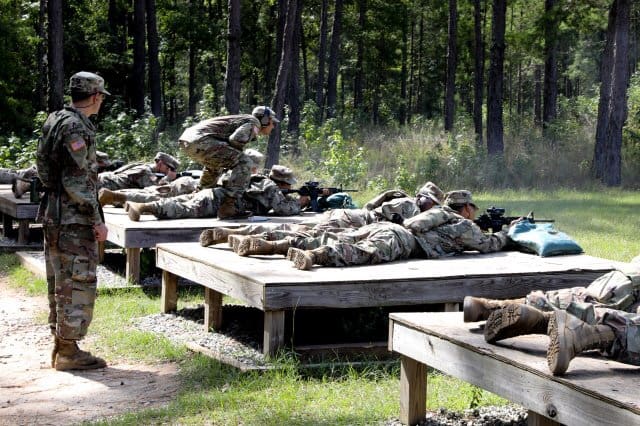
As it sits now, the new weapons qualification will feature four shooting positions–prone unsupported, prone supported, kneeling supported, and standing supported. Soldiers are issued four 10-round magazines, to engage 40 pop-up targets from the four shooting positions. Some iterations will show three or four targets at a time, forcing Soldiers to be extremely focused.

Sgt. Sol Griffith, a fire team leader with the Afton-based infantry company, said the unit will conduct the qualification with its parent unit in Alaska soon, and again during mobilization training at Fort Bliss, before deploying overseas this year.

During the March 7 training day, Griffith demonstrated the test for his comrades before they conducted the current qualification for their annual records when they concluded that test, the rest of the unit tried out the future test.

Spc. Lance Pierce, a target systems repairer, assigned to Camp Guernsey’s Training Center Command, learned about the new standard last year while attending a course at Training Center University, and built a software program that would run the test and the targets at Camp Guernsey.

“This is the first unit to try it out,” he said before the demonstration. “No one had any use for the program until now.”

“Now you have three or four targets up at the same time, and you have to transition between them very thoughtfully,” said Griffith. “It’s not like it was with someone yelling what target is coming up. Plus, the tower doesn’t tell you when to do a (magazine) change. You have to know when to do it, and then, do it.”

The new standard is going to be difficult for a lot of shooters, even those who hold the rifleman occupational specialty. For instance, the range noncommissioned officer in charge announced from the tower’s public address system that Griffith hit 22 of the 40 targets during the demonstration. “Sgt. Griffith usually hits 40 out of 40,” the tower announcer added.

As for the rest of the unit, Semmons said about half the Soldiers met the minimum qualifying standard of 23 hits, and a 32 was the high score of the practice round.

“It was the first time trying it for most of them,” he said. “But, I think it went extremely well, and they were very receptive to it. They liked the mag change and engaging more targets.”

By Sgt. 1st Class James McGuire, Wyoming National Guard

US Army Small Arms Championship Winners Announced

Tuesday, March 19th, 2019

FORT BENNING, Ga. – The 2019 U.S. Army Small Arms Championships, which is hosted by the U.S. Army Marksmanship Unit, concluded it’s seven-day competition at Fort Benning, Georgia on March 16 with an awards ceremony.

The annual competition, which is commonly called the All Army, is the Army’s premier marksmanship competition that tests Soldiers ability on both their primary and secondary weapons through 11 different course of fire. This year, more than 260 Soldiers from across the United States and all four components of the Army (active duty, National Guard, Reserve and ROTC) came seeking the top titles as they battled it out in both tactical and civilian-style rifle and pistol matches, as well as a multigun match.

This year’s winners are:
• The 2019 All Army Champion: U.S. Army Reserve Sgt. 1st Class Daniel Horner with the Army Reserve Careers Division. (Suffolk, VA native)

• The 2019 All Army Champion Team: The U.S. Army Reserve team from Army Reserve Careers Division. Team members are: Sgt. Joseph Hall, Sgt. 1st Class Daniel Horner, Staff Sgt. Rafael Fuentes, Sgt. 1st Class Charles Parker, and coach: Sgt. Maj. James Mauer.

• The 2019 All Army Lt. Gen. Benjamin C. Freakley Trophy awardee: Texas A&M Cadet Brannon Sickels. This marksmanship excellence award is presented to the top cadet having the highest combined score from all rifle and pistol excellence in competition matches. During the All Army Championships, Sickels earned his Distinguished Pistol Shot Marksmanship Badge.

• The 2019 All Army Col. Ralph Puckett Awardee: Texas Army National Guard Sgt. Jaymes Sendo. This for excellence in marksmanship award is presented to the combined top novice shooter from all the rifle and pistol Excellence in Competition matches.

• The 2019 All Army Multigun Champion: U.S. Army Reserve Sgt. 1st Class Daniel Horner with the Army Reserve Careers Division.

• The 2019 All Army Pistol Champion: U.S. Army Reserve Sgt. Christopher Liming.

• The 2019 All Army Rifle Champion: National Guard Maj. Samuel Freeman with the National Guard Marksmanship Training Center.

• The 2019 All Army Open Division Champion: North Dakota Air National Guard Senior Airman Gavin Rook.

• The 2019 All Army Top Cadet: Texas A&M Cadet Brannon Sickels.

• The 2019 All Army Novice Division Champion: U.S. Army Sgt. 1st Class Tyler Virgin with 1st Corps.

• The 2019 All Army High Drill Sergeant: U.S. Army Sgt. 1st Class Daniel Varela from the 198th Infantry Training Brigade.

• The 2019 All Army Pistol Champion Team: Texas Army National Guard. Team members: Staff Sgt. Justus Densmore, Sgt. Tyler Greene, Capt. Robert Lee, Sgt. Jaymes Sendo, and coach: Staff Sgt. Michael Richey.

• The 2019 All Army Rifle Champion Team: California Army National Guard. Team members are Master Sgt. Philip Brock, Sgt. 1st Class Jonathan Garcia, Staff Sgt. Wayne Gray, and Sgt. Obed Gutierrez.

• The 2019 All Army Multigun Champion Team: U.S Army 1st Corps Team. Team members are: Sgt. 1st Class Tyler Virgin, Sgt. Ashton Foster, Staff Sgt. Nicholas Wirts, Staff Sgt. Logan Frost, and coach: Staff Sgt. Jeffery Lewis.

Story by MAJ Michelle Lunato, US Army Marksmanship Unit

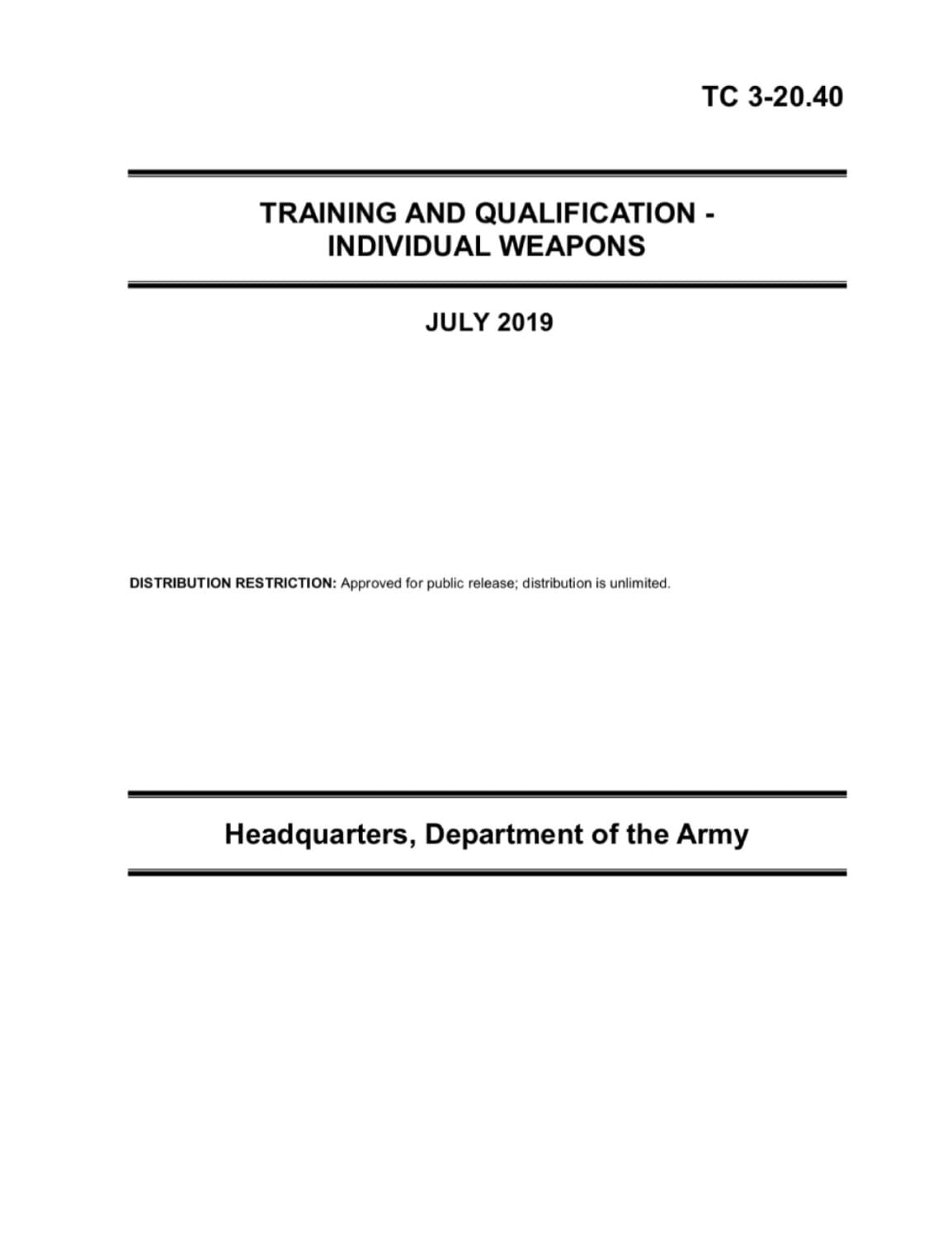
Army Releases New Deception Manual

Friday, March 1st, 2019

Get your copy at armypubs.army.mil.

Air Force Leaders Implement New Warfighting Planning Process

Tuesday, February 19th, 2019

WASHINGTON (AFNS) — Air Force leaders directed the implementation of a new approach to planning to better meet future threats. The team focused on this effort will be led by Maj. Gen. Clinton Crosier.

“The Air Force needs to plan across stove pipes to prepare for warfare of the future,” Secretary of the Air Force Heather Wilson said. “This will change the way we develop Air Force programs and budgets to face threats from high-end adversaries.”

In today’s technologically competitive, multi-polar world, the Air Force must be able to innovate and operate faster and more effectively than its potential adversaries. However, under the current force design model, planning and development are sub-divided into 12 core functions, such as rapid global mobility and air superiority, managed across seven major commands.

In October, Wilson and Air Force Chief of Staff Gen. David L. Goldfein initiated an interim effort to move forward an Air Force Warfighting Integration Capability.

Wilson and Goldfein charged Crosier with leading a 70-person team to develop the AFWIC way forward. The team is made up of Airmen from across the Air Force.

“Warfighting in the 21st century is all about multi-domain integration, agility in decision-making, and speed of action. We must consistently innovate, integrate and field capabilities more effectively than our adversaries,” Goldfein said. “AFWIC will help us evolve and transform our processes and organizations to meet the challenges of future warfighting.”

AFWIC will explore and wargame innovative solutions, develop an integrated family of concepts, and direct capability development efforts across the Air Force.

This organization will also develop a single, multi-domain strategy that will identify, guide, and prioritize future force development. That will improve Air Force agility, readiness, and lethality in the joint fight, Goldfein said.

By Tech. Sgt. Robert Barnett, Secretary of the Air Force Public Affairs

Space Operators Provide TACPs Tactical Space Training

Sunday, February 10th, 2019

PETERSON AIR FORCE BASE, Colo. —

Deployed Tactical Air Control Party Airmen expect space effects to work; otherwise pilots get shot down, bombs miss targets, and soldiers die. TACPs may not know how space works, but if it doesn’t work well for America and its allies then its results devastating.

U.S. Air Force Tactical Air Control Party Airmen with the New Jersey Air National Guard’s 227th Air Support Operations Squadron coordinate close air support with U.S. Marine Corps aircraft during joint training on Joint Base McGuire-Dix-Lakehurst, N.J., Dec. 6, 2018. (U.S. Air National Guard photo by Master Sgt. Matt Hecht)

Space operators from the 16th and 4th Space Control Squadrons at Peterson Air Force Base are working to change the TACP community’s knowledge of space by developing the first Space Operations Course, Jan. 7-11. The course was an Airman initiative designed to give the TACPs a working knowledge of what space effects from three Air Force Space Command wings do to specifically impact their ground operations.   

The week-long course, organized by Airmen of the 21st Space Wing and the 13th Air Support Operations Squadron, allowed TACP Airmen a look into tactical-level space operations with regard to mission planning.

“There are two big reasons why we came together to create this course,” said Capt. Ray Reeves, 13th ASOS flight commander and course planner. “The first reason is that the TACP community is focusing on integrating operations across multiple domains at the tactical level, based on the Air Force Chief of Staff’s priorities. The second was based off experiences from my last deployment. On the way out of theater I went by the Combined Air and Space Operations Center and received a brief from the space team in theater. I was surprised to learn there were a lot of capabilities and information that their assets were providing and major effects they could have on the battlefield. At the tactical level within my area of operations, neither myself nor the ground team I was with know those capabilities existed, which could have impacted our operations on the ground in a positive manner.”

Tactical air control Airmen assigned to the 19th Air Support Operations Squadron, Fort Campbell, Kentucky and the 818 Operational Support Squadron, Pope Field, North Carolina perform exercise Talon Fury Dec. 12, 2019 at Whiteman Air Force Base, Missouri. During the exercise TACP Airmen’s job were in charge of calling in the B-2 Spirit Stealth Bomber to help provide air support to those who are on the ground. (U.S. Air Force photo by Senior Airman Thomas Barley)

Upon return from that deployment, Reeves began working with the 21st SW to determine what space brings to the fight and how they can work together to improve battlefield operations.

TACP Space Integration Course 19-01 provided 18 Airmen from 11 units operational knowledge of the 21st SW, 50th SW, 460th SW and the National Reconnaissance Office.

“Space is really at the forefront of deployed operations,” said Capt. Chelsea Moss, 16th SPCS weapons and tactics flight commander and course planner. “TACPs are the subject matter experts for air power for the Army. There wasn’t any formal instruction on space, so we wanted to be able to provide this course to show the importance of space in mission planning and support.”

Topics covered during the course included GPS, communicating in jammed environments, space support in monitoring Remotely Piloted Aircraft, space threats, Intelligence, Surveillance and Reconnaissance threats, and battlespace situational awareness.

“Particularly from the perspective of the 21st SW, we wanted to show how we monitor RPA links and how we can provide support,” said Moss. “We wanted to show what we do on a basic level and how TACPs can request space support from the Air Operations Center.”

“Working with our Airmen on the ground and showing them how space capabilities can improve their operations is crucial to maintaining our warfighting superiority,” said Col. Devin Pepper, 21st Operations Group commander. “The creation of this course is such an important step for both Air Force Space Command and Air Combat Command.”

Equipped with a better understanding of the symbiotic relationship between space and ground operations, TACPs can better integrate space into their training and operations.  

“I can’t put into words how important this is to the TACP community,” said Reeves. “When we start talking about the future fights and what we’re training toward – and we’re talking about major contested operations with a peer enemy – the ability to operate from multiple domains is going to be key to any success on the ground. By us learning what space can provide and being able to integrate it at the ground level, we are going to impact far more than just the TACP community. TACPs are aligned from the lowest tactical echelon in the Army to three-star headquarters, so if we can help integrate space across those echelons I believe we can have a Department of Defense wide impact.”

TACPs are embedded with Army units and are responsible for planning, integrating and executing Air Force operations worldwide. When properly trained and positioned they ensure the space-based effects are used and integrated to support ground maneuvers.

By Staff Sgt. Emily Kenney, 21st Space Wing Public Affairs