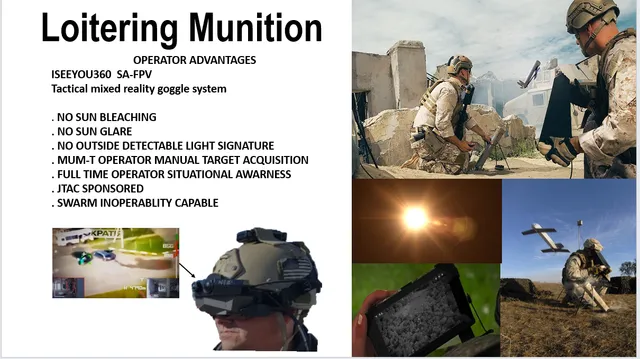
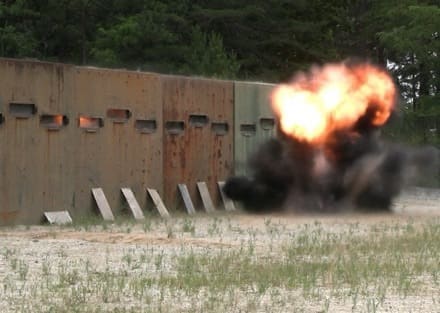
Robotics and in particular developing weapons for unmanned systems has become a focus of DoD. This poster was presented during NDIA’s recent Future Forces Capabilities Conference in Huntsville.

Contact info is on the poster for those interested.
Robotics and in particular developing weapons for unmanned systems has become a focus of DoD. This poster was presented during NDIA’s recent Future Forces Capabilities Conference in Huntsville.

Contact info is on the poster for those interested.

WASHINGTON — As ground robotics and autonomy are expected to play a critical role in future warfare, four Army leaders will jump start AUSA with a Warriors Corner discussion on human-machine integration at 12:50 p.m. Monday, Oct. 9, 2023.
Michael Cadieux, director of U.S. Army DEVCOM Ground Vehicle Systems Center; along with Brig. Gen. Geoffrey Norman, director of the Next Generation Combat Vehicles Cross-Functional Team, shortened NGCV CFT; Maj. Gen. Curtis Buzzard, commanding general at Maneuver Center of Excellence; and Col. Shane Upton, director of the Contested Logistics CFT, will address formation-based concepts developed with human-machine integration advances. Brig. Gen. Stephanie Ahern, concepts director at Army Futures Command, will moderate the panel discussion.
The session will be livestreamed on DVIDSHub.net.
Transforming for the future fight requires engagement across the Army and joint force. Advances in ground robotics and autonomy and the effective fusion of robotic systems into formations will provide new capabilities to help the Army achieve goals for multi-domain operations.
The fusion of robotics in formations is already taking place on the ground at various Army training locations.
“Soldier Touchpoints help us to help define future tactics and techniques for fighting with these revolutionary systems while informing future required capabilities for the science and technology community to develop,” Cadieux said.
“Human-machine integration is all about bringing the right mix of robotic elements to our formations to enable a total formation that is more capable than the sum of either the human or robotic elements,” he said.
Robotic combat vehicles will provide formation leaders new options on both the offense and the defense. The NGCV CFT has been at the forefront of robotic combat vehicle development and the experimentation that refines those vehicles.
“We’re already seeing the first robotic capabilities that we’ll be fielding, and our teams for years have been experimenting with the best way to integrate them into formations,” Norman said.
“We’re not sure yet what the integrated formations will look like, but it could require warfighters to control multiple platforms simultaneously, or perhaps multiple warfighters working different parts of the same system, or the flexibility to move between these two paradigms as the mission requires,” Norman said.
Robotic combat vehicles can accomplish some of the more dangerous and mundane tasks, such as refueling and for port logistics, while freeing up Soldiers to do the tasks that call for more thinking.
“Human-machine integration is fundamental to sustaining the future joint force operating in a contested logistics environment,” Upton said.
The integration of robotics into manned formations will iterate between doctrinal and training insights informing what the robots need to do and insights from experiments with the robots informing how doctrine and training need to adapt.
The Army has created a ground vehicle autonomy strategy built on a foundation of modular open systems approach, or MOSA, which will enable common unmanned maneuver capabilities across the ground vehicle fleet.
“Building a MOSA based, common approach to ground autonomy software lets the Army collaborate with a wide range of industry-leading partners while controlling current and future costs,” Cadieux said.
Understanding formation-based concepts developed with Human-Machine Integration advances is a key priority to designing the Army of 2040.
“The technologies Army pursues in the ground vehicle space drive at both robotic capability growth and in strengthening the interface between the Warfighter and the robotic elements,” Cadieux said.
By Jerome Aliotta
I’m pretty excited to tell you that SOFWERX, in collaboration with SOF Acquisition, Technology, and Logistics (SOF AT&L) Program Executive Office Tactical Information Systems (PEO-TIS), will host an Assessment Event (AE) 04-07 December 2023, to identify production model solutions for general-purpose multi-role/multi-mission robot systems.
This assessment solicits white papers to describe the current capabilities of off-the-shelf robot systems in the 10-40 lbs weight range. Systems will be reviewed by USSOCOM stakeholders and Subject Matter Expert’s (SME’s) to identify solutions for future participation in the FosUGS indoor presentation/outdoor demonstration that will occur at SOFWERX to provide a pathway to ultimately conduct tests on selected systems for specific cyber, safety, and performance requirements.
Technology desired by USSOCOM is an intelligence, surveillance, and reconnaissance (ISR) general-purpose multi-role/multi-mission robot system in the weight range of 10-40 pounds that has some level of autonomous behaviors or capabilities which reduce operator workload and can operate in all-weather conditions within rural/urban environments. The system must have an integrated electro-optical/infra-red (EO/IR) full motion video (FMV) capability for day and night ISR operations and be payload agnostic to support additional payloads.
The 10-40 lbs range seems to be the one which the services are having the most trouble with. There are lots on micro systems out there (below 10 lbs) and loads of larger robots on the market but this small size seems to be a bit of an engineering challenge, balancing size, capability, and payload.
Remember, the robot is the platform and carries tailored, modular mission platforms. A robot with sensors, or weapons built-in becomes a screwdriver rather than a multi-tool and is less desirable due to its limited use. The image below gives you an idea of what I’m talking about regarding size. The larger robot is the Transcend Vantage and the much smaller robot is the Mini Vantage.

Program Executive Office Tactical Information Systems is a newly formed PEO within USSOCOM which combines elements of the old PEO Special Reconnaissance and PEO C4. It is responsible for Technical collection and communication, Integrated sensor systems, Sensitive Site Exploitation, Remote Capabilities; and Tactical Communications. Enterprise C4 systems have moved under the Director for Enterprise Information Systems.
To participate in this AE, submit NLT 20 October 2023 11:59 PM ET here.

A lot has been made of the weaponization of ground robots. Much of it is is due to our fascination with science fiction. No sooner is an image shared online like the one above of a robot armed with a machine gun than the comments about “Skynet” and “Terminators” kick in. But what is lost on most is why we developed robots in the first place. It wasn’t to deliver a lethal effect; there are lots of ways to make that happen. Robots were created as helpers, in order to remove humans from environments which might endanger them.
We’ve also got to accept a truth which is lost on many. The robot isn’t the capability, it’s the vehicle which delivers the capability. We desire effect and that requires various capabilities which come in the form of payloads. What makes various types of robots more desirable over others is how they deliver the payload to the right place, at the right time, to have the right effect. We use robots to reduce risk, particularly to humans.

Take for instance this image from last week’s DSEI show in London. We see a Ghost Robotics Vision 60 Quadraped – Unmanned Ground Vehicle carrying another robot, in this case an unmanned aerial system configured for an Intelligence, Surveillance and Reconnaissance role. This combination may be perfect, depending on the operational environment. It may be highly lethal to humans and require close access to the target of the surveillance.
To be sure, there are definite reasons to weaponize ground robots. They can be used in overwatch for example, or to guard perimeters. But in each case, they are desirable in these roles because they take a human out of a threat environment. Recently, the US Army stated that it wants to place a Next Generation Squad Weapon XM7 rifle, firing the new 6.8mm cartridge on a Vision 60 Q-UGV. There are technical challenges which a couple of commercial companies have worked through, but it can be done. The question is, “why?” What effect do they believe it will provide? Is it the right payload for that platform?
During the Robotics track of next week’s NDIA sponsored Future Forces Capabilities event in Huntsville, Alabama, you’ll see a lot of talk of various means to weaponize robots. It makes sense considering the event evolved from annual small arms and armaments meetings. However, we need more participation from the ISR community in this event.
The air side of unmanned systems has taken the opposite path. Long dominated by collection activities, they’ve only more recently integrated kinetic weapons delivery to their repertoire.
I believe the best use of at least the smaller classes of ground robots is as platforms for various sensors, including ISR, CBRN and as comms relay nodes for these and others. Persistent access to items of intelligence value puts operators at risk. What’s more, the task is time consuming and boring. a human’s efforts are best spent elsewhere, like considering how to use the data being vacuumed by a multitude of robots fitted witg various collection payloads.
As a former SIGINTer and Intelligence officer I’ve been thinking a lot about how to use ground robots for ISR. There is a lot of synergy to be had between the air, subsurface (maritime), and ground robotics communities when it comes to payloads. We need more interest from the developers of sensors in utilizing ground robots of various classes as platforms and cross talk between the various warfighter communities.
Robots are coming to the battlespace. It’s up to us to determine how to best use them. Some will be armed and some will conduct ISR. Others will serve as logistics enablers and communications nodes.
We need to brainstorm ways to get the most out of our investment in ground-based unmanned systems. Soon, I’ll share a concept I’ve come up with to use Vision 60 Q-UGVs to access challenging terrain and environments to conduct Multi-Int persistent ground surveillance.
-Eric Graves
Editor
The European leading robotics and autonomous systems developer Milrem Robotics unveils a new THeMIS Combat Unmanned Ground Vehicle (UGV) equipped with loitering munitions that allow engaging targets farther behind enemy lines.
The new system is equipped with Hunter 2-S tactical swarming drones by Halcon and features artificial intelligence that offers frontline forces the ability to locate, track and accurately eliminate soft targets, light vehicles and armoured vehicles from safe distances in challenging battlefield conditions.

“Units can manoeuvre the THeMIS Combat with Hunter 2-S drones closer to the enemy line. This allows them to engage closer targets faster or venture farther behind the lines to find suitable targets,” explained CPT (res) Jüri Pajuste, Defence R&D Director at Milrem Robotics.
The Hunter 2-S is able to autonomously follow a flight plan to an intended target area, coordinate with other drones in the swarm and loiter while seeking and classifying targets until engagement by a man-in-the-loop.
“Deploying robotic systems across enemy lines is considerably faster and more efficient than using manned units for the same task,” Pajuste said and added that using loitering munitions also enhances a unit’s situational awareness and ISR capabilities.
Hunter 2-S drones carry a payload of 2 kg each, can reach a cruising altitude of 500 m and cruise at an indicated airspeed of 25 m/s with a total available flight time of 45 minutes.
The mission-proven THeMIS UGV, which is part of robotics programs in 16 countries, is intended to support dismounted infantry units. It comes equipped with MIFIK – Milrem’s Intelligent Functions Kit that allows for independent mobility of the system, including point-to-point navigation, follow me, obstacle detection and avoidance.
The THeMIS Combat and other Milrem Robotics’ solutions are presented at DSEI 2023 in London and can be found in stand no H4-122.
Milrem Robotics is the leading European robotics and autonomous systems developer and systems integrator, with offices in Estonia, Finland, Sweden, the Netherlands and the US. The company is known for their THeMIS and Multiscope UGVs, the Type-X Robotic Combat Vehicle and the MIFIK autonomy kit.
A Game-Changer That Redefines Future Battlefield Capabilities: The Type-X RCV, The First Robotic Combat Vehicle Equipped With A Mixed Reality Situational Awareness System.

Europe’s leading robotics and autonomous systems developer Milrem Robotics will present the Type-X Robotic Combat Vehicle (RCV), the first-of-its-kind equipped with a mixed reality situational awareness system (MRSAS) at DSEI 2023 in London.
The Vegvisir Remote MRSAS enhances the decision making of Type-X operators by giving them a 360-degree virtual dome with EO/IR sensor fusion for both close and medium proximity vision and target engagement capabilities in any condition. The system is optimised for lower bandwidth for remote use and connects the operator into a digital hub to interact and consume digital data.
“Milrem Robotics continues the development of the Type-X RCV by integrating cutting edge technologies to address the requirements of many countries interested in intelligent robotic systems, especially the Nordics and Western Europe, but also the US,” said Kuldar Väärsi, CEO of Milrem Robotics.
In addition to the new cutting-edge situational awareness system, the Type-X is equipped with KONGSBERG’s latest and best PROTECTOR Medium Calibre Turret that is changeable to specifically meet the particular needs of various end-users. The combination, that has passed several live firing tests, gives mechanized units the means to breach enemy defensive positions with minimal risk to their own troops.
The Type-X is also integrated with the QUADBOX by Elistair, that consists of a tactical tethered UAS for ISR, and communications relay designed to further enhance situational awareness for extended periods whilst on the move.
The Type-X RCV along with other Milrem Robotics’ products can be found at stand no H4-122.
The Type-X RCV is an organic part of mechanized units that can take the most dangerous positions and provide equal or overmatching firepower and tactical usage compared to traditional Infantry Fighting Vehicles.
It was developed to navigate the battlefield autonomously, with a human-in-the-loop control system and artificial intelligence (AI) as an integral part of the operating algorithm. With the Type-X Milrem Robotics also introduces a feature called Indirect Drive that allows remote controlled operations on higher speeds.
Milrem Robotics is the leading European robotics and autonomous systems developer and systems integrator, with offices in Estonia, Finland, Sweden, the Netherlands and the US. The company is known for their THeMIS and Multiscope UGVs, the Type-X Robotic Combat Vehicle and the MIFIK autonomy kit.
With over two decades of distinguished defence-related service, Patrick Shepherd joined Europe’s leading robotics and autonomous systems developer Milrem Robotics as Chief Sales Officer.

Shepherd has held diverse roles within the defence industry, culminating in his most recent position as the North American Customer Account Lead at VTT Technical Research Center of Finland.
His professional journey also includes a 16-year tenure at Lockheed Martin, where he served in various roles including Integration and Test Manager, Certified Program Manager, and Strategy and Business Development Manager for the Nordics.
“During this time, I spearheaded the development of numerous vehicles for both domestic and international armed forces. My work earned me a letter of commendation from the Commandant of the United States Marine Corps for exceptional Program Management skills,” Shepherd said.
Furthermore, Shepherd’s background encompasses a noteworthy period of service in the United States Army as an Artillery Officer in the 172nd Stryker Brigade in Fort Wainwright Alaska, during which he embarked on a 16-month deployment to Iraq, receiving a Bronze Star in recognition of his contributions.
“The global ground robotics market will grow significantly in the coming years and Milrem Robotics is expanding its global footprint. Our systems have already been delivered to 16 countries, but many more are looking for robotic systems. Milrem continues to grow the team with strong talents and industry leaders in order to be the leader in the robotics market,” said Kuldar Väärsi, founder and CEO of Milrem Robotics. “Patrick substantially increases the capabilities of our commercial team with excellent experience and knowledge of the customers and the industry. He, as our new CSO, will ensure that we know what our customers expect and that we provide the best solutions to solve their capability needs with robotics,” Väärsi added.
“It is with great enthusiasm that I embrace the opportunity to join Milrem Robotics as Chief Sales Officer. The company stands at the forefront of innovation in robotic vehicles and autonomous solutions, poised to revolutionize future combat operations and reduce soldiers’ exposure to the dangers of close combat, IEDs and artillery,” Shepherd said. “Drawing from the insights gained during my time in Iraq, I am committed to guiding our team and to providing paramount value to our clientele and their servicemen. Our duty is to ensure they have access to the most superior, high-performance machinery available on the market, all while maintaining an affordable price point.”
Milrem Robotics is the leading European robotics and autonomous systems developer and systems integrator, with more than 200 talented specialists working in offices in Estonia, Finland, Sweden, the Netherlands, and the US. The company is known for their THeMIS and Multiscope UGVs, the Type-X Robotic Combat Vehicle and the MIFIK autonomy kit.
Ansi Arumeel, who has held several leadership positions in logistics and e-commerce companies, will join Milrem Robotics’ team as Chief Operating Officer and member of the board as of September 2023.
Arumeel has extensive leadership experience, most notably from the Estonian state-owned post and logistics company Omniva where he worked in different roles for 14 year, last two as the CEO.
Since leaving Omniva, Arumeel has been the deputy managing director of the Polish Retail Robotics, the largest Automated Parcel Machine manufacturer in Europe with ca 500 employees.
His role was keeping the focus on strategy, aligning organisation to targets and creating an environment for the talents to succeed. He was also working with values and culture improvements, communication, KPI structure and visualisations, processes and improvement and business development.
Arumeel has a BSc. in Mechanical Engineering, Transportation Technology from TalTech – Tallinn University of Technology and a MSc. with distinction in Management of Transportation & Logistics from the Chalmers University of Technology.
“Ansi’s responsibility will be organizational development and the efficiency of operations,” said Kuldar Väärsi, CEO of Milrem Robotics. “We are significantly growing our team in the coming years and building a strong organization focused on competitiveness on the international market and providing a motivating and inspiring environment for Estonian and international talents. Ansi brings onboard excellent leadership skills and a vast experience which are very well fit to face the challenges on this path,” Väärsi added.
“I’m excited to join Milrem Robotics now, when the organisation has entered a new stage, to be scaled and prepared for future growth. I, as a true believer in autonomous and automated systems, see great potential in the products and concepts that the company is developing. My role will be to develop the organisation and make sure that we get the best out of the opportunities and talents that the company has,” said Arumeel.
Milrem Robotics is the leading European robotics and autonomous systems developer and systems integrator, with more than 200 talented specialists working in offices in Estonia, Finland, Sweden, the Netherlands, and the US. The company is known for their THeMIS and Multiscope UGVs, the Type-X Robotic Combat Vehicle and the MIFIK autonomy kit.