GORE-TEX Professional

Archive for the ‘Robotics’ Category

Rheinmetall Showcases Its World-Leading Autonomous Technology During Unmanned Ground Vehicle Trials in Estonia

Tuesday, August 1st, 2023

After being put through a series of gruelling challenges during the Unmanned Ground Vehicle Autonomy Trials in Estonia, Rheinmetall has yet again positioned itself as a world leader in autonomous technology.

The trials, designed to test the limits of autonomy, were organized by the Estonian Military Academy and the Estonian Defence Forces. The event attracted a multinational audience of military and civilian experts from over 20 countries, all of whom were keen to experience for themselves the latest technological advancements in the field of UGVs. Rheinmetall was one of the 11 companies taking part in the trials.

From open fields with high grass to dense woodland, the Rheinmetall Mission Master SP’s on- and off-road navigation capabilities were truly put to the test as it tackled rough terrains with limited visibility. Though the trials were not designed to be competitive, Rheinmetall’s autonomous vehicle turned heads with its limited driver intervention, obstacle avoidance technology, and speed and manoeuvrability.

“These trials have shown just how far autonomous technology has come in recent years. We were proud to put our system to the test alongside some of the world’s most skilled developers. We are really pleased with our performance and look forward to seeing how our technology will evolve over the coming years” stated Alain Tremblay, Vice-President, Business Development, Innovation & Robotics at Rheinmetall Canada.

Rheinmetall Mission Master and PATH autonomy kit

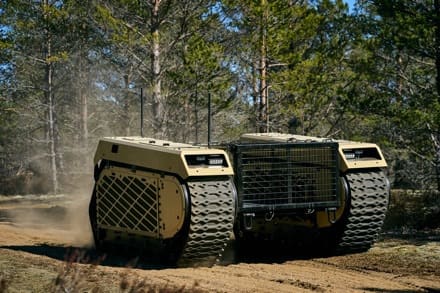
The Rheinmetall Mission Master SP, which stands for “silent partner”, is a fully-electric autonomous vehicle. It was chosen for the trials due to its compact profile that can navigate through tight spaces.

Like all members of the Mission Master family of UGVs, the Mission Master SP is powered by the Rheinmetall PATH autonomy kit: an AI-powered navigation system. This agnostic suite of advanced sensors and perception algorithms enables the Mission Master vehicles to navigate through challenging environments, while keeping soldiers out of harm’s way.

In addition to autonomous navigation, the Mission Master can support crewed and remote teleoperation, and seamlessly transition between each mode. The vehicles can also be fitted with different modules, including logistic transport, fire support, and medical evacuation.

Rheinmetall produced a video during the trials in Estonia to showcase the capacities of its Mission Master platforms to a wider audience.

For more information on the family of Rheinmetall Mission Master UGVs, visit rheinmetall.ca.

Milrem Robotics Excels at First-of-its-kind Ground Robotics Autonomy Trials

Wednesday, July 5th, 2023

Europe’s leading robotics and autonomous systems (RAS) developer Milrem Robotics’ unmanned ground system THeMIS equipped with the company’s intelligent functions kit MIFIK, excelled at comprehensive first-of-its-kind autonomy trials organized by the Estonian Military Academy.  

Last week, under the leadership of the Estonian Military Academy and the supervision of defence and autonomy specialists from Finland, Germany, the Netherlands, Norway, Sweden, and the UK comprehensive trials of autonomous ground robots took place. 

For two days at the Estonian Defence Forces central training area Milrem Robotics’ intelligent ground system was put to the test throughout increasingly complex scenarios during which observers from the aforementioned countries evaluated the elements needed to autonomously navigate on the road, off-road and in a dense forest – route planning, point-to-point movement, and obstacle avoidance. The tests assessed the technological readiness of the UGV and human-machine cooperation. 

The scenarios included driving on dirt roads, small forest roads, open fields with and without high vegetation and in the forest with moderate to severe density. 

“During the two days, we showcased a really mature autonomous system that is capable of handling very complex environments, succeeding even in the densest forest. Autonomy is a crucial and integral part of unmanned ground systems, especially on the battlefield, since it frees up manpower for other tasks and allows soldiers to concentrate on fulfilling their mission rather than operating vehicles,” said Kuldar Väärsi, CEO of Milrem Robotics. 

Väärsi emphasized that although Milrem’s intelligent functions can be hailed as a success based on the trials, autonomy development is a marathon, not a sprint and continuous improvements to reliability, features and the UI are being made by the company’s autonomy team and operatively delivered to customers via regular updates. 

The autonomy trials were organized by the Estonian Military Academy in cooperation with other units of the Estonian Defence Forces and included 11 RAS developers from nine countries and visitors from nearly 20 countries. The event was partially funded by the Milrem Robotics’ led EDIDP integrated Modular Unmanned Ground System (IMUGS) project and included the project’s autonomy team as a participant. 


USMC Requires Intelligent Robotics and Autonomous Systems

Tuesday, June 27th, 2023

QUANTICO, Va. —

“The Marine Corps requires unmanned air, surface, and ground systems to fully exploit our inherent expeditionary nature and capabilities. When operating forward, in small groups, under austere conditions, the ability to maximize unmanned systems to create outsized effects for our allies and against our adversaries is a key element of our future success.”

– Gen Berger, Commandant of the Marine Corps

The United States has long enjoyed a technological advantage as our robust industrial base and strong economy have provided our military with exquisite combat systems.  As a result, the U.S. has had been the preeminent global power since the end of the Cold War. However, the decreasing cost of technology combined with commercial availability of equipment that provide an asymmetric effect means the U.S. military must find new and innovative ways to leverage this growth in technology.  To do so, the U.S. military must be prepared to incorporate new warfighting techniques to meet the growing threat of an increasingly technologically advanced adversary.

Today, the Marine Corps is leading the services in development and integration of these emerging technologies. Paired with the sound combined arms doctrine that defines our Marine Corps, Intelligent Robotics and Autonomous Systems (IRAS) provides vastly increased situational awareness across all echelons of warfare. All-domain sensors that detect the enemy throughout the electromagnetic spectrum and pass real time targeting data over vast distances makes the battlefield increasingly transparent for the individual Marine and up through the chain of command, enabling sensors, weapons, and decision makers to rapidly close kill webs and destroy the enemy.

The ability to exploit the vast amount of information being received in the combat environment presents a cognitive challenge, as the commander’s decision-making becomes increasingly overloaded.  Conversely, the vast amount of information also creates opportunity.  Those forces that can most rapidly and effectively process information have a distinct advantage. 

Software developments in artificial intelligence and machine learning lighten the mental burden by rapidly organizing data in a logical and prioritized manner.  Through rapid prioritization, Marines can “make sense” and act before the enemy.  By establishing this competitive advantage, the adversary targeting, and decision cycle is disrupted, increasing survivability and expediting movement and maneuver. Ultimately, the combination of Marine decision makers with IRAS creates tempo that cannot be matched by the enemy.

As the operating environment becomes increasingly contested through the adversary’s use of anti-access/area denial systems, the ability to sustain our operating forces inside the enemy weapons engagement zone presents a significant logistical challenge. The physical burden on Marines to carry more supplies and ammunition inhibits their ability to rapidly displace and maneuver, creating exposure to the enemy and risk to the force. IRAS will lighten the Marines’ physical load, expedite staging and transfer supplies across vast distances in the maritime environment. Using a range of air, land, and surface logistical connector vehicles will enable ship-to-shore sustainment of maneuvering units, while reducing the risk to legacy manned resupply aircraft.

To maximize the benefits of IRAS, these systems must operate through networked, collaborative, autonomy. By fusing data from distributed platforms and operating from common mission controllers, individual warfighters will be able to control multiple platforms and payloads to accomplish their mission. Working with leading industry partners and research agencies, the Marine Corps is developing vehicles that will be able to conduct swarming maneuvers and attacks.   These swarming vehicles leverage numerous systems to sense each other across the network, process information at machine speeds, and enable kinetic effects with maximum efficiency. This technology will decrease the number of munitions required to create strategic effects, rapidly closing kill webs and further decreasing the logistics burden.

The category of warfighting tools historically referred to as “unmanned” provides an incomplete description of these capabilities. While this was a commonly accepted term, the human element in warfighting should not be discounted.  Most important to successful employment of IRAS is human oversight and interaction for successful employment.  Additionally, as IRAS are interoperable, modular, and secure allowing for streamlined training and proficiency, reducing cost, time to train, and manpower requirements.

As the threat and operating environment continue to change over time, the future remains clouded in ambiguity. If technology growth continues its current, exponential path, Marines in the future may find themselves equipped with physical augmentations, and hybrid virtual reality optics. Furthermore, teaming between legacy manned and IRAS fighter jets will also enable our cutting-edge aircraft.  Manned aircraft will become more survivable, and their signature optimized.  Weaponized IRAS aircraft will execute the will of the pilots and conduct dogfighting by predictive modeling to defeat enemy formations before they can even maneuver.

While ambitious and imaginative, the Marine Corps is exploring technologies that can someday make this vision a reality. The exponential growth of IRAS converging with new warfighting concepts will enable Marines to operate in distributed environments, with low cost, persistent, signature managed systems. Future Marines must be prepared to fight in new ways to confront the evolving threat, and commanders must build trust in IRAS to ensure their formations maintain the tactical advantage with maximum lethality.  Leaders at all echelons must also develop feedback mechanisms to allow the service to understand the evolving needs of the warfighter and equip them with the latest IRAS that allow them to locate, close with, and destroy the enemy.

Story by Maj Keenan Chirhart, Marine Corps Combat Development Command

Photo by Cpl Tyler Andrews

Persistent Systems to Support Tomahawk Robotics in $55 Million Upgrade of Navy Robots

Thursday, June 22nd, 2023

Flexible Cybersecure Radio (FlexCSR) contract will replace hundreds of legacy radios used by Navy EOD robots with MPU5 mobile ad hoc networking radios, plus NSA-certified Type 1 encryption

June 21, 2023

Persistent Systems, LLC (“Persistent”), a leader in mobile ad hoc networking (MANET) technology, announced today that it will support Tomahawk Robotics, a Florida-based developer of common control systems for unmanned systems, on a $55 million contract as it moves to production to upgrade U.S. Navy explosive ordinance disposal (EOD) robots.

The Flexible Cybersecure Radio (FlexCSR) contract, awarded by the Naval Surface Warfare Center Indian Head Division, will have Tomahawk Robotics replace hundreds of legacy radios used to control and communicate with Navy unmanned ground vehicles (UGVs) with Persistent Systems MPU5 MANET radios that have been incorporated by Tomahawk Robotics into a solution that includes NSA Type 1 encryption.

“We are very excited to be supporting Tomahawk Robotics on this Navy contract,” said Ryan Kowalske, VP Business Development for Persistent Systems. “FlexCSR will provide Navy EOD robots with more capable and secure radios. Plus, it shows how other military robots with our MANET systems can be upgraded with Type 1 encryption, when deemed appropriate.”

In addition to being the prime contractor on FlexCSR, Tomahawk Robotics is also a member of the Wave Relay® Ecosystem, an expanding industry alliance of unmanned system, sensor and controller companies all using the Persistent Systems MANET as their default communications network.

“With the growth of the Ecosystem and contract awards like FlexCSR, we are seeing a transition to the long-envisioned networked battlefield, where people, platforms and payloads are all interconnected,” says Kowalske. “Persistent Systems is proud to be making that happen.”

Milrem Robotics Led Consortium Successfully Delivers the iMUGS Project

Sunday, June 11th, 2023

The iMUGS consortium, led by Milrem Robotics and composed of several major European defence, communication and cybersecurity companies and high technology SMEs, successfully completed and delivered the project to the European Commission.

The consortium, that started work on the 32,6 MEUR integrated Modular Unmanned Ground System (iMUGS) project in late 2020, completed all the contractual activities and tasks, reaching the operative and technical objectives in May 2023.

“This project set a great example of cooperation and high-level results which we can expect also from coming European Defence Fund Projects. On behalf of the participated Member States, I would like to thank the Coordinator, Milrem Robotics, and all the industry partners involved for making this happen,“ said Martin Jõesaar, iMUGS project officer in the Estonian Centre for Defence Investments.

“The completion of iMUGS is a huge milestone for all involved parties. It is also a testimony that cooperation within 7 European Member States and between 13 different companies and organizations, in no way a simple task, is possible when working towards a worthy goal – strengthening the defence capabilities of the Union,” said Kuldar Väärsi, CEO of Milrem Robotics.

iMUGS created a European-wide architecture for ground and aerial platforms, command, control, and communication equipment, sensors, payloads, and algorithms. The project addressed challenges for interoperability, perception, and decision-making.

Progress was shown in periodic events arranged at all participating Member States consisting of Estonia, Latvia, Finland, Belgium, France, Germany, and Spain. “During iMUGS the consortium demonstrated that unmanned systems play a crucial role in military environments and scenarios, paving the way for wider adoption and use of these systems in the near future,” Väärsi added.

As a result of the project and the technology developed, the European Union will have a pathway for improved ability to respond to emerging military threats and challenges. iMUGS and its envisaged follow-up and peer projects will increase the efficiency and effectiveness of EU military operations through improved coordination of multiple assets and resilient collaboration between manned units and unmanned systems benefiting from digital communications.

The systems developed will improve situational awareness, leading to faster and more accurate decision-making for increased mission success rates and increased overall safety of military operations.

“The project also improved EUs competitiveness and reputation as an expert and innovator in the field of unmanned systems,” Väärsi said.

iMUGS was a 13-party collaboration focused on developing a modular and scalable architecture for hybrid manned-unmanned systems. The parties involved are Milrem Robotics (project coordinator), Latvijas Mobilais Telefons (LMT), Talgen Cybersecurity, Safran Electronics & Defense, NEXTER Systems, Krauss-Maffei Wegmann, Diehl Defence, Bittium, Insta Advance, SOL1, dotOcean, GMV Aerospace and Defence, and the Royal Military Academy of Belgium.

ADS Federal Range Day 23 – FN deFNder Remote Weapon Stations

Friday, June 9th, 2023

FN Anerica demonstrated their deFNder Remote Weapon Station during last week’s ADS Federal Range Day at The Crucible south of Washington, DC.


Offered in three variants: deFNder Light seen here for the M249 and M240; deFNder Medium which will accept the M249, M2, M3R, and 40mm AGLs; and the Sea deFNder for maritime applications.

The system is modular and will accept a range of sights, accepts a link/case collector, and smoke grande launchers. It is gyro stabilized and integrates a laser range finder. Seen here is the joy stick controlled remote.

Here is a video of the M240 firing remotely.

Units and agencies can procure products seen at ADS Federal Range Day by contacting ADS, Inc.

SOF Week 23 – Roam Robotics

Tuesday, May 16th, 2023

Roam Robotics exhibited Forge, a pneumatically powered exoskeleton in the Darley Defense booth.

Forge has been under evaluation by the US Air Force where it’s shown to double the endurance and stregth of the wearer as well as reduce experienced g-forces by 50%. This last factor is particularly important when jumping down from heights. It preserves the natural range of motion and generates torque by forcing air through lightweight actuators at the knee to introduce torque. The brace provides stability and support to the knee.

During a recent evaluation at Wright-Patterson AFV, two C-17 Loadmasters were able to move a pallet that weighed about 3,500 pounds by themsleves, a load which normally takes four Airmen.

The modular power pack generates pressurized air for the system and can be controlled on the fly.

SOF Week 23 – Ghost Robotics Vision QUGV-60 Complex Terrain Demo

Thursday, May 11th, 2023

I’ve heard a lot of questions about the ability of the Ghost Robotics Quadruped Unmanned Ground Vehicle (Vision 60) to negotiate complex terrain like stairs. I asked the operator at SOF Week to give me a short demo of its capability.

The operator simply gave it a direction command and the Vision-60 analyzed the path with visual and force feedback cues.